FanFest makes a comeback

The A’s have announced that there will be a FanFest prior to the 2012 season, and this time it’ll be a real event! FanFest 2012 will be held at Oracle Arena on Sunday, January 29, from 10 a.m. to 2 p.m. If you’re a season ticket holder or have made a deposit on season tickets for the 2012 season, you can RSVP for free tickets. If not, tickets are $8 for adults, $5 for kids. Parking is free.

In the past the A’s have struggled to get a corporate sponsor for the event, so it’s good to know that CSN California is doing the honors this time around – and hopefully for years to come.

Why Oracle Arena? According to the schedule, a Monster Energy AMA Supercross event is being held on January 28 at O.co Coliseum. Nothing like seeing hills of dirt instead of lush green grass to harsh one’s mellow.

The long slog to the South Bay

Last week’s news that VTA may get BART to the South Bay as early as 2016 was certainly welcome, though many important steps remain. In the spring, federal New Starts funding has to materialize for the extension to move forward. Fortunately, the fact that work is already underway on the separate-but-linked Warm Springs extension should help the Silicon Valley extension’s case. As we’ve discussed previously, the South Bay extension has been split into two parts to help its chances of getting funding for the entire project. As a result, the first part extension to Berryessa (the flea market) is scheduled to be completed by 2016-2018. The second part, which runs through downtown San Jose and up to the airport, has no completion date at this time. FYI, Phase 1 is about the same length as the Dublin/Pleasanton extension from Bay Fair.

The 10-mile Berryessa extension (Silicon Valley Phase 1) is in addition to the 5.4-mile Warm Springs extension

Terminating BART in Berryessa leaves no clear solution for ferrying fans from BART to the Diridon Station area, where the ballpark would be. Any highway-based bus routing is circuitous. Running on city streets would be a shorter trip. Either way it’s at least an extra 20 minutes after leaving BART even if it’s a direct bus with no additional stops. A natural BART-to-light rail transfer in Milpitas would take 40 minutes, though it would shave off a few minutes of BART time. Keep that in mind when looking at the following table of travel times, comparing BART, Caltrain, and Capitol Corridor.

Caltrain and Capitol Corridor trains arrive at ballpark. BART is more frequent but would require a 20-40 minute transfer (at least in the near term). Caltrain and Capitol Corridor times are published. BART times are estimates except for Coliseum.

What would take a shuttle 20-40 minutes to bridge the gap between Berryessa and Diridon would probably take only 5-6 minutes if BART went all the way to Diridon. Alas, that’s not in the cards until several years after Phase 1 starts operation. One interesting observation is that Capitol Corridor is somewhat competitive timewise with BART when heading all the way down to San Jose. Unfortunately, fares are much more expensive than BART.

There’s never been a doubt that just about any Oakland site is more convenient for much of the Bay Area and the existing East Bay fan base than San Jose. Even with BART coming to San Jose, it would seem that trips averaging an hour or more plus a transfer would be prohibitively lengthy for many fans. The flipside to that argument is that both the Giants and A’s in their current locations aren’t all that accessible from the South Bay, so if MLB were to place the two teams so that they could grab the largest potential audience for the MLB product, having the Giants in SF and the A’s in SJ would make the most sense.

Even if A’s management were to earn back much of the goodwill lost over the last decade, long trips from the East Bay will surely cause a reduction of fans from that region, making it all the more important that the A’s replace those lost or less frequently attending fans with South Bay fans. Certainly there are Sharks fans who make the trek from the East Bay now, but going to 2-3 games per week per homestand is a lot less rigorous than 6 games per week. The A’s have recently had among the lowest season ticket rolls in MLB (7-8,000), so replacing them may not be such a huge task. It goes to show that even if the A’s get the green light for San Jose, there’s plenty of work left to do.

More from TLR

Tony La Russa was at The Game’s studios in SF this afternoon with Brandon Tierney and Chris Townsend. Tierney asked about the state of the A’s, and here’s what TLR said:

Well, I think economically it’s not a fair playing field. That’s (the A’s) the glaring example. It’s not the Cardinals at $100 million and the Yankees at $200 million because $100 million is a lot. You can win with that.  So what you hope is that it becomes more economically fair, and I know there’s some noise that it could be built in Oakland – the new ballpark – around Jack London Square. I don’t know if that makes sense, I mean I don’t see the corporate support. So it’s about San Jose and I don’t know what MLB is going to say.

You know, the Giants have been great to ARF (TLR’s Animal Rescue Foundation), I want to make (it) clear about that. I don’t want to get Larry (Baer) and the Giants upset at me, but they got the San Jose territory because Mr. Haas was just really nice. Unless it comes –  something where the A’s can make some money – they can’t compete.

Listen to the interview. It’s fantastic and has more about TLR’s desire for the A’s to be able to compete economically, fairly. I’ve mentioned this before and I’ll say it again: the guy is plugged into the economy. Why? Because companies are huge benefactors for ARF. When corporate giving goes down, ARF can suffer just like any good cause. So yeah, he definitely knows what he’s talking about.

Speaking of ARF, TLR came on to promote a series of ARF events happening in the new year. There’s a Comedy Night on January 6 hosted by Dana Carvey, a concert called Stars to the Rescue on the 7th, and a 2011 season retrospective on the 8th. All of the events will be held Walnut Creek’s Lesher Center for the Arts.

Restraint of trade

It can be easy to forget that for all of the work Angels owner Arte Moreno has done to boost his franchise, the team has never won a World Series under his stewardship. Moreno bought the Angels from Disney at the outset of the 2003 season, as Orange County was still in its championship hangover. Renovations to Angel Stadium were only five years old, and the future seemed limitless. In the nine seasons Moreno has been at the helm, the Angels have gone to the postseason five times and the LCS twice. Moreno courted a PR disaster and was the butt of jokes when the team was renamed, but he emerged from that relatively unscathed as he curried favor with fans by dropping ticket and concession prices. Now Moreno has built up a huge amount of community goodwill and is cashing in two ways: by getting a new TV deal and signing Albert Pujols and C.J. Wilson. These moves are clearly designed to win that elusive World Series and perhaps to also gain parity with (if not surpass) the Dodgers. It’s a bold gambit that could pay off huge.

The Los Angeles market is defined as Los Angeles, Orange, and Ventura counties. All told, the combined population of the three counties is nearly 14 million. LA TV rights also extend up into Central California and east into the Inland Empire (Riverside/San Bernardino), adding another 5-6 million residents. Like the Chicago and New York markets, Los Angeles is shared. The Bay Area, through a series of procedural mistakes, is gerrymandered by county, five to two in favor of the Giants. Recently there has been some speculation that when the Wolff-Fisher group bought the A’s for $180 million in 2005, that price was a discount reflective of only having two East Bay counties, and certainly didn’t include Santa Clara County. It’s practically impossible to verify this kind of extremely inside baseball information. What we have to go on are the sale prices of the various franchises at different points in time. The last major sale of the Giants (to the Magowan-Burns group) occurred in 1993, for $100 million. The A’s were sold by Wally Haas to the Schott-Hofmann group in 1995 for $95 million. Back then franchises didn’t appreciate at the rate they have been over the last decade. The prices look pretty even, thus making it difficult to pin down what premium for the majority of the Bay Area actually exists.

Wolff-Fisher paid roughly the same amount for the A’s that Moreno did for the Angels two years prior. However, only a year after Moreno bought the Angels from Disney, Fox sold the Dodgers to Frank McCourt for $430 million. That figure included Dodger Stadium and its surrounding real estate so it’s an entirely fair comparison, but it’s clear that some premium was baked into the price by virtue of the Dodgers brand and presence in Southern California.

Franchise sales over the last decade

Good luck trying to find some consistency in the above table. The Brewers were sold to Mark Attanasio at the same time Wolff bought the A’s. Milwaukee is a smaller market than the Bay Area (or even the East Bay) but it has a new ballpark, which makes a big difference. The Marlins were worth less than the A’s and were subject to the same stadium issues. The Nats’ price was essentially a franchise expansion fee, done solely to get the best return for the other 29 owners and MLB as possible. As you would expect, the sale price was grossly inflated. The Rays sold for more than the A’s (and Angels) a year prior, also with poor stadium prospects in a worse market than Miami.

Given the history of franchise sales, it’s hard to argue what a proper premium would have been for the A’s in 2005 had the Bay Area been shared instead of split. $20 million? $40 million? Forbes had the Giants’ valuation at $381 million. At least a third of that could have been wrapped up in AT&T Park, some other amount related to being the team with the more established and historically larger fanbase.

With a renovated ballpark and a rejuvenated fanbase in his pocket, Moreno did what any good marketing wonk would do – shore up weak areas such as actively selling throughout the entire LA Basin and radio contracts. The freshly inked TV deal is another major step towards achieving parity with the Dodgers, a World Series win will be a crowning achievement. Wolff and Fisher, who bought the A’s for a similar amount two years later, have taken numerous backwards steps such as tarping and the constant trading of young talent. They’ve also worked on attaining better radio and TV deals and have been successful doing so. Unlike the Angels, the A’s are severely restricted in terms of where they can build a stadium, and it has done nothing but put the team in a corner while the Giants continue to enjoy near complete hegemony over the Bay Area. If the price for the A’s did not include Santa Clara County or a shared Bay Area, they are surely paying for it now with the worse economy, more difficult climate to build, and the roadblocks the Giants continue to put up to delay or stop the A’s. The team is going to take several years to repair the damage caused by all of this. If it doesn’t start soon, it may never happen.

Retreat!

On Friday there were actually three big news stories that could affect the A’s future for some time to come. Naturally, there was the Oakland press conference that amount to very little, followed up shortly thereafter by the trade of Trevor Cahill to Arizona for prospects. The biggest news, however, may be not directly related to the A’s at all. After the Angels’ blockbuster signings of Albert Pujols and C.J. Wilson, it was revealed how Arte Moreno is going to pay for them: a new TV contract with Fox Sports worth $3 billion over 20 years.

Think about that. $150 million per year for the next 20 years. The previous Angels TV contract (also with Fox) was worth $50 million a year, which already probably tripled what the A’s were getting via TV. Now they’re getting ten times as much as the A’s. They’ll get more from TV than the A’s get from all sources save for revenue sharing.  Jonah Keri wrote in September how the Rangers’ big TV deal with Fox Sports (20 years, $1.6 billion) made the Rangers poised to become another dynasty, and then the Angels come along and blow that out of the water with a deal worth nearly double. The Angels can practically service their entire payroll just with TV, radio, and a little bit Central Revenue money, which makes every ticket sold, every hot dog served pure gravy. And because the Angels have historically had among the lowest ticket and concession prices in the majors, they now have massive headroom to raise those prices and the obvious justification to do so.

Forbes’ 2010 revenue figure for the Angels was $222 million. For the 2011 season, that probably edged up to $230 million. You may recall that I wrote about $230 million being a revenue target for the A’s – in 2015.  The Angels hit that mark this year, and will absolutely blow past $300 million in the future thanks to the new TV deal. The next edition of Forbes’ list could have the Angels jump from #9 to #3 or even #2, past the Cubs, Red Sox, Mets, perhaps even the Dodgers. (Don’t worry about the Dodgers though, they’ve been court-approved for a new TV deal that will zoom past the Angels at around $4 billion over 20 years.) That’s scary. It doesn’t portend well for the A’s in the future. Seattle is just as much in a pickle. The Bay Area is home to 7 million residents, with less than half “devoted” to the A’s. The Seattle Metro has 3.5 million residents. The DFW Metroplex has 6.4 million. The LA-to-Riverside MSA has nearly 18 million. It would seem that TV deals tend to scale based on the number of households in each market, factoring in some level of fan interest. It also helps if there’s competition. LA’s chief cable provider, Time Warner, partnered with the Lakers to start their own RSN starting with the NBA’s 2012-13 season. The numbers for the deal look familiar: $3 billion over 20 years. That competition doesn’t exist in the Bay Area, where Comcast, Fox Sports, and the Giants partner on CSN Bay Area and Comcast wholly owns CSN California.

Given the massive amounts of money being thrown around, there doesn’t seem to be any practical way for the A’s to compete. In the October article I wrote that the A’s would have to double media revenues to compete, they might need triple or quadruple. Even then they’ll be way behind the Rangers and Angels. The best way to effect change might be for the A’s to start their own RSN, though that’s a huge gamble since running a network isn’t exactly cheap and the A’s aren’t the kind of ratings bonanza that’s attractive to advertisers. Plus there will be the immediate friction from Comcast, though in the end I’d expect it to be a ploy to get a better deal at CSNCA. Until then, if you’re the A’s braintrust what do you do? Sure, you work diligently for the stadium and you’ve been trying to improve your station in terms of media revenue. But despite your best efforts, with the new deals for rival teams threatening to make them Yankees equivalents of the West, the long rebuild strategy more than makes sense – it may be the only way to go.

oakland-presser1-120911

City Administrator Fred Blackwell talks about the Coliseum City concept. The only thing missing was a white flag.

Now let’s circle back to yesterday’s press conference. It was accompanied by a letter to MLB from Mayor Jean Quan (PDF). The letter affirms the City’s commitment to the A’s and outlines the support it can provide for its (now) two sites: Victory Court and Coliseum City. Here’s what was written about Victory Court:

Based on updated analysis, the City believes that the costs associated with the Victory Court ballpark project entitlements, land acquisition, and completion of site improvements and infrastructure have changed substantially since its earlier estimates and that those costs remain in the $250 million range. Although the mix of funding sources has been modified, the City remains confident that it will be able to deliver on its commitment to fund each of those elements. With regard to timeline, we believe we can deliver a site, which includes land assembly, full entitlement of the Ballpark project, and completion of infrastructure by November 2014.

The City claims that a new ballpark would be ready for the 2016 season. But that’s wrong. Assuming they were able to assemble the land and infrastructure pieces, construction would take 24-30 months from the ready date. That puts the opening of the Victory Court ballpark at 2017, not 2016. Remember, this is only one year after Victory Court was unveiled, with Quan saying when she got the mayor gig that Victory Court could be “fast-tracked“. Does 2017 sound like fast-tracking to you?

Beyond the problem grasping the schedule, there’s a major problem with the $250 million. City says that the “mix of funding sources has been modified”, which may be code for a reaction to the coming changes in redevelopment. Regardless, it’s clear that the money for this project would come from redevelopment, which means that the bulk of it would come from some form of TIF (federal grants? Don’t make me laugh.). Pushing the completion of the project out to 2017 suddenly becomes convenient. Why? The state’s plan to redirect “excess tax increment” would run for as much as the next five annual state budgets, with the system reverting back to normal once the budget crisis ends. As 2017 approaches and developers start to move on speculation near an approved-for-construction, vetted-by-MLB Victory Court site, property taxes should rise, which means that funding for the $250 million land/infrastructure piece should materialize. But there’s a fundamental flaw with the plan. Does anyone honestly believe that redevelopment will simply go back to normal and the state’s budget woes will be fixed in the next five years? The money to be realized from redirect redevelopment funds is only a small fraction of what’s needed to bridge the budget gap. Already, Governor Brown is pushing hard for new taxes next year and massive automatic budget cut triggers thanks to ongoing monthly revenue shortfalls. Then there’s the looming possibility that redevelopment will be abolished or transformed into a form that requires a new tax structure and local ballot measures.

Now on to Coliseum City. Exactly one year ago, I wrote an analysis of the Coliseum’s plans to build a new stadium for the Raiders along with ancillary development. Back then the plan looked like this:

coliseumredev2-sm

Something’s missing on the left side of the drawing.

The new version:
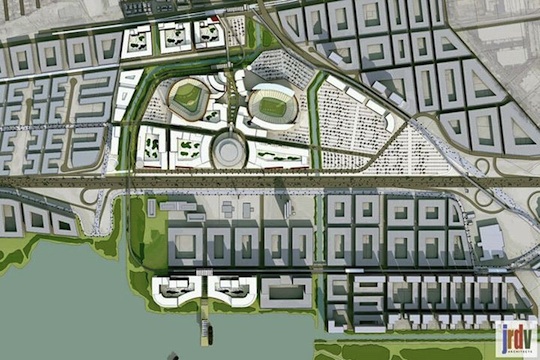
coliseum-city1-sm

Coliseum City with third venue

Most of the immediate ancillary development has been moved to in-between the venues and along 880. The scope has gotten much bigger. At 750 acres, the new initiative requires two specific plans, one for each side of 880. Coliseum City (at least the immediate area) is conceived of as three venues plus L.A. Live. It would require all three tenant teams to pony up most or all of the cost for their new or improved venues, with the possibility of ancillary revenue to help pay the bills. City is pitching the concept as having two big advantages over other cities or sites: No EIR required and land already owned by the City. While it’s correct that the environmental process should be streamlined, I think that having a third venue will require at least some form of EIR since planners have to account for the possibility of three events happening simultaneously and the impacts that would occur from that kind of situation. As for land, okay. And? The Coliseum has already been dismissed by MLB, so why pitch it as a feasible site now? Nothing has changed to explain how anyone can (not) pay for a privately financed ballpark there.

When I got word of the Friday event, I was curious, then suspicious. First of all, why do this on a Friday? What was the rush? Obviously, it was a reaction to the news that the Warriors are exploring an arena deal at China Basin. Here’s the irony of the situation: While the Giants are exploring with the Warriors a way to leave Oakland, Oakland has been consulting with the Giants on ways to derail the A’s efforts to move to San Jose. Strange bedfellows, indeed. Oakland’s strategy has turned into having a viable backup plan if San Jose doesn’t pan out, in which case not being able to deliver by 2015 or 2016 doesn’t matter since the A’s have no other choice in the Bay Area.

Very few members of the public were present since there was little advance notice. City could have drafted a resolution that would have been discussed at a future City Council session, but decided not to. Instead it was a short press conference with a short Q&A. That’s what it’s come to. A feeble punt of a letter. Even Quan’s letter ends on an odd note:

We are advocating for the A’s to remain in Oakland because we believe that sports franchises can lead to economic growth. So long as a team creates jobs and enhances economic development in the City, then we will encourage them to remain in Oakland. My advocacy for keeping the A’s is not about baseball or a particular sports franchise, it is about doing what is best for the City. I am convinced that Oakland has the best weather, transportation, fan base and sites available to MLB.

It’s all about what the City gets out of it. It’s not about the franchise. That’s refreshingly honest. Yet in the same paragraph Quan touts the sites, process delayed and shaky as they are, as the best. It’s this kind of fragmented, incongruous argument that melts under even the lightest scrutiny that’s had me so frustrated lo these many years.

With that, we have two big cases of retreating. The A’s know the new economic landscape, what steps they have to take to address it, and what shortfalls they face even if they achieve their immediate goals. Oakland has been flailing with its incoherent strategy, not revealing details or taking important steps. When I spoke to Doug Boxer yesterday, I told him that showing progress on an EIR matters. Milestones matter. He said it didn’t matter since the decision rested with one man (Bud Selig), and that the average fan doesn’t care. I was flabbergasted. What’s the point of having a Facebook operation if the average fan doesn’t matter? Why even have a press conference? He’s right about one thing, that there are no parties involved in this mess with clean hands. I came away saddened and I felt like a little bit of my soul died. Thankfully I had a few beers and nice conversation with LeAndre, then went to a friend’s donation party later that night. I could have drunken myself into a stupor, but I chose to ease up because I wanted to write this long article. Because I’m sick of the bullshit. It needs to stop. We need to move forward. Maybe the end is coming soon, maybe it isn’t. I’m not sure if I want to keep writing this blog if things don’t or can’t change. They say it’s always darkest before dawn, right? It’s pitch black right now.

Reopening an old wound

Mark Purdy’s newest column revisits a fuzzy period when the halcyon days of the Haas era were ending, and East Bay looked to bring the Raiders back to Oakland.

Reinsdorf’s statement about Oakland, meanwhile, outlines a chapter of the A’s stadium pursuit that many East Bay citizens either forget or refuse to acknowledge. The chapter dates to 1994, not long after the Haas family sold the team to Steve Schott and Ken Hofmann. The two men had big plans for remodeling the Coliseum into a fine baseball-only structure. They requested a meeting with the Coliseum commission.

“Here’s what we’d like to do,” Schott told the commission, outlining his remodeling ideas.

“That’s all very nice,” the commission replied, more or less. “But we have some news. The Raiders want to come back to Oakland, and we’ve got a financing plan to make it happen that will include building a new center field addition. You can’t fight this, because the important people in Oakland want it to happen and they’ll make it difficult on you if you try to get in the way.”

Schott and Hofmann acquiesced. From that moment forward, the A’s long-term future in Oakland was probably doomed. Years later, after Wolff and partner John Fisher bought the team, Wolff did assemble a new ballpark proposal near the Coliseum site. His plan involved mixed-use redevelopment and required Oakland’s assistance to acquire the necessary land. The project went nowhere when the city did not or could not cooperate. Wolff then looked south to Fremont and spent years on another failed plan before finally settling on San Jose as his last, not first, resort.

15-17 years doesn’t seem like that long ago. I have trouble remembering all of the details. Purdy’s account sounds roughly correct, though I’m not certain about how all of the dates fit together. There was a point after Schott’s proposal when the old Coliseum Commission came to an end in a political brouhaha, to be replaced by the Coliseum Authority (see “A Cup of Joe with the Georges” for George Vukasin Sr.’s take).

Fast-forward to last year, when the Coliseum Authority worked with the Raiders again on plans to redevelop the entire Coliseum area by constructing a new football stadium to replace the to-be-demolished old Coliseum. A proposal by Wolff when he worked for Schott and Hofmann went nowhere. I’m sure MLB cares not one whit about the apparent favorable treatment the Raiders repeatedly received over the A’s. It won’t affect their decision making at all. Water under the bridge, right?

Reinsdorf plays the heavy

Bulls/White Sox owner Jerry Reinsdorf has a unique bit of experience under his belt: he’s overseen the construction of a publicly-financed stadium (New Comiskey Park/US Cellular Field) and a privately-financed arena (United Center). He once played the I’ll-move-the-team-to-Tampa card with the White Sox and turned it into the birth of the new era of ballparks. He also has a reputation as a shrewd negotiator and plain talker. So I suppose it was not all that surprising that, when Susan Slusser and John Shea caught up with Reinsdorf at the Winter Meetings this week, he had a few choice words about the A’s situation.

Major-league owners can vote to overturn territorial rights, and recent signs point to a potential vote on the issue at the owners’ January meetings. The A’s will have at least one prominent backer in White Sox owner Jerry Reinsdorf, a longtime friend of A’s owner Lew Wolff.

“I’m totally supportive of Lew getting a new ballpark and going to San Jose,” Reinsdorf said. “He needs to be there. It has to come to a head soon.

“Certainly, (the Coliseum is) past its time. In my opinion, Oakland’s past its time, too. Oakland’s had plenty of opportunity to build a stadium and hasn’t gotten it done.”

Within MLB, it’s been well known that Reinsdorf backs his buddy Lew Wolff, along with Commissioner Bud Selig. As a 30-year tenured owner and a member of MLB’s Executive Committee, he’s been known to have nearly as much sway as Selig. When it comes to rallying votes and gaining consensus, Selig and Reinsdorf should be able to pass just about anything, including a resolution to the A’s-Giants territorial rights battle. Will that actually happen? It sure looks that way, based on how Billy Beane’s practically gushing about it.

As for Reinsdorf’s quip about Oakland, that was just mean and unnecessary. Then again, this is the man who sided with Jerry Krause over Michael Jordan.

Stand for San Jose sues City of San Jose

AP’s Janie McCauley has the news of a lawsuit filed by Giants astroturf group Stand for San Jose against the City of San Jose. The group alleges that City “abused their powers and ran roughshod over their legal duties, including their duties to protect the public’s right to vote and to comply with laws designed to protect the environment, prior to committing to sell public lands for a Ballpark Project.”

I snipped a piece of the City’s municipal code for occasions like this:

4.95.010 Prohibition of the use of tax dollars to build a sports facility 
The city of San José may participate in the building of a sports facility using tax dollars only after obtaining a majority vote of the voters of the city of San José approving such expenditure.

A “sports facility” for the purpose of this chapter is to be any structure designed to seat more than five thousand people at any one time for the purpose of viewing a sporting or recreational event.

“Tax dollars” for the purposes of this chapter include, without limitation, any commitment to fund wholly or in part said facility with general fund monies, redevelopment fund monies, bonds, loans, special assessments or any other indebtedness guaranteed by city property, taxing authority or revenues.

Nothing herein shall be construed to limit the city from allowing the construction of a sports facility funded by private investment.

If any provision of this chapter or the application thereof to any person or circumstance is held invalid, then the remainder of this chapter and application to other persons or circumstances shall not be affected thereby.

The phrase “participate in the building of a sports facility” has always been subject to interpretation. For some, it can mean the City bearing some of the direct construction cost of a stadium. It could mean contributing some or all of the land, especially if the land is sold or leased at below market rate. It seems that Stand for San Jose thinks that the City needed approval via a referendum before signing off on the land deal, even though it’s just an option at this point. The City has been consistent in that it will put the entire package – land deal and all – up for vote when all of the details are completed. By going in Stand for San Jose’s route, virtually every step of the process would have to approved by a public vote every time. The idea sounds like a recipe for gridlock, especially when you consider that the EIR process started in 2005, four years before Stand for San Jose was hatched by the San Jose Giants. All this time, a year after EIR certification, and that’s when you decide to file a lawsuit?

Of course, the Giants (both SF and SJ) could have chosen to stay quiet for years because they were lobbying the City for improvements to Municipal Stadium. Convenient then, that the timing of all of these political and legal actions would occur after the City provided redevelopment funds for Muni? Way to bite the hand that feeds you, Giants. Even more convenient, take a look at how a referendum is required for any venue with a capacity of 5,000 or more. Muni’s capacity? 4,200. Should Muni’s improvements have required a referendum too?

On the other hand, I think the A’s and City could reduce some of their exposure to these types of actions if the Diridon land deal was simply done at market value. Wolff Urban Development is buying the Hotel Sainte Claire at market value, why not the ballpark land? – is what people will argue. This 2005 SV/SJ Business Journal article hints at possible actions if City pushed for a discount. Then again, it’s likely that Stand for San Jose would simply sue based on the EIR, forget the land deal. Coincidentally, the positive budget deficit news reported yesterday (now down from $80 to $25 million) actually works against both Mayor Chuck Reed and Stand for San Jose, since resources won’t be so scarce in the near term.

I would’ve had more sympathy for the mini-Giants had their owners not chosen to sell out to the big paternal Giants to the north. Now it’s just one big corporate interest trying to push around another with the City in tow. We know that the Giants’ motive is to have the A’s leave the Bay Area altogether, or at least rot in the Coliseum for years to come. Thankfully, it appears that Bud Selig is getting off his duff and getting the Giants to the table. Then maybe, just maybe, all this B.S. posturing can stop. Or, as Christina Kahrl tweeted:

http://twitter.com/#!/ChristinaKahrl/status/142832962747113472

Two other observations – note how Stand for San Jose shared the news with the Associated Press instead of the local news outlets when they filed the lawsuit. Looks like someone else is figuring out how to work the national media as well. Also, I like how Stand for San Jose has no problem filing tons of paperwork with the City, yet can’t bother to post any of these filings or letters on their website. Come on astroturfers, if you’re gonna call for “transparency”, you should at least practice what you preach.

News for 12/2/11

Now that the tryptophan has worn off, we’re starting to get some news again.

  • Wolff Urban Development (Lew & Keith Wolff among others) is buying the Hotel Sainte Claire in downtown San Jose. The hotel, on the corner of Market and West San Carlos, is currently owned by Larkspur Hotels. Marin-based Larkspur dozens of other hotels throughout California, including the Larkspur Landing chain. Prior to Larkspur’s ownership, the Sainte Claire was part of the Hyatt chain. That’s all well and good now that the Wolffs will have three hotels in downtown (Fairmont, Hilton, Sainte Claire). The interesting scuttlebutt is that there may be some higher-ups at MLB that may be involved in the Sainte Claire purchase, perhaps with an eye towards revamping it so that it becomes the official hotel for MLB road teams. That would be a smart move, since right now the Hotel Valencia at Santana Row is eating their lunch in terms of attracting road teams (in this case, NHL squads). The Valencia is only slightly larger, but much newer than, the Sainte Claire, so the Wolffs will have to put a good amount of money into improvements to match or surpass the Valencia. SV/SJ Business Journal asked a consultant, Thomas Callahan of PKF Consulting, how much the Sainte Claire would cost. Callahan pegged the price at $34 million. (David Goll, Silicon Valley/San Jose Business Journal).
  • Staying downtown, San Jose Mayor Chuck Reed may be able to avoid a divisive budget battle with public employees unions thanks to new, lower pension cost projections that cut next year’s budget deficit in half, from $80 million to $40 million. Reed will argue that the projections are a one-time reprieve and that more fundamental changes are required, but this news will certainly make his case look weaker, especially because the unions appear to be offering concessions that will bridge that $40 million and more beyond the next budget year.
  • Moving to a mayor with a different set of concerns, Oakland Mayor Jean Quan’s supporters held a press conference yesterday that may have actually been a proactive rally against a recall petition effort, which is expected to begin next week. So that’s the point when Mayor Quan starts getting proactive. (Matthai Kuruvila, Matier and Ross, SFGate)
  • Meanwhile, a few A’s players have been making the rounds within the community. First it was Jemile Weeks and Tyson Ross at the Alameda County Food Bank on Wednesday, followed by the annual A’s Community Fund Holiday Party on Thursday. (Jane Lee, MLB.com)
  • A ceremonial groundbreaking at New York’s Willets Point (outside Citi Field) kicks off a $50 million redevelopment plan that will surely gentrify that part of Queens. (Nicholas Hirshon, NY Daily News)
  • Historical footnote: the New York Post revealed that prior to building the original Yankee Stadium in the Bronx, the pinstripers were looking for a stadium on 42nd Street in Manhattan. Now that would’ve been different. (David K. Li, NY Post)
  • In what may be the start of a trend, the New England Patriots and Miami Dolphins are pursuing development of casinos within shouting distance of their respective stadia. (Douglas Hanks, Miami Herald)
  • Ed Roski’s Majestic Realty (of the City of Industry NFL plan) and UNLV are still working on a new arena/stadium deal. (Paul Takahashi, Las Vegas Sun)
  • Magic Johnson is teaming up with Stan Kasten as part of a group bidding on the Dodgers. (Bill Shaikin and Bill Plaschke, LA Times)

More as it comes.

A’s plan spring training move to Mesa

In April the A’s and the City of Phoenix were set to extend a lease at Municipal Stadium and Papago Park, assuming that the parties could figure out a way to pay for around $10 million in improvements. Unfortunately the deal fell through, which led to discussions with neighboring Mesa, where the Cubs are building a new, $99 million facility on the west side of town to replace HoHoKam Stadium (ballpark) and Fitch Park (training facility). The A’s would move into HoHoKam/Fitch after the Cubs leave in 2014.

It’s terribly unfortunate that the A’s and Phoenix couldn’t come to some kind of agreement. Muni is the most transit-accessible Cactus League facility and it has a ton of parking around it. The Phoenix Zoo is within walking distance, and the views of Papago Park beyond the outfield are excellent. HoHoKam’s best attribute is its size, with a capacity of 12,623 (nearly 4,000 more than Muni). It also has a berm in the outfield, a feature never built into Muni.

By 2016, Valley Metro will extend its light rail line to downtown Mesa, putting it roughly 1.5 miles from HoHoKam. It’s unclear what improvements would be needed or requested by the A’s to move to HoHoKam/Fitch. With the A’s leaving Muni for good, only one Cactus League team will remain within Phoenix city limits, the Milwaukee Brewers (at Maryvale). The Brewers may leave Maryvale at some point because the neighborhood is a bit sketchy. That would leave Phoenix with zero Cactus League sites, which is strange considering how big the city is.