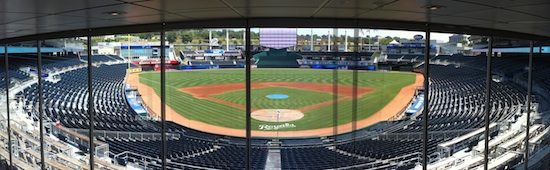
What makes a major league park?

Last night, Jeffrey published his thoughts on the new Cisco Field renderings, which naturally brought about some discussion. Before I get into what I think about the place, I want to get a sense for what you, the reader, feel defines a major league ballpark. Write a couple of sentences or a paragraph, submit it in comments, and I’ll put it in the post. I’d like to see if, based on the long history of ballparks and stadia in America, what kind of consensus exists, if any.

Dan:

I think a major league park is defined by having a nice, large, plot of green grass (that is mowed correctly, yes that’s a dig at SF) located in a central area of the city in which it lives (probably downtown). That grandstand should have large, open concourses allowing views of the surrounding city as well as the field. The stadium itself should be built from materials native to the rest of the buildings in the city or of materials native to the region (ie: Brick in Boston, Sandstone in San Diego, etc… (and yes that was another dig at SF’s brick ballpark in a city with almost no brick)). The stadium itself and the seats should have some relation to the color scheme of the team. There should be some museum(s), statute(s), etc… that pay homage to the team’s history.

Briggs:

Unity between fans, city and team.

It’s a privilege for any city/region to a MLB team. It’s also a privilege for MLB to operate in a major city, so each ballpark should be an appropriate cathedral to both its team and the city it’s in. Sometimes it’s gimmicky (Neon-fluorescent Liberty Bell/Big Red Apple) or classy (Bay Bridge/Gateway Arch). In either case, you need something that’s going to identify the ballpark with the city. The team’s history should be proudly and tastefully displayed. A family could go back with a team generations. Linking the players your grandparents cheered for with the players you’re cheering for is an important thing. Retired numbers, milestones and championships should be easy to identify. Sorry Coliseum, but a big yellow circle around “1989” on a tarped off upper deck doesn’t cut it and don’t get me started on how they display their appreciation for Ricky. The Braves have a good thing with their row of championship pennants.

Transportation.

MLB teams play 5-7 games a week, so if you’re going to a game, it should fit around your schedule. Depending on the day, you’re either leaving straight from work, meeting up with friends then trekking out or making a day of it. Trains, buses and cars should all be viable options. This isn’t just about convenience, it’s about the experience of traveling to/through the city or metro-area to get to the ballpark. Where ever you are in the area, getting out to the ballgame should be relatively easy. This ties back in with feeling the connection between the city, the team and the fans.

Location.

This ties in the top two points. Having a ballpark out in the middle of nowhere because land/construction is cheaper is very telling about the relationship between the city, fans and team is. Prime urban real estate is pricey for a reason. It’s valued. Having a ballpark on a prime piece of real estate includes the team with major activities around the city. I live a few minutes from AT&T park. The bars and restaurants around there light up with baseball camaraderie. The enthusiasm spills out over the city. Before and after games, you feel the highs and lows of your team along with fellow fans. If there’s time to grab a drink before an A’s game, I have to stop off 12th St. BART. Then I have to get back on BART and literally leave Oakland so I can go to an Oakland A’s game. It’s a buzz kill. I want to feel that A’s zeitgeist when I go to games. I want to get off the train and be surrounded with the anticipation, excitement and camaraderie for the A’s. DT Oakland, or DT SJ; it doesn’t matter as long as the fans has a place to be that’s worthy of their appreciation of the team.

jesse:

For me a stadium should do two things, take the fan to a different place once he/she walks through the turn style and second bring people together from all over a regional area to cheer, boo, and forget about any worries or concerns they may have for 2 to 3 hours.

gojohn10:

A major league park is more than a field that hosts a major league team. When the A’s played in Vegas back in April of 1996, they were major league team playing in a minor league park.

The criteria mentioned thus far are what make a good park great, but they  would exclude parks like the coliseum which, while not ideal, is certainly a major league park.
A major league park is a stadium with the capacity of >30-35k. Dogs and beers should readily be available. The park should have wall dimensions that roughly fall within the minimum standards required by MLB. Preferably, wall heights or distances in other portions of the park should compensate for regions that allow for “cheap” home runs. The park should have ground rules that don’t violate the flow of the game on a semi-regular basis. Finally, a major league park should host a MLB team, although even that is not technically a necessity. St. Pete had a major league park before they landed an expansion franchise.
News tidbits from Week of 8/20

I’m at a train “layover” in Spokane. They’re splitting the train so that one part goes to Seattle, the other to Portland (my half). Three more days, it’s been great so far.

  • So far, home teams are 1-8 in the games I have attended (or in the White Sox case, was prevented from attending). The first win came Wednesday night, as the Twins beat the White Sox in Target Field. BTW, I’ve already written the longish post for that one, but it’ll have to wait until after the other Wrigley Field and Miller Park posts are up. Next game is a AAA game in Portland later tonight, perhaps one of the last pro games in PDX for a while.
  • Lowell Cohn has another hit piece on A’s ownership, this time focused on the Fisher family’s vast art collection, which indicates they love art more than sports. Then he claims that ownership should be “sportspeople” as George Steinbrenner was. You know how good of a “sportsperson” The Boss was? He got New York State to fork over $160 million in public money to pay for Yankee Stadium in the mid-70’s. Hundreds of millions more in tax-free bonds were rammed through the legislature for the new Yankee Stadium. Do you think that any Bay Area owner is going to get a deal anywhere approaching that right now, Lowell? Hmmm???? Revenue sharing receipts are not a license to spend willy nilly. Major free agents aren’t coming here to sign long term deals (Rafael Furcal). Hell, they aren’t even going to the Giants. Here’s an proper response to Cohn’s non-sequitur:
  • Both the Las Vegas Review-Journal and the Las Vegas Sun are reporting that Mayor Oscar Goodman and Vegas interests are once again interested in a MLB franchise, possibly an AL team. Haven’t we heard this song before? And didn’t Goodman say barely two years ago that he didn’t want to be used as leverage against another city, say, St. Petersburg? Once he opens his mouth on the subject, which he is guaranteed to do shortly after someone calls, he and Vegas become leverage. Can’t blame him for wanting that legacy piece.
  • Speaking of St. Pete, Pinellas County (FL) extended an existing 1% bed or TOT tax originally used for funding the Tropicana Dome. The tax, which was set to expire in 2015, could potentially be used as a $4 million/year source of funding for a new Other Bay Area ballpark.
  • Finally, Baseball San Jose is organizing a Diridon site walking tour on August 30th at 6 PM. Jeffrey and I are both scheduled to attend. If you’re available, it should be informative. The prior tour I attended was a city-run affair and couldn’t address much about the baseball team and design in general. I’m hoping that because BBSJ’s booster status, we might get a little more specific. Side note: I’d love to do a walking tour of an Oakland ballpark site, though I’ve been told that there are no artist renderings of a ballpark site, nor has a site been specified (even though Victory Court is the big frontrunner).
  • Oakland Mayoral Candidate Rebecca Kaplan will have a talk on August 25th at Linden Street Brewery about sports and keeping franchises in Oakland. Sure to be top discussion topics will be the A’s and Raiders.
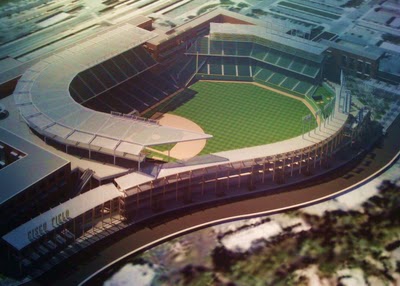
  • I’ve been sitting on the new pics from the San Jose Jazz Festival found at the Baseball San Jose blog. My only comment for now is that the RF addition, which would presumably follow the contour of Autumn Street/Parkway, is a good one. It’s a proper way to mitigate noise while adding revenue generating capabilities and even cheaper seats. However, it would likely require a major reconfiguration of the PG&E substation, instead of minor changes as has been discussed by San Jose Redevelopment. I’ll be pleasantly surprised if they figure out a way to shoehorn it in there. 10:00 AM – Now that I’ve seen the overhead render, I’m changing my mind. It does look like they’ve managed to shoehorn it in there. Clever. I should add that my previous sketches on this are largely based on stuff HOK/Populous has done, not the more radical with-column treatment that 360 and the A’s are attempting. Doing that could reduce the footprint some 10-20%, by my semi-educated estimate.

Anything else to report? Drop it in the comments and it’ll be added to the post.

Day 6: Kauffman Stadium

8/13. Game time- 7:05 PM
Attendance: 30,680
Matchup: New York Yankees vs. Kansas City Royals
Pitchers: Dustin Moseley vs. Kyle Davies
Results: KC 4, NYY 3, W – Davies (6-7), L – Moseley (2-2), S – Soria (32)
Ticket purchased: Upper Box Infield ($22)
Beer of choice: Boulevard Pale Ale ($7)
Food: BBQ Pulled Pork Dog ($6)
Travel cost: $10 in gas, $10 parking
Other: Kauffman Stadium All-Star tour ($20), Negro Leagues Baseball Museum/American Jazz Museum tours ($10)
Total spent: $95.00


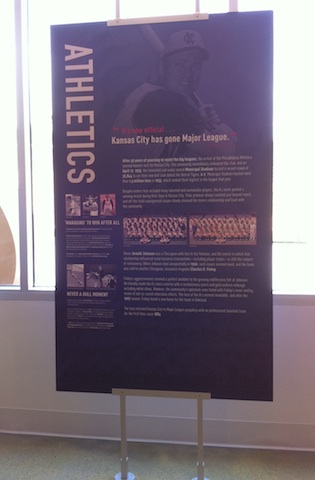
The footage above was captured by my iPhone as part of the Kansas City Royals Hall of Fame’s 14-minute video introduction to baseball in Kansas City. It is splendid. It is magnificent. It manages to make no mention of Arnold Johnson. Not that it matters, the presentation rocks – in particular because the technology used is not a projector but rather a large LED display, or a scoreboard/video board in layman’s terms. The colors are so vibrant, the video so crisp, the screen so wide, that it’s a visual feast. Every team, every major league city deserves this kind of tribute. I fortuitously got this clip as it has some relevant history for A’s fans.
017-Fountain_Pano-sm
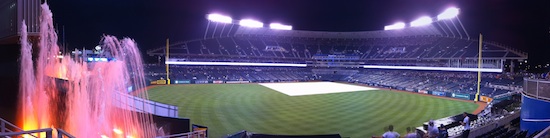
No matter where I travel, I maintain a place in my heart for Kansas City. Maybe it’s the barbecue. Or the shared history with the A’s. Or the general friendliness I always encounter. Whatever it is, the city’s Kauffman Stadium has always been lauded for being a postmodern relic that has managed to stand the test of time. No need to couch the praise anymore, as Kauffman is as good as any of the new ballparks built in the last twenty years.

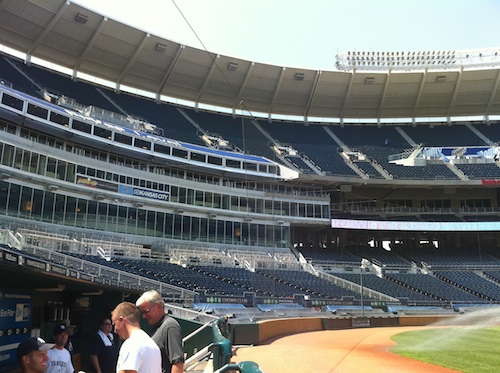
Every single thing a modern ballpark has is now in place. A concourse that allows fans to walk completely around the stadium? Check. Wider concourses with weather protection? Check. New press box? Check. Multiple clubs and restaurants? Check. Improved suites? Check. A museum? Check. Incredible video board? Check. It was always a comfortable place to watch a game. Now it’s comfortable and up-to-date. Sadly, a refreshed stadium is not the same thing as a new ballpark in terms of fan perception, and the revamp can’t fully cover for a crappy team, as 2009’s attendance didn’t surpass 1.8 million and 2010 looks to be a drop from that.

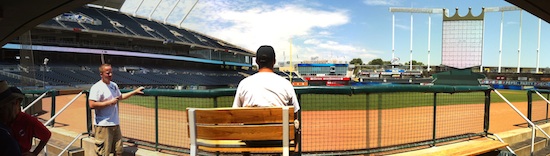
006-Dugout_Pano-sm

Getting There

As part of the post-war sprawl trend, the Truman Sports Complex was built in the middle of nowhere. 40 years later and it’s still in the middle of nowhere. You want in, you gotta drive. Parking is $10 and there’s plenty of it. Prior to the remodeling of the ballpark, local business interests spurred an effort to bring the team downtown. That effort went nowhere as the Royals’ interest was tepid at best.

Ticketing

Back Camera

I figured that a Yankees game might be somewhat impacted. Silly me. I was able to score a $23 seat in the front row of the upper deck. The deal proved too good to be true, as the ticket seller neglected to inform me about this:

Back Camera

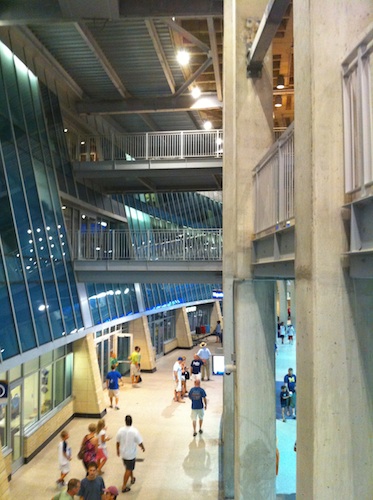
Then again, it started raining shortly after I took my seat, so I headed back to the concourse to get some cover from the rain coming through the area. That’s when the improvements at the stadium really started to shine. Simple things, like better traction on the steps and a weatherproof coating on the concrete, combined with a large, high roof covering the concourse made things bearable. It used to be that the only thing that helped previously was the back of the upper deck cantilevering over the concourse, which really wasn’t much protection at all.

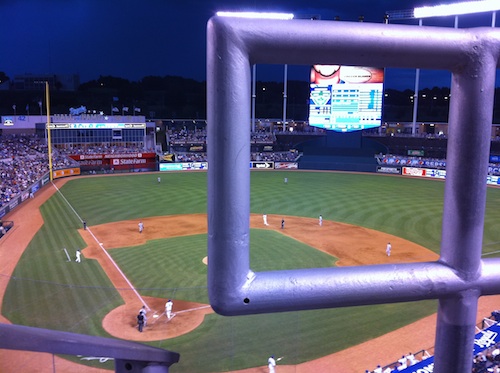
After the 2 hour, 15 minute rain delay, it was easy to find a good seat as two-thirds of the crowd cleared out. I didn’t even stick around for the whole thing as I needed to take an early train the next day. I wiped off a seat about 22 rows up on the third base side, and that’s when the place felt familiar. The seating bowl’s signature contours are still there, and the layout hasn’t fundamentally changed other than the outfield.

I left in the middle of the 7th, rain cleared out but constant thunder and lightning in the distance. My biggest regret was not being patient enough to capture lightning on camera as it lit up the ballpark. During the rain delay, I stopped at a picnic table to tap out the Day 4 post. Several other people were there, waiting out the rain. Two young girls from Wichita asked me what I was doing, and showed them the iPad’s MLB app. They asked if I they could see some highlights from the Wichita minor league club, I replied that it’s not ready yet. As the concourse filled up, the view to the field was blocked and I could no longer see if the grounds crew was working with the tarp or not. I scooted over to make room for an elderly gentleman. I asked him about the tarp and he ignored me, or so I thought at the time.

Turns out that the man and his wife were both deaf. As he saw me showing the MLB app to the kids, he started scrawling on a scrap of paper, which he laid in front me. It read, “Cardinals 6, Cubs 3. Box Score.” I quickly tapped the STL-CHC score, and the newspaper like box score opened in front of us. I quickly gestured to him how he could navigate the app, and he started smiling. Apparently he was really looking for Adam Wainwright’s line for the game. After he was done, he explained to me that he had season ticket to the Cards and was in KC visiting family. We “talked” some more and exchanged pleasantries. Okay I lied, I have one other regret, that I wish I had let that one girl I was dating in college teach me ASL.

Concessions

Seems like all over the Midwest ballparks are doing the gourmet dog thing. It’s a good way to charge an extra two bucks for a dog, a suppose. I figured I should try it once, and it was okay, not worth $6 but okay nonetheless. It was washed down with a Boulevard Pale Ale, KC’s most famous craft brewer. Strangely, the Pale Ale that cost $7 on the main concourse cost $7.50 on the upper concourse.

Circulation

Back Camera

The tour enters the ballpark at the main level. Behind home plate on the main level there is the Diamond Club, which despite its name is not the most exclusive club in the park. That honor would go to the BATS Club for the 100 or so seats directly behind the plate. Branding has gone way up since the last time I was here, over 10 years ago.

Now there’s proper room for escalators and those familiar circular ramps. Even with 20,000 people fleeing for the main concourse during the rain delay, it never felt cramped. The team administration building is physically separate from the rest of the ballpark, linked by a series of footbridges at each level. In doing this they allowed more natural light and air into the space. Very smart move.

The outfield area, which was once off limits, is now vast and spacious. There are special bars, a team store, frozen custard stand, fried chicken stand, play areas, and even a couple of mini golf holes. The piece de resistance is the Hall of Fame, which is tucked into the LF corner. It’s really lovely, covers over 50 years of baseball history without sounding bitter, and when coupled with a trip to the Negro Leagues Baseball Museum near downtown, makes for a really fun and educational day trip that also happens to include a major league game. If you go to KC, do all three. You’ll get the video, you’ll get a sense of justice, you’ll feel good about humanity.

001-Kauffman-PressBox-sm

Other Observations

  • Billy Butler was in the cage behind the dugout and taking extra BP. It must’ve worked because he hit the winning home run that night.
  • As impressed as I was by the Cowboys Stadium video boards, the single huge board at Kauffman rates nearly as high. The vertical orientation allows for an uncompromising combination of video and text information. It proved extremely useful during the rain delay as well, because it has plenty of space to support two simultaneous video feeds: the Red Sox-Rangers game and Chiefs-Falcons exhibition.
  • The bad seat I had was due in part to the way the new press box cut into the original upper deck. I’ve incorporated such a feature into some of my sketches. Now I know what to watch for.
  • Maybe BBQ is old hat in KC, maybe not. Whatever the case, it wouldn’t hurt to have one of the well known pit masters have a stand of their own in the ballpark, whether it’s Arthur Bryant’s or Gates. I had an Arthur Bryant’s “sandwich” before the game, and it heaven wrapped in butcher paper.
  • The team offers four different grades or levels of tours, based mostly on access. The cheapest tour offers basic info and access. The tour I took at $20 provided a free Kauffman Stadium hat, team magazine, and a longer running time. The most expensive tour allows fans on the field to watch batting practice.

Wrap-up

Kauffman Stadium rocks in many ways, even if the team doesn’t. If you’re planning a ballpark trip or even have already been there prior to the remodel, it’s worth going. It’s not garish or overstated, it’s family friendly, and it’s a great educational opportunity when coupled with the Negro Leagues Museum or even the American Jazz Museum, which is in the same building. This is my first true endorsement on the trip, and it’s a full one.
Back Camera

SJ City Council Session 8/3

Yes, they are having a session as previously scheduled. And yes, it will have a ballpark related issue on the agenda, though isn’t quite as impactful as approving a ballot measure. Instead, the Council will take up the matter of amended negotiating principles, which can be found on the last four pages of this memo. Hardly groundbreaking stuff, to be certain, but there are a few details worth pointing out. (Sorry, can’t cut-n-paste the memo.) 

Notice that it authorizes the remainder of land acquisitions, but doesn’t say what methods would be used to make the acquisitions.

Mayor Reed has given his introductory statement, followed by motions of support by Councilmembers Liccardo and Herrera. Former Mayor Susan Hammer is speaking now, to be followed by Michael Mulcahy. Marc Morris (Better Sense San Jose) is also speaking. Lots of pro-business supporters have shown up, including SVLG’s Carl Guardino, who also spoke in favor.

2:35 PM – Public comments are over. Limited council discussion. Negotiating principles approved unanimously. BBSJ folks leaving, SJFD members filling the chambers. This might get interesting.

News for the week of 8/1

This may be the only post of the week from me. I’ve got a lot of work to cram before I head out on the trip.

And now for the news:

The Merc’s Scott Herhold analyzes the political calculus of San Jose’s efforts of the last week.

Matier and Ross report on AT&T playing hardball with San Jose on the $12 million Diridon property.

City Councilman Sam Liccardo, whose downtown district includes the ballpark site near Diridon Station, says it’s troubling that a company “that depends so heavily on public good will” would attempt to “rake taxpayers over the coals.”

Nonsense, says AT&T California spokesman Ryan Rauzon. He says the center – which employs more than 100 people and serves as a maintenance and storage yard for a fleet of vehicles – is vital “to making sure we take care of our customers.”

“The land obviously is not for sale,” he said.

Councilman Liccardo might be better served finding a suitable landing spot for AT&T. I’ve mentioned before that I’ve been in work centers like the one that’s in question here. They are not central offices, so they don’t have tons of expensive switching equipment. They are, ironically, offices, with training facilities and conference rooms. More importantly, they have large parking lots to hold the various trucks that run around the service area. San Jose will either have to put resources into finding another centrally located spot with enough parking to make it work, or use eminent domain, which would be approved with the March vote. Note: AT&T is a sponsor of both the A’s and Giants, so it’s not a situation where the company is beholden to one team or another.

Over at The Biz of Baseball, Maury Brown’s covering the Rangers’ ownership debacle like a champ. There’s coverage of Mark Cuban and FOX perhaps being bidders on Wednesday. Get your popcorn ready. There are even threats that the Rangers would lose Josh Hamilton and Cliff Lee if the Greenberg-Ryan group were not the winner. Whatever, given the incredible job that FOX did owning the Dodgers, GOOOOOOO FOXXXXXXXX!!!!!

If you didn’t catch it last week, ESPN has a feature on health code violations by stadiums in the US and Canada. Bay Area facilities tended to perform among the best in the nation, though the Coliseum was the worst at 34%.

FWIW, I’m bringing in food tonight.

Reed pulls measure from November ballot

The press release in its entirety is quoted below.

Mayor Reed Pulls Proposal to Place Downtown Ballpark Measure on November Ballot

Decision comes after Major League Baseball offers to help cover the added cost for a possible special election and hints that a decision on territorial rights may come in time for a spring vote

San Jose, Calif. – Mayor Chuck Reed has announced that he is pulling his request that the city’s Rules Committee place a downtown ballpark initiative on the November 2, 2010 ballot, following a discussion with A’s owner Lew Wolff. The decision comes after Major League Baseball (MLB) President Bob DuPuy, speaking on behalf of MLB Commissioner Bud Selig, also agreed to help cover the taxpayer cost if a special election is required in the spring.

“I pursued a November election because I believe the citizens of San Jose deserve to have their voices heard.  We have strong community support to build a privately-funded ballpark, which would be a catalyst for thousands of jobs and millions of dollars in revenue to fund vital city services,” said Mayor Chuck Reed.  “After discussing our options with Lew Wolff, other elected officials and members of Pro Baseball San Jose, we have decided to forgo a November ballot measure.”

Mayor Reed will still be asking the City Council to adopt a resolution of support for allowing the Athletics to move to San Jose that incorporates the Mayor’s proposed amendments to the city’s ballpark Negotiating Principles.

Lew Wolff praised the strong leadership of Mayor Reed. “I’m grateful that San Jose has shown a gritty determination to help us build a new ballpark for our franchise. We appreciate the strong leadership of both the Mayor and Commissioner Selig,” Wolff said. “We look forward to a final decision from the Commissioner, and will vigorously pursue an election next year if that decision is a positive one,” he added.

Since April 2009, city leaders have been working in partnership with the Athletics on a possible relocation to San Jose. In that time, the city has developed a set of negotiating principles for a new stadium, completed an economic analysis and environmental impact review for a downtown ballpark, and met with members of a special MLB Committee formed to study ballpark options for the Athletics. However, city leaders have been waiting for a response from MLB regarding territorial rights that currently prevent the Athletics from moving to San Jose.

“The initial push to hold a November vote sent a strong signal to league officials that San Jose is serious about attracting a Major League ballclub and that it’s time to move forward with the process,” said San Jose City Councilmember Sam Liccardo, who represents downtown. “The Commissioner’s offer to help pay for a possible election in the spring was the first indication that the league is inching closer to a decision on territorial rights.”

Mayor Reed and Councilmembers Rose Herrera, Sam Liccardo and Nancy Pyle had originally proposed placing the San Jose Downtown Ballpark and Jobs Measure on the November 2010 ballot to avoid the added expense of a special election. Placing a measure on this November’s ballot would have cost several hundred thousand dollars while holding a special election is estimated to cost more than one million dollars.  Specific estimates are set by the Santa Clara County Registrar of Voters when a measure is submitted for placement on the ballot.  Voter approval is required to use city land or funds in conjunction with a downtown ballpark, and after this November, the next regularly-scheduled election in San Jose is not until June 2012.

Background:

The San Jose Downtown Ballpark and Jobs Measure required that the A’s would be responsible for 100% of the cost of building, operating and maintaining a new Major League Baseball ballpark. No new taxes could be raised to bring baseball to San Jose.

Ballpark Economic Impacts

A September 2009 Economic Impact Study commissioned by the City of San Jose states that the estimated $490 million private investment in a new downtown ballpark would bring positive economic benefits to the City:
–          More than 2,000 annual jobs (full, part-time, seasonal) of which 970 would be new jobs in San Jose as a result of the project
–          $2.9 billion total economic output for the local economy over a 30-year period
–          128 million in annual net economic impact as a result of direct spending on operations (that is partially re-spent in San Jose)
–          $5 million in annual revenues for local governments, including approximately $3 million to the City of San Jose’s General Fund and Redevelopment Agency

Following a discussion with Athletics owner Lew Wolff, Mayor Reed informed MLB President Bob DuPuy of his decision this morning and will rescind his request that the Rules Committee place the ballpark ballot measure on the agenda for the August 3 City Council Meeting. The Rules Committee will still decide today whether to place the proposed ballpark Negotiating Principles amendments on the August 3 agenda.
The Rules Committee will still meet today to discuss four other proposed ballot measures:
1. Reforming binding arbitration for police officers and firefighters;
2. Instituting a tax on medical marijuana;
3. Raising the sales tax by ¼ percent; and
4. Changing minimum benefits and contribution formulas for employee pensions

Now I can have lunch.

A session for concessions

As was advertised last week, San Jose Mayor Chuck Reed met with MLB COO Bob DuPuy to clear the air about the City’s move towards a November vote. What came out of it was an urging by DuPuy and his boss, Commissioner Bud Selig, to delay the vote until next March, which MLB promised it would partially fund. The idea is that Selig’s panel would complete its work and then allow him to render a decision which would allow San Jose to move forward (or not).

Unfortunately, no one in my household was a fly on the wall for the proceedings, so we have no idea what was said outside of the statement. What was said (and not printed) is the real story. Thing is, you could fill in the gaps there largely based on your own A’s worldview, framed by a simple question:

Is this process truly legitimate?

(I started out with some paragraphs explaining this, then scrapped them in favor of a table.)

Chances are that you fall into one of the green or yellow cells, depending on which city you are leaning towards. In organizing views in this manner, there is no obvious middle ground even though there are many that fill the “keep ’em in the Bay Area” crowd. The point of the table is that if you spend enough time analyzing the issues and assigning values to the various challenges and benefits each city carries, you’ll probably see yourself on one side of the fence or another. You may waver from time to time depending on the news cycle, which is perfectly acceptable given the lack of real insight the public has into the situation. If there’s anything we’ve learned throughout all of this, it’s that city governments have the transparency of an eggshell, whereas MLB has that of a brick wall.

(Note: Contraction is off the table for now. That doesn’t mean it couldn’t be revisited by 2013, though I’m sticking with my thought that it’s too expensive to pull off for MLB – for the owners and legally for the league.)

All right, so I’ve set up everyone’s relative worldview. Whatever your thinking is, it colors the way you view today’s news. In the immediate moments after the Mayor’s press release, I checked to see what the fallout would be here and in the media. SJ Councilman Sam Liccardo was quick to spin the news as positive for the city, in that it forced MLB to act. Mark Purdy just came out with a column in agreement with the councilman. And late last week, Oakland Mayor Ron Dellums and City Council President Jane Brunner jointly released a letter to MLB outlining the steps that the City has taken to retain the A’s. Here are the bullet points of the letter (made available to BANG late today):

  • Met with your Committee extensively over the 16 month period Identified three waterfront sites which each meet the physical and infrastructural needs for a 21st Century ballpark as identified by your Committee Generated detailed diligence materials on each of the three sites regarding
    o environmental conditions
    o infrastructure conditions
    o transportation access
    o parking studies
  • Generated a detailed land-use plan identifying key milestones and reviewing Oakland’s entitlement processes
  • Demonstrated that the City/Redevelopment Agency has the financial capacity to uphold its end of any negotiated transaction
  • Generated over 130 letters of support for keeping the A’s in Oakland from members of the East Bay private sector including business, labor and community leaders
  • Secured over $500,000 in deposits from 35 corporate entities expressing interest in luxury suites, sponsorship opportunities and, most significantly, naming rights for a new waterfront ballpark
  • Organized a grass-roots effort through Facebook with over 40,000 members committed to keeping the A’s in Oakland (see http://www.facebook.com/letsgooakland)
  • Commissioned and published an Economic and Fiscal study which found that a new waterfront ballpark in Oakland would generate thousands of jobs, generate $2.6 billion in economic activity, increase property values around the ballpark by $4.7 billion, and generate over $240 million for Oakland’s general fund

When you add up the avalanche of press releases and responses, the picture starts to become clear. The horserace that wasn’t supposed to happen, that MLB was supposedly trying to avoid, is here. And now’s when it gets interesting. It’s a mistake to read too much into the little machinations that occur. For instance, MLB offering money for a spring 2011 election is nothing as it’ll come out of Selig’s enormous discretionary fund. It just means that the pro and anti-ballpark forces will have 6 more months to add to their campaign warchests. It’s also a mistake to think that either Oakland or San Jose are in an advantageous position relative to each other.

What’s going to happen? Well, first I expect the SJ City Council to put off the vote, as suggested by Selig/DuPuy. And yes, they’ll take up the offer because it’s free money for what could be a one-issue special election. At the same time, Oakland will get its shot to put together the JLS ballpark deal. The schedule probably won’t be kind, maybe 12-18 months. Maybe as little as 9 months. It may or may not be enough to complete and certify an EIR. More important, they’ll be asked to line up those sponsors and business interests, as referred to in the Dellums/Brunner letter. It’ll be imperative that they execute on this, though I expect that if Don Perata is elected Mayor, his willingness to get in the machine will help. (It should be pointed out that the keeping the A’s is not a plank in any of the leading mayoral candidates’ platforms.) As a concession, MLB may ask Oakland and the Coliseum JPA to add 1-2 years to the A’s lease, which is due to expire after the 2013 season. This would have several cascading effects:

  • The A’s could move into an JLS ballpark in 2015 or 2016 if necessary. Or a San Jose ballpark if it doesn’t work out.
  • The Raiders would suddenly be in a pickle, as they probably don’t want to stay in the current Coliseum config for 2 more years beyond their lease. They could either move to Santa Clara if the 49ers’ stadium is built, or they could play hardball with the JPA and push for a revamped/new Coliseum. Then Oakland and the JPA would have to choose between the two teams.
  • Discussions with Oakland/East Bay-based sponsors, which until now have been under wraps, will have to be more public. Especially the naming rights sponsor, which would probably have to replace Cisco (I’d expect them to go with the Niners stadium instead).
  • Oakland interests could no longer claim that MLB hasn’t given The Town a shot.

None of that is good news if you’re Lew Wolff or a Baseball San Jose booster. Assuming that the process does have integrity, it’s the best way to be above reproach. However, Oakland will have little time to get everything together, a process that has taken San Jose fits and starts totaling 5 years. Oakland pols will have to somehow avoid the idea that they’re ramming a stadium deal through, in a city that is already enormously sensitive to bad stadium deals and doubly sensitive to huge budget cuts. Make enough early mistakes and MLB could kill the contest early. Keep in mind that as nice as 35 corporate sponsors and $500k in deposits sounds, Oakland’s going to need a lot more than that to make the math work on a $450 million ballpark, perhaps $20 million a year in commitments. For now a good first step would be to authorize an EIR. Some of the pledged sponsor money redirected towards the EIR would be a good gesture as it wouldn’t hurt the City fiscally.

Of course, if you think that MLB is prone to cronyism or otherwise rigged this, the endgame is quite different. Rigged for what, though? After all, the whole time San Jose will still be there, sitting and waiting for Oakland to fail, with MLB given a few more months to come up with a T-rights settlement between the Giants and A’s.

Major release from MLB: SJ, stop the vote

So it turns out Bud Selig isn’t Claude Rains after all. I had asked why MLB hadn’t simply requested that San Jose delay the vote, and it turns out that it took a weekend for them to make the call. From Mayor Reed’s office:

MLB President Bob DuPuy informed me today that Commissioner Selig has requested that the San Jose City Council refrain from placing a Downtown Ballpark Measure on the November 2010 ballot so that MLB’s special committee can complete its work. He also committed that, if a special election is required in the spring, MLB would help pay for it.

Mr. DuPuy also shared that he appreciated the amount of work the City has done and the level of excitement that the San Jose community has shown in attracting a Major League ballclub.

I informed Mr. DuPuy that I would consider the league’s request and talk with Lew Wolff. We also pledged to continue our conversation in the coming days.

How ’bout dem apples?

Notes from a movie set

Got to the set at 10:30. Line took an hour to process. Two release forms.

Craft services is skimpy on anything good. Party mix, granola bars, coffee. Yippee.

We’ve been moved three times along the 3rd base side. I’m pretty sure I’m not in any shots. Yes, the tarps are off.

There’s a problem with actor Stephen Bishop, who plays David Justice. Evidently casting forgot to make sure he was left-handed like Justice. It’s made for some comical throws back to the infield.

There are a few dozen paid extras in the crowd, sometimes in designated areas such as Diamond Level seats.

Philip Seymour Hoffman was here but by the time we got in he was relaxing in street clothes. He left around 1.

About 20 minutes in I realized that the scene being filmed was the KC comeback from 11-0 during game 20 of The Streak. Nothing like reliving the most panic inducing moment of the 2002 season.

They’ve reenacted the Michael Tucker double (and Justice’s reaction) over a dozen times.

The guy playing Eric Chavez is maybe 5’9″. The guys playing Miguel Tejada and Randy Velarde are 6′. Huddy looks like Huddy.

Diamond Vision is playing every highlight loop from the last decade, it seems.

Anything else? I left before the last scene, which has the crowd in the LF bleachers. Glad I did the unpaid extra thing, wouldn’t do it again.

A’s ratings much better but still terrible?

Today, a report at SportsBusinessJournal shows TV ratings for the 30 clubs. Despite a 46% increase in viewership on CSN California, the A’s have placed last in both ratings (1.23) and viewers (30,792 households). Ratingswise the A’s are actually tied for last with the Angels, but the Angels’ much larger SoCal market nets more than double the eyeballs.

You’ll remember that 2009 was the first season on the new CSN California network, and as expected it encountered growing pains. Many non-Comcast cable systems didn’t carry the network at first, and there’s always that adjustment period for fans as they grow comfortable with the new channel.

Interestingly, the A’s rating at the beginning of the season was 1.6, though that was a small and not properly representative sample. As the A’s continue to improve on the field, the ratings recovery should also continue, perhaps even approaching a 2.0 rating, or roughly 50,000 households. Both the A’s and CSN have to be encouraged by the increase, as the audience should only get stronger over time. The eyebrow-raiser is the Washington Nationals, who have finally emerged from their malaise over the past few years with an initially competitive team and a must-see horse in Stephen Strasburg.

Perhaps even more important is the size of the market. Plenty of small and mid market teams have to perform quite well to get 30,000+ households, which speaks to the Bay Area’s importance. If they were ever to move out of the Bay Area, maxing out in a small market could prove more difficult there than here. Add to that the Bay Area’s affluence, and even in second place it’s a difficult combination to beat.