Oakland/Alameda County to discuss/vote on Coliseum City framework Monday

The City of Anaheim is poised to give away development rights for virtually all of the land surrounding Angels Stadium in exchange for two simple things: the team staying in Anaheim, and the city no longer having to pay to maintain the old stadium. Is that too much to give? We’re about to find out in Orange County, and the same could be said in Oakland, where Colony Capital is being asked to provide hundreds of millions to bridge a funding gap at Coliseum City.

How big a funding gap? It depends on the scope of the project. Planning aspects of Coliseum City will be shown in presentation Monday to the Alameda County Board of Supervisors and the Oakland City Council for discussion and a vote. The session will be held at 1:30 PM, which means that there probably won’t be many members of the public on hand.

Three phases of Coliseum City have ballpark built out at the end of the project

Three phases of Coliseum City have ballpark built out at the end of the project

Initially, the football stadium would be built along with needed infrastructure to support future development. Included would be transportation improvements, which indicates to me that they’re counting on the transit funding that was narrowly voted down in 2012. Stadium capacity remains within a broad range, and there’s no indication of whether it will have a retractable or fixed dome.

Phase II looks relatively modest, as it includes a lot of housing and limited retail (40,000 square feet). By comparison, Bay Street Emeryville has 382,000 square feet of retail and 400 housing units. It would commence in 2019, the year following the completion of the Raiders’ stadium. Also included would be a 220-room, 3.5 star hotel, signifying a mainstream brand such as Sheraton, Hilton, etc.

The final phase is most aggressive, as it likely anticipates a boom sufficient enough to make Phase III buildout feasible. Along with the ballpark there would be over 15,000 parking spaces (presumably in garages), an “Upscale” hotel, much more retail space, and nearly a million square feet of office towers. At any point one or more of these components could be removed or  scaled back, which is often the case in such large projects. Since the A’s haven’t signed on with the project in any capacity, there’s no date for the ballpark’s opening. Also not included is the replacement arena, which is technically part of Area B from a planning standpoint (the focal Area A is the Coliseum and land east of 880).

Planned goals for Exclusive Negotiating Agreement

Planned goals for Exclusive Negotiating Agreement

coliseumcity-preso_ena

Additional goals for the Exclusive Negotiating Agreement

We’ve covered the complexity of Coliseum City as a development project in the past. The presentation works to delineate the many issues. Compared to the DDA of the 49ers stadium in Santa Clara, Coliseum City is several orders of magnitude more complex. The big X factor is the $100+ million in remaining debt on Mt. Davis, which Mayor Quan and the City Council have said has to be baked into the new deal. There will be some sort land sale agreement that will invite scrutiny, as that’s a major key for the cost assessment for Colony Capital. Colony has some limited experience in the football realm, having recently partnered with the Chargers on their stalled (or failed depending on who you ask) plans in Downtown San Diego. This is an important framework from which many important questions about Coliseum City will be answered. Better late than never.
Coliseum Authority approves Raiders/A’s lease extensions

Update 11/25 9:10 AM – Resolutions passed nearly unanimously, with one vote against.


=====

Original post from Saturday:

In your typical Friday disclosure before a hastily called meeting, the Coliseum Authority (JPA) released its agenda for a Monday board meeting in which it will vote on short-term lease extensions for both the Athletics and Raiders. It’s funny to see how the negotiations have progressed. The A’s offered up a 5-year deal last year which the JPA ignored because it thought it had leverage, only to be that perceived leverage taken away by MLB two weeks ago. The Raiders have talked up a long-term deal, but only if it came with a serious plan for a new stadium. The resolutions that the JPA board is looking to pass will undoubtedly amplify the uncertainty surrounding the two franchises. Highlights:

  • The A’s will get a two-year extension with no additional option years, thus extending the lease through December 31, 2015.
  • The A’s would pay a slightly higher rent payment than previously negotiated at $1.5 million per year.
  • In addition, the A’s would pay a mere $250,000 to maintain control over concessions.
  • The parking revenue dispute between the A’s and JPA would go to arbitration, which should be decided before the end of 2014. The A’s would agree to put the disputed amount (not disclosed) in escrow.

It’s good to see that the parking issue will be resolved soon. Apparently the A’s are raising parking prices for 2014, which makes the actions seem linked. The big takeaway is that the JPA caved on concessions. Under the new terms, the A’s have the right to choose a new concessionaire, whose contract may long extend past the A’s stay in the Coliseum. However, you have to think that any concessions contract has to factor in the significantly lower value of the Coliseum should the A’s and/or Raiders leave. Yes, this could mean Aramark is replaced by someone else.

  • The Raiders have a one-year deal for the 2014-15 season. The Raiders would pay $400,000 in addition to the revenue splits they currently share with the JPA. The end of the lease is described as 45 days after the end of the team’s season.
  • The Raiders could pay up to $525,000 per year to use their Harbor Bay headquarters in Alameda.
  • The lease terms acknowledge that the Raiders may play one regular season or preseason home game away from the Coliseum (London in 2014).

Also wrapped up in the Raiders’ extension language is something that I’d like to call the Santa Clara clause.

7.5 Additional Payments for Use of Permanent Training Facility and Training Site. If the Raiders announce a relocation or sign a lease to play football games outside of the City of Oakland or Alameda County for the 2015 season prior to March 1, 2015, then, commencing on March 1, 2015, Raiders shall have the option of continuing to use the Permanent Training Facility and Training Site for up to twenty-four (24) months, up to and including February 28, 2017 as determined in Raiders’ discretion and Raiders shall make an additional payment to Licensor each month for continued use of the Permanent Training Facility and Training Site in an amount equal to the fair market rental value of the Permanent Training Facility and Training Site on a monthly basis, as determined by a mutually agreeable licensed commercial real estate broker based on comparable rental space. Raiders and Licensor agree that the fair market rental value shall not exceed $525,000 per year. In the event the Raiders are engaged in good faith discussions concerning an extension of the Operating License or other arrangement for the Raiders to play future Football Events in the OACC Stadium as of March 1, 2015, any obligation to make payments shall not commence while such discussions are continuing and the twenty-four (24) month period and obligation to make additional payments shall begin when Raiders agrees to play football games at a location other than OACC Stadium for the 2015 seasonal provided, however, that if Raiders agrees to play football at such other location, Raiders shall pay such rental payments retroactively from March 1, 2015.

Got that? The Raiders won’t be charged to use the Alameda headquarters as long as they’re in talks about Coliseum City, even if they’re playing somewhere other than the Coliseum for 2015 and 2016. If the Raiders play elsewhere while using HQ and aren’t in talks over Coliseum City, they pay $525,000 annually. Obviously, the only place where they could play in this scenario (and while the Coliseum is demolished, presumably) is Santa Clara. UC Berkeley is forbidden by legal settlement from hosting NFL games, and Palo Alto would sue Stanford to high heaven for even considering it.

Both extensions should be easily passed, unless one or more of the commissioners complain that the terms are too favorable to the teams. The teams are effectively trading rent payments, and the JPA’s incoming revenues will not make much of a dent in ongoing debt service. At least the JPA will get the parking revenue they’ve clamoring for, which at the very least should help pay for additional Coliseum City studies or minimal prep work. As for scoreboards – you weren’t banking on that, were you?

P.S. – The resolutions would have to be passed by Oakland’s City Council and Alameda’s Board of Supervisors shortly after JPA approval.

Alternate history: Athletics stay in KC, Oakland gets expansion team in 1971

The late 60’s was a tumultuous time in American history, as we all know. Baseball, a notoriously conservative game, was starting to make its own moves in concert with the times. Two decades after baseball became integrated, a influx of talent prompted MLB to think expansion. The A’s and Braves’ moves to Kansas City and Milwaukee, respectively, were considered half-measures because they could be accommodated by train travel. When the Dodgers and Giants moved to the West Coast, planes became a necessity. That opened the door to the rest of the frontier, with numerous growing cities selling Midwestern and East Coast owners on the virtues of moving to new ballparks and wide open spaces.

Charlie Finley was brilliantly chronicled doing his part to hasten this change in his biography, which was published in 2010 and I’ve been rereading for the last week. Finley was considered the first owner to truly play the ransom game with a municipality, as he did in the mid-late 60’s. Even as he talked long-term leases with Kansas City pols and civic leaders, he had his eye on anywhere that could’ve hosted a team. Candidates included the South (Atlanta, New Orleans), Dallas-Fort Worth, and the West Coast (Oakland, Seattle).

It was Finley who pushed Kansas City Chiefs owner Lamar Hunt to agree that the new sports complex southeast of downtown KC should have separate baseball and football stadia, an against-the-grain move for the era. Finley, who long felt the A’s were being cast aside for the new football team, saw this as an equal measure. Yet Finley gave little support to the stadium plan, even though area voters passed it during the summer of 1967. By the end of the season the stage was set for a bidding war over the A’s that served nothing other than Finley’s ego.

Local interests tried to get Finley to sell, but he wasn’t interested. Finley had spent a bunch of insurance profits on bonus babies, so there was an interest in seeing his team through. That eventually occurred with the threepeat World Series wins in 1972-74. Finley also named a price that no one local could match: $25 million. He felt he had been previously mistreated by Kansas City – which he was based on previous KC Muni lease discussions – and set forth to burn all the bridges. As the offseason neared, KC interests turned their attention towards an expansion team. Finley prepared a presentation for AL President Joe Cronin and the other team owners that favored Oakland over Seattle and KC. The AL powers approved the Oakland move, in turn granting expansion franchises for KC and Seattle for 1971.

However, Missouri Senator Stuart Symington was furious over the three-year gap between the A’s leaving and the expansion team starting up. He took a meeting with Cronin and threatened to open hearings on baseball’s antitrust exemption. Taking the threat seriously, Cronin promised a 1969 expansion date, leaving a year gap. That meant that the team would have to play at Muni for a few years. It also meant that Seattle’s club would have to play at Sicks’ Stadium for an indeterminate period. Sicks’ Stadium was already deemed inadequate and whose condition was considered a major factor in Seattle losing the Pilots to Milwaukee (and Bud Selig) after only one season.

What if Finley had been magnanimous and relented? He couldn’t admit that having a future stadium all to himself in KC was better than having to share in Oakland, but that had to be part of his calculus. What intrigued Finley about Oakland was the promise of greater radio and TV revenues, which is ironic considering the A’s difficulties in that realm the past 20 years. If Finley kept the team in KC, KC would’ve gotten the World Series champs of the 70’s, and Finley probably would have sold to local interests in the late 70’s once he saw that baseball’s economics were surpassing his ability to compete.

Seattle, which had rejected previous votes on a domed stadium to attract a baseball team, was forced to approve one once they were granted the expansion franchise. Because they had no choice but to accelerate their efforts, Pilots ownership lost their shirts during the 1969 season, filed for bankruptcy, and sold to Selig when no local ownership groups stepped up. The Pilots relocated, which brought forth a lawsuit from Seattle against MLB, which led to the expansion Mariners in 1976. If the team had been given more time, it’s possible that needed improvements for Sicks’ would have been made to keep ownership and fans happy. Even though the domed stadium had faced stern opposition, it eventually was approved and opened in time for the 1976 season. That opening would’ve been earlier had the team already been in place. Milwaukee would’ve gotten an expansion team to go with Toronto in 1976 – unless the team was awarded to Denver or New Orleans.

As for Oakland, under this alternate scenario they would’ve had the team in 1971. Perhaps it would’ve been called the Oakland Oaks, or the Oakland “Baseball” Raiders (doubt it due to Al Davis’s desires). It definitely wouldn’t have been called the Oakland Athletics. The burgeoning talent that Finley stockpiled would’ve won titles in KC, and Oakland would be building from expansion castoffs. Another thing to consider is that the expansion draft in 1968 was for four teams (Montreal & San Diego were planned, Kansas City & Seattle were rushed) which created an enormous dilution of talent. A draft in 1970 would’ve been less painful for the expansion teams. Perhaps A’s ownership would’ve been more stable over time. Maybe not. The Coliseum still would’ve been relatively new and modern, and without Finley’s constant moving threats, the fan base could’ve grown more naturally – though during the 1968 season ticket sales were not exactly impressive.

After studying all of this for a while, it’s easy to understand the hierarchy of who has the power when it comes to franchise moves and stadium negotiations:

  1. League
  2. Team
  3. Municipality
  4. Stadium

That structure has remained throughout the eons, and is unlikely to change anytime soon.

Cobb County is the new Fremont

The story is familiar. An out-of-town ownership group sees a development opportunity on cheap land and a chance to build a ballpark in tandem. At the same time it moves away from its long-time home to a location with more money. No, I’m not talking about the Braves moving 12 miles to Cobb County. I’m talking about the A’s moving to Fremont.

Conceived in 2006, the Cisco Field/Ballpark Village concept had support from the Mayor and City Council of Fremont. Cisco went to A’s ownership and suggested the deal, which included the ballpark’s naming rights in partial exchange for heavily discounted land it controlled in south Fremont, near what was then the NUMMI plant. After negotiations stalled with landowner ProLogis and several retailers in the area, the A’s looked across the Nimitz to Warm Springs before giving up on Fremont completely.

Some blame the demise of Fremont on NIMBY concerns. While that had something to do with it, the biggest problem was the impact of the recession. As new home starts ground to a halt with the collapse of the real estate market, mega-developments like Pacific Commons failed to pencil out. That project and many others of similar scope sat dormant for several years, or died on the vine.

In 2013, the real estate market is recovering even if the broader economy is still somewhat stalled. In hot markets like the Bay Area and DC we’re back to real estate boom times. Investors from China and India are swooping in to make cash offers on houses sight unseen, and foreign money is coming in to support big projects such as Brooklyn Basin in Oakland.

It’s that backdrop that has allowed the Atlanta Braves to seek out their own mega-development in Cobb County, just in the suburbs outside Atlanta city limits. A more affluent area closer to corporate interests and away from mass transit? What you or I would call white flight, the Braves would call working to remain competitive.

The Braves, owned by DirecTV owner Liberty Media, recently moved a package of TV game broadcasts from local independent station Peachtree TV (WPCH) to Fox Sports South and SportSouth, the sister Fox-run RSNs in Georgia. While that will help boost revenues, it’s not nearly as lucrative as the single-RSN deals that the Mets have and the Phillies are seeking. To help their own revenue streams, Braves ownership are looking at the next avenues, a new ballpark and ancillary development.

Yesterday an article by the New York Times’ Atlanta bureau chief Kim Severson asked a question that seems relevant for the times: what defines urban and suburban areas? While Turner Field (and Atlanta-Fulton County Stadium previously) were in the middle of Atlanta, the location didn’t match what many would consider urban. Far from transit and surrounded by large parking lots, the neighborhood wasn’t vibrant the way we expect urban ballpark surroundings to be. Similarly, the Oakland Coliseum is set in a hundred acres of parking, and while its connectivity to BART is excellent, the neighborhood leaves much to be desired. The Braves are planning a dense, walkable community that should be largely self-contained, though again it’s far from MARTA. For years either new communities or established smaller cities and towns have used redevelopment funds to create the kind of urban environment that could attract new residents – or at least a subset of that urban environment.

There’s no clear definition of a properly urban neighborhood. Oakland has plenty of excellent established neighborhoods, such as Rockridge, Montclair, and Grand Lake. San Jose has Willow Glen, Rose Garden, and Naglee Park. None of those places have 12-15 open acres for a ballpark. Nor do they have a citizenry who won’t fight tooth and nail over parking and traffic concerns. Often developers will work for years to create that neighborhood feel and it doesn’t work out. Witness how Jack London Square developer Ellis Partners has practically thrown in the towel on making JLS an energetic retail district, electing to push for more housing instead. San Jose has an unquestioned success in the form of Santana Row, though it may not have been possible without Valley Fair already there across the street. With Coliseum City (and to an extent, Howard Terminal), Oakland is attempting to create that vibrance where none currently exists. The list of failures is long: Fremont, Arlington, and Coliseum North to name a few. Will Atlanta and Anaheim prove successful and create the blueprint?

And what of the white flight element? Atlanta and the Braves have jointly, proudly displayed their heritage regarding race in baseball. With the Braves poised to move to a decidedly more white, more moneyed location closer to most of the team’s ticket buyers, what will this mean for the Braves’ legacy?

While deflecting criticism over the Braves’ pending move, Atlanta Mayor Kasim Reed made one of the more magnanimous statements about cities I’ve read in some time:

“We’ve got to make a decision — either we’re going to be a region or we’re not. It bothers me that we have not come far enough as a community that people feel that a team moving 12 miles is a loss to the city of Atlanta.”

Of course, Reid just helped Atlanta give away the farm for the Falcons and their coming new uber-dome. Other motivations were at work to keep the Falcons downtown while allowing the Braves move to Cumberland, such as lobbying from the Georgia World Congress Center. The Braves weren’t allowed to get control over the land around Turner Field, so they looked for greener pastures. Which is how this sort of deal often gets started.

Atlanta’s population is just slightly above 430,000, which makes the city a little larger than Oakland. In California, Atlanta’s size would supplant Oakland as 8th-largest in the state, below Long Beach. Even though Atlanta is arguably the most prominent city in the South (non-Texas), it’s much smaller than other Southern cities such as Louisville and Charlotte. The Atlanta metro has over 5 million residents in area 20% larger than the Bay Area metro. Yet Atlanta remains the historical and cultural hub of the region and of the state, a claim that can only be made by LA and SF in California. Pushing for regional unity is easy when you don’t have to worry about a team changing names. That’s definitely where the comparison with the Bay Area ends.

What could this mean?

The Merc’s John Woolfolk (recently assigned the the City beat), tweeted this about the San Jose-MLB case less than an hour ago.

I’m not going to go so far as to say that there’s a deal in the works, but there has to be a reason for both sides to agree to postpone mediation. Certainly San Jose’s stance has been to get depositions and open the books to make MLB squirm a little. MLB’s desire is to get rid of the lawsuit altogether. Something’s up. The owners’ meetings are happening this week.

Woolfolk responded to this post with another tweet:

If true, well, thanks for trying to get the two sides to hash it out Judge Whyte.

—–

UPDATE 11/13 1:55 PM – The Coliseum Authority cancelled a previously scheduled Friday meeting. It’s probably related to the ongoing lease negotiations.

In the meantime, San Jose lead attorney Joe Cotchett said this at a San Jose Rotary Club function (courtesy of Merc columnist Sal Pizarro):

More bluster? Or something else?

Braves to move into new stadium in 2017

I ended my review of Turner Field from two weeks ago saluting the innovative way it was designed and repurposed, plus its status as a permanent baseball-only home.

Oops.

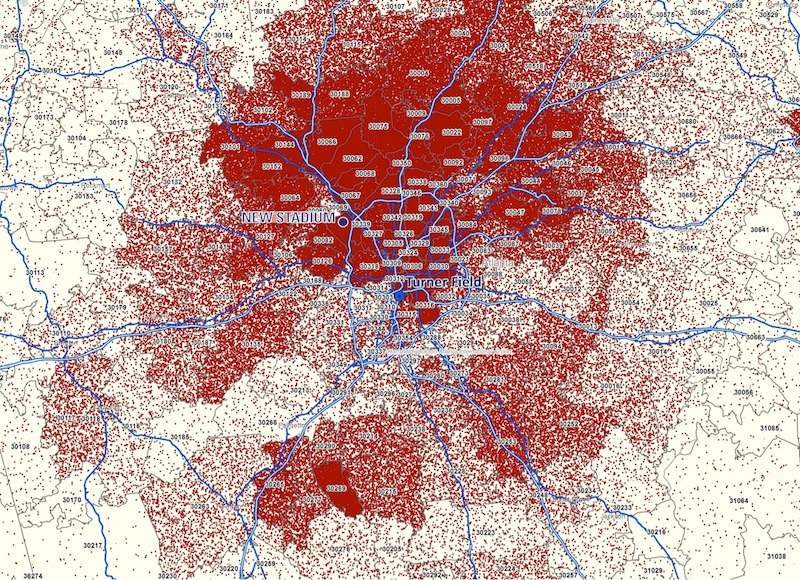
Turns out that today the Braves announced plans to move to suburban Cobb County, just on the outside of the Perimeter (I-285). Historically, the suburbs north of Atlanta are where most of the fan base is located, so the Braves are strategically making the move to be closer to them. Attendance at Turner Field started with four straight seasons with over 3 million fans. Since then attendance has hovered around 2.5 million. That’s good, but the Braves’ brass think they can do better.

Map of locations of ticket purchasers for Braves games

Map of locations of ticket purchasers for Braves games

According to the Braves’ new stadium website, Turner field has $150 million in infrastructure improvements that would be needed, yet aren’t enough to enhance the fan experience. Those additional improvements would make the project cost rise above $200 million.

On the other hand, the new stadium would cost $672 million to construct. The 60 acres of land on which the ballpark would sit has been “secured” according to the Braves. Cobb County would invest $450 million in the stadium, while the Braves would put in $200 million at the start and be responsible for cost overruns. The Braves would be the lead developer for the ancillary “ballpark village” adjacent to the stadium.

This announced move follows a string of other regional defections. Three performing arts organizations (Atlanta Ballet, Atlanta Opera, Atlanta Lyric Theatre) have already moved to or are in the process of moving to Cobb County, not far from the Braves’ planned stadium site.

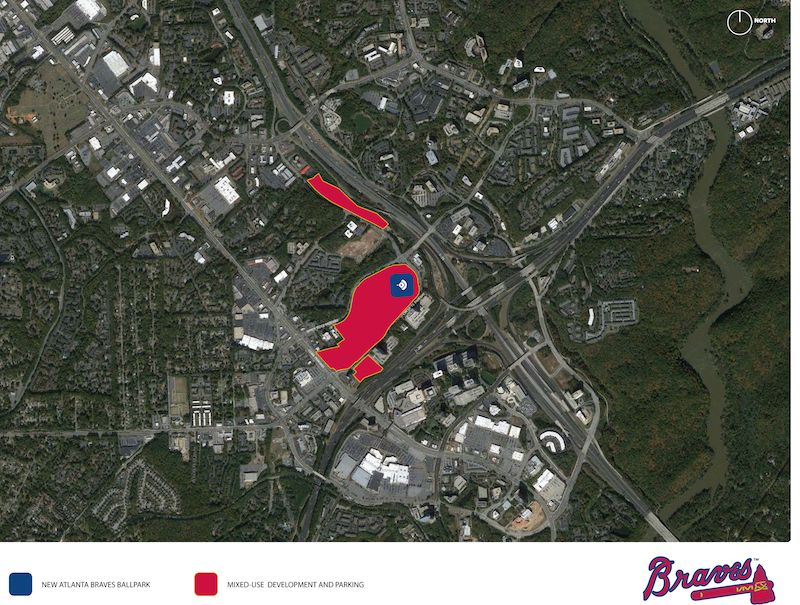
Braves ballpark site is in the Cumberland near the I-75/I-285 junction in Cobb County

Braves ballpark site is in the Cumberland near the I-75/I-285 junction in Cobb County

White flight? Follow the money? Yes and yes. As outrageous as this announcement and the Falcons’ plans are to replace fairly new, modern stadia, if they can sucker partner with some municipality to foot the bill for a move, they’re going to do it every time.

Should the Braves be successful in their move, it would mark the first urban-to-suburban franchise move since 1973, when the Royals left temporary home Municipal Stadium for the Harry S. Truman Sports Complex, a similar distance away from Kansas City’s downtown core as the Braves’ site is from downtown Atlanta.  The team plans to start play at the new ballpark in 2017. The current lease at Turner Field ends in 2016.

2014 A’s Spring Training schedule released

As the hubbub and posturing over the Coliseum lease subsides, today we got some good news: the A’s spring training schedule has been released! It’s a momentous spring, too, since it’ll be the last at venerable Phoenix Municipal Stadium before the A’s move 10 miles east to Hohokam Stadium in Mesa. Hohokam is vacant in 2014 as crews make changes to accommodate the A’s after the departure of the Cubs.

Speaking of the Cubs, they’re set to open their Wrigleyville West, also in Mesa, in 2014. That’ll be worth checking out. The A’s play only one split-squad game at the Cubs’ yet-unnamed ballpark on March 5. Even if you miss that, don’t fret because the great thing about the Cactus League is that all of the parks are within a reasonable driving distance of each other. While there’s no neat sideshow like the World Baseball Classic in 2014, there’s still plenty to watch.

If you’re interested in visiting, remember that the A’s work out at the ballfields at Papago Park, which is nearly 2 miles north on the other side of the park from Muni. One thing I’ve never done is walk from Papago (where minor league camp games are held) to Muni, so I might do that this year.

2014_spring_training

Oakland Athletics 2014 Cactus League Schedule (last 3 games are Bay Bridge series). All times Pacific.

Looking to check out several Cactus League ballparks? Consider that the 10 parks are set up in two clusters of five, to the west and east of downtown Phoenix. The east cluster, which Phoenix Muni is part of, is less spread out than the west cluster. Best to divide and conquer.

I’m targeting the 4-day weekend of March 13 through 16. The A’s play a rare night game at Muni. If I get there in the morning I can take in a game nearby in the afternoon before heading to Muni. There’s also a split-squad opportunity on Sunday the 16th, starting with a game in Muni and ending with the A’s taking on the Giants in Scottsdale.

There’s no league wide schedule available yet, as the teams are given the responsibility to arrange their schedules among themselves and publish when they’re ready. At this early stage, only a handful of teams such as the A’s and Giants have published theirs. Soon I’ll get all of them and put together a grid, the same way I did for the regular season.

One last note – keep in mind that Daylight Savings Time goes into effect on March 9, about two weeks into the schedule. That means all games before March 9 are an hour ahead of the Pacific time zone. From March 9 forward, games in Arizona are at the same time as California because Arizona doesn’t observe DST. The schedule shown is in Pacific time. If you’re planning to attend a game before March 9 and are traveling the same day, remember the time change.

In case you’re wondering who wears the pants in this house…

… it’s Major League Baseball.

The fallout started early this morning, when KTVU reached out to the A’s to get their reaction to MLB’s threat to move the A’s to AT&T Park.

Statement from the A's via KTVU at 8:30 AM Monday.

Statement from the A’s via KTVU on Monday morning

That was followed by AP sports scribe Janie McCauley reporting something similar, but without the weaselly-sounding “intend to” in it. Included was a statement from the Coliseum Authority (JPA):

“We are working on a deal that we believe will be beneficial for both our tenant and the people of this community,” the statement said. “We are confident that everyone involved sees the value in continuing for as long as possible the 45-year relationship between the A’s and the City of Oakland. While we cannot comment on the specific issues now under discussion or on whether there is any basis to recent rumors that Major League Baseball has played a role in the discussions, we are optimistic that a final deal is close at hand.”

Later, BANG’s Matthew Artz dug deeper, picking up more sentiment from East Bay pols.

Sources with knowledge of the Coliseum authority’s private deliberations Friday said there was movement toward softening its stance that the A’s relinquish control over concessions and signage revenue at O.co Coliseum, which comes at the expense of the Raiders.

“The key point is that the authority wants the A’s to stay in Oakland and is not willing to risk losing them over that issue,” said one source privy to the discussions.

Then Mark Purdy got into the JPA’s thinking in holding out over the extension:

Naturally, the A’s balked at the Coliseum’s original terms for a longer lease. Miley and his fellow board members reportedly held firm, believing that the A’s had no other options but to play at O.co in 2014. And at that point, MLB voices tossed out the concept of the A’s playing temporarily at AT&T Park until a new ballpark project could be developed elsewhere.

Also, don’t forget that the JPA hasn’t exactly shown a lot of urgency on behalf of the A’s. Consider what JPA board member and Oakland City Councilmember Rebecca Kaplan said a month ago:

And the six- to eight-year window should give Oakland plenty of time to get serious about building a replacement ballpark and luring the A’s to stay, Kaplan said.

You have to think that Selig’s threat action was motivated by this rather cavalier attitude towards the A’s.

It certainly appears that all that remains is for the A’s and JPA to make certain compromises and finalize the terms. One of the chief issues will be the $3 million in parking fees the A’s owe the JPA. A good compromise would be for the A’s to pay that money, which the JPA would turn around and use for the belated scoreboard revamp and other capital improvements. And the A’s should get that flexibility they’re seeking.

Concessions revenue is another matter. The A’s could retain control with their own cut of each beer or hot dog (this was originally negotiated when the A’s settled a lawsuit with the JPA after Mt. Davis was built). But how would the Raiders and Mark Davis react? Unlike the A’s, who are continuously profitable, the Raiders frequently flirt with the red – a seemingly impossible feat given the NFL’s extensive revenue sharing and TV contracts. Much of that is due to cap mismanagement during the Al Davis era. Some of that is attributable to lacking stadium revenues, especially concessions.  It seems unlikely that Mark Davis will bolt just because of maintaining the status quo, but he could also choose to build a case for leaving based on this. He and the NFL have been pushing the JPA on the Raiders’ own extension, Davis going so far as to prefer to demolish and build anew at the site of the current Coliseum. Such a plan would force the A’s out, a possibility that Lew Wolff has been rightly concerned about. MLB’s involvement has pushed the pendulum in the A’s direction.

It’s cruel that the NFL and MLB are (not so) stealthily playing tug-of-war with the JPA over the Coliseum. As the Giants would say regarding sharing AT&T Park or giving up territorial rights to the South Bay, It’s not personal, it’s business.

As for AT&T Park? Who knows, that threat may resurface down the road.

MLB breaks out stadium negotiating playbook in Coliseum lease talks

Last week I received a flyer from the A’s urging me to get my season ticket plans wrapped up soon, as early as mid-November. Thanks to a Sunday report from Matier & Ross about MLB’s entree into the Coliseum lease discussions, I expect the A’s Ticket Services department to get a lot of angry, misdirected phone calls starting tomorrow morning. And I feel bad for them for having to deal with it.

The fact is that until recently, MLB has stayed out of the lease negotiations at Lew Wolff’s behest. As the lease comes closer to expiring with the two sides still far apart on the terms, baseball has decided to start playing the heavy. As we’ve seen in Miami and many other cities, MLB doesn’t play nice. That doesn’t mean that they’re going to start asking for hundreds of millions for a ballpark. Instead they’re playing the leverage game, threatening to move the A’s across the bay to AT&T Park if the Coliseum Authority won’t relent.

We’re told MLB is also demanding that the Coliseum give the A’s just a two-year lease extension – not the five- to eight-year deal the authority has been pushing.

The short-term lease would give the A’s more flexibility should the team’s owners swing a deal to move to San Jose – or beyond.

Let’s be clear about one thing: this is not MLB’s preferred option. They’d rather have the A’s and Giants play in their own ballparks, because getting them to share is messy when it comes to logistics, scheduling, and revenue sharing. While sharing has happened in the past, it hasn’t happened in almost 40 years. Plus the last thing MLB would want is to have a situation where the experiment goes so well that the Bay Area populace is convinced that there’s no need for two parks, or that the A’s seriously eat into the Giants’ revenue. Just as in other stadium negotiations, MLB has never been afraid to rattle sabers when it feels it can work to the benefit of one of its franchises. From this point forward, don’t expect anything less. Chances are that the JPA will buckle, because they know that the A’s tentatively playing away from Oakland can easily transform into the A’s permanently playing away from Oakland. From MLB’s standpoint, this is a question of loyalty. Oakland and Alameda County shown repeatedly that they’re willing to spend money and make things work for the Raiders. They have also demonstrated that they’ve been willing to move the A’s (and MLB) to the back burner at the most inopportune times. If the JPA doesn’t make concessions for the A’s, that’s just more proof that they aren’t truly willing to make the A’s a priority, which would make MLB less motivated to back Oakland’s efforts to forge a long-term deal. Raiders owner Mark Davis seems to prefer that they start working on a replacement Coliseum on the site of a demolished Coliseum, which if granted would leave the A’s without a place to play. Without a lease extension tied to a well-developed stadium plan, the Raiders would prefer to go year-to-year. The A’s would like to do a five-year deal with early termination if they’re impacted by construction of a new Raiders stadium. The challenge for the JPA is to put together a deal that caters to MLB’s needs while not jeopardizing their relationship with the Raiders and the NFL.

For the time being, Giants chief Larry Baer has stayed silent, probably at Bud Selig’s request. To say they wouldn’t accommodate the A’s would torpedo baseball’s plans and leverage, the same way Wally Haas and then-AL President Bobby Brown rejected Bob Lurie’s plans to share the Coliseum while SF figured out a downtown ballpark plan. That occurred in 1985. Now that MLB is a singular governing body with less stated conflict between the two constituent leagues, the Commissioner has the ability and power to influence the Giants. However, Selig’s track record has been to stall regarding the A’s for nearly five years. Now that a “manufactured” crisis may arise, could Selig be more inclined to come up a with a solution? I’m not holding my breath.

Logistically, sharing the stadium could be difficult for the teams. Naturally there are only two clubhouses at AT&T Park, unlike the more flexible setups at many arenas and new football stadia. The visiting clubhouse would have to be converted into the A’s temporary home while the Giants’ clubhouse would be used for A’s home opponents. There are also 10 potential date conflicts (not 9 as M&R reported): May 12-14, May 26-28, June 13-15, and July 3. That last date is the end of a Giants homestand and the beginning of an A’s homestand. Offloading those conflicts to Raley Field would be difficult because the River Cats already have the first two series and July 3 already booked at home. Day/night doubleheaders would be difficult to make work because of game days can easily stretch beyond eight hours for players and personnel because of warmup/reporting times.

Then there’s also the appeal for AT&T and the various other sponsors in China Basin. AT&T would undoubtedly love double the home dates and exposure. So would Virgin America, Intel, and ironically, GAP competitor Levi Strauss. That and many more subjects (concessions shares, non-game event revenue, ticket pricing) would be up for debate. In the end, the A’s would pay a handsome rent payment and surrender a big chunk of non-ticket revenues. Both teams would deduct stadium expenses against their revenue sharing payments. One way to look at is that the A’s rent would effectively be a rebate against the Giants’ revenue sharing payment – assuming it was structured to fit within the CBA appropriately. Selig doesn’t seem inclined to force the Giants to share, but he can work with the rest of the owners to make it worth the Giants’ while.

Already I’ve seen a lot of anger from fans swearing that they’d never see an A’s home game in SF, or that they’ll cancel their season tickets posthaste. There’s another angle to consider if the A’s were given this two-year window at AT&T Park. The A’s have never called a modern ballpark home, so any serious revenue-generating potential at a new ballpark remains theoretical at best. What if the window was MLB’s opportunity to prove (or disprove) the A’s viability as the second team in the Bay Area? It’s not the same as having a new ballpark to themselves, but the better amenities and location should be attractive to many fans and companies that  normally don’t attend A’s games en masse. After all, the city with the most ticket-buying A’s fans (number, not percentage) is San Francisco, not Oakland or San Jose. If the two-year window fails to positively affect the A’s bottom line, The Lodge may be more inclined to allow the team to move out of the Bay Area. While M&R hinted at a move as a product of failed stadium plans, I think this could be a bigger reason.

MLB has entered the fray, and they’re getting ready to lay down the hammer. For that we can thank A’s and Giants ownership for their stubbornness, Oakland and Alameda County politicians for their lack of urgency, and Bud Selig for not resolving this sooner when he had all the time to do so. Unless a Coliseum lease gets struck in the next month, this is only going to get uglier. A “silly” idea like sharing AT&T Park may turn into something quite sensible. The big issue looming is the endgame, which as Ray Ratto points out, is the can that gets kicked down the road for two years.

Citi Field

The Turner Field review brought out a nice debate among the commenters about the ballparks of the NL East. Namely, which of the parks was least disappointing? Was it Turner, which is too large and not intimate? Nationals Park, which looks like an office building from the outside? Citizens Bank Park, which feels extremely contrived? Marlins Park, which feels a little too mall-like to be an authentic ballpark? Or Citi Field, Fred Wilpon’s attempt to bring the Dodgers back to the East Coast? Alas, my answer to that critical issue will have to come another day. For now I’ll just focus on the new park in Queens.

Jackie Robinson Rotunda from top of escalators

Jackie Robinson Rotunda from top of escalators

As much as the Mets are Wilpon’s team, Citi Field can easily be called The House that Bernie Madoff Built. By the time reports about Madoff’s Ponzi scheme surfaced in late 2008, the bulk of Citi Field had been built. With only a few months to go before the stadium opened, all that remained was some finishing work and to button up the ballpark. All of the expensive parts had been installed. Initial reports had Wilpon losing enough money that he’d have to sell the Mets. It turns out that Wilpon turned to Madoff to set up investment vehicles for various Mets employees. A lawsuit brought by defrauded Madoff investors sought as much as $300 million from Mets (legacy) ownership. They settled for $162 million. The extent of Wilpon’s and Howard Katz’s complicity will forever remain alleged, not proven. Which means that if there was any justice in the world, Wilpon should’ve been forced to sell the Mets.

Yet Wilpon remains, cutting payroll $40 million a year until debts are paid off, quashing hope among Mets fans. Even phenom pitcher Matt Harvey couldn’t escape the Wilpon taint, as his season was cut short in late August thanks to a bum elbow (he got Tommy John surgery last week). No matter, the Mets have a nice ballpark, right?

The thing is, they do have a pretty nice ballpark. Sure, the silly outfield dimensions had to be pulled in to encourage more offense. The Mets Hall of Fame was horrendously belated. At least it’s there, right next to the rotunda. Citi’s spacious, has good concessions and all of the amenities needed to bring in the big revenue when the team starts to contend again. The façade looks reminiscent of Ebbets Field (Wilpon’s obsession) from the outside. It looks nothing like Ebbets (AFAIK) from the inside. The rotunda is impeccable, yet feels somewhat removed from the concourses and the seating bowl.

citi-14-grandstand

Citi Field grandstand behind home plate

Look carefully at the picture above. How many glassed-in levels do you see? If you guessed five, you are correct. Behind the plate there are the very exclusive Sterling Suites. Above that is another suite level, then another suite level, then the press box, and finally the promenade club along the upper deck. Every new park provides another example of the stratification of moneyed fans. By this measure, Citi Field is among the worst offenders. That’s the kind of modern, business-driven compromise we’ve come to expect of new ballparks. There are mini rooftops behind the plate that could be perfect places for, oh I don’t know, seats? Just a thought.

Citi Field was built in the parking lot between Shea and the industrial wasteland of Willets Point, much the same way Great American Ball Park went up in the shadows of Riverfront Stadium in Cincinnati. Unlike Riverfront’s enclosed cookie cutter design, which required to have the outfield stands demolished to accommodate the new ballpark in a very tight fit, there was enough space for Citi Field in the lot. Another proposal to build a new form of multipurpose stadium for both the Mets and Jets came and went quickly, allowing then-mayor Rudy Giuliani to focus on separate ballparks for the Mets and Yankees while the football teams partnered up for MetLife Stadium in the Meadowlands. Building on the same site allowed the team to utilize existing infrastructure, which includes stations for the #7 subway, Long Island Rail Road, and proximity to the Grand Central Parkway, Van Wyck, and Long Island Expressways.

It’s telling that Citi underwent significant changes in its first two off seasons. Bullpens were moved around, the Mets Hall of Fame was added, and the fences were brought in last year. All that generates the feeling that the ballpark was the product of ticking features in a checklist, rather than designing the park holistically. Misgivings have only been magnified by the enormous amount of negative press surrounding the team and ownership. Over time this should subside, and what will remain is that Citi Field is a substantial improvement over Shea, albeit an extremely expensive one. Both Shea Stadium and Ebbets Field lasted 45 years for the Mets and Dodgers, respectively. Hopefully the Mets can get at least 45 years out of Citi Field.