No please, really, take your time Oakland

The Coliseum Authority released its agenda for the upcoming January 25th meeting. On the agenda is a procedural item of voting a new Chair and Vice-Chair. The other item, 6b, involves the following:

6b. Resolution of the Oakland Alameda County Coliseum Authority:
1. Waiving Competition and Authorizing Staff To Negotiate One or More Professional Services Contracts to Conduct

Studies for Site Planning and Development Scenarios, and to Create Estimates Of Building Budget And Profit And Loss Statements, For a Potential New Stadium and Related Development on Land Currently Owned By The Authority That Lies Within the Coliseum City Specific Plan Area, for a Total Amount Not To Exceed $500,000; and

2. Authorizing Staff To Competitively Procure and Negotiate One or More Professional Services Contracts to Conduct Studies of Revenue Potential and Market Demand From a Potential New Stadium and Related Development on Land Currently Owned By The Authority That Lies Within The Coliseum City Specific Plan Area, for a Total Amount Not To Exceed $500,000; and

3. Authorizing the Chair of the Oakland Alameda County Coliseum Authority to Execute Contracts for Services With Selected Consultants Without Returning to the Authority Board; and

4. Amending the Authority’s Budget to Allocate up to $1,000,000 in Available Oakland Alameda County Coliseum Authority Funding For These Purposes

Woah there, wait a second. Is the JPA really saying that it still has studies to complete? It needs to do financial projections and a development plan? And it’s executing this now without competitive bidding? You have got to be kidding me. This stuff was supposed to be done by now. Funding for Coliseum City was authorized in February 2010, almost three years ago. This is supposed to be the easy part.

Now, maybe the upshot is that the Raiders and JPA came to an agreement on a lease extension, allowing these funds to be freed up. But if anyone from the East Bay is looking for signs of progress soon, this certainly won’t help. At this rate the 49ers will have been at their Santa Clara stadium 7-10 years before anything gets built in Oakland. Also, note that the resolution says stadium in singular form. Will there be a two-stadium alternative, as some pols believe is the best option? Or are they talking about another multipurpose stadium? I can’t wait. Actually, I guess I can. I have no choice.

I suppose these “additional” studies can be completed by the end of the year. In a week full of unbelievable BS news in the sports world, this ranks up there, at least locally. Suspiciously, the JPA’s annual financials have not yet been released. They probably won’t show much in the way of funds spent on Coliseum City so far. This is so disappointing, and yet, par for the course. No wonder the Warriors plowed their own path. They can’t trust the JPA to make anything happen in a timely manner.

Two mayors, two different approaches

Some people are going to view this post as more piling on Oakland. It’s not. It’s a demonstration of what leadership is, and what it means to follow through. You’ve been warned.

—-

Many of the mayors throughout the country are in Washington this week to attend the US Conference of Mayors, where the big topic is gun violence and how to reduce it. The big fish at the event is Vice President Joe Biden, who President Obama tasked with developing a plan for gun control and other related initiatives.

In the face of increasing criticism over her effectiveness in handling the crime and murder rates in Oakland, Mayor Jean Quan left for the conference earlier this week. Her office says that she is “hoping to have conversations” on how to reduce the crime rate, which frankly, sounds like a bad excuse for taking a trip to DC for the inauguration. Maybe she’ll get some kind of commitment from someone in a federal capacity, but VP Biden’s team put together the plan and President Obama signed 23 executive orders without needing Quan to be in DC.

Also in DC for the conference is MC Hammer, who became an employee of the city’s Convention & Tourism Bureau last November. Hammer’s position is to promote tourism, which I have to imagine is a difficult sell when everyday there are headlines about one shooting or another. So there are two Oakland leaders in DC at the moment.

Now all of this would be little more than your typical Washington hobnobbing session if it weren’t for the actions of Sacramento Mayor Kevin Johnson, who abruptly canceled his trip to DC. Why would he cancel the trip even as he was scheduled to speak?

The things that KJ is referencing are his efforts to put together (in parallel) a competing ownership bid that would keep the Kings in Sacramento and an arena package that would be acceptable to David Stern and the NBA owners. KJ is working with a deadline of March 1st. Quan’s deadline for both the Raiders and A’s is effectively the end of the year, so she technically doesn’t have to act too swiftly. But it’s telling that while East and West Oakland are going to hell, Quan is in DC just a month after going to China. In both cases, she’s trying to find solutions, money, or both outside of the city. On the stadium front, Quan has created one task force or another and authorized money for a Coliseum City study which has not yet materialized. There isn’t much to show for Victory Court or Howard Terminal (so far) for that matter. Meanwhile, KJ is rallying forces in the Sacramento region to find a solution. It’s a stark contrast, and while there’s a good chance neither will be successful in the end due to circumstances beyond their control, it’s clear that there’s one mayor who’s trying, and another who’s simply asking for help and not actually doing much.

Then again, this is Quan’s last Twitter update (she’s more active on Facebook):

Welp.

FanFest 2013 SOLD OUT

If you were waiting to buy tickets to FanFest this week or by walkup, you’re out of luck. The event’s 10,000 tickets are sold out. Just as with the playoffs, fans shouldn’t take ticket availability for granted. You snooze, you lose.

Of course, the announcement will bring about the usual grousing about how anti-fan A’s ownership is and such. That ignores two big issues.

  • The Coliseum is unavailable because of a motocross event on Saturday the 26th. Most teams that have FanFest in their own ballparks use the field as a huge concourse and staging area. The A’s won’t have that luxury since the field will be a big pile of mud. That would force fans into aisles and concourses, and we know damn well how congested the lower concourse gets at times. I once took an out-of-town friend to the Giants’ FanFest in 2008, which was held at AT&T Park. The field was also unavailable there due to a motocross event. It was a less-than-ideal situation and had all the feel of a hard hat construction zone.
  • Oracle Arena’s concourses were very congested last year at FanFest. While some people chose to sit and watch interviews, most were on the main concourse, inside the lower club, or in line for autographs. The upper deck was blocked off (familiar story). I suppose that the A’s could’ve thrown an Eric Sogard autograph line up there. Would that really help things?

2012 FanFest

When putting on one-off events like FanFest, the biggest wildcard is the impact of a previous season’s success on attendance. The Giants were overwhelmed by the response at their 2011 FanFest, causing extremely long lines and waits for autographs and World Series trophy pictures. You want to bring in as many people as possible because you can sell tickets, but you also don’t to create a situation were the experience sucks for fans. Oracle Arena would be a perfectly fine venue if it had more expansive concourses like HP Pavilion or Staples Center. That wasn’t in the cards for the 1997 renovation.

Perhaps the A’s could’ve held FanFest at Jack London Square or another large public space. That’s fine, though personally I like having the clubhouse tour right there at the Coliseum/Arena. That’s not possible at JLS. Tell you what: Don Knauss and his people could’ve offered to sponsor FanFest by underwriting the cost to hold it at JLS, right next to their preferred Howard Terminal ballpark site. Oh well. Maybe next year.

A’s look to trade Papago for a Grotto

No, we’re not talking about the BatCave or the Playboy Mansion, but it’s a grotto of a sort. The City of Mesa has approved a memorandum of understanding between the City and the A’s that outlines the terms of the A’s move to Hohokam Stadium starting in 2015. (If you haven’t been to Hohokam or would like a visual refresh, this photo blog is a good start.)

Per the terms in the MOU, the A’s would stay at a renovated Hohokam for 20 years initially, though they have the chance to break the lease after the 15th year as long as they pay $1 million for each year they don’t stay. There are also two 5-year options the team can exercise after the 20-year term is up. Hohokam Mesa was the A’s spring training home from 1969-78, much of the era spent at a place near downtown known as Rendezvous Park. After spending a few years in Scottsdale, the A’s moved to Phoenix Municipal Stadium. The 2013 season marks the 30th spring training spent at Muni, with only one more before the move 8 miles east to Mesa. The Cubs were granted major improvements to Hohokam/Fitch in 1997.

At 12,500 (or 13,000) seats, Hohokam has arguably the largest capacity of any spring training ballpark, Cactus or Grapefruit League. That stands to reason because the home team has long been the Cubs, whose large, multigenerational, national fanbase and eager snowbirds regularly put up league-leading attendance figures. For the A’s some of that capacity won’t be needed, so some of the seating sections will be removed or reduced in size, to be replaced by more premium, revenue-generating facilities.
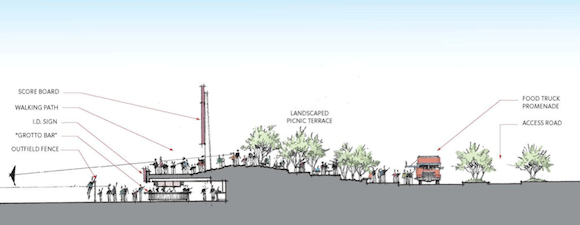
Renovated area beneath LF scoreboard includes “Grotto” bar at field level

Renovated area beneath LF scoreboard includes “Grotto” bar at field level

The biggest major change will be in left field, where the expansive berm will be significantly reduced if not altogether eliminated. Instead there will be two standing tiers, the lower one containing a dugout-like “Grotto bar”. This bar will be at field level, which means that the solid fence in left will be replaced by chain link to provide fans views from the bar. The upper tier leading up to the scoreboard is a smaller standing platform. Behind the scoreboard is a terraced picnic area leading down to a staging area for numerous food trucks. Though it’s not mentioned, I imagine that the scoreboard itself will receive some upgrades.
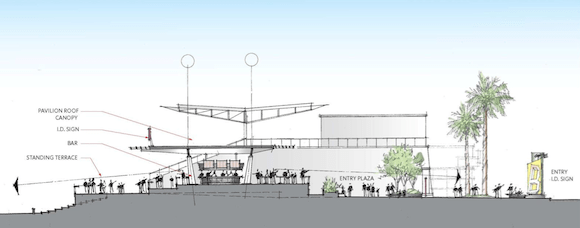
Down the LF line a set of bleachers will be replaced by a covered pavilion

Down the LF line a set of bleachers will be replaced by a covered pavilion

Another bar will take the place of a freestanding bleacher stand near the left field corner. It will be part of a covered pavilion whose standing terrace will replace several rows of seats down the line. The setup is very reminiscent of Raley Field’s beer garden, which is also down the left field line.

The drawings above are preliminary and are subject to change. They were the only two from the City Council presentation, with another slide devoted to changes at the nearby training facility, Fitch Park. Even with the reduced seating, I figure the capacity will be at or around 10,000, which would put Hohokam in the middle of the pack as far as the Cactus League goes. Unless the A’s make other changes, it appears that the other berm areas in center and right field will remain intact. Altogether, it’s a nice set of improvements from not only PHX Muni, but also from the current Hohokam. There will still be inexpensive and family-friendly options, along with more swanky facilities for fans. Fitch Park will get a clubhouse expansion. Even with the fairly restrained upgrades the A’s are getting compared to other teams with new spring training complexes, the Hohokam/Fitch combo will be superior to the Coliseum. There’s all sorts of just not right in that.

—-

The funding part is simple and straightforward. As we discussed two weeks ago, Mesa is paying for the first $15 million of the project. Mesa and the A’s split the cost from $15 million to $20 million, and the A’s will pay for the rest. What’s interesting about this is that the A’s aren’t paying any rent. For the three month period (January 15 to April 15) that the A’s occupy Hohokam/Fitch, they pull in and keep all revenues while paying for all costs. City controls revenue and pays for costs during the other nine months. Those costs include concessions, security, and parking personnel plus utilities. During spring training the A’s are responsible for repairs and maintenance inside the walls and fences so to speak, whereas City takes care of the surrounding grounds. Both sides are to contribute $25,000 annually to a capital improvements fund during the lease term, but that’s it as far as yearly obligations. Mesa has used a similar agreement for the Cubs for years.

Compare that to the now-dead lease extension agreement negotiated for PHX Muni. The A’s would’ve paid up to $500,000 per year plus a $50,000 capital improvements contribution through 2025. Assuming operating costs isn’t small potatoes, but it’s a preferable arrangement for any team since it has control over everything.

Why would the City of Mesa do the deal? City has been wanting to keep Hohokam/Fitch up-to-date even after the Cubs leave for nearby Riverview Park. They did a study to determine what the costs would be in three scenarios:

A: Do upgrades needed to make Hohokam/Fitch attractive for another team in the future, including teams currently in the Grapefruit League
B: Cease operating Hohokam/Fitch as a spring training facility and run it only as a public park
C: Do upgrades up to the A’s standards request
Turns out that the annual cost for Scenario C was $773,231, slightly more than half of Scenario B ($1,490,228) and slightly more than a third of the cost under Scenario A ($2,310,406). Those figures don’t include debt service on the $15-20 million of improvements. By that sort of limited perspective, having the A’s at Hohokam is better than the alternatives. It leaves one lingering question: Who’s paying for the $15-20 million?

Tourists and locals, that’s who. Funding for both Hohokam/Fitch and the Cubs’ $99 million Riverview Park (“Wrigleyvile West”) project will be covered by Mesa’s Enterprise Fund, which is essentially a big redevelopment fund bucket. Debt service is paid for by utility taxes on the 439,000 (bigger than Oakland) residents. Last year Mesa was able to refinance the existing fund debt, which could save Mesa up to $72 million over the next five years. Some money may also come from the Arizona Sports and Tourism Authority, the state-authorized body that boosted hotel and car rental taxes to help pay for numerous Cactus League ballparks and the market’s crown jewel, University of Phoenix Stadium.

While it’s not apples to apples, there may be some comparisons between the Hohokam/Fitch deal and whatever may be negotiated for the A’s at the Coliseum. Short of the Coliseum Authority giving the A’s an extension of the current deal and throwing in some improvements on top of that (fat chance), I can’t see how the A’s could get a better deal than what the team is getting in Mesa. Unless you’re the Cubs, that is. The Cubs are getting this:

Lew Wolff and Flip Maritz own a hotel in Mesa. Unfortunately for A’s fans, it’s 3.5 circuitous miles away from Hohokam. Luckily for Cubs fans and Maritz Wolff, the Hyatt Place is only a mile from Wrigleyville West, just off the top of the rendering above. I guess if Cubs fans are stuck with an eternally heartbreaking team, nice surroundings can provide some consolation.

=====

P.S. – If you’re going to the Valley of the Sun to catch some spring training action and you’re headed to Hohokam, you might want to check out the Mesa Historical Museum, which has an exhibition called “Play Ball: The Cactus League Experience“. The museum is located in downtown Mesa, 2 miles from Hohokam. Exhibits will include items and photos of the A’s first stay in Mesa.

Did anything happen at the owners’ meetings? January 2013 edition

Probably not. We’ll find out over the next couple of days, as the meetings kick off Wednesday. This quarter’s meetings are being held in Paradise Valley, AZ.

Absent any real news, here’s a musical interlude while you have your inevitable Hall of Fame water cooler discussion.

News for 1/8/13

The days are starting to get longer, and we’re five weeks from pitchers and catchers reporting. Huzzah.

  • The Alameda County Board of Supervisors is scheduled to meet in closed session today to talk about the Raiders’ lease. I wonder if they’ll also take up Lew Wolff’s recent request for an extension. [East Bay Citizen/Steven Tavares]
  • The Coliseum Authority hasn’t yet published its annual financials. In the past two years, that document has been available the first week of the year. Perhaps that will come out later today as well. The next open meeting is scheduled for 1/25.
  • The City of Oakland lost $3 million in previously used redevelopment funds to the state. That may cause a series of layoffs or other cuts. [SF Gate/Matthai Kuruvila]
  • Lew Wolff had a no-news interview in this week’s Silicon Valley Business Journal. (Note: “San Jose” has been dropped from publication title) [SV Business Journal/Greg Baumann]
  • Wolff’s real estate investment company Maritz Wolff sold another hotel last month. This time it was the Ritz Carlton in the St. Louis suburb of Clayton, MO. Price was not disclosed. In case you weren’t aware, Phil “Flip” Maritz, Wolff’s longtime partner, has a minority stake in the A’s. [St. Louis Post-Dispatch/Tim Bryant]
  • Dodgers ownership is said to be split on whether to partner up with Fox or Time Warner on a new RSN deal that could be worth upwards of $6 billion. [LA Times/Steve Dilbeck]
  • The Mets completed $450 million of desperately needed debt refinancing and got an infusion of $160 million that is expected to be used on day-to-day operations. The team now has $700 million in debt against the Mets’ network SNY alone. More analysis of the Mets’ financial picture here. [NY Times/Richard Sandomir | Capital New York/Howard Medgal]
  • Out of the fiscal cliff bill news was an item that aroused anger: $78 million in tax breaks for NASCAR racetracks. The crux of the deal is that track owners can accelerate writing off their investments in seven years as opposed to fifteen. [NY Times/Mary Pilon]
  • Virginia Beach Mayor Will Sessoms’ deadline seemed to come and go without an arena deal. He is expected to make a statement later today. Update 8:00 AM – Sessoms has declared the project dead for now as the city will not go to the state General Assembly to request $150 million in arena funding. [WAVY-10/Mila Mimica, Virginian-Pilot, Aaron Applegate]
  • San Diego power players including Steve Cushman are turning their attention to either a new or revamped Qualcomm Stadium at the current Mission Valley site. The new vision looks a lot like the Coliseum City plan, but with a large residential component. I think they could accomplish quite a bit at Qualcomm just by demolishing and rebuilding only the lower deck. [San Diego Union Tribune]
  • Talks are heating up to bring the Washington Redskins back to the District from the Maryland suburbs. There’s supposedly no public money to draw from as the District is running up against its own debt ceiling. That doesn’t mean someone couldn’t hatch his own Coliseum City plan at RFK. An idea being discussed is the sale of the Brutalist headquarters of the FBI, moving the Bureau out to the FedEx Field site, then taking the proceeds of land sales and development proceeds to build the new stadium at RFK. One of the people leading the charge: Marion Barry, who is on the DC City Council. [Washington Post/Tim Craig]
  • The Merc Editorial Board laments the true victims of the dysfunctional relationship between the NHL and its players, the businesses and workers near HP Pavilion. [SJ Mercury News]

More as it comes.

Comparison of current (2013) CBAs

A few years ago I did a comparison of CBAs. Now that the NHL deal framework is in place, it’s time to update the table. Here’s what we have now.

MLB remains the only major pro sports league in the US/Canada that has no salary cap.

MLB remains the only major pro sports league in the US/Canada that has no salary cap. NHL cap and NBA salary floor figures are for 2013-14 season.

The untold story is league debt. The NFL is far and away the richest league, but it also has a massive amount of debt. In 2008 that figure was $9.5 billion and has only grown with the expensive new stadia in New Jersey, Arlington, and Santa Clara. MLB’s credit facility, which is meant as a short-term solution for teams, had $1 billion going into this summer and issued $300 million more since then. None of the leagues are in jeopardy because of their respective debt positions because in most cases, that debt is backed by long term TV deals. Individual teams are at greater risk due to the lack of revenue stability in weaker markets, which is frequently the case in the NHL.

Luxury tax structures implemented in MLB and the NBA have worked to reign in many free-spending teams. The NY Knicks are under the NBA’s luxury tax threshold for the first time in recent memory, and the Yankees are set to follow suit in baseball.

All of this goes to show that for all of the talk of economic parity in pro sports, there are instances of haves and have-nots everywhere. It’s unavoidable, and thanks to CBAs that will run for as long as a decade, it’s enshrined. Cheers!

Bringing in the fences

In an effort to get their struggling teams to hit more home runs, the Seattle Mariners and San Diego Padres early during the offseason that they are pulling in fences in their respective ballparks. Whether or not this will actually work is up for considerable debate. Field dimensions are only one factor of many that influence a team’s HR total. As of the end of the 2012 season, we even have evidence from team that moved in fences last year, the New York Mets. In 2011, the Mets hit 50 HR at home. How many did they hit in 2012? 50.

None of the West Coast ballparks have changed their dimensions in the last decade, which allows for an nice comparison. Over the last nine years (since Petco Park opened), the numbers of HR hit by the home team and visiting teams per park have varied greatly per ballpark.

Home Runs hit in West Coast ballparks. H: Home team, V: Visiting team. Bold: First, Italics: Last

Home Runs hit in West Coast ballparks. H: Home team, V: Visiting team. Bold: First, Italics: Last

All West Coast ballparks have been historically considered pitcher friendly or neutral at best. What’s surprising is the lack of consistency from year to year for most teams. The A’s were the most consistent when it comes to giving up jacks at the Coliseum, but vary wildly from one year to the next, with the power figures acting as a leading indicator for team success. While the Padres have tracked similarly to the A’s recently, the Mariners have been straight up bad for nearly a decade. They lead the WC in HR given up at home in four of the nine years, while sustaining a gap of -139 HR hit vs. given up. The A’s are a net-positive (653 for vs. 614 against) at the Coliseum, thanks to 2012’s power surge.

No discussion of home runs on the West Coast can be had without a frank discussion of the dreaded marine layer. What we call our natural air conditioning (thanks California Current!) acts as a wet blanket for sluggers, who have frequently found the dense, moist air challenging for hitting bombs. The LA ballparks are less impacted because of their slightly inland locales, but during the April/May/September months they can be just as tough as the conditions at their counterparts to the north (and San Diego).

climate-westcoast1

Average high and low temperatures during baseball season

As for the actual field dimensions, well, we’ll just have to wait and see about that. Adjustments at Safeco Field are slight, with the biggest change happening in deep left-center.

safeco

Changes at Safeco Field are welcome, though not particularly severe.

After spending a month in San Diego in April/May, I echoed the same sentiment as everyone else that has been to Petco: It’s too big in right. No secret there. The park should play much more neutral now.

petco

At Petco, the terribly deep right field has been tamed, though right-center remains among the deepest in MLB.

In this new “dead ball” era, the real problem for the M’s and Friars is one of personnel, not fences. The M’s have a number of guys who could hit 25-30 HR annually in the near future, but they desperately need someone – anyone – to hit at least 10-12 at home. The leading basher at home was Michael Saunders with 8. Maybe the new fences will garner some badly needed confidence. What would probably help the M’s more is Giancarlo Stanton. As for the Padres, things may only get worse if Chase Headley is traded as expected before or during the season. Headley led the Pads with 12 HR at home, while no one else other than Carlos Quentin had more than 5. With the team expected to finish 4th or last in the NL West, the HR total could drop despite the dimension changes. The A’s have frequently sought out power via low-risk (financially), high-reward veterans at the end of their careers. The M’s signed Raul Ibanez and traded for Kendrys Morales, which should help with the HR numbers combined with the drawn in fences. And if you’re Brandon Moss and Josh Reddick, you have to like your chances in Seattle a little more too.

News for the End of 2012

It’s a light end of the year newswise, yet there are enough nuggets to put together a post.

  • The A’s are getting closer to a deal to play at Hohokam Stadium, the current spring training home of the Cubs. An announcement is expected to be made in January. The City of Mesa will contribute at least $15 million of the $20 million cost of renovations to Hohokam and Fitch Park, with the team and city splitting costs between $15 million and $20 million and then the A’s paying for the rest. When the announcement is made, I’ll devote a post or two to the transition and the differences between Hohokam and Phoenix Muni. [Arizona Republic/Gary Nelson]
  • For the two spring training games being held at the Alamodome at the end of March, no lower deck ticket can be had for less than $35 (plus Ticketmaster fees, natch). If you have time, watch the Alamo Bowl today and imagine what a baseball game would look like in there. Consider that the first row down the third base line will be several feet above the field.
  • Minnesota’s Hennepin County and the District of Columbia have pulled in greater tax revenues than expected for their respective ballparks. In Washington, city leaders have chosen in the past to pay for other budget items, whereas in Minneapolis they’re paying off ballpark debt early. In the case of Target Field, ballpark debt could be retired 5-10 years early – at long as the Twin Cities doesn’t turn into Detroit or Cleveland in the next decade. Or Cincinnati for that matter. [Minneapolis Star-Tribune/Rochelle Olson | Washington Times/Tom Howell Jr.]
  • Maury Brown estimates that revenue sharing for the 2012 MLB season is around $400 million. If you look at the history of teams and their relative financial status, there are usually 10-12 who constantly are on the receiving (welfare) end, including the A’s towards the higher end. By that measure, I figure that the A’s check for this year has to be in the $40-45 million range. [Biz of Baseball/Maury Brown]
  • AT&T Park is the #1 ballpark in America when it comes to Facebook and foursquare check-ins. What about the Oakland Coliseum? I mean, Oakland-Alameda County Coliseum? I mean, Oakland Stadium? I mean, O.co Coliseum? Um, nevermind. [ESPN/Bill Speros]
  • Take time to read @muppet151‘s request for the Victory Court EIR. It is on point. [TwitLonger]
  • Honestly, I should add an “Oakland dog park” item to the counter. This is laughably ridiculous. [SF Chronicle/Matthai Kuruvila]
  • If you’re not working or too hungover, head to the Exploratorium on Wednesday. That’s the last day in the wonderful Palace of Fine Arts location before it moves to Pier 15. It’s also FREE.
  • The NHL and NHLPA had conference calls to set up further talks. They’re running neck-and-neck with Congress for the most dysfuctional situation right now. Here’s the current NHL proposal. [ESPN/Katie Strang]
  • The Maloofs continue to say that they won’t sell the Kings, but privately say that they would sell for $500 million. [USA Today/Sam Amick]

Unless something major happens, this is the last post of the year. See you on the other side. Until then, have a safe and happy New Year.

Suggestion: Buy Used

Part of the game in the world of new stadia is the stadium improvements fund. It’s a set aside of stadium revenues from the partnership of team and city/county that is used to fix plumbing, lights, and seats. It’s also used in many cases to change other non-critical items that become obsolete over time, so that the partners can keep up with competitive venues and enhance fan experience. By enshrining the terms in a lease agreement, both sides can set proper expectations about what kind of maintenance and upgrades a venue will get over the short and long term.

To that end, the NFL stadia in Denver and Houston are getting fancy new LED displays as part of a $30 million audiovisual makeover. This makes sense both stadia are at least a decade old and display technology has advanced rapidly over the last several years. In Denver, the horseshoe shape at Sports Authority Field at Mile High means there are three boards of different sizes: one big board (27′ x 96′) on the open south end and two half-size boards in the north corners of the upper bowl. SAF@MH also lacks ribbon fascia boards, so one or two levels of LEDs are in the works there. Both the big displays and fascia boards will be capable of HD.

At least Denver’s displays are LED-based. Houston’s Reliant Stadium uses old CRT technology (like the Coliseum) and is finally moving into the 21st century with fully digital LED displays from Mitsubishi. The new displays will replace the old mix of incandescent, CRT, and static displays tucked under the stadium roof. When completed, each one will measure 52.5′ x 277′, officially longer and bigger than the center-hung boards at Cowboys Stadium (also built by Mitsubishi). Since the display is so long, only a portion of it will be used for replays, unlike Cowboys Stadium’s 16 x 9 boards. Despite that limitation, the new displays promise greater presentation flexibility for in-game information, video, and ads.

Compare that to what Raiders and A’s fans continue to live with at the Coliseum, and it starts to get depressing. Better than telling you, I’d rather show you via an infographic by reddit user dbeat.

nfl_scoreboard_sizes

Comparison of video displays in NFL stadia. Reliant Stadium’s new board will soon be the biggest. Denver’s is mid-sized. The Coliseum’s are among the smallest.

With the sad state of displays at the Coliseum and the cycle of change elsewhere, I got to thinking, What happens with the old displays? I’ve sent an inquiry into Denver’s Metropolitan Football Stadium District to find out (I’ll update here if I do). Some displays end up getting donated. Do they also get resold? LED lifespan is 50,000 hours, so unless you’re going for greater resolution the displays themselves should last the life of the stadium. Over 12 years at SAF@MH, it’s likely that the scoreboards were used only 500-1,000 hours per year.

Old displays at Denver stadium

Old display at Denver stadium

Denver would seem a prime candidate to get the scoreboards at a very good price. Why hated AFC West rival Denver? There are a few convenient reasons.

  • If the two north boards are put together into one board, the result is that each of the boards (north/south) measure 27′ x 96′. That would fit very nicely into the Coliseum’s existing scoreboard frames, which are about 40′ x 140′ not including the arched caps. Whether they’re each used as one contiguous display or split into two, it can work well while retaining static signage panels that currently populate the surround.
  • Since the both the Coliseum’s and SAF@MH’s old displays were manufactured by Mitsubishi’s Diamond Vision unit, it stands to reason that there will be some degree of interoperability.
  • Both the A’s and Raiders would welcome additional advertising opportunities on crisper displays.
  • SAF@MH’s monochrome scoreboards are also being replaced and even those would be an upgrade on what the Coliseum has.
  • As a secondhand product, the displays could be acquired at a significant discount, perhaps $1 million or less.
  • If the Coliseum is to be used for only 5-6 more years, it makes little sense to spend tens of millions on new displays.
coli-scoreboard_twilight-cropped

Current CRT video board and scoreboard system at the Coliseum

Seems like a decent idea, right? The difficulty comes when working among the Coliseum Authority, the Raiders, and the A’s. It would make sense to put something like this into a five year capital improvements plan. How it gets paid for, and how new revenues get divided, is the tough part. Divvying up signage revenue has long been a sticking point in the relationship, with the A’s getting the lion’s share of in-stadium revenue since the 1995 renovation. With all leases expiring, there’s a chance at a clean slate in negotiations. Would Lew Wolff forego an A’s-tilted ad revenue deal in order to get five fairly hassle-free years and opt-outs on a lease extension? Sounds like a deal point to me. It’s just a suggestion.