The illusion of pendulum swings

There’s been a wide range of reaction from Bud Selig’s non-update yesterday.

  • Gwen Knapp: “No decision means ‘no’ to the A’s. They aren’t getting the rights to San Jose, not yet, not soon, not even over Larry Baer’s stone-cold corpse.”
  • Mark Purdy: “And no action was taken — although Wolff’s quotes do indicate the blue-ribbon panel’s findings back up his contention that none of the Oakland stadium ‘proposals’ amount to anything.” (Purdy also brought up a potential antitrust case on KNBR.)
  • Ray Ratto: “So [the owners] see no compelling reason to hurry toward a decision they don’t want to make anyway.”
  • Art Spander: “The solution to all this is for Wolff, who wants nothing to do with authorities and business people in Oakland, a place he doesn’t live, to reach a compromise.”
  • Robert Gammon: “…it seems clear that the Giants’ presentation was more persuasive and that the rest of the league has no intention of overruling the Giants’ opposition to the A’s move.”
  • Jon Heyman: “Some progress is seen in that a significant amount of discussion is being dedicated to the A’s to the point where the talk has moved from committees to baseball’s Executive Council.”
  • Buster Olney: “The time has come for Oakland Athletics owner Lew Wolff to start firing off lawsuits in effort to move to San Jose — or sell the team.”
  • Ken Rosenthal: “Do not get distracted by any of this. The A’s focus is still on San Jose. The focus of the entire sport is on how the A’s can get to San Jose.”
All of that came from a few rather innocuous quotes from Bud Selig. At this point it doesn’t matter what Selig did or didn’t say – the quotes have been twisted so completely that anyone can weave their own “truth” from owners meetings.

Here’s what we knew going into the meetings:

  • There would be no official action taken on T-rights.

That’s it. Both the A’s and Giants made presentations, which some believe is encouraging and some don’t. Former Giants managing partner Bill Neukom was present at the meetings, presumably to plead the Giants’ case. It seems likely that both teams will continue to make presentations at future owners meetings until a decision is made.

The decision thing is the issue. The sad truth of the matter is that MLB doesn’t have to decide anything anytime soon, just as Lew Wolff doesn’t have to sell the team anytime soon. The A’s will stay afloat via revenue sharing through the end of the CBA, and as long as Wolff and Billy Beane don’t get out in front of their skis in terms of payroll, the team should continue to make money. In that short-term vein, the “best interests of baseball” may be to keep the status quo. You could easily say that Selig is kicking the can down the road, where his eventual successor will have to resolve the dispute. You might also say that the tossed off comment about moving outside the Bay Area is strategic one meant to incite at least a little panic. That may have worked in Miami and Minneapolis, but it’s not going to work here. It never has.

Eventually that short-term position will end and be replaced by a long-term, permanent solution. That’s when some kind of decision will have to be made. Unfortunately for us A’s fans, we have no idea when that might happen. There’s certainly no urgency on the matter. Maybe MLB is waiting for the Giants to retire debt, though the prospect of the team refinancing some of the remaining debt creates a gray area in its own right. The post-redevelopment world hasn’t shaken out yet, and won’t for at least several months.

Until some of these variables settle, it’s in baseball’s best interests to keep both Oakland and San Jose in play. For Selig to kill either option would be poor strategy on his part. San Jose boosters and politicians may be frustrated, but at least the city has most of its pieces in place. Oakland is finally getting some momentum thanks to Don Knauss, though it’s too early to tell if that momentum is real and sustainable. As long as a decision isn’t made on San Jose that shuts out Oakland, another lease extension at the Coliseum can be negotiated. This vague flexibility even opens up the possibility that Fremont could re-enter the picture, perhaps as soon as the next elected mayor takes office in 2013.

The wildcard here would be if San Jose decides to unleash the legal hounds. Again, this is where I think Selig’s M.O. comes into play. As long as Selig can say, “We’re still studying this,” there’s no specific decision to point to that San Jose can build an antitrust case around. Sure, they can make threats, but until someone files a case it won’t mean much.

Until then, what we’ve got here is a Mexican standoff. How do those usually turn out?

Update from May 2012 Owners Meetings

Piping hot updates from Fox Sports’ Ken Rosenthal and Sports Business Journal’s Eric Fisher. First Rosenthal:

;

Now Fisher:

In sum, no news, they’re still working on it and it may take longer to get right.

Selig deserves a lot of criticism for not being more decisive on this matter, but he is absolutely right about the issue being very complicated. Then again, he gets paid $18 million a year to run baseball. It’s his job to deal with complicated issues.

Update 11:26 AM – The media AP is running with the “move out of Oakland” story.

Update 11:47 AM – For added context, a Jon Heyman article yesterday had Bill Neukom at the meetings this week. The fact that he’s still representing the Giants indicates that he’s still the lead for the team on the T-rights issue. Like it or not, he casts a shadow.

Update 2:44 PM – As predicted in the comments, Lew Wolff had to clean up Bud Selig’s mess.

“Number one, my only objective is to remain in the Bay Area,” A’s owner Lew Wolff said Thursday. “And based on all our studies, plus receiving no indication from the blue-ribbon committee that we missed anything, the only location we can find to build a ballpark that’s do-able is in downtown San Jose. I intend to do that. And we intend to invest half a billion dollars in private funds to do so.”

Cleaning up Selig’s mess. That’s what a fraternity brother is for.

Back to the Futura

The day began with a 5:15 alarm. Not used to the early wakeup time, I spent the next ten minutes in a daze. The dog started licking my feet, a habit she does whenever she wants a walk, so I was up shortly thereafter.

Behind home plate. The logo is repainted daily.

Dog walked and fed and myself showered and dressed, I hopped in the truck to drive 40 minutes to Oceanside, where I was to catch the Metrolink train going all the way to Los Angeles Union Station. For those that don’t know, Metrolink is a diesel commuter rail service much like the Bay Area’s Caltrain, except that it has multiple lines that venture out to Ventura, Lancaster, San Bernardino, Riverside, and Oceanside, at the north end of San Diego County. One way trip price: $14.50. I was afraid of getting stuck and stressed in the normal weekday LA traffic, so rising early was worth it. Other than a brief delay to allow a late BNSF freight train to pass, the ride was smooth and uneventful.

After a little breakfast a few blocks away from the station, I set out to take public transit to Dodger Stadium so that I could catch the 10 AM tour. That’s right, public transit. There’s been a little talk about the Dodger Express, a bus that runs directly from Union Station to Dodger Stadium. The bus only runs on gamedays from 90 minutes before first pitch until shortly after the game ends, so the option wasn’t available to me. Instead I had a choice of either the #2 or #4 bus, both of which head north through downtown before going west on Sunset Blvd. The bus got me to Sunset & Elysian Park by 9:35, leaving me 25 minutes to hike up Chavez Ravine to the “Top of the Park” to make the tour time. The walk is about 3/4 mile, with an elevation change of 160-170 feet. No sweat, right?

Halfway up at the intersection of Elysian Park Ave. and Stadium Way.

Good thing I had 25 minutes to spare because I needed every one of them. Having never been to Dodger Stadium except for a game, I was not prepared for the security procedure that met me at the gate (pictured above). Every driver (and pedestrian as I would soon find out) had to check in at the gate and have their driver’s license or ID run. As I waited by the guard shack, I noticed that they were running ID on every person inside every car except for children. The guard told me that under no terms was I to stray away from the P lot to other areas of the park before I was to start the tour. Apparently this is because many of the stadium gates (not the gates to the parking lots) are open during the day so that maintenance can be easily performed around the premises. This rigamarole added an extra 7-8 minutes. At 9:50 I was on my way, printed badge sticker on my shirt. I arrived at the ticket booth at 9:57, the only person ahead me a cop who was getting tickets for a future home game.

View from in front of elevator at Top Deck, San Gabriel Mountains in background

Shortly after Frank McCourt bought the Dodgers from Fox, he announced a $500 million renovation and development plan for Dodger Stadium and the surrounding grounds. The goal was to fix some of the circulation issues within the stadium and update the venue to make it on par with the new generation of ballparks. Scoreboards were changed, as were seat options in the lower deck that cut into the wide expanse of foul territory. The lower concourses were refreshed with a retro-modern look harkening back to the stadium’s opening. All of the seats were changed to the original pastel color scheme. The upper concourses (reserved, top deck) remained untouched. Whether that was because McCourt was steeling himself for a nasty divorce or because he and Jamie McCourt were wasting money on mansions is hard to say. Whatever the case, the money didn’t filter up to the cheap seats.

The press box hasn't changed much either (note rust on ceiling). Neither has the great view.

Sure, the upper decks need the urinal troughs replaced. It would help if all signs were in Futura and the prominent ones had the sleek, brushed metal look. That’s for the new ownership group to do, and they’ve indicated that they’re going to make some upgrades, which are designed to last a decade. There isn’t an obvious place to add to the 33 suites in-house. That led to McCourt’s creation of “baseline boxes” and other field level premium options. A group including Orel Hershiser has proposed a horrific set of additions including a Arlington-like second deck in RF and an egregious amount of outfield signage. A restaurant or two and some party areas would suffice, along with getting rid of the troughs. The place is kept up well already. Concrete floors are generally polished. Painted walls are repainted every year.

Dugout Club. Memorabilia adorns the ramps leading down to the floor.

Much has been written about the origins of Dodger Stadium. To get the real story, look here. Or check out the construction pictures here. To me, Dodger Stadium is the perfect form of reactionary stadium. The vision that Walter O’Malley saw was formed by his experiences at Ebbets Field and his frustrations in getting a replacement built in Brooklyn (you’re welcome, Robert Moses). Ebbets Field couldn’t get any bigger than 35,000 cramped seats. It had no parking onsite, making it difficult to attract white flight suburbanites that were fleeing the city in droves. It was a bandbox. O’Malley wanted bigger, more spacious, more modern. When he couldn’t get that in Brooklyn (Moses offered Queens), he went to LA, a city that was all too willing to use eminent domain to drive people off a 200-acre hillside to attract a major league franchise. Dodger Stadium was built into that hillside with cantilevered decks, spacious foul territory, large dimensions and a great view of nature in the San Gabriel Mountains to the north. It was close enough to downtown (2+ aerial miles) to be central to the region, though it turns it back on downtown and its gritty nature. And parking, oh did it have parking. The future was cars, rockets, and Disneyland. If O’Malley brought the Dodgers to the West Coast, he would be feted like a king. Feted he was, until the end of his life. Forever the villain in Brooklyn, he was always a hero in Hollywood.

It’s with that sense of history that I hope there are no major changes at Dodger Stadium (they can build condos, just don’t change the actual venue). It’s a product of its time, good and bad. Stadia are becoming more disposable over time. Candlestick Park will be demolished soon after the 49ers leave. Whatever happens to the Oakland Raiders and Oakland A’s, it’s unlikely that the Coliseum will be left as is. Either it will also be demolished or it will be radically transformed. Qualcomm Stadium may stick around, but the land there in Mission Valley is too valuable not to reuse. We need Dodger Stadium to stick around as a reminder of what America was like in the postwar era: optimistic, not quite coming to grips with its socioeconomic and racial issues, hopeful yet paranoid, somewhat naive. It’s a messy, conflicted, beautiful period. Dodger Stadium is a testament to that.

Wolff willing to meet with Knauss + Quan & Miley in Chron

From the end of Joe Stiglich’s recap of Tuesday night’s thrilling walk-off slam win (courtesy of Mark Purdy, I assume):

A’s owner Lew Wolff said Tuesday that he would be willing to meet with Don Knauss, the Clorox chief executive officer who is spearheading the latest effort to keep the team in Oakland. But Wolff, who is traveling in Europe, said he would spend most of that meeting outlining his unsuccessful efforts to build an East Bay ballpark.

“If they want to look at all that, I would do that,” Wolff said. “I would be delighted to meet with him.”

For the sake of argument, let’s say that they meet in mid-June. That’s after the owners meetings and before the All-Star break, and without knowing the two men’s schedules, probably enough lead time to schedule something. Wolff explained what he’s going to do, which is in all likelihood to give the presentation he gave MLB some time ago. Knauss will probably try to sell Wolff on Oakland. He may or may not bring up the Giants’ T-rights. He’ll bring up his Coca-Cola/Minute Maid experience. What will he have on hand to try to refute Wolff’s case against Oakland? Keep in mind that Wolff has been working on this stadium business for longer than Knauss has been at Clorox.

Coming out of this hypothetical meeting, expect both men to have their talking points. Wolff will explain that he’s tried everything he could. Knauss will probably say that circumstances merit a fresh approach. Beyond that, what should we expect? Prepared statements? Mini press-conferences? No one should expect some great solution to come out of meeting, or that Wolff will suddenly feel like selling the franchise.

Will Oakland backers continue their PR war for the next month? Interestingly, the thrust of this campaign currently goes over Wolff’s head – appealing to John Fisher and MLB, not addressing Wolff directly.

While most fans were reading the Tribune ad from early Tuesday morning, Oakland Mayor Jean Quan and Alameda County Supervisor Nate Miley penned their own op-ed in the Chronicle. From the piece:

Over the past three years, MLB has made it clear that any new A’s ballpark would require the public agencies to provide land, infrastructure and some parking while the team would finance construction. Under this type of public-private partnership, the city and county’s general fund would not be put at risk. The city and county already own the land, and only minor improvements to the infrastructure surrounding the ballpark are needed. There is ample land at the new ballpark Coliseum site to provide the team with development rights, which could assist with the financing. The parcel is large enough to meet Major League Baseball’s specifications.

That’s a curious selling point, because the reality of Coliseum City appears to be different, at least according to a case study published by the Airport Area Business Association in conjunction with Coliseum City principal JRDV and students at UC Berkeley’s Haas School of Business. From the study:

Oakland, Taking Control of Its Destiny

The Coliseum complex presents a unique opportunity to prepare a pioneering business model that generates revenue for both public and private interests. A winning plan to finance, build, and operate a new Oakland stadium will draw upon historical data and the successes of other urban cities across the U.S. in developing projects that revitalized their surrounding communities and invigorated local and regional economies.

The estimated community benefits amount to upwards of $1.3 billion in direct spending, tax collection, employment, and wage earnings. Nonetheless, can the City of Oakland and Alameda County really afford to go down this path again given that it is still repaying its previous Coliseum bond and loan debts of at least $145 million?

Can Oakland overcome the challenges and obstacles it faces, and make the new stadium a reality? Are the withdrawal of redevelopment monies, the negative perception of Oakland (and especially Deep East Oakland) by investors, and the soft commercial real estate market insurmountable? Can the City of Oakland and Alameda County garner the public support required to approve the necessary public financing and inspire investor confidence?

It’s funny, the PR campaign hasn’t mentioned much about the difficulties Oakland and Alameda County face. It’s also curious, though not surprising, that the study has no mention of the A’s as a future tenant at Coliseum City. It only considers the Raiders and Warriors. Quan and Miley want people to believe that putting in a new ballpark is as easy as adding a bedroom onto a house. It’s all part of the disjointed narrative that the Oakland lobby continues to push: no consensus on a site, all sites are great, no broad, honest public discussion of the obstacles any project faces.

Mile wide, inch deep.

P.S. – A snippet from today’s Oakland Tribune editorial gets the tone right:

The next step — and this will likely be one of the toughest ones — is for the city to demonstrate some uncharacteristic vision. It must grab this opportunity with a firm grip and hold on with all its might.

That will mean putting asunder petty bickering and other nonsense to come together in common purpose. Not just saying the words in a photo op, mind you, but actually doing it.

When was the last time the City of Oakland accomplished a major project that didn’t turn out to be a budget-busting mess marked by political infighting and legal drama?

The Knauss Plan, for now

Clorox CEO Don Knauss has been making the rounds, first on KQED yesterday, then on KNBR this morning, and finally on The Game during the lunch hour. All three are worth consuming, so if you haven’t done that yet, get through all three links, then come back and read the rest of this post. Cool?

Okay. Knauss was very consistent with his messaging, which should be no big deal for a CEO of a high profile public company. The bullet points from his pitch were these:

  • Knauss and other East Bay business interests would like to meet with Lew Wolff and perhaps MLB to discuss options in Oakland.
  • If current ownership (Wolff/Fisher) continues to believe that there is no shot in Oakland, Knauss has put together a potential ownership group with members in the East Bay and others in SoCal that could buy the team, keep it in Oakland, and build a ballpark.
  • The group has identified three sites in Oakland. The preferred sites are the two on the waterfront: Howard Terminal and Victory Court. The Coliseum complex is the third site, though it is not “preferred”.
  • Financing for the stadium would be patterned after the model the Giants used to build AT&T Park. This includes the selling of seat licenses.

During The Wheelhouse, Mychael Urban pressed Knauss for answers about plan specifics and why the group has never directly contacted Wolff. Knauss replied that in the first case, he wanted to at least until after the May owners meetings (though he didn’t say anything would be released at that point), and in the second case, he “wanted to respect the process” MLB has put forth with the commissioner’s panel and so forth.

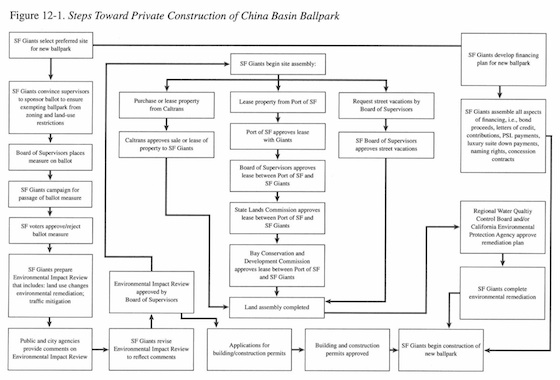
Well then, how does one go about making it work as the Giants did in China Basin? Thankfully, some very smart economists – John M. QuigleyEugene Smolensky, and Stephen J. Agostini – have gone to the trouble of diagramming the process.  The flowchart below comes from a paper titled Stickball in San Francisco. It’s better known as the San Francisco Giants’ case study in the book Sports, Jobs, and Taxes by noted sports economists Roger Noll and Andrew Zimbalist. Ready? Here’s the secret recipe:

stickball

Step-by-step instructions on how to follow the Giants’ plan.


See? Easy peasy, no sweat right? Sure, there are a few things that are different, such as the need for a ballot measure. Oakland has long claimed that it doesn’t need one. That claim originated from two theories: that either Oakland could leverage redevelopment money or the powers within the Coliseum Authority (JPA). The latter still stands technically. The former? As long as Oakland’s pledge to take care of costs to put the site together stands, and those site costs keep rising (Victory Court was at last count $250 million), the Mayor and City Council are going to have an extremely difficult time convincing the voters that they shouldn’t vote on it. Even in the Coliseum’s case, going without a vote is inherently very risky because many of the people on the JPA board are standing office holders, such as Ignacio De La Fuente and Scott Haggerty. The stench of the Mt. Davis deal still hangs thick and heavy over the Coliseum, and the Authority is having trouble refinancing existing debt at the complex. Does anyone honestly think a $2+ billion megaproject like Coliseum City won’t go to a vote? The project is calling for its own streetcar! Maybe Knauss will don a Harold Hill costume the next time he does a press conference.

Then again, Knauss expressed a preference for one of the waterfront sites. We know that Victory Court is incredibly expensive and that some current landowners aren’t exactly going to roll over for a ballpark, even though they are great Oakland supporters. Maybe it’s time to revisit Howard Terminal one more time. It’s difficult to see how the Howard Terminal site would work. Matson, one of the key corporate supporters at yesterday’s press conference, consolidated operations at HT several years ago. There’s no readily available place to relocate Matson should they give up HT. I suppose it’s possible they could give up a portion, say 15 of 50 acres, in exchange for some kind of break from the Port. Then it just be a matter of dealing with the nearby power plant and prepping the site, which would require completely new pilings/foundation work (just like AT&T Park). Judging from the price tag for SF’s Piers 30 & 32, the cost would be around $80 million to start plus whatever the price is to compensate Matson. Whatever that total is, it’s probably cheaper than Victory Court. (Personally I’d pick HT just because of its proximity to Beer Revolution, but that’s just me.)

Finally, there’s the matter of seat licenses. Knauss and his partners think there’s a market there. Lew Wolff has said there isn’t a market from the beginning. Who’s right? I’ll defer to Wolff, who has access to the season and advance ticket sales rolls and has a pretty good idea of what people are willing to pay for tickets and premium offerings. The Giants’ $255 million financing package included $75 million from 15,000 charter seat licenses. That’s a $5,000 average upfront payment (available in installments, of course). Is the market really there as Knauss claims? Consider for a moment that the 49ers are selling seat licenses right now. The Raiders, if they get a new stadium built at the Coliseum, will require their own seat licenses. They may also be in the mix for whatever venue the Warriors cook up. The A’s would be entering the fray with, if using the formula the Giants used, 20% of the ballpark cost, or $100 million of seat licenses. The A’s don’t have the Giants’ 25,000-strong season ticket roll, or the reputation of having a large number of premium ticket buyers (Green Collar Baseball, anyone?). So you’d have three, possibly four teams selling seat licenses along with more expensive tickets. That’s a good way to oversaturate the East Bay, a market which has historically shown trouble maintaining solid fanbases unless the teams are ultra-successful. These financing terms don’t work unless great support can be maintained through thick and thin, or at least if some of the load can be sloughed off to corporate interests. Otherwise someone has to make up the shortfall, and as we saw from the OFMA debacle, the results can be disastrous. MLB and Selig know this, and they won’t be impressed just because someone says “we can work it out”. Selig will want to see pledges, upfront payments, real tangible proof that seat licenses can be supported and that there won’t be a shortfall that drags down the franchise. The CBA has a provision that the A’s have to come off revenue sharing by 2016, unless they’re still at the Coliseum. MLB is not going to approve a plan that creates huge risk for the team and causes them to stay on revenue sharing even with a new ballpark.

Perhaps the best predictor of how portable the Giants’ financing model is comes from a 2002 AP article which quotes former owner Peter Magowan and  Rob Tilliss, the JP Morgan consultant who put the deal together. Magowan:

“You cannot expect a private ballpark to be built in Cincinnati or Milwaukee, there’s not the economic base there. It’s not the Silicon Valley,” he says. “And we couldn’t do it today. We were very lucky in our timing we had low interest rates and a very good economy.”

Tilliss:

“It definitely is not a one-size-fits-all kind of model.”

Knauss’s argument is that economically, Oakland is closer to San Francisco or Silicon Valley than it is to Cincinnati or Milwaukee. I find that hard to believe.

Oakland Press Conference at Clorox HQ (Updated)

Today at 10 AM, there will be a press conference at Clorox headquarters in Downtown Oakland about efforts to keep the A’s in town.

Clorox is handling the media advisories for the event. That’s all I know for the moment. Since I’m still in San Diego, I won’t be able to attend. I’ll keep an eye out for news as it comes in.

Update 10:30 AM – A tweet from KRON’s Haaziq Madyun:

11:10 AM – From Baseball Oakland’s Facebook page:

Today Clorox CEO Don Knauss has announced continued support by the East Bay buisness community in Keeping the A’s in Oakland. He is willing to work with current ownership, however if that cannont happen he is willing to work with another group that is willing to buy the team and pledge support for them (sic) 

11:30 AM – I just got off the phone with Lew Wolff. He confirmed that the team is not for sale and that ownership has explored all options in Oakland.

11:55 AM – Oakland Mayor Jean Quan has put out a press release.

FOR IMMEDIATE RELEASE

May 3, 2012

Clorox and Other Major East Bay Businesses Join Mayor Jean Quan to Voice Their Support
to Keep the A’s in Oakland

OAKLAND, CA– Chairman and CEO of The Clorox Company Don Knauss, joined by several of the largest companies located in the East Bay, today stood with Oakland Mayor Jean Quan to announce support for keeping the Athletics baseball team in Oakland.

At the event, Knauss stated, “Clorox strongly and enthusiastically endorses the efforts of the East Bay business community and City of Oakland to keep the Oakland A’s here in a new, world-class stadium. As former president and CEO of the Minute Maid Company, I was actively involved in the design of the new Houston Astros downtown ballpark and subsequently secured naming rights to change the name to Minute Maid Park. From that experience, I can speak first-hand to the revitalization a world-class ballpark can bring to a city. Certainly, Oakland would benefit greatly from the jobs, tourism and vitality a new stadium would bring.

“The business community is committed to helping drive an effort to support the current ownership group in their quest for a new stadium so long as they are committed to staying in Oakland,” Knauss went on to say. “However, if the current ownership group is not committed to Oakland, we want to make clear that Oakland and the East Bay business community are ready to step up to the plate to help ensure the A’s stay home where they belong in Oakland. We’re confident we have identified an ownership group with the financial wherewithal to buy the team, keep them here and get a new stadium built.”

Added Oakland Mayor Jean Quan, “I want to thank Clorox and members of the business community for doing what is necessary to keep the A’s in Oakland. Developing a world-class sports, entertainment and business complex as a new home for the A’s will generate thousands of jobs and create economic development opportunities for this City.”

At the event, the East Bay business leaders said they are prepared to work with the City, County and A’s ownership to help secure corporate sponsors in the following areas:

  • Stadium Naming Rights
  • Major Corporate Sponsorship Commitments – Significant anchor sponsorships, including seat licenses and luxury boxes. (A number of the companies have already made substantial deposits into an escrow account to demonstrate their seriousness when it comes to such sponsorship commitments.)
  • Other Regional Sponsorships — Given the size and breadth of the East Bay, home to nearly 2.5 million people, representing one of the country’s strongest economic markets and huge marketing and sponsorship opportunities, the business leaders made clear they would work with the City and the County to identify additional corporate supporters throughout the entire Bay Area and beyond, including Sacramento and Stockton.
  • Reaching Out to Business Partners – Given the size of the companies, many have relationships with business partners who would have a strong interest in supporting the team and the region as sponsors.
  • Identifying Specific Industry Anchor Sponsor Opportunities – Pursuing opportunities for the kind of anchor sponsorship relationships Major League Baseball teams typically have in sectors like the airlines, health care, car manufacturers, beverage and food companies, energy companies and major consumer companies.

Among the East Bay businesses represented today are:

  • Bigge Crane & Rigging
  • Jobs and Housing Coalition
  • Kaiser Permanente
  • Matson Navigation Company
  • Oakland Metropolitan Chamber of Commerce
  • Pandora Internet Radio
  • Reynolds & Brown
  • Safeway
  • Signature Development Group
  • Wendel Rosen Black & Dean
  • World Market

If the team is not for sale, and East Bay backers would prefer new ownership, where does that leave us? No different than yesterday or a week ago, I suppose. The game plan by many of the Oakland-only community has been to wait out the process and hope that Selig denies Wolff the rights to San Jose, then come forward with a new ownership group and stadium plans, which may or may not be tied to Coliseum City. The problem with this is that how do you impress Selig, who according to many of the community is out to get Oakland, without some serious level of detail and planning? They’ve had over three years to put something cohesive and coherent together. Press conferences like these, which seem to occur every couple of months, are good at generating media interest. Beyond that, where’s the substance?

Clorox deserves a lot of credit here. Don Knauss is driving this forward, and as I’ve mentioned before, every stadium campaign needs a champion. Knauss might be that guy.

There’s also one key difference between what’s happening with the A’s and what’s going on with the Sacramento Kings. The Maloofs are broke. The Wolff/Fisher group is anything but broke. The only party who can “force” a sale is Selig, and he’d need a very good case to make that happen.

Dodgers sold, O’Malley looks at Padres

It’s May Day for Dodgers fans. The Frank McCourt era is officially over, as the sale of the franchise was officially closed today with McCourt selling to Guggenheim Baseball Partners. I’m two hours south right now, yet I can hear a din of cheering. Or maybe that’s the exhaust fan in the kitchen.

McCourt’s still in the mix, thanks to his being part of a joint venture with the parking lots surrounding Dodger Stadium. As for running the franchise in any way, he’s gone. And for that, all of baseball can be grateful.

It was expected that some of the losing bidders would latch onto the new opportunity that was created when Jeff Moorad and Company gave up on buying the Padres from John Moores. The first one has surfaced. According to Ken Rosenthal, it’s former Dodgers owner Peter O’Malley. O’Malley, his family, and others with the money to make the deal happen, have requested to look into the Padres’ finances and are looking to wrap up a deal as early as the All Star Break.

That’s all well and good, but O’Malley should know from experience that Bud Selig is not going to allow the sale of the team to the first guy who shows up with a check. Selig wants a bidding war, and there is buzz that three of four other parties are interested in the team. He wants John Moores to get a little extra for his having to wait. The Padres aren’t going to go broke anytime soon. As crazy as this valuation and sale price bubble is, maybe it’s not so crazy to think that Moores could get $700 million, $800 million, maybe more.

If there’s a lesson to take from the last few years it’s this: If you’re an owner, embroil yourself in a scandal – messy divorce, financial, etc. You’ll make out great in the end.

News for 4/29/12

Good stuff:

  • The Kings arena deal was officially declared dead on Friday. Perhaps they were waiting for rigor mortis to fully set in. The team will stay for another year, after that? Who knows? I’m not generally a fan of boycott efforts, but if Kings fans really wanted to stick it to the Maloofs with both a fiscal and PR nightmare, they should boycott ALL games. The family may be struggling enough that a loss of $30-50 million in revenue could really hurt them, and force them to sell the team. That’s what the fans want, right?
  • Many readers are getting a buzz off the news that Angels’ owner Arte Moreno met with AEG recently. As Bill Shaikin writes, they’d have a long way to go before they started doing anything. Moreno’s a good businessman, and as a good businessman should he has to at least hear AEG out and get some kind of dialogue going. It won’t force the City of Anaheim to do anything, so the leverage play isn’t there – at least not right now. I wrote last week about AEG’s business model and goals for the LACC expansion-cum-NFL stadium, and how baseball isn’t really on AEG’s map. AEG has its own somewhat weak leverage play in that they want to push the NFL to make a move on their behalf, but as recent discussions between the two parties have revealed, the league is not easy to budge. The NFL can at any time revive the Roski/City of Industry plan and favor it over AEG’s concept, and it would have every right to do so. The NFL doesn’t care about AEG’s desire to hold the Final Four or BCS championship game there, or about AEG’s interest in expanding LACC. All they want is a new, Super Bowl-ready venue. AEG, on the other hand, would have to strain to make a downtown ballpark work within its convention center plans. Since AEG wants an indoor convention hall, the ballpark would require a retractable dome instead of open air. The field would have to be moved out like University of Phoenix’s field, yet there’s no space for such a field-on-a-tray. Because of the rather bespoke nature of a ballpark, it would be difficult to put in the flexible seating system AEG would need to hold the Final Four. Plus there’s the issue of not having enough seats for large football events. Baseball may provide 81+ annual events, but you can bet that the revenue share for AEG will not be beneficial enough to cover the debt service on the venue. There are few compatibilities between what Moreno wants and AEG’s goals. That makes a downtown ballpark a non-starter.
  • Minnesota lawmakers continue to work throughout the weekend on the tenets of a Vikings stadium plan. The big obstacle may be rank and file Democrats, many of whom who appear to have pledged to vote down any stadium proposal. Financing would come from a appropriations (state) bond, which means that debt would be serviced by an annual appropriation, to be paid back by gambling tax revenues and other sources. It’s certainly a “creative” public financing solution, though one that would never leave the budget committee in California.
  • Barclays Center in Brooklyn putting on an exhibition in October between the Islanders and Devils to test out the hockey configuration, which is suboptimal.

Petco: Lessons Learned

As beautiful as the setting and architecture of Petco Park is, the ballpark is not without its faults. Like just about every ballpark built in the last 20 years, it could’ve benefited from a a few design changes and a better sense of scale. None of the criticisms I have are anything more than minor, but it’s something to think about when planning for a new A’s ballpark.

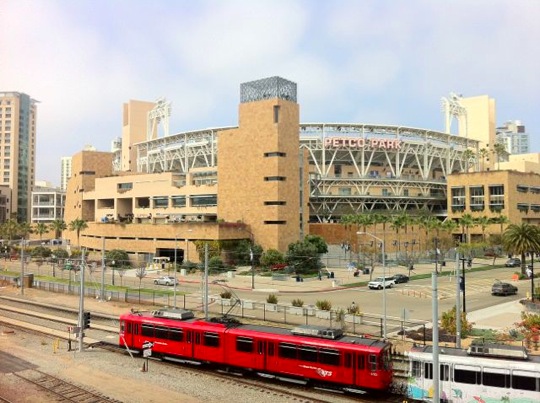
Petco trolley bridge

Its capacity of 42,691 is at least 2k too much for the market, though that’s easy to say in hindsight. The Padres eclipsed the 3 million mark only once in their 8-year history at Petco. Attendance per game has dipped below 30,000 in the last couple of years. If the team were to do it again they might have dropped the capacity to 40,000. There may be a solid argument to reduce the capacity to 37-38,000, but let’s be serious about this – when many of these parks were planned out a decade ago a capacity less than 40k would’ve been considered defeatist. PNC Park was the only park of that sara with a 38k capacity, and it made sense considering the Pirates’ place as a small-market, third tier team in a football town.

Day vs. Night Gap

8 years is enough to establish Petco as the most pitcher-friendly in the majors. It was even worse when it first opened, when the right-center dimension was a fly ball-killing 411 feet. The only change was in bringing that fence in to 400 feet, which has had little effect. During Wednesday’s game I saw three balls that would’ve been out elsewhere that were caught on the warning track. There’s already talk of bringing in the fences again, though I expect that it’ll be another similar half-measure. To give hitters a chance, new fences will have to be drawn up for the entirety of lett field and right field. The corners can remain the same since they’re fair. The right field wall is around 382 feet in the power alleys, and the wall itself is 12 feet high. Both are much too large. If they Padres add four rows and lower the wall to 8-9 feet it’ll be a much more fair park. This can be done taking the notch of seats that juts out from the corner and even it out through the rest of the wall. The place is probably due to replace the incandescent scoreboard with a full color LED model like the video board to the left, so there’s an excuse to make the change. The four rows could come from cleaving the top rows from the second deck in RF. A similar treatment can be done in LF. Net effect: more fair ballpark, no change in capacity. While we’re at it, the top rows of third deck (grandstand) could also stand to be removed. Removing four rows would bring the capacity down to 40,000.

RF Fence

Even with those quibbles, Petco still has a great deal of positive attributes that I didn’t get to in the previous post:

  • The front rows of the second deck (Toyota Terrace) are uneven from the infield to the outfield. It looks strange from afar. When you’re standing along the field level concourse it makes all the sense in the world. An extra 2-3 feet of vertical clearance opens up the viewing angle so that fans down the LF and RF lines can see the scoreboard across the way and more of the stadium. Standing fans along the infield are closer to the action so they don’t need such a treatment. Instead they get small scoreboards of their own and a host of HDTVs to check out replays, all tucked under the second deck.
  • The Western Metal Supply building, which was to be demolished in the original plan, was preserved and integrated into the ballpark. It’s the perfect example of the burgeoning trend of party suites in ballparks, and a fantastic example of adaptive reuse.
  • Suites are tucked under cantilevered upper decks, which are something of a mixed bag. From a practical standpoint, that placement reduces the load and allows for greater seating capacity in the second deck, and to a lesser degree, the lower deck. These are definitely not the closest to the field among new ballparks, though that aspect may not matter much to the consumers of suites. It’s not like there’s much local competition for premium seating as there is back in the Bay Area.
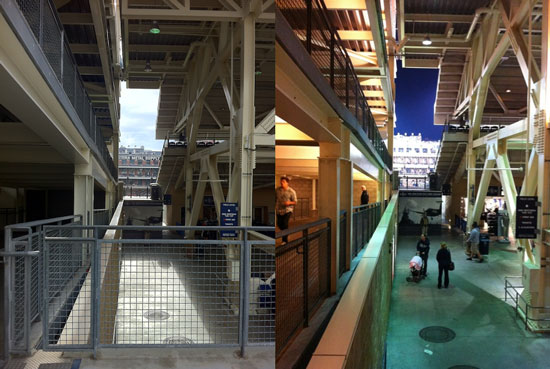
  • The whole grandstand feels overbuilt, and that’s a show of strength. Massive trusses support the cantilevers and are confidence-inspiring. They also appears to be something of a tribute to the numerous large steel ships, including Navy vessels, in the nearby harbor.
  • The towers which hold suites don’t seem to be as much of signature pieces as I thought they would be when they were initially unveiled. Perhaps this because they hold suites and not more publicly accessible areas. Maybe it’s because the towers don’t continue all the way down the stadium to grade. Whatever the case, they’re striking but at this point, mostly a visual affectation.
  • There are still a lot of old standard definition CRT TVs scattered throughout. I suspect that a tech upgrade is due soon, with the scoreboards and TVs done in a package deal.
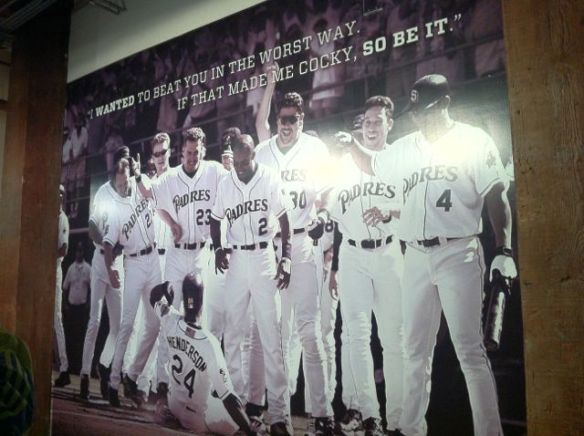
  • Under the outfield seating decks are two sets of tributes. In right is the military tribute, including a scale model of the USS Midway. In left, behind the Western Metal Supply building, are tributes to the history of baseball in San Diego, and the history of the Gaslamp Quarter. The latter is whitewashed to a Disney-esque sheen, but it’s still informative. There are also large photos and quotes from past Padres, including some guy you may be familiar with.

If I have any say over it, someday Rickey will have a huge statue and a room in a museum dedicated to his exploits.

Petco: the ballpark has two faces

Do you remember the old adage about the mullet haircut, “business upfront, party in the back”? I knew you did. Thing is, as generally uncool as the mullet is, Petco is extraordinarily cool. And yet, Petco very much fits that two-part description. It’s that convergence of philosophies, of catering to different audiences, that makes Petco so unique and special. It’s why, regardless of how bad the team is (quite bad right now), Petco is easily in my Top 5 ballparks. It’s definitely the friendliest ballpark in the majors.

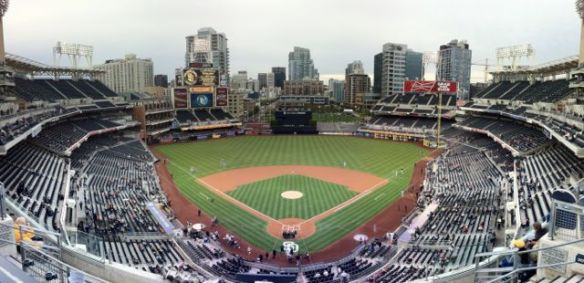
Petco upper deck panorama

The ballpark is oriented north to capture the downtown San Diego skyline

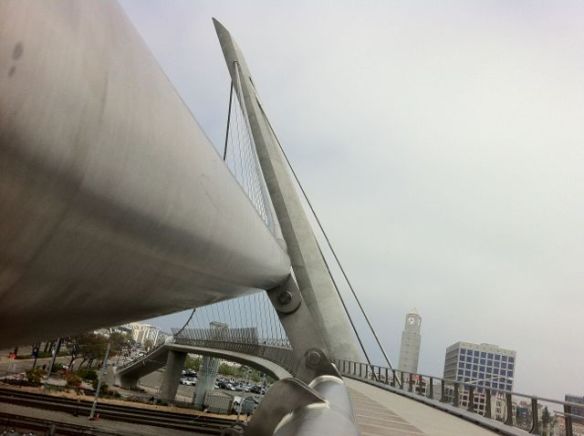
Petco Park is often associated with the historic Gaslamp Quarter, the retail and entertainment district frequented by both locals and tourists. The stadium is technically in the East Village, a grittier and still largely undeveloped neighborhood east of the Gaslamp. I found out how gritty it was when I went looking for a parking space on Saturday while the Padres were hosting the Phillies. I only had to drive six blocks away to see homeless encampments leaning against dormant construction sites. As the Gaslamp and the adjacent parts of the East Village became gentrified over the last 20 years, the homeless were pushed further out. That left the area immediately around Petco quite clean, safe, even serene. The park and neighborhood are connected to the harbor/marina/convention center by a striking new pedestrian bridge, which is elevated above train tracks and the main thoroughfare Harbor Drive. Two trolley stations flank the ballpark, bringing in fans from throughout the city, south to Chula Vista and the San Ysidro/Tijuana border, and east to El Cajon and Santee. Northern suburbs are serviced by the Coaster commuter train, which transfers to the trolley at Union Station.

Cable-stayed pedestrian bridge

From the convention center end of the Harbor Drive Pedestrian Bridge

My brother’s wedding ceremony was on Sunday. The wedding party stayed the weekend in a hotel in the Gaslamp only two blocks from Petco, so we felt the full brunt of humanity all over the neighborhood and downtown on Saturday night. Phillies fans came as early as Thursday and descended on the Gaslamp like a plague of locusts. I tweeted an observation over the weekend:

In the Bay Area we rave about how much AT&T Park improved the China Basin/South Beach area, or about the impact HP Pavilion had on downtown San Jose. Neither can hold a candle to what Petco Park has done for the Gaslamp. Part of that is because outgoing Padres owner John Moores bought numerous plots of land around Petco and developed them. That included two hotels (Omni and Solamar), condos, and master planning for the blocks including and surrounding the ballpark. That’s not to say that such work is required for a downtown ballpark in either Oakland or San Jose – it just doesn’t hurt to have that kind of vision. That’s probably a good reason why Oakland is contracting with Moores’ firm JMI Sports for the Coliseum City project.

Lower Concourse

Back to the mullet. No ballpark is going to work economically unless it has the stuff corporate interests will pay good money for, such as suites and clubs. All of that stuff is there and it appears to be sufficiently luxurious. Concourses go from wide to vast. Taking a page from recent mall design, there’s rarely a single long corridor. Instead the field concourse is broken up by informal plazas, a side concession court, numerous portable merchandise booths, and warm stucco along the many of the concourse walls. Every few feet the ballpark reveals something new, a different perspective or vantage point. The field is frequently within view, with spacious standing room areas everywhere. Yet there are always opportunities to walk a few feet and check out the harbor or downtown, making Petco feel wholly integrated with the neighborhood. If you’re walking in the Gaslamp and you go a block or two east to 8th Street, you can see the third base grandstand, beckoning you to come in with its arms open. The ballpark’s orientation (north towards downtown) is a choice I’m glad they made, because a waterfront ballpark wasn’t feasible and had already been done previously in San Francisco and Pittsburgh.

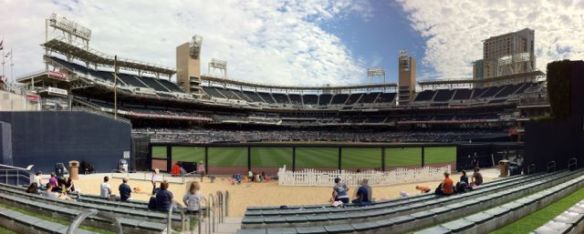
On Tuesday night, I checked out a pitcher’s duel between the Padres’ Clayton Richard and former Athletic, now Washington National Gio Gonzalez. Gio was his good self that night, firing a no-stress, two-hit, six-inning shutout on the way to a 3-1 win. My seat was in the upper deck, directly behind the plate (see top pic). I stayed for five innings, then moved around the ballpark to take pictures. The following day, I sat in the bleachers, which I had never done in previous games here. It’s not a perfect bleacher experience, but it is marvelous.

Bleacher Panorama

The “Beach” in the foreground, game in the background

First of all, the are numerous quirks. The bleachers are comfortable and spacious enough, with individual seat bottoms, plenty of leg room, and grass at your feet (all the better for flip-flops). As the bleachers are a fairly small seating section, they are subject to many obstructed views. My seat had one of the best views and I couldn’t see either LF or RF corner. If your seat is more towards CF, you stand to have a third of the field or worse obscured (a la Yankee Stadium). Plus if you’re below Row 7 and you’re trying to watch the game, you’re liable to get a great view of the chain link fence or worse, the padding on top of the fence. That said, maybe you’re coming to mostly hang out with friends, and for that it’s the best bleacher section in the majors. Plenty of concessions are always available behind you, and if you have kids with you they will take to the sandy “Beach” area like ducks to a pond. The hecklers have seen fit to get their seats in the RF corner where they can heckle the visiting pitching staff or right fielder.

In back of the bleachers is the “Park at the Park”, an open area and berm which is open to the public during non-game hours and is available for a $5 ticket during games. No matter how bad the attendance gets thanks to the Padres fielding one of the worst teams in MLB, the Park at the Park always has activity. This is even more of a case of a place where the casual fan can go, bring kids, and not worry too much about the cost. Fans with the $5 ticket still have access to the standing room areas within the grandstand, making a Park at the Park ticket effectively a cover charge. Now I have to wonder if this depresses the demand for non-premium tickets somewhat, but I figure that many of these people simply wouldn’t go at all if such an affordable ticket weren’t available. In the end it’s probably a wash in terms of revenue, with a positive PR boost to assist.

Park at the Park

If I worked in downtown San Diego, I’d make a lunch appointment everyday at the Park of the Park, no doubt about it. I hope we have the chance to celebrate something this lovely for the A’s, somewhere in the Bay Area. A boy can dream, right?

…..

Tomorrow: More technical and trivial information about Petco Park.