Selig talks Realignment

While the local and national media have been distracted by the Mets and Dodgers financial woes and have used those stories to project all sorts of cockamamie schemes, the commissioner has been on a different wavelength altogether and barely anyone has noticed. Whether or not you believe Bud Selig, here’s what he said last week about contraction in an interview with Chris Russo:

“The only thing I can tell you about contraction is we haven’t discussed it at all,” he said. “I’m not sure where that came from. We have not discussed contraction at all.”

What Selig has been talking about is realignment. Selig hasn’t divulged how broad his realignment vision is, and it’s likely that too many owners are comfortable with the current divisional alignments that major changes would be approved. He has put out some interesting concepts such as “floating realignment” in which have-not teams could move from to/from the AL East in order to get more stadium revenue from the unbalanced schedule’s greater number of intradivision games. That concept never got off the ground, but here may be some wiggle room for realignment that could come from a very simple numbers argument. Feast your eyes on the following table, whose data comes from NY Times resident geek Paul Robbins.

The path of each team can be seen on Robbins’ Google Maps mashup. Certainly no owner, front office, manager or player is going to get sympathy from fans about the pain that comes with having to travel frequently on plush charter jets. Still, there’s something to the large disparity in travel miles from top to bottom. As you might expect, many of the West Coast teams accrued the highest mileage. But why did the A’s have the third lowest, and the Padres the fifth lowest? Why did the centrally located Cubs finish fourth highest while their crosstown rivals hit sixth lowest? There’s no single factor to blame as scheduling is as much an art as a science. However, you can rest assured that Selig has an idea what part of the solution is: realignment.

The big four major sports don’t realign their leagues on a whim. In every case over the last 20 years, realignment has come with a league expansion event. Changes based on mere geographical “friendliness” do not occur frequently. Before 1994, the NL West would’ve been better named “NL Other” due to having two teams in the Eastern time zone (Atlanta, Cincinnati) and another in the Central (Houston). The leagues/teams have absorbed highly variable travel costs as the price of doing business.

  • 2004 – NBA changes from four to six divisions. Adds Charlotte Bobcats to Eastern Conference’s Southeast Division. Moves New Orleans Hornets (previously Charlotte) to Western Conference’s Southwest Division.
  • 2000 – NFL changes from six to eight divisions after adding 32nd team, Houston Texans. Conferences’ Central divisions become North; South divisions are added.
  • 1998 – NHL changes from four to six divisions after the Hartford Whalers (Northeast Division) move to North Carolina to become the Carolina Hurricanes (Southeast Division). Newly formed Southeast Division also contains two recent expansion franchises.
  • 1998 – MLB expands to 30 teams, adding Tampa Bay Devil Rays and Arizona Diamondbacks. Milwaukee Brewers switch from American League to National League, leaving the AL with 14 teams and the NL 16 teams.
  • 1995 – NHL approves Quebec Nordiques (Northeast) move to Denver to become the Colorado Avalanche (Pacific Division). Both conferences have 13 teams.
  • 1994 – MLB changes from four to six divisions. Both leagues’ West divisions have four teams each, the respective Central and East divisions have five teams each.

Many other relocations, such as the Minnesota North Stars’ move to Dallas or the Vancouver Grizzlies’ move to Memphis did not automatically cause realignment. The Washington Nationals naturally stayed in the NL East after they moved from Montreal. Divisional status quo also happened for the Houston Oilers-turned-Tennessee Oilers/Titans and the Cleveland Browns-turned-Baltimore Ravens.

TV convenience

The Texas Rangers would love nothing more than to leave the AL West and cut down the roughly 20 West Coast 9 PM CT start times their fans watching in the Metroplex have to endure every season. Unfortunately for the Rangers, no changes will happen just to placate one franchise. If two teams resist, then there’s a movement – especially if those two teams are the Cubs and Cardinals. In 1992 Fay Vincent initially pushed for a 1992 makeover in which the Cubs and Cards would be placed in the NL West, whereas the Braves and Reds moved to the East. It would seem unlikely that reverting to a two league, four division setup would gain traction, as there simply aren’t enough teams in the Pacific and Mountain time zones (eight team total) to deal with the problematic time shifts for the Central-based teams who would be stuck in the West.

Left: Existing leagues kept intact. Right: Geographic redistribution.

Selig frequently says that he tinkers with realignment concepts frequently while he’s traveling, much as you or I would. The conservative nature of The Lodge makes such tinkering more a mental exercise than anything, but it’s good to hear that he’s giving it some attention. The biggest problem Selig may be facing isn’t cumulative travel or TV time shifts. Rather, it may be the sheer number of teams. Prior to expansion in the 90’s and interleague play, the balanced schedule offered easy, predictable scheduling. Every team in your league was guaranteed to come twice every year. Once you add teams and reduce intraleague games by introducing interleague play, it becomes practically impossible to maintain a balanced schedule.

Top: Balanced schedule in AL. Bottom: Unbalanced NL schedule caused by expansion and interleague play.

It becomes more difficult once additional interleague series are added, since those will compete with intraleague or intradivision play for space within a 162-game season. Note that I’ve only allowed for two interleague series in this scenario. 14 teams is easy to work with, which is one reason why some have advocated for contracting two teams. It’s not a good reason given the big picture, but it’s not hard to see why it might be considered favorable – at least from a logistical standpoint. With 16 teams in 3 divisions, that oddball 6-team division will always complicate matters. MLB could add two expansion teams to make a 32-team league as I’ve wished for in the past, but there is absolutely no internal interest in expansion at this point so it’s a nonstarter. Nevertheless, 30 teams is extremely awkward.

There may be one admittedly strange way to smooth out scheduling and travel. That would be to keep the American League at 14 teams over 3 divisions while making the National League 4 divisions of 4 teams each.

AL remains status quo. NL switches to four division format.

A variant of the NL distribution has 12 intradivision games per team, which allows a bump vs. the “NL South” to 9 games, achieving parity with the other divisions and some semblance of a balanced schedule, if that is a goal. I wouldn’t expect the National League to do this because, as the more conservative of the two leagues, it just doesn’t seem like they’d be in a rush to introduce another pennant and an additional two teams to the playoff format. If the American League were doing this in concert it might make more sense. Since the AL isn’t expanding, the NL isn’t going to change. Regardless, the seemingly endless number of possibilities for realignment sheds light on how difficult it is to plan for MLB’s short and long term. For the fans’ sake, I hope that Selig can get the owners to at least honestly discuss the pros and cons of different scenarios. Surely there are practical ways to make realignment work for owners, players, and fans alike.

P.S. One thing you can’t expect from Selig and the owners: some form of a promotion/relegation system like the one used in European soccer. The delta of franchise values between MLB and AAA teams is much too vast for any owner to take such a risk. Many teams that have been relegated have never made it back and have even become insolvent, a phenomenon known in British soccer as entering administration.

More contraction B.S.

Forbes’ Mike Ozanian mused about contraction yesterday:

From what I am hearing, I doubt there will be any baseball at Tropicana Field after 2014 even though the team’s lease runs to 2027.

The funny part is that in the comments, someone pointed out to him that a second team would have to be contracted to make it work, which he casually acknowledged and then pointed the finger at the A’s.

Today the blowback has begun, from Craig Calcaterra’s brief and annoyed response to a much lengthier one from Maury Brown. That follows what Ken Rosenthal wrote six weeks ago, which I deconstructed in short order. None of the sensible arguments against contraction have changed. They’re just not noisy or loud enough.

Consensus appears to be that MLB is doing this to win concessions against MLBPA, which I find barely plausible at best. Instead, I think it’s more appropriate to look at the more hidden agenda. The endgame for the A’s and Rays would involve having New Yorker Stuart Sternberg own Mets and Los Angeles resident Lew Wolff own the Dodgers. Nevermind that Wolff owns less than 10% of the A’s, he could conceivably bring on big money partners to take on the rest of the Dodgers, a team with a $800 million franchise value.

It’s far more likely that interests in the two largest markets in the country want in on some kind of ownership piece and are on the outside looking in. They see Sternberg and Wolff as ways to get in The Lodge, and the greater the FUD spread about Fred Wilpon and Frank McCourt, the better their chances are. MLB is happy to entertain the notions for now, since they ultimately have the power to act on them – or not act on them, which is most likely. That’s a great strategy, as long as you’re only looking at things through a very narrow scope. Big picture, none of this makes any sense. As I argued in February, MLB has to get its own house in order before confronting MLBPA on any major issues. To get the Mets and Dodgers healthy and properly functioning again, it makes more sense to get new, non-crony blood owning those teams. There will be willing buyers, it’s just a matter of whether prospective buyers will balk when they look at those teams’ debt positions.

The debt and revenue problems for the Mets and Dodgers have far greater implications leaguewide than the A’s and Rays getting a combined $50 million in revenue sharing every year. When the Mets and Dodgers have large revenue and attendance drops, it hurts the league much more than changes to the A’s and Rays’ revenue profiles. While MLB could deal with all four teams in one fell swoop, a deeper look reveals that it’s not nearly as convenient as it appears. Wilpon and McCourt continue to be wrapped up in nasty litigation battles, and while McCourt’s divorce proceedings could end soon, the Wilpon-Madoff mess could stretch throughout the rest of the baseball season, if not longer. And if Bud Selig is as paralyzed by the Dodgers’ situation as he is by the A’s-Giants T-rights ordeal, nothing improves. Would that lack of progress and decisive action surprise anyone out there?

MLB may change debt rule

At the end of last season I wrote about how MLB’s lightly-enforced debt rule might impact the A’s in the future. Now that the Mets have been practically sunk by the Madoff scandal and the Dodgers handcuffed by the McCourts’ divorce proceedings, Bud Selig may be looking to actually monitor the situation more closely and even act on violations.

The NY Post kicked off today’s news by indicating that a change to the existing debt rule may be in order. The article cites the now obsolete 60:40 rule, which was mothballed in favor of a multiplier-based system in which debt couldn’t be more than 10x operating income, or 15x if a new stadium were in operation. The kicker is that MLB is looking to include holding company debt in the calculation, which has potentially enormous implications. For ownership groups that were heavily leveraged to buy TV networks and radio stations, enforcement could have crippling effects on how much they can spend in the future, whether it’s on players or anything else. MLBPA may be pushing in favor of such a plan since it would provide a more honest assessment of each club’s financial stability and risk.

A source who represents players said, “I think it [a rule change] is positive,” even if it could have a negative impact on salaries.

That kind of agreement is nowhere to be found among the NFL, NBA and their unions. Craig Calcaterra has a short take on the rule change as well.

Where I’m not clear on the impact is whether or not additional teams and their debt in other sports is applicable. After all, Tom Hicks overreached to buy Liverpool F.C. and lost both the soccer team and the Texas Rangers because of it. While that’s clearly an outlier case, crazier things have happened. Ask Fred Wilpon, John Moores, or Frank McCourt.

The upshot of this is that while the A’s appear to be clean at the moment, things will get a more stringent in the next CBA and with the building of a new ballpark. MLB will look at any stadium deal and the A’s ability to make it work very, very closely. And while Selig may be supporting his friends Wilpon and McCourt right now, it wouldn’t surprise me for Selig to make an example out of one of them in the future, and to use the A’s or Rays as an example of how to properly run a lower-revenue franchise.

To further explain this, let’s take a look at operating income for the A’s as reported by Forbes for the last three seasons:

  • 2009 – $26 million
  • 2010 – $22 million
  • 2011 – $23 million

The average of those is $23.7 million. With a 10x multiplier, the A’s debt ceiling is $236.7 million. They’re nowhere near that point right now. Once they add a ballpark, that number will shoot up considerably. The ceiling will be $355 million, though that’s not enough to fully cover construction costs (and outstanding debt). The stadium cost number may go down by MLB’s definition if more corporates are locked in early and long term, I suppose that’s at the league’s discretion. Just as important, the debt number will be as high or perhaps even higher than the franchise value. Whether the debt rule stays the same, just with greater enforcement, or evolves to include holding companies, it’ll be interesting to see how individual teams respond in terms of fiscal restraint. That a debt rule change is on the table would also reinforce the idea that the A’s stadium resolution may not come until after CBA talks are complete. Will that happen before or after the season ends? We’ll find out soon enough.

2011 Forbes valuations out, A’s up 4%

It’s late March, and you know what that means: the new Forbes MLB franchise valuations are out. With a few notable exceptions due to debt problems (Mets, Dodgers), things in baseball are going quite swimmingly. The A’s are back above the $300 million mark with a $307 million valuation, up 4% from 2010. The team remains second-to-last among all MLB franchises, eclipsing only the Pirates. Forbes also listed at $23.2 million, which is probably due entirely to revenue sharing.

To understand where the A’s may be headed, I took five teams and looked a little deeper at how their valuations were constituted. The teams are the A’s, Giants (natch), Red Sox (Giants’ aspirations), Rockies and Padres (aspirational western mid-markets for the A’s). The numbers are quite interesting.

First off, it’s important to note Forbes’ explanations for some of the components of each valuation. “Sport” is described as attributable to revenue shared among all teams. You’ll see there’s an inverse relationship between the bigger revenue teams and this number. If a team is highly dependent on revenue sharing, this number will be higher. “Market” seems self-explanatory, though for the two Bay Area teams it’s interesting that according to Forbes they share the same market, which based on its size (4,274,000) is probably defined as the SF-Oakland-Fremont MSA. That leaves out both the South Bay and all of the North Bay save for Marin County. Not clear on what impact this has, so I’ve reached out to Forbes editor Kurt Badenhausen for a clarification. Here’s his response:

We publish the population and revenue per fan numbers based on the San Francisco-Oakland-Fremont MSA. We use the official MSA designations for all those numbers. Market size plays a role in the value of teams in terms of how they drive revenues, but a bad stadium situation in a big market is still not going to help a team out.

“Stadium” is fairly straightforward, though it should be pointed out that just because you build a $500 million dollar stadium you’re not going to see a similar appreciation in your franchise valuation. That makes “Stadium” more a function of gate revenue and attendance, areas where the A’s and Padres fall behind while the Giants and Red Sox excel. “Brand Management” must be related to marketing efforts – or in the case of the A’s, a lack thereof.

Debt/value is a tricky beast, both in how it’s defined and how MLB’s debt rules get enforced. It always includes stadium debt, and should the A’s get their new ballpark in the next few years that number will jump up significantly from its 29% position, which has hovered there for several years. Since it’s possible that some of that debt may come in the form of a loan from MLB, it will be extremely important for Wolff/Fisher to ensure that revenue streams are locked in to service that debt (and then some) for the foreseeable future.

Surely, this annual release by Forbes will be followed up by a denial of the veracity of the figures by Commissioner Bud Selig. Despite this, it’s telling that franchise sales tend to use the Forbes figures as a baseline at the very least, leading me to believe that they’re far more accurate than Selig, who is loathe to provide any real financial data from MLB, is willing to let on.

Days of Reckoning

Governor Jerry Brown’s self-imposed budget deadline has come and gone, though Brown has asked for more time to work out details with the legislature. That body is trying to line up a floor vote next week, and they can waive the advance requirement for a public vote if they can get the budget basics outlined. If a compromise can’t be reached in the Capitol, Brown has warned of an “all cuts” budget in which every state agency and employee group will be in an “every man for himself” mode. It’s hard to conceive, but not out of the realm of possibility. It’s too early to know what such an impasse would mean for redevelopment, and for the various stadium projects throughout the state.

Speaking of redevelopment, Santa Clara County’s lawsuit against the City of San Jose and SJRA will have a hearing on Monday. The immediate issue at hand is the County’s request for an injunction against the transfer of the Diridon land to SJDDA. It’s a move that could have a paralyzing effect on ballpark efforts in San Jose, at least if the state goes through with the elimination of redevelopment agencies. One thing to keep in mind is that unlike many other Bay Area counties, Santa Clara County has no redevelopment agency of its own. That makes the County unique in that advocacy for curtailing or eliminating redevelopment presents no potential conflict of interest. San Jose has tendency to throw its weight around, so you can see why the County might feel it has to resort to a legal action.

If redevelopment goes away, it wouldn’t only threaten San Jose. Oakland, Santa Clara, and at least two or all three of SoCal football concepts would both see their stadium projects vanish (San Diego, City of Industry for certain, Downtown LA unclear).

Under Brown’s proposal, redevelopment agency property would be sold and the proceeds divided among the cities, counties, school districts and other local entities, finance spokesman H.D. Palmer said, so moves to protect the assets – transferring parking lots, buildings and other properties to a city, for example – could limit the amount those other local government bodies get if lawmakers eliminate redevelopment agencies.

Assuming that whatever lawsuits stem from the seizures get resolved, that would leave the various cities to work out deals where agreements and contracts already exist. That would include the Coliseum in Oakland and the Airport West property in San Jose.

In other news:

  • Chuck Greenberg is resigning from his CEO post with the Texas Rangers today, after only 8 months on the job. A shocker, and the background article is a worthwhile read.
  • The A’s will raise funds for victims of the Sendai earthquake and tsunami on April 3, a game against the Mariners. The day will also be called Japanese Heritage Day.
  • NFLPA appears to be ready to decertify itself, a move that would preempt a lockout. It would also set off a series of lawsuits. The two sides are said to be some $600-700 million apart n terms of sharing revenue, with the league offering 43% of the full pie ($9 Billion) and the players wanting 50%. By going down this path, both sides are setting a highly contentious precedent that could well be followed by the NBA this summer, MLB not so much. Update 1:19 PM – The league has reportedly upped their offer to 46%. Last minute talks are underway. Update 2:16 PM – False hope. Union is decertifying. Begin lockout posthaste.
  • Tim Kawakami continues to carry the torch for Larry Ellison’s NBA team ownership bid.

I need a drink.

Ray Ratto: Ballpark Feasibility Detective

Several hours ago I listed to the latest installment of Dale Tafoya’s Athletics After Dark podcast, this one featuring Ray Ratto. Ratto thinks that the San Jose stadium plan is near death:

The “Blue Ribbon Committee” is a fraud. The territorial rights argument is a fraud. This is about one thing and one thing only, and it’s always been about this: Do the A’s have the money to put a shovel in the ground? If they had the money to put a shovel in the ground, we would’ve gone to Bud Selig and said, “We’re ready to go now.” And then Bud Selig can either tell the committee to produce a report or he could just go without it and start harvesting votes if they really want this to happen. I think it is incumbent upon the A’s to show that they’re ready to go right now and the fact that they keep saying, “well we haven’t seen the blue ribbon report…” You know what? That’s due diligence and you’re supposed to do that. If you’ve got that stuff down you’re already working at that.

…In the current economic climate, where you really need help from cities and states to get buildings done if you don’t want to go into your own personal debt. I think that the idea of a San Jose stadium is really fading. It may be dead at this point. It’s taken too long for the A’s to get what ducks they have in a row, in a row. So I think the problem here is the A’s needed more help than they let on and now they’re stuck.

The bedeviling thing about how MLB works is this black hole of information around Selig. We know a lot about what San Jose is doing, we know a decent amount about what Oakland is doing. We have Wolff and his media campaign, we have responses from Neukom and Baer. The only thing we don’t have is the really important stuff. We don’t know what Selig’s, and by extension the other owners’, motivation is. To fill that void, Ratto theorizes that money is the problem. Which it may be, none of us have a financing plan in front of us.

But unlike the territorial rights issue or the progress of environmental impact reports, there is absolutely zero data or precedent to back up Ratto’s supposition. He is quite literally going on a hunch, making the analytical leap that it must be the money and everything else is a sham.

That makes little sense when you consider the following:

  • The Giants have been spending millions on preserving T-rights to the South Bay over the last two years. They bought a majority share of the SJ Giants. They’ve been redoubling marketing efforts in the South Bay. Their stance on T-rights has gotten more hardline with the passing of time. They’ve threatened legal action – not directly, through intermediaries. No organization goes to this much trouble if they don’t believe that something major is at stake.
  • They don’t call Selig “Slug” for nothing. The man is interminably slow when it comes to big decisions and is more than willing to say the sky is green when it is obviously blue (his remarks about competitive balance are a good example). This one’s a very big one since it involves something the big market owners consider sacred. I’ve said before that Selig isn’t going to act until at least one of these cities has all of their ducks in a row. That means the site, legal/political clearances, everything. San Jose isn’t there yet. Oakland isn’t there yet. And the Grim Reaper is coming fast for cities. Plus there’s the possibility that upcoming CBA negotiations will come into play, especially because the biggest debate will be about revenue sharing. If you’re Selig, why would you lift a finger until this other stuff shakes out? I wouldn’t. I guess you can call me “Slug” too.
  • The money is a lot more “there” than “not there.” Wolff hasn’t been afraid to say when money is an issue – look at what’s been happening with the Quakes. He also hasn’t been afraid to bail on a project when it couldn’t work out financially, as was the case in Fremont and Oakland. Is it all locked in and under contract? Probably not. The timing of the hiring of Darrin Gross to the business side of the A’s may be a clue. Wolff hired David Kaval under the same auspices with the Quakes last year, and now we’re a few months away from groundbreaking. And let’s not forget that Cisco and SVLG are nothing to sneeze at.
  • This stuff takes a long time to pan out. Peter Magowan took over the Giants in spring 1993. It took four years to get a ballpark deal in place and another three to build it. Magowan never had to worry about complications like T-rights. San Jose has been handicapped by the T-rights debate, which has strung the effort out to five years to get to this point (though there were two silent years). Ratto makes it sound like either Selig or Wolff can just forcefully say, “Make it so,” and things start happening, chop-chop. That’s not reflective of how this works. It’s an ugly, dirty process, borderline corrupt (if not outright) at times.

This post is yet another case of devoting nearly 1,000 words to something that was not news, merely a theory from a columnist. Who knows, maybe Ratto will be proven right in the end? If not, I suspect that when a groundbreaking ceremony occurs at Diridon this very interview will be played over the loudspeakers, an audio version of the “Dewey beats Truman” moment. Tech writer John Gruber calls it claim chowder. I’ll just call it a hunch.

Requiem for a Finley (or Peterson complains about Wolff’s complaining)

One of the problems I have with Lew Wolff pleading his case in the media is that it gives the media plenty of fuel for columns – columns that are almost invariably anti-Wolff. Such is the case today, with a Bloomberg article followed up by a rejoinder by Tribune columnist Gary Peterson. None of it moves the conversation forward, and it creates a cloud over a team at a time when all teams should have unfiltered hope on their side. You’ve got pro-Oaklanders and most local columnists on one side and Wolff, Beane, and the national columnists on the other side. And there isn’t much room for convincing either.

Peterson has plenty of good points (the beer size scandal) and some bad ones (the non-existent big development in SJ), but he makes one rhetorical mistake in comparing Wolff to Charlie Finley. In no way is Wolff as cheap, colorful, or rebellious as the maverick Finley. MLB wouldn’t have a Finley in the current era. As much of a mixed bag as Finley was, his honeymoon in Oakland may have ended as early as April 18, 1968. That was the date of the second ever home game for the Athletics in Oakland. After a sellout, 50,000+ crowd on opening night, game two brought in a whopping 5,304, most of those probably season tickets. Out of curiosity, I did a check of every first and second home game ever played in Oakland, and the results are only marginally better, sometimes worse.

Bold/italic figures indicate doubleheaders. Blue years are in Kansas City, Green years are in Oakland. Home games played outside of Oakland were not counted. Data source: Baseball Reference

There’s a story – possibly apocryphal – of how Finley said that he made a mistake in moving the A’s to Oakland when he saw the crowd for that second game (that may be how Selig got the basis for his famous quote). To be fair, BART was under construction. On the other hand, traffic was not nearly as bad on the Nimitz, then also known as Highway 17. Seriously though, 5,304? And less for the second games the next few years? The Haas era bumped things up, but even then the A’s had two years whose second games had four-figure crowds. Increased season ticket sales this year should ensure that a <10,000 crowd won't occur this year. Still, no matter how much Oaklanders and columnists despise Lew Wolff, hate alone won't save the A's. Showing up just might. I know that many of you will be there on Opening Day. What about the following day?

When encroachment is not encroachment

Update 3/1 2:00 PM – Lew Wolff is keeping the campaign going. In a Bloomberg article, Wolff states that he is “aghast” at how the Giants could be so stubborn in guarding T-rights when the A’s are moving further away.

Thanks to jk-usa for getting hold of KCBS In Depth’s (Doug Sovern / Ed Cavagnaro) interview with Giants president Larry Baer. Nearly four minutes of the interview is spent talking about the A’s and territorial rights. Below is a transcription of the relevant section (starting at 17:30 of the interview).

KCBS: The other team in our market – the A’s – their owner still very much has his eye on San Jose. What is the Giants’ on this, has it changed at all as far as, is there something you would accept to give the A’s entry into San Jose?

Baer: No change. When we go back to 1992 and the team was acquired by this group, there was a territorial right that went with that purchase… the exclusive right to exhibit baseball in San Francisco, San Mateo, and Santa Clara counties… We understand the A’s situation. We believe that they need a new ballpark. There’s no doubt about that… but they need a new ballpark, not a new territory. Certainly in their exclusive areas, Alameda or Contra Costa County or anywhere else in this region whether it’s Sacramento or wherever, we wish the A’s luck and hope that they’re able – for the good of the sport – to get a stadium that’s to their liking.

KCBS: We know you have the right and that you’re opposed, but do you think that there’s any chance that the owners would allow the A’s to move to San Jose, and the odds that the San Jose people would be able to build a baseball stadium?

Baer: Well, there’s no precedent for stripping a team of its territory. People point to Baltimore-Washington. That’s a totally different situation because the Orioles did not have a territorial right to Washington. In fact, when Montreal moved to Washington there were reparations paid to the Orioles even though it wasn’t necessary. So in a way it argues our point that even when another team doesn’t own a territory, that it’s allowed to move close, there’s a chance for real destabilization of the existing team. So this has been kicked around forever. The commissioner has never indicated to us that he believes that the territorial right that we have is in doubt.

KCBS: How do you feel having the A’s in San Jose would harm the Giants?

Baer: Well if you look at the patterns, Ed, and you look at over the years what’s transpired… when the team was first acquired in ’92 or ’93 the team was in trouble. We were playing in Candlestick but the fans weren’t coming. We were thinking that it was franchise that maybe could not survive. We redoubled the marketing effort – San Francisco, San Mateo, and Santa Clara counties. That is our core. If you look at – even though Oakland may be closer to SF than San Jose – there’s a little thing that people forget called the San Francisco Bay. The path of travel in this region is really north-south. If you look at KCBS traffic reporters and where people are moving it’s a north-south grid. People are well versed and in the habit of coming up the train to San Francisco – we have to preserve Caltrain by the way – coming up the train to Giants games. They take buses, they take BART into parts of the South Bay. That is our fanbase. It’s a big part of who we are, it’s where our sponsors come from, and we’d be destabilized if the Giants had another team that was right there.

That part of the interview was sandwiched by talk about an arena in SF and CBA matters.

First off, I have to admit I admire the way Baer said that he hopes it works out for the A’s in Alameda/Contra Costa Counties and sneaks in a reference to Sacramento or other parts of “the region” in the same breath. The Giants certainly won’t be shedding any tears if the A’s moved to Sacramento. They’d probably pay for the Mayflower trucks. Of course, Sacramento is such a hamstrung market right now that any suggestion like this is clearly a straw man. Still – well played, Baer.

Next up – the path of travel is really north-south? That must explain the full Embarcadero BART platform before and after each Giants game. Or the record BART ridership the day of the championship parade. Or the fact that fans coming via Caltrain are 5% of a typical Giants gameday attendance. Or the 444,000 vehicles that take the three east-west bridges every day. Come on, let’s get real. We all know something that neither Larry Baer nor Bill Neukom are willing to say – that the Giants and AT&T Park have taken much of the East Bay fanbase, especially the casual fan. They have that and they want continued protection of their “core.” As much as fans may come from the South Bay, it still isn’t the most convenient kind of fandom. If a weeknight Giants game ends at 10 PM, fans aren’t leaving on the train until 10:30 and won’t arrive at their respective stations in Santa Clara County until at least 11-11:15. Add a drive home and it’s 11:30. That may be perfectly acceptable for diehard Giants fans (it is for me when going to A’s games) but it’s a tall task to get a truly significant number of fans from the South Bay. And the “BART into parts of the South Bay” business? That is truly rich.

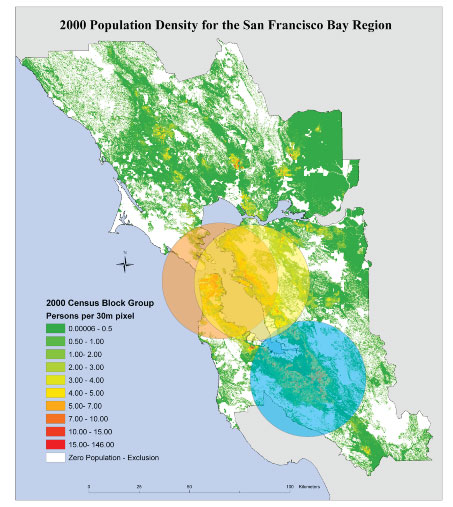
Circles indicate a 20-mile radius from China Basin, Coliseum, Diridon sites

Circles indicate a 20-mile radius from China Basin, Coliseum, Diridon sites

The Giants frequently like to point out that 50% of their ticket sales come from south of the San Francisco City-County line. Roughly half of those come from Santa Clara County, and many of those are long-time Giants fans. Many are corporate interests who can’t or won’t buy into the A’s where they’re currently situated. Sometimes it’s both. If they’re that worried, why not measure it? Let’s set a baseline for how much revenue comes from the South Bay, and if the Giants see an attributable drop to the A’s move to San Jose, MLB can set compensation on a seasonal basis until the loans on AT&T Park are paid off. I’ve suggested in the past the the A’s simply shift part of their existing revenue sharing check – which basically is paid by the Giants anyway given the clubs’ relationship to the revenue sharing pool – and be done with it. Once the A’s move in, then use the baseline. The fact is that San Jose is too far from either San Francisco or Oakland to be even remotely optimized as a market. If MLB wants to maximize sales to the entire Bay Area, it needs to maximize the sales territory. Ever wonder why Oakland doesn’t have great retail shopping districts or a mall? It’s partly because long ago, retailers and developers decided they could get sales from Oakland without having to locate in Oakland by locating in Emeryville, San Leandro, and even SF for some major stores. At some point MLB will have to decide if it wants as much from the Bay Area as possible or not. The status quo will surely not provide that.

Finally, there’s this matter of the Giants getting the South Bay baked into the $100 million purchase price paid by Peter Magowan and company in 1993. That price was a hometown discount, well shy of the $115 million offered by Vincent Piazza when he tried to move the team to St. Petersburg. We’re familiar with the hometown discount since it allowed Steve Schott and Ken Hofmann to get the A’s from Wally Haas for a cut rate. However, that brings up the question of how much the T-rights for the South Bay were worth back then and now. Below is a table showing the purchase prices for eight teams that changed hands in the early 90’s.

franchisesales-early90s

So Magowan paid about the same for a bigger market, greater legacy team as Drayton McLane and Nintendo did? Barely more than the two National League expansion franchises, both of whom were in inferior markets compared to the Giants? Incidentally, Magowan initially offered $95 million but may have brought in additional outside money to bolster the bid (at the time Magowan was worth a “measly” $60 million, hardly billionaire status).

If $95 million could be considered the Value of a Replacement Franchise, that doesn’t say much for having additional value baked into the 1993 price paid for the Giants, whether that value comes from T-rights to the South Bay or not. In all of the resale cases, franchise values may have been artificially depressed to maintain that team in-market. That’s fine, better that than a free-for-all. Let’s not kid ourselves about how much Santa Clara County was worth back then. In fact, in 1993 the A’s franchise valuation was $114 million, well north of the Giants, close to Piazza’s bid, and more reflective of an open market valuation. Shortly after Magowan assumed control, he inked Barry Bonds and the franchise value took off. It’s hard to argue that the South Bay had so much value in that transition when Magowan such a huge discount in the process. There’s more meat to the story if the value is baked into the financing of the stadium. But that’s done in 2017, and the Giants want the South Bay in perpetuity.

The funny thing is that I’ve spent over 1,000 words on what is essentially no change in position on the part of the Giants from 2009, when Neukom took the helm. While the A’s and South Bay interests have shifted to an appeal to decency, the Giants haven’t budged one bit. It’s clear that one team is better at playing this particular game, and it’s not the one who has more World Series trophies.

Concentrated Cactus

It wasn’t 20 years ago that the Cactus League was hanging on for dear life. With 20 teams in Florida and only 8 in Arizona, there was legitimate concern that the days of playing in dry desert warmth were coming to an end. With the Dodgers finally escaping Vero Beach and both Ohio teams now camping out in the Phoenix suburb of Goodyear, there are now 15 teams in the Cactus League, making for complete parity with the Grapefruit League. And if you ask around, you might get the sense that Arizona is much better. The teams aren’t as spread out as they are on the other coast, which makes travel for teams and fans a veritable picnic.

Even with the addition of teams to the Cactus League, the league has consolidated considerably. Only three years ago, three teams were in Tucson. Now there are none. The Padres called Yuma home for 25 years and the Angels springed in Palm Springs for over 30. All 15 Arizona teams are at worst 40 minutes away from each other, many within only a few minutes of each other.

This concentration of teams is largely due to teams like the Reds and Indians sharing facilities. Right now there are only 10 ballparks among the 15 teams in the league. The five shared ballparks are fairly new, with three of them coming in the last three years for over $100 million each. The five teams who have ballparks to themselves (A’s, Giants, Cubs, Angels, Brewers) are in the oldest parks, though HoHoKam and Maryvale are less than 15 years old and the other three have undergone some amount of renovation in the last decade. In a couple years the Cubs are set to move from the middle of Mesa to the western city limit near Tempe/ASU, which brings them even closer to the other teams.

Developing a ballpark is like building a scaled down version of a normal major league ballpark. A park typically holds 10,000 seats, much of them bleachers. Flanking many of the newer facilities are entire complexes with large indoor training centers and 4-8 baseball diamonds. Being in an old facility situation, the Cubs were dissatisfied with Fitch Park, only a few blocks south of Hohokam. The new plan has the ballpark colocated with the training facilities and a Cubs-themed village of sorts, all next to a lake stocked with catfish and trout. The final price of all of this is guaranteed to be well above $100 million and probably closer to $200 million.

Wrigleyville West rendering (source: East Valley Tribune)

At the other end of the spectrum is the A’s. Despite being wooed by developers to consider a move to the new Salt River Fields at Talking Stick, Lew Wolff chose to stick with the City of Phoenix and the A’s longtime home, Phoenix Municipal Stadium. Wolff has been trying for some time to work with the City and Mayor Phil Gordon on renovations to Muni, going so far as to offer to pay for it upfront as long as the city pays the A’s back over time. Wolff considers the $30 million pricetag on Muni renovations chump change – not the best choice of words but an apt description compared to the other mostly taxpayer-funded facilities.

Like the Cubs and Giants, the A’s have a split facility. Muni is at the south end of Papago Park, while the training facility and practice fields are at the north end more than a mile away. Wolff and the front office apparently like this arrangement, so no need to scope out a new site. There’s no denying that Muni is long in the tooth:

Wolff, though, said he’s hardly looking for a total reconstruction of the A’s current Spring Training site. He’d like to tear down and rebuild the blockhouse of an office and clubhouse building at Papago Park and make significant upgrades to Phoenix Muni, which was opened in 1964. The infrastructure of that yard is crumbling as evidenced by a water pipe break this week that flooded some of the A’s clubhouse offices.

Sounds familiar. At least Phoenix didn’t ruin Muni by sticking a huge triple-decked football stand in the outfield. Next year I expect to head out to Phoenix to catch some games while my brother is still going to school at ASU. By then I hope that Wolff and Gordon have hammered out a deal, because if they haven’t Wolff will have to start all over again with a new mayor. I prefer being able to fly into PHX and take the new light rail line from near the airport to the station near Papago to catch a game before settling in. No other Cactus League park is near transit the way Muni is. If Wolff and Gordon can’t strike a deal, there isn’t anywhere for Wolff to look, so it would be yet another year of staying at a decaying stadium in a nice climate. If the familiarity with obsolescence breeds contempt, Wolff must be feeling like Phil Connors right about now.

Revenue sharing rollback?

Fox Sports’ Ken Rosenthal is at it again. This time he’s talking about that horrible, disgusting word that I loathe, the one that makes my skin crawl, the C-word.

That’s right. Contraction.

Rosenthal notes that some of the big market owners are grousing about having to send money to low revenue franchises such as the Rays and A’s, who conveniently don’t have new ballparks to help their revenue cases. Both teams should be the likeliest candidates because of this. However, all is not as it appears to be! Rosenthal walks back the threat in the context of upcoming CBA negotiations. To wit:

Such a threat would, however, change the tenor of the upcoming labor negotiations, raising the tension considerably. Yes, the owners always could pull back to extract other concessions, but if the A’s can be saved, why risk a work stoppage to eliminate one troubled franchise?

Naturally, he pivots to an A’s move to San Jose, which could (and should) resolve the A’s poor revenue position. In the grand scheme of things, improving the A’s financial stance may bump up total MLB revenue 1% on annual basis. That’s not enough to make Joe Fan notice, but if the game is as also about getting more owners to sign off on the financial model for the next 5-10 years, it’s an important battle to not have to fight.

Right now, MLB and MLBPA are set to go into CBA negotiations with several draft related items such as bonus slotting, a potential international draft, and the possibility of trading draft picks (yes please). Competition matters include increased replay and that extra playoff round. These items are only peripherally related to how the revenue pie is split, so the tension regarding those matters is projected to be minimal at best. That makes the biggest struggle not between players and owners, but rather between owner haves and have-nots. It has building to this ever since revenue sharing was introduced, and the financial document leaks of last summer only added fuel to the fire.

For a while I’ve been talking about how revenue sharing isn’t going to be expanded. It faces a rollback, strange as it seems, and the big market teams are pushing it. Bud Selig is listening, as his response to Hank Steinbrenner’s comments from earlier in the week shows:

“We have more competitive balance than ever before,” Selig said. “We have more competitive balance than any other sport.

“Now, look, is the system perfect? No. I didn’t say it was perfect, but I said that I think what exists today is pretty darn good. In the next labor negotiation, we have to tweak it in some areas, and it’s significant tweaks.”

What kinds of tweaks are we talking about here? There might be a tweak to the luxury tax, but that would only really satisfy the Yankees. Revenue sharing is defined as 31% of revenue minus expenses. Which means that teams keep more than 69% of their gate, local TV and radio money thanks to the ability to deduct stadium costs. Forbes had the Yankees 2009 revenue at $440 million after expenses and revenue sharing. By reducing the required share from 31% to 25%, the Yankees could see their net revenue approach $500 million, half of that excess likely going to yet another free agent pickup.

On the other end of the spectrum, a have-not team like the A’s could see its revenue go south by only a few million. It also means that other have-nots would take similar hits. In practical roster terms, this means not signing some like Grant Balfour. For a team that tends to hoard revenue sharing like the Pirates, it simply means they have less to hoard since they are forever playing the waiting game until their competitive window opens.

(You can stop your laughing now.)

Thankfully, the have-nots and middle class teams outnumber the big markets. They’re not going to take this lying down and they can lobby Selig just as effectively as the Steinbrenner brothers or John Henry (who once owned a have-not team in the Marlins). What to do then? As Rosenthal suggests, getting one team off the dole – namely the A’s – could be a big difference maker. The Twins are already there. The Marlins will be healthier starting next year. The Royals have a greatly renovated ballpark and a fantastic farm system which could literally pay dividends over the next several years. The A’s will be once they have a ballpark built (and they have the revenue streams to pay for it). That leaves the Rays as the only team that can’t lift itself up by its proverbial bootstraps. Knowing that the Rays probably won’t have anything done at least through this next CBA means they are the only team to worry about instead of four or five should the A’s situation be resolved. The sooner the owners make this happen, the sooner they can end this major internal distraction and rally in solidarity against their real enemy: the players union.

.

P.S. One other thing that Rosenthal touches on is debt or legal issues facing certain owners like Fred Wilpon, Frank McCourt, and Tom Hicks. It would seem that owning a team is a license to do some seriously crazy things, like investing with Bernie Madoff or buying a bunch of other franchises that one can’t afford. While Selig may look to enforce debt rules better, his reach doesn’t go as far as telling owners how to run their own personal finances. Is this recent history of individual owner financial troubles simply a remnant of the economic downturn or something else? I don’t know that any additional “screening” of potential owners would help. It’s not like choosing owners is going to become an open, democratic process overnight. They don’t call it The Lodge for nothing.

P.P.S. Ray Ratto also dismisses contraction.