Sacramento, Seattle prep arena proposals

The March 1 deadline for the City of Sacramento to present a complete new arena proposal for the Kings and the NBA to consider has pushed at least one city to react in anticipation. Last year it was Anaheim, this year it’s Seattle. Seattle has been rumored for the last few weeks to have a big-money white knight getting ready to lure a team to the Emerald City. That white knight’s name is Chris Hansen, a Seattle native and SF hedge fund manager.

Seattle and King County held a joint press conference today to give details on the plan. Mayor Mike McGinn’s website has the presser and some backing info. The arena would cost up to $500 million, with $290 million by Hansen and his team(s). The big key to the plan is that unlike KeyArena on the other side of downtown, the new arena would be designed to house both NBA and NHL franchises. While there aren’t specifics about the financing, it’s clear that the arena deal would only work if teams from both leagues relocated there so that revenues would be high enough to cover debt service. Naturally, ensuring 82 regular season games, 3-4 preseason games, plus a good likelihood of at least one playoff series every year, would go a long way towards covering the loans that will be necessary. KeyArena would serve as a temporary home while the new arena was under construction.

Seattle and King County would partner up for $200 million in public financing, which would be backed by ticket and sales taxes. While they didn’t get specific, both City/County and Hansen and public financing as it relates to I-91, the 2006 ballot initiative that only allowed for such financing if the City could get a reasonable ROI (3.1% currently).

Hansen and associates have bought a three acre property south of Safeco Field in the city’s SoDo district. Three acres isn’t large enough for a new arena, so additional land will have to be acquired. The unacquired land includes Showbox SoDo, a warehouse concert venue. It would appear that Showbox SoDo, which was purchased by Showbox in 2007, would have to make way for the new arena.

Comparison of Seattle and Sacramento arena proposals

For its part, the City of Sacramento has put out some basics from its new arena term sheet, which is still in the works and to be presented to the City Council on February 28. The upshot from the $387 million proposal is that the Kings owners, Joe and Gavin Maloof, will have to put up $60 million in cash and donate $25 million in land to make the deal work. It’s unclear if the Maloofs, who already have sold off numerous assets and remain in debt to the City, have the resources to pull this off. The total cost of $387 million also feels rather low, at least by California standards. $200 million in public financing would come from the advance sale of downtown parking revenues.

Both plans have major questions attached. Besides the Maloofs’ outlay, there is a question of whether or not the NBA would sign off on such a deal, especially if the Kings’ low revenue position coupled with debt keeps the team at a competitive disadvantage. The Seattle plan’s dependence on having both NBA and NHL teams in-house sounds looks like a major potential stumbling block due to the complexity of catering to both. Both leagues currently have teams up for sale (NBA’s New Orleans Hornets, NHL’s Phoenix Coyotes), but both would prefer to keep them local if at all possible. Seattle’s plan makes the most sense if there’s only a single ownership group for both teams, as that would prevent competition between two ownership groups from derailing negotiations.

Chances are good that among the Hornets, Coyotes, and NBA Kings, at least one of them will move in the next few years, perhaps two or all three. When that happens it’ll be a tragic day for the adversely affected fans. The cycle of heartbreak continues.

Forbes loves the Warriors

As part of Forbes’ annual analysis of the NBA, staff writer Tom Van Riper put out a piece on our hometown heroes, the Golden State Warriors. Much of the info in the article has been dealt with elsewhere, such as the differences between Chris Cohan and the Joe Lacob/Peter Guber ownership group, or the latter’s interest in a new arena in San Francisco. More interesting and revealing is this tidbit about the new TV deal negotiated between the Warriors and Comcast:

That agreement paid the Warriors approximately $50 million up front—enough to take the sting off the purchase price—and roughly tripled the annual rights fee to over $25 million from $9 million. The agreement is for 18 years, with provisions to periodically renegotiate along the way.

Indeed, the $50 million probably did help pay down debt associated with the franchise purchase. Plus they didn’t take too much upfront, as $25 million per year is a healthy amount for an NBA team – though far less than the $150 million per year the Lakers are getting. No matter how bad the team gets (and they’re still bad despite a new coach this year), the Warriors remain an attendance and ratings bonanza. So hats off to Lacob and Guber for working the numbers. The TV deal runs well past the end of the new CBA, though it’s likely the team will option out and negotiate a new one before the decade is out.

When it comes to building a new arena, the obstacles are clear. It’s hard to build in this state. It costs 20% more to build than in most other markets. There is no redevelopment money available, let alone other public funds. The Bay Area won’t approve a stadium or arena tax. Yet it’s clear that ownership sees the gleaming lights of SF and wants to turn them into dollar signs. The only issue is the cost of a new arena, which Forbes pegs at up to $1 billion. That may be true, especially if the arena can’t open earlier than 2018. I think that $1 billion is the line of demarcation. Anything under that it and it would be worthwhile to invest in arena. Above that and it’s prohibitively expensive.

The actual raw cost to build at Mission Bay shouldn’t be more than $750 million even in 2017. Material and labor costs shouldn’t rise that high. The additional cost would be to furnish the arena, which would be co-owned and operated with the Giants, Burdened by a high construction cost (mortgage), both parties would be motivated to sell the arena for every kind of event from tiny to large, so the club areas, suites, and auxiliary spaces would be decked out to a degree never before seen in the Bay Area. And it’s likely that given the locale, the teams would attract a third party interested in fronting some of the construction cost in order to secure the operations contract for the venue. That could be AEG, Global Spectrum (a Comcast subsidiary), or even the Sharks, who operate HP Pavilion.

Right now the Warriors are a mere renter at Oracle Arena, and not for cheap at $4.7 million per year and little access to non-game revenues. They don’t have a say on who runs the arena, which has led to allegations that SMG didn’t try very hard to bring in events. Last summer, AEG and Live Nation were set to bid on the next deal to run Oracle Arena. Can’t exactly blame Lacob and Guber for trying to maximize their investment, though building in SF as opposed to staying in and improving Oracle Arena could prove a more cost-effective decision in the long run.

A perfect spot for a new arena is Lot C near AT&T Park.

As the Warriors reach the end of their contract, SF and Oakland will be “forced” into a bidding war for the W’s. SF and the Giants will be ready with an infrastructure/development rights deal, probably at Lot C on the other side of Mission Creek. The lot measures 400′ x 514′ not including sidewalks, which should be enough for a typical roundrect or oval arena, though not wide enough for the circular bowl layouts utilized at Oracle Arena or Staples Center. (HP Pavilion is roughly 440′ square). If Lot C were used, only 800 parking spaces would be lost, which would be easily replaced by a garage and ancillary development on Lot A. Lot C has a T-Third stop right outside it, plus Caltrain is only a few blocks away.

Oakland and Alameda County’s pitch lies squarely in the Coliseum City concept. By the time the cities get to brass tacks, we should know where the A’s and Raiders will be playing in 2014 and beyond. The A’s have a long-term play, the Raiders have both short and long-term scenarios. If both teams were to sign onto Coliseum City, it’d be very easy for the Warriors to partner up with everyone else. If the A’s and Raiders are headed elsewhere, it would be difficult to convince W’s ownership to shoulder the load for Coliseum City, especially if a compelling offer were coming from across the bay. I’ve advocated in the past for a downtown Oakland arena or one at Victory Court, but the cost to make that happen would probably be higher than the already city-owned lots in SF, so that’s not happening.

All the while, David Stern (or his replacement) would be pumping up the “need” for the Warriors, just as he’s done in practically every other city. The Cohan-era Warriors were analogous to the Autry-era Angels, in that they were generally undervalued and have great potential. Lacob and Guber intend to make good on the potential, preferably both on and off-court, though they’ll settle for off-court at least in the near term. If that path leads across a shiny new east span of the Bay Bridge, so be it. At least they don’t have territorial rights standing in their way.

Whither the Hornets?

On my birthday I woke up to news that the NBA and players had reached a tentative agreement to play the 2011-12 season. 20% of the regular season will be lost as teams will be forced to play a truncated, 66-game, 120 day season ending in late April. I thought this was a good opportunity to radically change the NBA schedule, which runs from Halloween to Easter with playoffs through the first week of June, to a pushed back schedule of Christmas to Memorial Day and playoffs until late July or even early August, commonly known as the dog days of summer. Oh well, they didn’t make such a change so we’re “blessed” with a rapid fire schedule with numerous back-to-back-to-back game sets. It will surely be brutal to the finish.

It’s also brutal seeing what’s happening to the New Orleans Hornets. GM Dell Demps had a deal to send superstar point guard Chris Paul to the Lakers, who would send Lamar Odom back to the Hornets and Pau Gasol to the Rockets, who would then send a bevy of players including Luis Scola and Kevin Martin to New Orleans. It seemed a fair trade last week and was assumed to be a done deal until Commissioner David Stern stepped in and killed it, citing the now infamous “basketball reasons”. An attempt to revive the deal with additional parts was also rejected, as were two attempts by the other LA team, the Clippers. The Hornets, which are owned by the league and the other 29 team owners, are completely handcuffed when it comes to making player moves and will surely field an awful team this year, whether they trade Paul by Christmas or not. The reasons for doing this are rather divergent. Cavs owner Dan Gilbert complained about not getting a piece of the Lakers’ luxury tax payment. Mavs owner Mark Cuban thought it was unfair to “take advantage” of a small market team. There were plenty of whispers that Stern wanted to stick it to superagency CAA and make Paul an example that the players can’t just dictate where they wanted to go, though that’s not what Paul was doing in this case. Supposedly Paul is being kept on the roster simply to raise the team’s attractiveness for potential buyers, even though it’s unlikely that Paul will stick around when he becomes a free agent in the summer.

A year has passed since the NBA bought the Hornets from two-time owner failure George Shinn, and there is no sign of a local buyer that could come in to rescue the team, despite the fact that the team reached its season ticket and attendance goals last year. There are a few prominent locals who could be positioned to be minority owners, but that’s not going to be enough. The NBA seems to have raised its bar to prevent undercapitalized groups from buying, such as Atlanta Hawks’ failed buyer Alex Meruelo. For the NBA to sign off on a new owner for the Hornets, the buyer will have to A) be willing to overpay for a franchise in the Big Easy, perhaps as much as $400 million, and B) be willing to absorb losses or deal with razor-thin margins in the market. It’s no wonder, then, that the Hornets are a prime relocation or contraction target.

Continuing to own the Hornets is a terrible conflict of interest for the NBA, which can’t operate the team normally while it tries to maximize value for a sale. On one hand, it wats to retain Paul as a key asset even though it’s clear he’s skipping town. On the other hand, it doesn’t want to saddle the team with a bunch of long-term contracts (read: talent) that would make the team less attractive for buyers. It’s a bad spot to be in, and it makes me scared that the league will simply throw its hands in the air and give up. I hope that’s not what happens, since there are options they can pursue:

  • Sell the team to Larry Ellison if he’s still interested. Ellison would obviously move the team to San Jose. I wrote in January that moving a team to San Jose, as much as Warriors owners Joe Lacob and Peter Guber would rail against it, could advance talks in San Francisco for an arena there, since it’s likely that an arena deal in SF couldn’t be completed for either the W’s or relocated Hornets until after the 2016-17 season. Neither San Jose nor Oakland would like it much, but the NBA would at least know there’s some cushion there. Ellison is wrapped up in the America’s Cup project, so it’s unclear if he still has interest in the Hornets. If he paid $450 million, as Lacob-Guber did for the Warriors, the NBA probably wouldn’t blink twice and would back up the moving vans for him. The problem is that last year Ellison offered $350 million for the Hornets, so why would he pay $100 million more a year later for an arguably devalued franchise? If he paid that $350 million for the franchise, and the remaining $100 million went to Lacob/Guber so that they could terminate the lease at Oracle Arena and jumpstart the process in SF, that might just work.
  • Find a Seattle-based buyer and move the team to the Emerald City. Stern played hardball with Seattle as the Sonics were on their way out of town, so it isn’t likely that he or the owners would approve such a move until an arena deal were in place. Any publicly financed arena deal up there is every bit as dead a possibility as one in the Bay Area. It’s also unclear who would surface as a potential owner.
  • Move the team to a place with a new arena, such as Kansas City or Louisville. Neither market is particularly rich so it’s at best a lateral move. Both markets have new arenas, with Louisville an arguably better hoops market. Like Seattle, it’s unclear who would surface as buyer. The Kansas City option revives the possibility of the shouldn’t-be-revisited Kansas City-Omaha dual-city franchise since Omaha also has a relatively new arena. Forget I mentioned it.

This is not how David Stern wanted to wind down his career. A labor stoppage is forgivable among hardcore basketball fans, of which there are many and I am one. There are enough stars to propel the league forward. The Hornets debacle is a different story. It’s a complete clusterfuck, and it will be expensive for the league to extricate itself from the mess. The only question is who is going to pay. Does the NBA give up on the NOLA market, a terrible PR move, then stick the buyer with the tab? Does it fold the team and give the money back to the other owners? That itself is an even worse admission of failure, given that none of the four leagues have contracted teams in the last three decades. Figuring all of this out is well above my paygrade and is why Stern has been at the helm for three decades. It’s a no-win situation for him, and for that, I don’t envy him one bit.

News for 11/17/11 (Post Owners Meetings Edition)

Time for a recap of the owners meetings.

  • The Astros will be in the American League West starting in 2013. Next up: Figuring out the details of the scheduling format. Despite the grousing from many about the change, a few columnists have written in favor of the move, including ESPN’s Jayson Stark and Danny Knobler of CBS Sports. Newly approved owner Jim Crane was required to accept the move to the AL as a condition of his approval. Crane was unanimously approved.
  • Stark also considers how another change, the addition of two more wild-card teams, could affect the annual playoff chase and divisional races.
  • MLB and the MLBPA have agreed to a five-year CBA. Ken Rosenthal reports that an announcement will occur on Monday.
  • Larry Baer was approved as the “control person” representing the San Francisco Giants at future owners meetings. There may have been more recent instances of this, but one high-profile one I clearly remember is Paul Beeston when he became CEO of the Toronto Blue Jays. Howard Lincoln also performs a similar duty on behalf of Nintendo for the Seattle Mariners.
  • The Los Angeles Dodgers saga continues, with pre-screening for prospective bidders scheduled to begin soon. That’s a good thing, because as Forbes’ Mike Ozanian reports, the Dodgers are saddled with a whopping $555 million in debt. Another lawsuit has been filed by Frank McCourt against Fox for allegedly trying to “interfere with the sale of the Dodgers and their assets in bankruptcy.”
  • Nothing on the A’s front, though there are murmurs of something happening in January. Maybe. The wait continues.

In other news…

  • The outlook for the NBA is not good. Dwyane Wade and most of the players rank-and-file believe the 2011-12 season can be saved (as they should since they’re losing paychecks from here on out). Meanwhile, former players union executive director Charles Grantham joined Kareem Abdul-Jabbar and Magic Johnson in voicing their opinion that the players should have taken the last “50%” deal.
  • NHL players are looking at what’s happening in the NBA very carefully, since hockey’s CBA will end next September.
  • Starting Friday, the Florida Marlins will no longer exist. They will be known forevermore as the Miami Marlins.
  • I haven’t posted much on the Minnesota Vikings’ stadium push, simply because it doesn’t seem to have any real momentum or money behind it. The team remains focused on the Arden Hills munitions site in suburban Ramsey County, whereas the City of Minneapolis has sites within city limits.
  • CSN Bay Area’s Nick Rosano has an update on the San Jose Earthquakes’ stadium plans. A permit hearing should be held soon. I’ll attend it if I can.
  • Santa Clara approved the $10 million expenditure for pre-construction work at the 49ers stadium site. $6 million will actually be loaned by the team.
  • MLB is commissioning a study on the economic impact of Miller Park now that the ballpark is well-established and past its honeymoon period. The study will be done by the University of Wisconsin-Milwaukee’s Institute for Survey and Policy Research. The same group did a study shortly after the opening of Miller Park which fell under heavy criticism. The study is due in the spring and could provide ammunition for either pro or anti-ballpark groups in San Jose (yes, I know that the anti-ballpark folks will trot out a Cato Institute study). Since the study is being commissioned by MLB, I expect it to be somewhat baseball-friendly, though not as much as the previous one.
  • The Financial Times has a Moneyball article featuring both Billy Beane and Michael Lewis. It’s a good read and serves as a nice epilogue to the book and movie. There’s also a discussion of the article at AN.
  • A new article by Carol Rosen of the Almaden Resident (a Silicon Valley Community Newspaper) examines the pro and anti San Jose ballpark factions and their stances.

That’s all for now.

News for 11/09/11

Tomorrow morning I’ll be in SF to check out oral arguments for the State vs. Redevelopment case. If I can liveblog it, I will.

The regular media (SFGate, Merc, MLB.com, KGO) covered yesterday’s proceedings fairly well, though I’m surprised there wasn’t a bigger mention of the discussion about the referendum requirement. No matter, the San Jose City Council formalized the requirement by amending the motion just before passing it. Still, I don’t think this is the last of the referendum discussion.

There’s other news on the ballpark/stadium front:

  • The Royals may or may not have agreement in place to sell the naming rights to venerable Kauffman Stadium.
  • Rangers Ballpark in Arlington is undergoing $12 million in renovations, including a major revamp of the area behind centerfield. Changes will include relocation of the suboptimally located visitor’s bullpen, the addition of an indoor club and several concession stands.
  • The University of Washington’s Husky Stadium just started a massive $250 million renovation project. The track will be removed, the field dropped four feet, and more seats will be added close to the field, similar to the changes at the LA Memorial Coliseum. In addition, new locker room and training facilities will be added, as well as premium seating options. Like the $321 million Cal Memorial Stadium renovations, these will be largely dependent on donations for funding. The Huskies will play next season at CenturyLink Field (formerly Qwest Field).
  • The Populous architect overseeing the 2022 Qatar World Cup project believes that the venues will not need air conditioning. The goal is to make the venues carbon neutral, something that made the winning Qatar bid attractive. A company called Arup Associates has a demo of the technology in place at a 500-seat stadium, though you could naturally be skeptical about the ability of the tech to scale to a venue with 100 times the spectators.
  • The Sacramento Bee’s Marcos Breton wonders what the ongoing NBA lockout means for the local arena effort.
  • A report on NPR’s Morning Edition goes over the economic impact of the lockout.
  • A’s naming rights sponsor Cisco Systems (Nasdaq: CSCO) beat the Street today, which may signal an upswing for the networking giant. The stock was down during the regular session but up in after hours trading.

That’s all for now.

CBA Talk: Cost certainty is a four-letter word

After another 8-hour marathon negotiating session, the NBA and NBPA again found themselves without any kind of agreement for a new CBA. This time, Commissioner David Stern also threw down the gauntlet, leaving the owners’ newest offer on the table for the players to stew over until the close of business Wednesday. If the players don’t accept the offer, the league will pull the deal and offer something measurably worse. First, let’s go over the basic tenets of the league’s offer.

  • League offers 49-51% “band” of BRI (defined league revenue) to players. This is essentially the same as the 50% offered to the players previously, but with a few wrinkles. The base offer is 50% to players, plus 1% annually set aside to fund retired player benefits. The 50% share would be dependent on the league reaching an unspecified BRI level, probably $4 billion. Any amount over that threshold would be split 57-43 in favor of the players, up to a total cumulative BRI split of 51% for the players. Running the numbers, for the players to reach 51% the league would have to beat the $4B revenue projection by $666 million, or 16.67%. That led NBPA president Derek Fisher to characterize the 51% figure as “impossible” to attain. In a move reminiscent of the NHL’s CBA, the players would be limited to 49% of BRI if BRI were significantly lower than the projection (also by an unspecified amount).
  • Escalating Luxury Tax. The previous dollar-for-dollar tax would be transformed into a much more punitive tax, starting at $1.50 per dollar over the tax threshold for the first $5 million over, then $1.75 for the next $5 million, $2.50 for the next $5 million, and $3.25 for the next five million. In addition, a “double tax” would be assessed at either $1 (league) or $0.50 (union) for teams who pay the tax three out of five years.
  • Variable Mid-level exception. There would actually be two definitions of the exception. For teams not over the luxury tax threshold, they’d be able to pay $3-4 million for 3-4 years. Teams over the threshold would only be able to pay $2.5 million for up to two years. There’s also some talk of having the maximum length of a MLE contract vary from season to season. This is clearly the most confusing part of the discussions and may be in flux, so expect some corrections in a few hours.
  • Sign-and-trade modifications. Luxury taxpayers would no longer have the ability to do sign-and-trade deals. If a team is over the cap and tax threshold and wanted a marquee free agent, they could work out a trade with that player’s previous team by having the previous team sign him for a lengthy max deal, then trade him immediately to the desired team for a mix of other players and draft picks.
  • Offer valid until close of business Wednesday (November 9).

Those five tenets were suggested by federal mediator George Cohen, and subsequently adopted by the league. A sixth item involving higher shared revenues for teams who don’t trigger the luxury taxes was not approved. For their part, the players aren’t backing off their request for 52.5% of BRI, though Fisher seemed to be somewhat amenable to 51% if it were a truly achievable number.

The Wednesday ultimatum sort of acts as a mini Doomsday, since the NBA will offer less if no deal is reached and it will probably cancel games in December. Any hopes of being able to play a full 82-game schedule in 2011-12 would be dashed. And there’s the growing possibility that the union will take a page out of the NFLPA’s playbook by calling for the union to decertify and an antitrust lawsuit against the NBA.

BRI for the 2010-11 season was $3.8 billion, which was up from 2009-10’s $3.65 billion, so it’s not hard to see the $4 B target as achievable. That’s where both sides are getting the “$40 million equals 1%” argument from. The players got 57% of BRI in the previous agreement, so a drop to 52.5% or 50% is a major concession. The problem for the players is that there’s a huge difference between the economy back when the last two CBAs were ratified and today’s economy. The NFL accomplished a major pullback in its negotiations with its players. The NHL is looking at the NBA talks with great interest, and is rumored to be pushing for a major pullback as well. MLB has no guaranteed payout to players as it has no salary cap or floor, but it regularly pays less than 50% to its players. The new trend for the four major North American sports is for the player-league split to drop to between 48% and 52%, depending on how revenue is defined. It’s quickly becoming a matter of bargaining against the other leagues, perhaps more than it is about preserving or changing existing agreements.

Every week lost in the 2011-12 NBA season translates to $100 million lost in game revenue, including tickets, other arena revenue, and broadcasting revenue. Over the span of ten years, which is the preferred CBA length for both NBA and NBPA, a few hundred million is not that much to lose compared to the impact of losing 2.5% of BRI over the course of ten years ($1+ billion). The league may see this as a test of the union’s collective will. Some want to play ASAP, others want to go the decertification route. It’s getting to the point that several weeks of games (and thus paychecks) will be lost and unsalvageable. There’s no guarantee that by holding out, the players will end up with a better deal. It didn’t work for the NHL players, and it didn’t work for the NFL players. MLB and the MLBPA must be laughing at their counterparts. Their biggest bone of contention is fixed slotting for first round draft picks, which the players union considers its own miniature form of salary cap. Somehow both sides have convinced the players that the lack of a salary cap/floor/guarantee is best for all concerned, despite the players getting less combined than their counterparts. But they get the biggest, longest individual contracts with most guaranteed years. While baseball’s business model does little for broad competitiveness among teams, it generally works for the players in terms of meritocracy and tenure. That’s hard to argue with when the other leagues have so much trouble arguing over details.

News for 10/7/11

If you haven’t seen it yet, you might want to wear shades before viewing the redesigned Miami Marlins logo:

Not enough warning? My bad.

Don’t think that’s crazy enough? Then try on this animatronic sculpture that will go a*****t when a Marlin hits a home run. (Miami New Times/SB Nation)

Did we enter a ballpark or a casino? Or the inside of a pinball machine? (Image from SB Nation)

Bad news for Mariners fans: the team’s general suckitude may continue well into the future, as long as minority owner Chris Larson’s divorce puts a freeze on spending. (Seattle Times)

San Antonio is looking to build a downtown ballpark after all. Too bad it’s only for the college team (UT-San Antonio) and the AA Missions. (SA Business Journal)

Business owners near NBA arenas are frightened about the impact of an extended lockout. (USA Today)

The NBPA rejected an owners’ offer of a 50/50 split of revenue (after expenses). The players wanted 51%. Bad move, players. That was the best offer you’ll get. You could’ve made it up with more guaranteed years or other concessions. (CBS Sports)

After getting slapped down by the Tigers Mets in their request to have their AAA affiliate play in Newark for a year, the junior team will play a barnstorming season in six different cities all of New York state. Nearly half of the schedule (37 games) will be played in Rochester. (NY Times)

Detroit citizens continue the good fight to save what’s left of Tiger Stadium. (ESPN)

Fitch withdrew its BBB- rating of San Jose Redevelopment Agency’s tax allocation bonds series 2006E and 2006F because the bonds weren’t actually sold. Fitch also put a Negative Watch on the NBA’s $1 Billion revolving credit facility, rating it a BBB+ in the process. (Marketwatch/Reuters)

Youth ballfields near the new Yankee Stadium won’t permanently open until 2012, a full three years after the big stadium opened.

September radio ratings are out. Looks like things are stabilizing a bit.

Dan Hennessey is stepping down from doing delay recaps at the Baseballin’ on a Budget blog (ESPN SweetSpot network). He did a pretty good job. If anyone’s interested, apply within.

BREAKING (2:30 PM): Union Pacific has decided to sell 167 acres of land near NUMMI. The land was supposed to be developed as a new railyard. BANG’s Matt Artz also got from the news that the northern parcels, 94 acres in all, would be available for only 12-15 months. The southern 53 acres (near the 880-Mission interchange) apparently would not be subject to such a deadline. San Jose mega-developer Barry Swenson has expressed interest. 

The adult conversation

Two weeks ago, Think Big Sacramento released its 100 Day report (PDF), meant to provide a clear picture of funding and economic impact of a new downtown railyards arena for the Sacramento Kings. The 199-page report is actually comprised of 10 separate reports, the last two covering nearly 70 pages of economic impact. Unfortunately, no reader will find the solution within the 199 pages, though that can be somewhat forgiven since they’ve only had 100 days to put this together. Still, the document is a good, important step on the way to actually building anything because it actually lays out all of the financing options, public and private.

Barrett Sports Group prepared a 74-slide Powerpoint presentation on those financing options. I’ll cut to the chase and list the conclusions (emphasis not mine):

  • Public-Private finance plan will likely include a public contribution in the form of land
  • Parcels of public land located in the downtown area, many of which are not currently being used or are severely underutilized have the potential to increase in value due to the development of the ESC downtown
  • ESC development development allows for the maximization of land sales that could increase the number of jobs created in the short term and increase the economic impact of the project by encouraging private development
  • Finance plan will require support from three areas: private investment, user fees and public participation
  • User fees represent a key contribution as these revenues are provided by those benefiting from the facility and bear a direct nexus to the complex

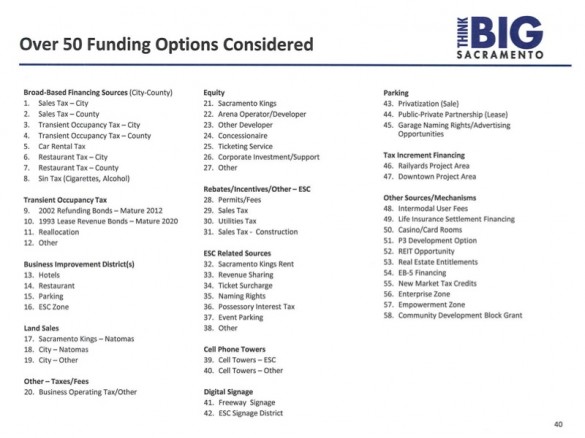
Doesn’t tell you much, does it? The conclusion actually belies the other key information within the presentation. For instance, BSG studied every possible public financing option, from taxes to fees to the sale of parking rights. Here’s the entire list:

funding_options-all-585x438

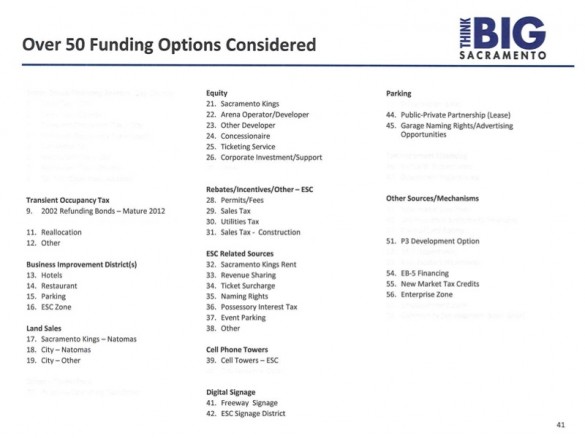
Unrealistic sources were culled, cutting it from 58 to 36. The following is the list Sacramento citizens, the public and private sectors can consider as feasible for any kind of contribution:

funding_options-culled-585x438

Once you get past the first eight options (the usual taxes used for many venue financing plans) the pickings get pretty slim. There was talk of potentially selling future parking revenue to a private operator in exchange for an upfront payment, which may be illegal in California. And notice how there’s no mention of redevelopment. That’s a good sign that the folks up in Cowtown are ready to engage in a substantive, adult conversation about how this is going to get done. The rest of the year is supposed to be spent creating the funding mix(es) that will be debated by the City Council, and in all likelihood, voted on by Sacramento voters. That’s a tough one to deal with, considering another component study’s admission that only one-quarter of visitors to ARCO/Power Balance come from within Sacramento city limits.

Some other interesting nuggets from the study:

  • The Oakland Coliseum gets $1.2 million per year from the numerous billboards spread throughout the complex. That’s about as much money as they get from the A’s. FWIW, the Raiders pay a little more than a half million bucks to the Coliseum Authority annually.
  • Public support for user fees is as follows: Selling naming rights: 74%; Parking surcharge: 71%; Ticket surcharge: 57%; Arena fee on concessions: 57%
  • One assumed source of revenue is the sale of other various lands, including the Natomas site where ARCO/Power Balance currently sits and another city-owned Natomas site.
  • A remote source of financing being considered is called EB-5, or “green card” financing. It would provide a conditional green card to immigrants who invest at least $500k or $1 million dollars. The Atlantic Yards project was cited as an example, though the EB-5 financing was used for ancillary development, not Barclays Center. The EB-5 may be what attracts Filipino investor Manny V. Pangilinan, though as someone a little familiar with the immigration process, I have to say that people with money or business skills aren’t the ones who need help with green cards.

While I’m glad that Sacramento is going through the process (even if it eventually leads nowhere), I’m confounded that Oakland has not gone through even a tiny bit of this. Why not? The Bee’s Marcos Breton nails the similarity between Sacramento and Oakland:

One thing is certain: Sacramento does not have the corporate base to privately finance buildings, such as AT&T Park in San Francisco or the Staples Center in Los Angeles.

Sounds familiar, right? No number of cute T-shirts or banners hung from railings is going to take the place of real discourse over what Oakland needs to accomplish to retain both of its outdoor teams, let alone the Warriors. If Oakland is serious about getting something done it needs to have its adult conversation. Not lip service. Not a claim of getting an EIR done in a year and then not having a draft in nine months. Getting something big done starts with getting the little things done. And if you’re not having that dialogue with your citizens, you’re just avoiding the subject.

P.S. Of course, Sacramento Mayor Kevin Johnson goes and blows away the adult conversation with an offhand comment about how Cowtown can support two teams, including a relocated A’s franchise.

Warriors ownership buys D-League team, may move to Bay Area

First reported by BANG Warriors beat writer Marcus Thompson (via David), the Golden State Warriors are buying the D-League’s Dakota Wizards franchise with an eye on moving it to the Bay Area. Both Thompson and Tim Kawakami think the eventual landing spot will be San Jose, which could create a plant-the-flag situation a la Bill Neukom buying into the San Jose Giants.

The ownership change will make the W’s only the fourth team to have sole control of a D-League team, the others being the Lakers, Spurs, and Thunder. All others have shared development pacts with one other team. That doesn’t mean that it always works. While it allows the parent team to install the exact offensive and defensive systems used by the big boys, it doesn’t always mean that the parent club will take advantage of it. The Lakers actually pulled back and didn’t operate the D-Fenders last season because they hadn’t figured out a way to effectively transition players from the D-Fenders to the Lakers. Operating a club is also expensive. The Lakers struggled figuring out a proper venue for the D-Fenders before settling on having the games be part of an early doubleheader with Lakers game. Given the notoriously late-arriving Lakers crowd at Staples, you can imagine how poor the attendance was. For the upcoming year, home games for the D-Fenders will be at the Lakers’ practice facility in El Segundo. The Spurs and Thunder have traditional out-of-town satellite relationships with their D-League teams (Austin and Tulsa respectively).

If you’re wondering where the Dakota Wizards might play after their last season in Bismarck, don’t think big as in the HP Pavilion. Too costly to do the changeover, and much too big for a D-League franchise, where the average attendance is around 3,000 per game. Instead, look to an ancient one-time barnstorming home of the Warriors, the San Jose Civic Auditorium. The Civic holds 3,000 and generally has a wide-open schedule. That lineage could also a factor. My favorite Rick Barry anecdotes are about playing in old arenas, including one where he chased a loose ball out of bounds along the baseline at the Civic and ended up running through a door and completely out of the arena onto San Carlos Street.

Henry J. Kaiser Convention Center would also be a good candidate, though I understand it would require some unknown amount of improvements before it was ready to host games again. There’s also the possibility of the Bill Graham Civic Auditorium being in play.

Update 1:30 PM – SJ Giants CEO Jim Weyermann has been named VP of Franchise Development for the Dakota Wizards. Given Weyermann’s South Bay ties, chances are that the franchise will move to the Bay Area once the sponsorships are lined up.

News for 6/21/11

The NFL and NBA are going hot and heavy with CBA discussions.

  • Latest proposal from the NFL (which has yet to be voted on by the owners) would guarantee a straight 48% share to the players, and would create a system in which all teams’ payrolls would approach the salary cap amount every year. The straight percentage is different from the previous system, which had the teams take $1 billion off the top for stadium expenses.
  • The NBA is proposing a “flex cap” which has a salary floor, max, and a sort of “supermax.” Previously, that upper limit was the luxury tax threshold, which if breached would require a dollar-for-dollar tax on additional payroll. The players consider the as-yet-not-enumerated upper limit a hard cap, since it provides a payroll ceiling. The two sides are early in their discussions.

Governor Brown is expected to announce an alternative to the budget he vetoed last week. Plans may include a revised (or not) take on redevelopment.

The California Redevelopment Association released a spreadsheet detailing the amounts that would have to be paid by various redevelopment agencies if AB 26 and 27 were signed into law by Brown:

  • Alameda County:  $7.7 million
  • Fremont:  $9 million
  • Oakland:  $39.7 million
  • San Diego:  $69.8 million
  • San Francisco:  $24.6 million
  • San Jose:  $47.6 million
  • Santa Clara:  $11.4 million

Remember that if the cities are not able to make these payments, they would not be able to issue additional bonds or otherwise acquire debt.

As initially reported by Rich Lieberman, KTRB is switching to a Spanish sports radio format, courtesy of ESPN Deportes. Once fresh capital is put into transmitter maintenance and facilities, I’d expect the 50,000-watt station to go after the… Giants. The Giants have Spanish broadcasts split between a 5 kW station in Pittsburg and a 10kW station in SF that drops to 500 W after sunset. Assuming the station got enough care and feeding, it could be a formidable player.