New info about Coliseum scoreboard project

People have been asking me everyday about the state of the new Coliseum scoreboard project. Until this week, all I could say was that most of the work would be happening in February and March. That’s partly because the Coliseum’s two scheduled major events: AMA Supercross last weekend, and Monster Jam on February 21.

Jane Lee’s column on Monday answered a question about the scoreboards.

Any update on if the A’s will have new scoreboards this year?
— Mike S., Alameda, Calif.

According to David Rinetti, the A’s vice president of stadium operations, the process for implementing the new HD video boards began Dec. 22, the day after the Raiders’ final home game, and is on track to be completed by the time gates open for an April 4 exhibition game against the Giants. Along with new scoreboards, new ribbon boards will also be on display by this time.

The new scoreboards will each measure approximately 36 feet tall and 145 feet wide.

Today a new Clubhouse Confidential blog post shed more light on the project. Renderings were also provided.

Rendering of new display package


To put things in perspective, each new board, which will take up the entire scoreboard frame in LF and RF, is almost 50 yards wide and 3 stories tall. There will be no permanent ad signs, though you can be sure that ads will be fixtures in the new video presentation. Still, there’s plenty of room on the boards themselves. Daktronics’ 13HD LED tech is being installed, just like the recent installations at Levi’s Stadium, Bank of America Stadium in Charlotte, and Jacksonville’s EverBank Field. If you’ve been to Levi’s, the new Coli’s boards compare with Levi’s south end zone board, which is 48′ x 142′.

Behind north end zone

Behind north end zone at Levi’s Stadium (view of south scoreboard)

Each pixel is 13 mm in size, or roughly a half-inch for those of you stubbornly stuck on Imperial measurements. That plots the pixel count at 854 x 3400, a very long panel though not so tall it can do Full HD (1080p). That’s the literal constraint the scoreboard frames provide. Considering that most people will be at least 150 feet away from a clear view of either scoreboard, I doubt anyone could tell the difference.

Ribbon boards are also being installed along the front of the plaza level seats. Those will be 5 feet high (Update: 3’6″ high) by 415 wide. 5 feet high is a bit curious, because it’s taller than the 3-4 feet high ribbon boards often seen elsewhere. I wonder if the boards will obstruct views from the lower concourse more than the already low-hanging second deck does. They only go from the end of the deck (Sections 200, 234) to the edge of the infield (211, 223) so at least the prime viewing areas won’t be affected. For those of you wondering about how ads and other information will be presented, consider that with few permanent signs remaining, ad space on both the ribbon boards and main scoreboards will be done on a sort of time-share basis. Sponsored promotions will appear far more prominently than before, which should lead to higher advertising rates by the A’s and the JPA/Raiders, who split revenue during Raiders games.

According to the Chicago Tribune’s 2014 visual comparison, each of the two new main scoreboards would place in the middle of the pack among MLB ballparks, though having two is something no ballpark can boast (nor should it). Recently there’s been a sort of Jumbotron arms race, with many displays less than a decade old being replaced by larger, crisper versions.

SB Nation comparison from May 2014

Chicago Tribune scoreboard comparison from May 2014

Yes, for once a key feature at the Coliseum will be superior to that at China Basin. However, the Giants have the scoreboard front and center, a much better placement than at the Coli. We all know what sits beyond CF in Oakland.

So say goodbye to this old relic, and hello to new technology at the Coliseum, which is always welcome.

The old scoreboard and DiamondVision combo

The old scoreboard and DiamondVision combo

One thing to keep in mind about all this scoreboard hubbub is that the A’s and Earthquakes (same ownership group) have been working on three different scoreboard projects in the last year: at Hohokam Stadium in Mesa, at Avaya Stadium in San Jose, and now the Coliseum. If there’s anything they’ll have a lot of experience with going into a new ballpark in Oakland, this is it.

P.S. (2:45 PM) – I checked with David Rinetti. He confirmed that the ribbon boards are 3’6″ high, so there shouldn’t be any obstruction issues. He also told me that the old scoreboards parts are being recycled, so they won’t be donated or auctioned off. Much of the original equipment has already been hauled away.

The Manfred era begins – Did anything change yet?

Over the weekend, the commissioner’s torch was officially passed from Bud Selig to Rob Manfred, starting the Manfred era in earnest. Manfred’s tenure as commissioner will depend largely on how he deals with specific business and big picture issues the sport needs to address. Selig handed Manfred a highly effective business model, surpassing $9 billion in revenue in 2014 along with the lengthiest uninterrupted labor peace of the four major pro sports. Certainly, Manfred could keep the ship pointed in the same direction while keeping the motor running, and there would be few complaints from the owners who elected him. But people don’t get commissioner’s jobs just to be caretakers; they’re expected to have their own agenda to push baseball beyond its current audience. That’s the part we the public don’t know much about yet.

In Manfred’s letter to fans, he mentioned that his top priority is to bring more people into the game, by greater youth outreach to foster the next generation of players and by streamlining the game to make it more palatable to casual fans, especially younger ones. The letter is quite high-minded, masking Manfred’s reputation as a tough yet also conciliatory negotiator. Manfred’s in his mid-50’s, which places him in the baby boomer era, seeing the worst of the 60’s and 70’s as a youth: concrete multipurpose donut stadia. His predecessor helped get rid of nearly all of the cookie cutters, though Manfred played the heavy in many stadium talks. League attendance has largely plateaued with only Oakland and Tampa Bay stuck with bad parks, so if he and the other owners want to see continued growth at the turnstiles, they’ll have to do something about those two teams.

CBA talks will begin before or during the 2016 season, and unless it goes badly there should be a deal struck by the World Series. That’s 20 months away. If talks are contentious, they could take out the 2017 World Baseball Classic or worse. We shouldn’t expect to see contraction on the table, as it won’t help extort new stadia out of those two markets, plus it will only anger the player’s union, who will see 50-80 jobs (not including hundreds of minor league jobs) disappear. And no, adding a player or two to every roster is not a good substitute. There will be some calls for greater revenue sharing, along with greater pushback against it by the big market teams. Players will want earlier free agency, tweaks to arbitration, and other perks. Talk of a soft or hard salary cap has largely died. Umpires signed a new CBA over the weekend, allowing their agreement to run concurrent with Manfred’s term, one less hassle for the new commish.

That doesn’t mean it’s all smooth sailing. There remain numerous legal disputes to work out, internal ones like the Nats-O’s-MASN deal, and external issues like the minor league antitrust and television blackout lawsuits. As a long time insider, Manfred is keenly aware of these battles, and of the future CBA negotiations.

That leaves little room for Manfred to take on the A’s and Rays’ respective plights. Manfred and Selig have remained committed to the Bay Area while rather noncommittal to Oakland. Quoth Selig from John Shea’s sendoff profile:

“I think two teams can exist in the Bay Area. Certainly, (A’s owners John Fisher and Lew Wolff) want to stay in the Bay Area. When I say Bay Area, you understand there are several alternatives.”

Manfred from two weeks ago, asked by Bill Shaikin about the A’s:

Not much difference there. Manfred’s going to leave both Oakland and San Jose dangling, knowing he has a plan A in Oakland if public officials choose wisely, and a plan B in San Jose if not. Plan B is not considered an easy plan because of the Giants, yet if a solution can’t be found at the Coliseum, Manfred will have to come up with a solution that works for both the A’s and Giants.

This site is coming up on 10 years old. I never thought I’d be at it this long. As I’ve said on multiple occasions, I’ll keep following the story where it leads. That’s Oakland, San Jose, Fremont, Mesa (for spring training), wherever it may go. A’s fans deserve nothing less than as complete coverage as this site can provide. Thanks for hanging in there, friends.

P.S. – Manfred aroused discussion yesterday when he said that he’d like to forego defensive shifts. I don’t consider that much of an likelihood, since there really aren’t rules that dictate how to set up defenses right now, so creating new ones would be an inevitable mess that would be difficult to enforce – as if certain rules aren’t already improperly enforced. Instead, I look at Manfred’s statement as something that got baseball in the national discussion at the beginning of Super Bowl week, a difficult thing to do. It is Manfred’s job to help promote the sport, after all.

P.P.S. – More from Manfred in an AP interview:

“I don’t think of the Oakland issue as Oakland-San Francisco. Oakland needs a new stadium. There’s a new mayor in Oakland. We just prevailed in the San Jose litigation, so things are moving around a little bit out there, and I’m hopeful we can make progress on getting a new stadium in Oakland in the relatively short term.”

Yesterday’s important takeaway is that City & County are on the same page

Update 1:05 PM – SF Business Times has more on the land deal aspect, including quotes from Floyd Kephart. 

Yes, Raiders and A’s fans alike can start dreaming up their new stadium(s), all shiny and new. A proper team store inside each. There will be chances to compare whatever’s proposed on each proposal’s merits. And there’s a great likelihood that whatever each team proposes pushes the other out of the Coliseum due to scarce land resources and financing difficulties. When those proposals are presented, we’ll have plenty of time to discuss them. It’s entirely speculation at this point, so I don’t want to focus on that yet.

Instead, I want to look at the one less exciting news item that came out of the last couple of days. As Oakland Mayor Libby Schaaf reiterated during her interview with Damon Bruce yesterday, the City of Oakland and Alameda County are finally working together on plans for the Coliseum. Prior to this week, the City had been working on Coliseum City independently of the County, leaving the County to consider working on its own alternatives. They even got to the point of hiring a new general manager for the JPA along with a development consulting firm headed by former City Manager Robert Bobb before backing away. Eventually they decided that the best way forward was to work in concert with the City, since both parties will need to sign off on any future plans.

The biggest obstacle for the City and County is that blasted remaining Coliseum complex debt. At $200 million (split almost evenly between the stadium and arena), it is an albatross threatening the feasibility of any project at the Coliseum. Thankfully, that debt is being whittled away over time by annual payments, so in a few years it’ll be about 25% less. That’s still a heavy load on buildings that may well be demolished as part of any plan, so dealing with the debt in a responsible way is arguably the biggest responsibility for Oakland and Alameda County all told.

The Coliseum complex's location adjacent to BART makes it hugely valuable to developers

The Coliseum complex’s location adjacent to BART makes it hugely valuable to developers

The one major asset the City and County have available to them is 120 acres of land, comprised of the Coliseum complex, additionally required property out to Hegenberger, and a smattering of parcels near the BART station. Many are presuming that the land could be swapped for the remaining debt, however much that is when the time comes. That may be a bad presumption, considering the complex’s value as a potential Transit Oriented Development site. Even if you discard 30 acres for new venues, that’s 90 acres to play with, one of the largest TOD sites in the Bay Area (along with Bay Meadows and San Jose Berryessa).

How much is the Coliseum land worth? Located in East Oakland and surrounded by light industrial uses, no one’s going to ask for $7-10 million. What is the the fair market value, though? A listing on Loopnet for nearly 3 acres just north of the complex is asking for $6.75 million, or $2.36 million per acre.

coli-nearby

At that rate, the publicly owned 120 acres would be worth $283 million, which would be double the value of the remaining Coliseum debt in a few years. Maybe the JPA uses land sale proceeds for infrastructure, maybe it gets split between the City and County – either way it’s worth more than simply giving away the land to the Raiders or A’s in exchange for paying the debt. One of the owners may even consider those proceeds as a worthy public contribution for a stadium. As the adult conversation continues in earnest, City and County will bring in an appraiser to figure out FMV for that land, find out its revenue generating potential as it gets rezoned, and plan for how to use future revenue streams. It’s a conversation that’s bigger than just keeping teams in town.

If a proposal lowballs land value, as Lew Wolff’s 66th/High (Coliseum North) plan did, selling the land may be considered a nonstarter. If land is the public’s biggest asset and leverage, it hold true to guarding it in the public’s interest. That may lead to discussions in which only parts of the land are sold. In any case, it should be a very lively conversation, one Oakland and Alameda County need to have whether there are two or zero teams in Oakland in a decade.

City of Oakland Press Release Regarding Coliseum City ENA Extension

Hat tip to Zennie Abraham, who posted this first and did a quick video blog about it.

MAYOR LIBBY SCHAAF, OAKLAND CITY COUNCIL PRESIDENT LYNETTE GIBSON MCELHANEY, COUNCIL PRESIDENT PRO TEMPS LARRY REID and SUPERVISOR NATE MILEY SUPPORT THE CITY AND COUNTY JOINTLY EXTENDING AGREEMENT WITH NEW CITY AND ADDING RAIDERS AND A’S TO NEGOTIATIONS

OAKLAND, CA – January 19, 2015 – Mayor Libby Schaaf, Council President Lynette Gibson McElhaney and Council President Pro Temps Larry Reid today announced their support for extending the negotiating agreement with New City, as well as bringing the A’s and Raiders to the table to discuss developing the coliseum land themselves. Mayor Schaaf has also secured a commitment from the Alameda County Board of Supervisors to consider formally joining the City of Oakland in this new approach at their next meeting January 27th. The Oakland City Council will vote in a closed session next Tuesday, January 20th, to extend the Exclusive Negotiating Agreement (ENA) for up to 90 days, with an express condition that the City may negotiate simultaneously with its sports teams about developing the entire coliseum site.

“I’m excited that, for the first time, both the Oakland Athletics and Oakland Raiders have expressed interest in coming to the table to join these serious discussions and that the City and County are poised to move forward together. This new approach represents real progress in crafting a project that protects the public dollar, retains our sports teams, and increases the economic vitality of the coliseum area,” said Mayor Libby Schaaf.

“Keeping our sports teams in Oakland with a world-class development is a top priority of these discussions,” said Oakland City Council President Lynette Gibson McElhaney. “As joint owners of the land in question, Alameda County will be a critical partner in the collaborative effort to retain our teams and determine the best way to build a state of the art complex that will be a beacon of civic pride for many years to come.”

“I appreciate Mayor Schaaf’s hard work to develop an approach that gets the city and county on the same page. I support the idea of signing onto the ENA with New City now that we will also start negotiating directly with our sports teams,” stated Supervisor and Coliseum Powers Authority Chair Nate Miley. “We’ll be doing our due diligence, but I’m optimistic that the City and County will start moving forward as a unified team after our January 27th action.”

More Tuesday, of course.

Schaaf proposal would allow competing proposals from Raiders and A’s

Oakland Mayor Libby Schaaf wants to extend the Coliseum City ENA. But that comes with one huge condition. From BANG’s Matthew Artz:

“…the 90-day extension, expected to receive City Council backing on Tuesday, would come with a condition that the two teams are free to offer competing plans.”

In effect, the Raiders and A’s would be pitted against each other, and also against Coliseum City.

It’s a bold and wise move by Schaaf that’s likely to garner much broader support from Alameda County than Coliseum City has so far. It would also force Mark Davis off the sidelines, into a role with much greater involvement in the stadium process. Previously, Davis had been content to be mostly hands-off, allowing developers to sell him on their plans while remaining detached. This would also explain the promotion of Marc Badain to Raiders team president. Badain, the CFO and interim team president, was the lead in Oakland stadium talks to this point.

What does this mean for Coliseum City? That depends on how much lifting the Raiders want to do. Badain’s the long-time numbers guy for the team, not a developer. It seems most logical for the Raiders to partner with Coliseum City, since some $5 million has already been spent on studies for the project, including an in-progress EIR. The plan already favors the Raiders over the A’s, so unless Davis dislikes some part of the plan so severely that he’d rather strike out on his own, it makes the most sense for him to partner with CC. At the very least he’d have to sign a completely nonbinding letter of interest or something similar.

If the Raiders choose to craft their own plan, Coliseum City as we know it is dead, since it would be competing against the two teams it’s trying to sign. It’s unlikely that CC would be able to satisfy both teams and its own investors to all parties’ desired benefit, especially now that the amount of land being discussed is merely the 120-acre Coliseum complex (out to Hegenberger), no additional land involved. That’s also a game-changer, since shrinking the focus to 120 acres would preclude further public land acquisitions by the City, County, or JPA.

Meanwhile, the A’s have been waiting for this moment for more than a year. Lew Wolff, as well as most of the discerning public, knew for some time that Coliseum City was serious pipe. Wolff will legally have the opportunity to present his own plan, and the City/County can decide which plan is best, or if no presented plan works. There’s a series of questions everyone will have to answer before a single shovel can hit the ground. Among those questions:

1. Which of the venues will be demolished to make way for new development? Neither team wants to play in the Coliseum long term, yet neither wants to build a new stadium for the other since it would blow up their own respective budget. So it might make the most sense to allow the other team to stay at the Coliseum, which would be renovated to some degree (or not) to make it more suitable long-term. Naturally, the Coliseum’s current condition is much better suited for football than baseball thanks to Mount Davis. Plans could also call for the demolition of the arena, which represents 8 valuable acres within the complex.

2. Who pays for the infrastructure? While it was assumed that the City/County would pay for new infrastructure, the introduction of competitive bidding gives them some leverage in terms of allowing the developer to pay for some or all of that cost. That cost would eat into each bidder’s bottom line, so the challenge for the bidders is to balance that public desire with their own internal projections. For instance, a bidder could adjust to assuming infrastructure costs by adding additional square footage to offset. However, keep in mind that Coliseum City’s full buildout at the complex called for around $400 million in infrastructure.

CC-easements

Colored lines represent easements for utilities, some of which may have to be relocated. Cost could run into tens or hundreds of millions.


3. How much does one team’s plan respect the other team? Both owners have expressed an interest in limiting the construction of parking garages in order to preserve surface parking. That’s also valuable, developable land. Again, how does the bidder strike the balance? Does one team’s bid kick the other team to the curb?

4. Does either plan pay off the existing Coliseum debt load? The original Coliseum City plan had no provision to pay off the $100 million at the Coliseum. Floyd Kephart added that responsibility to his plan. Lew Wolff’s alternative also appears to take care of this. If the Raiders propose their own plan do they offer the same? And what about the $100 million owed on the arena, which may not be paid off if/when the Warriors leave?

5. How does the development fit in with Oakland’s planning strategy? A hidden issue in all this redevelopment talk is how the future Coliseum will affect Oakland, especially East Oakland. Will it add much needed affordable housing? Will it gentrify East Oakland? Could it attract one major employer in a campus setting, or numerous smaller companies? Would the retail component be targeted properly, or could it end up with a bunch of empty shell buildings bringing in few rents? What if the retail part is just more big box stores? And how does the plan work with Oakland’s desire to create a thriving transit hub? Does that plan compete with downtown Oakland?

This is finally the emergence of the adult conversation we have long been waiting for. Kudos to Mayor Schaaf for acting so quickly to allow that conversation to begin in earnest. There’s actually a decent chance that Oakland can come out of this looking good in that the City won’t be ripped off. It’s a better chance than it had previously. It gives Oakland new, real leverage. Oakland should approve the ENA with the new conditions, and let the best team win.

Perhaps the City should fly in Mills Lane to judge the proceedings

Perhaps the City should fly in Mills Lane to judge the proceedings

Alameda County meets with group selling Coliseum City alternative

If you haven’t been aware before, the City of Oakland has an ENA (Exclusive Negotiating Agreement) with the principals behind Coliseum City. That includes newcomer New City Development, headed by Floyd Kephart, local architects JRDV, and Colony Capital (to some diminished extent). The ENA would also extend to any teams signing on to the plan, if the Raiders or A’s were interested. So far, neither has gotten on board. Nor has the Warriors, whose sights are set on San Francisco.

Now comes word that a group called O3 Capital is pushing its own plan to redevelop the Coliseum area. O3’s plan would include three new venues for football, baseball, and basketball, along with an unusual twist – a new terminal at Oakland International Airport. It’s unclear why specifically a airport terminal would be involved, but such an inclusion would make an already complex project significantly more complicated. My guess is that O3 would want a cut of revenues coming from running the airport and the sports venues. That would cut into the operations of the Port of Oakland, which oversees more than 70,000 jobs at the airport and the seaport.

It’s also worth questioning the viability of a third terminal. The airport has lost both United and American over the past several years, becoming more reliant on its status as a low-cost alternative to SFO as well as FedEx’s hub operations. It makes little sense for a third terminal to be built, especially after an expansion for Terminal 2 was already undertaken to satisfy Southwest Airlines’ growth at the airport.

Regardless, Alameda County Supervisor and JPA Board President Nate Miley appears willing to hear O3’s plans and others out. O3 head Tarik Hasan is unwilling to show his plans unless the ENA for Coliseum City expires, which would presumably allow for an open bidding process. With nearly $5 million spent on studies, reopening bidding might look to some like following up on a waste of effort and money, putting Coliseum redevelopment back at square one. It could also be said that the lack of progress made by the various groups associated with Coliseum City have simply shone a light on the fact that Coliseum City is too difficult to make work, so starting over is the next best step. Start over or allow for an extension and hope it works out? That should be decided this Tuesday.

Another thing I’m more interested in is whether others echo Miley’s sentiments on the project, especially within Alameda County. Over a year ago the Oakland City Council and Alameda County Board of Supervisors finally had a full, lengthy discussion about the project and its prospects. The Supes weren’t nearly as sanguine about Coliseum City as the Council was, given their more pointed questions and statements. There hasn’t been a similar session ever since, and I doubt that the Supes have since gained religion on the project with its struggles. The easiest thing for Oakland to do is the extend the ENA, effectively punting on the project for however many months. Inevitably some hard questions will need to be answered, and the Council will have to decide whether to fish or cut bait. Floyd Kephart has a hell of a sell job to make this week.

From Now Through Opening Day

With the MLB-San Jose legal battle out of the way (for now), we can turn our attention back towards Oakland, where most of the news over the last two years has originated.

January 20 – Tuesday is the deadline for the Coliseum City three-month extension, granted to Floyd Kephart’s New City Development group when they took over the project. The Oakland City Council will take up the matter in the afternoon’s closed session. During the evening open session the Council is expected to report on Coliseum City’s progress.

closed

Agenda item for 1/20 City Council meeting

If everything goes as expected, Kephart will get another extension of 3, 6, or 9 months so that he can try to rope the Raiders. The Raiders will probably be given another one-year lease extension, since Coliseum City is not yet a finished product and the Raiders have nowhere else to go for 2015. Mark Davis wants to retain maximum flexibility for his franchise, so a multiyear deal seems out of the question. Meanwhile, the A’s and Lew Wolff will be patiently waiting on the sidelines for Coliseum City to work itself out, wanting no part of the project.

February 8 – On Sunday comes FanFest. It’s worth going just to get acquainted with all of the A’s new players. If there’s a concurrent BlogFest event, there’ll be a post about it. Tickets are $10, and as usual you can expect a sellout.

On a personal note, this year’s FanFest will mark the first one since it came back that won’t be held on the same date as the Double IPA Festival, held at The Bistro in Hayward as part of SF Beer Week. Looking back, the doubleheader was truly my favorite day of the year. DIPA will be held the previous day, February 7 (Giants FanFest day). I may be draggin’ a bit during FanFest.

February 19 – Pitchers and Catchers report to Mesa, AZ. They’ll be at Fitch Park, as the renovated facility in Mesa has replaced Papago Park in Phoenix.

—-

March 3 – Spring Training Opening Day is a home game at Hohokam Stadium vs. the Giants. You might want to get your tickets in advance, or else the Giants fans will snatch them up. If you want to catch two games during a weekend, come to Phoenix the following weekend, March 7-8.

—–

March 13-14 – Want a different scene from laid back Arizona? The A’s and Cubs are playing a pair of spring training games at Cashman Field in Las Vegas. Yes, you can relive all the splendor that was the start of the 1996 season, then hit the craps tables and buffets.

——

April 6 – Opening Day at the Coliseum. We’ll see if Billy and Bob can work their magic again.

——-

Get comfortable, folks. We’re gonna be here a while.


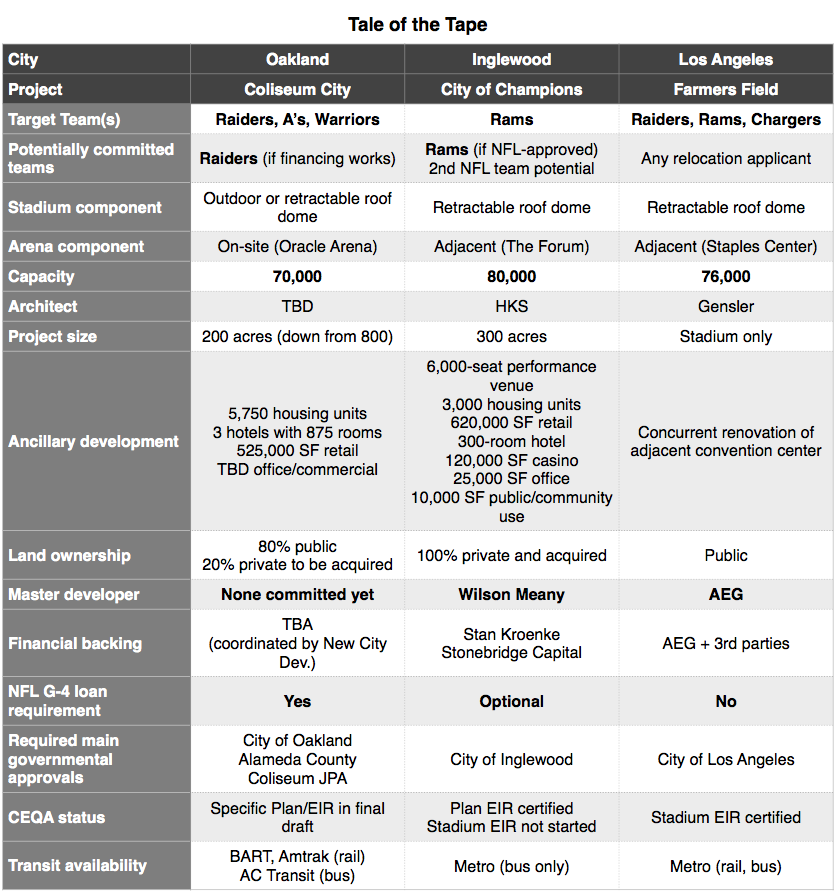
Football Stadium Proposal Tale of the Tape

I put together a simple table explaining the differences between the various stadium+ proposals being bandied about in California. Some of the information below is subject to change.

Click for larger version

Click for larger version


With LA off the table for 2015, what will Oakland and the Raiders do?

The Chargers chose to stay in San Diego last week. Over the weekend, word surfaced that the NFL would not approve any LA relocations for 2015. So for now, St. Louis, Oakland, and San Diego have year’s reprieve. So despite the fact that Coliseum City doesn’t have a deal in place, Oakland’s self-imposed deadlines will come and go with nary a penalty.

Yet it’s little more than cold comfort, as the delay was either caused by the NFL’s and AEG’s need for more time, or perhaps just as likely, certain teams’ need for more time. Either way, the process is not driven by anything happening within the current home cities. All three cities are looking at huge nine-figure subsidies, with little actual desire to deal with the reality of it. Even if the cities give away land, it’s still a tangible asset that’s being given away.

Incoming Oakland Mayor Libby Schaaf will have a number of options available to her and the City Council. If the City likes Floyd Kephart’s work in salvaging the project, they can extend the deal for another 6-12 months, which may be enough to get the Raiders and investors on board. Coliseum City’s EIR work can continue unabated, and there’s no longer any immediate pressure to make a deal. As mentioned previously, shrinking the project from 800 acres to 200 is nothing but good for its feasibility. No need for new bridges across the Nimitz, a new arena, or a trolley. Conversely, it also means that “giveaway” resource of land is more scarce. At the very least it allows for better focus on what can and should be done.

Schaaf beat Jean Quan and Rebecca Kaplan with her cheery pragmatism. That will be put to the test once talks start up anew. It would be safe to assume that with the A’s not in jeopardy, any alternative plans Lew Wolff has for the Coliseum area can be safely placed on the back burner by letting Coliseum City play out. The JPA still needs to hire a GM/Exec Director to lead negotiations whether they’re facing Floyd Kephart or Lew Wolff, so that’s the JPA’s biggest priority. Schaaf has maintained in interviews that she sees the impact of 82 baseball games as much greater than 10 football games. That said, perhaps she could be swayed towards some flexible aspects of the Coliseum City proposal, especially if there’s a retractable dome involved.

That brings me to the fundamental problem facing Oakland: How much stadium do they want to build? If they want to build a flexible venue that will bring in a Super Bowl and a Final Four and other indoor events, the potential price tag will easily surpass $1 billion, perhaps reaching $1.5 billion by the time it’s completed. And with every $100 million over the current $900 million cost estimate, that’s another $100 million added to the still-unresolved funding gap. It adds up in a very painful way.

Despite the uncertainty surrounding the team, Raider fans feel they have one over on 49er fans thanks to Levi’s Stadium’s inauspicious debut. The Raiders getting over on the 49ers two weeks ago is practically Super Bowl-worthy in the Raider Nation, and the 49ers’ turmoil, highlighted by Jim Harbaugh’s impending departure, only serves as a second helping of schadenfreude. Of course, if the Raiders and Oakland get the Coliseum City stadium deal done, they’ll face the same problems the 49ers faced. Longtime season ticket holders will be displaced and relocated to less desirable seat locations as preferred spots go to corporate interests. The crowd will change in noticeable ways, just as it did for the Giants, Jets, 49ers, and Cowboys. The Raiders don’t have to worry about burning through a season ticket waiting list, making tickets less of a seller’s market.

If there’s a lesson to be learned, it’s that right-sizing the stadium has huge benefits. As the second team to official tarp off Mt. Davis, the Raiders didn’t suffer through the constant PR war the A’s have. Regardless, it’s hard to argue with the results. The Raiders have a nice consecutive games sellout streak, few embarrassing empty crowd shots (unlike Santa Clara), and a compact stadium feel that’s difficult to duplicate anywhere outside of Green Bay. A place that’s downright cavernous feeling for baseball is intimate for football. Think about that.

It’s no secret that I’ve advocated for different types of Coliseum renovations for the Raiders instead of a new stadium, simply because they’re cheaper and more feasible. It also needs to be said that if a renovation is done properly it can conserve that atmosphere, instead of letting it weaken by attrition. The Bears’ controversial rebuild of Soldier Field may have killed the stadium’s landmark status, but it preserved the atmosphere and improved the facility immensely, which was a win-win for the Bears and Bears fans.

Citrus Bowl as of mid-December

Citrus Bowl as of mid-December

In May I pointed to the renovation of the Citrus Bowl in Orlando, a $200 million project that gutted 90% of the stadium and modernized it in every conceivable way. The stadium reopened last month with a college football game. Next week it will host two bowl games on the 29th and New Year’s Day. The Citrus Bowl won’t run into any grass problems because it has artificial turf. The turf is unfortunate but understandable, given the cost of maintaining a grass field all year round when its big events occur in December and January. Other than that, the stadium looks practically like a NFL venue, with 60,000 seats, large club areas, party decks, and a completely new bowl with new seats installed throughout. All for $204 million. How was it only $204 million? While it’s hard to isolate specific reasons, a nine-month construction timeline certainly helps. As for the Citrus Bowl venue, it sure looks like an NFL stadium.


No teams + No developer = No deal

BANG reports tonight that Floyd Kephart, who has been leading the effort to keep the struggling Coliseum City project alive, will not meet this weekend’s deadline to deliver a commitment from one of the Coliseum’s teams, namely the Oakland Raiders. Kephart described the situation in a manner we should all be familiar with.

It’s a complicated land situation; it’s a complicated team situation; and it’s a complicated Oakland situation. There is nothing simple here.

Kephart also revealed that he wasn’t ready to name a developer for the project. Whether that means the developer is under wraps or simply doesn’t exist is up to interpretation. Chances are that any developer’s commitment is contingent upon at least one team anchoring the project, which obviously hasn’t happened yet.

The 90-day deadline set in October was already going to be extraordinarily difficult pull off, so at least Kephart deserves credit for coming through on some of the other deliverables, such as necessary reports and studies (which to my knowledge haven’t been made public). The big stuff, however, is what counts. In the end Kephart won’t get credit for merely trying and he knows that. We’re still 31 days from the final deadline, and it’s worth asking whether or not Oakland should continue this process by extending the ENA another 30, 60, or 90 days. It’s unlikely that any potential partner (teams or developers) will suddenly commit just because the calendar flipped a couple pages. The fundamentals are still shaky at best.

The big takeaway is the Kephart revised the plan down to the 200 acres including the Coliseum and other pieces of public and private land immediately surrounding the complex. That makes for a much more feasible project in terms of acquiring and packaging the land, limiting infrastructure costs, and working out the regulatory aspects. The Coliseum City EIR is written so that the entire 800-acre plan area is the full scope, with the “Reduced Alternative” lowering densities within the full project area, not a smaller plan as a 200-acre project would require. It’s unclear if the final draft will include a 200-acre alternative, but it would seem that if Kephart’s plan moves forward such a major refocus would have to occur.

Lew Wolff has consistently said he’s not interested in being part of the project. He’d rather promote his own vision with no third parties (or perhaps his own) attached. If Coliseum City goes away and Wolff’s plan gets traction, the shoe would be on the other foot as the City, JPA, and Wolff would have to figure out how to accommodate the Raiders, as opposed to a Raiders-focused plan trying to accommodate the A’s.

Meanwhile, murmurs have been getting louder that the NFL will punt on LA for 2015. Hope remains in St. Louis for an 11th hour plan to build a new stadium for the Rams, which might give NFL the chance to extend its wait-and-see posture an additional year. The Chargers are staying in San Diego through at least next year. That leaves Oakland.

The Raiders will have to start negotiating a new lease with the JPA in the new year. Mark Davis prefers a single year or at worst a year-to-year arrangement for maximum flexibility. Davis pushed for the 1-year lease because he thought it would further the process at Coliseum City, which hasn’t happened save for the EIR. The JPA and City want a multiyear deal, which I wouldn’t expect Davis to sign. I’ve heard some strange rumors about backup venues Davis is calling about, which frankly is his right. The Raiders face severe limitations on where they can go, or rather, where they are welcome. We’ve already heard about the LA Coliseum and Rose Bowl slamming the door on the Raiders. There are also issues with Bay Area venues:

  • Levi’s Stadium has been ruled out by Davis. Even if he was interested the 49ers would require a multiyear commitment to pay for finishing construction on the second home team locker room.
  • California Memorial Stadium has a contractual ban on NFL games. Any deal to host the Raiders would run into an immediate legal injunction.
  • AT&T Park could host games, but is small and not ideal from a league perspective.
  • Stanford wants no part of the Raiders.
  • The ‘Stick is being dismantled per a development agreement with Lennar.

Even if the league owners got past Jerry Jones’ and Bob McNair’s objections, they wouldn’t approve a short-term stay for the Raiders in San Antonio. They want long-term stability and certainty. That’s also the problem in LA. Dodger Stadium could provide a short-term home, but the NFL and AEG have to work out a very complex deal for whatever team(s) commits. AEG asked for its own 6-month negotiating extension for Farmers Field. Given the complexity of arranging a temporary venue that it doesn’t control along with planning for the new stadium, getting it all done in 6 months is a tall order. That said, the NFL has assigned Eric Grubman to work on LA among other options, so it’s not like the league isn’t controlling what it can. The NFL may punt on LA for now, and punting is something Raiders fans are all too familiar with this year.

As for the A’s – they’re in a good spot. They have a lease that provides security. They’re working on a CC alternative that should be ready to go if Oakland drops CC. They can wait out the Raiders’ and Oakland’s indecisiveness, at least for a while.