Presented without comment.
Category Archives: Coliseum
Coliseum Authority approves Raiders/A’s lease extensions
Update 11/25 9:10 AM – Resolutions passed nearly unanimously, with one vote against.
@Athletics extension includes passage prohibiting “unfactual” statements about @OdotCoCOLISEUM. #oaccamtg
— Steven Tavares (@eastbaycitizen) November 25, 2013
#Oakland CM Larry Reid tells Coliseum City lead investor to “show me the money.” #oaccamtg
— Steven Tavares (@eastbaycitizen) November 25, 2013
Commish Goodwin says Coliseum Authority members labeled both deals less than satisfactory. “I don’t vote for bad deals.” @Athletics @RAIDERS
— Steven Tavares (@eastbaycitizen) November 25, 2013
=====
Original post from Saturday:
In your typical Friday disclosure before a hastily called meeting, the Coliseum Authority (JPA) released its agenda for a Monday board meeting in which it will vote on short-term lease extensions for both the Athletics and Raiders. It’s funny to see how the negotiations have progressed. The A’s offered up a 5-year deal last year which the JPA ignored because it thought it had leverage, only to be that perceived leverage taken away by MLB two weeks ago. The Raiders have talked up a long-term deal, but only if it came with a serious plan for a new stadium. The resolutions that the JPA board is looking to pass will undoubtedly amplify the uncertainty surrounding the two franchises. Highlights:
- The A’s will get a two-year extension with no additional option years, thus extending the lease through December 31, 2015.
- The A’s would pay a slightly higher rent payment than previously negotiated at $1.5 million per year.
- In addition, the A’s would pay a mere $250,000 to maintain control over concessions.
- The parking revenue dispute between the A’s and JPA would go to arbitration, which should be decided before the end of 2014. The A’s would agree to put the disputed amount (not disclosed) in escrow.
It’s good to see that the parking issue will be resolved soon. Apparently the A’s are raising parking prices for 2014, which makes the actions seem linked. The big takeaway is that the JPA caved on concessions. Under the new terms, the A’s have the right to choose a new concessionaire, whose contract may long extend past the A’s stay in the Coliseum. However, you have to think that any concessions contract has to factor in the significantly lower value of the Coliseum should the A’s and/or Raiders leave. Yes, this could mean Aramark is replaced by someone else.
- The Raiders have a one-year deal for the 2014-15 season. The Raiders would pay $400,000 in addition to the revenue splits they currently share with the JPA. The end of the lease is described as 45 days after the end of the team’s season.
- The Raiders could pay up to $525,000 per year to use their Harbor Bay headquarters in Alameda.
- The lease terms acknowledge that the Raiders may play one regular season or preseason home game away from the Coliseum (London in 2014).
Also wrapped up in the Raiders’ extension language is something that I’d like to call the Santa Clara clause.
7.5 Additional Payments for Use of Permanent Training Facility and Training Site. If the Raiders announce a relocation or sign a lease to play football games outside of the City of Oakland or Alameda County for the 2015 season prior to March 1, 2015, then, commencing on March 1, 2015, Raiders shall have the option of continuing to use the Permanent Training Facility and Training Site for up to twenty-four (24) months, up to and including February 28, 2017 as determined in Raiders’ discretion and Raiders shall make an additional payment to Licensor each month for continued use of the Permanent Training Facility and Training Site in an amount equal to the fair market rental value of the Permanent Training Facility and Training Site on a monthly basis, as determined by a mutually agreeable licensed commercial real estate broker based on comparable rental space. Raiders and Licensor agree that the fair market rental value shall not exceed $525,000 per year. In the event the Raiders are engaged in good faith discussions concerning an extension of the Operating License or other arrangement for the Raiders to play future Football Events in the OACC Stadium as of March 1, 2015, any obligation to make payments shall not commence while such discussions are continuing and the twenty-four (24) month period and obligation to make additional payments shall begin when Raiders agrees to play football games at a location other than OACC Stadium for the 2015 seasonal provided, however, that if Raiders agrees to play football at such other location, Raiders shall pay such rental payments retroactively from March 1, 2015.
Got that? The Raiders won’t be charged to use the Alameda headquarters as long as they’re in talks about Coliseum City, even if they’re playing somewhere other than the Coliseum for 2015 and 2016. If the Raiders play elsewhere while using HQ and aren’t in talks over Coliseum City, they pay $525,000 annually. Obviously, the only place where they could play in this scenario (and while the Coliseum is demolished, presumably) is Santa Clara. UC Berkeley is forbidden by legal settlement from hosting NFL games, and Palo Alto would sue Stanford to high heaven for even considering it.
Both extensions should be easily passed, unless one or more of the commissioners complain that the terms are too favorable to the teams. The teams are effectively trading rent payments, and the JPA’s incoming revenues will not make much of a dent in ongoing debt service. At least the JPA will get the parking revenue they’ve clamoring for, which at the very least should help pay for additional Coliseum City studies or minimal prep work. As for scoreboards – you weren’t banking on that, were you?
—
P.S. – The resolutions would have to be passed by Oakland’s City Council and Alameda’s Board of Supervisors shortly after JPA approval.
Evolution of a concept: Coliseum City
Before JPA and numerous East Bay officials finalize the cost of building Coliseum City, they need to understand its scope. How many venues would it hold – 3, 2, or 1? Which part(s) would get built first? How much of it is subject to market forces? And what of the extra niceties that they plan to put in there, such as the transit hub component?
Any project of this size is bound to go through numerous configurations and brainstorming before arriving at the final vision. To understand that, let’s look at some of the renderings released by Oakland architecture firm JRDV. If nothing else, you’ll get an appreciation of how complex this complex is.

One of the original drawings has an open-air football stadium, a high-rise hotel, and a hidden baseball stadium, while preserving the existing arena.

A daytime rendering of the redone complex
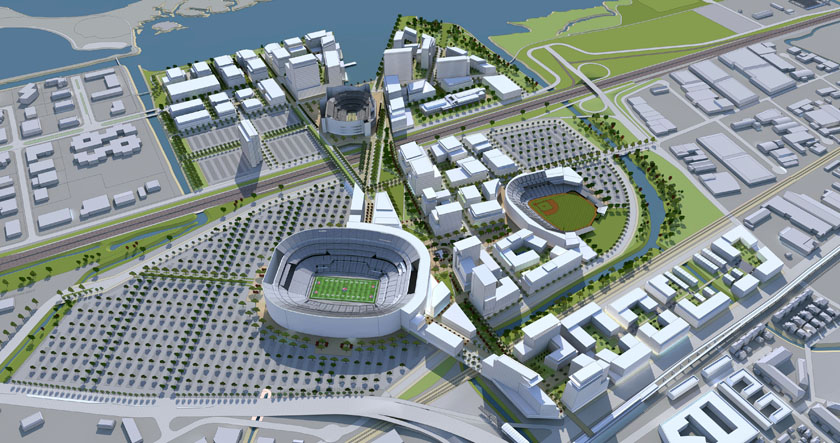
An updated version from earlier this year puts a new arena across I-880 from the existing complex
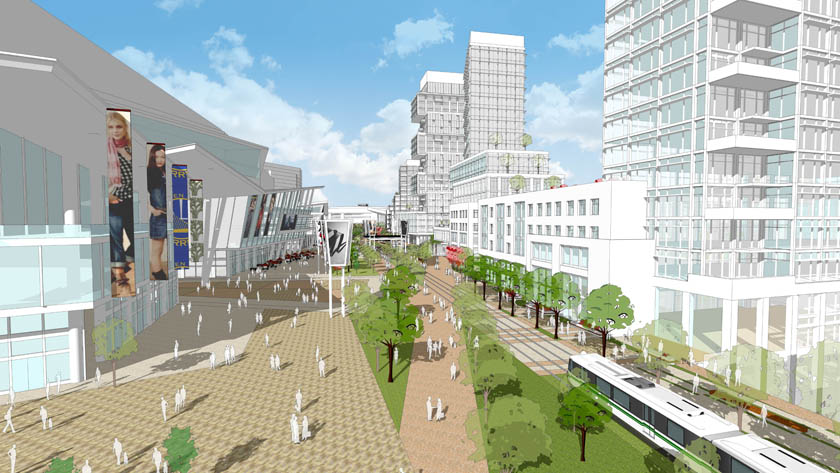
A look at the plaza between the venues features the mythical trolley, which would run from the BART station to the arena.
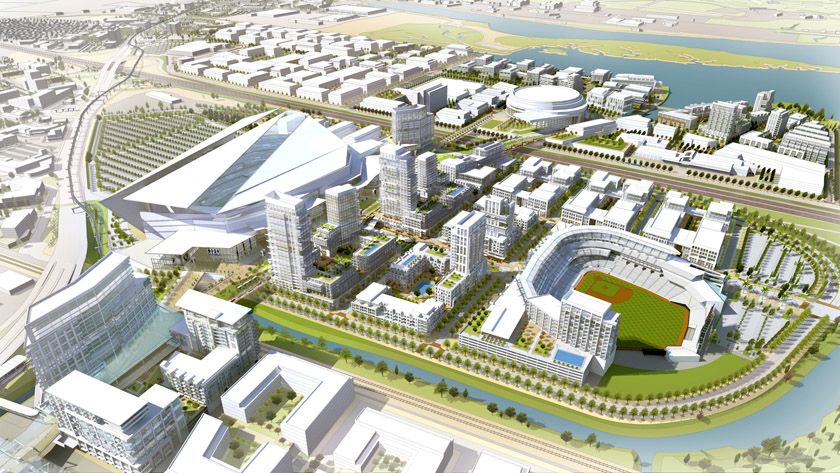
Most recent rendering showing retractable roof on football stadium and redesigned ballpark
With each iteration, the surrounding buildings have grown taller and more numerous, as if the stakes have only gotten bigger over time. But wait – something about that ballpark looks familiar. Hmmm…

D’Sjon Dixon’s concept at Estuary Park
Honestly, I wouldn’t have noticed if D’Sjon Dixon hadn’t pointed it out himself. The only meaningful difference between the two is that Dixon’s concept is squeezed into a very small lot, whereas there’s plenty of space in the Coliseum’s A lot for a ballpark to stretch out. Naturally, Dixon’s feeling a bit ripped off right about now.
@newballpark looks like jrdv and coliseum city have sum explaining to do, looks eerie similar to my old design???? pic.twitter.com/HKdb9cIBgi
— D’Sjon Dixon (@dsjondixon) November 9, 2013
For now Dixon is keeping current and future designs under wraps, though it appears as though Glenn Dickey has caught on and championed it to an extent.
Chances are that Coliseum City will undergo even more transformations before the parties settle on one vision. If they can’t, or if the project doesn’t prove feasible due to cost, well, at least these were nice renderings (hello, Pacific Commons).
The limits of the NFL’s G-4 stadium loan program
Last week at the NFL owners meetings, the assembled owners approved a raft of small G-4 loans for current NFL stadia. The recipients include the Panthers ($37.5 million), Redskins ($27 million), and Browns ($62.5 million). Combine that with the $58 million the Packers received last year, and you’ve got nearly the amount of one full slots ($200 million) awarded to a team building a new stadium. The fund, a continuation of the G-3 program started with the previous CBA, has already assigned full slots for the 49ers, Falcons, and Vikings. All told that’s around $800 million. When the 49ers were starting construction, I figured that there was about $1 billion available, making for 4 new stadium slots and the rest for renovation work.
Since the CBA was signed, the NFL’s revenues have risen at a 5% annual clip. 2011 produced $9 billion, 2012 yielded $9.5 billion. It stands to reason that the league will eclipse $10 billion either this year or next year. That’s a point of pride for commissioner Roger Goodell, who envisions the league reaching a whopping $25 billion in revenue by 2027. It’s that growth that may allow the NFL to loosen some pursestrings and provide more G-4 money.
Rules are well set, with all projects falling into specific tranches of potential funding. After the $200 or $250 million limit, the NFL provides access to banking syndicates that provide much of the gap funding. So far the 49ers and Vikings have utilized this access. It’s definitely no giveaway. Team owners have to pony up at least $50 million to get started, and the NFL provides matching funds depending on the amount a team owner is willing to provide. Of course, there’s also a public share that comes into play, since the NFL will only provide access to G-4 loans if it sees what it considers a viable public-private partnership.
The G-4 program has a set limit of 1.5% of annual revenue to fund various projects. In the first year of the current CBA, that amounted to $135 million. The loans are for as little as 15 years, so the annual payments can be quite high. For a $200 million loan at 7-9%, that’s up to $25 million per year. That translates to 4 full slots and the remainder for renovation work. However, if annual revenue rises above $10 billion that limit rises to $150 million, or 5 full slots and the renovation remainder. That could be huge for the remaining teams that haven’t yet finalized stadium deals, such as the Chargers, Rams, and Raiders. If the NFL chooses to base G-4 availability on initial revenue projections, the limit may be set at 4 slots, the same way the G-3 program slammed the door shut after 4 $150 million slots were awarded (DAL, IND, NY x 2). If the owners are comfortable with expanding the program, another slot just might open up. Three teams competing for two slots is a lot more comforting than all three competing for one award.
Still, time is of the essence. Given the league’s previous history it seems unlikely that they’ll make huge loans in the back half of the CBA. The incentive is there for the owners and municipalities to act quickly. For now, the NFL has chosen to control the funding process through G-4, public funding, and the banking syndicates, instead of allowing a third party like AEG to buy its way into taking some revenue or a piece of a team. If you’re Goodell it makes sense. What he doesn’t want is for outsiders to chip away at what it considers “pure” revenue streams, nor does he want to set a precedent that team stakes are easily available in exchange for a stadium. With the three remaining teams, we may be coming to a point where he has no choice. The best way for the Raiders to stay in Oakland may be to exchange a minority share for a new Raiders Coliseum.
Tim Kawakami had another chat with Mark Davis this week. Davis continues to play good cop with Oakland officials, while unnamed sources (league? team?) assume the bad cop role via Matier & Ross. Davis may not be negotiating through the media in public, but someone is. Davis say that Tuesday’s City Council vote is a “positive step” but there are many moving parts in getting the deal to work, whatever form it takes. If, as Kawakami surmises, Davis considers this the last chance to stay in Oakland, the bowl-cutted one is certainly giving the appearance of due diligence. Davis’s previous comments about the team’s share of a new Coliseum indicate that he’d be interested in one of the G-4 slots, since it would involve club seat and suite revenue. Davis will get to see everything develop right in front of him, which will inform his decision. Instead of deciding right after the current season ends, he could take a page out of his late father’s playbook. Al didn’t finalize the deal to move the Raiders back from LA to Oakland until July 1995.
I remember that summer being a whirlwind of activity for the Raiders and A’s as I spent much of that year in the locker rooms. I wonder if we’re due for another whirlwind.
Negotiating Extension and Investor Group Approved for Coliseum City
Two weeks after a potential investor group headed by Colony Capital and Rashid Al Malik’s HayaH Holdings was revealed, that same group was formally approved as part of the master developer team. With that approval comes a 12-month extension on the ENA (exclusive negotiating agreement) to figure out all most of the details, plus a 6-month administrative extension if needed.
That’s the news. Now let’s try to understand what has to happen next.
The City of Oakland has about $250,000 remaining in money it assigned towards Coliseum City studies. Bay Investment Group (BayIG), the Colony/HayaH partnership, will put in $500,000 towards a market study to determine the viability of Coliseum City. This is important since BayIG is expected to push that study to its own individual investors, who as a group will decide if/how to move forward. The forthcoming study is not to be confused with AECOM’s feasibility study, which was made available during the summer.
Over the next 12 months, the public and private sides have to make good on a set of deliverables. Some within the City, especially CM Larry Reid, wanted a shorter 6-month + 6 month extension instead of the 12 + 6 deal that was approved. Reid’s concerns, aired last week in a committee meetings, were that 12 + 6 was too long a period and didn’t show the necessary urgency to the NFL and the Raiders. Raiders owner Mark Davis has indicated that he wants a lease/stadium deal in place shortly after the NFL season ends.
Nevertheless, Coliseum City will move forward on its own timeline because BayIG asked for 12 + 6 in order to get everything in order. A short list of deliverables looks like this:
- November – Estimate on cost of remaining pre-development work
- February – Assessment of new infrastructure costs
- April – Letter(s) of intent from team(s) who choose to sign on with plan
- May – BayIG market analysis
- Summer/Fall – EIR and Specific Plan
These items, along with additional smaller ones, should lead up to preliminary project approval in whatever form it takes, plus a DDA (disposition and development agreement), the contract fine print on how Coliseum City is built, including costs, financing, and timelines. Zennie Abraham caught up with Oakland Asst. City Administrator Fred Blackwell at the meeting to summarize what’s next.
Simply put, BayIG just bought the City of Oakland and Alameda County some time. However, it’s easy to see how the list of deliverables doesn’t exactly line up with the timeframe that Davis is trying to dictate. Moving forward, the issue is whether the dev team can show significant enough progress to get Davis to sign on and sign a separate lease at the Coliseum that would keep the Raiders in Oakland throughout the transition. Then again, that part’s a little confusing too. When Raiders uber-fan Dr. Death asked JRDV’s Ed McFarlan when the earliest groundbreaking could be he received this rather optimistic response.
He said ground breaking for coliseum city would happen in September if all goes as planned
— Dr.Death (@26DrDeath) October 14, 2013
That seems unlikely given the scope of the project and all the little details that need to figured out. Is that groundbreaking for a new stadium alongside the existing Coliseum? Certainly it couldn’t be demolishing the current Coliseum and building on the same site, since the demo itself would take months and would displace both the Raiders and A’s. While BayIG indicated that it will reach out to the A’s and Warriors to gauge their interest in Coliseum City, it’s extremely unlikely that either team will commit. Despite recent setbacks, both teams are focused on their San Jose and San Francisco plans, respectively. Plus they’d have to commit without all deliverables in place, especially that market analysis. If you think that Lew Wolff would sign a short-term lease without knowing the development’s impact on the A’s, you’re crazy.
For the next 12 months, BayIG has control over most of the process. They could press the deal if they see encouraging signs, or they could kill it if the market analysis looks bad. They’re in great shape considering that they’ve only committed $500,000 towards the project – chump change for billionaires. Just as important, they don’t have to adhere to a specific vision of Coliseum City, though they’re positioning themselves to have at least the football stadium in place. Consider last night’s report on the agenda item:
The Coliseum City Master Plan is providing the basis upon which the City is currently under a separate contract with a specialized planning consultant firm to complete a Specific Plan and CEQA/EIR analysis. The Specific Plan will also identify alternatives to the Master Plan and will consider different development scenarios that will envision zero up to three sports facilifies at the site. Pursuant to CEQA, the separate planning contract will prepare an EIR to address the potential physical environmental effects of the Coliseum City project.
There’s nothing new there, but BayIG is positioned to take advantage of it. There could be a single football stadium, a football stadium and a ballpark, even an arena. At this early stage, it looks like it’ll just be the Raiders stadium, though even that is far from a given. BayIG could find that the best thing to do is to minimize its investment in the stadium, or seek out revenue streams from the stadium or team that could help pay back their investment. The infrastructure cost, which will be borne by City/County, could also prove prohibitively high on top of the remaining debt to be carried at the Coliseum. BayIG could even go with zero venues at the Coliseum. Such a plan would probably not get approval from City since it would represent a white flag. Yet it remains a distinct possibility – if not now, within a few years.
The upside, regardless of your optimism or skepticism of Coliseum City, is that things are coming to a head. Coliseum was introduced more than 21 months ago, and has shown only the most tentative progress until a few weeks ago. Now’s the time to put up, to see what results Coliseum City can yield. No more stalling, and for that we can all be glad.
—–
Note: The only local mainstream media coverage of yesterday’s news came from CSNBA’s Scott Bair. Seems like everyone else was preoccupied with transit strikes and some other multibillion dollar development in the South Bay which is a lot more than vapor.
Time lapse Coliseum conversion
If you attended the game on Saturday, you probably noticed that the only thing faster than the A’s running onto the field after Stephen Vogt’s walkoff single was the Coliseum’s conversion crew, getting ready to do the big switch. As I hoped, someone captured the entire thing on time-lapse video. Claiming credit is SF media company Evolve Media.
The conversion was announced as complete around 3 PM Sunday, 5+ hours before the rescheduled Chargers-Raiders game. That means it took 18 hours to complete the change, a very impressive figure for sure. For now it looks like the crew has been granted a well-deserved break, as they didn’t tear down the seats immediately after the Raiders won. However, a decision will have to made soon on if/when to switch back to baseball, perhaps as soon as after Game 3 ends. The issue for the Coliseum Authority is that there isn’t a Raiders game at home until October 27, a good three weeks from now. If the A’s don’t advance and the Authority decides not to pull the trigger on the conversion, they could save themselves $500,000. If they wait until the last minute and the field ends up extra crappy because of it, the teams playing Game 5 and MLB will not be pleased. Here’s to hoping the A’s can force the issue.
A’s lease situation looms in the shadows
Lost in all the postgame recriminations from Friday night is an article by the Chronicle’s Will Kane. It’s about the lease extension talks between the A’s and the Coliseum Authority, which to date haven’t yielded a new deal. When we last left off, Lew Wolff indicated that the A’s presented the JPA an offer of a 5-year extension at a higher annual payment, which would cover maintenance and some improvements at the Coliseum. The actual amounts and terms weren’t publicly disclosed. Wolff aimed for an escape clause that would be triggered by the Raiders building a new stadium that would presumably adversely impact the A’s. That was followed by Raiders owner Mark Davis pushing to demolish the old Coliseum and build a new one in its place.

Having this game as one of the last in the Coliseum is surely inconceivable. Right?
Oakland City Councilwoman Rebecca Kaplan, who has been touting the potential for Coliseum City since its public unveiling, believes that the two sides are close to a 6-8 year extension. What’s a little disturbing is this message from Kaplan:
And the six- to eight-year window should give Oakland plenty of time to get serious about building a replacement ballpark and luring the A’s to stay, Kaplan said.
Hold a sec. Plenty of time to get serious about building a replacement ballpark? You’ve got to be kidding me with that. I’m sure that Kaplan was merely referring to the idea of shoe-horning a ballpark into the A lot, a secondary item within the overall plan. It’s the tone that’s disturbing. It places doubt on the idea that Victory Court was serious, and it certainly raises questions on the seriousness of inclusion for the A’s in Coliseum City. Just as the A’s aren’t winning back burned fans by talking about leaving, Oakland isn’t going to win the A’s over by considering them an add-on or second/third phase. Plus the idea of 6-8 years should give anyone pause. For all the talk by Kaplan and Mayor Jean Quan about how projects could be fast tracked or don’t need extensive environmental review, 6-8 years is an awful long time to effect change. Especially if both Coliseum City and Howard Terminal are under site control, Oakland’s favorite new catch phrase. Mark Davis lightly admonished Oakland about showing urgency last month. A move like this shows more of the same lack of urgency from Oakland. How are any of the teams supposed to take Oakland pols seriously if the general feel is that they’re making moves to make it look like they’re making moves?
While Kaplan was quick to say that a deal was close, A’s President Michael Crowley doesn’t see it that way.
“We’ve had some discussions, but we still remain far apart,” Crowley said of the lease talks. “I really don’t want to negotiate in the press. We certainly hope to be playing here in 2014.”
We certainly hope to be playing here in 2014? That’s also a pretty bad tell. Wolff has been careful to talk about playing at the Coliseum for years to come, even talking to a fan about it in Anaheim during the last regular season road trip. But this is not a certainty. And if your argument for the A’s staying is simply, They have nowhere to go, think again. Of course they have somewhere else to go. It’s really a question of how much money they’re willing to pay to make it happen – short and long-term.
Consider this game of musical chairs.
- The A’s Coliseum lease ends at midnight on New Year’s Eve.
- Same goes for the San Jose Giants at San Jose Municipal Stadium. Obviously the A’s aren’t going to play at Muni, it’s much too small and is older and more dilapidated than the Coliseum.
- Raley Field is not old and dilapidated. It has 11,093 seats, plus berm seating up to 14,000. I did some measurements of the berm in RF and some of the other areas, and have concluded that if bleachers were installed atop those areas, the capacity could reach 20,000. Without standing room admissions. The A’s would sell that capacity out for 2-3 years straight, the transition time needed to build in San Jose. That capacity isn’t necessarily too small for MLB since there would be a clear transition path, and the A’s have been playing to an average of 20,000 per game for the last three years anyway.
- What about the River Cats? Well, Lew Wolff would have to call in a favor. The team is owned by Susan Savage, widow of Art Savage. Art Savage was an executive with the Sharks almost 20 years ago, and Wolff called him and his family good friends. Wolff would have to work with the family, who runs the stadium, to compensate them properly and plan Raley’s temporary expansion. The River Cats could continue to play select games there, or…
- Move temporarily to San Jose, where city leaders would be happy to kick the intransigent High-A Giants to the curb in favor of a AAA team while waiting for the MLB A’s to arrive. As of two weeks ago, there is no movement on a lease extension for the SJ Giants. Sound familiar?
- That leaves the SJ Giants without a lease, without a home. That will not go over well with long-time SJ Giants fans, some of whom are part of the Stand For San Jose lawsuit. Sucks for them, I guess. If the Giants started looking for a home somewhere else in the Bay Area or NorCal, trust me, there will be no shortage of smaller cities ready to roll out the red carpet for them.
- When the temporary arrangement ends in 2016 or thereabouts, Raley Field can be restored back to its previous glory. While there would be a big grassroots effort in Sacramento to attract the A’s full time, much of the available political capital has already been spent on the downtown Sacramento Kings’ arena. We already know that, when Raley was under construction, changes had to be made that dropped the possibility of easy vertical expansion. That makes it difficult to envision Raley as anything larger that 20,000 seats, unless someone’s willing to pay to gut it and rebuild the suites and a new upper deck. Besides, after 2-3 years it’ll become readily apparent how much better Raley is suited to being a AAA park than a MLB park. It’s akin to what happened when Bud Adams moved the Oilers out of Houston, Absent a modern stadium, Adams had his team play in the Liberty Bowl in Memphis for a year, followed one season at Vanderbilt Stadium. Adequate, and definitely not permanent.
Is any of this based on inside information? I assure you, it is not. Rather, it’s an example of a well-conceived Plan B, just in case the A’s can’t work out a Coliseum lease extension. It gives the A’s a decent place to play while they wait out the legal drama, while not infringing on T-rights. The way T-rights are written, Santa Clara County can accept any team it wants provided it’s not a MLB franchise. That’s how Wolff, Davis, and Crowley should be thinking. If they aren’t, then they’re not doing their respective jobs.
Hearing and Noise
Got some good news and some bad news. The bad news is that due to some scheduling conflicts I won’t be able to attend Friday’s antitrust hearing in San Jose. Stuff happens. Fortunately, Fangraphs and Sports on Earth’s Wendy Sturm (also a lawyer in a past life) will be covering the hearing. Judge Ronald Whyte isn’t expected to rule from the bench, so we probably won’t hear anything right away. Instead, expect to get top notch coverage from Thurm and from a Merc reporter, either John Woolfolk or legal affairs writer Howard Mintz.
The good news is that I will be doing some additional noise measurements while in the Coliseum for Game 1. Unlike last time, when I used a mixture of smartphones and phone apps, I’ll be mostly using a handheld sound level meter. One thing I noticed about using smartphones is that their sensitivity peaks at around 100 dB, making measurements above that level difficult to capture. That’s why I decided not to publish my findings from the final home game of the regular season.
That doesn’t mean that the data isn’t valuable. I’ll run a phone in parallel for logging purposes, and I have a decent idea about how to adjust measurements based on how the meter and phone/app differ.
This is where you get involved. Some of you have been asking to do your own measurements. If you’re going to attend either or both games, I can use your data. The methodology is simple.
- Download either Decibel 10th for iPhone or Noise Meter for Android to your phone. Both are free.
- Familiarize yourself with your respective app before the game if you get there early. Both have simple interfaces for turning both monitoring and logging on and off.
- Send me a log from the ceremonial first pitch. Both apps have direct email capability. Send the log to newballpark at gmail.com.
- Send a log from the first A’s rally with at least two runners on.
- Send one from the first A’s home run (if that happens) if you can capture it.
- Send one from the end of the game.
- In the email containing each log, include information about your location in the Coliseum and your phone (model, operating system, app calibration if you chose to use it).
As much as I’d like to get many different data points, I don’t want to stop you from cheering on the A’s. Making sound measurements is not conducive to multitasking, and rooting loudly or clapping can skew results (since you have a microphone right in front of you). If you can, restrain yourself a little. I know, not fun. That’s why I’m not asking you to log a dozen or twenty points. I’m also not asking to log the entire game, as it will most assuredly will kill your phone’s battery. It comes with the territory.
Throughout the night I will tweet readings I get. If I can I’ll post them in a new blog thread as well. Compare and send me tweets if you like. I hope to compile the results and plot them sometime next week.
If you’re interested in participating, reply in a comment here or via Twitter. I’ll try to give whatever support I can. Have fun, and go A’s!
—
Note: My meter uses A-weighting for its measurements. Your app should as well. If you’re using your own sound meter and it logs, send me the logs if you can. Please note which make and model meter you’re using.
ESPN’s Tim Keown pens sobering feature on future of pro sports in Oakland
It’s terrible timing to have a column about Oakland titled “Death of Sports Town” as the A’s jump into the postseason, yet here it is. Written by ESPN the Magazine writer and former Chronicle scribe Tim Keown, the piece tries to codify the meaning and value professional sports teams provide to their home communities.
Keown deftly explains the socioeconomic dichotomy that stratifies Oakland, the lack of outsider faith in The Town, the city government’s ongoing ineptitude, and the greed of owners who already have one foot out the door.
At the end of the column is a plea from Keown for the owners and overseers of these sports to, for once, forgo the extra $$$ and try to keep the community intact.
In the relentlessly monarchical world of professional sports, someone has to be able to forsake a digit or two in the bank account to create a legacy more meaningful than a trust fund that’ll cover a lifetime of BMWs and Botox treatments for the grandchildren of his grandchildren. Someone has to consider the void left behind.
Yet Keown can’t clearly answer the question he poses about gauging the impact of pro sports. I don’t know that anyone can. Yes, they are part of the fabric of any community fortunate to have them there. He drops the Raider-turned-San Leandro-cop Kenny Shedd anecdote. He interviewed Oakland native and NBA rising star Damian Lillard, who grew up near the Coliseum. These are all good, but anecdotes are the worst kind of gauge. There should be something between these feel-good stories and cold political calculation, as was exhibited in the Oakland Chamber’s poll yesterday.
In the poll, 50% felt that it was very or extremely important to keep the franchises in town. 55% of the 500 respondents said that they hadn’t attended an A’s game in the last 12 months. Another 20% only went 1-2 times. Obviously, part of the reason has to be the Coliseum’s dilapidated state. Some may be turned off by ownership. It shouldn’t be the team, since they’ve been meme-ing the sports world for the last 15 months. Someday someone – perhaps multiple people – will write an academic study on Oakland and its relationship with sports. Hopefully it’s not an eulogy.
Coliseum City’s Mystery Investors Revealed
Earlier in the year, Oakland Mayor Jean Quan talked up foreign investment in Coliseum City, which had the potential to fill in funding gaps for one or more venues planned for the project. The Trib’s Matthew Artz reports tonight, on the eve of a Tuesday City Council closed session, that those investors are a partnership between real estate powerhouse Colony Capital and Dubai financier Rashid Al Malik. The closed session would presumably lead to a public discussion item on October 8, which should include some basic terms for the price of the land, a development timeline, and other critical information.
Colony/Al Malik are no strangers to bidding on expensive properties. In the spring they jumped to the lead in bidding for arena/stadium giant AEG. Eventually they balked as AEG honcho Phil Anschutz refused to budge from his asking price, purportedly up to $10 billion. That led to the departure of Farmers Field champion Tim Leiweke, leaving the football stadium project in limbo.
Coliseum City, which could cost $2 billion just for a replacement arena and separate baseball and football stadia, is expected to have billions more in development costs associated with offices, retail, and additional infrastructure. It has the potential to be the biggest single redevelopment project in California history.
The main problem is that redevelopment is yesterday’s plan. Tax increment is off limits thanks to Governor Brown’s dismantling of redevelopment agencies all over the state. While TIF couldn’t finance a lion’s share of the project, it could’ve helped take care of the infrastructure work, which no developer wants to take on if he can help it. The closed session talks are centered around land sales, so Oakland (and Alameda County) could conceivably sell Coliseum land or other nearby properties to help raise the public share. It’s not much of a departure from Lew Wolff’s Pacific Commons plan, which involved a fairly simple purchase option of privately owned, not publicly owned, land. While the Bay Area’s real estate market is experiencing a rebound, chances are that Oakland would name a price favorable for Colony/Al Malik in order to get them to play ball.
If you’re Colony/Al Malik, you want to be able to get in with as little equity or borrowing as possible. At the same time, we’re hearing that the project could work with only one or two venues as opposed to three. That works in Colony/Al Malik’s favor, since there would presumably be less money going towards stadia that would otherwise go to their shareholders. Not having to build a new ballpark or arena would also free up 10-15 acres of “prime” development land near the Raiders stadium. Of course, that has to be balanced with the recognition that more venues equals more events and event days, which would make the project more attractive to prospective tenants. There’s the possibility that no teams remain, which would result in no new venues. There’s also a remaining disconnect regarding the different players’ respective visions. Raiders owner Mark Davis continues to focus on a smallish outdoor stadium with less than 60,000 seats. Planning consultant JRDV (and previously Mayor Quan) want something larger – and perhaps retractably domed – that could attract big events such as the Super Bowl.
There’s one other angle to play here. In 2010, Colony bought the construction firm Tutor-Saliba, the contractor responsible for rebuilding the Coliseum Arena, Mt. Davis (no, they weren’t the architects), and several transit projects including the planned California High Speed Rail and the BART-to-SFO extension. Colony could see some additional opportunities associated with having Tutor-Saliba control the construction process for much of the project. Not sure how that might conflict with an open bidding process often required when using public funds.
Besides the failed AEG bid, Colony and Al Malik have had their share of hits and misses. Colony invested heavily in Station Casinos just as the recession was starting, and Station eventually declared bankruptcy. Al Malik was head of Dubai Aerospace and launched an aggressive strategy to buy (and lease out) a bunch of jumbo jets in 2006. He quit the company in 2008 as DAE floundered. Colony once co-owned the French football club Paris St.-Germain, then flipped it to investors from Qatar two years ago.
There’s a great sense of irony in that much of the criticism of A’s managing partner Lew Wolff is that he’s a “greedy developer” who only wants to make money. Yet who is Oakland bringing in to give Coliseum City a whiff of viability? One of the richest developer/hedge fund groups in the world, Colony Capital. The master developer for Coliseum City appears to be Forest City, the company Brown favored for Uptown condos and apartments instead of a ballpark. When you need big money and expertise, there are only so many places to find it. What are the chances that this group isn’t “greedy”? Slim and none.
—
Update 12:25 PM – Got a copy of today’s agenda (thanks Matt Artz). The resolution calls for a 12-month extension of the ENA (Exclusive Negotiating Agreement) to figure out the terms of the deal. This comes on the heels of the the original ENA expiring October 21. In addition to the 12 months there would be another 6-month administrative extension option. No additional money would be needed to complete all of the project deliverables, a concern going back from the early summer.
What I have to wonder is what Mark Davis thinks of all of this. While it’s good to have the potential for additional investment to help defray the stadium cost, here’s another case of the JPA/Oakland/Alameda County pushing a deadline out. This time it could go into early 2015 before things are finalized. This doesn’t seem like the kind of urgency that Davis is looking for:
Whether there’s a sense of urgency or not? I know there is on our side. We have to find out how urgent on their side. The picture that’s been drawn is there. We know what needs to get done. It’s just whether it’s going to be able to be done.
It’s Davis, after all, who’s pushing for a long-term lease extension tied to a new stadium development deal. How does this news affect that? Another 2-3 year lease to stay in the game?
 newballpark.org