Knauss on 95.7 The Game: We think the world’s changed here

Clorox CEO was on with Chris Townsend earlier today. As usual, Townsend had a pretty thorough, wide-ranging interview that touched on a number of A’s and stadium-related topics. I’m going to highlight a couple of items.

Townsend: When it comes to buying the A’s, are you personally interested? Is Clorox interested?

Knauss: No I wouldn’t say we’re interested (Clorox) in buying the A’s. We clearly would love to work with the current ownership, Lew Wolff and John Fisher, on keeping the A’s here. I think there’s a lot of old data that Lew Wolff has about working in Oakland… We think the world’s changed here.

Later in the interview…

Knauss: I think we have this tremendous site down Howard Terminal, which is just adjacent to Jack London Square. We have what I believe can be the premier site in baseball… When I last talked to Lew about that last year, he said ‘we looked at that a long time ago, it’s not viable’. I think the last time the A’s actually sat down with the City in any serious way was over five years ago with Mayor Dellums. At the time I heard some of the old excuses why Howard Terminal wouldn’t work and they’re all void now, it’s a completely different place.

Townsend: Why do you believe Howard Terminal is viable?

Knauss: In 2005 the last time they looked, the Port was close to full capacity. Now it’s under 50% utilization. The Port can easily use Howard Terminal for a ballpark without adversely affecting the shipping business… The second thing I’ve heard over the years is that there is this environmental contamination on the site and people throwing some crazy numbers around about remediating that site. We’ve done the diligence there as well and have been assured by experts that the ballpark can be built on that site without a substantial cost associated with cleanup. Basically we can build a ballpark right on top of that site without scraping the site clean, the same way AT&T Park was built on that pier.

Knauss went on to talk about the revitalization of Jack London Square and the recent Brooklyn Basin deal. Then Townsend moved onto Knauss’s potential interest in owning the A’s.

Townsend: In the past you’ve talked about having a group to buy the A’s. Why have you never made an offer?

Knauss: We’re trying to respect baseball’s protocol. Our attitude is to negotiate this and not litigate this… We’d love to have Lew sit down with us and go over the new world that’s down there, not the old world that he’s familiar with. The other thing is that we’re close to getting this lease renewed so I think we’re demonstrating that you can get things down in Oakland and Alameda County… The second thing is getting site control of Howard Terminal. So I think that’s the reason we haven’t said, ‘Let’s find another ownership group.’ We think that could be viable, but I think clearly we’d rather say, ‘Look Lew, we’ve got a viable site, we believe that the team deserves a new world class ballpark, but there’s a way to get that done here in Oakland.’

Townsend: Clorox moved a number of jobs to Pleasanton. Why do you do that but yet you still say, ‘Ah we’re still about Oakland.’

Knauss: It’s a fair question. There are two things we wanted to try to achieve with that. One is, it’s a bus- it’s really a focus on innovation. The reason we’ve been around for 100 years is because it constantly innovates new products. We wanted to get all of our innovation people in one location. Now obviously innovation is driven by R&D, and we’ve always had R&D people folks out in Pleasanton. We had about 400 scientists out there and we’ve had ’em out there for decades. What we’ve learned over the years is that when you put all of the functions out there that drive innovation – marketing, sales, finance, human resources, legal, etc. – put all those people out there with the R&D people, then you get much quicker innovation, you get bigger ideas developed. So we wanted to create a new campus out in Pleasanton where we had our nucleus and add those people. We moved a lot of those folks out of downtown Oakland out to Pleasanton – but we kept them in Alameda County.

The second reason we did it was a business continuity issue. The headquarters building – obviously we’re all in the Bay Area sitting on various faults. We wanted to get some dispersion of our IT resources out in Pleasanton too where we thought we could spread out some of our risk from a business continuity standpoint. Those were the two central reasons: better innovation, better business continuity, minimizing risk. We’ve kept people in Alameda County, and we’ve kept our general office in Oakland, and certainly I’m sitting here in Oakland and I live in Oakland. So we’re committed to Oakland.

Let’s try to put this in perspective. Don Knauss was brought in as Clorox CEO in October 2006, shortly before Ron Dellums was elected mayor. Knauss is clearly referring to the anti-sports Brown administration and the general absence of leadership during the Dellums era. Are we – and Wolff & MLB – supposed to believe that a new sheriff is in town, that Oakland has suddenly gotten its act together? Moreover, Knauss recited Quan’s stance on the ballpark issue: As long as we provide the site, the A’s and MLB can’t turn us down. I think it’s pretty simple. If Oakland provides all site prep costs, streamlines the process, and throws in $200 million, then you can get MLB to pay attention. Without that it’s not really an even playing field with San Jose, where the greater number and size of upfront revenue commitments can help pay down ballpark debt early, just as is being done in Santa Clara.

Knauss also talked at length about the issues associated with developing Howard Terminal, which he minimized as much as possible. Muppet151 has a little insight into this:

HT is in a state of constant and PERMANENT review. I talked to the guy in charge of overseeing the site who said it’s somewhat similar to what contained contamination at the San Jose Arena. You can read the SJ documents here:

https://www.envirostor.dtsc.ca.gov/public/profile_report.asp?global_id=43730007

The HT project manager explained things a little further in an email to me when he said “While the Land Use Covenant restricts activities that would interfere with the cap from being conducted without DTSC approval, it is common in development plans to engineer acceptable solutions that modify cleanup remedies including caps under DTSC oversight.” If the footprint of the stadium extends outward to the point it’s over the capped area, and it’s my understanding it would, the stated scenario would take place.

From a technical standpoint, HT is definitely possible, and can be done. The problem is that this is not a 1 time fix. This is a permanent issue, and worst of all this is infrastructure work that the public will be on the hook for. There was cleanup work done in the area in 2004 making the ballpark possibility a little stronger. But the 200,000 cubic yards of capped material remains, as done the 2002 CA DTSC estimate of a $100 million cleanup should something go wrong. And again, that’s public money. Things might go smoothly….but over time, caps need maintenance, and putting a stadium over the underwater caps makes the situation remarkably unique.

Currently, nothing can be built at the San Jose Arena parking lot, including a garage for the arena or a future high speed rail terminal, without a comprehensive and costly remediation plan. Right now there’s only a sealed asphalt cap there.

Knauss also brought out the “respecting the process” stance used by many on the outside, including the mayors of both San Jose and Oakland. They’re all willing to “respect the process” until they hear something that doesn’t work with their agenda. That’s how the game is played. Unfortunately, as we’ve seen recently, the only way to get Bud Selig’s attention these days is to sue baseball.

When asked about Clorox’s move of hundreds of jobs to Pleasanton, Knauss’s previously well-focused responses devolved into some incredibly inane, weaselly CEO-speak. Read that response carefully. Earthquake faults? When Loma Prieta hit on the San Andreas fault, the Coliseum had enough structural damage to force Games 3 & 4 to be played at the ‘Stick, despite the Coli being on the Hayward fault (and supposedly less prone to damage). Knauss didn’t touch the issue that really caused the move: many of the scientists and their families lived along the 680 corridor and preferred to work there instead of commuting to Oakland. Knauss had to make the tough decision to keep Clorox competitive. That’s the reality of the move, not some BS reasoning about earthquake faults or risk management. And that’s the irony of it. Clorox is perfectly able to move 500 jobs to Pleasanton or 300 jobs to Arizona if it has business or competitive reasons. In terms of pure economic impact (tax revenue, job creation), the A’s are a much smaller company than Clorox, yet they can’t move 35 miles for competitive reasons. Makes me wonder if Knauss just did this to provide cover for the company’s previous and future moves under his leadership. It didn’t cost him anything, that’s for sure.

—–

Further reading:

MLB’s statement on SewerGate

You can feel the fortitude and resolve pulsing with each mushy keystroke that was pressed to create MLB’s mealy-mouthed, non-committal statement on #SewerGate:

“As we have stated many times, the Oakland A’s need a new ballpark. Sunday’s unfortunate incident is a stark illustration that they need a long-term solution. This industry has a long record of navigating challenging circumstances and finding solutions. The situation in Oakland is particularly complicated, evident through the years of work it has required, yet we remain hopeful that a resolution can be reached so that the A’s can secure the 21st Century venue that the franchise and its fans deserve.”

That, folks, is leadership at its finest. We can look forward to something happening… sometime in the 21st Century.

A River (of shit) Runs Through It

There’s fifty feet of crap. And then there’s us. – Billy Beane, Moneyball

Brad Pitt as Billy Beane in "Moneyball"

Brad Pitt as Billy Beane describing the A’s station in “Moneyball”

Figurative turned literal on Sunday, as the A’s and Mariners (and umpires) were forced to vacate their respective clubhouses after the game because of a sewage backup. The backup caused sewage to seep out of the shower drains as players were trying to clean up. Both teams were forced to use the Raiders’ locker room showers, which are located a level up in the old Exhibit Hall.

As part of the 1995 Mt. Davis renovations, the Exhibit Hall was transformed into new football locker rooms, while the A’s clubhouse and visiting facilities remained mostly untouched. As a result, the plumbing in the clubhouses continues to deteriorate and requires constant repairs, which the A’s usually end up paying for during the season. Per the team’s lease, they can deduct the cost of the repairs against their annual rent payment. During the NFL offseason, the Raiders locker room often gets used as an extra staging area for VIPs. As a part of the stadium that was constructed less than 20 years ago, it’s in much better shape than the old baseball clubhouses.

In 2011, I asked Lew Wolff about the state of affairs at the Coliseum. Here’s an excerpt of our discussion:

Wolff: We’re constantly making repairs that are not our obligation.

ML: Really? Like what?

Wolff: Leaks and things. The scoreboard. There are two of them because of football. I think they’re finally going to replace them, but if they don’t there are no more parts. If a light goes out we borrow it from another one. It’s aggravating. But they basically say they don’t have any money. They still have bonds to pay off. The place is old and this is not the time for cities to write a check for sports.

Two years later the leaks have gotten worse and the scoreboard still needs replacement, with funds to make that happen siphoned away to study Coliseum City. It’s easy to make scoreboards a low priority at a decrepit place like the Coliseum since they don’t affect players or revenues. Functional clubhouses, however, are a different matter entirely. It’s one thing if the clubhouse flooding and contamination was confined solely to the A’s clubhouse. This time it affected both teams and the umpires. Now there’s the prospect of complaints being filed by the A’s, Mariners, and the players’ and umpires’ unions. (Susan Slusser noted that the Angels complained about a similar incident in 2001, citing a possible E. Coli threat.) Ultimately the responsibility falls on the Coliseum Authority, the body acting as the landlord for the three Coliseum tenant teams. A Herculean effort by an industrial cleanup company like ServPro should get the place up and running. The structural deficiencies will continue to linger.

I know next to nothing about engineering sewer systems, but I do know that having facilities below sea level (such as the clubhouses) can make it difficult to get a proper gravity-based flow going. The funny thing is that one of EBMUD’s huge sewer interceptors runs right through the Coliseum complex, so it should be easy to get wastewater and sewage out of the complex assuming that the sewer lines and pumps are working properly. Evidently at least one part of the stadium’s sewage infrastructure wasn’t working at all. Think about that. There is a river of shit running right through the Coliseum and somehow it couldn’t be utilized on Sunday.

Some are pointing to the possibility that the sewer system was taxed by large crowds. The A’s drew 171,756 total fans during this recent six-game homestand. Let’s put that in perspective. That’s 28,626 per game, or roughly half the originally designed 1966 capacity of the Coliseum. Even the Sunday sellout was only 57% of the 2012 football capacity. The system as a whole should not have been stressed in the slightest.

As the investigation into the cause of the incident continues, it will occur against the backdrop of ongoing lease negotiations. Previously it was assumed that the Authority would have a good deal of leverage because the A’s have nowhere else to play in the Bay Area post-2013. Now the tables have turned, as it can be argued by many parties that the Coliseum is unfit to host MLB games until the clubhouse sewage problem and other deficiencies are addressed. MLB could even step in to make preconditions on the JPA prior to further lease talks. That would put the JPA in quite the pickle. How can the JPA recover more money from the A’s towards Coliseum debt service if it has to fund additional, costly improvements at the Coliseum? If the JPA wants to lock the A’s into a deal longer than 5 years, how much money is the JPA willing to put up to make it worth the A’s and MLB’s while? And how does that coincide with any requests the Raiders are making for their lease extension?

Prior to this incident, Lew Wolff offered to continue on at the Coliseum for five years with the current use terms, rent TBD. He could and should demand infrastructure improvements, but he and Michael Crowley could be enticed to stand pat and maintain the status quo since it would be less complicated. It would be hard for the A’s to make any leasehold improvements without prior approval of the JPA, and since they’re not bound by the lease beyond December there’s no immediate incentive to do so. All they’ll probably do at the moment is make necessary repairs, clean and disinfect the place, lay down some new carpet in the affected areas, and hope for the best. While that should be enough to get through the rest of the season, imagine another sewage incident occurring during the postseason. What kind of PR disaster would that be for Oakland? And I can’t image naming rights sponsor O.co is thrilled to be associated with this debacle. It’s bad enough that from afar the stadium resembles a toilet.

Three weeks ago Jon Heyman incurred the wrath of A’s fans over his snide tweet comparing AT&T Park to the Coliseum. He mostly stayed away from any remarks this time around, except for a retweet of Slusser getting a David Rinetti (A’s VP of stadium operations) quote:

Smart move by Heyman to stay away from this mess, though I wouldn’t blame him if he gloated in private. Trololol.

—–

Update 10:45 AMBob Nightengale has a choice quote from Wolff and reiterates a story from February.

The A’s, of course, have tried to bolt town for the last five years. The San Francisco Giants won’t share their territory and permit the Athletics to move to San Jose. Major League Baseball, which hoped the A’s and Giants would somehow reach an agreement on their own, finally got a resolution from their blue ribbon committee. The committee submitted a set of guidelines to Wolff in February, and if he agreed to meet the requirements, a move could soon be underway.

Wolff won’t talk about the guidelines. Neither will the Giants. Or even Major League Baseball.

Well, since the NSA isn’t sharing any of Wolff’s telephone conversations with Commissioner Bud Selig, it’s fair to say that if Wolff agreed to the parameters, he’d have a shovel in his hand today digging into the San Jose soil.

Wolff denied the February report in last week’s radio interview. Clearly something isn’t meshing here. The two short-term decisions at the moment are the lease and the S4SJ lawsuit. It would make sense to wait to announce something until both of those issues are resolved.

—–

Update 2:30 PM – Amazingly, Lew Wolff is pulling his punches, at least according to a new Carl Steward article.

“What it says basically is that it’s a deteriorating facility,” he said. “I think everybody is aware of that, even the people who run it. We’re sort of all in this together, so it isn’t something I would use … we just have to solve it right now.”

Wolff downplayed that this might be the kind of incident that would give him extra ammunition to force the hand of Major League Baseball to act on the A’s situation, which has been stalled for several years under a panel appointed by Selig to assess the team’s options.

“Even if they said tomorrow, `OK, you can have a new stadium,’ we can’t do it in one day,” Wolff said. “We’re still going to have a plumbing issue.'”

Of course, Wolff isn’t going to stop the M’s, other teams, MLBPA, or WUA (umpires) from filing their own complaints. Those may have more bite. On the other hand, Billy Beane’s comments were a little more pointed.

“Today this is national news, but it happens here all the time,” Beane said. “Our employees are impacted by this. I was the first to see the manager’s office (Sunday), but we see it all the time, and this is not unusual. I don’t blame them (the Mariners) for reacting, but we have to live with it on a semi-regular basis.

“If we say anything, we’re told we’re being opportunist,” Beane added. “I wish these were working conditions we didn’t have to work with. When it affects somebody other than us, it becomes a story. I’m used to it. I deal with it.”

Doesn’t get more Oakland than that.

Might as well dream big

Coliseum City strikes me as the City of Oakland’s equivalent of playing a big lottery like Mega Millions or Powerball. The chances are infinitesimal at best, yet they can’t win if they don’t play. So they’re putting in a few million dollars to get some studies done in hopes of a lot of circumstances falling very neatly for them to keep the three current tenants at the Coliseum complex.

Never was this more evident than in the Oakland Planning Commission meeting on Wednesday, when the City gave more details on the plan. It’s expansive, to put it mildly.
  • 68 – 72,000 seat NFL stadium with 1.8-2.2 million square feet of space, covering 12.6 acres
  • 35 – 39,000 seat ballpark with 1.2 million square feet of space, covering 12.3 acres
  • 18 – 20,000 seat arena with 850,000 square feet space, covering 5 acres
  • 14 million square feet of office, R&D, commercial, and retail space
  • 6,370 housing units
  • 15,000 parking spaces at Coliseum site (mostly through garages, existing site has 10,000 spaces)
The word expansive is often trailed closely by the word expensive. At a conservative $150 per square foot, the non-parking buildout alone hits $2.1 billion, closer to $3 billion when including the additional stadium development costs. Either is an astounding figure, and for anyone who actually operates in the commercial real estate development world or has even basic knowledge of the Oakland market, a truly puzzling one. This is redevelopment era thinking in a post-redevelopment world.
Coliseum City Specific Plan

Coliseum City Specific Plan

The facilities described in the project summary would be among the largest and most expensive in the nation respectively. The football stadium would rival Cowboys Stadium in scope, and while there’s no mention of a dome, there’s no way to get the kind of flexibility the City is aiming for without a dome. Cowboys Stadium was built with a $300 million loan from the City of Arlington, yet City Administrator Fred Blackwell “defiantly” stated that the era of publicly financed stadia was over. All Mayor Jean Quan talks about so far is EB-5 funding or grants to provide infrastructure. Infrastructure will probably end up being 10% of the cost of the project in the end. From the looks of things that will include:
  • A new transit hub, including a widened, more pedestrian-friendly bridge from the BART station to the stadium complex
  • Two additional bridges that span I-880 to the arena and greater development west of the freeway
  • An elevated, landscaped public space that connects everything
  • A revitalized Damon Slough
  • A new water inlet leading from San Leandro Bay to the arena
  • Many new garages
Just this list of items is going to run into the hundreds of millions of dollars. It’s a lot of new concrete construction – particularly the bridges, plus land acquisitions, and reshaping of waterfront areas. And let’s also consider the whopping 6,310 housing units. That’s twice as big as the finally reborn Brooklyn Basin project and nearly two-thirds of the way to Jerry Brown’s famed 10k plan, which was largely done under redevelopment. And note that in the map there’s a Ballpark District, which contains housing. Any chance of that getting built if the A’s aren’t there? Not likely.
Furthermore, how on earth is any of this going to be paid for? Something has to drive private development to gamble its own money on the other 90%, and it’s not clear what that is. East Bay Citizen noted that a meeting of East Bay business luminaries will be held to assess corporate capabilities in the region for the Raiders stadium. That’s a start. The stadium will be at least $1 billion to construct. Understand, however, that the East Bay alone isn’t going to cut it. Anyone without blinders on knows that the East Bay’s corporate strength is not a strong suit. Similar to what Kevin Johnson did in Sacramento, East Bay interests need to attract a lot of money from within the Greater Bay Area and outside it to convince anyone that the stadium is feasible. It’s going to be even tougher because the stadium will be twice as expensive as the planned arena.
Some on the Planning Commission rightly asked about how anything would be paid for, a question that went without a real response. Oakland officials can keep talking hope and pie-in-the-sky concepts as much as they want. They can only duck behind that for so long. Eventually they’ll need to reveal the price tag. When they do, they’ll have no place to hide.

Coliseum lease negotiations stall over parking taxes

It was bound to happen. As the Coliseum JPA and the A’s got further into lease extension talks, they were sure to hit a snag. KTVU reports that after year of ongoing dialog, talks halted last week over the requirement for the A’s to pay $7 million in parking taxes. (Note: Six weeks ago, Matier & Ross had the number owed at only $3 million.) The issue goes back to when Oakland, looking for a way to boost tax revenues, started to enforce a 18.5% parking levy in 2009. All three tenant teams boosted rates to cover the tax, including the A’s charging $17 instead of the $15 they had charged previously. Unlike the Raiders and Warriors, the A’s pocketed the hike while the City and Alameda County fought it out over how much money the two parties and the JPA should get.

The Authority has been asking the A’s for the money for a few years, with Lew Wolff focused chiefly on plans to move to San Jose, only in the last year or so turning towards an extension at the Coliseum. Both sides indicated that discussions were going well, but it’s probably difficult to come to an agreement over $7 million when that’s more than the A’s have paid in rent the past five years. The A’s say that they don’t owe money but will pay the tax moving forward, which sounds thoroughly disingenuous considering they raised the parking rate in response to the imposition of the tax.

The County wants a bigger cut of concessions revenue, which was practically signed away to the A’s when the team and the JPA settled their post-Mount Davis lawsuit. The A’s were also burned by the JPA when they chose to take money meant to replace scoreboards and rerouted it towards the Coliseum City study.

For their part, the A’s will only say that “The disputed items are subject to arbitration or possibly incorporated in a new five-year lease extension.” Arbitration could easily put the A’s on the losing end, paying the full $7 million, but if they’re aware of that and they could somehow get less through negotiation or arbitration, holding out is not a bad tactic. They know that the City’s and County’s stance is to go ofter them hard as the A’s have really nowhere to go while a move to San Jose sits in limbo.

The A’s abruptly cut off talks for now, which itself may be a negotiation tactic of sorts. Is Wolff willing this to go straight to arbitration, or does he want to wait until after the baseball ends to pick up talks again? If they, it’s not likely that everyone at the table will suddenly become nicer.

—–

P.S. – I did some quick and dirty math on this. The City imposed the tax start in July 2009. That left 3.5 years of tax accrual before the start of the 2013 season. 5000 spaces * 3.5 years * 82 games * 18.5% = $4.5 million. Not $3 million, not $7 million. Free Parking Tuesdays and last year’s playoff parking revenue are not accounted for.

Baseball in Oakland has gotten cheaper

When the A’s converted the all-you-can-eat sections in the upper deck to the Value Deck in 2010, it marked a major change in how tickets and concessions were priced at the Coliseum. Prior to 2010, both offerings were steadily increasing. Team Marketing’s Fan Cost Index, which tracks the cost of a game for a family of four, had the A’s above the middle of the pack even though the venue itself was no great shakes. Since the introduction of the Value Deck and Menu, prices have dropped and stayed remarkably flat as the newest MLB edition of FCI shows.

Fan Cost Index for the last four years

Fan Cost Index for the last four years

FCI considers the cost of four tickets plus soft drinks, beers for the adults, parking, programs, and caps. The caveat here is that such a package is not usually purchased by a family that goes to the park regularly. It also doesn’t take into account that many fans will eschew value menu fare and go for something a little more upmarket. In any case, it’s a fairly honest representation of pricing and spending at every stadium, and as you can see from the table above, a game at AT&T Park is considerably more expensive to attend than one at the Coliseum. As a matter of practice, Team Marketing surveys each team prior to the beginning of each season.

The A’s have chosen to keep prices steadily, remarkably stable for four straight years despite last year’s AL West crown. In 2010, FCI for the team was nearly 9% below MLB average. Now it’s almost 21% below the league. Instead of raising prices throughout, the team has chosen to charge more for premium items found in the Westside Club, Round Table pizzas or craft brews. It’s a reasonable philosophy to have, though for me personally I choose to drink my craft brews in the parking lot when I have the chance.

It’s normal for teams to raise prices in proportion to payroll increases. A’s payroll, like FCI, has remained steady over the last four years. Revenue has risen, though not dramatically. Revenue sharing fills in the gaps, so even if the A’s boosted prices that revenue increase would be partly offset by decreased revenue sharing.

As we’ve seen during the first homestand, fans aren’t terribly responsive to price, or even success carried over from last year. Tuesday’s “free parking” crowd was identical in size to the BART $2 Wednesday crowd. “Inclement” morning weather scared away Thursday’s getaway game walkup crowd. A multitude of factors play into every fan’s and family’s decision making process when it comes to attending any one game. The numbers show that advance and season tickets have improved measurably, but it’s not enough to move the needle much in terms of revenue.

For now the A’s price things to what they think the market will support. There’s enough room for one or two extra salaries to come via trade at midseason or at the deadline. The system allows for that. If the A’s wanted to boost payroll to $80 million, revenue would have to be boosted at least another $20 million independent of revenue sharing. Would the fanbase support the increased prices and attendance that would be necessary to generate that extra revenue? I’d sure like to find out.

Paid seat upgrades coming for A’s fans this season

As part of the growing trend towards e-ticketing, the A’s will start accepting admissions through Apple’s Passbook app on most recent iPhones. Erica Ogg of the tech site GigaOm reported that the program has expanded from 3 MLB parks in 2012 to 13 for 2013, now including the Coliseum.

Apple Passbook App with MLB e-ticket displayed

Redemption involves scanning a bar code much like the one shown above. Unlike my mostly positive experience with FanPass last year that involved scanning a credit card, the e-ticket should be sufficient and shouldn’t require a printed receipt for fans to have on hand in case an usher checks.

The SF Business Times’ Eric Young wrote yesterday that as part of this new wave of technology, for the first time the A’s will allow fans to purchase seat upgrades via MLB’s At The Ballpark app. Now that may sound like a joke considering the long history of “free” seat upgrades at the Coli, but really, Lew Wolff’s been planning for this since he unveiled the Coliseum North ballpark plan in 2006. During a game, fans can check in to the app and see an inventory of available seats. The inventory shown may not match what you see inside the seating bowl because it represents unpaid, available seats to purchase. When it’s really cold or there’s an unappealing opponent (or when the A’s suck), it’s common to have thousands of paid no-shows.

I look forward to using this several times this season just to see how dynamic it is. During some of the early April and May games when there are barely 10,000 fans in the house, it should show a ton of available seats. For Giants, Yankees, Cubs, and Angels games, the pickings should be much slimmer. Integration will be key. While scanning ticket will be done with Passbook (and presumably, Samsung Wallet on their Samsung phones), upgrades will be done through At the Ballpark. That lack of one stop shopping could be confusing for users at first. At the Ballpark is available for iPhone and iPad, as well as Android via the Google Play and Amazon Appstore.

As for the time-honored tradition of sneaking down? Well, when asked by Businessweek’s Brad Stone, MLB AM’s Bob Bowman had an answer for that:

“I think you’re harkening back to a slightly different day,” he says. “No matter what system you put in place, there will be people who do things like that. But increasingly in these stadiums that have opened in the last 15 years, you need to have tickets to get in there. This really isn’t for kids trying to sneak in on their own.”

It’s all part of the continuing drive for revenue, like it or not.

—–

Update 2:00 PM – I purchased a ticket for the second World Baseball Classic semifinal (TBD vs. Netherlands). The ticket was delivered to my Passbook. I’ll give it a shot on Monday and report back.

Albatross

When the season starts and you notice the A’s-themed tarps that will stay up the entire year except when replaced by Raiders-themed tarps, remember this:

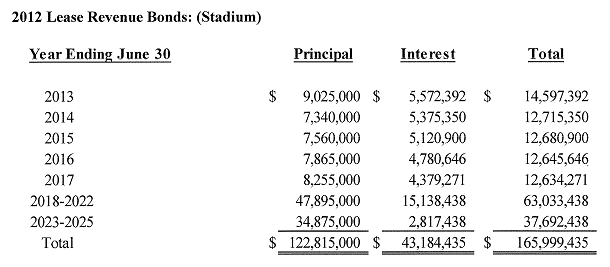
Payment schedule of Coliseum bonds

Payment schedule of Coliseum bonds

Last year the Coliseum JPA sought to refinance the stadium debt in order to switch the debt from variable to fixed rate. New bonds were issued in September.

It can’t be emphasized enough that whatever is planned in the future for the Coliseum, this debt has to be factored in. The City and County will want to repackage the debt in a way that takes the burden away from their respective general funds. Naturally, the A’s and Raiders probably want no part of this, considering how expensive it already is to privately build anything. Even if nothing gets built until 2018, $100 million in debt will remain, making that a sort of tax on any new stadium(s). The JPA is asking the A’s to pay more in rent, reportedly up to $3 million a year. Even then a substantial subsidy will be required. Ultimately, no deal on Coliseum City – no matter the size or scale – will go anywhere unless the outstanding debt at the Coliseum is addressed to all parties’ satisfaction. That’s a challenge as towering as Mt. Davis itself.

—–

Added 11:30 AM – Matier and Ross have an item covering the JPA’s ongoing lease negotiations with the A’s and Raiders. 

The tug-of-war for the five-year extension is over the $3 million in parking taxes that Oakland says the team owes, and over the A’s claim to about a third of the beer sales at the Coliseum – be they at an A’s game, a Raiders game, a U2 concert or any other event.

The tightrope is with the Raiders, who don’t like giving the A’s the beer money and don’t appreciate the A’s request for ballpark “improvements” that may come at the Raiders’ expense.

The parking tax referred to in the piece dates back to 2009, when Oakland unilaterally decided to enforce a long-dormant 18.75% tax per car at the Coliseum. The A’s hiked up parking fees from $15 to $17, and the price stayed there ever since. However, the A’s sat on the additional revenue while other details shook out, such as a revenue split between Oakland and Alameda County that was only settled last year. Assuming that a 2014-18 (or longer) lease extension can be worked out, the parking tax would be yet another detail to negotiate. The beer revenue split goes back to when the A’s sued the Coliseum Authority and received lease concessions, including a split on pouring rights for all events and some advertising revenues. As for the baseball-specific improvements that the Raiders may be resisting, I’m not clear on those. I’ll try to dig that up. All I know at the moment is that Lew Wolff has wanted an escape clause if the Coliseum undergoes changes for the Raiders. 

Finally, M&R end on a vague note – MLB might look favorably on Oakland if a short-term deal can be worked with Wolff/Fisher or “a new set of local owners”. Perhaps, but let’s be clear on a couple of things. First, even if Wolff were to declare today that the he and John Fisher were putting the team up for sale, the actual process to vet prospective bidders (such as a Don Knauss & Co. bid) and then complete the sale would take the better part of a year or more to complete, which is of no help to the A’s immediately as they try to work out a short-term extension. Second, MLB won’t approve a sale to an East Bay-focused group unless there is an ironclad ballpark deal in place. Otherwise there’s no point because the A’s would remain revenue sharing recipients indefinitely, even though it’s written into the CBA that they’re supposed to be off revenue sharing in the next several years. Third, MLB has offered to insert itself into the lease discussions, only to be told no by Wolff. Wolff’s making a leverage play here. He did well in getting a ton of flexibility in the last two lease negotiations. This time, talks are sure to be more rancorous. If MLB wants to float a feel good item to help soften up the JPA, I’m sure Wolff won’t mind. Finally, there’s the issue that appearing to help the A’s and MLB may send the wrong message to the Raiders, who are the only team directly working with the JPA and Oakland at the moment. It’s a very fragile, fluid situation. No one said it’d be easy.

Save Oakland Sports meeting with Santana, Blackwell (Updated with Oakland apology)

Update 7:20 PM – Around 4:30 today, an article by the Trib’s Matthew Artz indicated that Oakland officials apologized to Lew Wolff for erroneously stating that the City and Mayor Jean Quan didn’t receive the letter. Wolff angrily replied (in ALL CAPS no less) that he did, in fact, send the letter, and later produced a letter of acknowledgment from Quan dated January 2. During the Bucher & Towny show on The Game, Townsend explained that his crew and Phoenix reporter Kevin Curran had launched their own inquiry into the status of this now mythical letter. Curran sent an email to the Mayor’s office asking for the letter since, by law, the City has to file all such communications. This afternoon the story from Artz broke, followed by an email reply from Quan spokesperson Sean Maher explaining the situation. Apparently the original email, which was also sent to numerous media, was buried in the “mountain of (holiday) furlough email” the City received. Because of this, news outlets reported on it first, giving City staff the impression that they didn’t receive it, when in fact, they did. The explanation was also a bit wishy-washy because the Mayor supposedly “eventually” received the letter, giving the impression that she didn’t receive it directly. Statements coming out of the Mayor’s office yesterday continued to press that they didn’t receive the letter. In any case, Oakland comes off highly incompetent at the very least and petty on top of it all, just because Santana decided to lash out at Wolff. That’s simply poor form. Obviously, that led to today’s apology.

—–

Monday’s much-delayed Save Oakland Sports meeting was held at La Estrellita in downtown Oakland. Though host Chris Dobbins was keen to not put City Administrators Deanna Santana and (Asst. Admin.) Fred Blackwell on the hot seat, to their credit the staffers addressed several lingering issues with some degree of frankness and a general lack of spin.

Blackwell gave an update on the state of the Coliseum City studies and EIR. The study work should be awarded in the next month, and documents should be ready by the end of the year. Because of the broad scope of the project, there will be a master plan for the 750 acres on both side of 880 and a specific plan for each side, the big focus being on the sports complex. Blackwell called Coliseum City the most dynamic project in the state in terms of size and transit access.

View from east towards Oakland Estuary. Image: JRDV

View from east towards Oakland Estuary. Image: JRDV

Based on JRDV’s newest renderings, he has a point. Much of the area on either side of the Nimitz would undergo a drastic transformation. While there would be a new football stadium in Lot B and a ballpark pushed up to the corner of Lot A, almost everything else would get torn down and replaced. Chief among the changes is a new arena, which would be placed west of 880, where Coliseum Lexus and another empty car dealership are situated. Low and mid rise buildings would be tightly packed from Oakport to the Estuary and in between the two stadia. Two new pedestrian bridges would cross 880. The BART bridge would be transformed into a huge plaza over the Union Pacific tracks. The only two legacy structures that would remain intact in the vision are the 12-story high-rise office building that briefly housed the Tribune and the newer Zhone building.

Before your eyes roll completely into the back of your head, let’s look at the three venues, starting with the ballpark. Blackwell continued previous talk of Oakland giving Lew Wolff information on Coliseum City and Howard Terminal, repeating Wolff’s continued rejection of both sites on financial grounds. Blackwell flat out said that new ownership may be required to get something done in Oakland, and that a MLB could act on behalf of a team to get a deal done. Of course, Blackwell cited Miami as an example of that working. “Working” meant taxpayers putting up 2/3 of the cost and politicians who approved the deal being run out of office. MLB wouldn’t do that unless it felt it could get several pounds of flesh. In Oakland, there is no flesh to take. The only thing MLB has offered so far is to negotiate the short-term lease at the current Coliseum.

As for the Raiders, Santana mentioned upfront that it took four months to get all of the right people (City, County, Raiders) named and set to negotiate the future stadium deal. Four months? You’d figure an e-mail thread and a conference call or two would take care of that.

In a refreshing bit of candor, Santana and Blackwell talked about the challenges facing the Raiders’ stadium piece. Santana said twice that any new project would have to bake in the $100 million of remaining debt (Mt. Davis). As I’ve mentioned before, any advantages Oakland has because of “cheap land” are wiped away because of this albatross. It also makes financing somewhat unclean, though that would depend on how current and future debt are structured. Right now, Mt. Davis debt is tied to the general fund of both City and County and was refinanced last summer. I imagine it could be complicated to restructure the debt to be paid solely by stadium/project revenues and would drive up the cost of borrowing to boot. Santana also talked about how the defeat of Measure B1 in November negatively impacted funding for Coliseum City to the tune of $40 million.

Blackwell admitted that the NFL may have a hard time giving the $200 million that Mayor Jean Quan is looking for, citing fan and corporate support. Why? The G-3 and G-4 loan programs are dependent on two specific revenue streams: national TV money and club seats. TV money is not that big a deal since it’s highly distributed, but the NFL is wary of teams running into blackouts. The Raiders are a particular high-risk case because even though the stadium doesn’t have a large capacity among NFL stadia, it’s had its share of blackouts and has a relatively low season ticket base (30,000). The recent tarping and pricing moves done by the Raiders are being done to grow the season ticket figure and reduce the chance of blackouts. In future seasons, the Raiders could increase capacity as the roll grows and the team performs better. Corporate support is another matter. Blackwell said that the NFL considers corporate support more important than regular fan support. The 49ers have done exceedingly well selling to businesses, which allowed the NFL to release $200 million for the Santa Clara stadium. Corporate support is not great in the East Bay, and the 49ers may have taken some East Bay business from the Raiders, putting the Silver and Black in a very tough position. Blackwell didn’t offer any answers on this, other than to say that the East Bay will have to step up to show it can support the Raiders in a new stadium. It’s a sobering but realistic view, not one to go rah-rah about.

On the Warriors front, Blackwell laid out the City’s case very plainly: Oakland would wait until W’s ownership got frustrated with the process of building something at Piers 30/32, then welcome the team back with open arms. With the A’s, ownership is certainly frustrated (with MLB and the Giants), not enough to run back to make a deal with Oakland. While working in SF, Blackwell saw the same strategy in place for the 49ers, only to see the team start building in the South Bay.

Things got a little strange with Santana laid into the A’s. Santana accused the A’s of playing games, claiming that the letter Wolff wrote requesting a five-year lease extension was only sent to the media, not to City or County. That’s rather confusing, because as the Merc’s John Woolfork wrote on 12/21:

If Wolff’s letter was discouraging to Oakland Mayor Jean Quan, she didn’t let on, saying in a statement that she was “pleased to receive Mr. Wolff’s letter stating his desire to stay in Oakland for five more years.”

Considering that it took four months to figure out who the players were in a negotiation, I wouldn’t be surprised if the letter was lost somewhere. One thing to keep in mind is that Wolff has already done two lease extensions at the Coliseum during his tenure. If there’s one real piece of stability here it’s Wolff, not the turnover in Oakland City Hall.

The tough part of all of this back-and-forth is that even if Oakland is resurgent as its supporters say it is, it’s not to the scale of SF and SJ. It may never be to the scale of SJ. That makes it easy to make a case against the future of pro sports in Oakland. Without some kind of miraculous public and/or private miracle to really boost Oakland, it’s hard to see how Oakland could get to its rivals’ level. Maybe the argument is that Coliseum City is that miracle. Oakland has had nearly 50 years to show that pro sports is an economic stimulator. There’s no reason to believe Coliseum City, even in its fully realized, pipe dream scenario, is the miracle Oakland is looking for. The track record – in and out of Oakland – doesn’t support it.

—–

More reading:

Note: Look at how different the two Tavares articles are. Editors rule!


Pay Up Or GTFO

We’ve talked a lot in the past year about how the Maloof family is broke and can’t do anything on their own, whether it’s funding their piece of a downtown arena or sell anymore pieces of the Kings without losing control of the franchise. Travel west along I-80, and you can see that Oakland and the Raiders are in the same situation. Oakland has had to rob Peter to pay Paul for the Raiders study, and the prospects for the Coliseum are bleak without some extremely creative (and probably public) financing. Al Davis had his estate structured so that his son Mark could keep control of the Raiders, but the Raiders can’t sell additional shares of the club without giving up control. Overextended as they all are, they’re still under the gun to come up with a future stadium solution that works for both parties, while not adding significantly to either party’s debt load.

That puts the Oakland/Alameda County and the Raiders in very tense dance over how much each side will pay to create an anchor for Coliseum City. Make no mistake, both sides will have to pay something, starting at $100 million depending on how extensive the project will be. If there’s a new stadium, especially one with a retractable roof, up to $200 million could be provided by the NFL. If it’s a redone Coliseum, the NFL will offer significantly less. It’s all based on the scale of the project.

For example, take the deal struck between the Carolina Panthers and the City of Charlotte. They’re partnering on a $302.5 million package of improvements for 17-year-old Bank of America Stadium. The breakdown looks like this:

  • $96.25 million from Panthers (33%)
  • $143.75 million from City of Charlotte/Mecklenburg County via a 1% food and beverage tax hike (47%)
  • $62.5 million from North Carolina (20%, pending state approval)

The actual improvements will cost $250 million, the rest will cover the establishment of a maintenance fund, costs associated with staging City/County events, and other gameday expenses such as traffic control. The stadium, which was privately built by Panthers owner Jerry Richardson, will not get any major structural changes such as the addition or elimination of seating decks. Accessibility will be improved by the addition of escalators. Video boards will be replaced. Obviously those items won’t cost $250 million by themselves, so there will be other buildouts elsewhere in the stadium. Perhaps they’ll expand concourses, build field suites, or create additional premium spaces inside the stadium. BofA Stadium still ranks as excellent in terms of design, sightlines, and amenities, so the new improvements may be what Richardson wants to make the venue a viable future Super Bowl candidate. The Panthers would be guaranteed to stay and additional 15 years if the deal is approved and improvements completed.

Sidebar: It was the enormous success of the Panthers’ initial PSL plan that helped sell the 1995 Coliseum renovation plans to Oakland/Alameda County and Al Davis. The Panthers paid for their entire stadium with PSLs and other private sources, with the City only providing a cheap land lease. Where the East Bay went wrong was in severely overestimating demand.

Earlier this morning, Andy Dolich spoke with the Rise Guys about the Raiders’ tarp news and the prospects of Coliseum City. While he continues to believe that the best place for the A’s and Raiders is the Coliseum, his vision has shifted a bit. In 2010 he talked about a new multipurpose stadium with “technology” that could accommodate both teams. Now he prefers a separate ballpark at the complex and a refurbished Coliseum, which he estimated to cost $300-400 million. My immediate response:

Considering what’s budgeted for the Panthers and the Bills, does anyone think a $300-400 million budget as realistic for what the Raiders and the NFL would want? Frankly, I think that by the time everything got going, $500 million may be undershooting it by quite a bit. Dolich also thinks the Diridon ballpark cost could rise to $600-700 million based on additional costs to get the site ready. I tend to disagree with that, though if this saga keeps dragging on $600 million is an easy reach. Even if the land is free, why would two-thirds of a larger football stadium cost half as much as a nearly half-capacity ballpark?

Also, consider that we explored a Coliseum refurb on this blog back in 2008. It would’ve involved gutting the original bowl and replacing it with a new West stand and a single deck of seats along each end zone.

2008-refurb_d

Colors denote different seating decks or phases of development

The project as described back then would’ve taken two full NFL seasons and about 18 months to complete, with the Raiders playing in a 47,000-seat temporary configuration while construction work progressed, similar to their 1995 season at the Coliseum. Complicating matters is that Lew Wolff wants an out clause in his five-year lease extension request if the Raiders begin this very type of project. That makes sense, since there’s no way the stadium could host baseball during this period.

Let’s say that a refurb could be capped at $500 million. The breakdown of costs by party could look like this:

  • $200 million from Oakland/Alameda County (Coliseum Authority)
  • $200 million from Raiders
  • $100 million from NFL

The Coliseum Authority could get their piece from land leases, new stadium taxes, or other sources. However, they have factor in the remaining $100 million of debt on Mt. Davis since it affects City and County budgets every year ($20 million annual subsidy). The Raiders and the NFL could work together to sell new PSLs, naming rights, etc.

The NFL has two, maybe three $200 million slots in its G-4 program for new stadia, one already claimed by 49ers. Another could be the Vikings or Falcons. In theirs and the Raiders’ cases, the teams have to at least match the NFL spend, which means that they have to come up with $200 million of their own. The 49ers came up with closer to $800 million, though much of that is money borrowed through the quasi-governmental Santa Clara Stadium Authority. Chances are that the Coliseum City stadium project would borrow through the Coliseum Authority.

Oakland pols will want as much private funds going into the project as possible, but the Raiders will be wary of digging themselves too deep a hole. That stands to reason because of poor suite and club seat sales over the years, along with mediocre season ticket rolls. There’s been a lot of talk about Oakland not requiring a vote, none about how much it’s willing to invest besides land and infrastructure improvements. Unfortunately for Oakland, land and infrastructure only gets you in the door these days. How much skin will each side put into the game? The answer won’t be known without a (hopefully public) discussion about what it’ll take to make Coliseum City happen.