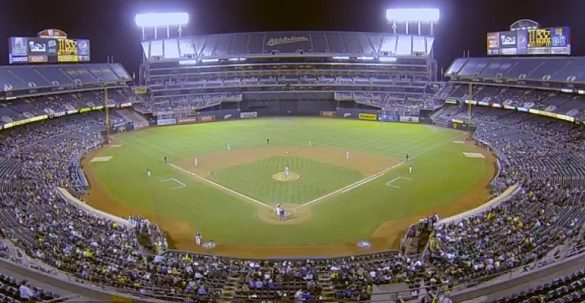
Mayor Quan shows up late to Raiders/NFL presentation

According to Matier & Ross, Mark Davis and the NFL held a meeting last week with East Bay pols to talk new stadium. Apparently things got off on the wrong foot when Oakland Mayor Jean Quan showed up late.

People at the meeting – none of whom would speak on the record, because the session was supposed to be private – say their efforts to convince the NFL that there’s still hope in the East Bay weren’t boosted by the tardy entrance of Oakland Mayor Jean Quan.

‘She arrived 20 minutes late,’ said our attendee. ‘he apologized, saying she was held up by a phone call.’

M & R also pointed out the elephant in the room, the lack of funds on either side, and the political reality surrounding the potential for public funds.

And while no one said it at the meeting, everyone knows the chances of voters helping out with a new stadium deal – while they are still paying off $20 million a year for the 1990s renovation of the old one – are slim to none.

Ah, maybe the pols can keep repeating the “no vote needed” mantra. Because that’s helpful.

I don’t know if Mark Davis and Lew Wolff have ever talked about their respective stadium issues. They both live in LA, so they could have lunch without Bay Area gadflies noticing if they wanted to. Even if they haven’t, Davis is doing Wolff a favor by forcing the issue with Oakland and Alameda County. By getting the public side to start moving, we’re finally seeing their level of commitment to the Raiders, and downstream to the A’s. As far as Mayor Quan goes, it’s at best token effort, which is what we’ve come to expect.

Raiders want to build at current Coliseum site, whither the A’s?

Absent a short or long-term lease at the Oakland-Alameda County Coliseum, the Raiders made an unusual request of the Coliseum Authority (JPA): they want to build a new stadium on the site of the current Coliseum.

That’s a departure from the commonly held belief that the Raiders wanted a stadium next to the current one, in the Coliseum’s B Lot. Should the JPA take up the Raiders’ request, both the Raiders and A’s would be unable to play in the Coliseum as the old one was torn down and a new one built. Of course, this isn’t necessarily a problem for the Raiders, since they could become roommates with the 49ers in Santa Clara for a few years while all of the upheaval occurred. As for the A’s, they’d be out of a place to play.

Of all the different ways we all considered how this dance could play out, the Raiders wanting the Coliseum to themselves in this way did not climb to the top of the list. If you think about it for a minute, it makes sense. What the Raiders want is what many teams want at their stadium sites – full control of the complex. All parking revenues, all signage, all ancillary event money, all of it. And I don’t blame them. If they say they’re going to put up $300+ million for the stadium, they want to ensure that they’ll get that back. Pushing the A’s out of the complex is the best way to do it because there’s much less chance of the legal (and revenue-sharing) love triangle between the Raiders, A’s, and JPA that Mt. Davis wrought.

Lame duck JPA board Vice Chair Larry Reid knows what this means for the A’s and MLB.

Lew Wolff would be happy if that was the scenario that played out. He could tell Major League Baseball, ‘See, they didn’t want us. Look what they’re doing for the Raiders.’

Exactly. The JPA knows this and they don’t want to be caught throwing more good money after bad, in this case, a second Mt. Davis. We don’t know yet what commitments Oakland and Alameda County are willing to make, yet the Raiders are making demands. At least the Raiders have put some cards on the table. The City/County haven’t. And the A’s have no interest in playing.

Funny thing is that there’s still doubt about what revenue the Raiders could generate to back a new stadium that could cost upwards of $800 million to build. Yet they don’t have to prove anything at the moment. This is about getting the JPA to commit to one team over the other. This won’t make the A’s respond with a different stance in the least. They sent a lease offer to the JPA that accounted for this. And that puts the JPA in a very, very tough position.

The Raiders have options and they’re playing this like they’re ready to exercise any of them. They could go to Santa Clara. Mark Davis is in talks with LA, despite how unlikely that move sounds. They’re giving the appearance of a team that wants, but does not need, Oakland. I told all of you about a reckoning earlier in the summer. It’s starting.

—–

Update 9:15 PM – In an ESPN interview today, Mark Davis laid out more specifically what he wants. Most interesting is the news that he confirmed the 58,000-seat capacity stadium concept.

I’ve come to the conclusion that a 53,000-seat stadium, that we played in from the 60’s and all that, is basically what our market is. We’re not an 80,000-seat stadium, we’re not a 65,000-seat stadium, really, unless you’re winning every game and all that stuff. But those aren’t the hardcore fans that are there … for us the 53,000–seat stadium is good and maybe 5,000 club seats bring it up to 58,000 seats.

Like I said, Davis is laying down his cards.

Postseason Coliseum scheduling conflicts mostly averted

MLB announced its schedule for the 2013 postseason today. For the most part it’s a very tidy package, further proof that it’s better for the league to start a little early, around April 1-2, instead of April 6-7. There are always tradeoffs, such as the increased possibility of weather postponements in the spring, but overall it’s better than having the postseason extend into November. As currently formatted, the seventh game of the World Series would occur on Halloween night.

october2013

American League 2013 Postseason Schedule

The National League will get things started on October 1st with their Wild Card Game. The next day will feature the American League Wild Card game. Friday, 10/4 will kick off the AL Division Series, followed a week later by the Championship Series. October 23 is the date of the first World Series game. Remember that by virtue of the American League’s All Star Game victory, the AL representative has home field advantage, including Games 1, 2, 6, and 7 (if necessary).

Since the A’s are the only team in contention that has to worry about scheduling conflicts with a football team, naturally there was concern when the Raiders’ schedule was released earlier in the year. For the most part, the concerns have subsided. The Raiders have home games against the Chargers on 10/6, an off day during the ALDS. Assuming that the A’s make it to the ALDS, there will be a conflict of sorts in that the Coliseum’s grounds crew will have a very tight timeframe to convert the Coliseum from football to baseball (or vice-versa). Normally the conversion takes 36-48 hours. In this case, there will be 18-20 hours tops. It should be a very good demonstration of how bad the situation is for both the A’s and Raiders.

Update 6 PM – The Chronicle’s Susan Slusser notes that because the 10/6 game is between division rivals, the dates could be swapped with the game in San Diego happening first.

The Raiders also have a home game vs. the Steelers on the 27th, but that’s during the three-game middle section of the World Series scheduled for the National League park, so there’s no conflict there. The previous week is a scheduled bye week. Including the just completed NFL preseason, there will be five baseball-to-football-to-baseball conversions in a matter of three months, plus the final conversion to the football configuration for the completion of the Raiders’ regular season. Could’ve been worse.

Stadium by committee

If MetLife Stadium is the result of two teams working together to build a stadium, the practice should be banned posthaste and forever until kingdom come.

The problem becomes apparent the minute one comes upon the stadium. The bulk of the stadium’s façade is gray steel louvers. They function to allow breezes into the concourses while protecting from wind and snow, and as far as that goes they do a great job. Unfortunately, it makes the whole place look like a parking garage. MetLife Stadium feels like it aspires to be an office building, which makes sense once you go inside.

East entry near the train station

East entry near the train station

Nearly everything inside is some shade of gray. There are four shades of gray for the seats. The columns are a sort of gunmetal gray. Walls are medium. Some of the color comes from mood lighting on some signage, which can be switched from green for the Jets to blue for the Giants from game to game. The rest of the color comes from corporate branding. MetLife has a huge plaza on the western sideline. Verizon, Pepsi, SAP, and Bud Light have their corners of the concourse. Banners are on rotating installations to allow for quick changeovers. Altogether, the place has all the charm of a brand new hospital: clinical, safe, boring, inoffensive.

Perhaps that’s the point. In order to make the Stadium appear to not favor one team over the other (as was obvious at Giants Stadium), MetLife Stadium was built essentially devoid of character. Sure, the place has the requisite suites (four levels), fancy clubs, and plenty of space under the bowl to host any number of event types. The technology inside is neat, and there’s even a mini concourse behind the 100 level for standing room admissions. Still, it’s impossible to get over the fact that MetLife Stadium is just one big soulless, brazen corporate exercise. In that sense, I suppose it’s perfect for the upcoming Super Bowl.

If the 49ers and Raiders had agreed to a co-constructed stadium in Santa Clara, it might’ve looked a little like this. I’d like to think that the two teams would do more to make the stadium truly dual-identity, instead of no identity in the Meadowlands. MetLife Stadium is living proof that technology is no substitute for vision. Cowboys Stadium is also brazenly corporate, but at least it places the Cowboys front and center. The Giants and Jets have to live with this pile of concrete indefinitely. Sucks for them.

Kawakami interviews Mark Davis about Coliseum plans

Say what you will about Tim Kawakami, but he’s the only local columnist talking Raiders’ (and Warriors’) stadium issues. He got a little time in with Raiders owner Mark Davis, who didn’t crack. Davis did, however, reveal some of his motivations for moving the way he has.

Davis continues to not consider Santa Clara as an option after 2013. He said that the team is still only talking to the JPA (Coliseum Authority) about a lease extension, with no actual negotiation yet on a long-term deal – which he prefers. Asked why he prefers a long-term deal, he replied:

(A short-term extension) doesn’t seem to be something that I want to do. I don’t see where that does any good.

If you go back and look at when we did the three-year extension last time, and you look at the quotes from the politicians and the people around, they said, ‘Great, now we’ve got an opportunity to work on a long-term deal with the Raiders.’

If we do it again, then it’s, ‘Great, now we’ve got a long time to work on a long-term deal with the Raiders.’ I think we’ve got to get a little more urgency about it.

Pretty subtle dig at the JPA and Oakland/Alameda County pols there. It’s a good move for Davis strategically, since it will eventually force the JPA to make commitments to a timeline and some minimal level of funding if they really want to keep the Raiders in town. If they’re reticent to make a deal, Davis can turn to Roger Goodell and say, See, I tried. Davis certainly sounds sincere about his stance, though it would be crazy if he didn’t take calls from interested municipalities. He also revealed that he was able to buy out a minority partner, bringing the family’s share of the team to above 50%.

Kawakami brought up Cal’s Memorial Stadium as a temporary venue option. Davis didn’t discount the possibility, but his response showed that he hadn’t considered it much either:

Sure. I mean, if they’d want us. We’ve done it before. There’s some… things about Berkeley that wouldn’t be optimal–the parking and all of that stuff is always tough.

But at the same time, if it’s (there’s a need to play elsewhere for a while) for a new stadium… and we like Berkeley. I think what they’ve done with the new stadium is great.

The issue at Memorial Stadium is a legal one. Neighbors who fought the stadium renovation project hard got a settlement in 2010 that placed a cap on the number of high-capacity events at the stadium and prohibited NFL games as well.

Contrast the Davis’s and Wolff’s positions on lease extensions at the Coliseum. Davis wants a long-term deal that includes a replacement Coliseum with untold amounts of public and private money. Wolff prefers a five-year, short-term extension that allows him to build a privately-funded stadium in San Jose. Neither owner has lashed out at the other or the team, instead calling the shared-stadium situation something their respective teams have to suffer through.

At the moment it doesn’t look like the two teams’ extension will be wrapped up before the end of the baseball season, at the very least. That will only put more pressure on the JPA to make commitments. The timeline will also coincide with a building Oakland mayoral race, which has gone from having few challengers to incumbent Jean Quan to several. It’ll be interesting to see how the sports teams are treated and cited on the campaign trail. Sports may be the one of the highest profile things about the City, but it’s also one of the trickiest to manage.

CenturyLink Field tour

A little over a decade ago, before the great “final” NFL realignment, the Seattle Seahawks were a fierce divisional rival of the Raiders. Who could forget this gem?

The Raiders will wrap up the preseason against the Seahawks at CenturyLink Field (née Qwest Field). If Mark Davis is looking for a good example to emulate in terms of stadium and game experience, he’d be hard pressed to do better than the Seahawks’ distinctive, modern home. Completed at a cost of $360 million in 2001 (plus $70 million for a large indoor exhibition space and garage), CenturyLink Field manages to provide top-tier amenities while creating a very intimidating home field atmosphere, which can’t be said for many new NFL stadia.

centurylink-05-top_north_view

View from upper deck towards downtown Seattle

The key to CenturyLink Field’s success is its arched roof structures, which each cover most of the west and east stands. Even though people were scarce during the tour, our guide had us yell while on the upper concourse to demonstrate the echo effect, and it was impressive. Most outdoor NFL stadia have at best a roof as a trim piece, nothing as big as this. The roof design was meant to evoke Husky Stadium on the University of Washington campus, where the Seahawks played for a year while the new stadium was being built. Husky Stadium and Oregon’s Autzen are the loudest stadia in the Pac-12. The Kingdome was also loud, now this place is loud. Guess they like loud football in the Pacific Northwest.

centurylink-06-12th_man_suite_cantilever

As far as pro football stadia go, this is an aggressive cantilever

Architectural firm Ellerbe Becket (now part of AECOM) incorporated another cool feature from Husky Stadium: an overhanging upper deck. From the picture above, the cantilever runs about 13 rows or 40 feet. The cantilever is actually something of a necessity because the stadium site, where the old Kingdome sat, is rather compact. While many league venues are surrounded by a sea of parking, CenturyLink Field is bordered by a street grid and railroad tracks (just like Safeco Field one block south). Without the cantilevers, Ellerbe Becket couldn’t have crammed 67,000 seats into this space unless they built more vertically, which would’ve been far more expensive.

centurylink-03-events_center

CenturyLink Field Events Center

Since tailgating wasn’t really possible in SoDo, a large exhibit hall was constructed adjacent to the stadium. Named the Event Center, the 200,000 square feet of flex space serves as a huge pregame staging area, a sort of scaled-down version of the NFL Experience at the Super Bowl. Non-ticketed fans are allowed inside until kickoff. The Event Center is also used as a concert venue (of debatable quality) and as a mini convention center.

Lower concourse is at field level

West side lower concourse is at field level

When fans enter the stadium through one of the gates on Occidental Avenue S, they are greeted by the team store (for both the Seahawks and MLS Sounders) and an enormous lower concourse, which also happens to sit at field level. Using this arrangement conserves space within the limited footprint, though it also also limits the amount of additional structures that can be built on different levels within the stadium. The same concourse on the opposite (east) side is elevated above the field to allow for the construction of locker rooms, the commissary, and other back-of-the-house necessities.

centurylink-07-east_stand

The simple, uncluttered grandstand is brilliantly efficient

There’s one suite level and suites on the club level beneath it. There aren’t three different club levels, or a stack of four or five seating decks. It’s a classic arrangement that has similarities with with Pittsburgh’s Heinz Field. The 49ers’ Levi’s Stadium has an unorthodox seating arrangement within a compact footprint. We’ll see if it provides the kind of atmosphere the ‘Stick could at times.

The State of Football displays helmets from every high school football program throughout Washington

The State of Football displays helmets from every high school football program throughout Washington

Before ever setting foot in CenturyLink Field, I had pretty good understanding of why it should be a great football venue. It doesn’t bow too much to the greedy, pervasive class system of stadium construction. It makes a nod to another great stadium in the area. It’s not a dome. It’s focused on football (and soccer to a surprisingly successful extent). It looks cool without looking too blingy. Unlike the Kingdome, a neither fish-nor-fowl space that both tenants wanted to abandon shortly after it was built, this stadium is something Seahawks and the public can be proud of (public financing problems notwithstanding). Besides the lack of tailgating lots, it’s just about everything a modern football stadium should be. As such, it’s probably the best among the new era of NFL stadia, and 2nd overall to Lambeau Field.

Battle: Field

Raiders owner Mark Davis was interviewed during Friday’s home exhibition opener at the Coliseum against the Cowboys. Davis left no doubt about how he felt about sharing the Coli with the A’s, calling the situation a “travesty“.

Just as the A’s and MLB complain about the state of the field when the Raiders invade the Coliseum every August, the Raiders and the NFL complain about the dirt infield dominating the football field. While that has proved to be something of a home field advantage because of Sebastian Janikowski’s well-developed skill in kicking off the brown stuff, the Polish cannon is not going to be around forever. Every other team has either a pristine grass or fake grass field, and frankly the Raiders should have the same conditions in today’s era.

081313-notbad

The baseball configuration 96 hours after the first Raiders game doesn’t look that bad.

Three more conversions to the football setup are planned through the rest of the baseball regular season. Another two or three could occur if the A’s reach the postseason and go deep. There’s an especially tricky period from September 29 to October 6, which will have two Raiders home games sandwiching an indeterminate number of A’s home postseason games. The home dates could be a division tiebreaker, wild card game, part of the best-of-five divisional series.

NFL commissioner Roger Goodell and the other franchise owners are monitoring the Oakland situation continually, with the knowledge that the Raiders’ lease expires at the end of the season. The ratcheted up rhetoric by Davis and the Raiders’ broadcast team is no coincidence. The state of the field is a wedge issue in lease negotiations for both tenants at the Coliseum, with both teams basically saying that they’d rather have the field in their preferred condition. Of course, the only way to truly get that is to get the other tenant to leave. The A’s and Raiders have a friendly and professional relationship so you won’t see them going after each other. Instead they’ll send their gripes the JPA’s way.

At the moment the Raiders have an advantage over the A’s in their respective lease talks due to their ongoing dialogue with the JPA over Coliseum City. However, the A’s need the field ready sooner because their season starts in April. In fact, lease decisions will have to be made in the fall because decisions have to be made about when to start growing grass and rebuilding the infield, a process that usually starts in late January or early February. And you can bet that MLB, which has stayed hands off for the moment, will have no choice but to get involved if there’s a threat of the A’s being “homeless” for 2014.

Davis has said previously that even a temporary lease at the Coliseum is tied to development of a new stadium at the Coliseum complex, which only serves to make negotiations even more complicated. Perhaps the Raiders can commit with only a tentative agreement on how to move forward with Coliseum City. The feasibility study should be complete in a month or so, whereas an EIR is still ongoing.

With all of the lease factors in play, let’s talk about what has to happen next. A Raiders lease extension will need to be finalized well before the end of the season, probably as early as November. The same goes for the A’s because of the earlier start. If the teams are forced to share, there may be a way to minimize the conversion impact. That would probably include the A’s playing late season games at AT&T Park, allowing for the “permanent” football conversion to commence earlier, or the Raiders playing preseason games in Santa Clara (which makes more sense for the A’s). The JPA has to be careful not to appear as if they’re playing favorites, considering that both tenants don’t need much impetus to bolt. Davis may not have formal discussions with anyone in LA, but he’s probably getting a lot of whispers. We know that Lew Wolff only wants to stay long enough to get a San Jose ballpark built.

For now, let’s shelve the possibility that one of the tenants will move. We’ll have the chance to talk about the more drastic scenarios in posts I’ve scheduled for the weekend. Let’s assume that both will stay for now. What do you think the JPA, Oakland, and Alameda County will need to do to keep the teams happy?

NFL-to-LA murmurs grow louder

Cowboys owner Jerry Jones can’t stop talking, including answering questions about the NFL potentially coming back to LA. At this point Jerruh is a very tenured owner (24 years), and is involved heavily in anything involving the economic growth of the sport. The LA Daily News’ Vincent Bonsignore asked Jones about LA, and he was about as forthcoming as anyone from the league has been regarding the possibility.

“I’ve never, ever been a part of any meeting or committee, ever, that didn’t want – and as quickly as we could – a team in L.A.” Jones said. “I’ve heard the same thing – that (L.A.) can be (used) as a threat (for) teams moving out here and what have you. But that’s not right.

“I can speak for everyone I’ve ever talked to, we always preferred to get a team here.”

About Farmers Field:

Jones praised Farmers Field and disagrees with reports that his league might be souring on it.

“I have no misgiving at all about it. It’s an outstanding (project) with outstanding people involved in it,” Jones said. “Philip Anschutz is an outstanding individual and would be an asset in any way to any group to (he’s) involved with.”

Whether or not this is part of the leverage game, Jones’s comments will surely raise eyebrows in San Diego, Oakland, and St. Louis. Interestingly, Jones is happy to promote LA even as Farmers Field could provide direct competition to Cowboys Stadium for future Super Bowls, Final Fours, and college football playoff games. My sense is that the owners and Roger Goodell are eyeing the $10 billion annual revenue mark, and they know the quickest way to get there is through LA.

Jones also spoke with SI’s Peter King and gave this assessment:

“I wouldn’t be surprised if within months – I don’t know – that you’d have an announcement of intent (for a team) to come to Los Angeles.”

At what point does a threat become a promise?

Radio interview with 1010 AM SoCal, talking Raiders & A’s stadium issues

I’m still in Pittsburgh. While resting at The Church Brew Works (a must-see if you’re ever in Steel Town), I did an interview with Julie Buehler and Geoff Bloom of Team 1010, an AM sports talk station in Palm Springs. Normally when I do when of these, I hem and haw a little on the “percentage chance something happens” game. This time I didn’t. Take a listen.


Video streaming by Ustream

Thanks to Julie and Geoff for having me on, and the Trib’s Matthew Artz for linking us up.

Coliseum City Football Stadium Revenue Study (Updated with analysis)

As planned, the study is out. It’s brief. A series of component updates are due over the next couple of months, with the final presentation(s) to come in September.

First, the part that seems to be contention is data that comes directly from the Raiders:

– Little corporate support in the market
– PSL program could potentially generate approximately $100 million
– Anticipated demand could justify approximately:
•  50,000 seats
•  85 to 95 suites
•  6,000 club seats
•  400 to 600 loge seats

The study is vague, perhaps intentionally so on both capacity and cost estimates. The numbers above are only demand, which is important. It’s subject to change based on various factors including team performance, price, and the general attractiveness of the stadium. That doesn’t mean the stadium is set for 50k, 56k, or 60k seats right off the bat. If anything it’s an indicator of two things:

  • What the Raiders feel the market can support right now
  • How low that is compared to other healthier markets (SF being the direct comparison)
map_of_fortune500s

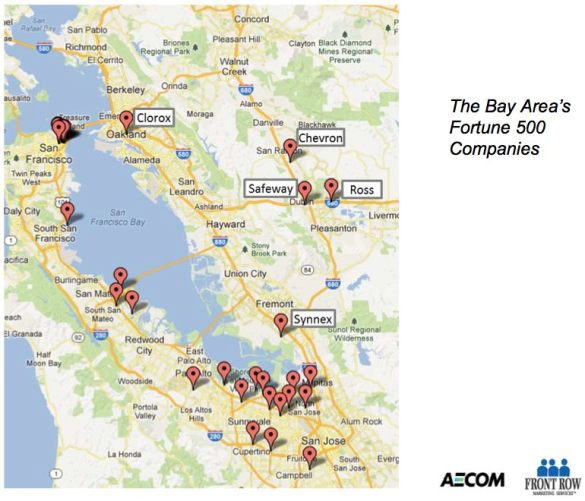
Map of Fortune 500 companies provided by consultants

One surprise coming out of this is that the Raiders revealed that they feel they can pull in $100 million worth of PSLs. Assuming that’s in the same form as PSLs for the 49ers & Cowboys, those are better than nothing, but also short of what the bigger revenue teams use to support their stadia.

For now the study assumes that all forms of financing are on the table: PSLs, NFL G-4, team equity, public. Chances are that by the September presentation, some of these will be pared down. The study doesn’t include some of the back room discussions that have been ongoing, such as the Raiders’ perhaps declining G-4 (if it’s even available) due to a lack of club seat demand. The study also touches on the impact of limited or zero public funds, but doesn’t assess what will happen if they are (not) available.

Keep in mind that while this report is being prepared for Oakland and Alameda County, the Raiders are doing their own study for themselves and more importantly, the NFL. These reports are not just about how to build and finance a stadium at Coliseum City. These studies are also about determining how viable the Oakland/East Bay market is. That’s the real question here. For now the NFL has not rendered a long-term judgement about the reduced capacity at the Coliseum or the possibility of a much smaller-than-normal Coliseum replacement. When these reports are completed, the NFL will most certainly tell Mark Davis exactly what it thinks about the East Bay as a NFL market long-term, and chances are if these demand numbers don’t improve at the end of this season, the owners and Roger Goodell may look outside the East Bay entirely whether that means Santa Clara or Los Angeles.

The big wildcard is the status of the Raiders’ extension at the Coliseum. We had heard that the extension was “weeks away” from being done as early as last summer. If the Raiders and the Coliseum Authority are still struggling with the extension, that’s because the JPA wants to better link the extension to Coliseum City. Moreover, ongoing tensions with the A’s can’t be helping things, since both teams are bargaining with the JPA for many of the same cuts of revenue (signage, concessions). Oakland/Alameda County have also been pushing hard to get both teams to take on more of the remaining debt at the Coliseum. This is the exact situation that everyone should’ve seen coming long ago. With both teams having no lease after 2013, they’re both free agents. At least the Raiders can crash in Santa Clara for a few years while they try to figure it out. The A’s have no such luxury.

Oakland has an even tougher task ahead of them. The September report should show what Oakland will be expected to put up for Coliseum City. Sure, they can levy new hotel and rental car taxes or create a community facilities district. All of those measures will require some kind of vote. Even more challenging is that Oakland/Alameda County has to take a gamble on what development can be brought in with the Raiders as the only anchor. This is the assessment:

  • 40-60,000 square feet retail
  • 35-70,000 square feet office
  • 150-250 hotel rooms
  • 400-700 residential units

The non-residential component is only around 250,000 square feet, about the size of Hegenberger Gateway across the Nimitz, with retail only a quarter of the total. Patriot Place in Foxborough, MA started out as a strip mall and gained momentum as the team did well and the stadium area became attractive. Now it’s 1.3 million square feet and doesn’t need the football stadium as an anchor. Santana Row (640,000 SF) or Bay Street (400,000 SF) are good comparisons in the Bay Area for what Oakland is aiming for. Oakland is severely under-retailed, but will that be enough to attract the private capital necessary to build the mall? No one can say with any certainty at this point. Plus it’s strange to juxtapose the image of Black Hole dwellers tailgating against what would be an urban/suburban mall landscape. The Patriots made it work because Robert Kraft owned the land and financed everything. He could afford to be patient. Mark Davis doesn’t have the funds to do anything like that. As far as we know, Davis is only interested in a stadium and little else. The retractable dome idea (championed by Mayor Jean Quan) appears to be properly scuttled. But if Oakland gets limited ancillary development from the Raiders’ stadium, what’s in it for Oakland besides pride? Does Oakland need another Hegenberger Gateway?

There’s a reckoning coming. It may be slow. It’ll get here soon enough. We’ll finally have some answers. Brace yourself.