News for 3/24/11

Quick housekeeping note: If you were not aware, this blog is a self-hosted WordPress site. Ever since I moved to this platform in November 2009 after years with Blogger, I have been astonished at the rapid pace of third party development for WordPress. One feature came out today in the form of a server-side plugin called Onswipe, which can automatically reformat any WordPress site into an iPad/touch-friendly format. If you’ve used iPad apps such as Flipboard, Pulse, and Zite, you’ll feel right at home. Here’s a screenshot:

If you have an iPad, your browser (Safari) will show this version of the site automatically. I’m going to leave it up for now, but if any iPad users would prefer to go back to the original version of the site with the sidebars, I’ll heed your words. No other browsers or platforms should be affected. If you are, let me know in the comments. I’ve experimented with a mobile version of the site, but I’ve chosen not to launch it because nobody’s asked for it, so I didn’t want to penalize readers who are happy with the full site on their smartphones, etc.

Now the news:

Evan Weiner has a good overview of how the landmark Tax Reform Act of 1986 impacted the ways stadiums and arenas could be financed.

Jorge Leon was interviewed by Oakland North, a three minute clip in which he manages to dismiss economic viability concerns in Oakland as easily as he does train safety.

Press Democrat columnist Robert Rubino bashes the Giants in consecutive weeks – first the fans, then the team over T-rights.

Bleacher Report’s Brandon McClintock seems to buying into a Wolff conspiracy theory – nevermind the millions spent in Fremont, the lack of interest or cooperation during the Brown administration, or the Coliseum Authority’s lack of willingness to explore a ballpark plus development at the Malibu/HomeBase site.

As for the fate of redevelopment? The legislature is steeling themselves for the fight over tax extensions. Redevelopment will have to wait.

Added 2:27 PM – Speaking of trains, the Harbor Drive Bridge, a pedestrian/bike span that goes over heavily used heavy and light rail tracks near PETCO Park in San Diego, has finally opened. It’s lovely and it only cost $12.8 million $26.8 million to construct. A Victory Court-to-Jack London Square bridge shouldn’t cost as much. It will probably cost many millions of dollars to build, and yes, it absolutely is necessary.

Picture from San Diego Union Tribune / CCDC

2011 Forbes valuations out, A’s up 4%

It’s late March, and you know what that means: the new Forbes MLB franchise valuations are out. With a few notable exceptions due to debt problems (Mets, Dodgers), things in baseball are going quite swimmingly. The A’s are back above the $300 million mark with a $307 million valuation, up 4% from 2010. The team remains second-to-last among all MLB franchises, eclipsing only the Pirates. Forbes also listed at $23.2 million, which is probably due entirely to revenue sharing.

To understand where the A’s may be headed, I took five teams and looked a little deeper at how their valuations were constituted. The teams are the A’s, Giants (natch), Red Sox (Giants’ aspirations), Rockies and Padres (aspirational western mid-markets for the A’s). The numbers are quite interesting.

First off, it’s important to note Forbes’ explanations for some of the components of each valuation. “Sport” is described as attributable to revenue shared among all teams. You’ll see there’s an inverse relationship between the bigger revenue teams and this number. If a team is highly dependent on revenue sharing, this number will be higher. “Market” seems self-explanatory, though for the two Bay Area teams it’s interesting that according to Forbes they share the same market, which based on its size (4,274,000) is probably defined as the SF-Oakland-Fremont MSA. That leaves out both the South Bay and all of the North Bay save for Marin County. Not clear on what impact this has, so I’ve reached out to Forbes editor Kurt Badenhausen for a clarification. Here’s his response:

We publish the population and revenue per fan numbers based on the San Francisco-Oakland-Fremont MSA. We use the official MSA designations for all those numbers. Market size plays a role in the value of teams in terms of how they drive revenues, but a bad stadium situation in a big market is still not going to help a team out.

“Stadium” is fairly straightforward, though it should be pointed out that just because you build a $500 million dollar stadium you’re not going to see a similar appreciation in your franchise valuation. That makes “Stadium” more a function of gate revenue and attendance, areas where the A’s and Padres fall behind while the Giants and Red Sox excel. “Brand Management” must be related to marketing efforts – or in the case of the A’s, a lack thereof.

Debt/value is a tricky beast, both in how it’s defined and how MLB’s debt rules get enforced. It always includes stadium debt, and should the A’s get their new ballpark in the next few years that number will jump up significantly from its 29% position, which has hovered there for several years. Since it’s possible that some of that debt may come in the form of a loan from MLB, it will be extremely important for Wolff/Fisher to ensure that revenue streams are locked in to service that debt (and then some) for the foreseeable future.

Surely, this annual release by Forbes will be followed up by a denial of the veracity of the figures by Commissioner Bud Selig. Despite this, it’s telling that franchise sales tend to use the Forbes figures as a baseline at the very least, leading me to believe that they’re far more accurate than Selig, who is loathe to provide any real financial data from MLB, is willing to let on.

Ray Ratto: Ballpark Feasibility Detective

Several hours ago I listed to the latest installment of Dale Tafoya’s Athletics After Dark podcast, this one featuring Ray Ratto. Ratto thinks that the San Jose stadium plan is near death:

The “Blue Ribbon Committee” is a fraud. The territorial rights argument is a fraud. This is about one thing and one thing only, and it’s always been about this: Do the A’s have the money to put a shovel in the ground? If they had the money to put a shovel in the ground, we would’ve gone to Bud Selig and said, “We’re ready to go now.” And then Bud Selig can either tell the committee to produce a report or he could just go without it and start harvesting votes if they really want this to happen. I think it is incumbent upon the A’s to show that they’re ready to go right now and the fact that they keep saying, “well we haven’t seen the blue ribbon report…” You know what? That’s due diligence and you’re supposed to do that. If you’ve got that stuff down you’re already working at that.

…In the current economic climate, where you really need help from cities and states to get buildings done if you don’t want to go into your own personal debt. I think that the idea of a San Jose stadium is really fading. It may be dead at this point. It’s taken too long for the A’s to get what ducks they have in a row, in a row. So I think the problem here is the A’s needed more help than they let on and now they’re stuck.

The bedeviling thing about how MLB works is this black hole of information around Selig. We know a lot about what San Jose is doing, we know a decent amount about what Oakland is doing. We have Wolff and his media campaign, we have responses from Neukom and Baer. The only thing we don’t have is the really important stuff. We don’t know what Selig’s, and by extension the other owners’, motivation is. To fill that void, Ratto theorizes that money is the problem. Which it may be, none of us have a financing plan in front of us.

But unlike the territorial rights issue or the progress of environmental impact reports, there is absolutely zero data or precedent to back up Ratto’s supposition. He is quite literally going on a hunch, making the analytical leap that it must be the money and everything else is a sham.

That makes little sense when you consider the following:

  • The Giants have been spending millions on preserving T-rights to the South Bay over the last two years. They bought a majority share of the SJ Giants. They’ve been redoubling marketing efforts in the South Bay. Their stance on T-rights has gotten more hardline with the passing of time. They’ve threatened legal action – not directly, through intermediaries. No organization goes to this much trouble if they don’t believe that something major is at stake.
  • They don’t call Selig “Slug” for nothing. The man is interminably slow when it comes to big decisions and is more than willing to say the sky is green when it is obviously blue (his remarks about competitive balance are a good example). This one’s a very big one since it involves something the big market owners consider sacred. I’ve said before that Selig isn’t going to act until at least one of these cities has all of their ducks in a row. That means the site, legal/political clearances, everything. San Jose isn’t there yet. Oakland isn’t there yet. And the Grim Reaper is coming fast for cities. Plus there’s the possibility that upcoming CBA negotiations will come into play, especially because the biggest debate will be about revenue sharing. If you’re Selig, why would you lift a finger until this other stuff shakes out? I wouldn’t. I guess you can call me “Slug” too.
  • The money is a lot more “there” than “not there.” Wolff hasn’t been afraid to say when money is an issue – look at what’s been happening with the Quakes. He also hasn’t been afraid to bail on a project when it couldn’t work out financially, as was the case in Fremont and Oakland. Is it all locked in and under contract? Probably not. The timing of the hiring of Darrin Gross to the business side of the A’s may be a clue. Wolff hired David Kaval under the same auspices with the Quakes last year, and now we’re a few months away from groundbreaking. And let’s not forget that Cisco and SVLG are nothing to sneeze at.
  • This stuff takes a long time to pan out. Peter Magowan took over the Giants in spring 1993. It took four years to get a ballpark deal in place and another three to build it. Magowan never had to worry about complications like T-rights. San Jose has been handicapped by the T-rights debate, which has strung the effort out to five years to get to this point (though there were two silent years). Ratto makes it sound like either Selig or Wolff can just forcefully say, “Make it so,” and things start happening, chop-chop. That’s not reflective of how this works. It’s an ugly, dirty process, borderline corrupt (if not outright) at times.

This post is yet another case of devoting nearly 1,000 words to something that was not news, merely a theory from a columnist. Who knows, maybe Ratto will be proven right in the end? If not, I suspect that when a groundbreaking ceremony occurs at Diridon this very interview will be played over the loudspeakers, an audio version of the “Dewey beats Truman” moment. Tech writer John Gruber calls it claim chowder. I’ll just call it a hunch.

When encroachment is not encroachment

Update 3/1 2:00 PM – Lew Wolff is keeping the campaign going. In a Bloomberg article, Wolff states that he is “aghast” at how the Giants could be so stubborn in guarding T-rights when the A’s are moving further away.

Thanks to jk-usa for getting hold of KCBS In Depth’s (Doug Sovern / Ed Cavagnaro) interview with Giants president Larry Baer. Nearly four minutes of the interview is spent talking about the A’s and territorial rights. Below is a transcription of the relevant section (starting at 17:30 of the interview).

KCBS: The other team in our market – the A’s – their owner still very much has his eye on San Jose. What is the Giants’ on this, has it changed at all as far as, is there something you would accept to give the A’s entry into San Jose?

Baer: No change. When we go back to 1992 and the team was acquired by this group, there was a territorial right that went with that purchase… the exclusive right to exhibit baseball in San Francisco, San Mateo, and Santa Clara counties… We understand the A’s situation. We believe that they need a new ballpark. There’s no doubt about that… but they need a new ballpark, not a new territory. Certainly in their exclusive areas, Alameda or Contra Costa County or anywhere else in this region whether it’s Sacramento or wherever, we wish the A’s luck and hope that they’re able – for the good of the sport – to get a stadium that’s to their liking.

KCBS: We know you have the right and that you’re opposed, but do you think that there’s any chance that the owners would allow the A’s to move to San Jose, and the odds that the San Jose people would be able to build a baseball stadium?

Baer: Well, there’s no precedent for stripping a team of its territory. People point to Baltimore-Washington. That’s a totally different situation because the Orioles did not have a territorial right to Washington. In fact, when Montreal moved to Washington there were reparations paid to the Orioles even though it wasn’t necessary. So in a way it argues our point that even when another team doesn’t own a territory, that it’s allowed to move close, there’s a chance for real destabilization of the existing team. So this has been kicked around forever. The commissioner has never indicated to us that he believes that the territorial right that we have is in doubt.

KCBS: How do you feel having the A’s in San Jose would harm the Giants?

Baer: Well if you look at the patterns, Ed, and you look at over the years what’s transpired… when the team was first acquired in ’92 or ’93 the team was in trouble. We were playing in Candlestick but the fans weren’t coming. We were thinking that it was franchise that maybe could not survive. We redoubled the marketing effort – San Francisco, San Mateo, and Santa Clara counties. That is our core. If you look at – even though Oakland may be closer to SF than San Jose – there’s a little thing that people forget called the San Francisco Bay. The path of travel in this region is really north-south. If you look at KCBS traffic reporters and where people are moving it’s a north-south grid. People are well versed and in the habit of coming up the train to San Francisco – we have to preserve Caltrain by the way – coming up the train to Giants games. They take buses, they take BART into parts of the South Bay. That is our fanbase. It’s a big part of who we are, it’s where our sponsors come from, and we’d be destabilized if the Giants had another team that was right there.

That part of the interview was sandwiched by talk about an arena in SF and CBA matters.

First off, I have to admit I admire the way Baer said that he hopes it works out for the A’s in Alameda/Contra Costa Counties and sneaks in a reference to Sacramento or other parts of “the region” in the same breath. The Giants certainly won’t be shedding any tears if the A’s moved to Sacramento. They’d probably pay for the Mayflower trucks. Of course, Sacramento is such a hamstrung market right now that any suggestion like this is clearly a straw man. Still – well played, Baer.

Next up – the path of travel is really north-south? That must explain the full Embarcadero BART platform before and after each Giants game. Or the record BART ridership the day of the championship parade. Or the fact that fans coming via Caltrain are 5% of a typical Giants gameday attendance. Or the 444,000 vehicles that take the three east-west bridges every day. Come on, let’s get real. We all know something that neither Larry Baer nor Bill Neukom are willing to say – that the Giants and AT&T Park have taken much of the East Bay fanbase, especially the casual fan. They have that and they want continued protection of their “core.” As much as fans may come from the South Bay, it still isn’t the most convenient kind of fandom. If a weeknight Giants game ends at 10 PM, fans aren’t leaving on the train until 10:30 and won’t arrive at their respective stations in Santa Clara County until at least 11-11:15. Add a drive home and it’s 11:30. That may be perfectly acceptable for diehard Giants fans (it is for me when going to A’s games) but it’s a tall task to get a truly significant number of fans from the South Bay. And the “BART into parts of the South Bay” business? That is truly rich.

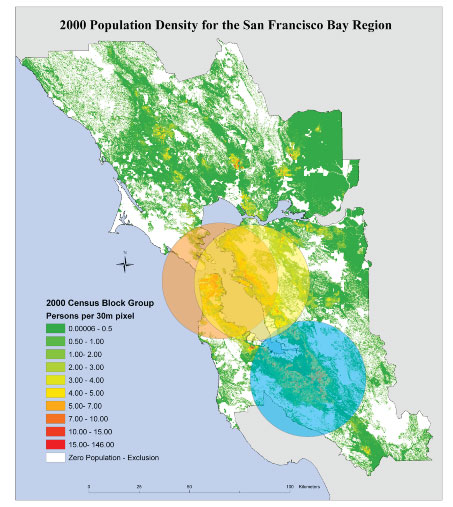
Circles indicate a 20-mile radius from China Basin, Coliseum, Diridon sites

Circles indicate a 20-mile radius from China Basin, Coliseum, Diridon sites

The Giants frequently like to point out that 50% of their ticket sales come from south of the San Francisco City-County line. Roughly half of those come from Santa Clara County, and many of those are long-time Giants fans. Many are corporate interests who can’t or won’t buy into the A’s where they’re currently situated. Sometimes it’s both. If they’re that worried, why not measure it? Let’s set a baseline for how much revenue comes from the South Bay, and if the Giants see an attributable drop to the A’s move to San Jose, MLB can set compensation on a seasonal basis until the loans on AT&T Park are paid off. I’ve suggested in the past the the A’s simply shift part of their existing revenue sharing check – which basically is paid by the Giants anyway given the clubs’ relationship to the revenue sharing pool – and be done with it. Once the A’s move in, then use the baseline. The fact is that San Jose is too far from either San Francisco or Oakland to be even remotely optimized as a market. If MLB wants to maximize sales to the entire Bay Area, it needs to maximize the sales territory. Ever wonder why Oakland doesn’t have great retail shopping districts or a mall? It’s partly because long ago, retailers and developers decided they could get sales from Oakland without having to locate in Oakland by locating in Emeryville, San Leandro, and even SF for some major stores. At some point MLB will have to decide if it wants as much from the Bay Area as possible or not. The status quo will surely not provide that.

Finally, there’s this matter of the Giants getting the South Bay baked into the $100 million purchase price paid by Peter Magowan and company in 1993. That price was a hometown discount, well shy of the $115 million offered by Vincent Piazza when he tried to move the team to St. Petersburg. We’re familiar with the hometown discount since it allowed Steve Schott and Ken Hofmann to get the A’s from Wally Haas for a cut rate. However, that brings up the question of how much the T-rights for the South Bay were worth back then and now. Below is a table showing the purchase prices for eight teams that changed hands in the early 90’s.

franchisesales-early90s

So Magowan paid about the same for a bigger market, greater legacy team as Drayton McLane and Nintendo did? Barely more than the two National League expansion franchises, both of whom were in inferior markets compared to the Giants? Incidentally, Magowan initially offered $95 million but may have brought in additional outside money to bolster the bid (at the time Magowan was worth a “measly” $60 million, hardly billionaire status).

If $95 million could be considered the Value of a Replacement Franchise, that doesn’t say much for having additional value baked into the 1993 price paid for the Giants, whether that value comes from T-rights to the South Bay or not. In all of the resale cases, franchise values may have been artificially depressed to maintain that team in-market. That’s fine, better that than a free-for-all. Let’s not kid ourselves about how much Santa Clara County was worth back then. In fact, in 1993 the A’s franchise valuation was $114 million, well north of the Giants, close to Piazza’s bid, and more reflective of an open market valuation. Shortly after Magowan assumed control, he inked Barry Bonds and the franchise value took off. It’s hard to argue that the South Bay had so much value in that transition when Magowan such a huge discount in the process. There’s more meat to the story if the value is baked into the financing of the stadium. But that’s done in 2017, and the Giants want the South Bay in perpetuity.

The funny thing is that I’ve spent over 1,000 words on what is essentially no change in position on the part of the Giants from 2009, when Neukom took the helm. While the A’s and South Bay interests have shifted to an appeal to decency, the Giants haven’t budged one bit. It’s clear that one team is better at playing this particular game, and it’s not the one who has more World Series trophies.

Quan speaks out in defense of redevelopment

We’ve been waiting for comments from Oakland Mayor Jean Quan about redevelopment, and now we have them courtesy of KGO-TV’s Alan Wong.

ORA apparently has $52 million in cash on hand, $20 million for Victory Court’s development area. Quan was quick to talk up the benefits of redevelopment, specifically pointing to the renovation of the Fox Theater as a glittering example done under Jerry Brown’s watch.

Updated: More from Oakland North’s Laura Hautala:

Currently, the city council is the governing body of Oakland’s redevelopment agency and directs its actions, but (CEDA director Walter) Cohen said the successor agencies might turn out to be cities themselves. If so, the council might continue overseeing the projects normally carried out by Oakland’s redevelopment agency, but with less funding.

Quan told the council that she and the nine mayors from California’s 10 biggest cities will meet with Brown’s finance director next week to discuss details of how the proposal would work. “The scary thing is that folks in Sacramento have not a clue what redevelopment is,” Quan said, adding that even Brown, formerly Oakland’s mayor, seems to have forgotten the extent to which the redevelopment agency provides funding for the city. “We have a special responsibility to make this real,” Quan said.

When the subject shifted to the A’s, things got a little more uncertain. Let’s Go Oakland head Doug Boxer took the question.

When asked if this was the nail in the coffin for the Oakland A’s, Doug Boxer — Co-found of Let’s Go Oakland — says, “I don’t like to think of it like that. It’s very difficult to move a franchise. The Giants were on their way out, quite frankly, including Canada.”

Not exactly confidence inspiring. And there’s an important distinction to make here. In nearly every case of the A’s or Giants wanting to move, the owner was looking to sell the franchise.

  • 1976 – Horace Stoneham looked to sell Giants to brewing giant Labatt’s, who would move the team to Toronto. A court injunction stopped the sale and the team was sold to Bob Lurie.
  • 1978-79 – Charlie Finley tries to move the A’s to New Orleans but is bound to his lease by the Coliseum Commission.
  • 1980 – Finley tries to sell to Marvin Davis, who would move the team to Denver. Commissioner Bowie Kuhn struck down the move. Finley was held to his lease again. (Thanks, MB) Finley would sell the following year to Wally Haas.
  • 1992 – Lurie tries to sell the Giants to Tampa Bay interests after striking out several times in his efforts to get a new stadium built in SF or the South Bay. NL President Bill White intervenes and allows time for Walter Shorenstein to assemble the saving ownership group.

Legal obstacles (ironclad lease, sale acting as a gating mechanism) prevented the moves in all cases. Talk of a lawsuit against the A’s emanating from a clause in the lease has been all but debunked. That leaves Wolff/Fisher with the thing we already know as the last true obstacle: T-rights enforced via the commissioner. We can debate all day and night about how sacrosanct T-rights actually are, but let’s be clear – they’re the only real obstacle left.

The Audacity of Orange

I’ve tried to avoid it. You know you have. But it’s there and it has to be addressed.

The Giants have spent much of the offseason showing off their newly earned World Series trophy. Two weeks ago it was at the Silicon Valley International Car Show. It’s been all over the Bay for fans to come up and take pictures with it. As A’s fans we just have to grin and bear it. The Giants have earned the right, and parading around with the trophy is a smart, smart move.

Now they might have taken it too far by hooking up with Showtime for a reality series, scheduled to air this summer. They’ll be mimicking HBO’s Hard Knocks and 24/7 series, in which cameras follow a single team or event throughout training camp. Production has already started on the series, which will chronicle the team’s attempt to repeat from hot stove and spring training to the dog days of August and the pennant chase.

24/7 has worked for years as a promotional tool in part because of the nature of boxing. With two combatants, it’s easy to pick sides among the different camps, and the zero sum result of a boxing match wraps things up neatly. The action within (training, sparring) always films great. HBO has gotten so good at promoting and filming fight action that the producers of The Fighter chose to have HBO Sports film the fight scenes. In the last year, HBO also extended 24/7 to non-boxing events such NHL’s Winter Classic and NASCAR driver Jimmie Johnson’ preparation for the Daytona 500.

Covering a team throughout a season, as MLB/Showtime are doing with the Giants, is much different. Not only do you have to worry about the level of distraction that comes with cameras following players and coaches around day and night, there’s also the worry about the level of drama. The Giants should be competitive in the NL West and may even be leading by the time the first episode airs, given that the Rockies present the only real competition for them at this point. The serial nature of the baseball season should provide plenty of footage, but is it going to be any good? Will they be reduced to off-field looks at how unique Brian Wilson and Tim Lincecum are?

If there’s something that the Giants should be worried about, it’s the filming of a meltdown. As much as the Giants’ marketing machine is building up the team, they are absolutely ripe for a fall. As “compelling” as the worst MTV reality show is when a trainwreck occurs, the Giants could be setting themselves up for weekly lampooning throughout the summer. Chemistry is fragile and a constant distraction won’t help maintain it. A meltdown not something I’d wish upon fans of any team. When a team gets filmed in this manner things haven’t turned out all that well. Hard Knocks has been around for 6 seasons. None of the teams profiled won the Super Bowl following the show’s airing (The Jets may find this out today next week).

Good luck with your reality experiment, Giants. You’re gonna need it.

Giants hegemony extends to North Bay

Last August, Jeffrey (heh heh) wrote about the ongoing vertical alignment among major league franchises, with the parent clubs buying and in some cases relocating their affiliates to closer locations. The Giants bought a controlling stake in the San Jose Giants in an effort to tighten their hold over the South Bay. That has caused complications for Windsor entrepreneur Chris Lee, who wants to build a new ballpark to house the Giants’ Class-A affiliate in the Sonoma County town.

“The Giants hold all the cards, and the Giants have declined to play,” he said Monday. Lee explained that the organization has territorial rights over which team affiliated with Major League Baseball can come to Sonoma County.

“If you want to add an affiliated team, you can’t do it without the permission of the Giants,” he said. “The Giants have declined to participate in that conversation.”

But on Tuesday, a Giants executive said the organization had not yet formally replied to the letter Lee sent after the World Series.

“I’m not aware of any formal rejection from the Giants,” Bobby Evans, vice-president of baseball operations said.

Evans said he didn’t want to give the impression the Giants were “leaning one way or another” on the issue of minor league baseball in Sonoma County, but he promised Lee there will be a written reply to his letter.

In the Giants’ ongoing efforts to marginalize everyone not related to their organization, this is yet another great success! Perhaps Lee would have more standing if he were a different Chris Lee:

… or this Chris Lee.

Wait, they’re the same guy? Well, you know what to do, Chris Lee in Windsor. Get on the horn and fly the man in from the U.K.

Or, here’s a crazy idea. How about the Giants play ball, get their situation with the A’s settled, and get everything else moving. Before all redevelopment funds run dry, and it becomes exponentially more difficult to get anything built. Just a thought.

Larry Ellison vs. SF Giants

As Gavin Newsom begins his switch from a real job to a ceremonial one, he has a few matters left to which he has to attend. A key development issue, according to Matier and Ross, is San Francisco’s America’s Cup bid. As the winner of the last Cup, Larry Ellison gets to decide where the next one is held, and the only US bid comes from SF. A couple different proposals have come in, both of which would exchange the development rights for select piers for the cost to rebuild them, a cost that the City can’t take on at the moment. A similar kind of development project is already underway in the relocation of the Exploratorium, which will move east from the Palace of Fine Arts to Piers 15 and 17.

Initially, the project’s location was going to be Piers 48 and 50, which are adjacent to AT&T Park’s main parking lots. This shifted to Piers 30 and 32, just south of the Bay Bridge, where Red’s Java House is located. Ellison has nixed the 30-32 idea, perhaps because he doesn’t want to work right next to/underneath a bridge.

The Giants are objecting to 48-50 because construction work there could be disruptive to the Giants’ plans for those parking lots, to which they have development rights. It’s highly likely that some of that land may have to be used as a staging area for construction equipment and the like.

It gets more interesting when you consider that Oracle has been a charter sponsor of the Giants, with its name on the ballpark’s suite level since the beginning.

So who’s going to win out? Surely the Giants can delay their plans for a couple of years while the waterfront beautification project happens. After all, the two key uses that the Giants have identified, a 5,000-seat concert hall or a NBA arena, aren’t exactly going to materialize for quite some time. The region isn’t begging for a 5,000-seat venue. The Bill Graham Civic Auditorium (7,000) is old but serviceable, the Warfield and the Fillmore cover sub-3,000 crowds quite nicely. On the other side of the bay Another Planet has cornered the market on mid-sized venues, as it has the Greek Theatre in Berkeley (5-8,000) and Oakland’s Fox Theatre (2,800). In the South Bay, San Jose State’s Event Center holds exactly 5,000. As for an arena, well, that would be easier to deal with if Larry Ellison owned the Warriors, you think? Even then, the W’s lease runs at least through 2017, with the team owners being liable for the remaining debt service if they don’t sign extensions that would keep the team until 2027. If the Giants decide on a concert hall, their dreams of a SF arena will vanish. If they decide to wait for an NBA team, they’ll be waiting quite a long time.

This round should go to Larry Ellison. A project like this comes around very rarely. If the Cup is staged locally, Ellison will be a very busy guy, probably too busy to entertain Oakland partisans’ dreams for him to wrest the A’s from Wolff/Fisher and build a ballpark in Oakland. Seriously, can anyone out there point to a single quote that can back up Ellison’s interest in the A’s?

Strange bedfellows

After Dave Newhouse’s A’s/Warriors panel with Oakland mayoral candidates at the beginning of the month, it wasn’t clear if anything would come of their responses. According to East Bay Express scribe Robert Gammon, it appears that something happened, as Lew Wolff and John Fisher gave a combined $25,000 to Don Perata’s campaign two weeks ago, perhaps a reward for his “candor.” Just to refresh your memory, here’s what Perata said about keeping the A’s in Oakland:

“I probably know a little more about this stuff than most people. I was part of two Raider deals that both failed. We got held up; we really did — by both (the A’s and Raiders). We got rid of the Coliseum board and then politicized it. … In retrospect, it was a disaster. I don’t think the A’s are going to stay here. We can’t play in this game, putting up the money. We haven’t been smart with our franchises.”

Gammon also got some follow-up from candidate and current City Council member Rebecca Kaplan.

Perata appeared uninterested in talking about keeping the A’s in town, according to several attendees. “He was very evasive,” said Kaplan, who was at the meeting with Quan, Perata, and fellow mayoral candidate Joe Tuman. “He basically conveyed that keeping the A’s is not very important.”

So, is it simply a matter of A’s ownership supporting Perata after the position was made public? Or was there a sort of quid pro quo there? Of course, Wolff denies any sort of link between the donation and the stance. Was the donation made because they truly feel that Perata is the best candidate? R-i-i-i-i-i-g-h-t. Though it should be mentioned that many longtime Perata friends, those who’d support a JLS ballpark, also donated serious money to Perata’s campaign affiliated, police union-funded political group. FWIW, San Jose Mayor Chuck Reed was reelected in June and virtually no one noticed.

The rather prolific (at least recently) White Elephant Parade looked up contributions by both teams, and found that the Giants donated nearly double the amount of the A’s during the same 2009-10 state legislative session.

For Wolff and Fisher, $25,000 is a trifle, especially compared to the land bill they’ll face as San Jose’s Redevelopment Agency checks the couch cushions for change needed to buy the rest of the Diridon ballpark site.