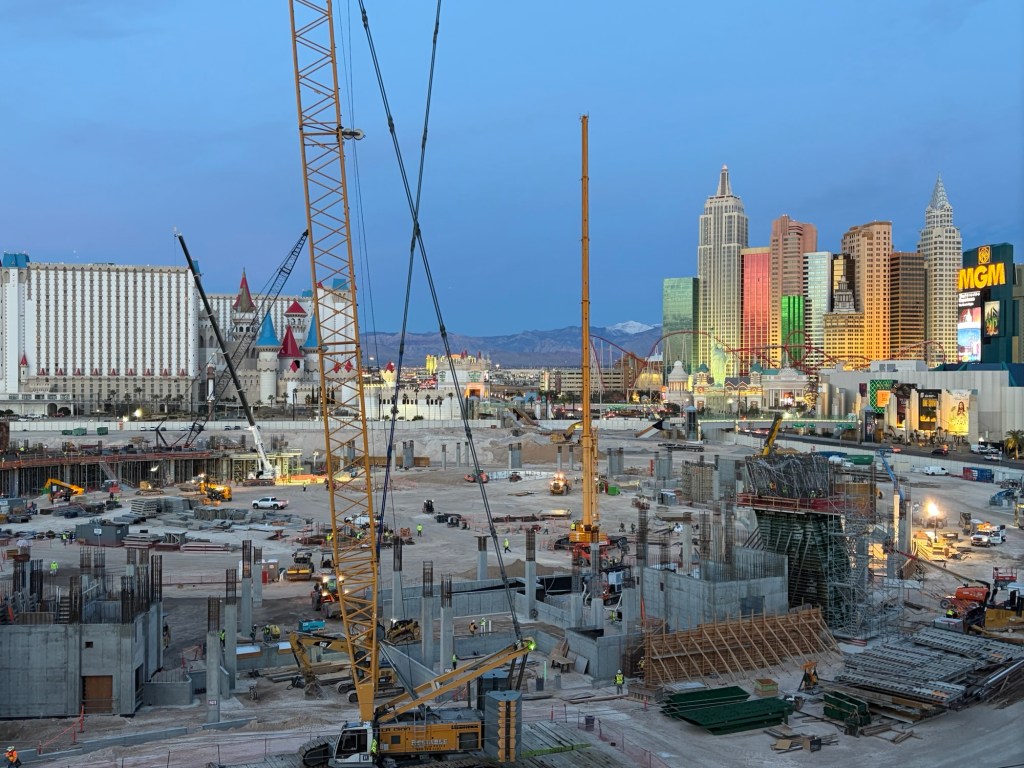
This morning I woke up before dawn to the cacophony of rumbling diesel engines and banging. When I looked outside a wave of relief – no, catharsis – washed over me because I saw this:
View of the Athletics Ballpark construction site from the Oyo Hotel ninth floor
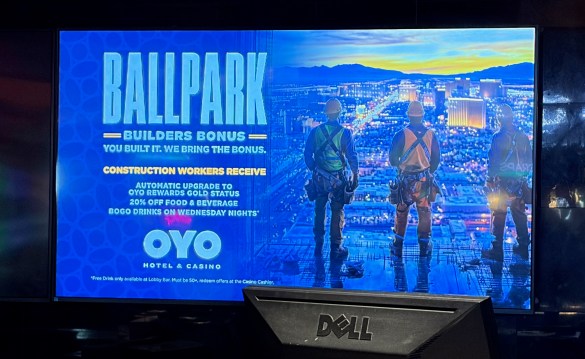
Greetings from the Oyo Hotel and Casino, just east of the A’s ballpark site on the Strip (formerly the Tropicana). I’m in Vegas for a family trip. Some flexibility allowed me to spend Monday night and Tuesday morning at Oyo, previously the Howard Johnson/San Remo/Hooters. If you’re not aware, Oyo is a multi-national hotel brand based in India. When I checked one of the signage displays behind the front desk briefly showed a promo for ballpark construction workers.
Anyway, my plans were to head out to the Athletics Ballpark Experience Center at uncommons in the southwest part of Las Vegas Valley. Unfortunately those plans were foiled by more important matters.
Sodey secured 🔒
We have agreed to terms with left fielder Tyler Soderstrom on a seven-year contract through the 2032 season with a club option for 2033. pic.twitter.com/Ykw9DQz8yJ
According to MLB.com’s Martin Gallegos, the press conference for the Soderstrom signing will be held at the Ballpark Experience Center, so they literally have bigger fish to fry. At least we’ll get to see video of Sodey in the virtual ballpark. I’ll be back later, when it’s fully open to the public. For now, I’ll settle for progress in the form of working construction crews on December 30, 2025. I spent twenty years on this website waiting seemingly in vain, plus ten more since the Raiders moved back to Oakland and destroyed the Coliseum. I can say with great certainty that I’ve been waiting my entire adult life for this moment as the A’s haven’t had a proper home since they left Shibe Park. I only wish the moment was in Oakland, San Jose, or Fremont instead. Alas.
I’ll spend the rest of the morning here before I meet with the fam at Treasure Island. I observed how fleeting this moment is.
As I write it occurred to me that 1) this view will be mostly obscured in a year by the enormity of the ballpark, and 2) Oyo itself probably won’t be standing in 20 years. #todaysperch#Athleticspic.twitter.com/EXT4jT1qrJ
My intent was for this post to be a year-in-review as you typically see after Christmas. Instead I’m going to have breakfast and coffee, enjoy this view and the noise for a few hours, then take the monorail to see my niece and nephew. I’ll do the wrap-up post later. I’ll have plenty of comments about the state of pro sports venue financing, the NBA in Vegas, and the future of pro sports in NorCal. It’ll be a doozy.
— Governor Joe Lombardo (@JosephMLombardo) June 24, 2025
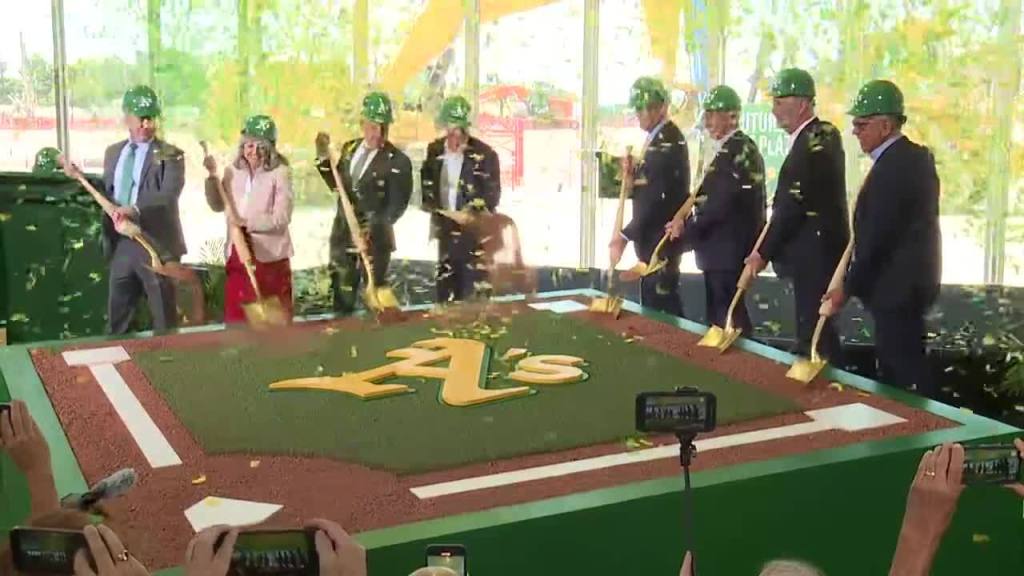
After some intrigue about when it would happen, the A’s chose today, June 23, to have a ceremonial groundbreaking ceremony at their ballpark site on the Vegas Strip. It happened to be a travel day for the team, embarking on a sure-to-be-crushing 10-day road trip to Detroit, New York, and Tampa Bay. A’s management gave the whole event a Vegas flair, with attendees bussed in from the MGM across the street. This makes sense in hindsight, since there’s been a decent amount of excavation on what is now a live construction site. It’s hard to tell how much dirt is removed from overhead views, but from the renderings it looked as if the field was going to be some 20 feet below street level. So while the ceremony was John Fisher and dignitaries shoveling a raised platform with a dirt planter, the A’s staged some yellow iron in front of the windowed event tent for show. Before the actual shoveling, the A’s showed a sizzle reel.
The emcee was Dallas Braden, which upset numerous Oakland partisans who called him a sell out. I mean, Dallas is an A’s employee. I’m sure he still feels bad for the East Bay, but eventually we all have to move on. Braden’s address preceded a number of project principals, including Fisher, who noted that Rickey Henderson attended the demolition of the Tropicana Hotel last summer prior to his untimely death. Steve Hill of LVCVA and Governor Joe Lombardo were also on hand and celebrated the ballpark like it was a rare event instead of yet another massive project going up on The Strip.
If the A’s face minimal delays, the ballpark construction schedule should follow this high-level timeline:
Of course, John Fisher knows stadium construction delays going back to PayPal Park. Baseball’s less likely to forgive mishaps or financial hiccups, though it’s unclear if MLB would provide much help or give Fisher a quick exit if worse came to worse. Sure enough, Rob Manfred was on hand to pump up the project and push for the 2028 opening.
It’s well known that Fisher, while a rich billionaire, is not particularly liquid. So it’s not surprising that he may be selling the San Jose Earthquakes, ostensibly to raise money for the Vegas ballpark. The aim is for a $600 million valuation for the soccer club and perhaps real estate interests such as PayPal Park. Would he be willing to sweeten the pot with a minority share of the Vegas A’s? Anything’s possible when you’re trying to bridge a nearly $1 Billion funding gap. I’m not going to get too much into the intricacies of funding the ballpark, simply because it’s very opaque at the moment, and also because Fisher appears to be doing something quite unusual: a pay-as-you-go model. He had $300 million to do the prep work and the initial concrete podium. After that he has Aramark, the State of Nevada, and Clark County chipping in, then whatever he needs to do to raise the rest, which will surely be over the $1.75 Billion mark when all is said and done. Most stadium projects are financed upfront and funded in tranches as different stages are reached. It will be most interesting to see if Fisher can pull this off, especially if he can avoid much higher interest rates and materials costs than what he probably had penciled in 2-3 years ago. Keep in mind that we haven’t talked about naming rights or other commercialization opportunities that will certainly become more important as the project becomes more… concrete.
For what it’s worth, Globe Life Field took 30 months to complete, with the official opening delayed by the pandemic. Nationals Park took only 26 months, though it is open-air park. LoanDepot Park took 32 months, Truist Park took 30. The A’s have 33 months from now to Opening Day 2028. I may occasionally check it out if I’m in town, though there’s plenty of regular YouTube videos and drone footage to satiate most interested fans.
Should Fisher see this all the way through, there are rules in place to ensure that whenever he sells the A’s, he’ll never have to worry about liquidity again.
There used to be a Bay Bridge Series featuring the two Bay Area MLB franchises, the Giants and A’s. It served as a ceremonial bridge between Spring Training and the long regular season. That’s gone, probably for good. It was replaced this year by some warmup games in Sacramento featuring the Giants and their AAA affiliate, the Sacramento River Cats. The A’s played out their Cactus League string in Arizona before starting the regular season on the road in Seattle.
Meanwhile in Oakland, the Coliseum hosted the Roots’ home opener against fellow USL Championship side San Antonio. The match brought in 26,000 fans who filled both the field and plaza levels. Next week’s game will have a much smaller crowd based on what sections are being sold. At least the sports-starved in the East Bay got a taste. And while there’s no longer a Bay Bridge Series, the San Jose Giants will host the Oakland Ballers in “Battle of the Bay 2.0” at Excite/SJ Muni on April 2nd. So there’s that.
Going back to Sacramento, the main question going into this season concerns the ability of Sutter Health Park’s grass field to withstand the nearly daily pounding of baseballs and baseball cleats.
The previous field was ripped out after the final River Cats game last season, replaced by a very high-tech solution called AirPAT from The Motz Group. AirPAT uses a combination of irrigation and aeration to the grass surface and roots to make for ideal outdoor maintenance conditions. The high-tech part comes from the use of various sensors and drones to monitor surface temperatures, hydration, and drainage. Coincidentally, a spring storm is blowing through California right now just to give the new field its first real test. The forecast calls for the rain to end shortly before first pitch, so we’ll get to see both the field and the grounds crew tested. Motz has a blog post explaining how their system works, though it’s curious that much of the expertise involves artificial turf fields – experience that maps better to Vegas or the original plan to replace grass at Sutter Health Park with a turf system. Motz isn’t bereft of grass experience, as they constructed the field at the Braves’ Truist Park.
Also I know many were curious about the field itself. “The installation of AirPAT technology will optimize root zone oxygenation, improve moisture management, and regulate subsurface temperatures – ensuring a healthier, more resilient playing surface year-round.” pic.twitter.com/3iJldu80J1
In any case, the first half of the 2025 is somewhat frontloaded with A’s games, 51 out of the scheduled 81. They won’t come back to West Sac until July 28, a full two weeks between home games. The River Cats will have nine games during that span, so they’ll get to break in a potentially resodded field just like they broke in the new field last weekend. If there are rainouts, they’re more likely to occur during this first opening series with Cubs than at any other time. That makes August and the first two weeks of September the crucial period for the grass to survive. The second half schedule has nine mutual off days to schedule makeup games if needed, though that may be more necessary for games on the East Coast. Should AirPAT work as advertised, the grass along the river will stay lush and green while much of the surrounding area turns brown.
Truth be told, I’ve been putting off writing this post for weeks. Something always came up. First I was going to comment on Sutter Health Park reverting to grass instead of a turf field in 2025. Next I was going to talk about the Athletics stripping any city designation from their team name during these three or four interim years. The election removed Sheng Thao as Oakland mayor, followed by at least two interim mayors. The A’s dipped into the free agent market to snag Luis Severino to fill a rotation spot*. Then we were hit by the sudden death of Rickey Henderson (RIP GOAT), which made the social media rounds for a nearly 24 hours before an official acknowledgment, apparently at his family’s behest, and finally the announced departure of A’s team president Dave Kaval, who spent most of the last eight-plus years navigating political corridors, eventually arriving on the Vegas Strip. After the Kaval news struck I realized that everyone would be best served with a year-end recap that could also serve as a coda to the Oakland Athletics era.
The Oakland A’s were effectively the middle child among the three major pro sports teams that called Oakland home (the Seals and Invaders were too short-lived to count). As the middle child they experienced many highs and lows and were proportionally ignored within and outside the Bay Area. They were the second team to come to the Coliseum complex and stadium. They were overlooked when it came time to upgrade the facilities, screwed as East Bay leaders desperately brought back the Raiders at the A’s expense. The A’s were also the subject of mostly half-hearted and ultimately failed attempts to keep the team within city limits. So the fact that they ended up staying the longest of all three teams is less a testament to A’s ownership’s resolve than a lack of options. If not for the Giants, the A’s would already be in San Jose. Or perhaps Fremont or somewhere else in Alameda County. Or even Oakland if the parties involved were reasonable about the process. What got lost is a simple practical reality of major pro sports: Cities play for 25-30 years, not forever, and they have to renew and rebuild to keep their teams.
Alas, 2024 is not the year of reason in California. Neither was 2023, 2022, or 2021. With Oakland not agreeable to the A’s terms in mid-2021, the A’s looked to Vegas and announced they were on parallel paths. For whatever reason, neither Thao nor her predecessor, Libby Schaaf, looked at parallel paths as a competitive situation, which set Oakland on its own path to oblivion. You could say that Oakland chose to compete by going along with John Fisher’s grandiose plans for two sites, the Coliseum and Howard Terminal. That worked for a short period when everything seemed to be economically healthy in the Bay Area. After the pandemic hit the money well went dry and Oakland was left with an incomplete process and little to show for their efforts.
Contrast that with what happened recently in St. Petersburg. As recently as spring 2023, St. Pete was considered an also-ran, with the Rays running out the clock on their lease at Tropicana Field. After looking across the bay in Tampa for several years, the Rays and St. Pete started working on a ballpark deal at the Trop site in September 2023. Progress came in fits and starts thanks to uncertainty about the site’s prospects and the Rays’ willingness to build there. Yet St. Pete stayed in the game, got their ducks in a row at the City, County and State levels, and got something done despite an actual hurricane that destroyed the Trop’s roof, leaving the Rays homeless. The eventual face of the effort was Pinellas County Commissioner Chris Latvala, who spent eight years as a State House member before terming out and running for the County post. Latvala brought a perspective that is entirely foreign to the A’s efforts in that he’s a Republican who made his name as a fiscal conservative. He’s also a big Rays fan as evidenced by last week’s interview with Locked on Rays. Latvala was against the Rays ballpark and redevelopment plan at first, then came around when he saw that the future of the Rays in Tampa Bay was at stake. In choosing to support the ballpark, he cited Rob Manfred’s support, which may very well prove a terrible mistake. At least now the onus is on the Rays to follow through on their end. Stu Sternberg has to come up with the money, like John Fisher pledged to do in Vegas. Oakland never got to the step of putting the ball in Fisher’s court. They equivocated, hemmed and hawed, and repeatedly sounded out of their depth when trying to deal with baseball. As the last two Oakland mayors have been women you may think that’s a sort of misogynist, old-boy take on things. It’s more about knowing ball and understanding what the ball club, which is a major constituent, needs to be successful. Without a proper grasp of that, any proposal is likely to turn into a big grab bag of initiatives that is fragile enough to fall apart like a house of cards. Latvala and others in St. Pete even pointed to the Vegas deal as an example of something more fleshed out that should be done in St. Pete, a completely alien sentiment for Oakland. Towards the end of the Oakland era, pols and fans were left to pull stunts to try to get Manfred’s attention. They knew what would it would really take.
In hindsight, it was probably best for all involved that Oakland and the A’s didn’t come to a deal. Because given the state of affairs now, how exactly would they come up with their hundreds of millions of dollars for infrastructure or other promises like community benefits? A bunch of the money meant for the Port has already been assigned to other projects and was never fully pledged towards the Howard Terminal project. Oakland’s current fiscal dire straits is going to involve some painful cost-cutting, which would undoubtedly come at the expense of a not-quite-finalized ballpark project – that’s how clawbacks work. And that would cause the A’s to look for a reason to escape Oakland for good, not that they weren’t already looking.
Times like this I’m reminded of one of my favorite bands of the last twenty years, The Civil Wars. A country duo that started out as a Nashville songwriting partnership, The Civil Wars went on to make two incredibly passionate, perfectly written and produced albums before breaking up (and breaking many fans’ hearts along with it). They were good enough to co-write a song with Taylor Swift to be included on the Hunger Games soundtrack. Whatever the reasons for their breakup, the situation seems as likely for a reunion as the A’s coming back to Oakland. In 2012, when the video below was recorded, everything still felt hopeful for Oakland, The Civil Wars, the world. Worlds can fall apart fast though. At the very least some fans got a year to appreciate the A’s before they were gone.
Note the date of the recording: October 1, 2012, the Monday before Game 162 of the A’s 2012 season
What’s next for Oakland? Hopefully the Ballers will keep playing at Raimondi Park for some time to come. The Ballers didn’t get the happy ending they wanted when the other team that was brought in to prop the Ballers up, the Yolo High Wheelers, won the 2024 Pioneer League championship, then folded their tents to move to a hopefully more permanent home in Marysville. That wasn’t in the script! The Roots are finishing their soccer transformation of the Oakland Coliseum, their sights still set on an interim park next door at the Malibu site, a new interest in Howard Terminal now that the A’s won’t be there, or most likely, a protracted stay at the Coliseum when the other two options prove infeasible or too costly. It’s better than having to crash couches like they’ve been doing for a few years. In Neil Young parlance, is Oakland burning out of fading away? We won’t know the answer for some time. Until then, I hope Oakland can get its act together. There’s nowhere to go but up.
—
* – The Severino contract was obviously done to pull up the A’s payroll to a minimum amount based on their increased revenue sharing receipt. That’s the system right now, and if you’re looking for a floor/cap system to make things more fair, nothing’s going to keep Steve Cohen or the Yankees/Dodgers from running circles around any A’s payroll, whether in Vegas, Oakland, or Timbuktu. Baseball still pays proportionally less to its players than the other sports that have caps and floors, so they are fine through the current CBA’s expiration in 2026. And now they are deferring the crap out of huge money deals to the point that they’re creating Bobby Bonillas left and right. All on Manfred’s watch nonetheless.
In the wake of Hurricane Milton I watched the news feeds closely to see what would happen to Tropicana Field. The fabric dome (an early form of PTFE) had a usable life expectancy of 25 years. The Trop was already 34 years old at the end of the 2024 MLB season, so it would seem that the facility was on borrowed time. Sadly, but not surprisingly, Mother Nature had its own plans for that roof.
The morning after #HurricaneMilton, one of the questions is, “Where will the Rays play?” Let’s go over the options. [1/x] (video from @Ry_Bass)
[2/x] The simplest, though not cheapest, option is to build a new roof at the Trop and play there. Assuming there are no additional structural problems, this is a likely path since the Trop itself is insured. It’s like getting a crappy insurance payout after your car is totaled.
[3/x] The Rays can’t play at the Trop without a roof. Nothing under the dome was properly weatherproofed for outdoor use. In the baking heat and frequent storms of the future it would rapidly degrade. So roofless is not even a short-term solution.
[4/x] Next options are local. There are plenty of spring training facilities – basically AA/AAA quality – where the Rays could play. Their own in Port Charlotte is small and 2 hours south. The closest/largest is George Steinbrenner Field in Tampa, same size as Sutter Health Park.
[5/x] As these are outdoor facilities they will be subject to weather. Everyone in MLB (players, other teams) will have issues. It’s too unpredictable to hang a schedule on. So it’s probably out except for some April games before heat really kicks in.
[6/x] Miami has a retractable roof stadium where the Marlins’ schedule should run roughly opposite the Rays’. That makes it a contingency plan in case the Rays can’t stay local. It would sacrifice any attempt at attendance. I’ve driven Alligator Alley. Miami/Tampa are not close.
[7/x] That leaves other markets outside of Florida. Nashville & Charlotte have AAA parks and desire expansion teams. Oakland has a MLB park and the A’s – who vacated it – playing 90 miles northeast. San Antonio has an old football dome with a baseball configuration. And Montreal.
[8/F] None of those markets are desirable unless they have new MLB ballparks in them. Stadia are too expensive to build on spec these days. So it’s a Catch-22, ironic since Tropicana Field (aka Florida Suncoast Dome) was built on spec. IMO it all leads back to the Trop. For now.
Another thing to consider is that MLB under Manfred is clearly separating East Coast teams like the Rays from West Coast teams like the A’s. They’re not to move between coasts as that affects divisional scheduling and travel.
—
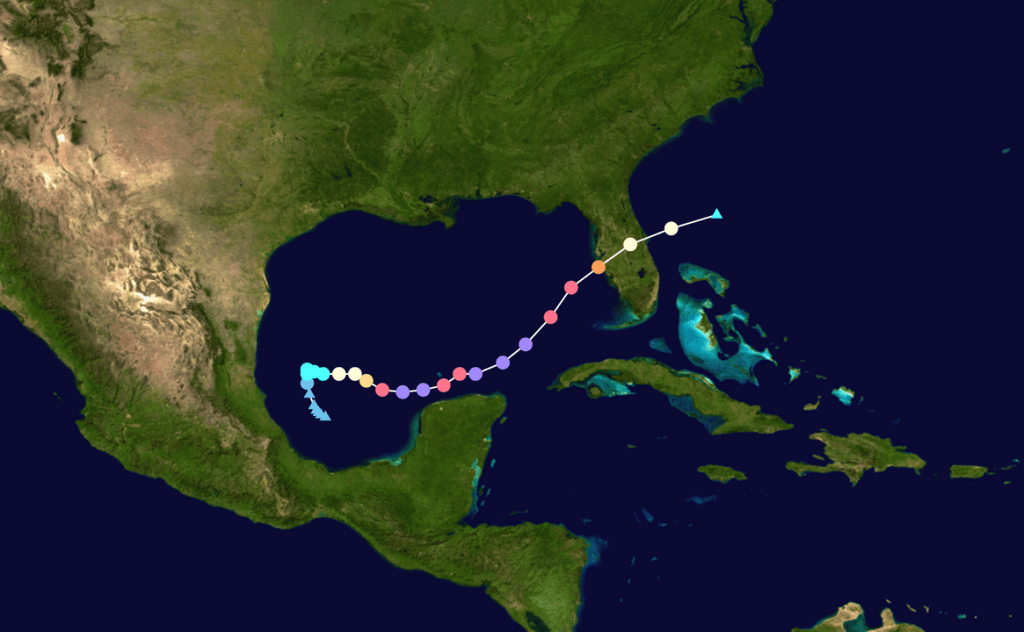
It’s worth briefly discussing how terrifyingly awesome a storm Milton was as it ravaged Florida, not just from the usual torrential rain, wind, and storm surge that comes with a hurricane, but also from a record number of tornadoes that spun up in South Florida and the Atlantic coast well away from the eye of Milton. It started in the Gulf of Mexico off the coast of Veracruz, thanks to the combination of extremely warm Gulf water to fuel the nascent storm and nudges from remnants of another storm from the Pacific. After Helene hit Florida’s Big Bend area and barreled north through southern Appalachia, I was curious about the path the new storm would take.
Milton technically became classified as a hurricane less than a week ago on October 5.
After churning as it made its way northeast, Milton took a slight southerly detour and hit landfall south of Sarasota instead of the Tampa Bay direct hit. Tampa Bay was not spared significant destruction, as shown by the damage done to the Trop’s roof.
In response, the Rays are taking an open approach to dealing with the Trop, saying that a proper damage assessment could take weeks to complete. If the facility was 4 or 14 years old instead of 34, the team would work more urgently to repair the roof and make the place playable again. The Trop is near its practical end-of-life and there is already a plan underway to replace it with a newer dome next door, so you may ask what the point is. Could the Rays and Pinellas County simply roll an insurance settlement into the next project? Presumably, yes. However, I have a feeling the depreciation is going to work against both parties, limiting the payouts to some degree. Still unknown at the moment is the extent of any flood or structural damage, so perhaps patience is in order.
Then again, there is the question of value. On Twitter yesterday I kept pointing to the Metrodome, which had a serious puncture in its inflatable roof that eventually justified a complete replacement two months after the storm damage. Replaced for $18 million, the work was done by August 2011, in time for the next Vikings season. Of course, the Vikings only played at the Hubert Horatio Humphrey Metrodome for two additional seasons as they planned their own dome successor on the same site, US Bank Stadium. The Twins already vacated for Target Field on the other side of downtown Minneapolis, and the University of Minnesota Golden Gophers football team left for the on-campus TCF Bank (now Huntington Bank) Stadium.
That makes the question of refurbishing the Trop largely one of value. This isn’t like the post-Katrina Superdome, which had nine figures of FEMA and state aid poured into it in order to keep the Saints from moving to San Antonio. Tropicana Field should be treated like a short-term case where the facility has a clear expiration date. Will the repairs cost $30 million? $50 million? $100 million? The Rays can’t throw some tarps and FlexSeal over the dome and call it a day. This will be expensive, and yet, clearly not enough.
-=-
P.S. – Al Lang Field, once a Spring Training venue and now the home of the Tampa Bay Rowdies soccer club, is being discussed as a temporary home. Other than it being a really small site, I can’t see anything wrong with it other than the usual weather concerns and the ridiculous “sail-like” roofed concept from over a decade ago. I loved that silly idea, so I will take any opportunity to include it in a post.
Amazingly this Olympic Stadium-lite concept wasn’t even air-conditioned.
Home plate is on its way to Cooperstown. What’s left is quite an image.
The game of bA’seball is worse as we wake today. Can’t shake the sadness & senselessness. Numb flying out of Oklnd knowing 1st hand tens of thousands insanely passionate fans employees families going thru even > pain.HARD goodbyes w/ so many Amazin people who took us in as family pic.twitter.com/UI0P7qlmhg
Ballpark and roof cutaway with scoreboard placed high above right field
A’s Vegas ballpark general contractor Mortenson McCarthy held a meeting and presentation with prospective subcontractors last week. The subs, who are largely experienced entities working on projects on and off the Strip, will be vying for a coveted spot to provide services for the first sports venue on the Strip itself after the Tropicana starts its demolition next month. The presentation puts forth a starting date of Q2 2025 and a 2028 completion. Naturally, there’s a limited amount of flexibility in there because of the normal 30-month construction period for most American sports venues. That could mean the ballpark could open April 2028 in keeping with the expected MLB season, or potentially later if delays arise. Modern Vegas has a well-earned reputation for building frequently and on-time, so it wasn’t terribly surprising that Mortenson McCarthy, which oversaw Allegiant Stadium, is in control of the project.
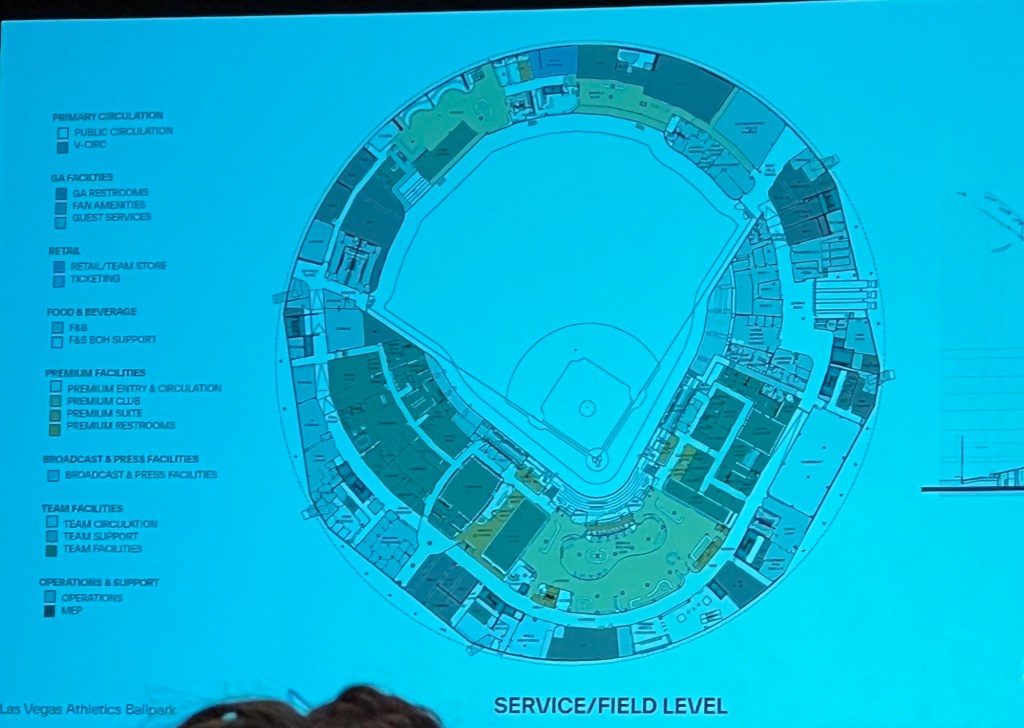
Service/Field Level (Home dugout on 3B side, club behind home plate)
The presentation shown included a number of floor plates to show how the circular dome would be laid out among its six levels. Those details weren’t included in the PDF download, probably because many of the details in there were either still being finalized or were otherwise not meant for public consumption at this early stage. Thankfully, Athletics Nation’s Jeremy Koo was on-hand to screen record the entire thing, so I’ll post some slides as a go. For now, let’s start with the project description directly from the preso:
PROJECT DETAILS
The Las Vegas Athletics Ballpark will be a fully enclosed multi-event sports arena accommodating uses such as baseball, concerts, dirt sports, and other special events.
The ballpark occupies 9 acres within a 35-acre site shared with a Bally’s integrated resort, bounded by Tropicana Avenue, Las Vegas Boulevard, and Reno Avenue.
Capacity:
30,000 fixed seats with 3,000 additional standing room locations
Levels and Height:
6 primary levels with field level close to the average national grade
Maximum height approximately 290′ above field level
Exterior Systems:
Approximately 700′ long-span roof
Metal roof finish with ETFE clerestories
36,000 square foot cable-net glass window
More structural detail including trusswork
The first thing that jumped out to me was the 290’ height. The field is expected to be sunken in 30’-60’, which should put the apex from street level at around 230’. For reference, the two existing hotel towers of the Tropicana are 230’ tall. As a result, there should be few worries about building too tall as the new structure isn’t expected to be taller than what currently exists there. Still, 230 feet is still one of the taller domes in the US. The Superdome and the now-demolished Georgia Dome were both more than 250 feet tall and looked it based on their monolithic appearance.
Ballpark and roof cutaway showing placement of scoreboard in right field
Such a tall roof allows the scoreboard to be placed practically anywhere in the outfield. It’s still in right, anchored to the ceiling above the RF upper seats and slanted down at the bowl for better sight lines, similar to what you see with newer basketball arenas. I would not be surprised if this was expanded either before opening or down the line as the screens seem to be growing exponentially with each generation of technology. Personally, I’m not a huge fan of the RF scoreboard at Globe Life Field since it frequently requires craning one’s neck from the lower deck.
The exterior of the roof will be metal, broken up by the ETFE clerestories and the armadillo-inspired design. I don’t think the current renderings properly capture how immense will be, especially at street level. With no other buildings immediately surrounding it, the only comparisons are other hotel towers the other corners of the Strip, which are at least a football field’s length away.
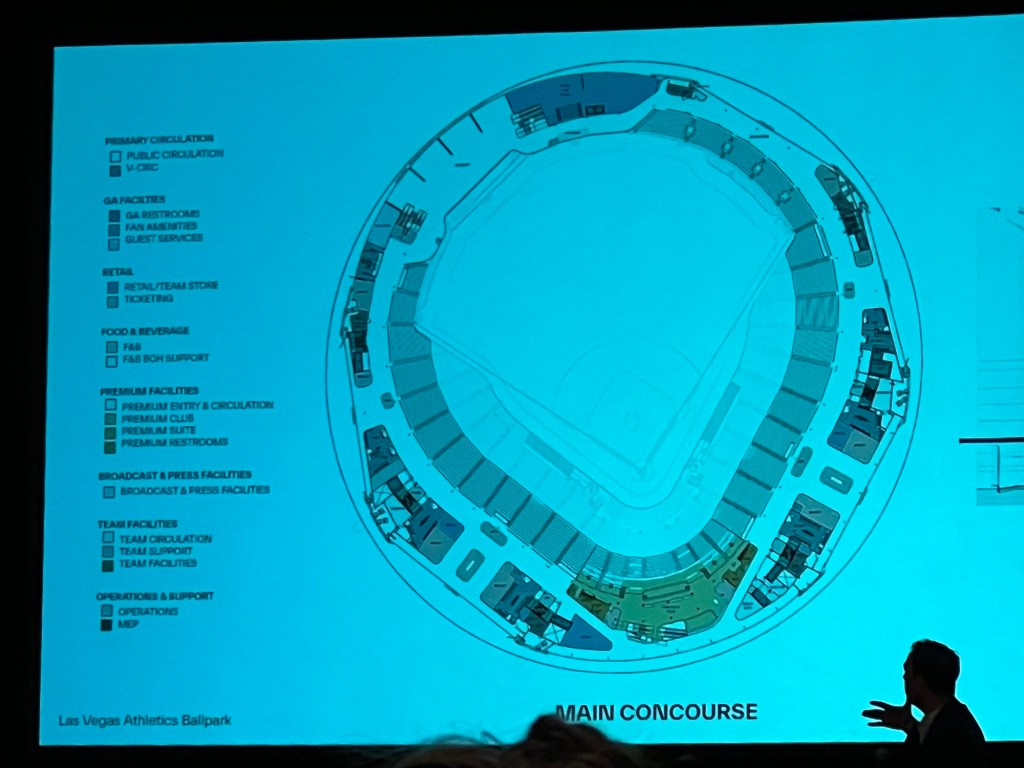
Main concourse
One thing the A’s are adopting is the minimal use of vomitories, or the tunnels and connected staircases that lead from a concourse to seating sections above. There are vomitories in right field, mostly to access higher-end concessions and bar areas along the lower suite concourse. Other than that, fans are mostly meant to access their seats from the top of the concourse. This practice was used for the Glendale Arena (near me), and it helps for hockey where the action covers the entire ice surface. For baseball, where the action is more tightly focused, this matters less.
The suites themselves will be arranged from foul pole to foul pole in the typical arrangement, with larger suites and flexible spaces accommodating placed further down the lines towards the corners. Additional lower suites will be set on their own level behind the backstop. I didn’t see any evidence of bunker suites, so the closest you’ll get to the field while being in a suite is about 12 rows back.
The whole package reminds me of Globe Life Field, with hopefully improved materials. Since there’s no retractable roof, BIG and HNTB can work on ensuring that the clerestories and the big window pane wall in left field are as attractive as possible.
These are some meaty details. They are subject to change with fast-moving stadium architecture trends, so we’ll see what sticks.
Thankfully they went away from the resemblance to the AT&T logo
–
P.S.: Next up for me: a game at Sutter Health Park so I can assess the situation in Sacramento. After all, it will be the A’s home for at least three years.
Update 9/12 – In response to some local Sacramento reporting that the interim ballpark terms may not be approved, MLB released the following statement:
The A's shared this statement from MLB: "It is a certainty that the A's will play their 2025 season in Sacramento as planned. MLB is continuing to work productively with the MLBPA on the details of the transition."
It’s Labor Day, which means there is less than one month remaining in the A’s season, and less than a month remaining in the incarnation known as the “Oakland Athletics.” For at least the next three years, the team will simply be known as the “Athletics,” with no city affiliation to Sacramento, their temporary home, or anywhere else. Once the Vegas ballpark is built at the Tropicana site, the team will go by “Las Vegas Athletics” but not until that point.
The twilight of the Oakland Athletics means there are 13 home games left in the season (and in Oakland history) including tonight’s game vs. the Mariners. The final series against the Rangers sold well, with the final game selling out and commanding ludicrous prices on the secondary market. Unsurprisingly, the penultimate series against the New York Yankees also commands high prices.
I made my last visit to the Coliseum in May with a doubleheader, so that chapter is closed for me. While I have an upcoming trip that puts me in the Bay Area on the same weekend as the Yankees series, I have precious little interest in going to the Coliseum. This funereal final month is a chance for fans to say goodbye. I already did that months ago.
Instead, I plan to attend the final game of the A’s-Cubs series at Wrigley Field on September 18. It’s a day game, a Ferries Buehler school-cutting special, and I’ve never gone to a day game at the “friendly confines.” So I’ll fly in, catch the final interleague contest for the “Oakland Athletics” and grab an Italian Beef and a Chicago dog along the way.
Then I’ll hop on another Southwest flight and head to Omaha, where I’ll have a couple hours to kill before boarding Amtrak’s westbound California Zephyr, destination Sacramento. Much of the trip will be in darkness, which will give me some precious shut-eye time and the always scenic views of the Rockies. I’ll arrive on Friday, September 20 a few hours before the River Cats take on the Sugar Land Space Cowboys (Skeeters) at Sutter Health Park. I’ll take in that game, survey the grounds and the state of affairs before the major improvements to accommodate the “Athletics” begin in earnest. After the game I expect to head down to the Bay Area for the rest of the weekend.
The A’s, who won’t pay rent during their tenure at the former Raley Field in West Sacramento, will share the AAA ballpark with the River Cats. To accommodate the MLB club, grass will be replaced with artificial turf, specifically Shaw Sports’ B1K product in use at numerous MLB domed facilities. B1K is also in use at a number of outdoor college ballparks, though the schedule of NCAA regular season baseball isn’t subject to summer heat the same way any MLB stadium would. Supposedly the A’s are installing a ‘hydration’ element on the surface, which means sprinklers? Many turf facilities water the surface before the game and at halftime for soccer use to help cool down the turf and the infill via evaporation. As baseball doesn’t have halftime, I’ll be curious to see how this is implemented. The A’s are paying for many of the improvements, including building their own clubhouse behind the plate instead of using the River Cats’ clubhouse in the outfield. Visiting teams still have to use the visiting clubhouse (correction: road teams will use the River Cats’ clubhouse), which most of the time is merely sufficient even in MLB facilities.
2024 A’s schedule with likely summer home getaway day games circled in gold
Regardless of the hydration implementation or its efficacy, it’s important to consider how many times it will need to be considered. I took a look at the A’s 2024 schedule and found 13 dates during the summer months of June, July, and August that for scheduling purposes have to be day games. The graphic above circles those dates in gold. White circles indicate non-summer dates, though we all how prolonged summer can feel in California. For night games, a quick spritz before the game will be fine as the evening begins and the atmosphere cools. Night games in Northern California tend to cool off quickly as the sun goes down, so the turf won’t need active cooling or monitoring for heat. I’m more interested in the use of the B1K infill system, which is made of sand and coconut husks instead of the crumb rubber pellets used in the typical football stadium artificial turf. The net effect there is that any infill flyout should be less of a health issue in terms of accidental inhalation of swallowing. That can be a tradeoff for rubber’s greater durability, which is a requirement of football’s higher intensity usage.
Weather Spark charts climate comfort for every city based on historical data in a neat chart format, so you can see what the best times are to play a baseball game in each city irrespective of daily weather changes like storms. For Sacramento (specifically West Sacramento) it looks like this:
West Sacramento year-round climate
Pending weather, the idea is to schedule games away from the “Hot” section (85-94°F) as frequently as possible, or to mitigate its potential effects. The slightly darker contour at the top and bottom of the graph is after sunset and before sunrise, respectively, and includes the effect of twilight and daylight savings time when they occur. A similar graph for Vegas shows that there’s little escape from the heat, hence the need for a roof. Both Vegas and Phoenix have an extra contour labeled “Sweltering” when the temperature surpasses 95°F. There is talk in Sacramento of starting getaway day games before noon to mitigate the heat. At least there’s some flexibility. In Vegas the chart looks like this:
Las Vegas year-round climate
You might be wondering what Oakland’s climate chart looks like. It looks quite pleasant with no mention of the marine layer’s summer effects. That goes to show you how being in a nice climate only gets you so far. Onward, and enjoy what’s left of the Oakland Athletics while they’re still in Oakland.
Or don’t. Pro sports has proven its willingness to leave Oakland in the dust.
–
P.S. – Some folks are crazy enough to suggest opening Mount Davis for the final game on September 26 without opening restrooms or concession stands up there (because they may not be working). Frankly, it could set a world’s record for the largest golden shower. Anyone up for that?
No bathrooms or concessions open on Mount Davis for the final game? For fans who will likely be daydrinking before entering? Oh sure, sounds like a fine fan experience. Have it open, but please give them the basics they are paying for, FFS. https://t.co/BJJRhmbQb8
The Arizona Coyotes started life as the former WHA team Winnipeg Jets, who joined the NHL in 1979. They moved to Arizona in 1996 as part of Gary Bettman’s Sun Belt expansion and relocation strategy, settling into what was then a modern-albeit-basketball-first America West Arena in downtown Phoenix. Compromised sightlines at AWA forced multiple ownership groups to look elsewhere in Maricopa County, first in South Scottsdale, then in Glendale, at a new entertainment and shopping complex called Westgate. Anchored by the Cardinals’ new retractable dome stadium and a hockey arena, Westgate proved to be a solid hub of activity in the West Valley. However, most of the hockey fans the Coyotes needed lived on the other side of the Valley in Scottsdale/Tempe/Chandler/Mesa/Gilbert. Most of the West Valley was and still is noted for retirement communities in Sun City, Peoria, and Surprise, and while those are solid ticket buyers, those communities lack the corporate and sponsor support needed to sustain the Coyotes long term. Multiple ownership groups shuffled in and out, peaking with the Wayne Gretzky-Steve Ellman era in the early 2000’s.
January 2018 Sharks-Coyotes game halfway through the first period
Gretzky was the big name to grow interest in the franchise. Ellman was a local developer who owned an older mall on the corner of Scottsdale Road and McDowell Road called Los Arcos. Interestingly, during spring training trip in 2001 I stayed at a hotel across Scottsdale from Los Arcos, which was fading and in disrepair. After Ellman’s Los Arcos arena plan stalled, he turned his attention to some undeveloped farmland north of the planned Cardinals stadium in Glendale. Glendale was in the midst of a building boom, its large footprint ensuring water from the Arizona Canal system would be secure. Ellman built Glendale Arena, which underwent several name changes in later years. The arena is fine and functional, with the requisite number of club areas and suites. Its location remained a problem because it was so hard to get hockey fans to come there 41 times a year. Eventually Gretzky stepped away after a disastrous stint as a head coach, and Ellman sold to trucking magnate Jerry Moyes, an even worse disaster that ended in Chapter 11 bankruptcy.
After more post-Moyes ownership misadventures, the team ended up in the hands of Alex Meruelo, a casino and media magnate who the NHL touted as its first Latin-American franchise owner. When Meruelo tried Scottsdale again for an arena site, they had little interest. Meruelo turned to Tempe, where a piece of landfill next to the Salt River had some public support and a good location for the East Valley fanbase. A referendum for the arena and development project failed at the ballot box last year. That left Meruelo to regroup. He settled on a site just over the Scottsdale city limit in North Phoenix, which caused Scottsdale mayor David Ortega to blast the plan for its negative local impact (traffic, water use, infrastructure).
Here’s where I can provide some local color. As some of you know, I lived in Scottsdale (Old Town area) for several years after I moved out of California. I now live in Glendale, so I can provide perspective on both sides of the Valley. There are two Scottsdales. There is South Scottsdale, informally south of Shea Blvd., which contains most of the city services, the huge mall, and most of the other commercial and denser residential development. Ortega, who I voted for before I left Scottsdale, is pro-development, and was an easy choice over the more conservative options on the ballot. But the prevailing attitude among the pro-development forces is that new building should occur in South Scottsdale, especially redevelopment of the area in and around Old Town. With some exceptions like the Airpark light industrial area near the airport and the horse training facility WestWorld, most large-scale development is forbidden in North Scottsdale. For those of you in the East Bay Area, it’s like trying to build in the Fremont or Hayward hills, or Rodeo. The residents are allergic to anything that might cause gridlock in their part of town. And if you’re wondering about Talking Stick and the spring training facilities, those are technically on Pima reservation land that’s in the South Scottsdale area. Yes, the Dbacks and Coyotes inquired about building somewhere in Scottsdale. They were denied every time except for smaller projects like Salt River Fields, which was subject to regional public funding.
Gary Bettman made the Sun Belt strategy his legacy to mixed results. Many purists decry the abandonment of traditional hockey markets in Canada in favor of bigger, newer audiences in America. The Phoenix market was promoted, propped up, even sustained by the league for years. After two years of playing in a college arena, the NHL is giving up. For now.
As I reported on ABC intermission… expectation is deal to send Coyotes to Utah will be completed next week.
Meanwhile, Alex Meruelo, business staff & AHL team will remain in Arizona—maintain youth hockey presence & try to win land auction for new arena….to bring the NHL back.
It’s a strange situation, because even though the Coyotes are about to announce a move to Salt Lake City starting next season, the story isn’t over yet. Phoenix is too large to completely vacate, so they’ll keep hope alive for an expansion team, hopefully at the arena Meruelo wants to build in North Phoenix. Ortega’s criticism was walked back earlier this week, but the damage was done. Unfortunately for that plan, the problems remain. The site is completely undeveloped at the moment and will require a large amount of infrastructure. While no one is planning any high-rises for the land, an arena that would create a great deal of event-related traffic on a regular basis is probably a step too far. North Scottsdale made its pact with seasonality, inviting snowbirds to live there during the winter months and encouraging the economic activity they bring. It’s a symbiotic relationship for those 3-5 months every year. An arena there is a hard sell as it goes against North Scottsdale’ sensibilities. There is other land in the Desert Ridge area further west, which is also controlled by the State Land Trust. Meruelo’s first step is to win a public auction for the land he seeks, then engage with the municipalities, Maricopa County, and Arizona DOT to formulate a plan that works for all involved. So the road to getting hockey back to Arizona is long, indeed.
The Coyotes’ foreseeable future lies 600 miles north of Phoenix in Salt Lake City. There, tech billionaire Ryan Smith already owns the Utah Jazz and the venerable Delta Center, situated in downtown SLC. He’s been angling to get a NHL team for some time, either through expansion or relocation. That effort was well publicized in SLC media over the past year. The time to strike came when John Fisher and the A’s chose Sacramento over Salt Lake City, mostly to preserve RSN money during the interim years before they move to Las Vegas for good. That decision left Smith free to pursue the Coyotes, which may be key to locking up the public funding he is going to request for a modern replacement for Delta Center.
Opened in 1991, the Delta Center replaced the old Salt Palace. Ever since the Jazz moved to SLC from New Orleans, the Salt Palace held the distinction as one of the smallest arenas in the NBA with a capacity of 12,666. It was designed like many of its late 60’s multipurpose peers: Phoenix Veterans Memorial Coliseum, Oakland Coliseum Arena, and The Forum in Inglewood. The sightlines were not optimal. It did its job of handling basketball, concerts, and the occasional ice show. Delta Center was built by Jazz owner Larry H. Miller to be first and foremost a basketball arena, a good example of what I call “reactionary” design. As a result, the Delta Center is not set up for quick changes like the former Staples Center or American Airlines Center in Dallas. The video shows how Delta Center set itself up for its annual NHL exhibition game, which required a long ice-making and prep period before the game.
To accommodate both sports, Delta Center will have to do what most multipurpose arenas do by laying down the ice surface before the season begins, and overlaying padding and floor over the top of it as needed. The worry there is condensation or leakage, which could create a slick basketball court if not properly managed. While it’s not an impossible problem to solve, it doesn’t appear that Smith’s staff have much experience doing it, so it will be a new challenge for them. Some of the retractable basketball seats at the ends of the court will have to sit on the overlaid ice as well. The NHL will be involved to ensure the quality and playability of the ice surface, one of the longstanding issues that plagues Sun Belt teams when contrasted with their northern and Canadian rivals.
Beyond the ice surface, the sightlines for hockey are going to suck. Those retracted end seats mean they’ll have to put some portable seats on ice level or leave huge blank spaces as was done for the figure skating competition during the 2002 Winter Olympics. It’s ironic considering the Coyotes left America West Arena because of a similar problem with sightlines. It’s not going to be resolved until a new arena is built that properly accommodates both sports.
Ryan Smith took advantage of two factors in attracting the Coyotes. He owned his arena which meant that a team could conceivably come there rent-free, and having two teams will boost any new arena efforts. You may be surprised to find that there are only a limited number of arenas that house two major pro sports tenants.
⁃ Los Angeles, former Staples Center (3 teams)
⁃ Chicago, United Center
⁃ New York, Madison Square Garden
⁃ Boston, TD Garden
⁃ Washington DC, Capital One Arena
⁃ Dallas, American Airlines Center
⁃ Detroit, Little Caesars Arena
⁃ Philadelphia, Wells Fargo Center
⁃ Toronto, Scotiabank Arena
– Denver, Ball Arena
Salt Lake City is much smaller than all of those markets. Most of those markets also benefit from large legacy cable RSN deals, which aren’t in place in Utah. The arenas in Los Angeles and Las Vegas were privately financed, so given that SLC will have two teams to fill dates, it may be worth debating if a new arena there will need public financing. Smith is reportedly buying the Coyotes from Meruelo for $1.2 Billion, of which $1 Billion will go to Meruelo and $200 million will go to the rest of the NHL as a relocation fee. That large outlay will probably translate into a great debt load for Smith Entertainment Group, the entity that will own the Jazz, Real Salt Lake (MLS), Delta Center, and the Coyotes. That’s before any substantive talks about a new arena are to begin. Smith is rich, but not on the level of Steve Ballmer, who is paying for the entirety of the construction of Intuit Dome in Inglewood, with enough leftover to buy the Forum from MSG. If there are conflicts in the Jazz/Coyotes scheduling or logistics, the Maverik Center in West Valley City should be able to handle it. The Maverik Center was used as the hockey venue for the 2002 Olympics and is home to the ECHL Utah Grizzlies, with a proper hockey rink-shaped seating bowl.
Delta Center in NHL seating configuration
Meruelo is expected to keep Arizona operations going in hopes that the North Scottsdale process results in a winning bid for land there and an arena. After that, Meruelo would presumably get the NHL next expansion franchise, whenever that occurs. He also owns the Tucson Roadrunners, the Coyotes’ AHL affiliate. A 33rd NHL team in a market that ran out of willing cities to provide stadium subsidies? I have my doubts.
Franchise relocations are fairly infrequent in the 21st Century. Baseball had the Expos in 2005 and the A’s in 2024. The NBA had four relocations in the past 20 years (Hornets/Bobcats, Sonics/Thunder, Nets to Brooklyn, Warriors to SF). The NFL’s LA/San Diego shuffle happened less than a decade ago. The aforementioned Thrashers became the second iteration of the Winnipeg Jets. And that’s all for now. Most of the teams that got new buildings in the 90’s-early 2000’s are coming up on the end of their original terms. Many of those teams negotiated lease extensions with improvements or better revenue sharing terms baked in, like the San Jose Sharks. Others like Golden State Warriors built anew to get away from “onerous” lease terms, and to follow the money. In both the A’s and the Coyotes’ relocation sagas, the league stepped in to make a crucial assist. They’ll do it again despite the protests (A’s) or lack thereof (Coyotes). The leagues’ main responsibility is to ensure their respective sports are healthy, which starts with individual teams. You’re only as strong as your weakest link, right?
=
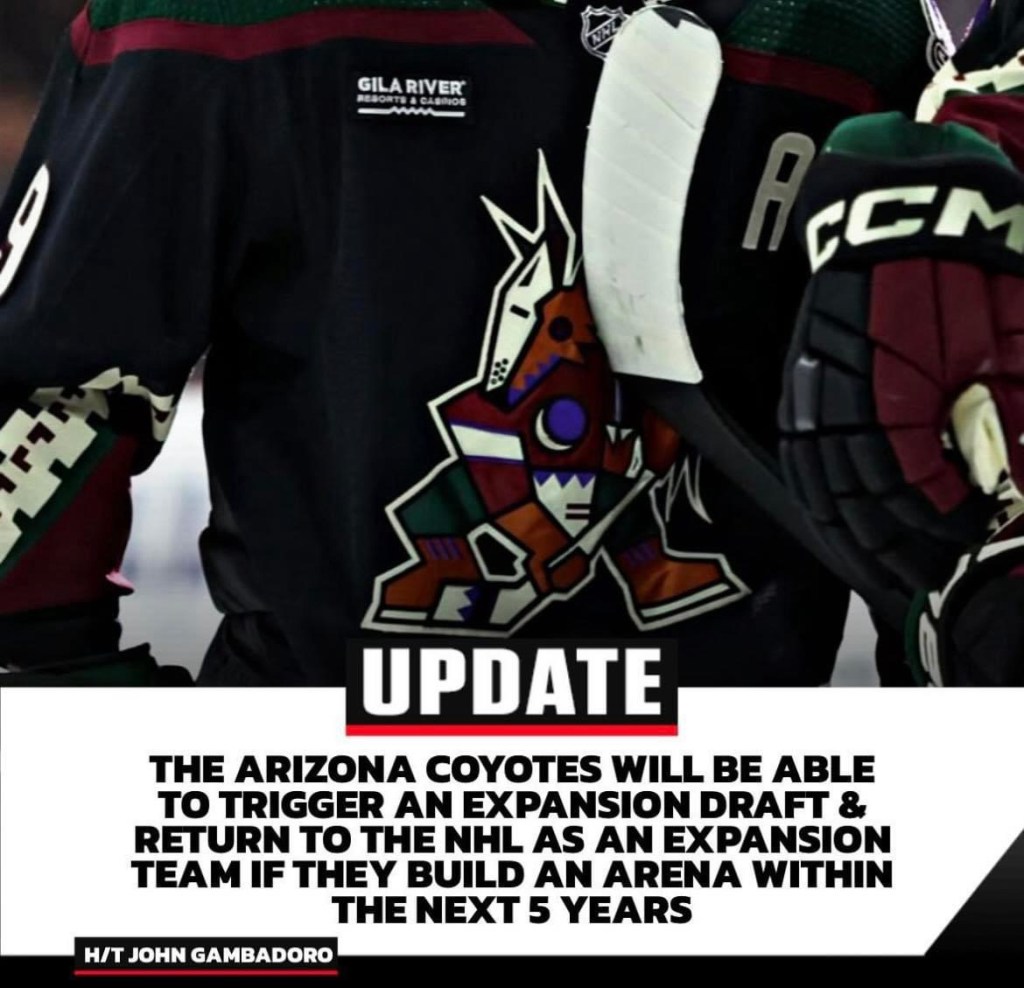
P.S. – If Phoenix media guy John Gambadoro is right, I can only conclude that the NHL needs the Phoenix market, at least more than MLB needs Oakland. 🤷🏾♂️
That said, if MLB put the same conditions on Oakland, could Oakland deliver?







 newballpark.org