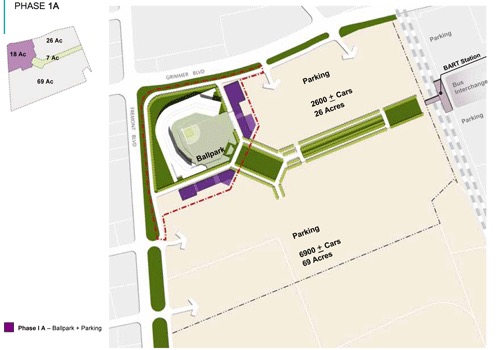
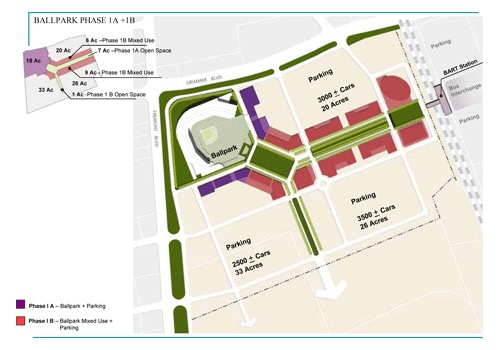
Judging from the lack of feedback, I take it that most of you haven’t read, let alone downloaded, the Fremont conceptual approach documents. That’s okay, it’s my (second) job to parse through that. If you had the wherewithal to go through the appendices, you would’ve found a hidden gem that explains a ton about where A’s fans come from and how they perform in terms of buying tickets on a per city basis. To help foster conversation on that, I’ve taken the six key pages from the appendices and made them available here.
Before we start the debate, let’s set the table. While we remember 2006 fondly – at least until the ALCS – 2007 rarely gets a mention anymore. That season is remembered for being the start of the current decline and rebuilding phase, but that wasn’t the intention going into Opening Day. Consider the following:
- Opening Day payroll was $79 million
- The only major free agent loss was Frank Thomas, who signed a severely overpriced 2 year, $18 million deal with Toronto only to underperform, get waived and subsequently re-signed by the A’s in 2008. Thomas was initially replaced by Eric Karros, who also failed to achieve a career rebirth. gojohn10 reminded me that the A’s lost Barry Zito. All of the KNBR bashing probably devalued him in my mind.
- Beane/Forst signed Alan Embree and Shannon Stewart – all excellent, productive, low cost moves.
- It was the first – and most promising – year of Jack Cust, who ended up being a left-handed hitting, poor-man’s version of the Big Hurt.
- Milton Bradley wore out his welcome.
- Once again, injuries sunk the team. This time it was the expected high risk players: Eric Chavez (snakebit), Rich Harden (fragile), Mark Kotsay (old), and Bradley.
- The team hovered around the .500 mark for the first two months, then made a brief surge until the end of interleague play when injuries finally caught up to and ravaged the roster.
- The selloff began with Bradley in June, followed by Jason Kendall in July.
Got that? 2007 began as a season in which the A’s were expected to contend for the division crown and perhaps make the WS if the roster stayed healthy. Unfortunately that didn’t happen, so the usual selloff-for-prospects began as it does in every season the A’s aren’t competitive. At that point, the A’s farm system was bereft of big prospects, causing the front office to unload Dan Haren and Nick Swisher the following offseason.
Now, you might expect that a team coming off an appearance in the LCS, with the highest payroll in its history, would have seen measurable gains at the gate. It didn’t. It was the second year of tarping, which drove total attendance lower while the experiment in scarcity failed to bear fruit. Just so we’re clear on how this manifested itself, take a look at attendance at the opening series against the White Sox:
- 4/8 (Opening Night): 35,077
- 4/9: 15,153
- 4/10 (BART Double Play Wednesday): 19,130
That was followed by three straight sellouts with the Yankees, then 20k and 17k for a short two-game series with LAAoA. The most damning figure comes straight from the spreadsheet.
- 2007 season attendance: 1,921,844
- 2007 local credit card sales: 1,013,977
Keep in mind that credit card sales could mean advance tickets or gameday/walkup tickets paid for by credit card. Around the time the Wolff/Fisher group took control, they got rid of those kiosks on the BART plaza and outside the lower gates which sold preprinted cheap tickets for cash. A primary motivation must have been reduced staffing. Beyond that, I’m certain that ownership wanted to obtain further information on how tickets were being purchased, so driving walkup fans to the box office probably helped in that regard. We can infer from this figure that tickets purchased hours/days/weeks/months ahead of first pitch were some amount lower than 1 million.
That said, selling just over 1 million advance tickets (less than 53%) to your core audience is PISS POOR. Sure, the A’s raised ticket prices 8.1% that year, but that’s to be expected coming off a division crown, ALDS win, and an appearance in the ALCS. If you want to look for Exhibit A for the MLB panel, that’s it. The Giants have most certainly sold far more than 2 million local advance tickets every season since they moved to China Basin, and there are plenty of teams for whom 3 million advance tickets was more than a mere aspirational goal.
I can’t count the number of times I’ve sat in the bleachers with no one in the eight immediately adjacent seats around me. Yes, it was April or May, and it was either Monday or Tuesday, with the marine layer dropping the temperature to the low 50’s. And yes, I’m partly responsible for that low number since I often bought walkup tickets with cash (not so this year, I got a fielder’s choice plan and will buy group tickets in advance). But really, given the on-field success the A’s showed in 2006, we as a fanbase should’ve responded much better the following season. The excuse makers will point to tarping, a lack of marketing, or even the loss of the Big Hurt. The problem goes far beyond that. If there are that many fans all over the Bay Area that would respond to a competitive team, to a higher payroll, 2007 was the time it should’ve happened. It didn’t for whatever reason. It bugs me to this day.
I’m writing this post not to get an answer, because I don’t know if I’ll get one that’s satisfactory. Instead it’s mostly therapeutic. I’m tired of wondering about it, and hopefully posting this will allow me to let it go. We now know that attendance and sales for the past several years is a key piece of evidence for the panel, and it will contribute heavily to the panel’s recommendation. The thing is that we as fans could’ve done better. We should’ve done better. If the A’s leave Oakland, we need not look further than that lost season of 2007, what could’ve been. Until a new ballpark is built, we may be due for another 2006-07 cycle, possibly in 2-3 years. For the have-nots like the A’s, the window for contention is fleeting. It has to be planned diligently by Billy and David. The hardcore fans can do their part by recognizing this. If you only want to be a fan on your terms (only going when ownership respects Oakland and pays for a competitive team), in the end you will lose. It’s one thing to argue about X percentage of the team’s sales come from city Y, but what if those sales aren’t good enough? That, I think, is the real problem, and the future of the franchise is at stake.