Like Montreal, Portland wants in

The lovely city of Portland, Oregon, expressed renewed interest in a MLB franchise this week. It’s been a decade since Portland lost out to Washington, DC, in the race to land the relocating Expos. In the offing, Portland traded its AAA baseball team for an MLS franchise, to rousing success. At the same time, multiple sites that were considered for a permanent baseball home ended up being developed for other uses. While a short season A team started up in the nearby suburb of Hillsboro, until now there has been little momentum towards attracting an MLB franchise.

Tracy Ringolsby has details on a renewed effort. New mayor Charlie Hales supports a site next to the two arenas at the Rose Quarter. Instead of an open air stadium, the plans now call for a retractable roof park with a smaller, 35,000-seat capacity. A funding mechanism that could pay for much of construction remains in place, though rising costs and the including of that retractable roof probably would cause PDX advocates to majorly revise the plan.

Most importantly, Portland interests have inquired with A’s ownership to see if they’d be willing to either move the team to PDX or sell to PDX-aligned interests. As expected, they were told no on both counts. Sacramento, Portland, and maybe in the past Las Vegas have inquired. Lew Wolff and John Fisher remain focused on the Bay Area, refusing to play the stadium ransom game. Someone had to temerity to brag about swindling the public earlier this week:

The Portland effort bears striking similarities to Montreal’s recently launched efforts. Both underestimate the cost of the stadium and the cost to acquire a franchise. Montreal’s study pegs the total cost at just over $1 billion, which would’ve been a better bet three or four years ago, during the recession and before the new national TV contracts. It’s hard to see any team being available for less than $600 million, maybe even $700 million because the revenue streams are so attractive. That would put the total cost at a combined $1.2 billion, maybe $1.3 billion when including infrastructure and land. Both cities also appear to be dependent on a rich investor group or corporation to fund the private side. That’s a lot to ask for, essentially a subsidy to be borne by a company. Guggenheim Partners made the overbid work because they had two things in their pocket: a to-be-negotiated local TV deal and 100 acres of land with huge development potential at Dodger Stadium. Neither Montreal nor Portland have such potential. Both teams stand a good chance of being future revenue sharing recipients, even with new ballparks in place.

With both the Rays and A’s entrenched in their current stadium malaise, it’ll be up to the next to the next commissioner to determine if Portland or Montreal gain entry to MLB. The new TV contracts are in their infancy, so the owners are only starting to see the benefits. At this point, it’s unlikely they’ll want to split up the pie 32 ways instead of 30.

San Jose files appeal in Ninth Circuit, also files state claims in Santa Cruz County

Sure, we knew that San Jose was going to file its appeal in the Ninth Circuit early this year, which they did today. The filing runs only two pages, with much more to follow.

The surprise was that the lesser state claims about economic damage via MLB’s alleged interference were also refiled – in Santa Cruz County Superior Court. That’s right, Santa Cruz County.

City attorney Philip Gregory brought up MLB’s mysterious denial of the A’s petition to move to San Jose. Although the state claims are not considered as substantial as the federal antitrust case, it’s clear that San Jose aims to dig up some dirt on MLB’s machinations, which could help their case. The denial letter, which MLB has refused to release citing confidentiality, is probably the big prize. Santa Cruz County may also have a lighter docket compared to other nearby counties, which could be a factor in San Jose choosing to look south. Nothing’s expected to happen in either Santa Cruz or the Ninth Circuit until spring at earliest. Until then, the sides will prepare their next filings.

BlogFest at 2014 FanFest, February 8

Last year’s FanFest expanded to include the Plaza of Champions in between the Coliseum and the Arena. This allowed for extra space to accommodate autograph lines and other potentially concourse-clogging queues. The arena itself was still a little cramped, but at least the crowd was broken up a bit.

This time, the A’s announced that the Coliseum will also be in use for this year’s edition on February 8. The team introductions piece, which has players on a stage on the arena floor, will kick off the proceedings at 10 AM (Doors will open at 9). The Coliseum will open at 10:15. Like last year, fans will be able to access the A’s clubhouse for tours. Tickets will be $10, $5 for season ticket holders, free for children 6 and under.

BlogFest will also be held, which will allow us digital media types to interview Bob Melvin, David Forst, and an assortment of players (TBD). I intend to be there to ask a question or two and take some pictures.

Earlier this month I found out that longtime concessionaire Aramark had been replaced by Ovations. I’m curious to see if we’ll get to see or sample some of Ovations’ offerings at FanFest.

Having the general player interview piece in the arena continues to make the most sense, since there isn’t a nice, large video screen at the Coliseum for fans to watch. (It’d be nice if they did.)

I’m looking forward to FanFest/BlogFest this year, as it will provide a brief tease before spring training. I’m really looking forward to Arizona – more on that later.

New Howard Terminal ballpark group pushes for site lease/ENA

Finally.

We may finally have some deadlines. We may have a framework from which important questions can be answered. We may finally find out if Howard Terminal makes sense once and for all.

A group calling itself Oakland Waterfront Ballpark L.L.C. sent a letter to the Port of Oakland last week, asking for an exclusive negotiating agreement (ENA) for Howard Terminal. The ENA would run up to 12 months, allowing OWB to negotiate a long-term ground lease for Howard Terminal. A second period would be used to obtain permits from the City, Bay Conservation Development Commission (BCDC), and State Lands Commission (SLC) as needed. That time would also be used for the environmental studies (EIR, others) that would be required to secure such permits. After that’s done, the actual ground lease would be exercised, potentially leading to the construction of a ballpark on the site – pending club and league approvals and buy-in.

OWB is made up of mostly familiar faces: Clorox CEO Don Knauss, former Dreyer’s CEO T. Gary Rogers, Signature Properties principal Mike Ghielmetti, Baseball Oakland leader Doug Boxer, and a new entrant, developer Seth Hamalian. Hamalian’s planning a high-rise residential building in Uptown.

Howard Terminal’s still in a state of evaluation by the Port, as the Port is considering three other bidders for short-term use as longtime operator SSA departs for Middle Harbor. A group assembled by the Port to study future uses will not complete its work until the end of this quarter at the very least, and the Port is bound by the SLC to ensure that the land is used for maritime purposes as long as possible. A ruling in favor of OWB would help pave the way for a non-maritime use such as a ballpark. It’s possible that maritime uses could be arranged as a temporary use while the details of the ballpark plan are worked out.

HowardTerminal2a

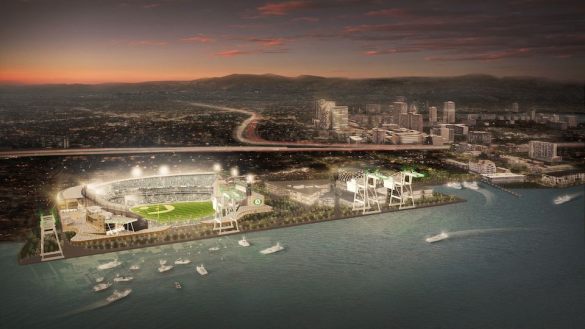
Rendering of a new A’s ballpark at Howard Terminal

A key item in the letter is the notion that OWB could come in at any time do testing of soil or groundwater at the site. While that’s good, that’s really only a continuation of monitoring that’s already in place by law. The big issue is what happens to the site as it’s modified to accommodate a ballpark (and ancillary development). That includes potential cleanup or contamination that may occur with a breach of the asphalt cap at Howard Terminal.

OWB would be obligated to deposit $50,000 with the Port for the original six-month ENA, with another $50,000 due if a six-month extension is required. If they two sides can’t come to an agreement on the ground lease, the deposit is refundable. OWB would have the right to assign the ENA to current or future A’s ownership if they came around to liking the site.

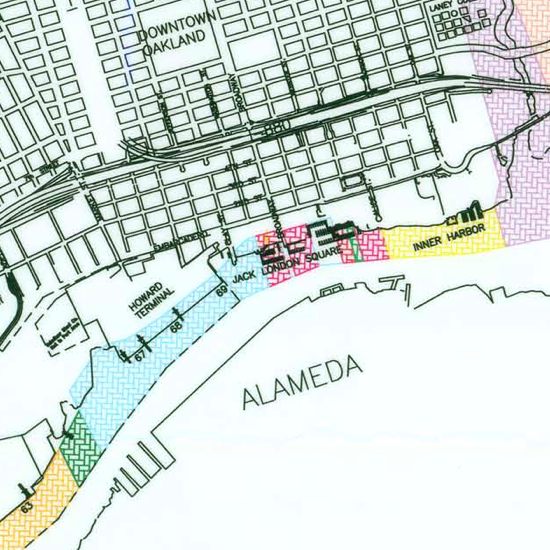
Oakland Mayor Jean Quan, for her part, keeps pushing an idea that zoning should be easy at Howard Terminal because the site was considered for a convention center long ago. It’s a strange claim, we’ll see how well it holds up. At least OWB acknowledges the roles of the BCDC and SLC. Those two bodies are going to impact the scope and final approval on the project, there’s no way getting around it. Among the matters to resolve: Where is the shoreline technically and how close to the shoreline can they build?

tidelands_downtown

Map of Tidelands Trust areas where development is highly restricted

One thing missing from the KTVU and EBX links above is the ever-persistent question of cost. Cost sank Victory Court before ($240 million), and it threatens to sink Howard Terminal. 2001’s HOK study had Howard Terminal’s site cost at $177 million, and that was without any new transit infrastructure such as a nearby infill BART station or a streetcar to bring fans from existing BART stations downtown. A 2004 Caltrans feasibility study commissioned to investigate such options estimated that a new BART station along the West Oakland alignment between Market and Filbert Streets would cost $250-300 million, and that other options at Brush/Castro or Washington Streets were not doable due to the incline of the track, more than the 1% grade required for BART platforms.

Neither OWB nor Oakland has to start a feasibility study or an EIR until the ground lease with the Port is worked out, which is a shame because we’ve been wanting to know the cost for many years. There’s absolutely no reason why such work couldn’t start today, as long as one party budgeted money for it. It’s a chance to delay the reveal until circumstances force a decision, which is the way the mayor’s painting the situation. Quan mentioned on KTVU that the Raiders’ stadium deal at the Coliseum could be done by the summer. That assumes that everything goes well, including the all important determination of how to bridge Coliseum City’s funding gap. The adult conversation comes with many steps. This is a big step.

SF Bulls minor league hockey team could fold, move to Oakland or Fresno

The costs of operating a minor league team in San Francisco have caught up to the San Francisco Bulls, according to the Chronicle’s Susan Slusser (yes, our Susan Slusser). The Sharks ECHL affiliate Bulls, who have called the Cow Palace home for the last 1 1/2 seasons, may have a deal to sell the team to a new ownership group by next week. In turn, the team would move its home games to either Oracle Arena or Save Mart Center in Fresno.

The Bulls were always going to be an interesting test of viability in arguably the most expensive place to live and work in the nation. Sure, the Cow Palace is much closer to Visitacion Valley than Pacific Heights, but given the very low salaries for players and the high cost of living around SF, making the team work was going to be a struggle. Coach/GM/Owner Pat Curcio also cited the out-of-pocket improvements the team made at the arena, the big ticket item being a very nice center-hung scoreboard.

Seats near ice level are not well pitched, creating some bad viewing angles

Seats near ice level are not well pitched at the Cow Palace, creating some bad viewing angles. These seats have been replaced by a beer garden.

The view above comes from a free seat offer I received at an A’s game in 2012. Back then the Bulls were just launching, offering a cheaper hockey alternative to the Sharks. The seating bowl was practically the same as when the Sharks played their first two seasons in the NHL, or the short-lived SF Spiders. Ever the utilitarian venue, the Cow Palace was compact for hockey and prone to get fairly loud. Oddly enough, it’s perhaps too large for minor league hockey, which realistically is best served by a 5,000-7,000 seat venue in the Bay Area. The Bulls even removed at least a third of the Cow Palace’s seats by taking the “floor” seats shown above and converting them to a beer garden, right behind the two team benches. The beer garden had previously been located at one end of the rink.

Should the franchise move to Oakland or Fresno, they would be moving into even larger arenas. Save Mart Center seats 14,000 for hockey or ice shows, though it’s likely that the upper deck would be curtained off for hockey games. The same could be said for Oracle Arena, which due to its basketball-centric seating bowl layout, has thousands of obstructed view seats for hockey.

oraclearena-rinkoutline

Panorama of Oracle Arena during FanFest, showing the outline of the ice rink

Last year’s A’s FanFest had the arena laid out in the way you’d expect a hockey game to be staged. At one end, retractable seats would be folded back to accommodate the rink’s 200′ x 85′ dimensions. Seats above the retracted sections would have obstructed views. This is a similar arrangement to what the NY Islanders will have when they move into Barclays Center. If the Bulls move to Oakland, it’ll be interesting to see what pricing the team will offer and the turnout in response. The last minor league team to call the arena home was the Oakland Skates, a roller hockey team that ceased operations when the arena renovation project started in 1996.

The Warriors would have to sign off on the Bulls’ move, and the Bulls would have to reschedule some home dates to defer to the Warriors. There’s also the matter of laying the basketball court on top of an ice sheet, which would have to be done on occasion. Typically, the Warriors’ schedule has avoided any conflicts. For instance, this year a six-game road trip coincides with a Disney ice show in late February. Condensation on hardwood basketball floors can be an issue even in the newest arenas, and Oracle doesn’t have a ton of experience doing these types of switchovers.

Fresno could end up being the best place in the long run, because of the lower cost of living for players and Save Mart Center’s hockey-friendly layout. In Fresno, the team would have instant Central Valley rivalries with the Stockton Thunder and Bakersfield Condors, both teams that play in smaller, newer arenas. Friend of the blog @wacchampions also noted that the team could play at Selland Arena, which underwent an AEG-funded renovation to better support ice shows and ice hockey.

cowpalace-history

Ice hockey history on display at the Cow Palace

If this is the end for the Bulls, it’ll be another brief stay for minor league team at the Cow Palace. The venue is run not by a city or county, but rather the State Department of Food and Agriculture, which also operates Cal Expo. There’s little local sentimentality to how they run the Cow Palace, making the arena fully a bottom-line-first affair. For the sake of NorCal hockey fans, I hope the team doesn’t shut down, and that it will resurface either in Oakland or Fresno, providing them an opportunity to thrive.

MLB and unions approve expanded replay, will Coliseum fans benefit?

The usually brief January owners meetings had one major item on the agenda: the approval of expanded replay. Reports coming into the meetings indicated that the discussions could be drawn out, even approaching the start of the regular season. Thankfully, all parties quickly approved the package of changes, including MLBPA and the World Umpires Association. For now the players’ union has agreed to one year of the new replay scheme, leaving the option for future replay arrangements to be collectively bargained or extended on an annual basis.

Basically, just about everything that happens when the ball is in play or batted is subject to replay. That includes the previously reviewable home run calls. Now the package includes fair/foul calls, catches and traps, timing plays, and even force plays (except for the “neighborhood” play on attempted double plays). Pitches that hit (or come close) batters are also up for debate. Like the NHL, all replays will be sent to review officials at MLB headquarters in New York, where they’ll need “clear and convincing” evidence to overturn a call. Unlike previous years, there will no longer be a monitor for use by field umpires to render or influence any decisions.

Perhaps the biggest benefit coming out of the replay plan is that all stadia now get to show all close plays on their video boards, including plays that aren’t under review. This change has been long in coming for ballparks, as it was always frustrating to be unable to see anything controversial. Now fans will be able to truly see how bad umpires blew calls or no-calls – well, most fans at least.

In Oakland, we’re still stuck with pretty old video technology dating back from the mid-90’s. The vintage Diamond Vision CRT displays aren’t the most crisp, and the boards’ size and distance from most fans will make viewing replays a frustrating affair. The Coliseum has by far the smallest video boards in the majors, and they located significantly further from the seats than anywhere else. The chart below illustrates how sad the state of affairs is:

dodgers-others-videoboards

Comparison of video boards throughout MLB from the Chicago Tribune

Throughout the lease negotiations between the JPA, A’s, and Raiders in the fall, we held out slim hopes of improvements that would’ve included scoreboards. Unfortunately, that didn’t happen. We and the tenant teams will have to make do with what’s in the Coliseum. Yet there’s a little hope for something better and more reliable to be installed at the Coli.

A little over a year ago, I suggested that the Coliseum buy used video boards off any team or stadium operator that was in the process of replacing their 5 or 10-year-old displays. Turns out that the A’s had checked in with the SF Recreation and Parks department about the displays at Candlestick Park. Now, you may think that the boards at the ‘Stick are awfully outdated and decrepit like the rest of the stadium, but you’d be wrong. The existing displays were only installed in 2008 as part of a suite of technology enhancements. The old Jumbotron in the northeast end was replaced by a 48-foot-wide Daktronics display, mirrored by a much smaller display in the south end. In addition, ribbon boards were added for score and advertising purposes. So there’s the opportunity for only 6-year-old technology to be installed at the Coliseum, right?

Well, maybe not. The A’s (not the JPA or Raiders as far as I know) inquired about the displays, and were told that the displays would be used at least through the spring for events. No chance of getting anything in time for the start of the season, then. SFPR also informed the A’s that the displays would probably be put up on craigslist for the highest bidder, with the idea of recouping whatever funds they could get. Nevermind that to properly use the Daktronics technology a buyer would also have to invest in the control system (hardware and software) to operate the boards. The A’s, in particular, would have to rip out the existing control room and replace it with Daktronics equipment – hopefully the stuff currently at the ‘Stick. To do that the A’s would at some point have to involve the JPA and the Raiders and amend the new leases to reflect the A’s investment – basically a leasehold improvement.

Then there’s also the issue of whether the boards fit. The ‘Stick’s big board is 26′ x 48′, much larger than either of the 20′ x 31.5′ boards at the Coliseum. However, Daktronics’ LED display technology is modular, broken down into 16 x 16 pixel panels that are each slightly larger than a foot square. In theory, it’s possible to reconfigure the boards to fit the scoreboard frames at the Coliseum or change the frames to accommodate larger displays. To illustrate how this might work, I put together a table that shows how these displays would be mixed and matched.

oldstickvideoboards-sm

The key is that all of the displays – the big and small video boards and the ribbon boards – use the same underlying module size. The top lines show the Candlestick configuration, with different sized video boards and 4 ribbon boards elsewhere. The next scenario has a set number of modules replace each of the Diamond Vision displays, conforming to the current size and aspect ratio. The last group shows the boards reconfigured to support standard definition 16:9 video, with 2 of the ribbon boards used to expand the LF/RF scoreboards and the other 2 used to replace the Coli’s current boards. There would still be an issue of replacing the old matrix displays, but that’s a relatively cheap fix. The big non-video scoreboard in the ‘Stick’s north end zone is too football-centric to repurpose for baseball, though it might be useful for the Raiders. I joked earlier today that the JPA should take the displays and stick them on top of Mount Davis since no one’s sitting there, but was told that there’s no way make that work.

Candlestick Park's display setup, with a scoreboard on the left and video board on the right

Candlestick Park’s display setup, with a football-purposed scoreboard on the left and video board on the right

Assuming that some billionaire doesn’t snap up the ‘Stick displays for nostalgia or to build his own stadium somewhere, those boards should be available come spring for the Coliseum to buy. They should be relatively cheap to acquire and a no-brainer purchase for all parties to agree to. The relatively new technology would be a big enhancement for fans with little cash outlay, and would be a pretty responsible recycling of technology. If it can’t happen – well, can’t say someone didn’t try.
Ovations Food Services to replace Aramark at Coliseum

Well, this sure looks like news:

It isn’t news that the Coliseum is getting ready to do its seasonal hiring. The news is that the vendor isn’t Aramark. Instead it’s Ovations Food Services, an arm of venue management firm Comcast Spectacor. Ovations’ client list doesn’t have any current MLB regular season ballparks, making the Coliseum the first. However, they have plenty of local and Northern California experience, working at Raley Field, Banner Island Ballpark, and Chukchansi Park. They also handle food service at three Bay Area fairgrounds: Sonoma County, Santa Clara County, and Alameda County. In fact, Ovations’ California office is located at the Alameda County Fairgrounds, so if you have any complaints you can easily head to Pleasanton to speak your mind.

Part of the offseason is used to reevaluate any current vendor’s offerings in terms of successes and failures. With this offseason, Aramark’s contract was expiring so rival companies were bidding for the contract. It’s not as lucrative as it would be for a new ballpark, especially given the short lease extensions by both the A’s and Raiders. Nevertheless, the Coliseum remains a high profile venue, at least higher than what Ovations had in the baseball world. Chances are slim that any new offerings could be ready in time for FanFest – even though the Coliseum will be open this time around – because the turnaround is short. But it’d be nice if they had a booth to display a preview of their offerings.


The stage shifts in 2014

As we bring on a new year and a new baseball season, let’s reflect on the rather tumultuous year that was 2013.

  • January – FanFest was a great event again, though the cramped concourses at Oracle Arena had many fans wishing for the event to be held at the Coliseum instead.
  • The Coliseum Authority raided scoreboard funds to pay for the ongoing Coliseum Study.
  • February – Oakland officials were forced to apologize to A’s owner Lew Wolff for misplacing a letter requesting further lease extension talks.
  • March – The City of Mesa, AZ, approved a renovation plan and 20-year lease for Hohokam Stadium that will bring the A’s over from their longtime spring home, Phoenix Municipal Stadium. 2014 will be the last year at Muni for the A’s, after which the stadium will be home to the ASU Sun Devils. The Cubs, who vacated Hohokam after 2013, are moving to their own mega-complex on the west side of Mesa.
  • San Jose was dealt the first of a series of setbacks when the state rolled back the City’s transfer of the Diridon ballpark site to the Diridon Development Authority. Eventually the City and Santa Clara County worked out the details of a deal, though it remains up in the air for now. In addition, a request to disqualify the Stand for San Jose lawsuit failed.
  • April/May – Kevin Johnson rallied Sacramento and Bay Area interests to put together an ownership group that eventually bought the NBA Kings from the Maloof family.
  • SAP takes over for HP as naming rights sponsor of San Jose’s Arena. Most fans continue to call the building The Shark Tank.
  • The Giants refinance the remaining debt at AT&T Park (originally due to be paid off in 2017) in order to provide funds for their own project in the parking lot across McCovey Cove from the ballpark.
  • Oakland Fan Pledge kicks off a campaign to build a list of fans willing to buy  season tickets (and in some cases PSLs) at a new A’s ballpark in Oakland. Currently there are just over 5,000 pledges.
  • Levi’s Stadium and the 49ers are awarded Super Bowl L in 2016. While the game will take place in the new stadium in Santa Clara, most of the other festivities will take place in San Francisco at venues like Moscone Center.
  • June – San Jose files an antitrust lawsuit against MLB, alleging that the league’s stalling is costing the City tax revenues.
  • A settlement between Howard Terminal operator SSA and the Port of Oakland could help clear the way for a ballpark on the waterfront site. Site proponents call this move “site control.” The Port was also motivated to get rid of an expensive, ongoing lawsuit by SSA over more favorable lease terms given to a nearby rival operator.
  • A sewer main at the Coliseum is clogged, causing sewage to overflow the clubhouse level and requiring the teams to use the Raiders’ facilities (up one level). Eventually a towel or piece of clothing is found to be the culprit.
  • July – A feasibility study for Coliseum City outlines the funding gap (now $400-500 million) that needs to be bridged for a new stadium, along with an explanation of the economic weaknesses of the East Bay market.
  • The Earthquakes’ stadium is further delayed (until 2015) when numerous underground bunkers are found and need to be demolished before building anew. Erection of the stadium bowl would begin in late December.
  • August – Raiders owner Mark Davis starts crowing for a long lease extension at the Coliseum, with the condition that the extension comes with a replacement to the Coliseum, preferably on the same site as the current stadium.
  • MLB and the San Jose make filings in anticipation of an October hearing in their antitrust lawsuit.
  • September – Lew Wolff clarifies that he seeks a five-year lease after the current lease ends after the 2013 season, with flexibility to leave early if impacted by a Raiders stadium.
  • October – A federal judge throws out San Jose’s antitrust complaint against MLB, but allows the City an immediate appeal (Ninth Circuit) and for the state tort claims to continue. The state claims were also thrown out at the end of the year.
  • A private investor group headed by LA mega-hedge fund Colony Capital and Dubai’s HayaH Holdings signs on to be the financial muscle behind the Coliseum City development. The group, teamed up with architecture firm JRDV, is tasked with providing a series of deliverables that will determine the feasibility of the project.
  • Bloomberg estimates that the A’s are worth $590 million, a huge jump over Forbes’ preseason estimate of $468 million.
  • November – With talks between the A’s and the JPA at an impasse, MLB steps in and negotiates a two-year extension for the A’s, resolving an outstanding issue regarding parking taxes. The Raiders receive a one-year extension with a one-year team option, which they would presumably exercise if they saw sufficient progress on the stadium front.
  • December – The Oakland City Council and Alameda County Board of Supervisors hold their first joint session to discuss the pros and cons of Coliseum City. The Supes claim that the City has dragged the County along, and the County has not been sufficiently involved in the process.
  • A court filing in the antitrust case states that MLB denied the A’s proposal to move to San Jose in June, just before the lawsuit was filed. MLB is unwilling to disclose the contents of the rejection letter. Sources inside baseball indicate that the A’s proposal, not the City of San Jose, was denied, opening the door to another proposal that MLB could conceivably accept.
  • Renderings of the Howard Terminal ballpark are released. It appears that the vision would try to avoid the BCDC’s jurisdiction by placing the footprint sufficiently inland. It is unclear if such a move will work. Normal CEQA issues remain, and proper environmental review has not started yet. Meanwhile, the Port solicits bids for use at the vacated terminal per state law.

What can we expect in 2014? A lot of follow-up to many of the issues above. Lawsuits will continue, and short-term leases only kick the can down the road. With the leases temporarily out of the way, 2014 is the year of the election. Both Oakland and San Jose have mayoral races this year. Oakland Mayor Jean Quan finds herself at the top of a list of five declared candidates. The race to replace San Jose Mayor Chuck Reed will also be hot and heavy, with several current council members facing off against a former councilman and current county supervisor. We should expect to see some serious progress on Coliseum City’s feasibility, as several project deliverables are due in the first half of the year. Oakland partisans will continue to flog Wolff, while San Jose partisans flog Mayor Quan. 2014 is also Commissioner Bud Selig’s last full year in his job. The search for his replacement could be interesting, though the favorite is currently COO and longtime MLB exec Rob Manfred. Movement on the antitrust lawsuit is not expected until the spring, and the “forgotten” Stand for San Jose lawsuit continues its machinations. All in all it looks to be a very newsworthy year. Will attendance continue to grow? Will it be an eventful 2014? That depends on whether anything gets resolved. This site has been running for nearly nine years. The stadium situation has never looked more muddled, with no end in sight. Something’s gotta give, right? Right?

How to negotiate a ballpark deal without giving away the farm

If you haven’t heard, the City of San Jose finalized a five-year lease extension with the San Jose Giants this week. Talks were somewhat contentious for several months, as it was Giants ownership (San Francisco Giants) that spearheaded the Stand For San Jose-vs.-City of San Jose lawsuit two years ago. The relationship was so sour that the SJ Giants had to remove themselves from the lawsuit in order to repair the relationship with the City. The Giants, usually at the tops of the California League in attendance, had things pretty good with a favorable lease and a vast array of corporate sponsors to choose from.

In fact, it wasn’t that long ago that the Giants took the City for granted. In 2007 they even played the old stadium ransom game, threatening to leave if they didn’t get as much as $8 million to renovate Municipal Stadium. City let the San Jose Arena Authority manage the situation, so renovations on an annual basis were kept reasonable, a little over $1 million from that point until now.

So when the time came for the two sides to talk, you can imagine how uninterested the City was with the Giants’ sales pitch. The S4SJ lawsuit involved the Giants’ law firm, Pillsbury, and from what I heard, City was happy to let the Giants twist in the wind a little. Eventually cooler heads prevailed, resulting in the five year extension through 2018.

The lease remains dirt cheap at about $25,000 per year. In addition, the City is for the first time granting the sale of naming rights to Muni. Money from any naming rights deal will go into a capital improvements fund. The important takeaway is that the City is no longer responsible for general upkeep at Muni, nor will it be pushed into funding other improvements at Muni as the Giants had previously requested. In a related move, a deal to share parking with Sharks Ice next door was also reached.

With the coffers running low to fund ongoing facilities improvements, City has used naming rights successfully to take care of various small projects. Most recently, the venerable Civic Auditorium received a name change to the awkward sounding City National Civic, after City National Bank. And of course, there’s also SAP Center, which changed from HP Pavilion in a rather quick manner after the CEOs of HP and SAP talked it over. City National Civic’s deal is worth $240,000 a year, within the range of single-A ballpark naming rights deals. It remains to be seen if Muni will fetch more because of the Giants’ name and the size of the market or less because Muni’s elderly condition. In either case, there should be a number of local sponsors who should be expected to bid, Adobe and Orchard Supply Hardware to name two.

Or, if the parent SF Giants wanted to get really snarky about it, they could rename it Giants Stadium. Talk about planting a flag. The Sharks took over the naming rights to their practice facility from Logitech, and have been expanding that brand ever since with rinks in Fremont and uptown Oakland.

Reaction time

It would be silly to devote a post to every single new tidbit that comes out, so I’ll do one of those rare newswraps here.

  • The East Bay Express’s Robert Gammon reported that the previous group showing interest in buying the A’s (Don Knauss, Doug Boxer, Mike Ghielmetti) is back again talking up buying the franchise. This time, they’re not alone. There could be up to three groups, including one fronted by Warriors owners Joe Lacob and Peter Guber. Lacob and Guber were previously associated with the Dolich-Piccinini group in 2001. Lew Wolff continues to maintain that the team is not for sale.
  • Bill Shaikin of the LA Times partly shot down the Warriors connection when he contacted Guber, who said unequivocally that he’s not interested in the A’s. Lacob and others may be interested, though Lacob is not commenting at the moment.
  • BANG’s Marcus Thompson wrote a quite stirring column asking Oakland to act now to save the A’s in Oakland. Thompson also asked many of the important questions about both Howard Terminal and Coliseum City that currently have no answers.
  • SFGate has a new editorial imploring MLB to make a decision, once and for all. In the column is a quote from Wolff claiming that Howard Terminal’s cost would be more than $1 billion.

Pretty heavy news day, huh? Well, not according to KCBS’s Doug Sovern.

Is there actual news to report? Why yes there is!

  • The FCC is moving forward with its proposal to eliminate TV blackouts of sports broadcasts. The proposal mainly targets NFL games, so naturally the NFL opposes it.
  • The 49ers struck a partnership with fellow Santa Clara resident Intel for a major sponsorship & technology deal. Intel will provide a great deal of tech infrastructure while taking control of the big northwest gate.

Finally, Bizjournal’s Nate Donato-Weinstein has been tracking the iStar development and has an update. If you’re not aware, iStar is a developer and land owner tied to the Earthquakes stadium project. While the stadium is going up west of San Jose Airport, the iStar land is in South San Jose’s Edenvale neighborhood. The plan was to take some of the proceeds of various development activities at iStar and funnel them towards the stadium. The numbers:

  • 260,000 square feet of office space
  • 150,000 square feet of retail
  • 720 housing units
  • $10 million would be funneled to the stadium

Those numbers are important because they can provide a comparison to what is being proposed at Coliseum City.

  • 837,000 square feet of office space
  • 265,000 square feet of retail
  • 837 housing units
  • 2 hotels comprising 478 units

iStar went through numerous struggles and iterations as the recession ravaged the real estate market. Now that things are on the rebound, projects like iStar are picking up again. It’s surprising that despite the fairly large scope of the project, only $10 million is being made available. That’s one-sixth one-seventh the $60 $70 million budget for the Earthquakes stadium. Now consider that Coliseum City, whose Area A phases cover comparable development plans (other than the much greater office space) over a very long timeline. How much could the development activity realistically provide? $50 million? $100 million? While revenue sharing formulas will probably be different, there is a practical limit before eating into profitability. The Raiders stadium will cost more than 15 times as much as the Earthquakes’ new digs. Bridging the gap is the foremost issue for these stadium initiatives. Without that puzzle solved, there really isn’t much else to talk about.