Last week, Zennie Abraham teased with one of his video blogs, this one about Coliseum City. In it, he claimed that a financing plan for Coliseum City fell apart recently.
Abraham, who is still connected with Oakland City Hall to an extent, made a few other points:
- Mega-developer Forest City Enterprises (responsible for Uptown among other projects) was/is to be the master developer.
- A businessman from Torrance wants to bring the Raiders south.
- The Raiders pushed for a cheaper, open-air stadium ($900 million)
Last night Abraham elaborated on the story, filling in some of the gaps.
- The “Torrance businessman” is in fact Ed Roski, he of the City of Industry stadium plan.
- Roski attended a Clippers game in april with Raiders managing partner Mark Davis, who may be willing to split with 17% of the team to take care of some inheritance tax obligations after Al Davis passed away. In the past Roski has wanted a 30% share, large enough to be managing partner.
- A big stumbling block is the potential of seat license sales, which continues to plague the original Mt. Davis project but is also considered a requirement for new NFL stadia due to the enormous cost.
- Redevelopment funding alternatives are under consideration, such as the establishment of a Mello Roos or Community Facilities District (CFD). It’s not clear how that would work in the case of Coliseum City where a large swath of land is publicly owned. Normally, property owners all choose to vote to tax themselves to fund public improvements, such as infrastructure.
Here’s the thing about Roski’s plan: it’s about as sexy to the NFL as Coliseum City is to MLB. The main draw of Industry was Roski’s advertised low cost to implement, thanks to cheap land, a cheaper stadium design (built into a hillside), and redevelopment money that could’ve paid for new infrastructure. The state’s RDA raid claimed $180 million that was to be earmarked for the project. If, as expected, the funds go away, Roski might have to lobby local legislators to pass a bill that creates a carveout on his behalf, which is a step further than what the Warriors and AEG were seeking in their venue efforts. Regardless, you can’t blame Roski for trying. He waited until the Farmers Field deal fell apart. He can do the same for Coliseum City.
The interesting outside angle for Roski is that last week St. Louis declined to pay for $700 million in improvements for the Edward Jones Dome, setting the stage for negotiations on what would probably be a new outdoor stadium somewhere in the metro. Of course, a new NFL stadium is guaranteed to cost more than $700 million, so it’s hard to know what kind of deal the city/county/state could offer Rams owner Stan Kroenke. A situation involving the Rams and Raiders at Roski’s Industry with Roski getting smaller minority shares could be just the ticket. Now there’s no speculation of this deal happening, but it’s definitely an option, if remote.
Going back to Coliseum City, I’ve said for over a year now that the financing for the project, whatever the scale is, looks iffy at best. That’s expected to be borne out in a feasibility study that should come out latter this summer/fall. What we’ve been told so far has not made the financing picture any clearer:
- City Administrator Fred Blackwell said in February that the Raiders stadium may not end up with a NFL G-4 loan because of difficulty getting the revenue backing for the loan (club seats). The G-4 money may not be an issue moving forward since the Falcons are getting the last full slice.
- Contradicting Blackwell, Oakland Mayor Jean Quan has said that she wants the NFL’s loan. She also said she wanted a retractable dome stadium, which appears to be a nonstarter at this point.
- The “preferred” open air stadium will still cost $900 million, which isn’t chump change, and if the 49ers’ stadium is any guide, destined to grow in cost. In most current stadium development agreements the team is on the hook for cost overruns. How could the Raiders agree to that when Mark Davis doesn’t have the cash?
- If it’s not a dome it can’t be used as a convention center or an otherwise flexible facility. What incentive is there for Oakland and Alameda County to invest limited resources for a limited use stadium? Is it just because the Raiders are playing nice right now?
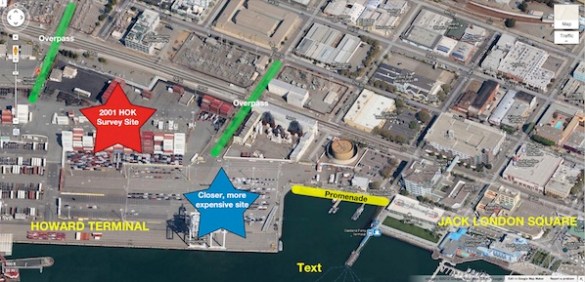
Another interesting element about the financing piece is that investors are focused on the area currently known as the Coliseum complex, plus the Malibu/HomeBase lots. In the Coliseum City study, an alternative will include a ballpark in the northern corner of the complex. But what if Forest City recommends that additional commercial or retail development go there instead to help pay for the cost of the NFL stadium? That would be something. Forest City helps kill two Oakland ballpark plans (even if no one cares for Coliseum City for the A’s). Why not get them to develop Howard Terminal while you’re at it?
Speculation about who outside investors are or which country they come from is neither here nor there. The problem is that whoever it is, they need to be able to make money off this plan. We’re starting to see far more realistic discussion of the revenue generating capability at Coliseum City, not some pie-in-the-sky projections. This is a good thing, because it will eventually lead to the adult conversation about what it’ll take to keep one, two, or all three teams in town. Until now every party involved in Coliseum City has been looking to get someone else to pay for their stadium, their resurgence. Soon, we’ll finally find how much it’ll cost everyone, including the public. That’s a lot more honest than the discussion that led to Mt. Davis.



 newballpark.org