Baer softens stance, new San Jose rumor emerges

Earlier today, Giants CEO Larry Baer was on the MLB Network show Clubhouse Confidential, reflecting on World Championships and Barry Bonds, when he spoke briefly about the A’s and their continuing ballpark problem. A couple of sharp observers were watching closely, including KCBS’s Joe Salvatore.

Fangraphs’ Wendy Thurm also picked up on this, and I was quick to reply:

I later qualified things:

So here’s what I know. Remember how Bud Selig imposed a gag order on both ownership groups going back over a year ago? That went part and parcel with the Commish bringing (forcing?) both parties to the table. Over the past couple of weeks I’ve heard from multiple sources that Selig apparently has other team owners lined up and ready to approve a move to San Jose. The remaining issue is, naturally, compensation to the Giants. Effectively, we can consider the battle half over for the pro-San Jose forces. Getting Giants ownership to back down from their no-negotiation stance is a major development. That said, determining proper compensation for the rights to the South Bay is not expected to be a picnic. Prior to this latest set of rumors, I had heard that the Giants were seeking $200 million or more to cede San Jose. In keeping with the A’s giving away the South Bay in the first place 20 years ago, A’s ownership wanted to keep the payment as close to $0 as possible. With such a huge gap, it’s hard to know what number would be mutually acceptable for both parties. They may be subject to binding arbitration, which is sometimes the case when settling team-team or team-league disputes.

The remaining issue is one of timing. Lew Wolff has been pushing out a San Jose ballpark opening date, first to 2016 and now 2018. Unless there’s some newfound sense of urgency on his part, he’s probably in no hurry to pay money for something he won’t be able to claim for several years. He’s probably not willing to make a huge lump sum payment for the privilege either. Then there’s this upcoming season, which is the last at the Coliseum without a new lease extension, and there have been no real talks about an extension to date other than Wolff’s request for a five-year deal. So there has to be determination of when to make an announcement that doesn’t impact the A’s finances and their status in Oakland in the interim. For those and related reasons, no one should expect an announcement anytime soon. Chronicle beat writer Susan Slusser checked in with Lew Wolff and another source, and got this out of the owner:

If it happens for real, we won’t hear about it until it’s all done, approved by the owners and Selig. Until then, keep dreaming.

Added: A transcribed snippet of the Larry Baer-Brian Kenny interview:

KENNY: What’s the club’s view on the Oakland A’s attempt to go to San Jose?

BAER: Our view is that it’s really up to the commissioner and the baseball processes. We’re not involved talking about it. It’s really something that the commissioner has to sort out. Obviously the A’s need a new ballpark and we hope that they get one.

Note: Clubhouse Confidential is on MLB Network today at 4:30 and 9:30 PM.

Oakland City Council session briefly upstaged by Coliseum JPA-related vote

So there I was Tuesday night, home sick with the flu instead of at my weekly Pub Trivia night. I figured that I’d keep an eye on the Oakland City Council session, because the debate regarding the William Bratton hiring was expected to be thick and fierce. To my surprise, the discourse was more civil and less disruptive (measured in degrees) than many #oakmtg sessions, As I write this, the meeting is still going on and there remains a large number of speaker cards, meaning the session may easily run past 1:30 AM.

There was one item of tangential interest to the crowd that reads this blog on the meeting’s agenda. That was the appointment of two City Council members to the Coliseum JPA’s 8-person Board of Commissioners. Former Councilperson Ignacio De La Fuente was the Chair until last weekend, while the other seat representing the City Council on the board is currently held by Desley Brooks. Larry Reid, who has previously served on the Board, was appointed without a hitch. That was no big deal because Reid is replacing De La Fuente. Brooks, on the other hand, had expected to remain in her capacity on the Board but was cast aside in favor of Rebecca Kaplan. After a motion was made to nominate Kaplan, a full 30 people came up to speak in support of Brooks. Many spoke about Brooks’ record supporting the black community. The Twitterverse blew up with jokes about Brooks, her colleagues in the Council, and the rather personal, catty, tense nature that the proceedings transformed into.

Brooks has been out of favor with Council President Pat Kernighan, who has the power to make appointments such as this one. A major criticism of Brooks that emanated from the debate (though not from the Council members themselves) was that Brooks’ abrasiveness makes her difficult to work with. Being an outsider to Oakland politics, I can’t substantiate that claim, or the undercurrent of corruption taint that follows Brooks. But there is some level of agreement within that Brooks’ attitude was an issue despite her legion of supporters. As an alternative, Kaplan’s more congenial nature was meant to improve working conditions inside the board. I guess.

Eventually the Council voted 7-0 to approve Reid and 6-1 to approve Kaplan, with Brooks being the dissenter on the Kaplan vote and Reid absent for both votes. The discussion leading up to those votes shed some light on the struggles in the JPA and the problems the City has having the $20 million annual subsidy for the JPA as the City’s albatross. In defending herself, Brooks noted that she brought AEG in to replace SMG. She mentioned that her focus has been to reduce the drain that the sports complex has on the City, even if that means forgoing certain opportunities that might come its way. For instance, remember how there was talk about having a WNBA team play in Oakland, especially after the Sacramento Monarchs franchise folded? Brooks argued that hosting a team would’ve cost $35,000 per game that the City didn’t have. That translates to $600,000 for a full season of games, plus whatever nominal costs would be associated with prepping the arena to host a team. (Obviously there’s more to having a WNBA team in Oakland, but we’re focusing solely on hosting the games right now.)

Who was the Oakland politician most gung-ho about bringing in a WNBA team? Kaplan. Who’s pushing Coliseum City the hardest? Kaplan. When it was Kaplan’s turn to speak on her nomination, she didn’t hesitate to bring up Coliseum City’s potential, though she qualified her words a little by saying that it wasn’t solely “about the sports (teams)”, it was as much about redeveloping an area that long needs it. As we all know by now, redevelopment as an institution has been blown up by Governor Brown, with mostly small-scale efforts like affordable housing left as available project types for cities to work on.

Just like that, two of the councilmembers who could be considered more skeptical of the sports-as-savior strategy (IDLF, Brooks) were replaced by two who are all for it (Kaplan, Reid). None of this means that anything substantial will happen with Coliseum City anytime soon. It’s still going to cost billions of dollars to pull off and will require commitments from at the very least the Raiders to have any shot of happening. However, if developers or AEG wanted a sign that things could go more smoothly on the political front for them, this is it.

The WNBA team idea, which has receded from consciousness in the Bay Area over time, sounds like a very good project for Oakland and its business community to pick up. A franchise is worth somewhere in the $10 million range, less than MLS. Player salaries are affordable. The schedule runs during the NBA’s offseason, so there are no date conflicts at Oracle Arena. Plus there’s the advantage of the Bay Area as something of a hotbed for women’s basketball, thanks to the stalwart Stanford program and a recently powerful Cal program. It’s achievable, doesn’t require ridiculous amounts of resources from the business community, and as has been demonstrated in Seattle, a franchise can survive and even thrive when its NBA brother leaves town. That’s not to say that Oakland should give up on the A’s/Raiders or even the Warriors. Far from it. It would show that Oakland and the East Bay can coalesce to get a team that the community can rally around. Even Mayor Quan has referred to that possibility. It’s kind of hard to know if Oakland is capable of big successes if it doesn’t have small ones to build upon, and its biggest success were decades ago. If you want a test case, well, there it is. Seize it.

News for 1/21/13

Update 11:00 PM – Tomorrow at 2 PM Mayor Johnson will hold a press conference where further plans to keep the Kings in Sacramento will be unveiled, possibly including the disclosure of one or more assembled bidding groups for the the franchise.

NorCal has it pretty good these days in terms of sports. Unless you’re a Raider fan. Or the Kings fan. About the Kings…

  • Around the end of the AFC Championship Game, a flurry of reports from national sources had the purchase/sale agreement between the Maloofs and the Hansen-Ballmer group sewn up, with the paperwork being submitted as early as tonight. The price hasn’t budged from the oft-discussed figure: a $525 million valuation with the Hansen-Ballmer group paying for a 65% majority share, or $341.25 million. One new wrinkle is the Maloofs’ demand of a non-refundable $30 million deposit, which sounds like either pure desperation on the buyers’/sellers’ part or a sign that the move will be rubber stamped with it reaches the NBA’s Board of Governors. The remaining 35% of minority shares have not been arranged to be sold in any way except for a 7% chunk that will be sold in a bankruptcy proceeding. For their part, Sacramento Mayor Kevin Johnson and forces in Cowtown continue to work towards providing a counteroffer. It’s unclear if that counteroffer will get more than a cursory look. [Pro Basketball Talk/Aaron Bruski | ESPN/Marc Stein]
  • In the latest Matier & Ross column, there’s an item about John Fisher attending a Warriors game courtside with W’s owner Joe Lacob. “That prompted one East Bay mover and shaker to speculate that a deal might be in the offing for Lacob to buy the A’s,” a notion that was summarily shut down by Lew Wolff. Hmmm, who could that East Bay mover and shaker be? Perhaps someone who is working as a consultant for the Warriors to move the team to SF? Grasping at straws, anyone? [SF Chronicle/Matier & Ross]
  • Lew Wolff spoke at the Silicon Valley Business Journal’s Economic Forecast breakfast on Thursday. SVBJ had one choice quote from Wolff, “I want people in LA to say ‘the one place in California I want to build is San Jose.’ ” Wolff also joked, “Next time I’ll take on the pyramids instead of baseball.” Nonsense, Lew. You just have to be more of a dick to the other owners to get your way. [Silicon Valley Business Journal/Shana Lynch]
  • A little-reported story on this blog has ended rather quietly. That would be the ballad of Charlotte lawyer Jerry Reese, who filed lawsuit after lawsuit against the City of Charlotte and Mecklenburg County to prevent a AAA ballpark from being built there. Reese’s reasoning was that any such deal would impair the market’s ability to get a major league stadium deal done. After a judge threatened sanctions, Reese agreed to settle and drop all lawsuits, including those related to a AAA ballpark under construction in Uptown Charlotte. Charlotte is considered a somewhat overextended market for MLB to begin with so it’s hard to take such an effort seriously, but you can’t blame Reese for trying. [Charlotte Observer/Gary L. Wright]
  • No surprise that the Chargers will stay in San Diego at least through the 2013 season. Better to wait until the AEG sale happens (or doesn’t). [NFL.com/Dan Hanzus]
  • Cleveland Browns Stadium will now be known as “FirstEnergy Stadium, Home of the Cleveland Browns”. Poetic. [Cleveland Plain Dealer/Tom Reed]
  • The 49ers may hold off on selling naming rights to their stadium until the proper deal comes in. With all of the advance money coming in, they can afford to wait. One thing they don’t have compared to another unnamed stadium, Cowboys Stadium, is the sheer number of events held annually that can help draw enough attention for a company to justify the naming rights fee. I imagine that the 49ers will get a naming rights deal done before Super Bowl L in 2016, the better for a bidder to take advantage as MetLife will prior to Super Bowl XLVIII. [SF Chronicle/Matier & Ross]
  • One stadium is getting rid of its naming rights sponsor, Sporting Park in Kansas City, KS. They’re distancing themselves from Livestrong for obvious reasons. One not-so-obvious reason: the MLS All-Star Game will be held there this year. No need for a tarnished brand to represent the league in that manner. [Reuters/Simon Evans]
  • The Cubs have unveiled plans for their massive renovation of Wrigley Field. Besides the oft-reported newer, larger clubhouses, there will also be two large club areas behind the plate, expanded concourse areas throughout, and a patio in the left field corner. One new deal point is that the Ricketts family is willing to pay for the $300 million themselves as long as the City of Chicago/Cook County doesn’t start placing a bunch of restrictions on what the club can/can’t do at Wrigley. More night games, anyone? [Bleacher Nation]
  • Sports economist Andrew Zimbalist considers downtown Tampa the best place for a Rays ballpark. That won’t make the keep-em-in-St. Pete-crowd happy. [Tampa Bay Times/Stephen Nohlgren]
  • One community in Florida is having a tough time figuring out what to do with a stadium-related sales tax once the stadium is paid off. [Florida Today/Matt Reed]
  • It seems that the only way to introduce a new stadium concept in Las Vegas is to make it bigger and more ostentatious than the previous concepts. The UNLV Now concept has a $800-900 million cost attached to it. That seems very Vegas to me. The new wrinkle: a 100-yard long video screen stretched along one of the sidelines. Why put seats in the best place you could have a video screen there instead? [Las Vegas Sun/Ray Brewer]
  • The Oilers and the City of Edmonton are reportedly close to a new arena deal. Oilers ownership backed off a $6 million/year subsidy demand, which was a major sticking point previously. Instead, the team will be asking for more direct subsidies upfront. [Edmonton Journal/Marty Klinkenberg]
  • As the Kings prepare to leave their home of 25 years, another former Kings home may be up for demolition. That home is Kemper Arena, which was barely a decade old when the Kings moved from Kansas City to Sacramento in 1985. An effort is underway to save Kemper, spearheaded by the namesake’s descendants. Kemper Arena hosted the 1988 Final Four, numerous “home” games for the Kansas Jayhawks basketball team, and most ignominiously, the 1999 WWF event Over The Edge, during which Owen Hart plummeted 70 feet to his death from a malfunctioning harness. [KCTV-5/Chris Oberholtz]
  • According the Milken Institute, the South Bay is the #1 economic market in the country. SF/Peninsula is 36th, while the East Bay is 155th, below Vallejo-Fairfield and Fresno. Milken seems to attribute much a market’s economic power to its tech proliferation, which might penalize the East Bay, but if you look at the rankings, it doesn’t. [Milken Institute]
  • It what has to be considered your classic Friday afternoon bad news dump maneuver, Clorox announced that it’s selling its headquarters building in downtown Oakland for $110 million. The buyer is real estate firm Westcore Properties. Westcore is leasing back more than half of the building to Clorox, though the length of the lease was not disclosed. The news comes several months after Clorox relocated much of its R&D staff to Pleasanton. Now I can understand Clorox not wanting to deal with the overhead of being a landlord, and the company runs quite lean with a small cash position. But whenever you hear about similar sell/leaseback deals, they usually aren’t good. A similar deal was reported that very same day by Sony when the tech giant announced that it was selling its midtown Manhattan headquarters for $1.1 billion. The Maloofs sold and leased back ARCO Arena because they were low on cash. In other words, no one’s celebrating about this. [Oakland Tribune/George Avalos | Financial Times/Michiyo Nakamoto]

More as it comes. One quick viewing note: on most cable/satellite systems, NHL Center Ice is doing a free preview through the end of the month. Check your local provider.

No please, really, take your time Oakland

The Coliseum Authority released its agenda for the upcoming January 25th meeting. On the agenda is a procedural item of voting a new Chair and Vice-Chair. The other item, 6b, involves the following:

6b. Resolution of the Oakland Alameda County Coliseum Authority:
1. Waiving Competition and Authorizing Staff To Negotiate One or More Professional Services Contracts to Conduct

Studies for Site Planning and Development Scenarios, and to Create Estimates Of Building Budget And Profit And Loss Statements, For a Potential New Stadium and Related Development on Land Currently Owned By The Authority That Lies Within the Coliseum City Specific Plan Area, for a Total Amount Not To Exceed $500,000; and

2. Authorizing Staff To Competitively Procure and Negotiate One or More Professional Services Contracts to Conduct Studies of Revenue Potential and Market Demand From a Potential New Stadium and Related Development on Land Currently Owned By The Authority That Lies Within The Coliseum City Specific Plan Area, for a Total Amount Not To Exceed $500,000; and

3. Authorizing the Chair of the Oakland Alameda County Coliseum Authority to Execute Contracts for Services With Selected Consultants Without Returning to the Authority Board; and

4. Amending the Authority’s Budget to Allocate up to $1,000,000 in Available Oakland Alameda County Coliseum Authority Funding For These Purposes

Woah there, wait a second. Is the JPA really saying that it still has studies to complete? It needs to do financial projections and a development plan? And it’s executing this now without competitive bidding? You have got to be kidding me. This stuff was supposed to be done by now. Funding for Coliseum City was authorized in February 2010, almost three years ago. This is supposed to be the easy part.

Now, maybe the upshot is that the Raiders and JPA came to an agreement on a lease extension, allowing these funds to be freed up. But if anyone from the East Bay is looking for signs of progress soon, this certainly won’t help. At this rate the 49ers will have been at their Santa Clara stadium 7-10 years before anything gets built in Oakland. Also, note that the resolution says stadium in singular form. Will there be a two-stadium alternative, as some pols believe is the best option? Or are they talking about another multipurpose stadium? I can’t wait. Actually, I guess I can. I have no choice.

I suppose these “additional” studies can be completed by the end of the year. In a week full of unbelievable BS news in the sports world, this ranks up there, at least locally. Suspiciously, the JPA’s annual financials have not yet been released. They probably won’t show much in the way of funds spent on Coliseum City so far. This is so disappointing, and yet, par for the course. No wonder the Warriors plowed their own path. They can’t trust the JPA to make anything happen in a timely manner.

David Stern’s Reverse Solomon

As much as I enjoy much of the drama in the Kings-Sacramento-Seattle love triangle, even I don’t want to bog down this blog with daily updates on the situation. If a deal is signed, the Maloofs apply for the move, or something happens in April when the NBA’s Board of Governors is set to meet, I’ll write about it. Until then, the Kings issue is best relegated to the weekly newswrap.

However, I’ll take this story in a different direction. There’s a solution on the horizon, one that can satisfy all parties: the Maloofs, Chris Hansen, Mayor KJ and Sacramento civic leaders alike. It all starts and ends with two old guys who spent a couple of years in St. Louis.

What’s that, you say? There’s no NBA team in St. Louis? Well, that’s absolutely correct. There hasn’t been a NBA franchise in St. Louis since the A’s moved to Oakland. The St. Louis Hawks moved to Atlanta and never looked back. The only other pro basketball team that has graced the city since is the ABA Spirits of St. Louis, whose two-year stint in the Gateway City was marked more by off-the-court actions than on-court.

That’s because when the ABA merged with the NBA, Spirits team owners Ozzie and Daniel Silna pulled off one of the greatest deals in the history of pro sports, one that continues to benefit the Silnas and haunt David Stern to this day. As several ABA franchises such as the Baltimore Claws and Virginia Squires sputtered to the end, other franchises that were in better financial shape were under consideration to be brought in as new NBA franchises. Eventually, the NBA decided it would accept only four teams into the league: Denver, Indiana, San Antonio, and the New York Nets. It was the culmination of several years of lawsuits, threats, and strife for both leagues as the NBA was struggling with huge image problems. Two teams remained to be dealt with, the Spirits and the Kentucky Colonels, long regarded as the most stable franchise in the ABA. The Chicago Bulls had NBA rights to Artis Gilmore, and they wanted him so badly that they blocked the Colonels from being included in the merger. The NBA paid $3.3 million to Colonels owner John Y. Brown, Jr. to fold the franchise. Soon after the merger, Brown, who owned KFC prior to getting into the pro hoops business, bought the Buffalo Braves and later swapped that for the Boston Celtics.

Ozzie and Daniel were a different story. Instead of taking the $3.3 million payout, they chose to take only $2.2 million and a 1/7th share of national TV revenues for the 4 merged teams in perpetuity. Back in the mid-70’s, no one knew how big the NBA would be. It was common for playoff games and even the finals to be broadcast on tape delay. The Silnas’ prescience became legendary as the league took off only a few years later with Magic-Bird and then soared to unimaginable heights with Michael Jordan. Ever since, the brothers have been getting a 4/7ths team share of national TV money, which has grown exponentially since 1976. In recent years that 4/7ths share has meant around $17 million every year for doing absolutely nothing. It’s the height of rent-seeking, and the crazy thing is that last September, they filed suit to get even more! Now they want cable and international TV dollars, claiming that they lost everything during the Bernie Madoff scandal. No settlement has yet been reached between the Silna brothers and the NBA.

This is where the Kings come in. We know that the franchise’s value has been inflated because of the sale talk and the Maloofs’ financial liabilities. It’s a situation in which one city will come out the winner of the franchise, while the loser may get a “promise” of an expansion team down the road. When it comes to expansion, leagues tend to be hazy on their promises, especially when the leagues don’t really need the cash (like the NBA) and owners naturally don’t want to slice off another piece if they can help it. Yet there’s an interest in getting rid of the Silnas, who have long been a thorn in Stern’s side. Some kind of buyout would also help the 4 former ABA teams, since they’d be on a level playing field in terms of national TV money. 3 of the 4 franchises are in small/mid-markets, so this is no joke.

While the Kings will be sold in a straightforward transaction, the “losing” city’s prospective ownership group can pay an expansion fee, which thanks to Kings-related inflation, should be $500 million. Take some of that money ($200-250 million) and give it to Silnas and their lawyer, while splitting the rest up 29 ways (new Kings owners not included). The other teams would get a one-time $8.6 million-$10.9 million infusion, and future TV money would be split 31 ways instead of 30.57 ways inequitably. The downside is that all other shared revenues would also be split 31 ways, but that’s limited to merchandise and other non-TV sources (not tickets). The Silna brothers walk away with a quarter billion dollars, Stern fixes that nagging legacy problem, and fanbases in Seattle and Sacramento are happy. The NBA would do well to solve this problem before TV contracts come up for renewal after the 2014-15 season. By acting now, owners will have complete cost controls and expanded revenue sharing throughout the life of the CBA.

Funny thing to point out – the total combined national TV revenue for the ESPN/ABC/TNT deals is $930 million annually. It’s quite a coincidence that the total splits into 31 neat, $30 million shares. The solution only works if the Silnas are interested in a big lump sum payout, which they have rebuffed twice already. A quarter billion dollars, however, may be an offer they can’t refuse.

Two mayors, two different approaches

Some people are going to view this post as more piling on Oakland. It’s not. It’s a demonstration of what leadership is, and what it means to follow through. You’ve been warned.

—-

Many of the mayors throughout the country are in Washington this week to attend the US Conference of Mayors, where the big topic is gun violence and how to reduce it. The big fish at the event is Vice President Joe Biden, who President Obama tasked with developing a plan for gun control and other related initiatives.

In the face of increasing criticism over her effectiveness in handling the crime and murder rates in Oakland, Mayor Jean Quan left for the conference earlier this week. Her office says that she is “hoping to have conversations” on how to reduce the crime rate, which frankly, sounds like a bad excuse for taking a trip to DC for the inauguration. Maybe she’ll get some kind of commitment from someone in a federal capacity, but VP Biden’s team put together the plan and President Obama signed 23 executive orders without needing Quan to be in DC.

Also in DC for the conference is MC Hammer, who became an employee of the city’s Convention & Tourism Bureau last November. Hammer’s position is to promote tourism, which I have to imagine is a difficult sell when everyday there are headlines about one shooting or another. So there are two Oakland leaders in DC at the moment.

Now all of this would be little more than your typical Washington hobnobbing session if it weren’t for the actions of Sacramento Mayor Kevin Johnson, who abruptly canceled his trip to DC. Why would he cancel the trip even as he was scheduled to speak?

The things that KJ is referencing are his efforts to put together (in parallel) a competing ownership bid that would keep the Kings in Sacramento and an arena package that would be acceptable to David Stern and the NBA owners. KJ is working with a deadline of March 1st. Quan’s deadline for both the Raiders and A’s is effectively the end of the year, so she technically doesn’t have to act too swiftly. But it’s telling that while East and West Oakland are going to hell, Quan is in DC just a month after going to China. In both cases, she’s trying to find solutions, money, or both outside of the city. On the stadium front, Quan has created one task force or another and authorized money for a Coliseum City study which has not yet materialized. There isn’t much to show for Victory Court or Howard Terminal (so far) for that matter. Meanwhile, KJ is rallying forces in the Sacramento region to find a solution. It’s a stark contrast, and while there’s a good chance neither will be successful in the end due to circumstances beyond their control, it’s clear that there’s one mayor who’s trying, and another who’s simply asking for help and not actually doing much.

Then again, this is Quan’s last Twitter update (she’s more active on Facebook):

Welp.

Super Bowl Musical Chairs

In May the NFL owners are expected to award the Super Bowl L (50th Anniversary in 2016) to either Miami, or San Francisco/Santa Clara. The loser will get to square off with Houston for the right to host Super Bowl LI in 2017.

Officials in Miami are scurrying to make improvements at Sun Life Stadium that will make it continue to be viable for future Super Bowls including L/LI. Recently, the NFL had been hinting that Sun Life Stadium could end up out of the game’s regular rotation (every 5-7 years) if changes weren’t made. That’s possible now that the Marlins have left, allowing the Dolphins to remake the stadium as a football-only facility.

Improved viewing distances to the sideline and displays should make Sun Life Stadium more appealing

Improved viewing distances to the sideline and displays should make Sun Life Stadium more appealing

To accomplish those goals, the Dolphins plan to add seats along the lower level to reduce the 90-foot gap between the first row and sideline. They’ll also replace all of the existing seats, which will be colored turquoise instead of orange. (I think we’ve all learned over the years that orange seats don’t do well in the sun.) Sections in the upper deck corners will be reduced to accommodate large video board. Sun Life received two of the largest boards in sports a few years ago. Those will probably be moved with two others added. The big addition is a free standing canopy that will cover much of the seating bowl and upper concourse.

Will that be enough? While Miami is a veteran of putting on big events like the Super Bowl, it lacks ancillary features at Sun Life that could bring in more revenue, such as a convention center. South Beach is 18 miles away from the stadium, closer than the distance between the Santa Clara stadium and what is expected to be the media hub in downtown SF.

Dolphins owner Stephen Ross has pledged to pay for the “majority” of the project’s $400 million cost, with no new taxes as part of the promise. Some public funds could come from a sales tax rebate on items sold in the stadium. 8 of the 9 pro teams in Florida already receive this benefit. The Dolphins are the only ones that don’t. The team estimates that this will raise about $3 million per year, which would go towards debt service on the improvements for 30 years.. Additional funding could come from hotel taxes.

The 49ers and the City of Santa Clara are being asked to make their own concessions, though the requests are not of the stadium. Instead, the NFL wants the nearby Santa Clara Convention Center, Soccer Park (next to the 49er HQ), blocks of hotel rooms, and perhaps a cut of different revenue streams.

It’s all part of the laundry list of items the NFL usually asks for from host cities. The NFL has the leverage in this relationship, and their M.O. has always been to pit cities against other every year to get the best deal possible. We discussed this laundry list a year ago. The league asks for a lot, and in most cases, they get it.

Santa Clara is also unique in that it controls its own power utility, Silicon Valley Power. City backers have been quick to note this as a way to cut costs. However, the NFL could just as easily make demands of the City to extract the lowest possible cost for power during the week. Down in the Phoenix area, Salt River Power is giving a $1 million sponsorship for 2015’s Super Bowl XLIX, which includes numerous services the utility controls.

It’s also unclear how the Super Bowl could affect operations out of SJC on gameday. When planes take off during good weather, they head north before quickly turning east for the most part. If the weather is bad, SJC reverses its approach, having planes land from the north. That puts those planes rather low and – as I noticed over the Thanksgiving weekend when I flew in from SoCal – directly over the stadium.

Neither city should expect to get much in the way of direct tax revenues. They’ll be able to tout an immense amount of acute economic activity, and for most cities, that’s plenty.

Other cities are working to keep up appearances. Houston’s bringing in new scoreboards, while Charlotte is looking to state legislators to approve $125 million in improvements at Bank of America Stadium. The NFL sees this and loves it. It’s all part of the game to get The Game.

George Gund III: 1937-2013

I never met George Gund. I’ve heard quite a few stories about him. He was a character, an iconoclast, a real fan who just happened to be rich. He lived the kind of lifestyle many sports fans would’ve liked to live, jetting off to tournaments and film festivals and pretty much doing whatever he wanted. To appreciate the man, read these four articles about Gund:

What I’d like to do is tie his career into the fabric of the Bay Area sports world. First, we have to start in Cleveland. Gund was what we’d now call a trust fund baby. He loved sports, film, and classical music. In keeping with those passions, he bought two hockey franchises, married a filmmaker, and sat on the board of an orchestra. He partnered with his brother, Gordon Gund, to buy the Cleveland Cavaliers. George was always the hockey fanatic while Gordon was the basketball junkie. It worked out pretty well for both in the end.

The journey, however, was long and at times quite difficult for the Gunds. After George Gund permanently moved out to San Francisco, he took a minority stake in the California Golden Seals NHL franchise. The Golden Seals were sold by Charlie Finley, who tried and failed to establish his “branding” on the hockey club (green and gold colors, white skates). Gund partnered with Mel Swig, who owned the Fairmont in SF (like someone we know). For various reasons, running the Seals wasn’t working out at the Coliseum Arena. Swig tried to put together an arena deal in SF, but that fell through. The Gund brothers bought the team from Swig and relocated it to their childhood home of Cleveland.

Except that the team, now named the Cleveland Barons, played out in the sticks at the Richfield Coliseum, about halfway between Cleveland and Akron. The idea was to leverage the fanbase from both markets, and it failed miserably. With the Barons and the Minnesota North Stars in danger of folding and the NHL still struggling against the rival WHA, the league decided to merge the two teams. The franchise remained the Minnesota North Stars and would have a good deal of stability for the next decade, including a Stanley Cup Finals appearance in 1981 (a loss to the juggernaut NY Islanders). The Cavs stuck it out in Richfield for over a decade before moving back to downtown Cleveland. The new home was named Gund Arena.

In 1991, George saw his opportunity to bring a team to the Bay Area. The NHL was starting its Sun Belt expansion phase, and it seemed a good time to put a team in the Bay Area. Howard Baldwin, who was already known as a sort of serial franchise owner, was pushing hard for the franchise to be in San Jose. George Gund stepped in to swap the North Stars for the rights to the expansion franchise, which eventually became known as the San Jose Sharks.

The Sharks played its first two seasons at the aging Cow Palace, an arena that was already outdated for both the Warriors and Golden Seals by the mid-70’s. A new, hockey-focused arena deal was in the works in San Jose, with recent transplant and future Sharks play-by-play man Randy Hahn playing a key organizing role. Gund had the opportunity to try the Oakland experiment again even though the Coliseum was small and poorly set up for hockey, or try to get an arena built in SF. He found willing partners in San Jose in Mayor Tom McEnery and numerous business leaders, all of whom were willing to do what it took to put San Jose “on the map”.

With two major franchise moves under his belt, George Gund could’ve been considered a carpetbagger. He didn’t live in San Jose, choosing to stay in SF and build an apartment inside San Jose Arena. (Frankly, I’d do it if I was asked to contribute.) Yet his legacy stands as a key figure who made San Jose major league and cultivated a great, appreciative fanbase – even though the Sharks mostly sucked during the Gund era.

Gund’s story as an owner is similar to that of Wally Haas, Jr. Both were scions of very wealthy families. Both were revered by their respective team’s fans. Both made great efforts to make their teams successful, business of the game running secondary to winning. Both were well known as philanthropists. Both bought teams from Charlie Finley. The biggest difference between the two was the state of their leagues – while MLB was still clearly the national pastime during the 80’s, the NHL had major competition, growing pains, and difficulty carving out a niche as the fourth major North American pro sports league. Haas was 20 years older than Gund and part of the established SF gentry, so I can’t imagine they ran in the same circles. But I imagine that when Gund took the elevator upstairs over the weekend, he was greeted by Haas and Franklin Mieuli. Mieuli handed Gund a cigar and the beverage of his choice, while Haas showed him the way to the lounge. They could talk about how the Warriors and A’s are resurgent, and that Gund got there just in time to watch his beloved Sharks start their new season. You’re home now, George. Relax and enjoy the game.

FanFest 2013 SOLD OUT

If you were waiting to buy tickets to FanFest this week or by walkup, you’re out of luck. The event’s 10,000 tickets are sold out. Just as with the playoffs, fans shouldn’t take ticket availability for granted. You snooze, you lose.

Of course, the announcement will bring about the usual grousing about how anti-fan A’s ownership is and such. That ignores two big issues.

  • The Coliseum is unavailable because of a motocross event on Saturday the 26th. Most teams that have FanFest in their own ballparks use the field as a huge concourse and staging area. The A’s won’t have that luxury since the field will be a big pile of mud. That would force fans into aisles and concourses, and we know damn well how congested the lower concourse gets at times. I once took an out-of-town friend to the Giants’ FanFest in 2008, which was held at AT&T Park. The field was also unavailable there due to a motocross event. It was a less-than-ideal situation and had all the feel of a hard hat construction zone.
  • Oracle Arena’s concourses were very congested last year at FanFest. While some people chose to sit and watch interviews, most were on the main concourse, inside the lower club, or in line for autographs. The upper deck was blocked off (familiar story). I suppose that the A’s could’ve thrown an Eric Sogard autograph line up there. Would that really help things?

2012 FanFest

When putting on one-off events like FanFest, the biggest wildcard is the impact of a previous season’s success on attendance. The Giants were overwhelmed by the response at their 2011 FanFest, causing extremely long lines and waits for autographs and World Series trophy pictures. You want to bring in as many people as possible because you can sell tickets, but you also don’t to create a situation were the experience sucks for fans. Oracle Arena would be a perfectly fine venue if it had more expansive concourses like HP Pavilion or Staples Center. That wasn’t in the cards for the 1997 renovation.

Perhaps the A’s could’ve held FanFest at Jack London Square or another large public space. That’s fine, though personally I like having the clubhouse tour right there at the Coliseum/Arena. That’s not possible at JLS. Tell you what: Don Knauss and his people could’ve offered to sponsor FanFest by underwriting the cost to hold it at JLS, right next to their preferred Howard Terminal ballpark site. Oh well. Maybe next year.

A’s look to trade Papago for a Grotto

No, we’re not talking about the BatCave or the Playboy Mansion, but it’s a grotto of a sort. The City of Mesa has approved a memorandum of understanding between the City and the A’s that outlines the terms of the A’s move to Hohokam Stadium starting in 2015. (If you haven’t been to Hohokam or would like a visual refresh, this photo blog is a good start.)

Per the terms in the MOU, the A’s would stay at a renovated Hohokam for 20 years initially, though they have the chance to break the lease after the 15th year as long as they pay $1 million for each year they don’t stay. There are also two 5-year options the team can exercise after the 20-year term is up. Hohokam Mesa was the A’s spring training home from 1969-78, much of the era spent at a place near downtown known as Rendezvous Park. After spending a few years in Scottsdale, the A’s moved to Phoenix Municipal Stadium. The 2013 season marks the 30th spring training spent at Muni, with only one more before the move 8 miles east to Mesa. The Cubs were granted major improvements to Hohokam/Fitch in 1997.

At 12,500 (or 13,000) seats, Hohokam has arguably the largest capacity of any spring training ballpark, Cactus or Grapefruit League. That stands to reason because the home team has long been the Cubs, whose large, multigenerational, national fanbase and eager snowbirds regularly put up league-leading attendance figures. For the A’s some of that capacity won’t be needed, so some of the seating sections will be removed or reduced in size, to be replaced by more premium, revenue-generating facilities.
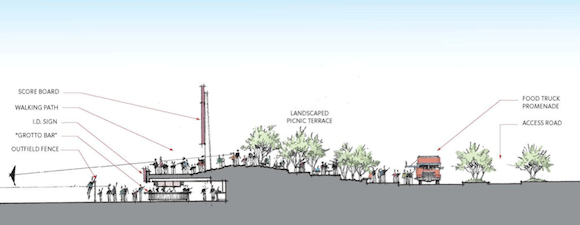
Renovated area beneath LF scoreboard includes “Grotto” bar at field level

Renovated area beneath LF scoreboard includes “Grotto” bar at field level

The biggest major change will be in left field, where the expansive berm will be significantly reduced if not altogether eliminated. Instead there will be two standing tiers, the lower one containing a dugout-like “Grotto bar”. This bar will be at field level, which means that the solid fence in left will be replaced by chain link to provide fans views from the bar. The upper tier leading up to the scoreboard is a smaller standing platform. Behind the scoreboard is a terraced picnic area leading down to a staging area for numerous food trucks. Though it’s not mentioned, I imagine that the scoreboard itself will receive some upgrades.
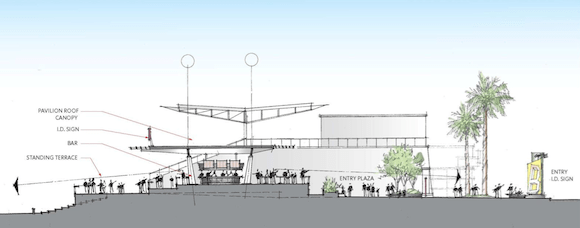
Down the LF line a set of bleachers will be replaced by a covered pavilion

Down the LF line a set of bleachers will be replaced by a covered pavilion

Another bar will take the place of a freestanding bleacher stand near the left field corner. It will be part of a covered pavilion whose standing terrace will replace several rows of seats down the line. The setup is very reminiscent of Raley Field’s beer garden, which is also down the left field line.

The drawings above are preliminary and are subject to change. They were the only two from the City Council presentation, with another slide devoted to changes at the nearby training facility, Fitch Park. Even with the reduced seating, I figure the capacity will be at or around 10,000, which would put Hohokam in the middle of the pack as far as the Cactus League goes. Unless the A’s make other changes, it appears that the other berm areas in center and right field will remain intact. Altogether, it’s a nice set of improvements from not only PHX Muni, but also from the current Hohokam. There will still be inexpensive and family-friendly options, along with more swanky facilities for fans. Fitch Park will get a clubhouse expansion. Even with the fairly restrained upgrades the A’s are getting compared to other teams with new spring training complexes, the Hohokam/Fitch combo will be superior to the Coliseum. There’s all sorts of just not right in that.

—-

The funding part is simple and straightforward. As we discussed two weeks ago, Mesa is paying for the first $15 million of the project. Mesa and the A’s split the cost from $15 million to $20 million, and the A’s will pay for the rest. What’s interesting about this is that the A’s aren’t paying any rent. For the three month period (January 15 to April 15) that the A’s occupy Hohokam/Fitch, they pull in and keep all revenues while paying for all costs. City controls revenue and pays for costs during the other nine months. Those costs include concessions, security, and parking personnel plus utilities. During spring training the A’s are responsible for repairs and maintenance inside the walls and fences so to speak, whereas City takes care of the surrounding grounds. Both sides are to contribute $25,000 annually to a capital improvements fund during the lease term, but that’s it as far as yearly obligations. Mesa has used a similar agreement for the Cubs for years.

Compare that to the now-dead lease extension agreement negotiated for PHX Muni. The A’s would’ve paid up to $500,000 per year plus a $50,000 capital improvements contribution through 2025. Assuming operating costs isn’t small potatoes, but it’s a preferable arrangement for any team since it has control over everything.

Why would the City of Mesa do the deal? City has been wanting to keep Hohokam/Fitch up-to-date even after the Cubs leave for nearby Riverview Park. They did a study to determine what the costs would be in three scenarios:

A: Do upgrades needed to make Hohokam/Fitch attractive for another team in the future, including teams currently in the Grapefruit League
B: Cease operating Hohokam/Fitch as a spring training facility and run it only as a public park
C: Do upgrades up to the A’s standards request
Turns out that the annual cost for Scenario C was $773,231, slightly more than half of Scenario B ($1,490,228) and slightly more than a third of the cost under Scenario A ($2,310,406). Those figures don’t include debt service on the $15-20 million of improvements. By that sort of limited perspective, having the A’s at Hohokam is better than the alternatives. It leaves one lingering question: Who’s paying for the $15-20 million?

Tourists and locals, that’s who. Funding for both Hohokam/Fitch and the Cubs’ $99 million Riverview Park (“Wrigleyvile West”) project will be covered by Mesa’s Enterprise Fund, which is essentially a big redevelopment fund bucket. Debt service is paid for by utility taxes on the 439,000 (bigger than Oakland) residents. Last year Mesa was able to refinance the existing fund debt, which could save Mesa up to $72 million over the next five years. Some money may also come from the Arizona Sports and Tourism Authority, the state-authorized body that boosted hotel and car rental taxes to help pay for numerous Cactus League ballparks and the market’s crown jewel, University of Phoenix Stadium.

While it’s not apples to apples, there may be some comparisons between the Hohokam/Fitch deal and whatever may be negotiated for the A’s at the Coliseum. Short of the Coliseum Authority giving the A’s an extension of the current deal and throwing in some improvements on top of that (fat chance), I can’t see how the A’s could get a better deal than what the team is getting in Mesa. Unless you’re the Cubs, that is. The Cubs are getting this:

Lew Wolff and Flip Maritz own a hotel in Mesa. Unfortunately for A’s fans, it’s 3.5 circuitous miles away from Hohokam. Luckily for Cubs fans and Maritz Wolff, the Hyatt Place is only a mile from Wrigleyville West, just off the top of the rendering above. I guess if Cubs fans are stuck with an eternally heartbreaking team, nice surroundings can provide some consolation.

=====

P.S. – If you’re going to the Valley of the Sun to catch some spring training action and you’re headed to Hohokam, you might want to check out the Mesa Historical Museum, which has an exhibition called “Play Ball: The Cactus League Experience“. The museum is located in downtown Mesa, 2 miles from Hohokam. Exhibits will include items and photos of the A’s first stay in Mesa.