Manfred status quo on A’s in Oakland, considers expansion

MLB commissioner Rob Manfred held the first All Star Game press conference of his tenure Tuesday, and he seemed prepared for most every question asked of him. On the recent push for baseball to extend netting near the plate to protect fans, Manfred said that MLB was still studying the issue and can’t formally make any changes until 2016, although individual teams can choose to extend the nets if they wanted.

Manfred referred to a forthcoming domestic violence policy, the difficulty of shortening the schedule to 154 games, even machine-judged balls and strikes. The discussion eventually moved to the subject of franchises and cities. Montreal remains impressive, though trying to project fan support based on a couple exhibition games each year is taking things a bit far. There was a question about the A’s, too.

No change there.

Things got interesting when Manfred was asked about the possibility of expansion. His response?

“Maybe one of the reasons I got this job is, I’m bullish on this game. I think we are a growth business, broadly defined. And over an extended period of time, growth businesses look to get bigger. So yeah, I’m open to the idea that there will be a point in time where expansion may be possible.”

Manfred was careful not to provide a timetable for expansion or put it at a high priority, similar to stadium efforts in St. Petersburg and Oakland. Regardless, this is a major revelation and a complete turnabout from predecessor Bud Selig’s consistent no-expansion stance since the tense 2002 CBA talks.

It’s important not to read too much into Manfred’s statement, but it’s likely that his favorable view on expansion is fueled by a handful of factors:

  1. The American economy (at least capital) is surging, with many cities emerging from the recession potentially ready to entertain new stadium deals.
  2. Montreal functions as both a relocation candidate and an expansion candidate, taking the place of DC, which filled the role for more than three decades.
  3. Manfred’s continued hopeful statements about Oakland may be a sign that a resolution for at least one team (probably not the Rays) is coming.
  4. Like Roger Goodell, Manfred probably has revenue growth goals for MLB. With 28 new ballparks built, national TV deals locked in, and most RSN carriage deals maxed out, few other growth avenues exist. MLB AM is its own juggernaut, one that may spin out and go public in time. The obvious way to achieve bigger growth is to enter new markets by expansion.

Of course, the problem for baseball is that unlike the other three major sports, MLB’s every day scheduling requires that expansion comes in pairs of teams, not single teams. I’ve long been an advocate of a 32-team MLB, with 16 teams per league. It would create smaller, more manageable divisions and eliminate the need for interleague play throughout the entire year, though that would remain an option if The Lodge decided it worked for them economically.

Realignment could work with two leagues of four divisions each with heavily unbalanced schedules, or two leagues of two divisions each – the pre-interleague arrangement – with more balanced schedules.

realign-32

As usual, placement of teams is purely for discussion purposes and not based on any league reports or rumors

Amazingly, the landscape has changed for expansion city candidates. Assuming that Montreal is penciled in as the first expansion franchise, there would be a race to fill the other spot. Unlike the Expos’ barnstorming tour of a decade+ ago, there are far fewer candidates and many more questions to be answered by expansion candidate cities. Portland has given itself over to soccer and would have to build a new stadium in conjunction with landing a franchise, the same way the Dbacks and Chase Field were developed together. Las Vegas is no longer a player thanks to ongoing development, a loss of political will (Oscar Goodman), and a new arena being built on the Strip. Puerto Rico has become America’s own Greece. Monterrey, Mexico seems to have the market size and a ideal temporary stadium, but with some misgivings by the players’ union. Charlotte has a brand new AAA stadium and an overstretched market. Sacramento is now in the firm grasp of the Giants, who would fight any expansion franchise over TV rights (not stadium building rights).

Manfred’s statements are sure to get those dormant expand-to-my-home-city machines going again. And that’s just fine with him, since it will keep baseball in the news year-round. I have confidence that MLB will expand to 32 teams sometime in the next 10 years. If it doesn’t happen, it will be a sign that the owners’ collective greed goes completely unchecked despite an ever-expanding pie.
Make. Them. Pay.

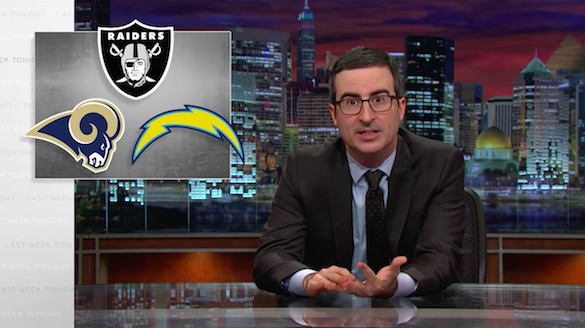
When HBO announced its own fake news show Last Week Tonight with John Oliver I felt great about Oliver, who did exemplary work at The Daily Show. I also felt rather hesitant at the show’s format: a 30-minute show on Sunday night featuring the previous week’s news. It didn’t take much time for Oliver to prove the format a winner. Instead of the rat-a-tat nature of TDS, The Colbert Report, and other late night shows, Oliver was given the freedom of devoting a lengthy segment every week to a single topic. Those segments, usually ending each episode, have providing cutting and often educational rants on a broad range of topics, from FIFA corruption to race relations to an interview with Edward Snowden. So it shouldn’t have surprised me that this week’s topic was near and dear to my heart: stadium development in America.

nfl_teams_la

Oliver starts and ends the segment with references to soaring locker room speeches. I took the liberty of transcribing his own speech at the end. As you watch the end, read the speech.

For the rest of you I want you to look deep down inside your hearts. I want you dig in there and I want you to find something. And it’s gonna seem tiny but it’s the most powerful thing in the world. And it’s the word “No.” No.

So when a billionaire asks you to buy him a hologram machine that doesn’t exist yet, what are you gonna say?

NO.

That’s right! And when they ask you to build a stadium with public money without opening their books, what are you gonna say to them?

NO!

That’s right! And when they ask you if they can keep all the money for calling their arena “Smoothie King Center” what are you gonna say to them?!?!

NO!!!!!

FUCK NO that’s right ‘cause that’s a stupid name for anything, even a smoothie store!

‘Cause I want you all to get out there. And the next time a team comes around asking for a new stadium I want you to MAKE THEM PAY. What are you gonna do?!?!

MAKE THEM PAY!!

WHAT ARE YOU GONNA DO!!!

MAKE THEM PAY!!!!

WHAT ARE YOU GOING TO DO!!!!!

MAKE THEM PAY!!!!!

CLEAR EYES! FULL HEARTS!

CAN’T LOSE!!!

LET’S GO DO THIS!!!!!!

crowd ends in a MAKE THEM PAY! MAKE THEM PAY! chant.

Already my week is made.

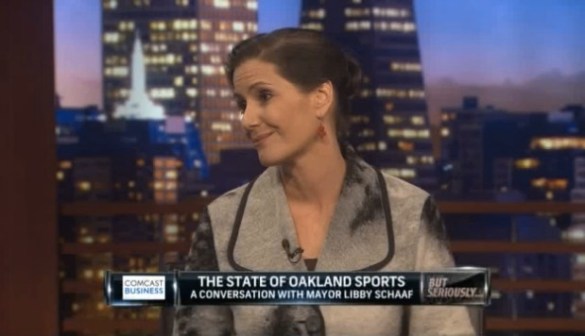
Schaaf talks Oakland sports on CSN

Oakland Mayor Libby Schaaf made an appearance on CSN’s Sports Talk Live program. Her segment, hosted by Jim Kozimor and featuring Ray Ratto and Tim Kawakami, offered the chance for Schaaf to field myriad questions about the respective fates of Oakland sports teams. Schaaf spent much of her studio time not directly answering most of the pointed questions, such as Ratto’s inquiries about choosing one team over another or Kawakami’s question about Howard Terminal.

schaaf

That said, she perked up more than her usual sunny demeanor when describing ballpark talks with the A’s:

She was also quite excitedly described Howard Terminal, though when pressed on putting a ballpark there she was clear about what she wasn’t prepared to do.

Schaaf went on to describe Howard Terminal as a place that could be home to some sort of sports or entertainment development, referring specifically to a concert venue. Port commissioner and former mayoral candidate Bryan Parker advocated for a waterfront arena at HT, either beside or instead of a ballpark.

As for Coliseum City, Schaaf threw her predecessor Quan under the bus while assuring the panel that Floyd Kephart’s final deadline was August 21, and really September if the City Council wanted to extend things further. The NFL has owners meetings starting August 11, and though the NFL could decide on one or two teams to move to LA at that early juncture, it seems more likely that they’ll hold off until at least November or after the football season ends. That would give Oakland, San Diego, and St. Louis more time to work out stadium deals and allow the teams to sell a full season of tickets without an early move announcement hanging over their heads.

The mayor emphasized the potential for other proposals from the Raiders and A’s, having little positive to say about Coliseum City itself. She’s definitely encouraging the ongoing work by the teams apart from Coliseum City, but leaving CC in play allows Schaaf to play the same wait-and-see strategy that Lew Wolff is playing. No rush right now, don’t succumb to the pressure to provide subsidies the way St. Louis and San Diego are, and don’t commit to a team if you can help it. That will probably work throughout the summer, but what happens when the football season starts, or when the NFL decides to play hardball? Then we’ll see well the mayor handles the political calculus of trying to keep two or three sports teams in Oakland.

Damage Control

Floyd Kephart spent much of the week trying to rescue the badly damaged image of Coliseum City by giving interviews on three radio shows, while also assailing Matthew Artz, the BANG reporter who got access to part of the proposal given to Oakland/Alameda County. It was all flailing and little substance for Kephart, who until the PR disaster had mostly kept his message under control.

Kephart appeared first on Fred Roggin’s show in LA, then with Scott & BR on a podcast for the Mighty 1090 in San Diego, and finally with Damon Bruce on The Game.

Among the notes I gathered from Kephart’s interviews:

  • None of the money from the public land sale will pay off the existing Coliseum debt. If that’s the case, what is paying off the debt?
  • Some of the stadium debt would be repaid from project taxes. We know that different kinds of taxes would be used for infrastructure, though that was for a much larger project. Somehow the infrastructure would be downsized, yet the project would still have 4,000 housing units, a hotel, and large commercial square footage. How does that work?
  • Kephart believes that the proposal excerpt was leaked to kill the deal. Probably true, especially if others would rather start moving forward with an A’s deal. Though in all honesty isn’t the leak simply accelerating the process?
  • When pressed, Kephart refused to talk about buying a 20% stake in the Raiders, citing the confidentiality agreement. Smart on his part, since he’ll have to continue to work with the private equity groups he needs to provide that confidentiality. Everyone else, from municipalities to sports interests, can be thrown under the bus.
  • The point of buying the 20% stake was that private equity was not going to make money on investing directly in the stadium, so having a stake in the team was the only way to get access to the stadium’s (really the team’s) net revenue. In the same breath, Kephart said that New City doesn’t have a “burning desire” to buy into the Raiders.
  • According to Kephart and a number of Raider fans, 81 baseball games can’t possibly compare to 10 football games.

The pretzel logic used to argue that the NFL would be preferred is mindbogglingly awful. Sure, the NFL is the highest profile sport with the greatest cachet – at least in the US. It has bigger ratings and bigger national media coverage. Those factors, however, have absolutely nothing to do with bottom line arguments. The City and County are looking for the option(s) that provide the greatest economic impact. There is no way that hosting the NFL can provide this, with the possible exception of hosting the Super Bowl every year. We know that’s not going to happen, since the Raiders stadium will be too small, Levi’s Stadium already exists as host stadium in the Bay Area, and LA will have its own West Coast option soon.

Not including playoff games, the Raiders will bring in 550,000 per season (55k x 10 games). In a new ballpark, the A’s are projected to get around 2.2 million in attendance per season, 4x the football total. The important thing to remember is that the revenue streams (tickets, concessions, parking) will by-and-large remain with the team. The City and County are set up to recognize very little of gameday revenue. What, then, are football stadium backers relying upon to boost revenue? Out-of-towners. Fans of the Raiders and visiting teams will fly into Oakland, rent cars at OAK, stay at Oakland hotels, eat at Oakland restaurants. Sounds like a reasonable claim. What economic impact does that make?

The NBTA did a 2009 study on the top 50 cities in the US and tax impacts from visitors. It was focused on business travelers, but the basic tenets are the same. The study calculated hotel and car rental taxes, along with sales taxes from meals in each target city. Care was taken to separate downtown (center city) locations from airport locations, since they can have different dynamics.

visitor-taxes

Each city is ranked based on combined taxes, which mostly range from $25-35 per day. Bay Area cities are in the middle of the pack statistically. Oakland comes out at $32.45 per visitor, per day. Now let’s take those 550,000 football fans, and let’s estimate that 10% of them are from out of town and fly in, stay for a night, and eat locally.

55,000 fans x $35 per day (adjusting for inflation) = $19,250,000 per year

55,000 fans x $35 per day (adjusting for inflation) = $1,925,000 per year

Less than $20 $2 million in economic impact? That’s good, but remember that the ongoing debt and operating subsidy for the Coliseum and Raiders is $22 million per year. How is less than $2 million per year supposed to work, especially if the debt isn’t being addressed?

(Ed. – Commenter Victor pointed out my bad math. Corrected it’s even an even worse deal.)

Kephart wondered aloud why so many people had problems with the deal as proposed, claiming that it worked for everyone. If the Raiders are paying the full freight on the stadium and the City/County aren’t getting the old debt addressed, it’s not working for anyone except New City. Frankly, he shouldn’t be surprised at the cold reception.

P.S. – Now let’s apply the same economic impact to baseball. Far fewer tourists visit ballparks except during the summer, so it stands to reason that a smaller percentage of attendance could be attributed to baseball fans from out of town. If only 2.5% of fans, or 600-700 per game, fit that tourist description, that’s still 56,250 total visitors, more than the football tally. And while that football total is maxed out, the ballpark still has headroom of 500,000 or more fans per year, which means more tourists. Plus there are 2 million locals and casual fans to boost economic activity per baseball season, compared to 500k football fans.


Coliseum City Proposal revealed and it sucks

Try as Floyd Kephart and the City of Oakland tried to keep the Coliseum City proposal away from the public for 20 days, the key summary was revealed by BANG’s Matthew Artz late last night. As you might gather from the action to hide the documents from the public under a confidentiality arrangement, there was plenty to hide and precious little to tout. Kephart’s New City did get the documents to Oakland/Alameda County by the June 21 deadline, which is to be commended (somewhat). Beyond that, the whole thing sucks for a multitude of reasons.

Kephart’s New City Development pitched a $4.2 billion plan, which would include:

  • $900 million Raiders stadium to be owned by team, land underneath to be leased by City to team for $250k per season
  • Sale of public lands (Coliseum and surrounding) to New City for $116 million
  • Proceeds would pay off Mount Davis debt
  • Potential for additional proceeds to fund affordable housing subsidy; if not fully covered, bond issue
  • Land reserved for an A’s ballpark through 2019
  • 4,000 housing units
  • 450,000 square feet of retail, 1.5 million square feet of office/R&D space
  • 400-room hotel
  • $100 million in new infrastructure (BART transit hub, roads), not including…
  • $187 million in parking garages (financed by New City)
  • Stadium and essential infrastructure completed by 2019, hotel by 2020, full buildout by 2022
  • Sale of 20% stake in Raiders to New City for $200 million, half of which goes to into stadium
  • Creation of “Stadium Company” to finance $300 million in debt for stadium (49ers have a similar entity)
  • $500 million from the Raiders and NFL G-4 fund (combined)

The football stadium part of the plan has no magic bullet to cover the $400-500 million funding gap. The NFL and Raiders would their part, probably closer to $400 million. There remains an open question about how likely it is the Raiders would get that $400 million. It’s one thing to award the full $200 million G-4 loan (to be matched by the team) to the 49ers and Levi’s Stadium or the Vikings and Falcons, teams whose projects will certainly host future Super Bowls. The Raiders stadium would be smaller and less capable of hosting a Super Bowl and other big events. Its premium revenue-generating capacity would be much lower than other recently built stadia, which makes me wonder just how well the G-4 loan would be serviced. Chances are that the stadium would qualify for a smaller loan, perhaps closer to the old G-3 cap of $150 million. So when you really start to add it up, it’s much more realistic to expect $350-400 million as the “standard” private contribution from team and league. More than that is rather wishful thinking considering the stadium’s size and scope.

A “Stadium Company” would be created on the private side to manage funneling game revenues towards debt service. Its counterpart would be the Coliseum Authority (JPA) or its successor. If the sides ever got down to real negotiations, the real sticking point would be whether the debt would be issued publicly (tax free) or privately (taxed). On one page the Raiders are said to own the stadium, on another they lease the stadium. The model is similar to what the 49ers created for Levi’s, which means that the same questions would arise during the period leading up to the stadium’s opening. Can the Raiders and the various entities sell enough sponsorships and get a big enough naming rights deal to cover the gap? Or does this sound too much like Mount Davis?

Ancillary development, which has been already been dismissed by Mark Davis and NFL point man Eric Grubman, is still very much in play here. The worst part about it is that the money the ancillary development will generate won’t go towards paying for the stadium, or for affordable housing. New City would get to reap the rewards, pay a little towards infrastructure, not get saddled with the responsibility of financing affordable housing, and get a piece of the Raiders in the process. Sweet deal, eh? No wonder the NFL has been so averse to having “middle men” like Kephart involved in these deals. It prefers to have Goldman Sachs and big banks there as the established partner financing arms instead of deal makers.

The ballpark gets one whole line in the 19-page document:

Parcel 6 for development of the ballpark will be reserved through January 1, 2019.

In the Specific Plan Parcel 6 is to the right on the other side of 880 from the Coliseum

In the Specific Plan Parcel 6 is to the right on the other side of 880 from the Coliseum

I can’t blame Kephart for reducing the A’s to one line considering how Wolff disregarded him and the project at every turn. If Kephart’s gonna go out, he’ll go out guns-a-blazing. Wolff was never going to take part anyway, so this is at least a modest allowance. Yet what is Parcel 6? We’ll find out more in a couple weeks assuming the documents are released as expected. For now we don’t have an updated site plan. If Parcel 6 is the same one identified in the EIR/Specific Plan, it’s the Hegenberger Gateway shopping center anchored by Walmart and other properties along Hegenberger. How does that get repurposed for a ballpark? I’ll let you know when BART builds an Airport Connector station there to service the site, more than a mile away from the Coliseum BART station.

Lastly, there’s the sale of public land. The document cites $116 million as fair market value, though that is entirely dependent on use and density. $116 million is ridiculously cheap, at around $1 million per acre depending on how much is actually used for the ancillary development. Lew Wolff’s Coliseum North plan was derailed because he lowballed local business owners, offering the same value ten years ago. Two weeks ago the City of Oakland pushed through a $5.1 million sale of one acre on East 12th Street overlooking Lake Merritt for housing, with the developer agreeing to provide $8 million towards affordable housing elsewhere. City Council sessions got so heated that housing activists took over the Council Chambers in the first meeting, followed by the City blocking off public access in subsequent meetings. All that because the process was supposed to dictate that the sale of public land in Oakland mandated use for affordable housing (if housing was the intended use). Now we’re looking at an exponentially larger project in the Coliseum area. How’s that gonna go over?

With the stench this deal is serving up miles away from any actual deliberation over its merits, recent revelations about an exit strategy and a backup plan for City/County should come as no surprise. That’s both good and bad, as the millions spent on Coliseum City will have gone to waste while that backup plan will have only a few months to gestate. That’s a great recipe for a terrible deal, one even worse than New City’s vision Coliseum City. There’s always a renovation concept to fall back upon, and Wolff’s biding his time waiting for CC to collapse. Looks like you’ll be on the clock soon, Lew.

Decisions, decisions, decisions

We all have different opinions about what’s happening with the teams at the Coliseum. One or more will likely leave, maybe one or two stay, maybe everyone leaves or stays. Perhaps the remaining Coliseum debt will be paid off by private interests, maybe not. There are different timelines for each team, different project costs, different levels of financial wherewithal, and differing approaches. And that says nothing about a third party like Floyd Kephart, who has to figure out how to keep a team and make money off the deal, or the City and County, who are scared to death of being ripped off as they were 20 years ago.

Take all of those factors, throw them all into a bowl, mix them up, and see what you get out of it.

Kephart announced that he submitted his June 21 deliverables on time. City/County/JPA will take 20 days to review the documents, and decide after that review whether to continue with the plan as offered by Kephart, with no leaks or public release prior to that date. For me it’s frustrating, but I get their caution. Coliseum City is extraordinarily complex, so due diligence is of the utmost importance.

While I’m certain many behind the Coliseum City effort have been nothing but sincere in their desire to retain teams while revitalizing Oakland, there’s also been an underlying feeling that the whole thing is a stalling tactic. To that end it has worked to an extent. Both the A’s and Raiders could’ve been gone as early as after the 2013 seasons thanks to their short-term leases. Instead the Raiders are in Oakland through at least 2015, and the A’s could be in the Coliseum until 2024. Yet while Oakland treads water, the teams aren’t standing still… actually, they are standing still. The A’s chose to wait this process out in hopes of getting the Coliseum all to themselves, a strategy that Andy Dolich called “intelligent inaction” on YSTL tonight. They pushed for the lease extension last year, and so they have a sort of first-mover advantage because the lease is solid and they have fewer complications than the Raiders. The Raiders could’ve taken a similar approach, but Mark Davis chose to use one-year leases to help spur Oakland – a strategy that hasn’t worked so far. Meanwhile, Davis has given some broad strokes about what he wants:

  • Raiders would buy some of the Coliseum land (for how much and for what purpose aren’t clear)
  • City/County/JPA would provide free infrastructure, costing $100-140 million
  • City/County/JPA would retire Mt. Davis’s debt

There’s still no word on how exactly the funding gap on the stadium would be addressed. I figure that 1 & 2 are related and would offset each other somehow. The Mt.Davis debt has to be added to the total cost of the stadium, as the City and County have been adamant about not subsidizing the old venue more than they have to. Does that make the gap $400 million? $500 or $600 million? Hard to say at this point.

This project has been marked by a series of decisions made on all sides. The teams chose not to negotiate, waiting either for a stadium to fall into Mark Davis’s lap or for the project’s demise. The City chose to partner with three different entities in hopes of finding someone that had the resources and connections to make the project take off. The County chose to sit out for three years, not becoming a party to the talks until this spring.

Ironically the City/County/JPA, the Raiders, and A’s all would benefit if they didn’t have to make choices of their own free will. If the Raiders leave on their own the public sector gets a little political cover, since they can point the finger at Mark Davis for abandoning Oakland. Should the A’s wait and the Raiders put together a stadium deal, the A’s can say that the Raiders caused hardships, forcing the A’s out. And the Raiders can point to either the A’s no-sharing stance or Coliseum City’s expected demise as their own obstacles to staying in Oakland. Even when they don’t actively decide, there are consequences.

Try as they might, the big decisions can’t truly be avoided. Because in multibillion dollar stadium deals just as in life, eventually if they don’t make choices, someone else (NFL, MLB) will make choices for them.

P.S. – At the end of the Dolich segment he expresses amazement at how the City/County/JPA aren’t in direct negotiations with both the Raiders and the A’s. That sentiment is completely understandable if the goal is to wrap up a deal ASAP. The problem is that the teams aren’t on a level playing field. If both had separate stadium projects with similar costs and similarly sized private contributions, working out fair deals for both should be simple. That’s not the case here because of the football stadium’s massive funding gap. If the public sector attempts to make any kind of public contribution (land, infrastructure, direct or indirect funding) for the football stadium, you can be assured that Rob Manfred will ask about the same kind of contribution for the ballpark. He’ll have every right to ask, and he’ll have every right to be severely disappointed if City/County/JPA can’t deliver. That’s the danger in making the deal. 

Manfred visits Oakland, stays on message – with a wrinkle

Before I get into today’s edict from MLB Commissioner Rob Manfred, let’s first sum up his position on the A’s with regard to a new ballpark.

  1. The A’s need a new ballpark.
  2. Oakland is the city for the A’s.
  3. The Coliseum is the only site under consideration in Oakland.

Okay, now let’s unpack what he said in today’s pregame press conference.

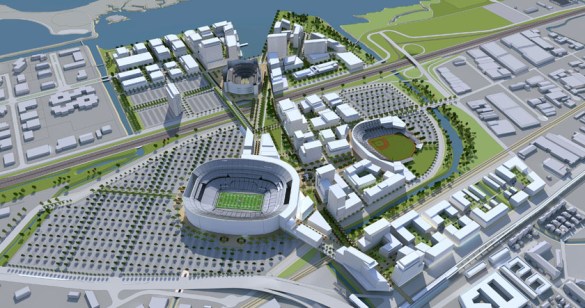
View from east towards Oakland Estuary. Image: JRDV

View from east towards Oakland Estuary. Image: JRDV

Via BANG’s John Hickey:

Speaking before the A’s played the Angels Friday night, Manfred said, ‘With respect to San Jose, all I can say is that we are still involved with really significant litigation, significant enough that it’s in the Supreme Court of the United States. I can’t foresee any movement until at least that litigation is resolved. That litigation has clearly been an impediment to things moving forward.’

At the same time, Manfred all but ruled out the A’s staying in Oakland if the Raiders attempt to build a stadium on the Coliseum site. The Raiders also are considering a move to Southern California, but Manfred suggested that if the NFL team stays, the A’s would have to go.

Another constant has been Manfred’s stance on San Jose. The South Bay city will not be in play as long as the antitrust lawsuit, which SJ city leaders are petitioning to have taken up by the Supreme Court, is still pending. MLB wants that little gnat gone, which should that happen by this fall, immediately brings up another question: What is MLB’s relationship with San Jose once the lawsuit is over? I’ve said all along that MLB is not going to kill San Jose while the A’s long-term fate remains unclear, especially in Oakland. That hunch certainly seems correct.

From the Sacramento Bee’s Matt Kawahara:

Manfred urged that the city of Oakland and Alameda County ‘focus on the need to get something done in respect to baseball — not to the detriment of football, but the need to get something done with baseball.’

‘I’ve said publicly I think it’s absolutely vital to the long-term health of this franchise that the A’s get a new facility,’ Manfred said. ‘It remains my goal, part of baseball’s long-standing policy, that we try to get that stadium built here in Oakland, where the A’s have been and have their fan base.’

There are some within the Oakland-only crowd who have been complaining endlessly about the A’s not providing a proposal to Oakland after the Coliseum City process was “opened up” last fall. Manfred knows this and is likely nudging Lew Wolff and John Fisher to get their ducks in a row. To me the idea of pushing Wolff has never made much sense. Wolff’s bargaining position will be best if the Raiders leave, and the lease gives him plenty of time to wait that out, plus there’s no indicator that he’ll get any financing help from MLB on an Oakland ballpark, so MLB can only dictate so much. Yet there’s a different suggestion that comes straight from Manfred himself, and it may come down to what Coliseum City has represented from the start.

Coliseum City was not originally conceived as a precise plan to keep all three current tenants in town. It was a mostly a plan to convince the Raiders to stay. It had a large, multipurpose domed stadium as its centerpiece. A ballpark was shuffled off to the northeast corner, a developmentally distant Phase B to the football stadium. The existing arena could stay – inadequate as the NBA sees it – or be replaced by a venue on the other side of the Nimitz. That new arena concept has practically disappeared as the scope of the project has shrunk, and while Floyd Kephart and CC proponents are still pitching separate venues for all teams, a distinct possibility is an either-or scenario, baseball or football. To that end Manfred has qualified his plea as “not to the detriment of football,” but he and his counterpart at the NFL, Roger Goodell, know full well what’s at stake. Neither league wants to share, or to put it more diplomatically, neither league wants to step on the other’s toes, which is exactly what would happen if both teams stay while a new venue is constructed.

If anything, Manfred seems to want the same kind of attention given to the A’s by Oakland as the City has given the Raiders. While Manfred strong-armed Oakland into signing the 10-year Coliseum lease last summer, he also did them a favor. Manfred kept the A’s in place for several years to come and enforced the territorial rights issue. If anything, Manfred wants Oakland to submit its own Coliseum-tailored-around-the-A’s plan. It may not be something that Wolff would sign on to, but it would likely curry favor with Manfred, and that tactic could be much more effective within the Lodge than keeping the A’s in their second banana status. Oakland tried to make this play before with Howard Terminal, but the difficulties there made it effectively infeasible, and OWB’s giving up on the site does nothing to discount that widely-held opinion.

From SFGate’s Lev Facher:

‘My information is that it would be extremely difficult, if not impossible, to have two facilities on the current Coliseum site,’ Manfred said, indicating that a successful Raiders project could preclude the construction of an adjacent baseball stadium.

‘The A’s folks have been pretty clear that they believe the Coliseum site is the best site for a baseball stadium in Oakland,’ Manfred said.

Manfred’s in Oakland’s corner. That is, until Oakland starts to act in a way that displeases the Lodge. I’m going to go out on a limb and suggest that picking the Raiders over the A’s at the Coliseum is a sure fire way to get Manfred out of Oakland’s corner and into Wolff’s corner.

Oakland Mayor Schaaf to speak with MLB, NFL commissioners in NYC next week

BANG reported yesterday that Oakland Mayor Libby Schaaf will meet with the commissioners of MLB and NFL next week, as part of a trip to New York for the World Cities Summit Mayors Forum.

Chances are that she will provide an update on Coliseum City, while explaining to both commissioners that the project is the best chance to keep either team despite misgivings on the part of Lew Wolff and Mark Davis. What the commissioners will probably ask – and this is the challenge for Schaaf – was what happens after Coliseum City. Whether Floyd Kephart some or all of the deliverables expected on June 21 (he won’t be able to provide the biggest, a commitment from a team), Schaaf and the City Council will be under pressure from both leagues to cut bait and start looking at alternatives. Those options are expected to be proposals from Wolff and Davis, though neither has offered one yet.

Let’s be clear about one thing – Schaaf’s talks with Roger Goodell and Rob Manfred will not be negotiating sessions. Neither league is participating in the Coliseum City process, and no other proposals are on the table, so there are no points to negotiate. Schaaf has remained adamant that Oakland can’t incur additional debt in the effort to retain any teams. Council member Noel Gallo took that no-giveaway notion a step further, announcing earlier this week that he’s against selling public land.

The problem is that everyone involved is talking around the problem at this point. Goodall and Manfred should by now be well aware of Schaaf’s no-subsidy stance. The land giveaway idea is practically a moot point. Neither team wants to extensively develop the Coliseum complex, so there’s no point to selling the land or figuring out a way to fund costly infrastructure when none will be built. Coliseum City point man Floyd Kephart keeps plugging away, even though he’s close to achieving persona non grata status in some circles. Manfred indicates that the A’s shouldn’t worry about what’s happening with the Raiders, though the current arrangement has their fates in Oakland intertwined and he knows it. Neither commissioner is going to tell Schaaf to boot the other’s team off the Coliseum property, yet that’s exactly what it will take for something to move forward. And neither is currently offering a solution for any funding gaps (NFL G-4 funds are limited, keeping the A’s on baseball’s revenue sharing plan is a subject for the next CBA talks in 2016).

What can we expect, then? Some words of encouragement. Renewed talk of urgency, moreso on the NFL’s part. The City of Oakland will probably keep its June 21 and August 21 deadlines, since they have little to lose over the next three months. It will be in their best interest to start formulating an exit strategy and plans to accommodate both teams on different sites if they haven’t done so already. That may be why the BANG item mentioned Howard Terminal. Dismissed out of hand from the start and declared dead last year, Howard Terminal is the only available large patch of land outside the Coliseum complex. It remains a difficult site to pull off because of regulatory hurdles and major infrastructure costs, but it’s something. And if someone can figure out how to pay for all of it, it may be viable after all. But who’s going to do that? No one talking in NYC next week will. Neither will either team.

Again, where are we with all of this?

Mark Davis revises his Coliseum “vision”

In a fairly lengthy interview with ESPN’s John Clayton yesterday, Raiders owner Mark Davis held court on his team’s stadium issues. While much of it was a rehash for those who have been following this saga intensely, it was good for casual fans and observers to get even the tiniest bit clarity. In any case, the Raiders saw fit to republish it on their own website so it must have the boss’s approval.

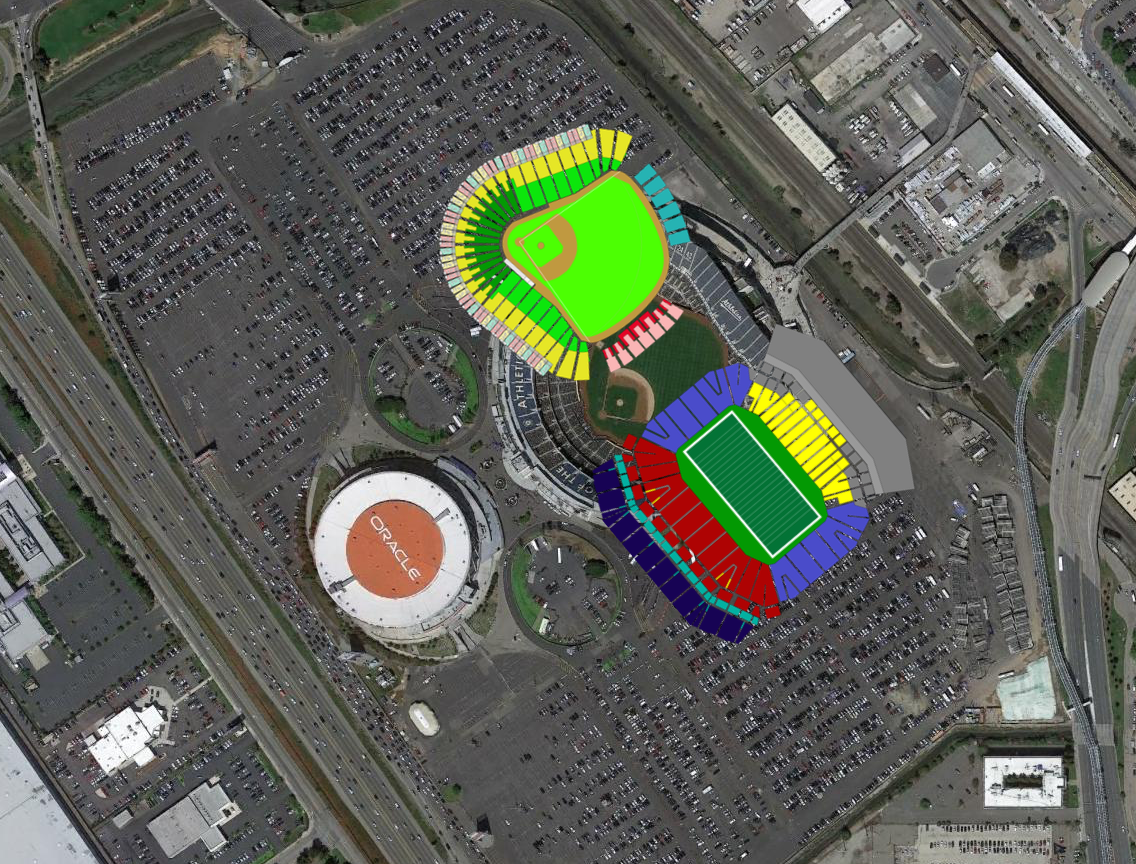
What caught my attention was a change in how he saw the Coliseum being developed. While continuing to call for the Coliseum’s demolition, Davis dreamed out loud of a dual-stadium concept in the old venue’s place (emphasis mine).

One of the challenges we have with that is that we share the stadium with the Oakland A’s. The Oakland A’s have a 10-year lease to remain in the Coliseum. One of the plans that they’re talking about is, is us building the stadium in the corner of a parking lot and then once our new stadium is built, then they would rip down the stadium and build the new one for the A’s and build housing and all of that stuff. That just isn’t a situation that I want to get us into. I would like for, if possible, the Raiders and the A’s to stay on that site and that the Raiders and A’s vacate the Coliseum for the next two or three years. We build a brand new football stadium and a brand new baseball stadium on the site and then we’d come back and begin playing in two brand new stadiums without construction going on around us, in brand new stadiums.

The desire to avoid construction zone headaches remains steady for Davis. Plus in this concept Davis would preserve surface parking, a goal shared by A’s owner Lew Wolff. Wolff doesn’t think the place can properly support more than one stadium project, so how could something like this be done? It’s nothing like Coliseum City, which has planned phases. Both stadia would be done simultaneously, like Arrowhead Stadium and Kauffman Stadium in Kansas City. Let’s imagine a timeline for Davis, assuming no legal, logistical, or financial obstacles (follow me on this).

  • End of 2015 – Coliseum City is scrapped. Raiders play their last game at the Coliseum in December. Raiders and A’s hammer out stadium development deals with Oakland/Alameda County. Partial demolition begins (ironically) with the newest part of the Coliseum, Mt. Davis, returning the venue to its 1995-96 state – but with the Oakland Hills back in full view. That occurs from November 2015 to March 2016.
  • 2016 – A’s play their last season in the old Coliseum in reduced facility. A’s lease is revised (with no penalty to anyone) to reflect this. Raiders and A’s finalize their financing plans for their respective venues.
  • November 2016 – Demolition of rest of the Coliseum begins, which should take 6 months to complete including grading for new venues (use drawn out Candlestick Park demolition for reference).
  • April 2017 – Construction starts on both stadia, with a planned completion of Spring 2019 for the A’s, Summer/Fall 2019 for the Raiders. Both teams use smaller footprint, simpler plans and Levi’s Stadium-style incentive/penalty system to execute those accelerated schedules (24 months for A’s, 28 months for Raiders).
  • 2018-2019 – Warriors vacate Oracle/Coliseum Arena for San Francisco. Decision is made on whether to keep arena or demolish it to make way for other development.
  • April 2019 – A’s ballpark opens
  • August 2019 – Raiders stadium opens

The finished product(s) would look like this:

Two new venues on a slightly larger footprint than the original

Two new venues on a slightly larger footprint than the original

The Raiders would have to play at a temporary facility for three seasons, the A’s for two. AT&T Park would have to be a considered a frontrunner for both, oddly enough. Memorial Stadium remains off limits to the Raiders thanks to a legal agreement between UC and the City of Berkeley, and Stanford Stadium is a nonstarter for both the university and City of Palo Alto. Davis doesn’t want to play at Levi’s Stadium for his stated reasons, though it must also have something to do with the 49ers’ desire to have a tenant for at least a decade in order to pay for the second home team locker room.

That brings me to the real problem in all of this, the financing. Tallying up all of the associated costs, we come to:

  • $900+ million – Raiders
  • $600+ million – A’s
  • $100 million – Remaining Coliseum debt including interest
  • $65 million – Remaining Arena debt in 2018

Final total, not including the planned work on the Coliseum transit hub, is $1.665 Billion. Obviously, much of that would be covered by the teams, the NFL, and perhaps third parties, but the gap for the Raiders remains, and the need to retire the legacy debt from project sources without hitting either Oakland’s or Alameda County’s general funds means that the public sector would have to give up something. For now it’s unclear what that is since the Coliseum’s land is not going to be that public contribution.

Price tag aside it’s a tantalizing vision for fans, and one that runs counter to planning and growth goals for Oakland and Alameda County. From a broad perspective, the public sector wants housing of different kinds and price ranges to ease the current crunch. Pols may see this as nothing more than doubling down on the stadium deals of 20 years ago, which brought only fiscal pain and little real security with regards to the teams staying in Oakland. The people who might like it the most are workers at the Coliseum complex and businesses west of the Nimitz who thought their livelihoods were being threatened by Oakland’s sweeping zoning change proposals. As for East Oakland residents, well, how much has this hulking pro sports complex improved their lives in nearly 50 years?


Davis affirms desire to tear down Coliseum

As the NFL owners meetings get underway at the Ritz Carlton in SF, KTVU reporter Noelle Walker caught up with Raiders owner Mark Davis, who made it abundantly clear that he wants the Coliseum complex for himself:

Davis confirmed that if a Coliseum City plan goes forward at the current Coliseum site, he wants the old stadium demolished before a new one is built.

‘If we’re going to build on that 120 acre site, we would have to tear down one stadium to build another one in that same place,’ Davis said. ‘I don’t want to build a brand new stadium and then have it be in a construction zone for next two, three, four years.’

Davis doesn’t want a construction zone around a new stadium. Wolff put in the A’s lease terms that would give the team an out if their operations were impacted by the Raiders’ stadium (construction taking out parking). If by now you haven’t come to terms with the need for Oakland to make a choice (or else have a choice made for them), make yourself a pot of coffee in the morning and breathe in its aroma deeply.

In her report Walker termed the dilemma Oakland’s “Sophie’s Choice.” Call it that, a Catch-22, Kobayashi Maru, Hail Mary. whatever construct you like that doesn’t exactly fit but helps explain the dilemma. Oakland has chosen to try to juggle both teams. In the process it has looked indecisive. The NFL disapproves. And so Oakland’s best hope is in that very same NFL keeping the Raiders from moving because it deems Oakland’s proposal at least compelling, if not altogether sufficient. Might need to throw in an Act of Contrition on top of that Hail Mary.