Before JPA and numerous East Bay officials finalize the cost of building Coliseum City, they need to understand its scope. How many venues would it hold – 3, 2, or 1? Which part(s) would get built first? How much of it is subject to market forces? And what of the extra niceties that they plan to put in there, such as the transit hub component?
Any project of this size is bound to go through numerous configurations and brainstorming before arriving at the final vision. To understand that, let’s look at some of the renderings released by Oakland architecture firm JRDV. If nothing else, you’ll get an appreciation of how complex this complex is.
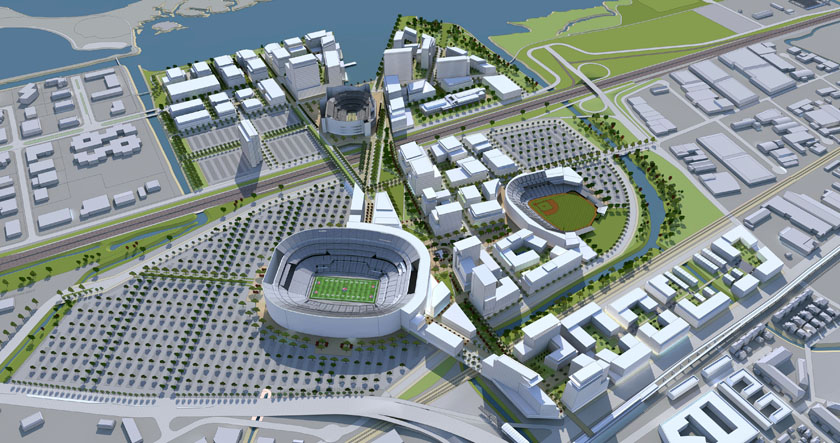
One of the original drawings has an open-air football stadium, a high-rise hotel, and a hidden baseball stadium, while preserving the existing arena.
A daytime rendering of the redone complex
An updated version from earlier this year puts a new arena across I-880 from the existing complex
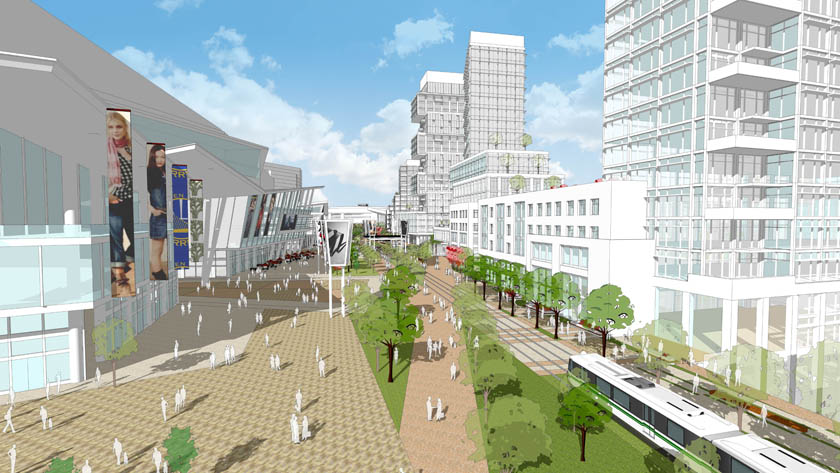
A look at the plaza between the venues features the mythical trolley, which would run from the BART station to the arena.
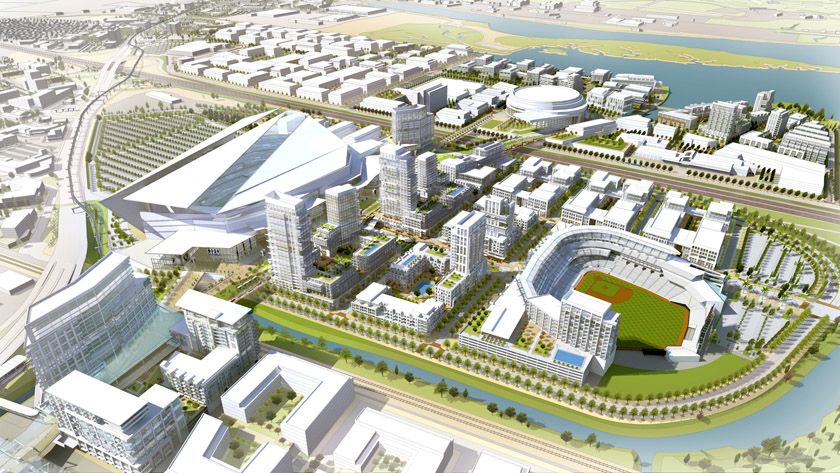
Most recent rendering showing retractable roof on football stadium and redesigned ballpark
With each iteration, the surrounding buildings have grown taller and more numerous, as if the stakes have only gotten bigger over time. But wait – something about that ballpark looks familiar. Hmmm…
D’Sjon Dixon’s concept at Estuary Park
Honestly, I wouldn’t have noticed if D’Sjon Dixon hadn’t pointed it out himself. The only meaningful difference between the two is that Dixon’s concept is squeezed into a very small lot, whereas there’s plenty of space in the Coliseum’s A lot for a ballpark to stretch out. Naturally, Dixon’s feeling a bit ripped off right about now.
For now Dixon is keeping current and future designs under wraps, though it appears as though Glenn Dickey has caught on and championed it to an extent.
Chances are that Coliseum City will undergo even more transformations before the parties settle on one vision. If they can’t, or if the project doesn’t prove feasible due to cost, well, at least these were nice renderings (hello, Pacific Commons).
The fallout started early this morning, when KTVU reached out to the A’s to get their reaction to MLB’s threat to move the A’s to AT&T Park.
Statement from the A’s via KTVU on Monday morning
That was followed by AP sports scribe Janie McCauley reporting something similar, but without the weaselly-sounding “intend to” in it. Included was a statement from the Coliseum Authority (JPA):
“We are working on a deal that we believe will be beneficial for both our tenant and the people of this community,” the statement said. “We are confident that everyone involved sees the value in continuing for as long as possible the 45-year relationship between the A’s and the City of Oakland. While we cannot comment on the specific issues now under discussion or on whether there is any basis to recent rumors that Major League Baseball has played a role in the discussions, we are optimistic that a final deal is close at hand.”
Later, BANG’s Matthew Artz dug deeper, picking up more sentiment from East Bay pols.
Sources with knowledge of the Coliseum authority’s private deliberations Friday said there was movement toward softening its stance that the A’s relinquish control over concessions and signage revenue at O.co Coliseum, which comes at the expense of the Raiders.
“The key point is that the authority wants the A’s to stay in Oakland and is not willing to risk losing them over that issue,” said one source privy to the discussions.
Naturally, the A’s balked at the Coliseum’s original terms for a longer lease. Miley and his fellow board members reportedly held firm, believing that the A’s had no other options but to play at O.co in 2014. And at that point, MLB voices tossed out the concept of the A’s playing temporarily at AT&T Park until a new ballpark project could be developed elsewhere.
Also, don’t forget that the JPA hasn’t exactly shown a lot of urgency on behalf of the A’s. Consider what JPA board member and Oakland City Councilmember Rebecca Kaplan said a month ago:
And the six- to eight-year window should give Oakland plenty of time to get serious about building a replacement ballpark and luring the A’s to stay, Kaplan said.
You have to think that Selig’s threat action was motivated by this rather cavalier attitude towards the A’s.
It certainly appears that all that remains is for the A’s and JPA to make certain compromises and finalize the terms. One of the chief issues will be the $3 million in parking fees the A’s owe the JPA. A good compromise would be for the A’s to pay that money, which the JPA would turn around and use for the belated scoreboard revamp and other capital improvements. And the A’s should get that flexibility they’re seeking.
Concessions revenue is another matter. The A’s could retain control with their own cut of each beer or hot dog (this was originally negotiated when the A’s settled a lawsuit with the JPA after Mt. Davis was built). But how would the Raiders and Mark Davis react? Unlike the A’s, who are continuously profitable, the Raiders frequently flirt with the red – a seemingly impossible feat given the NFL’s extensive revenue sharing and TV contracts. Much of that is due to cap mismanagement during the Al Davis era. Some of that is attributable to lacking stadium revenues, especially concessions. It seems unlikely that Mark Davis will bolt just because of maintaining the status quo, but he could also choose to build a case for leaving based on this. He and the NFL have been pushing the JPA on the Raiders’ own extension, Davis going so far as to prefer to demolish and build anew at the site of the current Coliseum. Such a plan would force the A’s out, a possibility that Lew Wolff has been rightly concerned about. MLB’s involvement has pushed the pendulum in the A’s direction.
It’s cruel that the NFL and MLB are (not so) stealthily playing tug-of-war with the JPA over the Coliseum. As the Giants would say regarding sharing AT&T Park or giving up territorial rights to the South Bay, It’s not personal, it’s business.
As for AT&T Park? Who knows, that threat may resurface down the road.
Last week I received a flyer from the A’s urging me to get my season ticket plans wrapped up soon, as early as mid-November. Thanks to a Sunday report from Matier & Ross about MLB’s entree into the Coliseum lease discussions, I expect the A’s Ticket Services department to get a lot of angry, misdirected phone calls starting tomorrow morning. And I feel bad for them for having to deal with it.
The fact is that until recently, MLB has stayed out of the lease negotiations at Lew Wolff’s behest. As the lease comes closer to expiring with the two sides still far apart on the terms, baseball has decided to start playing the heavy. As we’ve seen in Miami and many other cities, MLB doesn’t play nice. That doesn’t mean that they’re going to start asking for hundreds of millions for a ballpark. Instead they’re playing the leverage game, threatening to move the A’s across the bay to AT&T Park if the Coliseum Authority won’t relent.
We’re told MLB is also demanding that the Coliseum give the A’s just a two-year lease extension – not the five- to eight-year deal the authority has been pushing.
The short-term lease would give the A’s more flexibility should the team’s owners swing a deal to move to San Jose – or beyond.
Let’s be clear about one thing: this is notMLB’s preferred option. They’d rather have the A’s and Giants play in their own ballparks, because getting them to share is messy when it comes to logistics, scheduling, and revenue sharing. While sharing has happened in the past, it hasn’t happened in almost 40 years. Plus the last thing MLB would want is to have a situation where the experiment goes so well that the Bay Area populace is convinced that there’s no need for two parks, or that the A’s seriously eat into the Giants’ revenue. Just as in other stadium negotiations, MLB has never been afraid to rattle sabers when it feels it can work to the benefit of one of its franchises. From this point forward, don’t expect anything less. Chances are that the JPA will buckle, because they know that the A’s tentatively playing away from Oakland can easily transform into the A’s permanently playing away from Oakland. From MLB’s standpoint, this is a question of loyalty. Oakland and Alameda County shown repeatedly that they’re willing to spend money and make things work for the Raiders. They have also demonstrated that they’ve been willing to move the A’s (and MLB) to the back burner at the most inopportune times. If the JPA doesn’t make concessions for the A’s, that’s just more proof that they aren’t truly willing to make the A’s a priority, which would make MLB less motivated to back Oakland’s efforts to forge a long-term deal. Raiders owner Mark Davis seems to prefer that they start working on a replacement Coliseum on the site of a demolished Coliseum, which if granted would leave the A’s without a place to play. Without a lease extension tied to a well-developed stadium plan, the Raiders would prefer to go year-to-year. The A’s would like to do a five-year deal with early termination if they’re impacted by construction of a new Raiders stadium. The challenge for the JPA is to put together a deal that caters to MLB’s needs while not jeopardizing their relationship with the Raiders and the NFL.
For the time being, Giants chief Larry Baer has stayed silent, probably at Bud Selig’s request. To say they wouldn’t accommodate the A’s would torpedo baseball’s plans and leverage, the same way Wally Haas and then-AL President Bobby Brown rejected Bob Lurie’s plans to share the Coliseum while SF figured out a downtown ballpark plan. That occurred in 1985. Now that MLB is a singular governing body with less stated conflict between the two constituent leagues, the Commissioner has the ability and power to influence the Giants. However, Selig’s track record has been to stall regarding the A’s for nearly five years. Now that a “manufactured” crisis may arise, could Selig be more inclined to come up a with a solution? I’m not holding my breath.
Logistically, sharing the stadium could be difficult for the teams. Naturally there are only two clubhouses at AT&T Park, unlike the more flexible setups at many arenas and new football stadia. The visiting clubhouse would have to be converted into the A’s temporary home while the Giants’ clubhouse would be used for A’s home opponents. There are also 10 potential date conflicts (not 9 as M&R reported): May 12-14, May 26-28, June 13-15, and July 3. That last date is the end of a Giants homestand and the beginning of an A’s homestand. Offloading those conflicts to Raley Field would be difficult because the River Cats already have the first two series and July 3 already booked at home. Day/night doubleheaders would be difficult to make work because of game days can easily stretch beyond eight hours for players and personnel because of warmup/reporting times.
Then there’s also the appeal for AT&T and the various other sponsors in China Basin. AT&T would undoubtedly love double the home dates and exposure. So would Virgin America, Intel, and ironically, GAP competitor Levi Strauss. That and many more subjects (concessions shares, non-game event revenue, ticket pricing) would be up for debate. In the end, the A’s would pay a handsome rent payment and surrender a big chunk of non-ticket revenues. Both teams would deduct stadium expenses against their revenue sharing payments. One way to look at is that the A’s rent would effectively be a rebate against the Giants’ revenue sharing payment – assuming it was structured to fit within the CBA appropriately. Selig doesn’t seem inclined to force the Giants to share, but he can work with the rest of the owners to make it worth the Giants’ while.
Already I’ve seen a lot of anger from fans swearing that they’d never see an A’s home game in SF, or that they’ll cancel their season tickets posthaste. There’s another angle to consider if the A’s were given this two-year window at AT&T Park. The A’s have never called a modern ballpark home, so any serious revenue-generating potential at a new ballpark remains theoretical at best. What if the window was MLB’s opportunity to prove (or disprove) the A’s viability as the second team in the Bay Area? It’s not the same as having a new ballpark to themselves, but the better amenities and location should be attractive to many fans and companies that normally don’t attend A’s games en masse. After all, the city with the most ticket-buying A’s fans (number, not percentage) is San Francisco, not Oakland or San Jose. If the two-year window fails to positively affect the A’s bottom line, The Lodge may be more inclined to allow the team to move out of the Bay Area. While M&R hinted at a move as a product of failed stadium plans, I think this could be a bigger reason.
MLB has entered the fray, and they’re getting ready to lay down the hammer. For that we can thank A’s and Giants ownership for their stubbornness, Oakland and Alameda County politicians for their lack of urgency, and Bud Selig for not resolving this sooner when he had all the time to do so. Unless a Coliseum lease gets struck in the next month, this is only going to get uglier. A “silly” idea like sharing AT&T Park may turn into something quite sensible. The big issue looming is the endgame, which as Ray Ratto points out, is the can that gets kicked down the road for two years.
Two competing narratives define Howard Terminal at the moment. The first, proffered by Oakland ballpark boosters, insists that because of the summer move to attain “site control” over the Port locale, getting a ballpark built should be a mostly a matter of procedure that can quickly result in HT being shovel-ready. The other narrative, promoted by this site and other skeptics, argues that because of the land’s heavy industrial and maritime uses over the last several decades, it could be prohibitively expensive and time-consuming to even attempt it.
Adding to the information fog surrounding Howard Terminal are suggestions that the permitting and CEQA processes for the site could somehow be streamlined. One Twitter follower even explained to me a few months ago that the site wouldn’t need rigorous environmental review because HT was somehow zoned for a convention center. That’s not true, and even if it was that’s a wholly different use and set of impacts compared to a ballpark. No, HT is zoned as heavy industrial, Port land. No commercial uses are allowed there. I’ve also heard that there’s a way to build at HT without breaching the thick contamination cap already there. That’s patently ridiculous. Now if someone wants to offer up some great technology that allows for building a code-compliant, earthquake-safe, 10-story tall permanent ballpark whose foundation doesn’t require digging out some dirt, I’m all ears. Pardon me for being cynical.
Or if you don’t want to pardon my cynicism, take it from the Port. In the aftermath of the SSA consolidation deal inked between the Port and one of its bigger operators, Port staff prepared a report for a forthcoming RFP to find bidders who could use HT in the short-term. The concern is that the Port is losing $10 million a year while Howard Terminal remains vacant post-consolidation. I’ve bolded some of the more noteworthy language, and summarized the issue below each quoted graf.
Urgency of Revenue
With the loss of about $10 million/year of revenue at Howard Terminal starting October 1, 2013, finding a new tenant that can quickly establish operations and pay rent to the Port is critical. Because the property is already generally permitted and entitled for maritime and maritime-related uses, maintaining land use consistency will help expedite occupancy. However, it should be noted that even some maritime uses may require additional entitlement work; for example, construction of extensive break bulk facilities may require some California Environmental Quality Act (“CEQA”) analysis and permitting work. This work, however, is expected to be relatively limited as compared to non-maritime uses of the property.
Issue #1: The Port is trying to maintain maritime use so that they can get a tenant in there tout de suite. That doesn’t mean that the Port is against a ballpark, but it’s clear that a non-maritime use like a ballpark is bound to be tied up in red tape for some time to come.
BCDC Seaport Plan
Howard Terminal is included in the Bay Conservation and Development Commission (“BCDC”) Seaport Plan as a “Port Priority Use” area. This designation is based on a Bay-wide study performed by BCDC periodically to determine whether enough capacity exists across all Bay Area ports to accommodate anticipated cargo growth in the long-term future. Using Howard Terminal for non-maritime uses conflicts with this designation, and de-designation of lands from Port Priority Use requires a Seaport Plan amendment, which is a fairly lengthy and involved process. To pursue an amendment, the Port would be required to provide evidence that sufficient capacity exists within the remaining Port seaport properties, or elsewhere within the Bay Area Port priority lands, to support the long term maritime growth demands for the region. BCDC would then independently analyze that information before proceeding with an amendment.
Issue #2: In order to accept non-maritime reuse of Howard Terminal, that red tape would include a Seaport Plan amendment, proof that the consolidation properly makes up for HT’s lost cargo handling capacity. If the consolidation doesn’t prove enough, more capacity would have to be found elsewhere, even somewhere outside Oakland city limits.
Tidelands Trust Compliance
Howard Terminal is currently encumbered by the Tidelands Trust. Uses of the property are therefore generally limited to water oriented commerce, navigation, fisheries, and regional or state-wide recreational uses. Approval from the State Lands Commission would be required for any uses of the property that are not Tidelands Trust compliant. Many non-maritime activities are not considered Trust compliant uses and thus may require lengthy negotiations with the State Lands Commission, and potential legislation, before the Port could proceed with such non-Trust uses for the property.
Issue #3: This is a very similar situation to what the Warriors face with their planned arena at San Francisco’s Piers 30/32. Howard Terminal is on the water, on the bay, thus any plans there mandate special consideration of the effects of such a project. Since that process could take years to shake out, project proponents have pushed local legislators to write “streamlining” bills that can cut down review time normally associated with EIR-challenging lawsuits.
Other Entitlement, Environmental & Regulatory Issues
Howard Terminal is subject to a complex set of regulatory permits and deed restrictions related to the hazardous materials in the soil and groundwater underlying the property. Development of new structures that penetrate the ground surface or changes in land use will require notices to regulatory agencies, and compliance with existing health, safety and soil management plans. Non-maritime uses will likely require extensive and expensive clean-up or other protective environmental measures, precluding expeditious turn-over of the property to a new rent-paying tenant. Further, non-maritime uses will likely require numerous land use entitlements including local land use permits, an amendment to the Oakland General Plan, and CEQA review. These activities could take several years to complete.
Issue #4: The cap problem.
Remarkably, there was no mention of a ballpark anywhere in the proposal for the RFP. There was also no mention of an EIR for a ballpark or any other Howard Terminal-related project. That makes sense when the goal is simply to get a tenant in there in the next year. No chance that can be anything but a shipping concern. Staff’s recommendation is to carry forward an RFP focusing only on maritime uses. That could change if City Hall leans hard on the Port to formally open up HT for non-maritime uses. Then again, as staff pointed out, Broadening the RFP scope further would complicate the evaluation process. SSA’s transition was originally supposed to complete at the beginning of this month. Now it may slip until January, which seems more realistic considering the work involved.
When it comes to Howard Terminal, you can read this site or listen to some story that some people are selling. Or you could disregard both and read Port staff’s own words. Don’t worry, I won’t be offended if you do. Mayor Jean Quan has been claiming for some months that some good news would be coming by the end of the year regarding HT. Hopefully the news isn’t limited to announcing that the Port has identified a new operator at the site for negotiations. That’s what happened with the Coliseum City RFP. In February 2012. The Port of Oakland has is semi-autonomous. It has to be fiscally responsible and self-sufficient. A $10 million hit per year is a big hit no matter how long it lasts. The Port also has another project, the Oakland Army Base reuse plan, which may now be counted upon to replace the jobs lost if Howard Terminal can’t find a new tenant. All of these issues and others are why I suggested caution when Howard Terminal came into play again. Now let’s see what site proponents can do about all the obstacles in their path.
—–
P.S. – Don’t forget, the issues identified by Port staff don’t include issues that could arise specific to the construction of a ballpark: pedestrian and vehicular bridges needed over the Embarcadero railroad tracks, and potential resistance from Oakland residents over the prospects of a tall stadium on the waterfront.
Last week at the NFL owners meetings, the assembled owners approved a raft of small G-4 loans for current NFL stadia. The recipients include the Panthers ($37.5 million), Redskins ($27 million), and Browns ($62.5 million). Combine that with the $58 million the Packers received last year, and you’ve got nearly the amount of one full slots ($200 million) awarded to a team building a new stadium. The fund, a continuation of the G-3 program started with the previous CBA, has already assigned full slots for the 49ers, Falcons, and Vikings. All told that’s around $800 million. When the 49ers were starting construction, I figured that there was about $1 billion available, making for 4 new stadium slots and the rest for renovation work.
Since the CBA was signed, the NFL’s revenues have risen at a 5% annual clip. 2011 produced $9 billion, 2012 yielded $9.5 billion. It stands to reason that the league will eclipse $10 billion either this year or next year. That’s a point of pride for commissioner Roger Goodell, who envisions the league reaching a whopping $25 billion in revenue by 2027. It’s that growth that may allow the NFL to loosen some pursestrings and provide more G-4 money.
Rules are well set, with all projects falling into specific tranches of potential funding. After the $200 or $250 million limit, the NFL provides access to banking syndicates that provide much of the gap funding. So far the 49ers and Vikings have utilized this access. It’s definitely no giveaway. Team owners have to pony up at least $50 million to get started, and the NFL provides matching funds depending on the amount a team owner is willing to provide. Of course, there’s also a public share that comes into play, since the NFL will only provide access to G-4 loans if it sees what it considers a viable public-private partnership.
The G-4 program has a set limit of 1.5% of annual revenue to fund various projects. In the first year of the current CBA, that amounted to $135 million. The loans are for as little as 15 years, so the annual payments can be quite high. For a $200 million loan at 7-9%, that’s up to $25 million per year. That translates to 4 full slots and the remainder for renovation work. However, if annual revenue rises above $10 billion that limit rises to $150 million, or 5 full slots and the renovation remainder. That could be huge for the remaining teams that haven’t yet finalized stadium deals, such as the Chargers, Rams, and Raiders. If the NFL chooses to base G-4 availability on initial revenue projections, the limit may be set at 4 slots, the same way the G-3 program slammed the door shut after 4 $150 million slots were awarded (DAL, IND, NY x 2). If the owners are comfortable with expanding the program, another slot just might open up. Three teams competing for two slots is a lot more comforting than all three competing for one award.
Still, time is of the essence. Given the league’s previous history it seems unlikely that they’ll make huge loans in the back half of the CBA. The incentive is there for the owners and municipalities to act quickly. For now, the NFL has chosen to control the funding process through G-4, public funding, and the banking syndicates, instead of allowing a third party like AEG to buy its way into taking some revenue or a piece of a team. If you’re Goodell it makes sense. What he doesn’t want is for outsiders to chip away at what it considers “pure” revenue streams, nor does he want to set a precedent that team stakes are easily available in exchange for a stadium. With the three remaining teams, we may be coming to a point where he has no choice. The best way for the Raiders to stay in Oakland may be to exchange a minority share for a new Raiders Coliseum.
Tim Kawakami had another chat with Mark Davis this week. Davis continues to play good cop with Oakland officials, while unnamed sources (league? team?) assume the bad cop role via Matier & Ross. Davis may not be negotiating through the media in public, but someone is. Davis say that Tuesday’s City Council vote is a “positive step” but there are many moving parts in getting the deal to work, whatever form it takes. If, as Kawakami surmises, Davis considers this the last chance to stay in Oakland, the bowl-cutted one is certainly giving the appearance of due diligence. Davis’s previous comments about the team’s share of a new Coliseum indicate that he’d be interested in one of the G-4 slots, since it would involve club seat and suite revenue. Davis will get to see everything develop right in front of him, which will inform his decision. Instead of deciding right after the current season ends, he could take a page out of his late father’s playbook. Al didn’t finalize the deal to move the Raiders back from LA to Oakland until July 1995.
I remember that summer being a whirlwind of activity for the Raiders and A’s as I spent much of that year in the locker rooms. I wonder if we’re due for another whirlwind.
Two weeks after a potential investor group headed by Colony Capital and Rashid Al Malik’s HayaH Holdings was revealed, that same group was formally approved as part of the master developer team. With that approval comes a 12-month extension on the ENA (exclusive negotiating agreement) to figure out all most of the details, plus a 6-month administrative extension if needed.
That’s the news. Now let’s try to understand what has to happen next.
The City of Oakland has about $250,000 remaining in money it assigned towards Coliseum City studies. Bay Investment Group (BayIG), the Colony/HayaH partnership, will put in $500,000 towards a market study to determine the viability of Coliseum City. This is important since BayIG is expected to push that study to its own individual investors, who as a group will decide if/how to move forward. The forthcoming study is not to be confused with AECOM’s feasibility study, which was made available during the summer.
Over the next 12 months, the public and private sides have to make good on a set of deliverables. Some within the City, especially CM Larry Reid, wanted a shorter 6-month + 6 month extension instead of the 12 + 6 deal that was approved. Reid’s concerns, aired last week in a committee meetings, were that 12 + 6 was too long a period and didn’t show the necessary urgency to the NFL and the Raiders. Raiders owner Mark Davis has indicated that he wants a lease/stadium deal in place shortly after the NFL season ends.
Nevertheless, Coliseum City will move forward on its own timeline because BayIG asked for 12 + 6 in order to get everything in order. A short list of deliverables looks like this:
November – Estimate on cost of remaining pre-development work
February – Assessment of new infrastructure costs
April – Letter(s) of intent from team(s) who choose to sign on with plan
May – BayIG market analysis
Summer/Fall – EIR and Specific Plan
These items, along with additional smaller ones, should lead up to preliminary project approval in whatever form it takes, plus a DDA (disposition and development agreement), the contract fine print on how Coliseum City is built, including costs, financing, and timelines. Zennie Abraham caught up with Oakland Asst. City Administrator Fred Blackwell at the meeting to summarize what’s next.
Simply put, BayIG just bought the City of Oakland and Alameda County some time. However, it’s easy to see how the list of deliverables doesn’t exactly line up with the timeframe that Davis is trying to dictate. Moving forward, the issue is whether the dev team can show significant enough progress to get Davis to sign on and sign a separate lease at the Coliseum that would keep the Raiders in Oakland throughout the transition. Then again, that part’s a little confusing too. When Raiders uber-fan Dr. Death asked JRDV’s Ed McFarlan when the earliest groundbreaking could be he received this rather optimistic response.
He said ground breaking for coliseum city would happen in September if all goes as planned
That seems unlikely given the scope of the project and all the little details that need to figured out. Is that groundbreaking for a new stadium alongside the existing Coliseum? Certainly it couldn’t be demolishing the current Coliseum and building on the same site, since the demo itself would take months and would displace both the Raiders and A’s. While BayIG indicated that it will reach out to the A’s and Warriors to gauge their interest in Coliseum City, it’s extremely unlikely that either team will commit. Despite recent setbacks, both teams are focused on their San Jose and San Francisco plans, respectively. Plus they’d have to commit without all deliverables in place, especially that market analysis. If you think that Lew Wolff would sign a short-term lease without knowing the development’s impact on the A’s, you’re crazy.
For the next 12 months, BayIG has control over most of the process. They could press the deal if they see encouraging signs, or they could kill it if the market analysis looks bad. They’re in great shape considering that they’ve only committed $500,000 towards the project – chump change for billionaires. Just as important, they don’t have to adhere to a specific vision of Coliseum City, though they’re positioning themselves to have at least the football stadium in place. Consider last night’s report on the agenda item:
The Coliseum City Master Plan is providing the basis upon which the City is currently under a separate contract with a specialized planning consultant firm to complete a Specific Plan and CEQA/EIR analysis. The Specific Plan will also identify alternatives to the Master Plan and will consider different development scenarios that will envision zero up to three sports facilifies at the site. Pursuant to CEQA, the separate planning contract will prepare an EIR to address the potential physical environmental effects of the Coliseum City project.
There’s nothing new there, but BayIG is positioned to take advantage of it. There could be a single football stadium, a football stadium and a ballpark, even an arena. At this early stage, it looks like it’ll just be the Raiders stadium, though even that is far from a given. BayIG could find that the best thing to do is to minimize its investment in the stadium, or seek out revenue streams from the stadium or team that could help pay back their investment. The infrastructure cost, which will be borne by City/County, could also prove prohibitively high on top of the remaining debt to be carried at the Coliseum. BayIG could even go with zero venues at the Coliseum. Such a plan would probably not get approval from City since it would represent a white flag. Yet it remains a distinct possibility – if not now, within a few years.
The upside, regardless of your optimism or skepticism of Coliseum City, is that things are coming to a head. Coliseum was introduced more than 21 months ago, and has shown only the most tentative progress until a few weeks ago. Now’s the time to put up, to see what results Coliseum City can yield. No more stalling, and for that we can all be glad.
Additionally, San Jose Mayor Reed’s office released a statement in reaction to the ruling:
I am pleased that the judge has allowed our case to move forward. Major League Baseball’s unfair and anti-competitive actions are costing San Jose residents millions of dollars in annual tax revenues that could go towards paying for more police officers, firefighters, libraries, road repairs and other critical services.
San Jose filed this lawsuit after waiting patiently for more than four years for a decision from Commissioner Selig. The court’s decision this brings us one step closer to paving the way for San Jose to host a major league ballclub.
Carry on.
—–
Update from the Merc’s John Woolfolk on San Jose’s antitrust lawsuit against MLB:
judge mostly rules against San Jose in antitrust lawsuit against MLB, sides with city on state tort claims
During the hearing last Friday, Judge Ronald Whyte gave indications that he would back MLB based on the standing issue, while allowing San Jose to rework its case and try it in a state court. MLB had pushed for Judge Whyte to dismiss all claims, including those that could be covered by California’s more stringent antitrust laws. San Jose hoped Judge Whyte would rule that the City had standing, which would move the case forward and start a potentially damaging discovery phase for MLB.
Assuming that the tweets above are correct, baseball’s antitrust exemption remains immune to a legal challenge. Instead the case will be about tortious interference, or MLB’s stalling that has prevented San Jose and the A’s from getting a ballpark built. San Jose claimed initially that this amounted to $1.5 million per year in tax revenue, and could be awarded treble damages as a result. Over 30 years that comes to $135 million, not adjusted for inflation.
If San Jose can force discovery into the dealings of its “Blue Ribbon Commission” and other activities related to San Jose and Oakland, it could also force MLB to make a deal since they’re against any kind of opening of their books. There’s a lot more to the TI argument than standing.
A press conference may be in the offing. If it happens I’ll see if I can head out to City Hall.
For now I’ll end with this Bill Shaikin tweet:
Judge in San Jose vs. MLB writes that baseball's antitrust exemption makes no sense but that he is bound by precedent.
The Raiders and the NFL announced yesterday that the team will one of three franchises to host “home” games next season in London’s Wembley Stadium. Jacksonville, which has done this before, and Atlanta will also be “home” teams. It’s an expansion of the NFL’s exposure in Europe. Previous seasons often had only one London fixture, this season has two. Both of this season’s games are sellouts, which likely convinced NFL brass to expand the program.
CSNBA’s Scott Bair notes that the Radiers’ current lease, which ends this season, has a requirement that the Raiders play all home games at the Coliseum. A lease extension would have to be amended to reflect the new arrangement. Of course, the Raiders and the Coliseum Authority first have to agree to basic terms of a new lease, and there are no indicators that the two sides are close to completion of that yet. Owner Mark Davis has made it clear that he wants to tie a lease to a long-term deal that produces a new stadium for his franchise.
Enter today’s Matier & Ross item, which described the NFL as not impressed in Oakland and the JPA’s efforts regarding Coliseum City.
‘The NFL came in a couple of months back to see how the city and county were coming along with their plans and basically rolled their eyes,’ said a source close to the Davis camp, who asked not to be named because of ongoing negotiations in Oakland over a possible replacement for the Coliseum.
Surprised? You shouldn’t be. Davis has chided the JPA about an apparent lack of urgency on their part. Last week’s news that big-pocketed investors including Colony Capital helps their cause. The structure of the deal that pushes out the JPA’s study another 12-18 months doesn’t. That’s probably why the NFL isn’t impressed. They can see right through the public officials’ moves, which are mostly stalling tactics until something drops into their lap. The NFL has not shown patience with that in the past. They want results. Plus they’re fine with Davis talking to anyone who will listen, whether that’s in LA, Concord, wherever.
Moreover, Matier & Ross bring up the idea that if Colony is asked to help subsidize the stadium, they’ll want something out of it. Maybe that means a piece of a team or even a controlling share. That’s not likely to happen on Davis’s watch, as he’s been buying out smaller ownership stakes to further strengthen his hold over the franchise. Perhaps that’s for the purposes of flipping a small minority stake in exchange for a stadium, but no more than that. As we’ve seen with the NFL’s discussions with AEG over Farmers Field, no owner nor the league has any interest in swapping a major ownership stake for stadium rights. I wrote previously that Colony will want to pay as little as possible for a stadium since it’s money pit. This is the opposite of such an arrangement. Whatever the case, Colony didn’t grow to its current size and status by giving things away. The JPA can keep studying the issue until the cows come home. The NFL will remain unimpressed.
If you attended the game on Saturday, you probably noticed that the only thing faster than the A’s running onto the field after Stephen Vogt’s walkoff single was the Coliseum’s conversion crew, getting ready to do the big switch. As I hoped, someone captured the entire thing on time-lapse video. Claiming credit is SF media company Evolve Media.
The conversion was announced as complete around 3 PM Sunday, 5+ hours before the rescheduled Chargers-Raiders game. That means it took 18 hours to complete the change, a very impressive figure for sure. For now it looks like the crew has been granted a well-deserved break, as they didn’t tear down the seats immediately after the Raiders won. However, a decision will have to made soon on if/when to switch back to baseball, perhaps as soon as after Game 3 ends. The issue for the Coliseum Authority is that there isn’t a Raiders game at home until October 27, a good three weeks from now. If the A’s don’t advance and the Authority decides not to pull the trigger on the conversion, they could save themselves $500,000. If they wait until the last minute and the field ends up extra crappy because of it, the teams playing Game 5 and MLB will not be pleased. Here’s to hoping the A’s can force the issue.
Lost in all the postgame recriminations from Friday night is an article by the Chronicle’s Will Kane. It’s about the lease extension talks between the A’s and the Coliseum Authority, which to date haven’t yielded a new deal. When we last left off, Lew Wolff indicated that the A’s presented the JPA an offer of a 5-year extension at a higher annual payment, which would cover maintenance and some improvements at the Coliseum. The actual amounts and terms weren’t publicly disclosed. Wolff aimed for an escape clause that would be triggered by the Raiders building a new stadium that would presumably adversely impact the A’s. That was followed by Raiders owner Mark Davis pushing to demolish the old Coliseum and build a new one in its place.
Having this game as one of the last in the Coliseum is surely inconceivable. Right?
Oakland City Councilwoman Rebecca Kaplan, who has been touting the potential for Coliseum City since its public unveiling, believes that the two sides are close to a 6-8 year extension. What’s a little disturbing is this message from Kaplan:
And the six- to eight-year window should give Oakland plenty of time to get serious about building a replacement ballpark and luring the A’s to stay, Kaplan said.
Hold a sec. Plenty of time to get serious about building a replacement ballpark? You’ve got to be kidding me with that. I’m sure that Kaplan was merely referring to the idea of shoe-horning a ballpark into the A lot, a secondary item within the overall plan. It’s the tone that’s disturbing. It places doubt on the idea that Victory Court was serious, and it certainly raises questions on the seriousness of inclusion for the A’s in Coliseum City. Just as the A’s aren’t winning back burned fans by talking about leaving, Oakland isn’t going to win the A’s over by considering them an add-on or second/third phase. Plus the idea of 6-8 years should give anyone pause. For all the talk by Kaplan and Mayor Jean Quan about how projects could be fast tracked or don’t need extensive environmental review, 6-8 years is an awful long time to effect change. Especially if both Coliseum City and Howard Terminal are under site control, Oakland’s favorite new catch phrase. Mark Davis lightly admonished Oakland about showing urgency last month. A move like this shows more of the same lack of urgency from Oakland. How are any of the teams supposed to take Oakland pols seriously if the general feel is that they’re making moves to make it look like they’re making moves?
While Kaplan was quick to say that a deal was close, A’s President Michael Crowley doesn’t see it that way.
“We’ve had some discussions, but we still remain far apart,” Crowley said of the lease talks. “I really don’t want to negotiate in the press. We certainly hope to be playing here in 2014.”
We certainly hope to be playing here in 2014? That’s also a pretty bad tell. Wolff has been careful to talk about playing at the Coliseum for years to come, even talking to a fan about it in Anaheim during the last regular season road trip. But this is not a certainty. And if your argument for the A’s staying is simply, They have nowhere to go, think again. Of course they have somewhere else to go. It’s really a question of how much money they’re willing to pay to make it happen – short and long-term.
Consider this game of musical chairs.
The A’s Coliseum lease ends at midnight on New Year’s Eve.
Same goes for the San Jose Giants at San Jose Municipal Stadium. Obviously the A’s aren’t going to play at Muni, it’s much too small and is older and more dilapidated than the Coliseum.
Raley Field is not old and dilapidated. It has 11,093 seats, plus berm seating up to 14,000. I did some measurements of the berm in RF and some of the other areas, and have concluded that if bleachers were installed atop those areas, the capacity could reach 20,000. Without standing room admissions. The A’s would sell that capacity out for 2-3 years straight, the transition time needed to build in San Jose. That capacity isn’t necessarily too small for MLB since there would be a clear transition path, and the A’s have been playing to an average of 20,000 per game for the last three years anyway.
What about the River Cats? Well, Lew Wolff would have to call in a favor. The team is owned by Susan Savage, widow of Art Savage. Art Savage was an executive with the Sharks almost 20 years ago, and Wolff called him and his family good friends. Wolff would have to work with the family, who runs the stadium, to compensate them properly and plan Raley’s temporary expansion. The River Cats could continue to play select games there, or…
Move temporarily to San Jose, where city leaders would be happy to kick the intransigent High-A Giants to the curb in favor of a AAA team while waiting for the MLB A’s to arrive. As of two weeks ago, there is no movement on a lease extension for the SJ Giants. Sound familiar?
That leaves the SJ Giants without a lease, without a home. That will not go over well with long-time SJ Giants fans, some of whom are part of the Stand For San Jose lawsuit. Sucks for them, I guess. If the Giants started looking for a home somewhere else in the Bay Area or NorCal, trust me, there will be no shortage of smaller cities ready to roll out the red carpet for them.
When the temporary arrangement ends in 2016 or thereabouts, Raley Field can be restored back to its previous glory. While there would be a big grassroots effort in Sacramento to attract the A’s full time, much of the available political capital has already been spent on the downtown Sacramento Kings’ arena. We already know that, when Raley was under construction, changes had to be made that dropped the possibility of easy vertical expansion. That makes it difficult to envision Raley as anything larger that 20,000 seats, unless someone’s willing to pay to gut it and rebuild the suites and a new upper deck. Besides, after 2-3 years it’ll become readily apparent how much better Raley is suited to being a AAA park than a MLB park. It’s akin to what happened when Bud Adams moved the Oilers out of Houston, Absent a modern stadium, Adams had his team play in the Liberty Bowl in Memphis for a year, followed one season at Vanderbilt Stadium. Adequate, and definitely not permanent.
Is any of this based on inside information? I assure you, it is not. Rather, it’s an example of a well-conceived Plan B, just in case the A’s can’t work out a Coliseum lease extension. It gives the A’s a decent place to play while they wait out the legal drama, while not infringing on T-rights. The way T-rights are written, Santa Clara County can accept any team it wants provided it’s not a MLB franchise. That’s how Wolff, Davis, and Crowley should be thinking. If they aren’t, then they’re not doing their respective jobs.




 newballpark.org