When meaningless numbers are spun

In the eight-plus years I’ve been writing this blog, I’ve remembered a lot of little details. I’ve also forgotten just as many. Such was the case Thursday, when a John Shea article brought up San Jose’s economic impact report from 2009 (Exhibit 3 in the antitrust case filing). Shea asked whether a move to San Jose would boost attendance. He then pointed to the report’s assumption of only 2.1 million in annual attendance at a hypothetical 32,000-seat ballpark.

A’s superfan, radio gadfly and occasional commenter here (and friend of the blog) Bleacher Dave stepped up to push the idea that San Jose has an attendance problem, even though an Athletics game has never been hosted there. I rebutted that the attendance claims were never meant to forecast actual demand, only to provide a baseline for tax benefits (conservatively) and indirect benefits (usually outrageous). No matter, Dave pressed on, citing study author CSL’s experience in the field to buttress his argument.

CSL also did similar reports for the 49ers and Raiders to back those teams’ respective stadium campaigns. So far, only the 49ers have their stadium going. I pointed Dave to the Raiders report. Later I remembered that Let’s Go Oakland did its own report for a hypothetical Oakland ballpark either at the Coliseum or somewhere in the Jack London Square area.

Funny thing. Gruen Gruen & Associates, the firm hired to do LGO’s study, made its own attendance assumptions for a new ballpark:

  • Coliseum: 2.11 million/year
  • Jack London Square: 2.24 million/year

The key difference is that LGO’s study has a ballpark capacity of 36,000 instead of San Jose’s 32,000, which would in theory allow for larger sellout crowds when sellouts occur. The projections put the Coliseum roughly on par with San Jose and JLS ahead of both to the tune of 1,600 fans per game. If San Jose’s capacity were greater and had a similar number of sellouts, San Jose would land somewhere in the middle of the Coliseum and JLS projections.

Now if I wanted to twist these numbers into something they aren’t, I’d say that there’s something definitely wrong with the supposedly rabid Oakland fanbase only increasing attendance over the old Coliseum years by 7-13%. Surely there’d be a better response than that, right?

But I won’t. Because that’s not what these studies are for. The studies base their assumptions on five-year historical ticket sales at the Coliseum, which as we all know isn’t exactly an attractive, modern venue. Only one of those years was a playoff year. A major rebuilding plan marked the following years, which negatively affected ticket sales and fan interest. Wherever the A’s build, they won’t have the luxury of getting a big public subsidy as was the case in Miami or Washington, DC. If this thing actually gets built, it’s reasonable to expect that there will be so much pent-up desire to be there (the wildcard of on-field performance notwithstanding) that attendance should easily surpass those assumptions. It all has to do with season ticket sales.

Before a single pile is driven or brick is laid, the A’s will probably have to get somewhere in the neighborhood of 15,000 season ticket commitments or FSEs (full season equivalents). The closer to 20,000, the better (the A’s hover below 10k currently last I heard). The Giants maintain 25-27,000 FSEs annually, and they were so confident in the demand when their park opened that they only offered full season ticket subscriptions. (Note: More upfront ST commitments – especially multiyear – also proves to banks that the project is worth financing.)

The greater the ST sales, the better for the whole A’s market. It creates scarcity for the remaining seats, it provides a solid secondary market, and if pricing tiers are set correctly, should create good value for fans at multiple levels. It also means a lot fewer really cheap seats, but that’s the price of growing into a better, privately funded facility.

The two economic impact reports written for San Jose and Oakland provided none of this context and took none of these factors into account. All they did was average attendance over a short window, bump it initially upon opening, and taper it down over time as the honeymoon effect wore off. That’s the most basic of analysis and should be treated as such. Actual numbers should be better, but could also be worse if prices are too high or the team is pitiful. There are no guarantees.

If the goal of certain individuals is to create a gotcha moment out of a misinterpreted number, then we’re going to waste a lot of time finding gotcha numbers and moments everywhere. It smacks of a political race. There are much more important numbers to consider, such as the cost of Howard Terminal or a territorial rights payoff. Those are the numbers that matter. Not some previously ignored projections from several years old documents that are easily disregarded.

If people want to persist with stuff like this, I can’t stop them. We’ll be here as we always have, ready to provide the nuance that the news articles, tweets, and radio callers often lack.

—–

P.S. – Oakland Fan Pledge, which was started to prove fan commitment to the A’s, has just over 4,000 pledges so far (including mine). We’ve got a long way to go, folks.

P.P.S. – One more thing to consider. The Giants have long maintained that they need attendance of 30,000 every game in order to take care of AT&T Park’s debt service and field a competitive roster. How on earth would the A’s be able to pay for a more expensive park with 25,000 a game, even if prices were jacked up?
Oakland’s Port settlement gamble: Short-term pain, long-term gain

The Port of Oakland’s board ended today’s session without a decision on the SSA settlement, pushing the matter to a special session next Tuesday. Thankfully, the Port also released the upcoming meeting agenda, which includes summary of the settlement terms this afternoon, allowing the public to review the settlement.

At no point in the document do the words “Athletics”, “stadium”, or “ballpark” show up. While anyone following recent news could divine Oakland’s purpose for Howard Terminal, no pro sports (or any other development) are associated with it. For now. Instead there’s a pretty level-headed analysis of the pro’s and con’s of settling SSA’s lawsuits against the Port, repurposing Howard Terminal for non-revenue uses, and the broader effects on overall Port operations.

As part of the settlement, SSA would cease operations at Howard Terminal on behalf of Matson, and would move down the harbor to Berths 60-63, where they’d take over for Eagle Marine Services (who chose SSA to succeed them). SSA, which was complaining about higher fees compared to competitors, would starting running the new terminal under the same fee structure as EMS. In exchange for the lower costs, SSA has agreed to drop its lawsuit against the Port.

If Howard Terminal is vacated, the Port assumes that it will lose $10 million per year in revenue, minus any offsetting revenues gained by SSA’s consolidation and costs associated with the lawsuits (I pointed this out last year).

While the settlement is driven by Port’s desire to get rid of the lawsuits while consolidating facilities, the ballpark push looms in the background. There’s no amount of ballpark activity that can pump $10 million per year into the City/Port, but that’s a moot issue since there’s no way a ballpark would be ready anytime in the next four years. The big gamble is what happens to Howard Terminal if MLB doesn’t like the site, or if MLB approves the A’s move to San Jose? What to do with land that has to be regularly monitored that has limited use?

Assuming that the settlement is approved as expected on Tuesday, the City is showing that it’s making an effort towards providing a proper ballpark site away from the Coliseum. That may be just as well, since former Coliseum JPA board member and current Oakland City Councilman Larry Reid said this towards the end of City budget discussions tonight:

Ah, but will Oakland and Alameda County spend many, many more dimes to get Howard Terminal spiffed up?

Settlement could move Howard Terminal forward

Previous posts about Howard Terminal:

Later today the Port of Oakland’s Board of Port Commissioners will hold a meeting, during which an important settlement with SSA Marine will be discussed. This settlement is important as it should resolve the biggest legal obstacle hanging over Howard Terminal. The settlement discussion is a closed session item, so the terms weren’t made publicly available. Still, there’s no reason to think that the terms won’t be approved as the parties apparently have been in discussion for some time, and would probably prefer to avoid further litigation (which could run through next year).

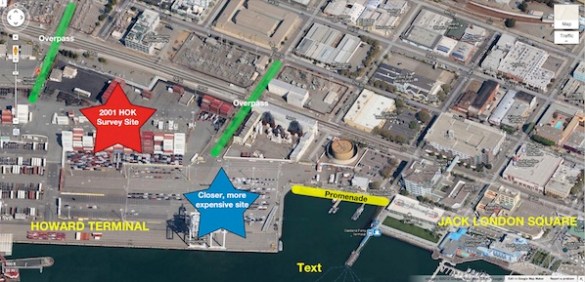
howardterminal_birdseye-labeled-sm

Howard Terminal overhead shot with Jack London Square nearby

During the Don Knauss interview, he mentioned that environmental concerns were overblown. To wit:

We’ve done the diligence there as well and been assured by experts that a ballpark can be built on that site without a substantial cost associated with cleanup. Basically we can build a ballpark on top of that site without having to scrape the site clean like AT&T was built on (China Basin).

Wait a minute. China Basin was built without having to scrape it clean? Actually, it was scraped clean. Site remediation was done by the Giants, not the City or Port, and reimbursed to some degree by the federal government via the Federal Brownfields Tax Initiative. Piles were driven deep into bay mud (fill) to provide a proper foundation. Knauss is suggesting that a Howard Terminal ballpark can be built without replacing the fill currently at the site or even piercing the asphalt cap designed to contain the site’s contamination. I’ve heard this claim before but not the plan behind it. Naturally I have to be skeptical of this claim. China Basin and Howard Terminal are similar enough that it’s hard to conceive of how this would work.

AT&T Park’s foundation was built the many expected: land was cleared, cleaned up, and piles were driven to support the stands and ancillary buildings. This was required because China Basin sits in an extreme liquefaction zone. Howard Terminal also sits in an extreme liquefaction zone, which would presumably mean similar measures to China Basin would have to be undertaken. The difference with Howard Terminal is that the State of California put the asphalt cap over the contamination over a decade ago instead of cleaning it up completely, a process which would’ve cost $100 million ($131 million in 2012). That cost has long been the biggest source of the site costs associated with Howard Terminal.

Then again, maybe Knauss and the Oakland backers have a clever, innovative plan that would not require piercing the asphalt cap, or at least minimizing the number of intrusions. That would probably require building a smaller number of larger sized footings at the site, then constructing an above grade podium on which the ballpark would be placed. If that sounds familiar, it’s because Bryan Grunwald proposed a similar approach at his 980 Park site. There’s no concrete estimate of the cost of such a podium, but I’d expect it to be at least $100 million given the the size and load it would have to carry. That could conceivably be cheaper than cleaning up Howard Terminal. Would it be that much cheaper? We’re talking about building a ballpark in a liquefaction zone. There’s no room to cut corners.

Another issue is the amount of planned infrastructure. Again, Knauss claims that costs are being overblown. But he also acknowledged that parking would need to be provided on site, which makes sense given the lack of parking in the immediate area (only 1,200 spaces within 1/3 mile). And if more parking is to be provided on the 50-acre Howard Terminal site, more infrastructure has to be built to bring cars into the site. I had previously suggested two overpasses, one for vehicle traffic and one for pedestrians. Add those to the podium, other site improvements, and additional improvements to the area north of HT, and we’re talking about an estimate north of $150 million. Maybe it’s less, maybe they’ve come up with something really innovative. The problem is that quality engineering is expensive and requires expensive materials. Heck, even bad engineering can be really expensive.

Finally, there’s the lingering question of Who will pay for it? The Giants paid for their site cleanup, got a tax credit from the Feds, and received a minimal amount of TIF funds for the surrounding area. If Knauss is suggesting the same kind of deal to Lew Wolff, it’s a nonstarter. That’s around $650 million worth of risk, 95% of it to be borne by the A’s, with little promise of the kinds of returns the Giants got at China Basin. (Note: Walter Shorenstein thought China Basin was so risky that he divested his share of the Giants, and many within The Lodge looked askance at the plan.)

Maybe, just maybe, Knauss and his people have this figured out. Maybe there’s a creative way to make this all work for everyone. Again, I’m skeptical. Many of the same claims were made about Victory Court, and that site was swept under the rug with barely a peep.

—–

P.S. – We haven’t even touched the transportation gap at Howard Terminal (BART or the mythical streetcar). Or whether the City, Port, and County would create yet another joint powers authority. Or lease terms. Or the lack of redevelopment funds for surrounding area improvements.

Knauss on 95.7 The Game: We think the world’s changed here

Clorox CEO was on with Chris Townsend earlier today. As usual, Townsend had a pretty thorough, wide-ranging interview that touched on a number of A’s and stadium-related topics. I’m going to highlight a couple of items.

Townsend: When it comes to buying the A’s, are you personally interested? Is Clorox interested?

Knauss: No I wouldn’t say we’re interested (Clorox) in buying the A’s. We clearly would love to work with the current ownership, Lew Wolff and John Fisher, on keeping the A’s here. I think there’s a lot of old data that Lew Wolff has about working in Oakland… We think the world’s changed here.

Later in the interview…

Knauss: I think we have this tremendous site down Howard Terminal, which is just adjacent to Jack London Square. We have what I believe can be the premier site in baseball… When I last talked to Lew about that last year, he said ‘we looked at that a long time ago, it’s not viable’. I think the last time the A’s actually sat down with the City in any serious way was over five years ago with Mayor Dellums. At the time I heard some of the old excuses why Howard Terminal wouldn’t work and they’re all void now, it’s a completely different place.

Townsend: Why do you believe Howard Terminal is viable?

Knauss: In 2005 the last time they looked, the Port was close to full capacity. Now it’s under 50% utilization. The Port can easily use Howard Terminal for a ballpark without adversely affecting the shipping business… The second thing I’ve heard over the years is that there is this environmental contamination on the site and people throwing some crazy numbers around about remediating that site. We’ve done the diligence there as well and have been assured by experts that the ballpark can be built on that site without a substantial cost associated with cleanup. Basically we can build a ballpark right on top of that site without scraping the site clean, the same way AT&T Park was built on that pier.

Knauss went on to talk about the revitalization of Jack London Square and the recent Brooklyn Basin deal. Then Townsend moved onto Knauss’s potential interest in owning the A’s.

Townsend: In the past you’ve talked about having a group to buy the A’s. Why have you never made an offer?

Knauss: We’re trying to respect baseball’s protocol. Our attitude is to negotiate this and not litigate this… We’d love to have Lew sit down with us and go over the new world that’s down there, not the old world that he’s familiar with. The other thing is that we’re close to getting this lease renewed so I think we’re demonstrating that you can get things down in Oakland and Alameda County… The second thing is getting site control of Howard Terminal. So I think that’s the reason we haven’t said, ‘Let’s find another ownership group.’ We think that could be viable, but I think clearly we’d rather say, ‘Look Lew, we’ve got a viable site, we believe that the team deserves a new world class ballpark, but there’s a way to get that done here in Oakland.’

Townsend: Clorox moved a number of jobs to Pleasanton. Why do you do that but yet you still say, ‘Ah we’re still about Oakland.’

Knauss: It’s a fair question. There are two things we wanted to try to achieve with that. One is, it’s a bus- it’s really a focus on innovation. The reason we’ve been around for 100 years is because it constantly innovates new products. We wanted to get all of our innovation people in one location. Now obviously innovation is driven by R&D, and we’ve always had R&D people folks out in Pleasanton. We had about 400 scientists out there and we’ve had ’em out there for decades. What we’ve learned over the years is that when you put all of the functions out there that drive innovation – marketing, sales, finance, human resources, legal, etc. – put all those people out there with the R&D people, then you get much quicker innovation, you get bigger ideas developed. So we wanted to create a new campus out in Pleasanton where we had our nucleus and add those people. We moved a lot of those folks out of downtown Oakland out to Pleasanton – but we kept them in Alameda County.

The second reason we did it was a business continuity issue. The headquarters building – obviously we’re all in the Bay Area sitting on various faults. We wanted to get some dispersion of our IT resources out in Pleasanton too where we thought we could spread out some of our risk from a business continuity standpoint. Those were the two central reasons: better innovation, better business continuity, minimizing risk. We’ve kept people in Alameda County, and we’ve kept our general office in Oakland, and certainly I’m sitting here in Oakland and I live in Oakland. So we’re committed to Oakland.

Let’s try to put this in perspective. Don Knauss was brought in as Clorox CEO in October 2006, shortly before Ron Dellums was elected mayor. Knauss is clearly referring to the anti-sports Brown administration and the general absence of leadership during the Dellums era. Are we – and Wolff & MLB – supposed to believe that a new sheriff is in town, that Oakland has suddenly gotten its act together? Moreover, Knauss recited Quan’s stance on the ballpark issue: As long as we provide the site, the A’s and MLB can’t turn us down. I think it’s pretty simple. If Oakland provides all site prep costs, streamlines the process, and throws in $200 million, then you can get MLB to pay attention. Without that it’s not really an even playing field with San Jose, where the greater number and size of upfront revenue commitments can help pay down ballpark debt early, just as is being done in Santa Clara.

Knauss also talked at length about the issues associated with developing Howard Terminal, which he minimized as much as possible. Muppet151 has a little insight into this:

HT is in a state of constant and PERMANENT review. I talked to the guy in charge of overseeing the site who said it’s somewhat similar to what contained contamination at the San Jose Arena. You can read the SJ documents here:

https://www.envirostor.dtsc.ca.gov/public/profile_report.asp?global_id=43730007

The HT project manager explained things a little further in an email to me when he said “While the Land Use Covenant restricts activities that would interfere with the cap from being conducted without DTSC approval, it is common in development plans to engineer acceptable solutions that modify cleanup remedies including caps under DTSC oversight.” If the footprint of the stadium extends outward to the point it’s over the capped area, and it’s my understanding it would, the stated scenario would take place.

From a technical standpoint, HT is definitely possible, and can be done. The problem is that this is not a 1 time fix. This is a permanent issue, and worst of all this is infrastructure work that the public will be on the hook for. There was cleanup work done in the area in 2004 making the ballpark possibility a little stronger. But the 200,000 cubic yards of capped material remains, as done the 2002 CA DTSC estimate of a $100 million cleanup should something go wrong. And again, that’s public money. Things might go smoothly….but over time, caps need maintenance, and putting a stadium over the underwater caps makes the situation remarkably unique.

Currently, nothing can be built at the San Jose Arena parking lot, including a garage for the arena or a future high speed rail terminal, without a comprehensive and costly remediation plan. Right now there’s only a sealed asphalt cap there.

Knauss also brought out the “respecting the process” stance used by many on the outside, including the mayors of both San Jose and Oakland. They’re all willing to “respect the process” until they hear something that doesn’t work with their agenda. That’s how the game is played. Unfortunately, as we’ve seen recently, the only way to get Bud Selig’s attention these days is to sue baseball.

When asked about Clorox’s move of hundreds of jobs to Pleasanton, Knauss’s previously well-focused responses devolved into some incredibly inane, weaselly CEO-speak. Read that response carefully. Earthquake faults? When Loma Prieta hit on the San Andreas fault, the Coliseum had enough structural damage to force Games 3 & 4 to be played at the ‘Stick, despite the Coli being on the Hayward fault (and supposedly less prone to damage). Knauss didn’t touch the issue that really caused the move: many of the scientists and their families lived along the 680 corridor and preferred to work there instead of commuting to Oakland. Knauss had to make the tough decision to keep Clorox competitive. That’s the reality of the move, not some BS reasoning about earthquake faults or risk management. And that’s the irony of it. Clorox is perfectly able to move 500 jobs to Pleasanton or 300 jobs to Arizona if it has business or competitive reasons. In terms of pure economic impact (tax revenue, job creation), the A’s are a much smaller company than Clorox, yet they can’t move 35 miles for competitive reasons. Makes me wonder if Knauss just did this to provide cover for the company’s previous and future moves under his leadership. It didn’t cost him anything, that’s for sure.

—–

Further reading:

Dust settles after the big lawsuit filing

I’ve spent much of the last week in transit, as my job requires a lot of travel all over the country. Some of the pictures and posts you’ve seen since the beginning of the season have been a byproduct of little side jaunts taken at the end of business trips or cashed in frequent flyer miles. It’s allowed me to visit a lot of the parks I’ve wanted to see fairly cheaply, though the downside is that it has severely reduced my attendance at A’s home games.

Another byproduct of near-constant travel is that I can’t get into a good writing rhythm. I’m already a rather deliberate writer, and I’m envious of the pros who can toss out 500 words constructed in cogent manner in only 15 minutes. Instead I’ve preferred to shift my writing to ever longer pieces, 1000-1500 words, eliminating many of the peripheral “busy” posts that I used to do.

Yet when the San Jose-vs.-MLB lawsuit was filed on Tuesday, I was left at a loss as to how I was going to cover it. While I get a lot of advice from lawyers and legal experts, I still went through the week uncomfortable about touching the legal issue with any real depth. I wasn’t sure I could do it justice (pun intended). Instead I sat back and read all of the great writing by many lawyers-turned/cum-baseball writers like Jason Wojciechowski, Wendy Thurm, and Craig Calcaterra. ESPN legal analyst Lester Munson covered the lawsuit in the broadest manner possible, but the effect of his piece was greater than most because of the wide audience. And we have plenty of lawyers who read and comment on this site. Judging from the last post, they’ve been waiting for this moment for a long time. I’m glad that they may have a chance to sink their teeth into something juicy like this. As for me, I’m glad that at long last the A’s plight is getting the attention it deserves (and San Jose to a lesser extent). (While I was in Phoenix on Thursday, the local ESPN affiliate did a wide-ranging interview with Tim Kurkjian, and the A’s/San Jose/Sewergate were one of the main topics!)

However, let’s be clear about what we should expect from this potential circus. While many can’t agree on what the outcome will be, let’s understand what’s really at stake.

1. San Jose isn’t really trying to overturn baseball’s antitrust exemption.

Attorney Joe Cotchett’s initial bluster aside, San Jose would be perfectly fine with territorial rights being modified, their basic structure left intact. That could mean sharing Santa Clara County or the Bay Area at large, or something in between. As long as they have the right to host the A’s, they’d be fine with territorial rights maintaining monopolies (or duopolies as the case may be) here and elsewhere.

2. San Jose didn’t decide to do this on a whim.

Mayor Chuck Reed told Lew Wolff last week that the City was planning to sue baseball. Councilman Sam Liccardo had been talking up the lawsuit threat since spring 2012. From what I hear Cotchett has been involved for nearly as long. What they’ve been doing during that time is strategizing the particulars. What they came up with is arguably weak from the standpoint of trying to overturn AE, but if the goal is shake up baseball, there’s a chance it could work. SewerGate became a most serendipitous event PR-wise – as serendipitous as rising floods of sewage can be.

3. MLB is not concerned… yet.

MLB knows San Jose’s strategy, and they will certainly push hard to get the case thrown out for lack of standing. If they succeed, we go back to the status quo and San Jose is at the mercy of baseball. That doesn’t mean that San Jose is done, it just means the City can’t force the issue. All parties, including the A’s, know this. The important thing for MLB is that San Jose remains an option, however slight, because if the only option is Oakland and a scramble for extremely limited public funds, the option is poor. Of course, the City could decide at that point that it would give up the seemingly quixotic quest for a MLB franchise. Knowing how the current mayor and leading mayoral candidates operate, that’s highly unlikely. The lawsuit is costing them nothing and giving the City a ton of press and awareness. None of it is bad except that it annoys Bud Selig, who is supposedly in his lame duck period anyway.

On the other hand, if the federal judge finds that the City does have standing, then MLB has to decide what it’s willing to risk during the pre-trial discovery phase, when pertinent documents are exchanged between the two sides. As we saw in the Stand for San Jose case, one side made the blunder of providing privileged information, which the opposing side tried to use in its case. S4SJ’s attorneys, who didn’t disclose or return the confidential docs until they were caught, then were dressed down by two separate judges and nearly thrown off the case. The Lodge has demonstrated in the past that they are very fearful of any releases of team or league financial data, forced or leaked. I wouldn’t expect them to fold like cheap tents, but if enough pressure is applied, the pendulum could swing in the City’s direction as the owners simply prefer the quickest exit to the fiasco. The quick exit won’t come cheap or easy because the issue is complex, as Selig has said (but never properly articulated).

MLB’s lawyers will argue that there is no contract, hence no standing. The City’s lawyers will argue that there could’ve been a contract if MLB hadn’t dillydallied. It’s not mentioned in the lawsuit, but they could easily point to…

4. The Earthquakes

Lew Wolff and San Jose have a contract in place to build a stadium. In San Jose. On land sold by the City to Lew Wolff that started with an option. While the stadium has been delayed due to financing and general economic problems, it’s getting done. Without tortious interference – the real issue in this case. The bar for some antitrust complaints may be lower in California than the federal standard, thanks to the Cartwright Act. Whether this passes muster is up for a judge to decide.

5. The A’s are a defendant

In suing MLB, San Jose is suing all 30 member clubs in the process. So even though Lew Wolff wants to move the A’s to San Jose, he isn’t joining the lawsuit. Wolff’s public statement indicates, yet again, that he doesn’t want any part of the legal process, fiddle-dee-dee. And it sort of makes sense given that teams are bound by the MLB Constitution not to sue baseball or each other. Except that…

6. MLB’s Constitution expired?

According to Cotchett, the last Major League Constitution expired at the end of 2012. Baseball hasn’t posted a new one, so it appears that they aren’t operating with one. It sounds crazy to think that baseball could operate without a Constitution for even a brief period, as the document lays out all manner of league and team business, in conjunction with the CBA. The most recent version dates back to 2005, as part of the Expos’ move contraction-and-expansion to DC. It outlines everything from banal matters such as the timing of the owners meetings to how the leagues and divisions are constructed, and pertinent to our ongoing discussion, club operating territories. You’d think that the document would at least be amended to include the Astros’ switch to the American League West. Right?

Then again, if the league is operating without a Constitution, does it mean that there’s a loophole? If there is no binding Constitution then are territories no longer assigned? I doubt it, there’s too much at stake. The New York teams aren’t going to allow Stuart Sternberg that kind of loophole to move the Rays. Prior to the gag order, the Giants pointed to the Constitution every chance they got to back up their T-rights claims. You think they’d let the document lapse? Even if there technically isn’t a Constitution, the clubs are certainly operating within the spirit of the legacy document, which is probably good enough for a judge. The Lodge is the Lodge is the Lodge, after all. Now, if MLB intentionally let the document expire so that no one can point to the constraints of T-rights, then we’ve just devolved into anarchy within the Lodge. Which probably isn’t a bad thing.

In all likelihood, MLB does have a new Constitution and simply needs to produce it. Issue rendered moot.

7. Where does Oakland fit into all of this?

Oakland is not a party to the lawsuit. That’s just as well, since there’s a good chance San Jose will fail and the A’s will have no choice but to deal with the East Bay. The “tail-between-legs” scenario is what they’ve been hoping for all along, not that they’re presenting realistic options should that happen (remember Victory Court?). The real problem for Oakland is simple: no one’s fighting over Oakland. The clubs are fighting over San Jose, and they’d fight over San Francisco if it came to that. No one outside of the Oakland-only holdouts and Larry Baer is talking about Oakland as anything more than a short-term solution. Have you heard any other owners talk about Oakland in terms of a permanent home for the A’s? Of course not, because it isn’t even entering their minds. The only thing helping Oakland at the moment is each owner’s self-interest. In this scenario Oakland is the safety school of cities, the girl from work you go out with because she’s accessible. And that’s what really hurts. Whether the neglect is benign (Coliseum deterioration, deprioritizing the A’s) or more “sinister” (ownership motivations), Oakland’s status as a baseball town is at best tentative. If San Jose comes out of this with the A’s, no other existing teams are going to start looking to Oakland as a viable MLB home. Expansion is out of the question. The best Oakland could hope for is a minor league club of some sort, either AAA (Pacific Coast League) or high-A (California League). If Oakland is truly afforded the opportunity to keep the A’s, they’ll be ransomed like many other cities have been. MLB will bring in the consultants (just like Miami) to say that a franchise there isn’t viable without a publicly-financed stadium. Then what?

Other observations:
Exhibit 3 in the filing is the CSL-written economic impact report commissioned by San Jose in 2009. Normally we roll our eyes at how these things are written, because they’re designed to convince mayors and city councils, not judges. The use of such a document against baseball is more than a little ironic.

During the first press conference, Cotchett trotted out the SVLG letter and list of companies as signed-on supporters of the lawsuit. He quickly backtracked on that. The letter is Exhibit 2.

—–

As I finished this post the plane descended over the Peninsula. I saw the lights on at AT&T Park while Candlestick Park sat silent and lonely. I wanted to get a good look at the Coliseum, but the view across the bay was obscured by a scratched up plane window and the encroaching marine layer. We landed at SJC and the plane was held on the tarmac because a computer malfunction at Southwest Airlines’ headquarters kept all other planes at their respective gates. How appropriate, I thought.

MLB’s statement on SewerGate

You can feel the fortitude and resolve pulsing with each mushy keystroke that was pressed to create MLB’s mealy-mouthed, non-committal statement on #SewerGate:

“As we have stated many times, the Oakland A’s need a new ballpark. Sunday’s unfortunate incident is a stark illustration that they need a long-term solution. This industry has a long record of navigating challenging circumstances and finding solutions. The situation in Oakland is particularly complicated, evident through the years of work it has required, yet we remain hopeful that a resolution can be reached so that the A’s can secure the 21st Century venue that the franchise and its fans deserve.”

That, folks, is leadership at its finest. We can look forward to something happening… sometime in the 21st Century.

A River (of shit) Runs Through It

There’s fifty feet of crap. And then there’s us. – Billy Beane, Moneyball

Brad Pitt as Billy Beane in "Moneyball"

Brad Pitt as Billy Beane describing the A’s station in “Moneyball”

Figurative turned literal on Sunday, as the A’s and Mariners (and umpires) were forced to vacate their respective clubhouses after the game because of a sewage backup. The backup caused sewage to seep out of the shower drains as players were trying to clean up. Both teams were forced to use the Raiders’ locker room showers, which are located a level up in the old Exhibit Hall.

As part of the 1995 Mt. Davis renovations, the Exhibit Hall was transformed into new football locker rooms, while the A’s clubhouse and visiting facilities remained mostly untouched. As a result, the plumbing in the clubhouses continues to deteriorate and requires constant repairs, which the A’s usually end up paying for during the season. Per the team’s lease, they can deduct the cost of the repairs against their annual rent payment. During the NFL offseason, the Raiders locker room often gets used as an extra staging area for VIPs. As a part of the stadium that was constructed less than 20 years ago, it’s in much better shape than the old baseball clubhouses.

In 2011, I asked Lew Wolff about the state of affairs at the Coliseum. Here’s an excerpt of our discussion:

Wolff: We’re constantly making repairs that are not our obligation.

ML: Really? Like what?

Wolff: Leaks and things. The scoreboard. There are two of them because of football. I think they’re finally going to replace them, but if they don’t there are no more parts. If a light goes out we borrow it from another one. It’s aggravating. But they basically say they don’t have any money. They still have bonds to pay off. The place is old and this is not the time for cities to write a check for sports.

Two years later the leaks have gotten worse and the scoreboard still needs replacement, with funds to make that happen siphoned away to study Coliseum City. It’s easy to make scoreboards a low priority at a decrepit place like the Coliseum since they don’t affect players or revenues. Functional clubhouses, however, are a different matter entirely. It’s one thing if the clubhouse flooding and contamination was confined solely to the A’s clubhouse. This time it affected both teams and the umpires. Now there’s the prospect of complaints being filed by the A’s, Mariners, and the players’ and umpires’ unions. (Susan Slusser noted that the Angels complained about a similar incident in 2001, citing a possible E. Coli threat.) Ultimately the responsibility falls on the Coliseum Authority, the body acting as the landlord for the three Coliseum tenant teams. A Herculean effort by an industrial cleanup company like ServPro should get the place up and running. The structural deficiencies will continue to linger.

I know next to nothing about engineering sewer systems, but I do know that having facilities below sea level (such as the clubhouses) can make it difficult to get a proper gravity-based flow going. The funny thing is that one of EBMUD’s huge sewer interceptors runs right through the Coliseum complex, so it should be easy to get wastewater and sewage out of the complex assuming that the sewer lines and pumps are working properly. Evidently at least one part of the stadium’s sewage infrastructure wasn’t working at all. Think about that. There is a river of shit running right through the Coliseum and somehow it couldn’t be utilized on Sunday.

Some are pointing to the possibility that the sewer system was taxed by large crowds. The A’s drew 171,756 total fans during this recent six-game homestand. Let’s put that in perspective. That’s 28,626 per game, or roughly half the originally designed 1966 capacity of the Coliseum. Even the Sunday sellout was only 57% of the 2012 football capacity. The system as a whole should not have been stressed in the slightest.

As the investigation into the cause of the incident continues, it will occur against the backdrop of ongoing lease negotiations. Previously it was assumed that the Authority would have a good deal of leverage because the A’s have nowhere else to play in the Bay Area post-2013. Now the tables have turned, as it can be argued by many parties that the Coliseum is unfit to host MLB games until the clubhouse sewage problem and other deficiencies are addressed. MLB could even step in to make preconditions on the JPA prior to further lease talks. That would put the JPA in quite the pickle. How can the JPA recover more money from the A’s towards Coliseum debt service if it has to fund additional, costly improvements at the Coliseum? If the JPA wants to lock the A’s into a deal longer than 5 years, how much money is the JPA willing to put up to make it worth the A’s and MLB’s while? And how does that coincide with any requests the Raiders are making for their lease extension?

Prior to this incident, Lew Wolff offered to continue on at the Coliseum for five years with the current use terms, rent TBD. He could and should demand infrastructure improvements, but he and Michael Crowley could be enticed to stand pat and maintain the status quo since it would be less complicated. It would be hard for the A’s to make any leasehold improvements without prior approval of the JPA, and since they’re not bound by the lease beyond December there’s no immediate incentive to do so. All they’ll probably do at the moment is make necessary repairs, clean and disinfect the place, lay down some new carpet in the affected areas, and hope for the best. While that should be enough to get through the rest of the season, imagine another sewage incident occurring during the postseason. What kind of PR disaster would that be for Oakland? And I can’t image naming rights sponsor O.co is thrilled to be associated with this debacle. It’s bad enough that from afar the stadium resembles a toilet.

Three weeks ago Jon Heyman incurred the wrath of A’s fans over his snide tweet comparing AT&T Park to the Coliseum. He mostly stayed away from any remarks this time around, except for a retweet of Slusser getting a David Rinetti (A’s VP of stadium operations) quote:

Smart move by Heyman to stay away from this mess, though I wouldn’t blame him if he gloated in private. Trololol.

—–

Update 10:45 AMBob Nightengale has a choice quote from Wolff and reiterates a story from February.

The A’s, of course, have tried to bolt town for the last five years. The San Francisco Giants won’t share their territory and permit the Athletics to move to San Jose. Major League Baseball, which hoped the A’s and Giants would somehow reach an agreement on their own, finally got a resolution from their blue ribbon committee. The committee submitted a set of guidelines to Wolff in February, and if he agreed to meet the requirements, a move could soon be underway.

Wolff won’t talk about the guidelines. Neither will the Giants. Or even Major League Baseball.

Well, since the NSA isn’t sharing any of Wolff’s telephone conversations with Commissioner Bud Selig, it’s fair to say that if Wolff agreed to the parameters, he’d have a shovel in his hand today digging into the San Jose soil.

Wolff denied the February report in last week’s radio interview. Clearly something isn’t meshing here. The two short-term decisions at the moment are the lease and the S4SJ lawsuit. It would make sense to wait to announce something until both of those issues are resolved.

—–

Update 2:30 PM – Amazingly, Lew Wolff is pulling his punches, at least according to a new Carl Steward article.

“What it says basically is that it’s a deteriorating facility,” he said. “I think everybody is aware of that, even the people who run it. We’re sort of all in this together, so it isn’t something I would use … we just have to solve it right now.”

Wolff downplayed that this might be the kind of incident that would give him extra ammunition to force the hand of Major League Baseball to act on the A’s situation, which has been stalled for several years under a panel appointed by Selig to assess the team’s options.

“Even if they said tomorrow, `OK, you can have a new stadium,’ we can’t do it in one day,” Wolff said. “We’re still going to have a plumbing issue.'”

Of course, Wolff isn’t going to stop the M’s, other teams, MLBPA, or WUA (umpires) from filing their own complaints. Those may have more bite. On the other hand, Billy Beane’s comments were a little more pointed.

“Today this is national news, but it happens here all the time,” Beane said. “Our employees are impacted by this. I was the first to see the manager’s office (Sunday), but we see it all the time, and this is not unusual. I don’t blame them (the Mariners) for reacting, but we have to live with it on a semi-regular basis.

“If we say anything, we’re told we’re being opportunist,” Beane added. “I wish these were working conditions we didn’t have to work with. When it affects somebody other than us, it becomes a story. I’m used to it. I deal with it.”

Doesn’t get more Oakland than that.

The power of Selig compels you

Allan H. "Bud" Selig, at your disservice

Allan H. “Bud” Selig, at your disservice

Well, not you, Gentle Reader. Lew Wolff and Larry Baer, to be specific. Both respective team head honchos were interviewed on The Game as part of the Newsmakers week of sitdowns with owners. Baer talked mostly about the Giants’ franchise, but was also asked (by Bucher & Towny) about their apparent cockblocking of venue efforts by both the A’s (San Jose) and the Warriors (Piers 30/32). Baer indicated vague support for both teams’ efforts, but would not comment further on what that meant.

Then on Tuesday, Lew Wolff had an absolute disaster of an interview, one where he hesitated, fumbled, and dodged. By the end, everyone including the interviewers were clearly frustrated, Wolff even half-jokingly saying that he wanted the A’s PR department to get him out of the interview.

Wolff’s prior-held opinions on Oakland and San Jose were repeated, but it took only 30 seconds for Wolff to give the first of an endless stream of “No Comment” responses to many of the solid, pointed questions that were aimed his way. “No Comment” has come about because of the gag order imposed by Bud Selig over Wolff and Baer, who had been previously sniping and using the media to their own ends at regular intervals.

Beyond the ongoing rejection of Oakland having any viable sites, Wolff also repeated the mantra that he has been guided to put baseball first, team second. That means no antagonistic PR battles or lawsuits, no waging the territorial rights war. What it also means is that the A’s will continue to be in limbo, at Selig’s and The Lodge’s behest, until Selig or his successor deems the A’s dilemma important enough to resolve in a meaningful way. Lew has always painted himself as a go-along-to-get-along guy, even if the scope of that philosophy is limited to baseball and alienates A’s fans everywhere, along with friends in the South Bay.

Lew is clearly grateful to Bud for bringing him into the Lodge, that much is clear. Thing is, now that he’s in, it’s hard to get him out. Besides the ownership group or individual partners going into bankruptcy (no sign of that happening), there’s little anyone can do in The Lodge or outside it to force anyone out. Lew knows this and has tried to work the process (calling for a vote, etc.) to no avail. It wouldn’t hurt to fight for the franchise instead of always taking one for The Lodge, as is happening now. If the idea is to curry favor with the other owners for something down the road, there’s no indication of such a deal.

I think we’re seeing a repeat of what happened with the 49ers and the Yorks, where Dr. York spent a few years fumbling around as the head before handing the job over to the more media-savvy Jed York. Lew’s son Keith Wolff has had his hands full taking care of the Earthquakes stadium, and may be wary of absorbing the arrows anew with the A’s after having completed an arduous, albeit smaller, task for the soccer franchise. Nevertheless, if Keith is up to it, he’s the guy to smooth things over. Even then, nothing can actually be smoothed over until Selig provides better answers and more information. As the team gets further into the season and off-season without an inked extension for whatever length, this is only going to get weirder and uglier. And as long as the gag order is in place, there will be no point in having additional interviews like Tuesday’s.

Is your city disrespected? Nobody cares.

After Tuesday’s Game 2 of the Bay Bridge Series, CBS Sports national baseball writer Jon Heyman jostled the hornets nest that is the Oakland faithful with this tweet:

That brought a furious wave of replies, including some by current A’s players such as reliever Sean Doolittle.

Of course, numerous fans came to the defense of the Coliseum, citing certain sightlines that are better than at AT&T Park (only a few) and the more raucous crowd. I tried to sum up the general sentiment with this tweet:

Now let’s set the table for the discussion to follow. This is Newballpark.org, after all.

  • The Coliseum is, in fact, outdated and a replacement is needed for the long-term viability and competitiveness of the franchise.
  • The long-time, hardcore fanbase has stayed loyal thanks to not being priced out of attending games, despite ownership’s general indifference towards them.
  • Attracting casual fans to games is difficult unless the team is playing extremely well (sometimes) or the opponent is a good draw (Yankees, Giants, Red Sox).
  • The experience of attending a game is not luxurious in the slightest, but it can be very energetic and entertaining.
  • Fans debating about the future of the Athletics mostly squabble over the site of the next A’s home, whether it’s in Oakland, San Jose, or elsewhere in the Bay Area.

Heyman’s uninformed opinion is sadly reflective of much of the East Coast (Northeast) media, which still holds onto the notion that in the Bay Area, San Francisco is “The City” and everything else is a satellite orbiting around it.

Nevermind that Oakland has undergone significant upheaval over the last several decades, or that San Jose has grown to become larger than SF. San Jose remains sleepy and banal, Oakland dangerous and difficult. It takes more than a generation or two to shake a reputation, especially when there are forces at work to maintain certain aspects of that rep (crime, politics, growth policies).

A look back at Frank Deford’s 1968 Sports Illustrated article shows that things haven’t changed that much in terms of perception from the outside. It was during that era that the other Bay Area cities started to puff out their own chests and brandish their own civic pride. That pride led to Bob Nahas getting the Coliseum complex built. It also fomented a backlash against SF, according to late Warriors owner Franklin Mieuli:

“Now, everybody’s thinking is reversed. People feel they must swallow local pride to come to San Francisco. Or they’re indignant. You know, ‘Why the hell should I have to go to San Francisco?’ People come from halfway around the world, breathless, to get to San Francisco, and the people around here are annoyed if they have to go 15 minutes.”

After 45 years, much of the country and the world doesn’t know about this, and more importantly, they don’t care. New York and Chicago have had more than a century to build rivalries among boroughs or along north-south divides, and there’s plenty of documented historical support to back them. Allowing the Warriors and Seals to carry the generic “California” or “Golden State” monikers only steeled Oakland’s collective resolve. Defenders of cities can scream to the high heavens about their town being disrespected. Most casual observers have little empathy when other issues take greater import. Outsiders don’t know that these days, the only true satellites of SF are the Peninsula and Marin County.

Yet the lion’s share of tourist attractions and cultural resources remain in SF. Since the 60’s Silicon Valley become America’s (and the world’s) tech capital, and Napa Valley became the American focal point of the wine industry. Tract homes replaced farms and fields. Ever-growing freeway systems and disorganized public transit systems were built to meet citizens’ needs.

During the decade from 1972 to 1981, Oakland teams won six championships: 3 by the A’s, 2 by the Raiders, and 1 by the Warriors. None really changed much for Oakland as a city, though it did solidify the teams’ fanbases to various degrees. Even when Al Davis took the Raiders to LA, Oakland officials plotted for years to lure him back – and they eventually did.

Oakland has garnered exactly one title since Al left and none since he returned. If the point of having teams winning championships is to build civic pride, the luck hasn’t been on Oakland’s side. Is there anything that can be done to correct long-held misconceptions? Probably not – at least not immediately. Civic leaders can try to build a ballpark or arena downtown, and most have used forms of redevelopment to remake rundown parts of their cities, often with mixed results. Sure, there’s a nice ballpark in Cleveland, but it’s still in Cleveland. The new ballpark in Miami has done little to change the prevailing notion that it isn’t a baseball town. Phoenix has both a ballpark and arena, but outside of events at those venues people would rather go to Scottsdale.

Al Davis, in the 60’s light years ahead of his peers and others in terms of strategizing football, proved sagelike when it came to thinking about cities in the Deford article.

“Haven’t we passed the point of who is Oakland and what is Oakland?” he asks. “Too many people are still living on local color. They can’t see past the Golden Gate. They keep telling me: ‘Hey, we showed those 49ers.’ I have to say, ‘Look, can we show Green Bay? They’re the epitome of football. Green Bay, not San Francisco.’ “

Then again, what happens when the champion IS San Francisco?

P.S. As for the Coliseum, I figure I’ve written about it ceaselessly for 8 years. The issue is really up to MLB at this point. Does the Lodge want to force “progress” via a new ballpark that will inevitably price out many of the fans who currently are a big part of the A’s image? Is the status quo fine for now until whatever form progress takes is fully formed? And who will foot the bill for the Coliseum’s replacement? The bitter truth is that MLB doesn’t care much for the $12 fan, preferring to kick them to the upper deck corners where The Lodge thinks they belong. If someone protests, The Lodge can simply point out that the A’s pull in $30+ million a year in welfare and that Oakland fans should be grateful they still have a team within city limits. Progress, however it comes, will satisfy some and alienate just as many. Unreserved bleachers will become $20 reserved seats. Tailgating opportunities will be reduced. Section 317 will be much higher. At the same time there will be myriad improvements. A beautiful field throughout the whole season. Less foul territory (the most spun thing among A’s fans ever). Facilities that will make marquee players want to stay or sign as free agents. Functional scoreboards. Better food on the concourses. I have seen these things, I have experienced them, and they are good. In the end, it’s as much a choice for fans as it is for MLB. If we’re priced out of the seats that we currently have, how do we react? Do we swallow the higher prices? Go to fewer games? Pick worse sections? There is a price for all cities to be major league. In one way or another, everyone pays for it.

With Trask gone, who will carry torch for Raiders’ stadium?

Less than two weeks ago, Amy Trask came on The Game’s morning show to talk about the Raiders’ ticket donation program. While there she talked up the Coliseum as the best location for a future stadium and defended Raider Nation to the hilt – as she has done frequently. So it came with some surprise that Trask resigned her CEO post over the weekend. She went out honoring the team and its fans. She could easily write a book on her 25-year tenure as a rare female executive in pro sports. Chances are that she’ll write a paean about her experiences with the Raiders instead.

Under the surface it seemed Trask’s days were numbered. With Reggie McKenzie handling the football side and Dennis Allen as his coach, Trask was marginalized to the role of figuring out the Raiders’ future stadium situation. Even then, the team got little momentum on that front as its lease was renegotiated and running towards its end. According to Tim Kawakami, at first Trask pushed for a stadium-sharing model with the 49ers, a move that would’ve been highly practical. As the 49ers pushed forward in Santa Clara, any murmurs about sharing died, replaced by a renewed push for something new in the East Bay. Mark Davis made calls to folks in the Tri-Valley about Camp Parks while Trask emphasized that the Coliseum was the best spot. Davis is working in conjunction with the NFL on the Raiders’ spot within Coliseum City, a less showy vision than what Oakland pols are promoting.

Now that Trask is gone, it’ll be up to Davis and a hired gun to sell the prospects of a new stadium at the Coliseum. Rumors abounded during the offseason that a new team president would be hired. There was even talk that Davis would give the reins to Jon Gruden, which went nowhere. It would seem that Andy Dolich would be a natural fit since he performed that kind of role for the 49ers and he’s perhaps Oakland’s biggest booster outside of the city limits. Yet Dolich took a job with recruiting firm Odgers Berndtson instead. Perhaps Davis wants to go with someone younger or someone not previously associated with the 49ers. Whatever the reasoning, it’s a puzzling non-move.

Successful stadium/arena campaigns are usually the product of a solid public-private partnership. The Giants had Larry Baer, Peter Magowan, and Willie Brown pushing for a ballpark. The 49ers had Jed York go door-to-door and two mayors, Patricia Mahan and Jamie Matthews. The Earthquakes had Lew and Keith Wolff, David Kaval, and Chuck Reed keeping San Jose’s bureaucracy from getting in the way. Miraculously, Kevin Johnson had no help from a team owner, but KJ had a history and reputation as a great NBA player to help himself within the NBA. Let’s assume for the moment that Jean Quan, Larry Reid, and Rebecca Kaplan can capably lead the public side. Mark Davis isn’t going to do the heavy public campaign himself, will he? It’ll be up to the new President/CEO/COO or whatever the proper title is to pound the pavement, rally the sponsors, gather the votes. Without that effort there’s little chance Coliseum City will get the necessary support behind it to be successful.