News for 8/10/12

We’re overdue for a news roundup. Now seems like a good time for one.

From BANG’s Joe Stiglich:

Last week’s visit to Oakland and San Jose by Bud Selig’s three-man panel foreshadowed this.

Update 1:04 PM – Stiglich has a writeup with quotes from Wolff, such as:

“It’s up to the commissioner’s office,” Wolff said. “… This is a process that unfortunately is taking longer than I hoped, but it’s a fair process.” 

Other news:

  • Janet Marie Smith, who oversaw the construction of Camden Yards and the renovation of Fenway Park, is moving out west to Los Angeles to take a similar role with the Dodgers. If her previous work is any indication, she will keep it classy all the way. [Dodgers press release]
  • NHL Commissioner Gary Bettman has set a deadline of September 15 to wrap up labor negotiations before the league imposes a lockout. The NHL and NHLPA are always playing catchup with the other leagues in terms of CBAs. They imposed a 57% player share in the last agreement as other leagues were dropping towards the 50% mark. Now the NHL wants to drop it to 46%. It’s going to be a long winter. [AP]
  • A developer is proposing a ballpark for the Tampa Bay Rays in the Gateway area of St. Petersburg, just over the bridge from Tampa. St. Pete’s stance has been to not allow the Rays to get out of their lease at Tropicana Field unless a new stadium were conceived in St. Pete, not Tampa. No financial details were available. [Tampa Tribune/Michael Sasso]
  • The 49ers and the City of Santa Clara settled a lawsuit with a County oversight board. $30 million in redevelopment money was at stake. In order to keep local school budgets balanced, the 49ers won’t get the $30 million for several years. Seems fair. [SJ Mercury News/Mike Rosenberg]
  • Get used to metal detectors at NFL games starting this season. [Oakland Raiders]
  • Speaking of the Raiders, they are using the league’s new 85% measure to determine sellouts this season. The way it works, a team has to sell out 85% of its non-premium seats by the usual deadline (normally Thursday for a Sunday game) in order for a game not to be subject to a blackout. The catch is that any tickets sold between the 85% and 100% marks are subject to higher revenue sharing. Teams like the Raiders and Bucs chose to use the new standard, the Bills and Jags went with the old standard, which required all non-premium seats to be sold by the deadline.
  • The City of Industry approved a deal to buy 600 acres within city limits for up to $26.7 million. The land is where the somewhat-forgotten Ed Roski/Majestic Realty stadium would be located. The parties still have to scramble to find a proper replacement for now-evaporated redevelopment funding. [Inland Valley Daily Bulletin/Ben Baeder]
  • MLB’s postseason schedule has been released (knock on wood). [Biz of Baseball/Maury Brown]

More if it comes.

Challenges Facing Howard Terminal

After yesterday’s game, I headed up to Howard Terminal yet again to snoop around and take a few more pictures. I also read up on SSA Terminals/SSA Marine’s lawsuit against the Port of Oakland. This post will contain an analysis of both.

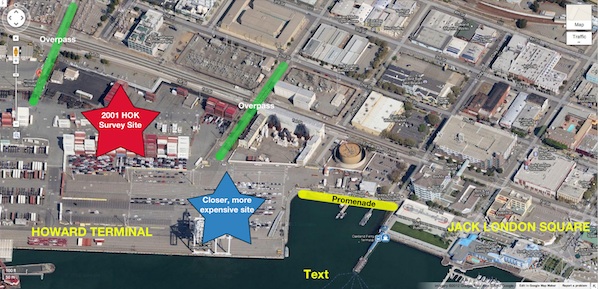
First, let’s start off a bird’s eye view of the site, with a few items labeled for further discussion.

howardterminal_birdseye-labeled-sm

Overview of Howard Terminal and Jack London Square

From right to left you see:

  • Jack London Square in the southeast corner. A one-block stretch of Broadway is visible.
  • One block over from the heart of JLS is Washington St, followed by Clay St. Broadway and Washington extend to downtown Oakland. Clay does not.
  • At the end of Clay Street is the Ferry Terminal, the Ferry Landing (10 Clay St.) commercial building and a small public plaza and green space.
  • A narrow promenade (10 feet wide in an important stretch) runs along the shoreline west to Howard Terminal. If a ballpark were built at Howard Terminal, the lightly-used promenade would have to be widened as it’s the safest and best pedestrian access from the Ferry Terminal and the JLS shoreline and marina.
  • Complicating matters is the Oakland Fire Department EMS Station, which is home to Fire and Police boats. The station would have to be reconfigured to widen the promenade.
  • The blue and red stars indicate the rough locations of ballpark sites. The blue star is the site I identified on Tuesday. It would probably be the most expensive site because it’s all piers, not land, and would make the foundation more expensive. The red star is the site surveyed in the 2001 HOK study. It is inside the original shoreline.
  • North of the blue star is the power plant, which can’t be moved without incurring great expense.
  • The green lines are possible locations for pedestrian and vehicular overpasses, lining up with MLK Way and Market Street, respectively. Both connect with North and West Oakland, as well as 980 and 880. At Howard Terminal, the streets are 900 feet apart.

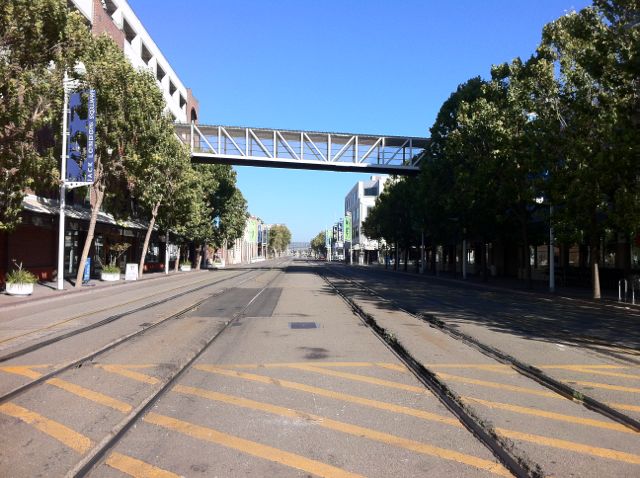
Now I’ll explain why the overpasses (green lines) will be needed. A couple of pictures for comparison:

howard_term-26-view_east

View East from The Embarcadero and Clay toward Jack London Square

howard_term-26-view_east

View East from The Embarcadero and Clay toward Jack London Square

howard_term-27-view_west

View west from The Embarcadero and Clay towards Howard Terminal

These tracks cannot be moved. They are a big part of what makes the port truly intermodal. If 40,000 people are going to cross these tracks and The Embarcadero to get to a Howard Terminal ballpark, it is paramount that safe methods for getting those people across are implemented. Gates and traffic cops aren’t going to stop stupid, drunken fans from playing chicken with an Amtrak or freight train. Unlike the light rail trains run by SF Muni outside AT&T Park, these trains don’t stop quickly even if they’re traveling fairly slowly.

The second picture also shows that there is little streetscape west of Jack London Square. The westbound car lane ends in another block at Jefferson, and the track area isn’t paved. It would make the most sense to completely shut down The Embarcardero near Howard Terminal to all traffic other than trains for a 6-8 hour window on game days.

How then, do you get people across The Embarcadero? It’s for all intents and purposes a moat. By building bridges, of course! The scale and number of bridges would be driven by the amount of parking that is made available adjacent to the ballpark. And that is largely driven by the amount of parking available in and around Jack London Square. Over 3,000 spaces in lots and garages are present, plus at least 500 on-street parking spots. However, only 1,250 spaces are within 1/3 mile of either HT ballpark site. Extend the radius to 2/3 mile, which is sort of the fringe distance that people are willing to walk, and you get 7,000.

parking_comparison

Comparison of parking near ballpark sites

Additional parking may be made available under the BART alignment or on street, but it’s clear that parking near Howard Terminal is a clear site deficiency. The obvious place for a new facility is next to the ballpark. 16 acres would yield 2,000 spaces, which should serve the dual purposes of filling the needs of the ballpark and satisfying current JLS tenants (restaurants, Yoshi’s, movie theater) that have depended on the existing infrastructure. For that much parking, whether it’s all surface or new garages, two entrances would be required, or rather, two overpasses. That’s why I drew the two overpass paths. Market Street is the main entrance to Howard Terminal and is already set up to handle heavy traffic with four lanes. MLK Way is also four lanes. The overpasses would also create two additional pedestrian overcrossings, netting four total along The Embarcadero.

The price for the overpasses? Around $10 million each. Add that to the promenade expansion, parking construction, and other site improvements to make Howard Terminal hospitable for a ballpark.

howard_term-19-corridor1

Promenade from Ferry Terminal to Howard Terminal

Before we get ahead of ourselves, it’s important to note that no ballpark at Howard Terminal will be possible without SSA Marine/SSA Terminal vacating the premises. And while Matson (partnered with SSA) provided support to Don Knauss in his efforts to either build a ballpark on the waterfront or buy the A’s (or both), it doesn’t appear that Howard Terminal operator SSA will be easy to move. While SSA’s container business is down in Oakland, the company is not blaming the downturn on the way Howard Terminal is configured. Instead, SSA has a problem with its lease at Berths 57-59, just over a mile west of Howard Terminal (Berths 67-68). SSA is suing the Port of Oakland over alleged violations of the federal Shipping Act. SSA alleges that the Port is giving preferential treatment to Ports America, a competing terminal operator at the Outer Harbor, Berths 20-26. SSA’s claim is that Ports America (PAOHT) is leasing its site for 45% less per acre than SSA, while not having to contribute much to infrastructure improvements. Due to the more expensive lease, SSA is saying that it’s losing business to lower-cost competitors like PAOHT to the tune of $46 million per year.

Renegotiating SSA’s lease to make it on par with PAOHT could negatively affect port revenue $10 million annually (offset somewhat by new lease terms), and while the two sides have talked they haven’t sat down to negotiate. The lawsuit will be three years old in December. SSA is being coy about what they want out of this besides a lease. The ballpark gives them a very convenient trump card that it wouldn’t otherwise have, now that we know that Howard Terminal is the only site in Oakland that MLB is investigating. It’s a very tough spot for the Port and City to be in. If the City doesn’t get the Port to renegotiate the lease along SSA’s terms, Howard Terminal is dead before it begins. It can’t kick SSA off the property as the lease goes until 2017, with two possible 5-year extensions that SSA will probably decline. Plus any changes to Howard Terminal like the ones I described previously have to work for the other tenants of the Port like PAOHT and other shippers, making the Port every bit as beholden to its tenants as it is to the City (from which the Port operates independently anyway). And if you want to make things even more complicated, the City of Oakland wants out of a bad bond hedge deal with Goldman Sachs. Who’s a major investor in Carrix, the parent company of SSA? Goldman Sachs.

Cost estimation is difficult, but back-of-the-napkin math has infrastructure at $50 million depending on site and foundation, and an ongoing loss of $10 million in fees to the Port with a redone lease and relocation costs. From the looks of things, SSA might play ball if they get their lease redone. If not, what’s their incentive? This reminds me a lot of what the City of San Jose did with AT&T on a rezoning deal near Valley Fair. Considered a quid pro quo deal, we may never know if it really is one unless a ballpark in San Jose is built. SSA appears to be in line for a similar enriching.

Howard Terminal Revisited (Again)

Yes, we’ve been here before. I suppose it’s time to discuss Howard Terminal yet again.

In June I attended a weekday afternoon Rangers-A’s game, followed by a ferry trip from Oakland to South San Francisco. San Francisco Bay Ferry was using that week to launch the new service, which to that point had its southernmost terminal at AT&T Park. I noticed many people who, when they learned of the free promotional ferry ride, decided to take a quick cruise across the bay.

While I was waiting for the ferry, I walked around JLS and near Howard Terminal to take some updated pictures just in case.

howard_term-07-overhead

Overhead view of Howard Terminal, with power plant and ferry terminal included for comparison. (via Google Maps)

The best place for a ballpark may be the southeast corner, where the two cranes are located. The cranes can be and often are relocated. The area designated for auto processing is about 9 acres and is surrounded by the rest of Howard Terminal, a power plant, the Inner Harbor, and OFD property. The Trib’s Matthew Artz reported yesterday that tenant/operator SSA Marine (Matson) is suing to get out of the 25-year lease it signed only 7 years ago. Howard Terminal was chosen as a site for consolidated operations by SSA Marine. A planned multi-story auto processing/storage facility had to be scrapped amid NIMBY concerns and Howard Terminal only runs at 55% capacity thanks to market changes. Those may be the biggest factors in SSA Marine’s decision to file suit. The issue there is that while SSA Marine may ultimately want concessions on the lease, they may not necessarily want to leave or downsize their presence there. If the site I described as ideal were to be reused for a ballpark, SSA could only stage one large vessel at a time as opposed to two now. If SSA were to agree to relocate to elsewhere on Port property, it’s likely they’ll require a huge cut in lease terms while trying to maintain the kind of consolidation they were able to enjoy when they first inked the current deal. They’d also want to be able to expand if their container shipping business improves.

howard_term-13-water_edge

View of Howard Terminal from Ferry Terminal pier

If the City and the Port wanted to use all 50 acres of Howard Terminal, the solution is simple: tear up the lease and start the process on alternative development (planning, EIRs, infrastructure, identified projects). From looking at the Port’s budget documents, SSA Marine provides a substantial portion of the $10 million in revenue the Port derives from Inner Harbor maritime activities. That figure isn’t broken out by location or by company, so it’s hard to speculate further on SSA’s impact. Regardless, any disruption or change to SSA’s operations has to be considered an opportunity cost, since the Port would be foregoing that revenue stream to take on a ballpark lease and other commercial lease revenue. Currently, Inner Harbor provides nearly as much revenue as the entirety of Commercial revenue at the Port.

howard_term-05-train_power

Train passing the power plant along The Embarcadero. Part of Howard Terminal is behind the plant. Intersection is Martin Luther King, Jr. Way and The Embarcadero.

In the picture above, you’ll notice that along this stretch of The Embarcardero, only one side of the tracks is paved street. The near side is gravel. This continues to Jefferson and Clay Streets, where the Jack London Square streetscape as we know it begins. If a ballpark were to be placed at Howard Terminal, a great deal of new street and pedestrian infrastructure would have to be planned and constructed in order to safely accommodate the anticipated large crowds. That includes at least one pedestrian bridge leading from MLK, Brush, or Market. Additional acreage at Howard Terminal could be repurposed for parking, though that’s a double-edged sword. If a large amount of parking is built there, streets will have to be beefed up to accommodate traffic increases. There’s no obvious place north of Howard Terminal where parking could be built without the demolition of existing structures.

howard_term-10-ferry_landing

Ferry Terminal with Howard Terminal in background

East of Howard Terminal is a stark contrast. Jack London Square dominates and has a great variety of mixed uses. The waterfront building at 10 Clay Street is largely unused and could make a great A’s museum, as slo_town identified in June. Some negotiation would also have to be done with Oakland Fire Department because Station 2, where the Fire Boat is located, sits between HT and JLS.

10 Clay Street

10 Clay Street

Finally, there is the issue of the impact of the ballpark itself. Besides increased traffic and the distance from BART (3/4 mile to the 12th Street/Oakland City Center Station), the visual impact of a ballpark will be up for much debate. If the field is oriented to face downtown (away from the water), there’s a risk of a having a 500-foot-long, 10-12 story tall edifice bumping up against the water. If the field faces the water, the visual impact is much less since the ballpark will be “camouflaged” by the power plant, but the impact of lights on Alameda becomes greater. Either way it’s no slam dunk.

howard_term-14-boat_view

View from departing ferry

Still, when you look at the picture above, it’s easy to see why someone would advocate for Howard Terminal, challenges and all.

No stone left unturned

Two articles from Sunday (Chronicle: Matier and Ross, Mercury News: Bruce Newman/Sharon Noguchi) point to a special trip made to the Bay Area last week by Commissioner Bud Selig’s three-person committee. The committee, which has been studying the A’s stadium issue for more than 40 months, met with San Jose officials on Tuesday, followed by Oakland officials on Wednesday.

The M&R report indicates that Oakland’s bid is moving towards a potential deal at Howard Terminal, anchored by a $40 million sale of land there to help kick things off. Present were Clorox CEO Don Knauss and Signature Properties’ Mike Ghielmetti.

The $40 million part has me confused. To whom would Howard Terminal be sold? To the A’s or some ownership group? To other developers like Ghielmetti? For years, the minimal entry for any Oakland site had to be to take care of the land and any infrastructure at the very least. But if that responsibility has to be shouldered by whomever builds a ballpark, the price to build the venue will only get higher. Remember that at Howard Terminal, some amount of reconstruction of the site’s foundation will be required to make it safe and suitable for a ballpark and perhaps other surrounding commercial development. If the ballpark costs $500 million just in construction cost, and the land acquisition and site preparation costs $140 million, the final price tag is $640 million!

It would’ve been interesting to find out how much time Knauss & Co. spent presenting themselves as ballpark backers first before jumping to a different role as would-be owners. Assuming that they pay the full freight on a ballpark and a minimum $500 million for the A’s, they’d have to come up with $1.14 billion for the whole package. That’s a tall sum just to keep the A’s in Oakland, no matter how it’s sliced. A downtown site such as Howard Terminal was expected to be more expensive than the Coliseum because of the added complexity in pulling off the deal, but is that difference (at least $100 million) worth it? It’s hard to pass judgment on Howard Terminal until we know more specifics. Nevertheless, at this point the committee is probably of many of these details, and that will be important for MLB’s continued evaluation.

Last Tuesday’s meeting with San Jose seemed to be a more ho-hum affair, with the exception of the presence of Brad Ruskin, a very prominent lawyer who has at one time represented all of the major pro sports leagues other than Major League Baseball (he has also represented some MLB clubs). One of his specialties is antitrust law, and he is a trial lawyer, so his presence may be to show that he could represent MLB in an antitrust case if push comes to shove. Opposing Ruskin would presumably be Allen Ruby, who the A’s brought on board earlier in the year.

For his part, Lew Wolff continues to be defiant in the face of questions about selling the team. His angle is that, unlike much outdated criticism about his previous efforts to put together a ballpark deal in Oakland and Fremont, his plan is simply to build a ballpark. Ancillary development using surrounding land is becoming more increasingly difficult to pull off, yet that’s the formula being espoused by all of the Oakland bids: Howard Terminal, Coliseum City, and Victory Court. The committee has to be taking all of this into account.

Another factor is State Controller John Chiang’s review of the land transfers between San Jose’s defunct Redevelopment Agency and the son-of-redevelopment San Jose Diridon Development Agency. If the transfers are upheld, Santa Clara County has indicated that it won’t make any further challenges to the land deal so the ballpark could conceivably move forward. If the transfers are ruled improper, the land would go to the the redevelopment successor agency, which would subsequently auction off the land. The land would be sold to the highest bidder, who may be someone other than Wolff. Keep in mind that San Jose would still hold the final trump card as it was would have any final determination over what could be done with the land. As much as AT&T claims that its land is of paramount importance to its service delivery model, they’d have sold the land years ago if it could’ve been rezoned to medium-density residential as was considered a decade ago. In any case, Wolff seemed confident that he’d be able to get the land however Chiang’s office ruled. That ruling is due in the next couple of weeks.

The cynic in me looks at this trip with a simple explanation. Summer owners’ meetings are scheduled for next week, and while there will be more pressing matters on the agenda (Padres sale, national TV deals, Nats-O’s-MASN deal) it’s expected that there will be some sort of update on the A’s-Giants ongoing saga. What better way to look like you’re doing something than to have a couple of meetings right before the owners’ sessions? It seems unlikely that Selig will be able to render a decision or bring up a vote based on whatever new information was gathered based on the trip since it’s so fresh, so it’s just one more opportunity to kick the can down the road – at least until November. In the meantime, whatever’s happening to the A’s on the field can take precedence, and that’s not a bad thing at all.

Pick and choose your spots

The problem with having a 10-game homespan, like the one the A’s are on now, is that the casual fan has too many choices of games to attend. A fan might go to tonight’s game for the fireworks, with Dan Straily’s debut thrown in as a bonus. The same fan might go to one of two Wednesday day games to get $2 tickets in the warm sunshine. Or maybe a weekend game’s better because weekdays create scheduling conflicts, or because of the kid-oriented promotions on Saturday and Sunday.

It’s that range of choice that probably accounts somewhat for the somewhat disappointing turnout so far this homestand.

  • Monday: 12,564
  • Tuesday: 15,836
  • Wednesday: 18,161
  • Thursday: 10,823

Tonight’s attendance could surpass 30,000 because of fireworks night. Quantities of 2 or more tickets are tough to find except in some of the less desirable locations of each seating tier. There have been three Fireworks Fridays this season, and as you would expect, the attendance for all three has been much better than average.

  • Game 21 vs. Yankees: 33,559
  • Game 28 vs. Padres: 24,528
  • Game 38 vs. Red Sox (July 3): 35,067

Just from looking at crowds over the years, fireworks can bring out an extra 10,000 fans. It also helps that two of the games were scheduled against the beasts of the east, who can be counted upon to bring thousands of fans along with them. Funny that the A’s and Rays, teams with historically some of the worst turnout over the last decade, are the two teams most dependent on other team’s fans to bolster attendance. The Giants provide three guaranteed sellouts, with easily half the house dressed in orange and black. The Yankees are good for 10-12k per date, whereas the Red Sox are worth 7-8k. Add that up and it’s around 123,000 visiting fan attendees from just those three teams. That translates to 7% of overall home attendance during recent years.. The Giants get periodic invasions of Dodger fans, but those seats would sell regardless of the opponent.

Now Monte Poole’s Thursday column raises the “quandary” of fans who hate ownership so much as to not attend games against their better instinct of showing up to support the resurgent A’s. Everyone who goes or doesn’t go has every right to express their preference. But to eternally prosecute ownership, the front office, anyone involved with the team for every little decision (or non-decision) is seriously becoming tiresome. First it was that Lew Wolff, John Fisher, and Billy Beane have conspired to keep the fans away by intentionally fielding awful teams or by trading away talent. Now that the team has been hot, it’s either that ownership is seething that the wins work against their nefarious plan or the team’s success thoroughly discounts any arguments about the Oakland fanbase, or even more absurdly, the stadium. Look at the first four games of attendance and tell me that it’s working. Beane’s moves are being microexamined as well, with the lack of a deadline trade “proving” that the team is surrendering. Then there was this today, following the Kurt Suzuki trade:

Apparently the detractors are looking for any excuse to pile on. Can’t give credit, oh no. Poole himself can only rise to giving the backhanded compliment “making an effort”.

Right. It doesn’t matter that the team stacks one promotion on top of another to bring in fans. That it has a weekend dedicated to Moneyball and the Streak coming up. That inserting dynamic pricing deals on tickets for the last two homestands have done a bang-up job of bringing in fans (check the field and plaza levels for the on-sale sections for proof). I even got into a debate on Twitter with a fan who drove up to the Coli on Wednesday and was angry that the A’s ran out of $2 tickets – that were sold out days if not weeks in advance. Really? You can’t plan for that?

That points to the biggest problem that the A’s and the A’s fanbase face, and they face it together. Both ownership and the fans have taken the A’s – the team, the brand, the fact that it’s one of thirty MLB franchises – for granted. Even during the Moneyball era (1999-2006), the A’s had all of these same promotions and attendance was about 500k per year (6,000 per game) better. And no, the much larger Coli back then was nowhere close to selling out, except for those games where the visiting team’s fans took up the slack. The A’s can count on the 8-10k of season ticket holders to provide some revenue while at the same time showing Bud Selig that the hardcore fanbase is too small to be sustainable. For those on the fringe like me or casual fans, there’s always a plentiful supply of tickets so that during a six or ten-game homestand, we might be able to go once or twice and feel good about ourselves.

That’s not good enough. While ownership shrugs its shoulders, Oakland partisans and East Bay supporters thump their chests about how they’ll support the team “when it’s good, and ownership respects Oakland, the fanbase, and stadium” – and also keeps ticket prices low. You can’t have all of that and be taken seriously. This is Major League Baseball. It is the upper echelon of this great sport. Constantly, the whiners and whingers seems to be conveniently unaware of that fact. The average payroll is $100 million, a number the A’s would be hard-pressed to support at the current prices unless they hit 3 million fans. That’s how far behind we are compared to the rest of the league. And we, collectively, don’t care. It’s better to get a few shots in at the enemy.

I don’t know how the season’s gonna end. Maybe the A’s will make the postseason, maybe they won’t. Progress will be measured in part by the rise in season ticket sales. If subscriptions don’t grow it’ll tell me two things: that A’s ownership isn’t trying hard enough (hard to believe from the calls I’ve gotten from ticket services), and that the holdouts are hoisting themselves on their own petard. It would prove to me that both sides are fine with the status quo: low, non-major league prices, low season ticket rolls, and “disenfranchised” fans complaining yet again about being alienated. At some point, it comes down to how much you and I value this team as it’s currently formulated, the A’s legacy, and optimism about the future. It also matters how much we care about having a MLB franchise here. If that’s not enough, then well, the petard is waiting in the form of an empty Coliseum and no future ballpark. Though I’m sure there’ll be plenty of recriminations for that too.

Request to open gates earlier

A few weeks ago I contacted A’s veep of Stadium Ops David Rinetti to confirm if anything had changed during the season regarding gate opening times during the season. No, he replied, the schedule is the same as it ever was: gates open 2 hours before first pitch on weekends, 90 minutes on weekdays. I followed up asking if a change could be made this year to the weekday schedule as some folks might want to catch Yoenis Cespedes, Chris Carter, and Josh Reddick mash during batting practice.

Rinetti said that with two months left in the season, the franchise doesn’t plan to make any changes. Any change to the gate schedule would be reviewed during the offseason. He also mentioned that when the weekday times were changed to 90 minutes a while back, not many fans entered the Coliseum during that first half hour.

Now, I’d like to see the gates open 2 hours prior to every game, across the board. Yesterday I saw a queue of several hundred at the C and D gates at 11 a.m. I want to see parents bringing their kids to the front row to shag balls. I know that A’s fans will come early to games. Problem is that too many of times the early birds come for bobbleheads or other “high value” collectibles. That’s fine, even as so many of these so-called fans are jumping right back onto the BART bridge minutes after grabbing the item to stick it on eBay. We’ve got an entertaining team with budding stars. If we have the time, we should head out there every so often to check out BP, which for the A’s typically starts 2:05 before the first pitch.

Many of you readers are season ticket holders. If, like me, you would like to see gate opening times change to 2 hours across the board, inquire about it when it comes time to renew, at functions like the STH Appreciation Party, or other events. The players are here. Let’s show the team that we want this.

.

P.S. – Credit goes to the Chronicle’s John Shea (via Susan Slusser), who suggested this idea early in the season.

The future is temporary

Spurred by LoneStranger’s thought experiment on AN which carried over to here in expanded form, I had an email back-and-forth with him about what’s possible post-2013. I suggested a concept that he add to the post, and when I realized how long it would take to flesh out and how much longer it would make his post, I decided it deserved its own treatment. So here goes nothing.

First off, I have to say that I have no idea what will happen in the next 18 months. Oakland Mayor Jean Quan was at the game last night and hung out in the right field bleachers for the duration, which was quite impressive. Lew Wolff will be on the broadcast in the third inning this evening to talk – something, probably about the team for the most part. For the A’s to stay at the Coliseum after the 2013 season, those two have to start negotiations on some kind of lease extension. I’ve heard out of Oakland that the City is going to play hardball and try to get the A’s to commit long term. Councilmember Rebecca Kaplan and others have been comfortable in claiming that the A’s have nowhere to go. I’ve also heard that discussions between the City and Raiders have been accelerating, perhaps to the point of getting something announced prior to the Raiders’ lease ends (also in 2013). Any future at the Coliseum for either team depends largely on what happens with the still nascent Coliseum City project, and we probably won’t know anything about that until the end of the year at the earliest.

The old Coliseum will have to be demolished to make way for a hotel or perhaps parts of two new stadia.

Knowing that new stadia for the Raiders and A’s can’t possibly be ready before 2016, the most practical solution would be to figure out a way for them to co-exist for another three years. Oakland and Alameda County want to use that extension as leverage against either team, but that’s not a great play. The Raiders could easily become roommates at the 49ers stadium for at least three years, leaving the Coliseum in the lurch. If the Coliseum JPA chooses to shut out the A’s, the decision will provide more than enough justification for MLB to hasten a move to San Jose – even while MLB is keeping Oakland in the game by not deciding anything yet.

Now, if circumstances conspire to have the A’s leave 2013 due to construction of a new football stadium or other reasons, the A’s will have to play somewhere. There’s no stadium in San Jose as Municipal Stadium is too small and unacceptable amenities-wise. They may be able to play at AT&T Park for a while, though as we’ve seen this week scheduling the two teams to not overlap schedules can be tricky.

Barnstorming for a series here or there can work from a marketing standpoint. The players union, on the other hand, will probably have considerable objections to a barnstorming team, especially one that has to do it for three or four years. The union and its members would prefer permanence. It’s not the minors, it’s the majors, and the players deserve major league treatment. While there’s been no poll on this, I imagine that free agents could look at the situation and declare it a organizational demerit, just as the Coliseum now isn’t exactly a selling point.

Then there’s the matter of cultivating the fanbase. If the team is going to stay in Oakland or move to San Jose, every effort has to be made to cultivate that fanbase. Having a traveling team hampers that effort significantly, so I would expect that the A’s and their civic partners would do everything possible to make a temporary home seem as permanent as possible. The transitional three years are very delicate. With the San Jose Earthquakes, we’ve seen what happens when the organization delays building a new stadium – the fanbase gets restless. The stakes are much higher with MLB, and Bud Selig isn’t going to approve a temporary solution that doesn’t at least attempt to maximize revenue.

Knowing all of these factors, I suspect that the A’s would play those transitional years in a temporary stadium. It may not hold more than 20,000 seats. It would be built in the vein of numerous temporary facilities such as the soccer stadia at the 2010 World Cup in South Africa or some of the venues at the London Summer Games.

London’s Olympic Stadium holds 80,000 for the games, but was designed to be deconstructed to a 25,000-seat permanent capacity by virtue of a large, removable upper deck. Some of the materials used are either recycled or are recyclable. Many concession stands are not permanently installed, which reduces costs and simplifies the dismantling process.

London Olympic Stadium is designed to be scaled down and repurposed. Note the very large upper deck. Image from London 2012

The Basketball Arena, which has been affectionately nicknamed “The Mattress”, is an entirely temporary structure. At 12,000 seats, it can be considered the bigger cousin of the 3,200-seat tent arena the Warriors are building in Santa Cruz. After the Olympics and Paralympics, the arena will be removed, though there doesn’t seem to be a fully coherent re-use plan in place.

Temporary basketball arena. Image from London 2012.

I think the A’s could easily build a 20,000-seat temporary stadium at either HomeBase lot next to the Coliseum or on the Hunter Storm part of the Airport West development near Earthquakes Stadium site in San Jose. Either site would work because it would be available for cheap or free and there would be no worries about competing development, at least in the near term. Infrastructure already in place for the nearby stadia could be leveraged (concessions, facilities) with potential additions easy to scale back or value engineer. In both cases, already approved EIRs or uses would already be in place, with supplemental studies possible but easier to anticipate and manage than completely new studies. And if the A’s plan properly, they could re-use parts of the old stadium in the new one, though that has proven trickier to execute than conceived. Once the temporary facilities have completed their work, they could be dismantled and re-used, donated, or recycled, leaving behind a perfectly ready-to-build site.

Airport West site. Temporary ballpark could conceivably be built on orange land if a lease agreement were worked out.

Cost would be the huge mover. The Quakes have spent the last few years ratcheting down the cost of their new stadium, only to introduce new features when demand arose. That, and the construction methods they’ll be using, could be very useful if they wanted to deploy a temporary stadium anywhere. How much of the stadium would be seats, as opposed to bleachers? What kinds of premium facilities would be built, and where would they be located? How fancy would the clubhouses be? These are all valid and hard-to-answer questions, and there’s no doubt that MLB would have a lot of input into how any temporary stadium would be situated and conceived. Chances are that the project would cost at least $30 million, and could escalate quickly. Would it be worth it? That’s for A’s ownership to figure out.
Back-to-back double-dips

Thanks to a bit of serendipitous scheduling from the baseball gods, we in the Bay Area have the opportunity to see the Giants and A’s play day-night, cross-bay doubleheaders – not once, but twice – this week. I’ve raved about these experiences before and I won’t stop now. If you’re a baseball fan and you have a some time to get away from the office to take in a doubleheader, you should do it. Put it on your bucket list. It’s worth it.

The happy scheduling quirk comes from the fact that the A’s and Giants have overlapping 10-day homestands. Normally the overlap is three games. In this case it’s four, which leads to the back-to-back double-dips. The Giants have a four-game series with the Mets starting tonight before going on the road, whereas the A’s have a three-game set with the Rays followed by a four-game set with the Blue Jays. No off days to mess with this schedule, which is a rarity in itself.

The schedule:

  • Wednesday, August 1: Rays @ A’s, 12:35 p.m.; Mets @ Giants, 7:15 p.m.
  • Thursday, August 2: Mets @ Giants, 12:45 p.m.; Blue Jays @ A’s, 7:05 p.m.

The slightly tighter scheduling of the Thursday doubleheader may prove more hospitable for some, while Wednesday may be better in the sense that the Coliseum is a vastly better as a day venue than for night games. I’m definitely going to Wednesday’s set, not so sure about Thursday. Thanks to the magic of dynamic pricing, no seat for the Wednesday night Giants game can be had for less than $40 at tickets.com, although at least SRO is available.

See you at the yard(s).

Hacks don’t understand the competitive window

The Chronicle’s Scott Ostler is signing onto the claim that the A’s recent on-field success serves to foil Lew Wolff’s plans to move to San Jose. He’s not the first. The Trib’s Monte Poole and the Press Democrat’s Lowell Cohn have done the same since the All Star Break. The reasoning is that the way the A’s are playing, it proves with complete certainty that the A’s can, in fact, compete in Oakland.

Anyone who has read most Bay Area sports columnists over the years could see this dime store analysis coming. It’s more than ludicrous, it’s absolutely fallacious. Think about it. These writers are basing the viability of a franchise on 17 games. 17 games! Look, I’m the last person to rain on this parade and I’m loving every minute of this run, but to base any long-term decision-making on 17 games is the stupidest idea I’ve ever heard. The sample size is incredibly small. Over the next 1-4 years, it may prove to be the start of a trend. Then again, it could be a blip. If the A’s fade in August-September the same way the Mets and Indians are now, what does it mean for success in Oakland? Nothing, because there’s no real causality there.

If we’re going to look at any trends, it’s the team’s 40-24 (.625) record with Yoenis Cespedes in the lineup. The team was pretty bad in May, largely due to Cespedes not being in the lineup for lengthy stretches. It didn’t help that Josh Donaldson and Daric Barton were black holes regularly manning the corners, while Josh Reddick was left to carry the lineup in the Cuban defector’s absence. Now with better contributions from numerous fringe and platoon players plus continued health (knock on wood) for Cespedes, the A’s are doing just enough offensively to win games.

None of this is very related to the A’s long term success. Cespedes is locked up through 2015 unless Billy Beane flips him for prospects. Yet Beane is keenly aware of the organization’s continued inability to develop quality hitters, so unless rivals offer Billy the moon for either Cespedes or Reddick, the heart of the order isn’t going anywhere. Beyond that, there are questions about Cespedes’s durability. The Cuban baseball season is only 90 games long, and Yoenis has had little nicks already and a tight hamstring halfway through his rookie campaign. If Cespedes runs into a lengthy injury spell like what befell Joe Mauer and Justin Morneau in Minnesota, the A’s will be screwed moving forward unless certain hitters on the farm (Grant Green, the just-injured Michael Choice, other recent draftees) make miraculous Sean Doolittle or Dan Straily-style transformations into solid contributors.

We’ve talked a bit about the competitive window every have-not team faces. Refuse to acknowledge it at your peril. San Diego, Arizona, and Colorado all had brief, 1 or 2-year runs in the past few years. When injuries hit or players didn’t perform up to potential, all three teams sold off key players in order to rebuild for the next competitive window. The same just happened to the Miami Marlins, who nearly doubled their 2011 payroll in hopes of bringing in bigger crowds and revenue. With the team fighting to keep itself out of the NL East cellar, the Marlins are looking to sell off vital pieces. Already Hanley Ramirez has been traded to the Dodgers, and Josh Johnson may be the next one out of town. The aforementioned Twins had a bright future prior to the 2011 season, then Mauer was lost for half the season and Morneau struggled to recover from concussion symptoms. Now they have no choice but to rebuild, starting with a trades of Morneau and Francisco Liriano that many are anticipating in the future. Competitive windows for many mid- and small-market teams all were slammed shut in a hurry.

For the have-not teams, the competitive window means there’s little room for error, practically no room to absorb expensive mistake contracts. The Dodgers had plenty of flexibility to absorb Ramirez’s contract. The Yankees somehow got Seattle to pay for part of Ichiro’s contract even though the Pinstripers sent back a middling starter and a guy who had already been traded or cut six times in his short career. The A’s have a league-low $55 million payroll, which gives them the flexibility to pick up a one-year rental. It doesn’t give them the flexibility to start trading for guys with long, bad contracts, like Ramirez and Jimmy Rollins. Brett Anderson is due for some raises in the coming years. Reddick is sure to become a Super Two thanks to his breakout season – which will give him a hefty raise. He could very well be locked up through his arbitration years this offseason. Cespedes will be paid nearly $30 million over the next three years. Beane and David Forst will have to decide which young pitchers to keep and which ones to use as trade pieces. Kurt Suzuki already has a bad contract and he’s worth pennies on the dollar. By 2014, the A’s could easily be committed to spend $40-50 million on just 4-5 guys. It’ll help that new national TV money is on the way, but it doesn’t mean that fiscal responsibility will go out the window.

Sustaining the competitive window will depend greatly on picking the right guys to commit to (remember the Chavez-Tejada debate from a decade ago?) and those cornerstone guys staying healthy. If not, all bets are off. It won’t prove that the A’s should leave Oakland posthaste. What it would prove is that the A’s again are a big-market team that is forced to operate like a small-market team because of revenues from playing in Oakland. The current CBA calls for the A’s to get off revenue sharing by 2016 as long as the team stays in the Bay Area, however the stadium solution occurs. That’s language from on high saying that having the A’s in the Coliseum is not what MLB has in mind, no matter how good this run is or how many pies are thrown. The Lodge doesn’t care about 17 games. They care about the long view.

Not every idea is a good one

Over the weekend, the Santa Rosa Press Democrat’s sports columnist Lowell Cohn entertained a concept for privately-financed stadia at the Coliseum for both the A’s and Raiders. Put together by Sacramento developer Rick Tripp, the plan is neither new nor novel. In fact, we’ve heard it here several years ago, when the Lew Wolff trying to build a ballpark first north of the Coliseum and later in Fremont. The venue(s) would be paid for by a combination of surrounding area development entitlements and stadium revenues such as naming rights and concessions. During the housing bubble in 2005, it sounded like a decent plan since it wouldn’t have required a bond issue or  new taxes on Fremont’s or Oakland’s part. Of course, once that bubble burst, such a plan was no longer feasible.

Tripp revives that plan and adds a wrinkle in that “unconventional” sources such as real estate brokerage fees are also used. Tripp admits that he hasn’t lined up all of the necessary money, some of which could come from Middle East financiers. He has also pitched his plan unsuccessfully twice – first in San Diego for the Chargers, then in his hometown, Sacramento, for the Kings’ railyards arena. In both cases, his respective bids were rejected. No explanation is given as to why, but I have a few guesses as to why which I’ll get to in a minute.

Before that analysis, first let me turn your attention to a small article which also surfaced over the weekend. The Arizona Diamondbacks are pushing to have ownership of Chase Field changed from one public entity (Maricopa County) to another (City of Phoenix). The point? To allow the D-backs to exert more control over Chase Field’s revenue streams, which are currently somewhat split between the team and Maricopa County. The team pays $4 million per year in rent and maintenance costs, a decent amount compared to other leases throughout baseball. No new money is being raised by virtue of the D-backs’ proposal, and it might net the team a few more million per year. That’s enough to make the request worthwhile. It’s of utmost importance to team ownership that it gain control over as much of its local revenue stream as possible.

It’s in that light that if you read Tripp Development’s San Diego stadium proposal that you can see why it didn’t pass muster. The plan, which included a $900 million NFL stadium and a $400 million arena, would charge $15 million per year to the Chargers and $10 million per year to a relocated NBA team. Given the somewhat similar cost between a ballpark and an arena, let’s suppose that the A’s would lease a new ballpark from Tripp for $10-12 million a year. That’s three times as much as the D-backs, a team that is at best a mid-market franchise and is trying to scrape up every bit of revenue it can. Worse, the terms have the A’s (or Raiders) with precious little control of stadium revenue except for games. While it sounds nice that the A’s would get a “free stadium”, their inability to control revenue streams would leave them only marginally better than they are now, especially in years when attendance isn’t impressive. It’s a deal that, if presented to either Lew Wolff or Mark Davis, would be politely declined by both. It’s not something that would be approved by either the NFL or MLB. Similar lease terms helped allow the Seattle Supersonics to leave the Emerald City, and they’re making it easy for the Warriors to look across the Bay towards San Francisco – even though the price tage for a new arena will be huge.

Now, that isn’t to say that Tripp’s concept is bad. If you’re an Oakland-only partisan or someone who doesn’t scratch the surface like Cohn, it might sound great. And at least Tripp is being fairly transparent about the substance of the deal, whereas we have few clues about Oakland Mayor Jean Quan’s Coliseum City plan other than federal transit money or the exotic EB-5 visa program (neither of which will provide much money to build any stadia). The problem is that so much revenue has to go towards paying off the project that it severely limits the amount that can go to the tenant teams. That puts the teams at a handicap relative to their division and league competitors. Both owners and the leagues are going to agree to deals that give them the highest levels of revenue and control. A large mortgage for the A’s is somewhat mitigated by the fact that it can be deducted against revenue sharing. Any deal that doesn’t give the team revenue control is inferior, even if a high-revenue/control deal means creating greater risk (see: 49ers).

Moreover, while the plan doesn’t say redevelopment explicitly, it’s effectively a redevelopment plan when it talks about entitlements. That may be the most risky thing of all. Tripp and his investors probably have a target in terms of real estate sales and fees associated with those sales that will help pay back the debt ($90-100 million per year if separate football and baseball stadia are built). If they don’t hit those targets because of an Oakland real estate market that trails the rest of the Bay Area, what does it mean for the teams? Investors want to counterbalance risk with return and protection if possible. With limited government help, the risk may be excessive. Remember that former New Jersey Nets owner Bruce Ratner faced several delays in trying to move the team to Brooklyn, which eventually forced him to sell the team and the development to Russian billionaire tycoon Mikhail Prokhorov. Bailout guys like Prokhorov don’t grow on trees.

Tripp’s plan is the first of many such proposals for Coliseum City, and he admits that he’ll know if it’s workable in 18 months, around the time several studies regarding Coliseum City are due. If nothing else, his proposal should stimulate discussion within Oakland about how Coliseum City can get accomplished – not just to keep the teams in place, but to allow them to thrive. For any team to stay in Oakland the financial terms need to make the teams more than merely competitive. As long as the teams face revenue limitations from any proposal, they’ll keep looking for better deals elsewhere. That said, if Tripp is able to successfully get commitments from one or both teams, he’ll deserve extreme kudos. Third time would be the charm, I guess.