A’s renew land lease option with San Jose for 7 years

With Oakland’s Coliseum City dominating the news over the last few weeks, it’s a shock to see San Jose come out of nowhere with news of its own. According to the Merc’s Mike Rosenberg, the A’s and San Jose have agreed to a seven-year option on the Diridon ballpark site next to the main train station. The new deal is essentially an extension of the previous land option, which was due to expire next month. The A’s will pay $25,000 per year to retain the option, the same terms as in the previous agreement.

The other big reveal in the article was that last month, San Jose Mayor Chuck Reed met with baseball’s Commissioner-elect (and current COO) Rob Manfred in New York. While Reed didn’t make any headway in getting Manfred to loosen the Giants’ grip on territorial rights, it’s a positive sign for San Jose that the two had a meeting, which could lead to more discussions. Reed’s mayoral successor – either County Supervisor Dave Cortese or SJ Councilman Sam Liccardo – would be the new point person, both willing to take Reed’s baton. Retiring commission Bud Selig created a 3-man panel to act as a buffer so that he wouldn’t have to be directly involved. The panel (BRC) was apparently disbanded earlier this year, leaving Manfred to handle any new talks. It’s no guarantee of future talks for sure, but it does have some weight.

More meaningful is the impact of the land option deal. Though the A’s couldn’t build there tomorrow or even next year, the very presence of the land option keeps San Jose in the game and gives MLB a card to play against Oakland in case they turn future ballpark talks with the A’s into yet another circus. After all, it was Manfred who purportedly threatened Oakland with the immediate approval of a move to San Jose if Oakland killed the A’s lease extension. At the time many called it a mere negotiating ploy, which it was. Oakland folded quickly then, so there’s little reason to think it wouldn’t work on some level again.

Complicating things for MLB is that other tenant in the Coliseum, the Raiders. Since Coliseum City is ostensibly a Raiders project, everyone has to wait for the Raiders’ eventual approval or rejection of the project before knowing what to do next. The list of outcomes is short and clear.

  • Oakland and Raiders sign Coliseum City deal, triggering clause for A’s to escape lease and look to San Jose
  • Coliseum City talks break down, allowing A’s to start up talks with the JPA and Oakland while the Raiders look elsewhere
  • Mark Davis becomes indecisive and signs a short-term lease at the Coliseum, status quo

Lew Wolff has been clear about his disinterest in Coliseum City, so his becoming a signatory over the next three months is just wishful thinking. The terms of the lease extension have kept Howard Terminal out of the discussion, with the focus on the Coliseum only. The Oakland crowd will consider this cagey and deceitful, whereas San Jose (or pan-Bay Area) partisans will call Wolff’s moves prudent and in the best interest of getting a ballpark built ASAP. There’s some truth to both views, and they’re inextricably linked. For some time Wolff’s priorities have been simply to build a ballpark and figure out a way to pay for it. If the Raiders’ fate can be determined, the A’s will be the next domino.

Timing is also interesting. For a while I’ve been of the opinion that San Jose could never be completely ruled out as a ballpark option as long as so many things in Oakland remained uncertain. MLB’s tacit approval – twice – of the A’s-San Jose land option affirms that. If MLB truly wanted to affirm T-rights as iron-clad and non-negotiable, they wouldn’t allow the land option. They know the value there. To be certain, MLB does not want to break that glass if an emergency occurs, but it’s there and it allows MLB and Wolff to maintain focus on the Bay Area, instead of playing the usual stalking horse game with another market outside NorCal. All this comes out just after the 90-day countdown on Coliseum City begins and the Raiders accelerate towards the NFL’s February relocation window. MLB and NFL have been careful to enter in the A’s and Raiders discussions only when they had to, and to let the process in Oakland work itself out. The JPA is readying itself by hiring Robert Bobb to work with either New City Development or Lew Wolff.

Is this the winter when resolution occurs? Well, let’s not get ahead of ourselves. The winter will arrive soon enough.

P.S. – As usual, much of the initial Oakland reaction is, Why doesn’t Wolff (and Fisher) sell the team? Because they have no interest, and no one can force them to sell. Next question.

P.P.S. – How long will it take for Oakland Mayor Jean Quan’s office to call up Rob Manfred, asking for a meeting?

P.P.P.S. – My initial draft didn’t include that third “Indecisive Mark Davis” option. It’s a distinct possibility, though it comes with its own permutations. Davis wants maximum flexibility in whatever he does over the next couple years. He has looked at various non-Coliseum stadia to temporarily host his team. You might think the leading candidate would be Santa Clara, but the terms don’t work for him because he’d have to sign a longer-term lease to cover the additional construction required at Levi’s Stadium. The leading candidate is, would you believe… AT&T Park? The Oakland Raiders at AT&T Park. You can always count on Larry Baer to always have Oakland sports’ best interests in mind.

P.P.P.P.S. – Wasn’t San Jose’s lawsuit vs. MLB supposed to make the city persona non grata in baseball’s eyes? Yet they have a meeting. Funny, that.
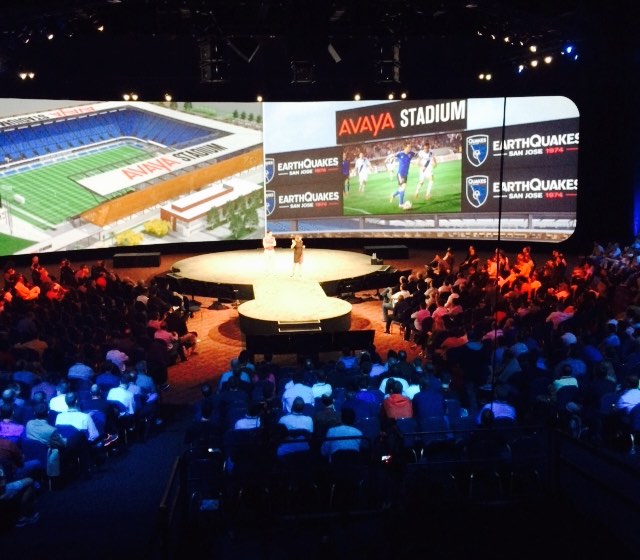
Avaya may become Earthquakes’ stadium naming rights sponsor

This was posted to the BigSoccer Earthquakes’ forum by Soccer Silicon Valley’s Colin McCarthy:

avayastadium

Until yesterday there hadn’t been much discussion about who would buy the naming rights to the stadium. Since the stadium is in the heart of Silicon Valley, it was figured that the Quakes would eventually find one prior their first match in 2015.

Avaya is a tech firm based in Santa Clara. They are a spinoff of Lucent/AT&T, specializing in digital phone (IP/PBX) systems. They also are make networking equipment such as switches and routers, and that’s where there may be a bit of a snag. Sunnyvale’s Ruckus Wireless signed a deal last March to be the stadium’s in-house WiFi provider. Ruckus and Avaya are competitors in at least the networking segment, and team president David Kaval has acknowledged the difficulty of working between competitors when trying to land sponsorship deals. Typically a sponsor wants to be known as the official ___ sponsor of the team, whether we’re talking networking, soda, or airlines. Ruckus does a small fraction of the business Avaya does, so there’s certainly the potential for one of the sponsors to be overshadowed by another.

Speaking of networking companies, what about Cisco? We haven’t heard from them in a few years, since discussions about a San Jose ballpark were in high gear. Both Ruckus and Avaya are competitors of Cisco Systems, and while the soccer stadium is quite separate from a ballpark, the ownership at the top for the A’s and Quakes is basically the same. Cisco has gone through a series of acquisitions and layoffs lately, and speculation has bubbled for some time about CEO John Chambers’ possible retirement. If he retires, there’s a good chance that any A’s ballpark naming rights deal would be subject to new bidding, as Chambers was a driving force behind it. Beyond that there’s some question about whether Cisco would sign on to sponsor an Oakland ballpark as opposed to the highly supported Fremont and San Jose sites. The Valley is big, rich, and ever evolving, perhaps too fast for MLB’s glacial pace.

Mesa, A’s show off Hohokam Stadium progress

With two months to go before completion, A’s ownership and the City of Mesa did a tour of Fitch Park and Hohokam Stadium today, emphasizing all the  improvements A’s players and fans will get to enjoy in a few months. I visited back in the summer. I should have a chance to check it out again in the coming weeks. Until then, take a look at tweets by local media showing the project’s progress. The new clubhouse isn’t quite finished yet, but the seats and scoreboard appear to be complete.

Think about that for a moment. Over the span of six months, the A’s are installing new scoreboards at Hohokam, the Earthquakes Stadium, and the Coliseum. That’s a lot of blinking lights!

As much as I loved the old school, laid back intimacy of Phoenix Muni, I’m looking forward to attending games at Hohokam, which is a fairly short bike ride from my brother’s house in Mesa. The spring pilgrimage looks to become an annual rite for me.

Kaplan returns Wolff campaign donations; Coliseum City courts hedge fund

Last week the Trib’s Matthew Artz asked Oakland City Council member and mayoral candidate Rebecca Kaplan about $2,100 in donations that came from Lew Wolff, his wife and daughter. There was a suggestion of impropriety, as an Oakland law prohibits campaign contributions from any party that has done contract negotiations with the City during the prior six months. After huddling with her staff over the legality of the donations, Kaplan decided to return the checks. Wolff appeared to be unaware of the law. You may remember that Wolff donated a much more eye popping sum of $25,000 to a committee backing Don Perata’s mayoral campaign during the 2010 election, a move that may have helped cost Perata the election. Perata admitted that he wasn’t going to waste time or money trying to keep the A’s in town.

That’s a much different stance than Kaplan today, as she has staked a claim to helping save the A’s by spearheading lease extension talks. Kaplan has also supported Coliseum City, though the project is considered Mayor Jean Quan’s baby, at least politically. The now returned donations are under investigation by the California Fair Political Practices Commission, as is another $1,000 that was donated to a Kaplan committee whose fund has been liquidated under similar concerns.

Kaplan has been the frontrunner in recent polls, beating Quan in a projected ranked choice voting scenario. It’s unclear what damage the donation investigation could cause the Kaplan campaign, which is only three weeks from the election.

Matier and Ross reported over the weekend that Coliseum City is getting cozy with yet a hedge fund to potentially finance the project. The SF Business Times revealed that the target is Perry Capital, a fund managed by Paul Leff and Dan Golding. They purchased a non-voting, minority share (20%) of the Raiders for $150 million from Al Davis before his death. The fact that Perry already owns a share of the team gives the story more credence than previous stories about the Crown Prince of Dubai. Then again, let’s keep in mind the rather unimpressive amount of financial support for the project so far:

Forest City backed out because they didn’t see the numbers working out. Colony/HayaH has purportedly been hesitant to fully commit for similar reasons. The Dubai story was just that, a story, and Perry Capital? Well, at least there’s an existing relationship there. There’s a $500-600 million funding gap that needs to be addressed. If Perry is going to assume a large percentage, they’ll want their pound of flesh in return. That could mean a larger slice of the team, though Mark Davis is reluctant to drop below a controlling percentage, which in the NFL has been 30% for a family and 10% for a controlling partner in that family. Davis and his mother own 50-51%, so there’s some room to drop. The NFL may also be looking to lower the requirements for legacy family ownerships.

It’s hard to judge based on the limited information we have, but we can assume that trading in a share of the team for a private stadium subsidy (to be paid back by a rise in team equity and development revenues) is an option available in both Oakland and Los Angeles, and perhaps in San Antonio as well. Leff and Golding have seen their investment appeciate 29% since their 2007 purchase, which seems impressive enough except when compared to the skyrocketing values of many other NFL teams. The Raiders for now are a low revenue team in a low value market, with the only obvious recourse being the construction and selling out of a new stadium. Leff and Golding could push hard and try to bring in even more partners to spread out the risk. The problem is that Coliseum City is clearly a long game, with significant profits going to pay for the stadium and ancillary development. Rental and real estate sales revenue are the prize that will take years to materialize.

The struggle to attain financing for Coliseum City highlights how different Coliseum City is from other NFL stadium development plans. The NFL and the Raiders at first wanted to focus on the stadium, with further development coming down the line and not necessarily tied to stadium loans or bonds. The league has a very sophisticated financing structure in place. It gauges the size of the stadium project, assesses the ability of the applicant team to pay for its share, and doles out loans from its G-4 program. The league also plays matchmaker, hooking team owners up with huge financial institutions like Goldman Sachs and BofA. Those banks are there to manage that funding gap, the same kind that Coliseum City is trying to fill for the Raiders. When Oakland decided to move in their own direction, the NFL decided to play wait-and-see with the project. If JRDV and the other CC principals can pull it together, the NFL can give the project its blessing and untie the G-4 purse strings. If not, Oakland’s future will look very bleak on the Raiders front. It makes one wonder why they’re going to so much trouble when there is a tried-and-true method to financing a new NFL stadium. It limits the number of potential partners in favor of a high-risk strategy with a low chance of success. And if they’re having to resort to working with a hedge fund, the usual avenues for funding may all be exhausted.

There is some historical symmetry to this effort, as the original Oakland-Alameda County Coliseum Complex was privately financed after Bob Nahas and others went to some far-flung places to secure that funding. The ENA deadline is October 21, and news of a new partner may allow Oakland to extend the period six months, though such a transparent move isn’t likely to gain Mark Davis’s support. The development team has spent three years and $5 million on Coliseum City. What do they have to show for it? So far, not much beyond the 3,500 pages in the EIR.

LA smoke = NFL’s fire

So far this year I’ve mostly held off from commenting the routine every-six-weeks rumors about a NFL team or two moving to LA. Buttressed by nothing but anonymous sources and a whisper campaign, I chose to sit back and wait for real news to come forth. Unfortunately for the three cities in line to have potential relocation candidates – San Diego, St. Louis, and Oakland – there’s now too much going on to dismiss it all as mere rumors. Something else is happening, and chances are the NFL is directing the whole affair.

Could Dodger Stadium be a temporary NFL home? The NFL isn't dismissing the idea.

Could Dodger Stadium be a temporary NFL home? The NFL isn’t dismissing the idea.

It always starts out with the NFL leaking info to two national reporters, NBC Sports/Pro Football Talk’s Mike Florio and CBS Sports’ Jason La Canfora. “Fresh” rumors will cycle about the aforementioned teams, or even the Bills, Jaguars, and Vikings prior to their respective ownership or stadium changes. The nature and frequency of such leaks – with little subsequent activity to make them pay off – made them easy to dismiss. Now, I’m not so sure. Last week AEG asked the City of Los Angeles for a six-month extension to bring in a team. The current agreement is set to expire next week, on October 17. An additional six months would allow AEG to cover the postseason window during which teams are allowed to declare their intent to relocate, usually in February. That could easily happen with the Rams and/or Raiders, who are unencumbered by leases past this season.

Then yesterday, LA Times football reporter (and former Merc scribe) Sam Farmer revealed that the NFL may consider Dodger Stadium as a temporary stadium. That would put three venues in play in LA: the Rose Bowl, LA Memorial Coliseum, and Dodger Stadium. Each comes with a sticking point, even for temporary use. The Rose Bowl has a restriction on the number of large events that can be held there, yet the City of Pasadena wants to encourage additional events that could help it pay for $168 million in recent renovations. The LA Coliseum is controlled by USC under a new lease agreement. An NFL team having to play tenant to a college is not something the league prefers, and the size and condition of the venue are not ideal either. Dodger Stadium, not previously considered as a temporary venue, has a hard cap on the number of seats inside the venue at 56,000. That’s small for NFL’s taste, and it’s obviously not a football stadium. However, Dodger Stadium has plenty of suites and luxury amenities that any team could use to make up for the lack of capacity by jacking up prices. Previously Dodger Stadium had been considered as a potential football venue, with new construction either adjacent to or replacing the current venue with the baseball team moving downtown. That’s an extremely far-fetched idea that has far too many moving parts (AEG, Guggenheim, City) to take seriously at the moment.

One idea that seems possible is the NFL making agreements with two or perhaps all three venues to host some numbers of games. This is especially important if two teams come to LA. The NFL would be able to play matchmaker, juggling three teams and three venues. Eventually one team and one venue will lose out, creating a competitive environment largely controlled by the league. They already wield control in the form of the G-4 stadium financing program and the associated hookups with banks and large financiers such as Goldman Sachs. Those hookups are just as important as G-4 because they mean that the bulk of the stadium construction cost wouldn’t have to be bonded through an open market (read: more expensive) process. Stan Kroenke is certainly rich enough to build a stadium at Hollywood Park himself, but he’s not going to turn down savings of several million per year in order to do it.

Moreover, the NFL has assigned an executive to oversee the LA market. From the LA Times:

Eric Grubman, an NFL executive vice president, said the league was guardedly optimistic about its discussions with AEG and supported the company’s request for an extension of its agreement with the city.

“The discussions are very preliminary, but we are encouraged enough by recent progress that we share AEG’s view that continued conversations would be worthwhile,” he said in a statement. “An extension could well provide the time necessary for us and AEG to determine whether the downtown site can be considered by our membership during our next off-season period.”

AEG’s seemingly dead Farmers Field project has suddenly gotten a boost and some level of validation from the league. The NFL probably still doesn’t like the terms (AEG gets piece of relocating team in exchange for building stadium), but such an exchange may be unavoidable in the future. It certainly doesn’t hurt or cost the NFL to keep Farmers Field in play for now. Ed Roski’s City of Industry plan, a frontrunner several years ago, appears beyond dead though the land remains available if the NFL is willing. There’s even the crazy concept of the NFL building a stadium on its own and housing two teams within. It would be the ultimate in control, though the league would have to go through the lengthy, arduous CEQA process to get it done.

Finally, there’s the very basic notion of teams and the NFL using LA as a stalking horse, which it has done successfully for nearly two decades. While that card will always be in play, inaction on the local level by San Diego, Oakland, and St. Louis make the tactic less effective than it has been previously. If the NFL can use scare tactics to cajole one of these cities to pony up for a stadium, I imagine that they’ll consider it a success. The other two can relocate under the NFL’s guidance and supervision. Relocation fees would probably be baked into the stadium deals and a sale of an ownership stake, with the payoff coming in the form of a 2X franchise valuation.

Now that the FCC has struck down local market NFL blackouts, the ratings-related advantages for keeping teams out of LA will disappear after the current broadcast agreements expire in 2022. It’s a good time for the NFL to act.

AAA Affiliate shuffle: Love the one you’re (not) with

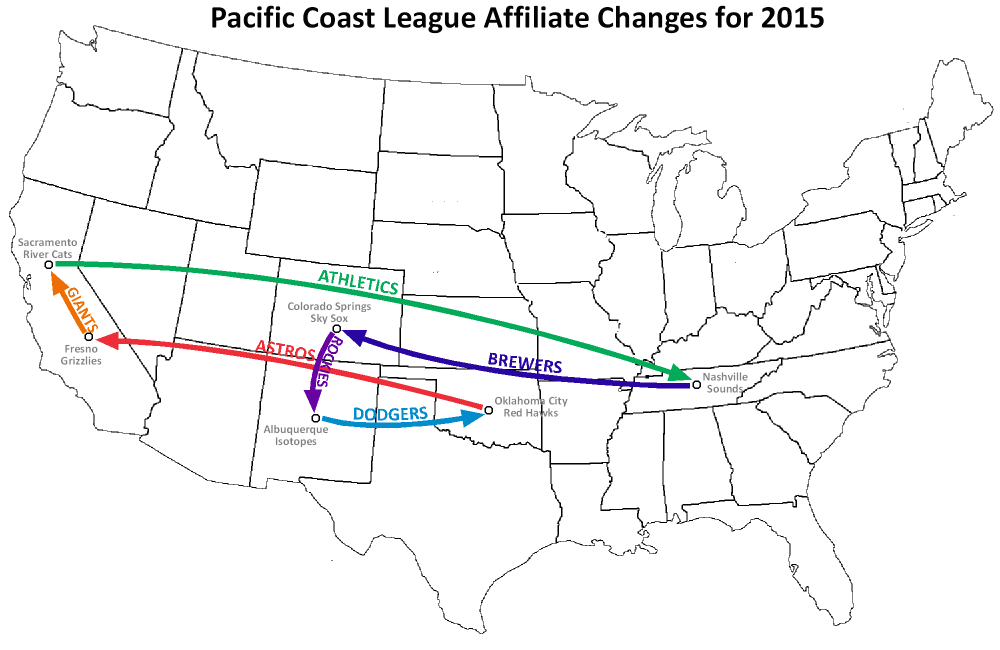
A flurry of PDC agreements came throughout the day. It seemed that the A’s kicked things off before 10 AM with their 4-year PDC with the Nashville Sounds. However, the Giants and Sacramento River Cats scheduled their own press conference, also at 10, to talk about their 2-year PDC. Then all the other affiliates and PDCs got in line, finishing with a hastily agreed upon agreement between the Brewers and Colorado Springs.

Brewers GM Doug Melvin even sounded like a spurned lover:

“Very disappointing. We gave them 10 years there. A number of times we had a chance to move and we were patient with (the Sounds). I’m just disappointed they wouldn’t have given us two [more] years for what we put up with there.”

There happens to be Greer Stadium, the aging, 36-year old ballpark south of downtown Nashville which is being replaced by shiny First Tennessee Park. The agreement’s only for 2 years, which may allow the Brewers to try another city, since Colorado Springs is only slightly above the seventh circle of hell when it comes to desirable affiliate cities because of park factors. That doesn’t explain why the Rockies were so eager to bolt for Albuquerque, a city that is more than a mile above sea level. The game of musical chairs, which was truly kicked off by the Dodgers when co-owner Peter Guber bought a 50% interest in the Oklahoma City Red Hawks last week. OKC will be the new AAA affiliate of the Dodgers, which left the Astros to hook up with the Fresno Grizzlies.

All of this was done in the last 24-48 hours

All of this was done in the last 24-48 hours

Sooooo…. Nashville? It’s nearly 2000 miles from Oakland with nary a direct flight link them together since neither city has a major hub airport. Nevertheless, the River Cats-turned-Sounds will be playing in a fabulous, Populous-architected ballpark next year. First Tennessee Park will be at Sulphur Dell, the site of an old ballpark (also named Sulphur Dell) that dates back to 1870. Like Sacramento pre-River Cats, Nashville had a lengthy gap in 60’s with no pro baseball in town after Sulphur Dell closed in the 60’s. Herschel Greer Stadium opened in 1978. The Brewers came calling in 2005 and have been there ever since. The Brewers, Sounds management, and civic leaders have been trying to get a new ballpark in Nashville since 2007 (sounds familiar), finally putting together a deal that raised $65 million in public bonds while tying Sounds ownership to some $37 million in private development surrounding the ballpark. It’s a deal similar in structure to Petco Park, though there is some fuzziness on whether that private investment truly has to come in and when. Construction only started in earnest in March, making the development time very short, much like El Paso, Reno, and Sacramento.

Certainly the A’s front office was attracted by a brand new ballpark, as it would make for an easy transition for players who don’t make the big club. Sounds owner Frank Ward was probably salivating at the prospect of a winning, contending team playing in his new digs, as the Brewers-affiliated Sounds haven’t gone to the postseason in eight years, a cumulative .504 winning percentage since becoming a AAA city in 1985. Coincidentally, the Sounds finished with a 77-67 record this season, good for second in the American Southern division, but the team has generally been inconsistent.

FTP is bounded by 5th Avenue N, 3rd Avenue N, Jackson and Harrison Streets. While a 1,000-space parking garage will be built next to the ballpark, the site is only three-quarters of a mile from Printer’s Alley, Nashville’s well known downtown nightlife area. Numerous hotels are located downtown, with several more located along Music Row to the southwest. Catch some live music, maybe a Predators game at Bridgestone Arena, or take a tour of legendary Ryman Auditorium, the former home of the Grand Ole Opry.

This slideshow requires JavaScript.

After going over several different design options, it was decided that the ballpark would be oriented south-southeast. The northern edge would have an entry gate behind home plate, but otherwise there wouldn’t be the usual contour following the seating bowl that you usually see at most minor league parks. The idea is that ancillary development would occur to the east and south, between the park and downtown. If done correctly, a “ballpark village” of sorts may emerge, capturing visitors and locals who may park downtown and walk to the park. Again, there are shades of Petco Park in the site plan, although at a much smaller scale.

The full Sounds 2015 schedule is not yet available on the team’s website. When it is I’ll put together some sample ballpark trips you may consider. Next summer I’d like to do a AAA trip consisting of Nashville, Memphis, Indianapolis, Louisville, and perhaps Columbus again. The closest cities (within a 4 hour drive) are Atlanta, Cincinnati, and St. Louis, so putting together trips that involve MLB teams, especially the A’s, will be tough. If you’re planning a trip, you may find yourself flying through ATL, so that may work to your advantage.

As for the River Cats? I wish them luck. Their PDC with the Giants is only 2 years, a somewhat surprisingly short term considering the fan cultivation effort that is obviously the goal of the affiliation switch. They should do fine in 2015 thanks to a honeymoon period of sorts. The River Cats have a good promotional machine that should crank up into high gear with the Giants involved. If they can regain some of the attendance losses they’ve suffered the last few years, the change will have been worth it.

Quan, BayIG strike back with “basics” of Raiders deal

Matier and Ross reported today that the City of Oakland and BayIG, the group behind the Coliseum City project, have put together the “basics” of a deal that would include a ~$1 Billion stadium for the Raiders and development of up to 800 acres surrounding the stadium.

Now, Zach Wasserman, an attorney representing backers of a hoped-for sports, housing and retail complex called Coliseum City, says the “basic terms” of a financial deal have been worked out among his group, the city’s negotiators and the Raiders.

The big takeaway is that the City and County, which would be giving up land and paying for infrastructure costs as part of any deal, would also have to pay off the remaining $120 million in Coliseum debt. That is an enormous giveaway on Oakland’s part no matter how you slice it. Both City and County officials have insisted in the past that any large plan like Coliseum required the debt to be taken care of – preferably by the developers. If you can remember back to the “adult conversation” in December, County Supervisor Keith Carson practically hijacked the proceedings by having the first 10-15 minutes of the meeting spent on recounting the debt liability faced by the JPA.

Carson emphasized that there will be no future project if debt isn’t addressed first.

So, let’s tally up what we know are the costs of Coliseum City so far:

  • $344-425 million in infrastructure cost
  • $120 million in Coliseum debt

That’s up to $565 million in project costs, all without building a single stadium, hotel, or office building. And there’s more. Not included is the $80 million in arena debt, the responsibility for which is up in the air. In the EIR (you guys have been reading that, right?), the City states that of the 800 acres covering the entirety of the project, 535 are publicly owned. That includes the City, County, JPA, and EBMUD. The remaining 265 acres are privately owned, making those properties subject to negotiation. Most of that land is on the west side of 880, but some important pieces are right next to the Coliseum or in between the Coliseum and the BART station. Now let’s take a low market rate offer of $2 million per acre. That’s another $530 million that would be borne probably by developers, but could also be paid to some degree by the City since Oakland has eminent domain capability. No matter who pays for it, the total cost of land, infrastructure, and dealing with outstanding debt is $1.1 Billion. That’s the cost of the Raiders stadium right there, or two A’s ballparks.

The counter is that the Raiders, NFL, and BayIG are paying for the football stadium, which may or may not have a retractable roof, may have 56,000 or 68,000 seats, etc. The potential upside is 10,000 new residents, 21,000 jobs, and retaining all of the teams – though it still hasn’t been articulated how any sort of carveout for the A’s would work.

Now compare that to what Lew Wolff is offering, which is to pay off the debt on both the Coliseum and the Arena. While we haven’t seen plans, the planned development is not expected to be as expansive as Coliseum City, as Wolff has said that acquiring private property for this purpose is a bit sticky for his liking (Coliseum North being Exhibit A). Besides, even 120 or 200 acres is a lot of land.

We haven’t yet heard Alameda County’s side, and Carson is certain to raise questions about the giveaway. The City can come to terms on a deal, but without the County as a partner the deal isn’t sealed. I fully expect a sequel to the adult conversation, when all of the costs and liabilities are laid bare. If the A’s get it together in time, there may even be a sort of competitive situation with two bidders. Let the rich guys duke it out over what is purported to be high quality, valuable land. Chances are that such a discussion won’t happen until after the election. After all, there’s something fishy about the timing of this release, considering that last week Oakland mayoral candidate and CM Rebecca Kaplan took credit for “saving the A’s in Oakland” (h/t Zennie Abraham).

AAA Shuffle Begins with Guber’s Purchase of OKC RedHawks

Though we’re at least two weeks from MLB and AAA franchises from coming to new player development contracts (PDC), at least one team has gotten proactive to secure its future allegations early. A group led by Dodgers (and Warriors) co-owner Peter Guber is purchasing the Oklahoma City RedHawks, currently the AAA affiliate of the Houston Astros. The franchise will fetch $22-28 million according to The Oklahoman. Currently, Mandalay Entertainment owns the team. That company is also headed by Guber, making the purchase largely a paperwork matter. Mandalay also recently sold the Dayton Dragons (A-Midwest League) for a whopping $40 million, reflective of the team’s incredible attendance record and financial success.

The purchase of the RedHawks means that the Dodgers will soon switch their AAA affiliation from Albuquerque to Oklahoma City, making ABQ another free agent in this fall’s affiliate shuffle. Historically the Dodgers have never cared too much about having their AAA affiliate within driving range, as Albuquerque has hosted their AAA team twice, as the Dukes and now the Isotopes for nearly 50 years combined. It appears that the Dodgers have been more concerned about developing pitchers at more than a mile above sea level, resorting to using a humidor last year.

Rumors remain strong that the Sacramento River Cats will drop the A’s and hook up with the Giants, leaving Fresno as another free agent. Las Vegas may be re-upping with the Mets despite the distance from New York. Nashville, which will open a new stadium next year, remains up in the air in terms of its continuing relationship with the Brewers. Colorado Springs may also be available depending on how talks with the Rockies go. The El Paso-Padres and Tacoma-Mariners deals also expire in a week, though those seem more secure than others; El Paso because of a brand new ballpark, Tacoma because it’s so close to Seattle.

Making affiliate deals is as much about the bottom line as any other factor. Fresno has looked increasingly unattractive in recent years because of unstable ownership and the Grizzlies’ habit of running in the red. Fresno’s biggest may be something it can’t control: the cost of airfare in and out of its smallish airport. Air travel costs may also explain why the Mets have few qualms about extending with the 51s, since NYC-Vegas flights are relatively cheap and plentiful.

Here’s a list of potential upcoming AAA affiliation changes:

  • Oklahoma City RedHawks (from Astros to Dodgers)
  • Sacramento River Cats (from A’s to Giants)
  • Fresno Grizzlies (from Giants to Brewers or A’s)
  • Nashville Sounds (from Brewers to A’s)
  • Albuquerque Isotopes (from Dodgers to Astros)

Other changes to look for in the future are the Round Rock Express (owned by the Ryan family) switching affiliations from the Rangers to the Astros after 2018, and the Reno Aces, whose relationship with the City of Reno and Washoe County has been strained at times. The Twins just announced an two-year extension of their PDC with the Rochester Red Wings, cutting off a potential switch candidate for the Mets. And the Angels extended with the Salt Lake City Bees earlier in the spring.

Selig’s Lamentations and the Law of Unintended Consequences

To hear outgoing MLB Commissioner Bud Selig explain it, he was stuck in the middle. Powerless. The issue was forever “complicated.” He wished he could’ve resolved it. So when he rolled through Oakland on his farewell tour, there was no staged ceremony near home plate, no televised gift of a rocking chair made of bats. The only real exchange was a series of questions from local media, asking him if he could’ve done more get the A’s to a new ballpark. All he could say was that a ballpark was needed. Acknowledging that the so-called Blue Ribbon Commission/Panel/Tribunal was effectively shut down, the only thing missing was a hook to pull him off the podium.

Anyone’s thoughts on how the A’s (and Giants) should be treated are largely colored by three views:

  1. Oakland’s standing as a major league host city
  2. How much power the Commissioner has over teams and whether he should wield that power
  3. The sanctity of territorial rights and baseball’s antitrust exemption

There was never a question of whether the Coliseum is decrepit enough to be replaced; of course it is. There’s also little question of whether San Jose is large enough or wealthy enough to host a team if not encumbered by territorial rights; of course it is. The three items listed above, however, are up for serious debate. And despite the A’s 11th-hour lease extension last year and the hurried extension talks this year (done to give Selig something to hang his hat on as much as anything else), those questions will continue to dominate the discussion moving forward. All we get for the next few years as A’s fans get is a brief respite. Frankly, that’s rather welcome at this point.

Selig touted the 22 parks built during his tenure as head cheese. Virtually all of those parks have a single thread in common that Oakland can’t give at this point: public funding. The notable exception is San Francisco, where the Giants were somewhat ostracized for daring to privately finance their yard. The Lodge thought that baseball was on a slippery slope to No-Subsidies-Ville, with noted baseball town St. Louis playing hardball with its beloved Cardinals enough that the team financed $290 million for Busch on their own. They didn’t need to worry, as the extortion game succeeded in Miami and Minneapolis, even through the recession.

Oakland doesn’t have cash to offer. Despite their repeated shows of incompetence, Oakland’s pols are not crazy enough to offer cash straight up (I think). But they’re showing signs of being willing to offer up a big swath of Coliseum land, which in the long run is nearly as good as cash. If the City/County hadn’t gotten so legally entangled with the Raiders, Oakland would’ve been in the position to offer a Coliseum City-like deal to the A’s. Selig would’ve acknowledged the skin that Oakland was willing to wager, and I’d be watching the game in a new ballpark right now instead of an old one. That’s not to say it would’ve been a good deal for Oakland. It would still be a big-time subsidy. But it wouldn’t have been as disastrous as Mount Davis, that’s for sure.

Selig took the acting commissioner job in September 1992, as Bob Lurie was finalizing a deal to sell the Giants to the Vincents (Naimoli and Piazza). Still carrying the scar from losing the Braves to Atlanta, he purportedly held off the deal long enough (enduring a lawsuit in the process) to allow San Francisco interests to pull an ownership group together. After failing to save the 1994 season, he worked hard to avoid further work stoppages, though he sacrificed the Montreal Expos to do it. After he screwed over the original TB Giants owners, he settled with another group to get them an expansion team in 1998, helping to infuse baseball with cash after the Lodge took it on the chin with the owners’ collusion lawsuit. In the process, he bound the Rays to practically unbreakable lease at a domed stadium. Plus he forgot that San Jose and Santa Clara County, which were gifted to the old Giants ownership when they pursued a ballpark in the South Bay, remained granted territories to the Giants after the new SF-only ownership group took over. All of that happened while he was acting commissioner.

As the elected, properly sworn-in permanent commissioner, Selig orchestrated the Expos contraction-then-expansion ownership swap among three teams that netted baseball a handsome expansion fee and brought baseball back to DC. To satiate O’s owner Peter Angelos, he and his executive team cobbled together a deal that made the O’s majority owner of a new regional sports network, MASN, which owned broadcast rights to the Nationals. Apparently Selig didn’t see the TV rights bubble coming or the conflict such an arrangement might create. The Nats, whose initial term on MASN is now up, want in on that bubble while the O’s are unwilling to pay market rates. Naturally, the teams are in court. Selig, who gave Angelos MASN to get him to stop a lawsuit against MLB, now sees two teams stuck in trench warfare, arguing over hundreds of millions of dollars. To mollify the Nats, Selig is giving the team money from his eight-figures-per-year iscretionary fund. These days $25 million or so is small potatoes compared to the riches Ted Lerner sees going forward, so the struggle continues.

It’s with that perspective that Selig has found himself stuck trying to satisfy both the A’s and the Giants. There’s Selig the legacy-protector, who would prefer to keep the team in Oakland if they could just pull out their checkbook. There’s Selig the Lodge-unity-protector, afraid to take the territorial rights issue head on for fear of reprisal from one faction of owners or owner. Then there’s Selig the procrastinator, whose blind eye towards many baseball issues (PEDs, inner city youth development, growing economic disparity among teams) made this particular outcome entirely predictable. Some want to give Selig credit for MLB Advanced Media or growing TV revenues, when really he just stood aside and let his underlings innovate for him. I mean, really, Selig and MLBAM? The guy doesn’t even have email.

Complete conjecture on my part: I suspect there was a plan at some point in which the Nats-O’s TV issue was resolved permanently and the under-the-table payments could be rerouted to either the A’s or Giants as part of another temporary deal. If the A’s were granted San Jose, the Giants would be given a “refund” of their revenue sharing payment. If the Giants kept the territory, the A’s would get the piece of the discretionary fund as financial ballast as they built in Oakland (remember, per the CBA revenue sharing goes away if the A’s build anew in the Bay Area). Over time such payments would taper off as the teams adjusted. With such funds indefinitely in use for another conflict, there was no solution to be had. Another consequence of the Nats-O’s dispute is that any thought of creating a new Bay Area RSN with the Giants in control in a similar arrangement to the O’s now has to be considered verboten.

So yes, Selig is right to an extent. The problem is complicated. Still, all it would’ve taken is better foresight to manage this and all of the other problems. They are merely ways of moving money around a table, out of one pocket and into another. Some have argued for MLB to establish a stadium loan program like the NFL’s G-3/G-4. That’s not happening soon because the NFL’s TV dollars used to establish G-4 dwarf baseball’s national TV revenue $6 billion to $1.5 billion. The big market owners see the new TV contracts, in which each team receives $50 million per year, as enough in terms of support when coupled with revenue sharing and the luxury tax. That’s enough to give the sense of competitive balance that Selig likes to tout. Then again, we all know that’s an illusion.

Competitive balance means allowing the poor teams to play as if they don’t see the glass ceiling. That’s your Oakland Athletics, now and into the foreseeable future.

Rob Manfred elected next MLB commissioner by owners

After a full day of deliberation and several trays of cookies, MLB’s owners finally approved MLB executive Rob Manfred as baseball’s next commissioner (NY Times/USA Today/LA Times/MLB/ESPN Sweetspot. Throughout the day, there were frequent reports that the vote was deadlocked at 22-8 or 21-9, 1 or 2 votes shy of the three-quarters of owners needed to approve Manfred. A late afternoon break preceded the final vote, which in true Bud Selig fashion, was tabulated at 30-0. Perhaps the so-called Reinsdorf block saw the writing on the wall and gave in knowing Red Sox co-owner Tom Werner didn’t have a chance, or they knew that Manfred, who has worked in the league offices for 15 years, was the more qualified candidate. Either way, in February Manfred stands to inherit a full plate of for now unresolved issues from Selig, who is now officially a lame duck.

Who was the swing vote that got Selig’s man, Manfred, over the top? It appears to have been Brewers owner Mark Attanasio,

Among the issues that need resolution sometime in the future:

  • Nats-O’s (MASN) television rights negotiations/lawsuit
  • The future of the Tampa Bay Rays
  • Negotiating terms of an Oakland ballpark, if it can come to fruition
  • The next collective bargaining agreement (current one expires after 2016 season)
  • Blackout rules for local broadcasts

Jerry Reinsdorf wanted to go hardline against the players’ union, despite MLB having one of the most favorable, cost-controlled deals in sports. He considered Selig to be too conciliatory in his dealings with the union. It’s hard to say how much more Reinsdorf would’ve gained in the next labor talks, though the obvious goal would’ve been a salary cap of some sort. Reinsdorf was considered the power behind Selig’s throne, the senior whip who got the votes Selig needed. Here’s to hoping that sanity, not greed, wins out in the next labor talks.

During Selig’s tenure, he sought to consolidate power, getting rid of the league president roles and the deputy commissioner, opting instead for a more vertical org chart with subordinates’ autonomy reduced. One of the rumored challenges for the owners in the upcoming CBA/Constitution talks is how to curtail the powers of the commissioner’s office, which now includes disbursements of a discretionary fund that runs into eight figures (see Nats-O’s).

Going in, it was thought that the Larry Baer and the Giants supported Manfred, while Lew Wolff and the A’s supported Werner. Early voting seemed to bear this out. They even had some discussions early in the day.

The official approval of Manfred would appear to confirm the status quo going forward: Giants not budging on T-rights, A’s forced to make a deal in Oakland. The recently approved Coliseum lease extension further keeps the A’s in Oakland at least for the next several years. After that, well, who knows? MLB has seen enough of the stadium saga to know that neither city is a slam dunk, so contingency plans are needed. And it was Manfred who affirmed the threat to move “out of Oakland” last month, supposedly going so far as to mention San Jose in the same breath. So if anyone’s thinking that any city has an ally in the MLB commissioner moving forward, they shouldn’t. Manfred’s on baseball’s side, not yours.