The false horse race narrative

Mark Purdy has a new column. It’s designed to get San Jose supporters to buck up, keep a stiff upper lip, hang in there, what have you. It has a bunch of quotes from the likes of San Jose Councilman Sam Liccardo and A’s managing partner Lew Wolff that trash Oakland. It’s a counterpoint to Marcus Thompson’s column from over the weekend that was meant to breathe life into the Keep-the-A’s-In-Oakland movement. Purdy laid odds, a generally weak tool to use for complicated situations like this:

Odds of the 2020 Athletics playing in a new Oakland ballpark: 25-1.

Odds of the 2020 Athletics playing in a new San Jose ballpark: 10-1.

Odds of the 2020 Athletics playing at AT&T Park: 50-1.

Odds of the 2020 Athletics playing in another part of the country: 80-1.

Odds of the 2020 Athletics still playing at decaying O.co Coliseum, with everybody still arguing about where they should move: 2-1.

Perhaps Steven Tavares from the East Bay Citizen spent too much time at Oakland’s City Council session tonight (the A’s lease extension was approved, BTW), but something in Purdy’s column flipped Tavares’s wig, leading to a litany of entertaining, rant-filled tweets. Among them:


You see, here is the problem. You have one guy laying odds, and another characterizing one party as in the lead. The brutal truth is that this type of narrative is completely useless. It’s bullshit. If you scratch the surface even a little bit, any oversimplified telling like this crumbles to dust. And there’s a simple reason for this.

There is no race.

We know what a horse race looks like. The showcasing of the Expos when MLB bought the team out from Jeff Loria is proof of that. Las Vegas and Portland were used in the process, and DC was taken. We’re not seeing that here. That’s not to say that MLB and either Commissioner Selig or his replacement will end up choosing between Oakland and San Jose at some point. They well could. The problem is that MLB doesn’t like either city’s plan, so it’s not going to choose either city. You can’t have a race when the judge thinks the two competitors don’t qualify. MLB would rather intervene only when it has to, say, when the A’s lease extension talks hit a snag. Then it can breath a sigh of relief, stretch it out a couple more years, and hope that a solution materializes.

Guess what? Oakland and San Jose pols are hoping for the same thing! Oakland is hoping that Wolff gives up and MLB kills off San Jose, so that they’re the only horse left. San Jose hopes that Oakland exposes itself as incapable of getting a deal done, forcing MLB to deal with San Jose. (At least San Jose is trying to force the issue with the lawsuit, but that’s a long shot at best.) None of these rather similar hope-based strategies are predicated on getting a site and pulling together financing.

Unless San Jose and Oakland provide something MLB wants ($$$ or an equivalent), MLB doesn’t have to listen to either one. When MLB negotiated the Coliseum extension, it didn’t set a deadline for Oakland to get a deal done. Selig didn’t tell Oakland to get Howard Terminal ready ASAP – hell, he didn’t do that for Victory Court either. If any substantive talks for a new ballpark are going to take place, MLB will have to be at the table brokering everything because of the intense mutual distrust between Oakland and A’s ownership. That’s exactly what happened in Miami (hello again, Loria!), and we know how badly that turned out. Yet do you hear about something like that happening in Oakland? Nope.

Now maybe MLB’s hand will be forced if Oakland decides to go with the Raiders’ preference of demolishing the Coliseum and leaving the A’s with no obvious place to play. Then it could support Wolff and say to Oakland, you made your choice. It could explore Howard Terminal further, though I suspect it has plenty of information on which to base a decision by now. It could go to San Jose, which would mean it would have to untangle the mess made by the Giants – who I hear have spent eight figures on legal work trying to derail the A’s and San Jose so far. As far as the A’s are concerned, MLB probably views them as an unstable Third World country on another continent. It would rather not get involved.

So until MLB actually decides to give a damn, let’s dispense with this horse race narrative. It’s not helpful and it only provides false hope to fans on either side of the divide, or even those who don’t particular care for a city and just want to keep the team in the Bay Area. It’s not fair to fans, and it’s a total distraction.

The Proposal

The last public statement Bud Selig made on the A’s-San Jose lawsuit was at the beginning of the World Series, when he held court for the assembled national media. The session included the obligatory question on the A’s situation, which included Selig’s reflection on the lawsuit because Judge Ronald Whyte had recently thrown out many of San Jose’s claims in the case. Here’s what MLB.com’s Paul Hagen wrote then:

A judge, ruling on a lawsuit filed by San Jose against Major League Baseball, recently upheld MLB’s right to determine when and where franchises may relocate, but left open the question of whether the city of San Jose may sue for damages. Selig said, however, that this doesn’t impact the timetable for a resolution.

“I wouldn’t say so. We were very pleased with the decision, obviously. But nothing has changed,” Selig said. “We’re working on details. Look, I know everybody says it’s taking so long. But the more our group has gotten into it, the more complex it is. If people really understood all the complexities, they would understand. But it’s a situation that needs to be dealt with.”

Selig was asked if the complexity was the San Francisco Giants’ claim that they have territorial rights to San Jose.

“The complexities are all the parties,” Selig replied.

A month earlier, Selig went on John Feinstein’s radio show to complain about the A’s and Rays’ stadium problems. At the time Selig referred to the state of the Coliseum.

“It’s a pit,” Selig said. “It reminds me of old County Stadium and Shea Stadium. We need to deal with that. I’ve had a committee working on it for two or three years, and there’s no question we’re going to have to solve that problem.”

But hasn’t the committee been working on it for a long time? What’s the hold-up?

“We have, John, but I’ll tell you it’s far more complex,” Selig said. “Look, you have one team that wants to move and the other team doesn’t want them to move, and it’s a very complicated situation. Before I leave, I’m satisfied we’ll work out something.”

Now let’s pivot to the most recent revelation of a letter “formally” rejecting the A’s proposal to San Jose. MLB didn’t release the letter with the recent court filing, so we’re left to guess as to what the letter truly contained. The filing characterizes the letter as a final decision on the A’s move request. Since the news broke, several reporters have gotten unnamed sources to characterize the letter as a rejection of the proposal as written, but not a rejection of San Jose. Selig’s statements above – made three and four months after the rejected proposal letter – don’t sound like any decision, final or not, has been made.

Since we know nothing about the proposal, we can only speculate on its terms. Some of the discussion on this blog has been about the need for a greater public contribution. That may be the case, but I suspect that MLB wouldn’t focus on stadium deal terms that far afield. There’s always the matter of negotiation with between the team and the city when it comes time to write a DDA. Instead, I’m certain that the issue boils down to the overarching issue at play: territorial rights and compensation.

From the start of the San Jose talk in 2009, the Giants have never publicly stated a price. Lew Wolff has joked that he’d prefer to pay the same amount the Giants paid for Santa Clara County in 1992, which was $0. Since then, Wolff has hinted that he’d be willing to pay compensation based on actual demonstrable losses suffered by the Giants, not a big lump sum payment. Given that the Giants sell out regularly, demonstrable losses could be difficult to prove. If anything, MLB wants a serious compromise between the two sides, and isn’t satisfied with Wolff’s definition of compensation. While Wolff may be loathe to pay anything to the nemesis Giants, ponying up something is probably the only way to get down to San Jose.

At the same time, the proposal has to work within other written (and unwritten) rules MLB has set forth. Consider these additional issues at stake:

  1. How much additional debt does the club have to take on to make the ballpark happen?
  2. If the land encumbrance issues at the Diridon site can’t be resolved, what backup sites are being considered?
  3. Does the proposal involve the A’s staying on revenue sharing for some period of time?
  4. Are the A’s sticking to the small, 32,000-seat concept, or will they move to 36,000 or higher?

While all of these are legitimate concerns, I still think that it all comes down to the compensation issue. In February, Bill Shaikin reported that MLB gave the A’s temporary guidelines in order for Selig and the owners to approve the move. If there were guidelines given to the A’s, then it’s up to Wolff and John Fisher to comply with those guidelines. Otherwise they’re just spinning their wheels. Shaikin wrote then that compensation was not “among the list of matters for the A’s to resolve.” Sure, as long as the A’s are in compliance. If they proposed a different form of compensation or different terms, suddenly that issue is front and center.

If MLB convinces Judge Whyte to grant a stay in the discovery phase of the lawsuit, we probably won’t find out the substance of that letter or proposal. That would be, to put it mildly, unfortunate.

Lawsuit update: MLB says Selig rejected A’s-to-San Jose move a day before lawsuit was filed

Michael McCann’s Sports Law Blog, which has been keeping track of the legal maneuverings in the MLB-vs.-San Jose case, has uncovered a bit of a bombshell (hat tip Nathaniel Grow). From the most recent filing (defendant’s section):

In fact, MLB denied the Athletics’ relocation request on June 17, 2013, one day before this lawsuit was filed. On that date, Commissioner Selig formally notified the Athletics’ ownership that he was not satisfied with the club’s relocation proposal. The sole basis of Plaintiffs’ only claims that remain after the MTD Order—the purported failure of MLB to render a decision within the initial two-year term of the Option Agreement—is therefore meritless.

MLB is arguing that the land option agreement the A’s and San Jose entered into in late 2011 is invalid, making the case moot. To back up its claim, MLB cites this heretofore (and still) unseen letter, the ongoing Stand for San Jose-vs.-City of San Jose lawsuit, and the lack of a public vote. To be clear, that last part is because Commissioner Bud Selig discouraged a vote way back in 2010 (which to this day I consider a strategic error on San Jose’s part). MLB wants to keep the letter confidential and doesn’t want to show it unless the plaintiffs agree to confidentiality.

Of course, that’s the opposite of what San Jose wants, because they’re pushing for complete discovery. From their filing:

In fact, Defendants’ sections of this CMC Statement are filled with Assertions of fact. This Court should order immediate commencement of discovery so that these “facts” (and others) surrounding the Athletics proposed move to San Jose and their reasons for entering into (and then not exercising) the Option Agreement may be explored.

MLB is fighting hard to avoid any degree of discovery.

Timing is the issue here. MLB argues that Selig sent the letter 19 months after the option agreement was signed, and that 19 months was reasonable timing for a decision, even though MLB started formally addressing the ballpark issue and San Jose two years earlier. Did San Jose file the lawsuit upon receiving the letter, or did MLB send the letter preemptively, knowing that the lawsuit was coming? I knew the lawsuit was coming the week it was filed, and I figure MLB did too. Addtionally, what other communications could be brought up that could contradict the letter?

Grow notes:

It is of course possible, and perhaps even likely, that MLB would reconsider the move [to San Jose] in the future.

While we’re left to wildly speculate on everything, let’s consider the idea that MLB doesn’t like San Jose’s proposed contribution of land-and-infrastructure, and wants more than that to seal the deal. And understand that all the activity we’re seeing is happening because of the lawsuit. Everything should be understood within the context of the lawsuit. For better or worse, that’s where we are. I won’t be in town next Friday for the hearing, but I’m sure it’ll be juicy.

The adult conversation, at last

It’s been awhile. Today’s unusual joint meeting of the Oakland City Council and the Alameda County Board of Supervisors was the first such joint session in several years. It’s also been more than a couple of years since I wrote a post titled The adult conversation, which implored Oakland (and Alameda County) to start talking about what it will truly take to keep the pro sports franchises in town, and what it might mean to lose one or more of them. After watching today’s proceedings, I can say that we’ve had our first session, one of many to come.

If you were an unabashed supporter of Coliseum City, things didn’t get off on the right foot as AlCo District 5 Supervisor and Board President Keith Carson demanded to know the state of the Coliseum’s outstanding debt. Oakland City Council President Pat Kernighan tried to reel the discussion back in, but Carson insisted, and eventually he got what he wanted – a plain telling of debt for both the stadium ($113,790,000) and arena ($90,290,000) by County Auditor Pat O’Connell, who also happens to be the JPA’s auditor. That’s $200 million combined for the complex, though that figure goes down every year thanks to a $20 million annual debt and operating subsidy paid by City and County. Carson emphasized that there will be no future project if debt isn’t addressed first. The debt may prove to be a structural problem, since whatever public borrowing has to be made for infrastructure or other uses will be on top of or consolidated with the existing debt. The City and County want the teams or the private development group, BayIG, to cover that debt as part of the plan. Incidentally, Carson’s district covers Berkeley, Albany, and much of Oakland.

The debt talk lingered for 10 minutes, then Kernighan got the discussion back on the rails. Assistant City Administrator Fred Blackwell gave an overview of the current situation, with the renewed leases for the Raiders and A’s, their desires, and the Warriors’ plans. Blackwell said that the funding gap for the Raiders stadium, which he called a “sunken cost,” was $400-500 million after the Raiders’ contribution. AlCo Supe Scott Haggerty cast doubt on the viability of the three venue configuration of Coliseum City, noting that so far only the Raiders have been willing to listen. Haggerty suggested that the most effort should be put towards the Raiders’ venue because of that reality, and that the A’s, who don’t even have a set date for their Phase III ballpark, could easily show that information to MLB and say, “we’re not even on the radar.” CM Desley Brooks, a previous JPA Board member, expressed doubt in a different way, citing the need for multi-use venues instead of single-sport venues. Brooks was also concerned that the project wouldn’t pencil out, asking for a pro forma for that configuration (and others, presumably).

Next up in the presentation were two members of Oakland’s Office of Neighborhood Investment, Larry Gallegos and Gregory Hunter. Gallegos gave more detail about the project’s phases and master plan. Due to the photocopied quality of the images, I skipped over this slide initially. Upon closer inspection, something needs to be explained further.

View of Coliseum City development phases

View of Coliseum City development phases

The top image, Phase I, shows an outdoor football stadium, some ancillary development, and outlines for the “spine” of the project and the ballpark. The next image shows a dome on top of the stadium and the spine in place. Hold the phone – is the dome part of Phase II? There’s no other mention of a dome anywhere else in the presentation, nor was it brought up during today’s session. That dome, assuming that it is part of Phase II, is no trivial matter at $300 million to construct. Oakland Mayor Jean Quan has been pushing for a dome, and while the interest in holding conventions and other types of events is understandable, it seems like this rather important detail was merely snuck into the preso with no explanation whatsoever.

Discussion then centered on the phases and once again, the venue configuration. Blackwell admitted that if only the Raiders’ stadium were built, ancillary development potential may be limited as few examples of such a plan were found. The limited number of football game dates contributes to this problem. CM Rebecca Kaplan, a staunch supporter of Coliseum City, talked up the need for more density within the project as that’s where the payoff is. Of course, that brings to mind the question of whether Coliseum City is even feasible if it never goes past Phase I. In addition, how dependent is the project on Phases II and III to provide enough funding for everything? Those questions won’t be answered until the spring.

Mayor Quan repeated her usual hackneyed sports metaphor and pushed for more information. If that’s the case, why did this meeting occur because of a letter from Carson to the City of Oakland? Quan, who hastily made her remarks before heading to the airport, is supposed to be the champion of this project. Yet Kaplan is clearly the more informed, more passionate advocate. Someone desperately needs to grab this thing by the reins and control it, as it’s considerably late for all this confusion given the very tight timeline imposed on the City and County. CM Libby Schaaf was silent during the session, just hours after she filed papers to run against Quan for mayor in 2014.

Hunter talked about the goals and key elements of the project, one of which is the property transfer element. It’s unclear what that means. City has indicated in the past that it’s not willing to give away land, and may not even be interested in selling land. Unfortunately for them, the only valuable resource the JPA has at its disposal is land. Discussion of this topic was deferred to the DDA, though it will clearly become a hot topic before then.

Members of the public spoke, followed by questions and remarks by members of the City Council and Board of Supervisors. General bewilderment gave way to soapbox speeches. CM Larry Reid, already on the outs with the JPA, claimed that Quan took credit for his concept while calling Coliseum City “insane.” Supe and JPA board president Nate Miley asked if there had been an appraisal on land the JPA owns. Hunter said it wasn’t. Miley expressed frustration that developer BayIG hasn’t put down earnest money to kickstart some of these studies. Blackwell said that only recently the agreement was finalized in which BayIG (Colony Capital & HayaH Holdings) replaced Forest City as the investor group. Miley then dropped a mini bombshell when he asked if the City could buy out the County’s half of the JPA. Blackwell laughed it off, replying that the City didn’t have the resources to pull off such a move. Nevertheless, it’s quite telling that Miley could even suggest that the Coliseum is such an albatross that the County would be fine divesting its share. There’s also a situation in which the County could buy the City’s half. Judging from the across-the-board sentiments from the Supes, that seems even less likely.

Other notes:

  • District 2 Supe Richard Valle: “Gifting of public funds to any franchise is not part of my political framework.”
  • There was continued confusion over Howard Terminal. Blackwell mentioned that the Port of Oakland has to explore all possible maritime uses before moving to non-maritime uses like a ballpark. That would explain why a recent RFP for Howard Terminal makes no mention of a ballpark.
  • There was no discussion about how long the teams would be displaced or where they would play if Coliseum City came to fruition.
  • Blackwell mentioned that the market study, which is key to determining the project’s feasibility, would be delayed 30 days.
  • I tweeted that the football stadium deal could come by the end of the 2014 NFL season, but that seems like a long ways away considering the amount of work that has to be done.
  • Brooks got in a shot when she said that leverage had “walked out the door” when the new lease extensions were approved.

As the first substantive meeting of this kind for Coliseum City, it was bound to be at times painful and awkward, and it sure delivered. That’s part of the process and a welcome one, because there’s no way in hell this thing moves forward without much greater detail. Everyone on the dais was keenly aware of the political fallout that could occur with a bad deal. The Board of Supervisors felt that Oakland was leading and dragging them into the deal, which brought about Carson’s letter and this session. There was a general consensus that communication about the project has been poor. Right now there’s a lot of skepticism to go around, most of it healthy. Project proponents have every opportunity to whip up sentiment and numbers to back their claims of renaissance and jobs. As long as the numbers are there, Coliseum City has a fighting chance. If it doesn’t pencil out, that information and the new short-term leases will conspire to make MLB’s and NFL’s decisions easy. And they’ll make today’s recriminations look like a civil dinner party.

Braves to move into new stadium in 2017

I ended my review of Turner Field from two weeks ago saluting the innovative way it was designed and repurposed, plus its status as a permanent baseball-only home.

Oops.

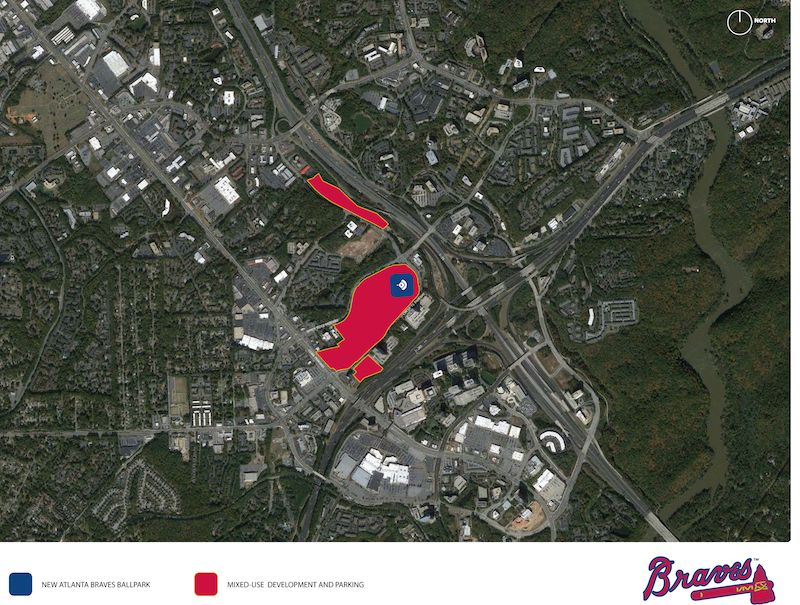
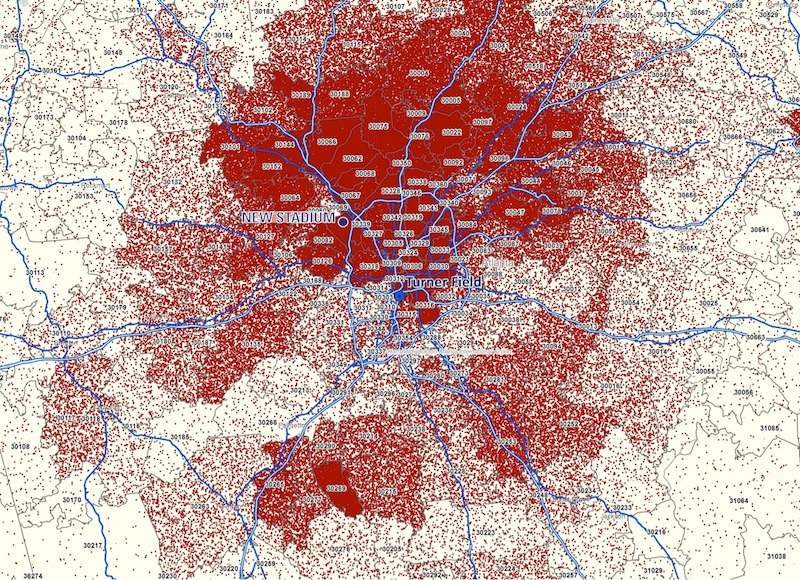
Turns out that today the Braves announced plans to move to suburban Cobb County, just on the outside of the Perimeter (I-285). Historically, the suburbs north of Atlanta are where most of the fan base is located, so the Braves are strategically making the move to be closer to them. Attendance at Turner Field started with four straight seasons with over 3 million fans. Since then attendance has hovered around 2.5 million. That’s good, but the Braves’ brass think they can do better.

Map of locations of ticket purchasers for Braves games

Map of locations of ticket purchasers for Braves games

According to the Braves’ new stadium website, Turner field has $150 million in infrastructure improvements that would be needed, yet aren’t enough to enhance the fan experience. Those additional improvements would make the project cost rise above $200 million.

On the other hand, the new stadium would cost $672 million to construct. The 60 acres of land on which the ballpark would sit has been “secured” according to the Braves. Cobb County would invest $450 million in the stadium, while the Braves would put in $200 million at the start and be responsible for cost overruns. The Braves would be the lead developer for the ancillary “ballpark village” adjacent to the stadium.

This announced move follows a string of other regional defections. Three performing arts organizations (Atlanta Ballet, Atlanta Opera, Atlanta Lyric Theatre) have already moved to or are in the process of moving to Cobb County, not far from the Braves’ planned stadium site.

Braves ballpark site is in the Cumberland near the I-75/I-285 junction in Cobb County

Braves ballpark site is in the Cumberland near the I-75/I-285 junction in Cobb County

White flight? Follow the money? Yes and yes. As outrageous as this announcement and the Falcons’ plans are to replace fairly new, modern stadia, if they can sucker partner with some municipality to foot the bill for a move, they’re going to do it every time.

Should the Braves be successful in their move, it would mark the first urban-to-suburban franchise move since 1973, when the Royals left temporary home Municipal Stadium for the Harry S. Truman Sports Complex, a similar distance away from Kansas City’s downtown core as the Braves’ site is from downtown Atlanta.  The team plans to start play at the new ballpark in 2017. The current lease at Turner Field ends in 2016.

In case you’re wondering who wears the pants in this house…

… it’s Major League Baseball.

The fallout started early this morning, when KTVU reached out to the A’s to get their reaction to MLB’s threat to move the A’s to AT&T Park.

Statement from the A's via KTVU at 8:30 AM Monday.

Statement from the A’s via KTVU on Monday morning

That was followed by AP sports scribe Janie McCauley reporting something similar, but without the weaselly-sounding “intend to” in it. Included was a statement from the Coliseum Authority (JPA):

“We are working on a deal that we believe will be beneficial for both our tenant and the people of this community,” the statement said. “We are confident that everyone involved sees the value in continuing for as long as possible the 45-year relationship between the A’s and the City of Oakland. While we cannot comment on the specific issues now under discussion or on whether there is any basis to recent rumors that Major League Baseball has played a role in the discussions, we are optimistic that a final deal is close at hand.”

Later, BANG’s Matthew Artz dug deeper, picking up more sentiment from East Bay pols.

Sources with knowledge of the Coliseum authority’s private deliberations Friday said there was movement toward softening its stance that the A’s relinquish control over concessions and signage revenue at O.co Coliseum, which comes at the expense of the Raiders.

“The key point is that the authority wants the A’s to stay in Oakland and is not willing to risk losing them over that issue,” said one source privy to the discussions.

Then Mark Purdy got into the JPA’s thinking in holding out over the extension:

Naturally, the A’s balked at the Coliseum’s original terms for a longer lease. Miley and his fellow board members reportedly held firm, believing that the A’s had no other options but to play at O.co in 2014. And at that point, MLB voices tossed out the concept of the A’s playing temporarily at AT&T Park until a new ballpark project could be developed elsewhere.

Also, don’t forget that the JPA hasn’t exactly shown a lot of urgency on behalf of the A’s. Consider what JPA board member and Oakland City Councilmember Rebecca Kaplan said a month ago:

And the six- to eight-year window should give Oakland plenty of time to get serious about building a replacement ballpark and luring the A’s to stay, Kaplan said.

You have to think that Selig’s threat action was motivated by this rather cavalier attitude towards the A’s.

It certainly appears that all that remains is for the A’s and JPA to make certain compromises and finalize the terms. One of the chief issues will be the $3 million in parking fees the A’s owe the JPA. A good compromise would be for the A’s to pay that money, which the JPA would turn around and use for the belated scoreboard revamp and other capital improvements. And the A’s should get that flexibility they’re seeking.

Concessions revenue is another matter. The A’s could retain control with their own cut of each beer or hot dog (this was originally negotiated when the A’s settled a lawsuit with the JPA after Mt. Davis was built). But how would the Raiders and Mark Davis react? Unlike the A’s, who are continuously profitable, the Raiders frequently flirt with the red – a seemingly impossible feat given the NFL’s extensive revenue sharing and TV contracts. Much of that is due to cap mismanagement during the Al Davis era. Some of that is attributable to lacking stadium revenues, especially concessions.  It seems unlikely that Mark Davis will bolt just because of maintaining the status quo, but he could also choose to build a case for leaving based on this. He and the NFL have been pushing the JPA on the Raiders’ own extension, Davis going so far as to prefer to demolish and build anew at the site of the current Coliseum. Such a plan would force the A’s out, a possibility that Lew Wolff has been rightly concerned about. MLB’s involvement has pushed the pendulum in the A’s direction.

It’s cruel that the NFL and MLB are (not so) stealthily playing tug-of-war with the JPA over the Coliseum. As the Giants would say regarding sharing AT&T Park or giving up territorial rights to the South Bay, It’s not personal, it’s business.

As for AT&T Park? Who knows, that threat may resurface down the road.

MLB breaks out stadium negotiating playbook in Coliseum lease talks

Last week I received a flyer from the A’s urging me to get my season ticket plans wrapped up soon, as early as mid-November. Thanks to a Sunday report from Matier & Ross about MLB’s entree into the Coliseum lease discussions, I expect the A’s Ticket Services department to get a lot of angry, misdirected phone calls starting tomorrow morning. And I feel bad for them for having to deal with it.

The fact is that until recently, MLB has stayed out of the lease negotiations at Lew Wolff’s behest. As the lease comes closer to expiring with the two sides still far apart on the terms, baseball has decided to start playing the heavy. As we’ve seen in Miami and many other cities, MLB doesn’t play nice. That doesn’t mean that they’re going to start asking for hundreds of millions for a ballpark. Instead they’re playing the leverage game, threatening to move the A’s across the bay to AT&T Park if the Coliseum Authority won’t relent.

We’re told MLB is also demanding that the Coliseum give the A’s just a two-year lease extension – not the five- to eight-year deal the authority has been pushing.

The short-term lease would give the A’s more flexibility should the team’s owners swing a deal to move to San Jose – or beyond.

Let’s be clear about one thing: this is not MLB’s preferred option. They’d rather have the A’s and Giants play in their own ballparks, because getting them to share is messy when it comes to logistics, scheduling, and revenue sharing. While sharing has happened in the past, it hasn’t happened in almost 40 years. Plus the last thing MLB would want is to have a situation where the experiment goes so well that the Bay Area populace is convinced that there’s no need for two parks, or that the A’s seriously eat into the Giants’ revenue. Just as in other stadium negotiations, MLB has never been afraid to rattle sabers when it feels it can work to the benefit of one of its franchises. From this point forward, don’t expect anything less. Chances are that the JPA will buckle, because they know that the A’s tentatively playing away from Oakland can easily transform into the A’s permanently playing away from Oakland. From MLB’s standpoint, this is a question of loyalty. Oakland and Alameda County shown repeatedly that they’re willing to spend money and make things work for the Raiders. They have also demonstrated that they’ve been willing to move the A’s (and MLB) to the back burner at the most inopportune times. If the JPA doesn’t make concessions for the A’s, that’s just more proof that they aren’t truly willing to make the A’s a priority, which would make MLB less motivated to back Oakland’s efforts to forge a long-term deal. Raiders owner Mark Davis seems to prefer that they start working on a replacement Coliseum on the site of a demolished Coliseum, which if granted would leave the A’s without a place to play. Without a lease extension tied to a well-developed stadium plan, the Raiders would prefer to go year-to-year. The A’s would like to do a five-year deal with early termination if they’re impacted by construction of a new Raiders stadium. The challenge for the JPA is to put together a deal that caters to MLB’s needs while not jeopardizing their relationship with the Raiders and the NFL.

For the time being, Giants chief Larry Baer has stayed silent, probably at Bud Selig’s request. To say they wouldn’t accommodate the A’s would torpedo baseball’s plans and leverage, the same way Wally Haas and then-AL President Bobby Brown rejected Bob Lurie’s plans to share the Coliseum while SF figured out a downtown ballpark plan. That occurred in 1985. Now that MLB is a singular governing body with less stated conflict between the two constituent leagues, the Commissioner has the ability and power to influence the Giants. However, Selig’s track record has been to stall regarding the A’s for nearly five years. Now that a “manufactured” crisis may arise, could Selig be more inclined to come up a with a solution? I’m not holding my breath.

Logistically, sharing the stadium could be difficult for the teams. Naturally there are only two clubhouses at AT&T Park, unlike the more flexible setups at many arenas and new football stadia. The visiting clubhouse would have to be converted into the A’s temporary home while the Giants’ clubhouse would be used for A’s home opponents. There are also 10 potential date conflicts (not 9 as M&R reported): May 12-14, May 26-28, June 13-15, and July 3. That last date is the end of a Giants homestand and the beginning of an A’s homestand. Offloading those conflicts to Raley Field would be difficult because the River Cats already have the first two series and July 3 already booked at home. Day/night doubleheaders would be difficult to make work because of game days can easily stretch beyond eight hours for players and personnel because of warmup/reporting times.

Then there’s also the appeal for AT&T and the various other sponsors in China Basin. AT&T would undoubtedly love double the home dates and exposure. So would Virgin America, Intel, and ironically, GAP competitor Levi Strauss. That and many more subjects (concessions shares, non-game event revenue, ticket pricing) would be up for debate. In the end, the A’s would pay a handsome rent payment and surrender a big chunk of non-ticket revenues. Both teams would deduct stadium expenses against their revenue sharing payments. One way to look at is that the A’s rent would effectively be a rebate against the Giants’ revenue sharing payment – assuming it was structured to fit within the CBA appropriately. Selig doesn’t seem inclined to force the Giants to share, but he can work with the rest of the owners to make it worth the Giants’ while.

Already I’ve seen a lot of anger from fans swearing that they’d never see an A’s home game in SF, or that they’ll cancel their season tickets posthaste. There’s another angle to consider if the A’s were given this two-year window at AT&T Park. The A’s have never called a modern ballpark home, so any serious revenue-generating potential at a new ballpark remains theoretical at best. What if the window was MLB’s opportunity to prove (or disprove) the A’s viability as the second team in the Bay Area? It’s not the same as having a new ballpark to themselves, but the better amenities and location should be attractive to many fans and companies that  normally don’t attend A’s games en masse. After all, the city with the most ticket-buying A’s fans (number, not percentage) is San Francisco, not Oakland or San Jose. If the two-year window fails to positively affect the A’s bottom line, The Lodge may be more inclined to allow the team to move out of the Bay Area. While M&R hinted at a move as a product of failed stadium plans, I think this could be a bigger reason.

MLB has entered the fray, and they’re getting ready to lay down the hammer. For that we can thank A’s and Giants ownership for their stubbornness, Oakland and Alameda County politicians for their lack of urgency, and Bud Selig for not resolving this sooner when he had all the time to do so. Unless a Coliseum lease gets struck in the next month, this is only going to get uglier. A “silly” idea like sharing AT&T Park may turn into something quite sensible. The big issue looming is the endgame, which as Ray Ratto points out, is the can that gets kicked down the road for two years.

Bloomberg pegs A’s franchise value at $590 million

In what will probably become an annual study, Bloomberg released MLB franchise valuations today. The timing, prior to the first World Series game, stands in contrast to Forbes’ release, which is usually on Opening Day. While there will continue to be heavy debate as to the veracity of the valuations (MLB financials are not public data), having a second set of numbers released is good at least for discussion purposes. Besides, the bubble effect we’ve seen with valuations the past several years has allowed Forbes to set a baseline for franchise sales, whether teams and leagues want to acknowledge the data or not.

There’s also a very useful, colorful, interactive info graphic that breaks down both franchise valuations and revenue sources. The former includes $110 million for each club’s 1/30th share of MLB Advanced Media, the league’s digital media arm. The latter indicates which teams have shares in regional sports networks, along with revenue sharing payers and receivers.

The A’s ended up 26th in the rankings with a $590 million valuation. That’s 26% higher than Forbes’ spring figure. Methodology is rather murky, but the two outlets seem to be using similar types of data (if not datasets). Bloomberg also has the A’s tied for 1st (with the Royals) among revenue sharing recipients with $36 million. That’s more than the $33 million the A’s brought in via ticket sales. The Giants, who were valued at $1.23 billion, paid in $21 million to the $480 million revenue sharing pool. The Giants may be worth more than twice the A’s value, but the media revenues aren’t as big a gap as you might think. Bloomberg has the Giants at $88 million via their evergreen deals with CSN Bay Area and KNBR, whereas the A’s pulled in $65 million thanks to new deals with CSN California and Entercom’s KGMZ over the last few years.

Curiously, quotes from A’s PR man Bob Rose and Giants control person Larry Baer provide some owner insight. While in the past Lew Wolff may have argued against the numbers due to perceived discrepancies in local revenue (Wolff thought they were overstated), Rose offers up the notion that the valuation may be low. If revenue is $175 million, Rose argues, then the team is worth 4x that amount, or $700 million. Previously I had multiples at 3x for low-revenue teams and 2x for high-revenue teams. Perhaps a rethinking is in order.

If Rose is correct, the cost to buy the A’s and build a stadium would cost upwards of $1.2 billion, not including land and infrastructure. Chances are they could get it, considering the attractiveness of MLB revenue streams. Of course, future value of the A’s would be heavily tied to whatever ballpark deal is made. If the A’s stay in a ballpark they largely have to pay for themselves, that would limit revenue potential. A publicly subsidized venue would make things easier on the A’s balance sheet.

All in all, it’s more reason for Lew Wolff and John Fisher to hold onto the club despite the ballpark territory stalemate. Then again, without a lease we may see that coming to a head soon enough.

Negotiating Extension and Investor Group Approved for Coliseum City

Two weeks after a potential investor group headed by Colony Capital and Rashid Al Malik’s HayaH Holdings was revealed, that same group was formally approved as part of the master developer team. With that approval comes a 12-month extension on the ENA (exclusive negotiating agreement) to figure out all most of the details, plus a 6-month administrative extension if needed.

That’s the news. Now let’s try to understand what has to happen next.

The City of Oakland has about $250,000 remaining in money it assigned towards Coliseum City studies. Bay Investment Group (BayIG), the Colony/HayaH partnership, will put in $500,000 towards a market study to determine the viability of Coliseum City. This is important since BayIG is expected to push that study to its own individual investors, who as a group will decide if/how to move forward. The forthcoming study is not to be confused with AECOM’s feasibility study, which was made available during the summer.

Over the next 12 months, the public and private sides have to make good on a set of deliverables. Some within the City, especially CM Larry Reid, wanted a shorter 6-month + 6 month extension instead of the 12 + 6 deal that was approved. Reid’s concerns, aired last week in a committee meetings, were that 12 + 6 was too long a period and didn’t show the necessary urgency to the NFL and the Raiders. Raiders owner Mark Davis has indicated that he wants a lease/stadium deal in place shortly after the NFL season ends.

Nevertheless, Coliseum City will move forward on its own timeline because BayIG asked for 12 + 6 in order to get everything in order. A short list of deliverables looks like this:

  • November – Estimate on cost of remaining pre-development work
  • February – Assessment of new infrastructure costs
  • April – Letter(s) of intent from team(s) who choose to sign on with plan
  • May – BayIG market analysis
  • Summer/Fall – EIR and Specific Plan

These items, along with additional smaller ones, should lead up to preliminary project approval in whatever form it takes, plus a DDA (disposition and development agreement), the contract fine print on how Coliseum City is built, including costs, financing, and timelines. Zennie Abraham caught up with Oakland Asst. City Administrator Fred Blackwell at the meeting to summarize what’s next.

Simply put, BayIG just bought the City of Oakland and Alameda County some time. However, it’s easy to see how the list of deliverables doesn’t exactly line up with the timeframe that Davis is trying to dictate. Moving forward, the issue is whether the dev team can show significant enough progress to get Davis to sign on and sign a separate lease at the Coliseum that would keep the Raiders in Oakland throughout the transition. Then again, that part’s a little confusing too. When Raiders uber-fan Dr. Death asked JRDV’s Ed McFarlan when the earliest groundbreaking could be he received this rather optimistic response.

That seems unlikely given the scope of the project and all the little details that need to figured out. Is that groundbreaking for a new stadium alongside the existing Coliseum? Certainly it couldn’t be demolishing the current Coliseum and building on the same site, since the demo itself would take months and would displace both the Raiders and A’s. While BayIG indicated that it will reach out to the A’s and Warriors to gauge their interest in Coliseum City, it’s extremely unlikely that either team will commit. Despite recent setbacks, both teams are focused on their San Jose and San Francisco plans, respectively. Plus they’d have to commit without all deliverables in place, especially that market analysis. If you think that Lew Wolff would sign a short-term lease without knowing the development’s impact on the A’s, you’re crazy.

For the next 12 months, BayIG has control over most of the process. They could press the deal if they see encouraging signs, or they could kill it if the market analysis looks bad. They’re in great shape considering that they’ve only committed $500,000 towards the project – chump change for billionaires. Just as important, they don’t have to adhere to a specific vision of Coliseum City, though they’re positioning themselves to have at least the football stadium in place. Consider last night’s report on the agenda item:

The Coliseum City Master Plan is providing the basis upon which the City is currently under a separate contract with a specialized planning consultant firm to complete a Specific Plan and CEQA/EIR analysis. The Specific Plan will also identify alternatives to the Master Plan and will consider different development scenarios that will envision zero up to three sports facilifies at the site. Pursuant to CEQA, the separate planning contract will prepare an EIR to address the potential physical environmental effects of the Coliseum City project.

There’s nothing new there, but BayIG is positioned to take advantage of it. There could be a single football stadium, a football stadium and a ballpark, even an arena. At this early stage, it looks like it’ll just be the Raiders stadium, though even that is far from a given. BayIG could find that the best thing to do is to minimize its investment in the stadium, or seek out revenue streams from the stadium or team that could help pay back their investment. The infrastructure cost, which will be borne by City/County, could also prove prohibitively high on top of the remaining debt to be carried at the Coliseum. BayIG could even go with zero venues at the Coliseum. Such a plan would probably not get approval from City since it would represent a white flag. Yet it remains a distinct possibility – if not now, within a few years.

The upside, regardless of your optimism or skepticism of Coliseum City, is that things are coming to a head. Coliseum was introduced more than 21 months ago, and has shown only the most tentative progress until a few weeks ago. Now’s the time to put up, to see what results Coliseum City can yield. No more stalling, and for that we can all be glad.

—–

Note: The only local mainstream media coverage of yesterday’s news came from CSNBA’s Scott Bair. Seems like everyone else was preoccupied with transit strikes and some other multibillion dollar development in the South Bay which is a lot more than vapor.

Judge partially sides with MLB in antitrust lawsuit, allows San Jose to argue interference claims

UPDATE 2:07 PM – I’ve uploaded a copy of the ruling. It’s worth a read.

Additionally, San Jose Mayor Reed’s office released a statement in reaction to the ruling:

I am pleased that the judge has allowed our case to move forward. Major League Baseball’s unfair and anti-competitive actions are costing San Jose residents millions of dollars in annual tax revenues that could go towards paying for more police officers, firefighters, libraries, road repairs and other critical services.

San Jose filed this lawsuit after waiting patiently for more than four years for a decision from Commissioner Selig. The court’s decision this brings us one step closer to paving the way for San Jose to host a major league ballclub.

Carry on.

—–

Update from the Merc’s John Woolfolk on San Jose’s antitrust lawsuit against MLB:

And other tweets:

During the hearing last Friday, Judge Ronald Whyte gave indications that he would back MLB based on the standing issue, while allowing San Jose to rework its case and try it in a state court. MLB had pushed for Judge Whyte to dismiss all claims, including those that could be covered by California’s more stringent antitrust laws. San Jose hoped Judge Whyte would rule that the City had standing, which would move the case forward and start a potentially damaging discovery phase for MLB.

Assuming that the tweets above are correct, baseball’s antitrust exemption remains immune to a legal challenge. Instead the case will be about tortious interference, or MLB’s stalling that has prevented San Jose and the A’s from getting a ballpark built. San Jose claimed initially that this amounted to $1.5 million per year in tax revenue, and could be awarded treble damages as a result. Over 30 years that comes to $135 million, not adjusted for inflation.

If San Jose can force discovery into the dealings of its “Blue Ribbon Commission” and other activities related to San Jose and Oakland, it could also force MLB to make a deal since they’re against any kind of opening of their books. There’s a lot more to the TI argument than standing.

A press conference may be in the offing. If it happens I’ll see if I can head out to City Hall.

For now I’ll end with this Bill Shaikin tweet:

Hooray for inertia!