TV rights wave brings A’s along for the ride

When the A’s made the move to basic cable full-time, it was considered to be a solid, though not groundbreaking, improvement for the A’s in terms of revenue. More games would be broadcast (still not all games), and peripheral coverage would would improve via CSN California’s revamped local programming. While the second part would prove true, it wasn’t clear what financial benefits the A’s were getting. As late as last fall the rights fee being paid by Comcast to the A’s was kept hush-hush. I had heard the rights fee started at $15 million with escalators for improved ratings. Whatever the figure truly was, it wasn’t supposed to be terribly competitive within the new TV rights bubble, let alone the mega-deals signed by the LA teams and Texas.

Well, turns out that Lew Wolff and Ken Pries worked out a pretty good deal after all. In Wendy Thurm’s latest post on Fangraphs there’s a table that shows updated TV rights deals (courtesy of Sports Business Journal). The A’s are in pretty decent shape with a deal that works out to $43-48 million per year, which is a lot more than previously speculated or earned in the previous contract. $43+ million still pales in comparison to the Rangers’ or Angels’ $150 million, but those teams were playing a different game from the A’s anyway. The boost is enough to help the team competitively, not enough for management to start making a bunch of stupid personnel decisions. The annual rights fee puts the A’s at 11th or 12th depending on how you’re counting, squarely within MLB’s CBA-defined Top 15 markets.

Of course, the downside is that what looks good now could look puny a decade from now, when the A’s can exercise their first option to renegotiate or extend the CSNCA deal. Several teams will have the opportunity to renegotiate their deals or start their own RSNs before the end of the decade. Chances are good that they’ll do just that. Look for the A’s to follow suit a years later.

How the A's TV deal stacks up against division and crossbar rivals

How the A’s TV deal stacks up against division and crossbay rivals

Despite the added revenue, let’s be clear about something: the A’s are still last in the AL West in terms of TV revenue (and probably radio as well). I suppose that no A’s fan will care as long as the team keeps leading the division in the standings.

—–

Note: The SBJ article dates back to Opening Day. Either I missed it completely or I skipped over the updated figure. Apologies.

Radio interview with 1010 AM SoCal, talking Raiders & A’s stadium issues

I’m still in Pittsburgh. While resting at The Church Brew Works (a must-see if you’re ever in Steel Town), I did an interview with Julie Buehler and Geoff Bloom of Team 1010, an AM sports talk station in Palm Springs. Normally when I do when of these, I hem and haw a little on the “percentage chance something happens” game. This time I didn’t. Take a listen.


Video streaming by Ustream

Thanks to Julie and Geoff for having me on, and the Trib’s Matthew Artz for linking us up.

Warriors backing away from 2017 SF arena opening date

On June 20 the California Assembly easily passed AB 1273, a bill from San Francisco’s Phil Ting that aimed to speed up the CEQA process by bypassing the Bay Conservation and Development Commission (BCDC). That hope faded on the 25th, when a Senate committee refused to take action on the bill, citing the importance of the BCDC and the State Lands Commission. The bill was withdrawn from committee shortly thereafter.

The Snøhetta/AECOM-designed Warriors arena on San Francisco’s Piers 30/32

The BCDC is the first and largest regulatory body that approves any and all development along the bay. The Warriors and SF pols hoped that by not involving the BCDC they’d be able to hit their target opening date of fall 2017. For now the 2017 date looks shaky, as involvement with the BCDC and contingent agencies could add a 1-2 years (or more) to a normal CEQA process.

Tim Kawakami saw the other shoe drop when he interviewed Warriors co-owner Joe Lacob this week.

LACOB: I do know there’s a possibility, certainly, that (the arena) could be delayed. It’s not a probability at this point. The probability is that we achieve our goal.

Not exactly a rallying cry, rather a more tempered response than Lacob has previously exhibited. Lacob has shown no signs of giving up on the project, as he and Peter Guber most certainly see the revenue advantages it would bring even the arena were delayed 1-2 years. Lacob also said that he’d consider Lot A across McCovey Cove/Mission Creek from AT&T Park, but not Pier 50 next door (which would bring up the BCDC threat all over again). Chances are that the W’s would only build on Lot A if they received exclusive development rights, which have already been given to the Giants with plans drawn up. Not that they couldn’t be changed if the right deal were struck. The Giants are refinancing their remaining debt on AT&T Park to help finance the Lot A project, so you have to think it’s already pretty far along in the process for them.

Interestingly, the apparent defeat of AB 1273 marks the fourth instance of large political effort to fast-track a project that has either backfired or failed to help the effort. A letter from the Pacific Merchant Shipping Association (among others) made note of previous instances:

  • AB 900 in 2011 was legislation for a Portside San Diego Chargers stadium. Eventually the plan fizzled as no one could figure out how to bridge the funding gap.
  • A fast track bill for Farmers Field was passed in 2012, but became moot as Phil Anschutz wavered when confronted with the high price the NFL was going to make him pay to bring one or two teams downtown.
  • Seattle interests also bumped up against their own working Port to ram through a SoDo Sonics arena.

The first two instances of demise were purely financial as no one could make the deal terms pencil out. Bills or other measures may have helped in the end, we’ll never know. The brief list doesn’t include Carole Migden’s failed attempt to block the 49ers’ move to Santa Clara. Seems like the memo to any teams trying these shenanigans should be to simply let the process work itself out, no matter how painful it is.

In the letter link above is also Oakland Mayor Jean Quan’s opposition to the bill, framed in terms of economic impact to Oakland. Quan has also mentioned the BCDC in interviews, but she was smart to not include that argument in the letter. After all, she’s advocating for a ballpark at Howard Terminal, a piece of land that, like Piers 30/32 in SF, is subject to BCDC and SLC review. The BCDC website’s FAQ barely scratches the surface of the regulatory work required to build anything on the Bay (bold are my emphasis):

What types of activity require a permit?

A BCDC permit must be obtained before you do any of the following things within the Commission’s jurisdiction:

Place solid material, build or repair docks, pile-supported or cantilevered structures, dispose of material or moor a vessel for a long period in San Francisco Bay or in certain tributaries that flow into the Bay.

Dredge or extract material from the Bay bottom.

Substantially change the use of any structure or area.

Construct, remodel or repair a structure.

Subdivide property or grade land.

Shouldn’t be a problem for a Howard Terminal ballpark, right? Easy peasy.

—–

In the Kawakami interview, Lacob also referenced the departure of AECOM from the project. According to Lacob, the AECOM had already finished its task of completing design work for the inside of the arena. That means that design work is largely complete, barring CEQA-mandated changes to the project. That should show you how serious the W’s are about getting this thing built.

Coliseum City already running into financing problems

Last week, Zennie Abraham teased with one of his video blogs, this one about Coliseum City. In it, he claimed that a financing plan for Coliseum City fell apart recently.

Abraham, who is still connected with Oakland City Hall to an extent, made a few other points:

  • Mega-developer Forest City Enterprises (responsible for Uptown among other projects) was/is to be the master developer.
  • A businessman from Torrance wants to bring the Raiders south.
  • The Raiders pushed for a cheaper, open-air stadium ($900 million)

Last night Abraham elaborated on the story, filling in some of the gaps.

  • The “Torrance businessman” is in fact Ed Roski, he of the City of Industry stadium plan.
  • Roski attended a Clippers game in april with Raiders managing partner Mark Davis, who may be willing to split with 17% of the team to take care of some inheritance tax obligations after Al Davis passed away. In the past Roski has wanted a 30% share, large enough to be managing partner.
  • A big stumbling block is the potential of seat license sales, which continues to plague the original Mt. Davis project but is also considered a requirement for new NFL stadia due to the enormous cost.
  • Redevelopment funding alternatives are under consideration, such as the establishment of a Mello Roos or Community Facilities District (CFD). It’s not clear how that would work in the case of Coliseum City where a large swath of land is publicly owned. Normally, property owners all choose to vote to tax themselves to fund public improvements, such as infrastructure.

Here’s the thing about Roski’s plan: it’s about as sexy to the NFL as Coliseum City is to MLB. The main draw of Industry was Roski’s advertised low cost to implement, thanks to cheap land, a cheaper stadium design (built into a hillside), and redevelopment money that could’ve paid for new infrastructure. The state’s RDA raid claimed $180 million that was to be earmarked for the project. If, as expected, the funds go away, Roski might have to lobby local legislators to pass a bill that creates a carveout on his behalf, which is a step further than what the Warriors and AEG were seeking in their venue efforts. Regardless, you can’t blame Roski for trying. He waited until the Farmers Field deal fell apart. He can do the same for Coliseum City.

The interesting outside angle for Roski is that last week St. Louis declined to pay for $700 million in improvements for the Edward Jones Dome, setting the stage for negotiations on what would probably be a new outdoor stadium somewhere in the metro. Of course, a new NFL stadium is guaranteed to cost more than $700 million, so it’s hard to know what kind of deal the city/county/state could offer Rams owner Stan Kroenke. A situation involving the Rams and Raiders at Roski’s Industry with Roski getting smaller minority shares could be just the ticket. Now there’s no speculation of this deal happening, but it’s definitely an option, if remote.

Going back to Coliseum City, I’ve said for over a year now that the financing for the project, whatever the scale is, looks iffy at best. That’s expected to be borne out in a feasibility study that should come out latter this summer/fall. What we’ve been told so far has not made the financing picture any clearer:

  • City Administrator Fred Blackwell said in February that the Raiders stadium may not end up with a NFL G-4 loan because of difficulty getting the revenue backing for the loan (club seats). The G-4 money may not be an issue moving forward since the Falcons are getting the last full slice.
  • Contradicting Blackwell, Oakland Mayor Jean Quan has said that she wants the NFL’s loan. She also said she wanted a retractable dome stadium, which appears to be a nonstarter at this point.
  • The “preferred” open air stadium will still cost $900 million, which isn’t chump change, and if the 49ers’ stadium is any guide, destined to grow in cost. In most current stadium development agreements the team is on the hook for cost overruns. How could the Raiders agree to that when Mark Davis doesn’t have the cash?
  • If it’s not a dome it can’t be used as a convention center or an otherwise flexible facility. What incentive is there for Oakland and Alameda County to invest limited resources for a limited use stadium? Is it just because the Raiders are playing nice right now?

Another interesting element about the financing piece is that investors are focused on the area currently known as the Coliseum complex, plus the Malibu/HomeBase lots. In the Coliseum City study, an alternative will include a ballpark in the northern corner of the complex. But what if Forest City recommends that additional commercial or retail development go there instead to help pay for the cost of the NFL stadium? That would be something. Forest City helps kill two Oakland ballpark plans (even if no one cares for Coliseum City for the A’s). Why not get them to develop Howard Terminal while you’re at it?

Speculation about who outside investors are or which country they come from is neither here nor there. The problem is that whoever it is, they need to be able to make money off this plan. We’re starting to see far more realistic discussion of the revenue generating capability at Coliseum City, not some pie-in-the-sky projections. This is a good thing, because it will eventually lead to the adult conversation about what it’ll take to keep one, two, or all three teams in town. Until now every party involved in Coliseum City has been looking to get someone else to pay for their stadium, their resurgence. Soon, we’ll finally find how much it’ll cost everyone, including the public. That’s a lot more honest than the discussion that led to Mt. Davis.

Oakland Mayor Quan with Bucher & Towny, 7/3/13

Update 7/5 5:00 PM – The Trib’s Matthew Artz confirmed what we were all thinking:

Get on that, Oakland. Chop chop!

—–

Oakland Mayor Jean Quan continued to make the case for Howard Terminal on Bucher & Towny’s show today, talking up site control at both the waterfront site and at Coliseum City, which she more-or-less admitted MLB has little interest in based on their inquiries. She even got a dig in at Lew Wolff, saying that “to say there are no sites in Oakland you have to have blinders on.”

Streetscape of The Embarcadero adjacent to Howard Terminal

Quan also revealed that the A’s Coliseum lease extension is very close, that the JPA has been negotiating all spring, and one item remains to negotiate – the scoreboard replacement. A capital improvements fund that was set to cover replacement scoreboards was raided to cover costs associated with the Coliseum City study, and that chicken has come home to roost. There’s no reason to think that the scoreboard would be a showstopper for the two parties moving forward, but this is the JPA we’re talking about. Who knows what can happen in the coming weeks.

Chris Townsend alluded to a July 11 announcement that Howard Terminal could be fully available. In all likelihood that’s dependent on the Port approving settlement terms with SSA, which are now under fire by the longshoremen’s union.

Townsend also tried to get an explanation for what needs to be done with railroad tracks at Howard Terminal, which brought on the following exchange:

Townsend: Someone has told me that one of the problems with Howard Terminal – I wonder if you can speak to this – is that the railroad tracks that run through there… can you talk about that one main concern?

Quan: Well, the ones that go to the Amtrak are outside the (area) so I don’t see that as a problem at all. The other tracks were going straight to the ships. If that’s no longer a terminal they’ll just be lifted up or out, or maybe we’ll make it part of a new light rail system into the ballpark. I don’t know. All of the developers I’ve had look at it have never raised that as an issue.

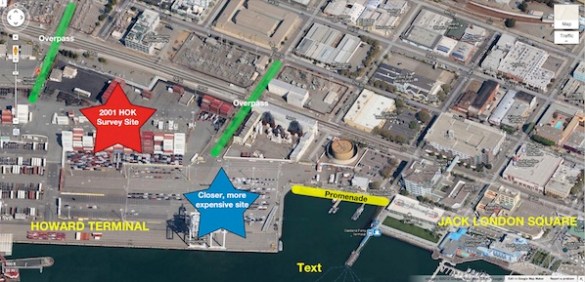
A couple things to point out here. First, the main tracks that run down The Embarcadero are owned and operated by Union Pacific, who also has a huge yard just northwest of Howard Terminal. The rail line is a vital part of port operations, and that won’t be moved. There’s no chance of that. The issue, as we identified last year, is that a bunch of infrastructure has to be built in conjunction with Howard Terminal’s conversion to a ballpark site in order to support cars, bikes, and pedestrians that would all converge there for games. Plus there would have to be streetscape improvements and safety equipment installed to prevent people and drivers from playing chicken with heavy diesel trains. Add in the presence of a gas pipeline and you have a situation where the Public Utilities Commission will have to come in and approve everything that gets done along The Embarcadero.

Second, the tracks on the site are little more than an afterthought at this point. They were preserved as part of the capping process. If, as Quan says, the tracks can be lifted up or out, the cap would be breached. I always figured that the cap would have to be breached to prep the site, so no big deal there, right? But if a ballpark is supposed to be built without disturbing the cap, how is digging up and removing the tracks supposed to be compatible with that? Moreover, the thought that the tracks could otherwise be folded into a light rail or streetcar project shows how little Quan understands about the situation there. There are strict federal rules about separating freight and other heavy rail trains from light rail trains, to the point that grade separations are frequently required to ensure safety along both lines. The tracks as they sit feed directly into the big railyard, so they couldn’t be used for light rail or a similar purpose unless someone built another bridge to lift trolleys above the heavy rail tracks. The cost to do that would be astronomical on top of the other bridges that would be required there.

Look, I don’t expect Quan to be on top of all of the little details. She seems content to delegate much of the work to her teams and committees, and that can work in many instances. On the other hand, this puzzling response about the rail safety issues clearly shows that her background info on Howard Terminal is very limited. Maybe there’s a reason for that, and that reason is that there is no environmental impact report. Townsend suggested that there’s an EIR for Howard Terminal is coming, but Quan backtracked from that, saying that the Coliseum City EIR is around the corner while not providing a timeframe for Howard Terminal. She said that she believed the Port Commission has ordered the review work. There’s no record of any initial or ongoing environmental review happening at Howard Terminal, so color me confused. Quan took some time out to talk about the importance of CEQA, so she’s fully aware of how mindbogglingly thorough CEQA can be. CEQA is so thorough that new construction has to at least have an initial determination of whether or not a project requires the rest of the CEQA process. So far, there’s no record of that step or any beyond that happening. Now, the Port could be doing some background work to help supplement an EIR if it gets formalized. If that has occurred it hasn’t been publicized. That’s far different from the running clock on an EIR. Oakland won’t be able to cut the EIR clock in half by doing prep work. There are hearings and public comment periods that are required.

Quan fielded election-related questions at the end, with the knowledge that no one of note is running against her in 2014. She’s full of bravado if not outright swagger, propelled by the green lights at the OAB Port project and Brooklyn Basin. She even articulated Oakland’s general stance about the stadium effort in a very succinct way, “You have to prove that we can’t do it.” Well, it’s been proven that Victory Court was a loser. Will Howard Terminal and Coliseum City be strikes two and three?

Settlement could move Howard Terminal forward

Previous posts about Howard Terminal:

Later today the Port of Oakland’s Board of Port Commissioners will hold a meeting, during which an important settlement with SSA Marine will be discussed. This settlement is important as it should resolve the biggest legal obstacle hanging over Howard Terminal. The settlement discussion is a closed session item, so the terms weren’t made publicly available. Still, there’s no reason to think that the terms won’t be approved as the parties apparently have been in discussion for some time, and would probably prefer to avoid further litigation (which could run through next year).

howardterminal_birdseye-labeled-sm

Howard Terminal overhead shot with Jack London Square nearby

During the Don Knauss interview, he mentioned that environmental concerns were overblown. To wit:

We’ve done the diligence there as well and been assured by experts that a ballpark can be built on that site without a substantial cost associated with cleanup. Basically we can build a ballpark on top of that site without having to scrape the site clean like AT&T was built on (China Basin).

Wait a minute. China Basin was built without having to scrape it clean? Actually, it was scraped clean. Site remediation was done by the Giants, not the City or Port, and reimbursed to some degree by the federal government via the Federal Brownfields Tax Initiative. Piles were driven deep into bay mud (fill) to provide a proper foundation. Knauss is suggesting that a Howard Terminal ballpark can be built without replacing the fill currently at the site or even piercing the asphalt cap designed to contain the site’s contamination. I’ve heard this claim before but not the plan behind it. Naturally I have to be skeptical of this claim. China Basin and Howard Terminal are similar enough that it’s hard to conceive of how this would work.

AT&T Park’s foundation was built the many expected: land was cleared, cleaned up, and piles were driven to support the stands and ancillary buildings. This was required because China Basin sits in an extreme liquefaction zone. Howard Terminal also sits in an extreme liquefaction zone, which would presumably mean similar measures to China Basin would have to be undertaken. The difference with Howard Terminal is that the State of California put the asphalt cap over the contamination over a decade ago instead of cleaning it up completely, a process which would’ve cost $100 million ($131 million in 2012). That cost has long been the biggest source of the site costs associated with Howard Terminal.

Then again, maybe Knauss and the Oakland backers have a clever, innovative plan that would not require piercing the asphalt cap, or at least minimizing the number of intrusions. That would probably require building a smaller number of larger sized footings at the site, then constructing an above grade podium on which the ballpark would be placed. If that sounds familiar, it’s because Bryan Grunwald proposed a similar approach at his 980 Park site. There’s no concrete estimate of the cost of such a podium, but I’d expect it to be at least $100 million given the the size and load it would have to carry. That could conceivably be cheaper than cleaning up Howard Terminal. Would it be that much cheaper? We’re talking about building a ballpark in a liquefaction zone. There’s no room to cut corners.

Another issue is the amount of planned infrastructure. Again, Knauss claims that costs are being overblown. But he also acknowledged that parking would need to be provided on site, which makes sense given the lack of parking in the immediate area (only 1,200 spaces within 1/3 mile). And if more parking is to be provided on the 50-acre Howard Terminal site, more infrastructure has to be built to bring cars into the site. I had previously suggested two overpasses, one for vehicle traffic and one for pedestrians. Add those to the podium, other site improvements, and additional improvements to the area north of HT, and we’re talking about an estimate north of $150 million. Maybe it’s less, maybe they’ve come up with something really innovative. The problem is that quality engineering is expensive and requires expensive materials. Heck, even bad engineering can be really expensive.

Finally, there’s the lingering question of Who will pay for it? The Giants paid for their site cleanup, got a tax credit from the Feds, and received a minimal amount of TIF funds for the surrounding area. If Knauss is suggesting the same kind of deal to Lew Wolff, it’s a nonstarter. That’s around $650 million worth of risk, 95% of it to be borne by the A’s, with little promise of the kinds of returns the Giants got at China Basin. (Note: Walter Shorenstein thought China Basin was so risky that he divested his share of the Giants, and many within The Lodge looked askance at the plan.)

Maybe, just maybe, Knauss and his people have this figured out. Maybe there’s a creative way to make this all work for everyone. Again, I’m skeptical. Many of the same claims were made about Victory Court, and that site was swept under the rug with barely a peep.

—–

P.S. – We haven’t even touched the transportation gap at Howard Terminal (BART or the mythical streetcar). Or whether the City, Port, and County would create yet another joint powers authority. Or lease terms. Or the lack of redevelopment funds for surrounding area improvements.

Knauss on 95.7 The Game: We think the world’s changed here

Clorox CEO was on with Chris Townsend earlier today. As usual, Townsend had a pretty thorough, wide-ranging interview that touched on a number of A’s and stadium-related topics. I’m going to highlight a couple of items.

Townsend: When it comes to buying the A’s, are you personally interested? Is Clorox interested?

Knauss: No I wouldn’t say we’re interested (Clorox) in buying the A’s. We clearly would love to work with the current ownership, Lew Wolff and John Fisher, on keeping the A’s here. I think there’s a lot of old data that Lew Wolff has about working in Oakland… We think the world’s changed here.

Later in the interview…

Knauss: I think we have this tremendous site down Howard Terminal, which is just adjacent to Jack London Square. We have what I believe can be the premier site in baseball… When I last talked to Lew about that last year, he said ‘we looked at that a long time ago, it’s not viable’. I think the last time the A’s actually sat down with the City in any serious way was over five years ago with Mayor Dellums. At the time I heard some of the old excuses why Howard Terminal wouldn’t work and they’re all void now, it’s a completely different place.

Townsend: Why do you believe Howard Terminal is viable?

Knauss: In 2005 the last time they looked, the Port was close to full capacity. Now it’s under 50% utilization. The Port can easily use Howard Terminal for a ballpark without adversely affecting the shipping business… The second thing I’ve heard over the years is that there is this environmental contamination on the site and people throwing some crazy numbers around about remediating that site. We’ve done the diligence there as well and have been assured by experts that the ballpark can be built on that site without a substantial cost associated with cleanup. Basically we can build a ballpark right on top of that site without scraping the site clean, the same way AT&T Park was built on that pier.

Knauss went on to talk about the revitalization of Jack London Square and the recent Brooklyn Basin deal. Then Townsend moved onto Knauss’s potential interest in owning the A’s.

Townsend: In the past you’ve talked about having a group to buy the A’s. Why have you never made an offer?

Knauss: We’re trying to respect baseball’s protocol. Our attitude is to negotiate this and not litigate this… We’d love to have Lew sit down with us and go over the new world that’s down there, not the old world that he’s familiar with. The other thing is that we’re close to getting this lease renewed so I think we’re demonstrating that you can get things down in Oakland and Alameda County… The second thing is getting site control of Howard Terminal. So I think that’s the reason we haven’t said, ‘Let’s find another ownership group.’ We think that could be viable, but I think clearly we’d rather say, ‘Look Lew, we’ve got a viable site, we believe that the team deserves a new world class ballpark, but there’s a way to get that done here in Oakland.’

Townsend: Clorox moved a number of jobs to Pleasanton. Why do you do that but yet you still say, ‘Ah we’re still about Oakland.’

Knauss: It’s a fair question. There are two things we wanted to try to achieve with that. One is, it’s a bus- it’s really a focus on innovation. The reason we’ve been around for 100 years is because it constantly innovates new products. We wanted to get all of our innovation people in one location. Now obviously innovation is driven by R&D, and we’ve always had R&D people folks out in Pleasanton. We had about 400 scientists out there and we’ve had ’em out there for decades. What we’ve learned over the years is that when you put all of the functions out there that drive innovation – marketing, sales, finance, human resources, legal, etc. – put all those people out there with the R&D people, then you get much quicker innovation, you get bigger ideas developed. So we wanted to create a new campus out in Pleasanton where we had our nucleus and add those people. We moved a lot of those folks out of downtown Oakland out to Pleasanton – but we kept them in Alameda County.

The second reason we did it was a business continuity issue. The headquarters building – obviously we’re all in the Bay Area sitting on various faults. We wanted to get some dispersion of our IT resources out in Pleasanton too where we thought we could spread out some of our risk from a business continuity standpoint. Those were the two central reasons: better innovation, better business continuity, minimizing risk. We’ve kept people in Alameda County, and we’ve kept our general office in Oakland, and certainly I’m sitting here in Oakland and I live in Oakland. So we’re committed to Oakland.

Let’s try to put this in perspective. Don Knauss was brought in as Clorox CEO in October 2006, shortly before Ron Dellums was elected mayor. Knauss is clearly referring to the anti-sports Brown administration and the general absence of leadership during the Dellums era. Are we – and Wolff & MLB – supposed to believe that a new sheriff is in town, that Oakland has suddenly gotten its act together? Moreover, Knauss recited Quan’s stance on the ballpark issue: As long as we provide the site, the A’s and MLB can’t turn us down. I think it’s pretty simple. If Oakland provides all site prep costs, streamlines the process, and throws in $200 million, then you can get MLB to pay attention. Without that it’s not really an even playing field with San Jose, where the greater number and size of upfront revenue commitments can help pay down ballpark debt early, just as is being done in Santa Clara.

Knauss also talked at length about the issues associated with developing Howard Terminal, which he minimized as much as possible. Muppet151 has a little insight into this:

HT is in a state of constant and PERMANENT review. I talked to the guy in charge of overseeing the site who said it’s somewhat similar to what contained contamination at the San Jose Arena. You can read the SJ documents here:

https://www.envirostor.dtsc.ca.gov/public/profile_report.asp?global_id=43730007

The HT project manager explained things a little further in an email to me when he said “While the Land Use Covenant restricts activities that would interfere with the cap from being conducted without DTSC approval, it is common in development plans to engineer acceptable solutions that modify cleanup remedies including caps under DTSC oversight.” If the footprint of the stadium extends outward to the point it’s over the capped area, and it’s my understanding it would, the stated scenario would take place.

From a technical standpoint, HT is definitely possible, and can be done. The problem is that this is not a 1 time fix. This is a permanent issue, and worst of all this is infrastructure work that the public will be on the hook for. There was cleanup work done in the area in 2004 making the ballpark possibility a little stronger. But the 200,000 cubic yards of capped material remains, as done the 2002 CA DTSC estimate of a $100 million cleanup should something go wrong. And again, that’s public money. Things might go smoothly….but over time, caps need maintenance, and putting a stadium over the underwater caps makes the situation remarkably unique.

Currently, nothing can be built at the San Jose Arena parking lot, including a garage for the arena or a future high speed rail terminal, without a comprehensive and costly remediation plan. Right now there’s only a sealed asphalt cap there.

Knauss also brought out the “respecting the process” stance used by many on the outside, including the mayors of both San Jose and Oakland. They’re all willing to “respect the process” until they hear something that doesn’t work with their agenda. That’s how the game is played. Unfortunately, as we’ve seen recently, the only way to get Bud Selig’s attention these days is to sue baseball.

When asked about Clorox’s move of hundreds of jobs to Pleasanton, Knauss’s previously well-focused responses devolved into some incredibly inane, weaselly CEO-speak. Read that response carefully. Earthquake faults? When Loma Prieta hit on the San Andreas fault, the Coliseum had enough structural damage to force Games 3 & 4 to be played at the ‘Stick, despite the Coli being on the Hayward fault (and supposedly less prone to damage). Knauss didn’t touch the issue that really caused the move: many of the scientists and their families lived along the 680 corridor and preferred to work there instead of commuting to Oakland. Knauss had to make the tough decision to keep Clorox competitive. That’s the reality of the move, not some BS reasoning about earthquake faults or risk management. And that’s the irony of it. Clorox is perfectly able to move 500 jobs to Pleasanton or 300 jobs to Arizona if it has business or competitive reasons. In terms of pure economic impact (tax revenue, job creation), the A’s are a much smaller company than Clorox, yet they can’t move 35 miles for competitive reasons. Makes me wonder if Knauss just did this to provide cover for the company’s previous and future moves under his leadership. It didn’t cost him anything, that’s for sure.

—–

Further reading:

Miller Park (The Return)

Upper deck behind home plate with the roof open

Upper deck behind home plate with the roof open

Last time I visited Miller Park in 2010, I had scheduled a stadium tour followed by a night game at Wrigley. On the way back on I-94, I was pulled over for speeding. The patrolman asked why I going 78 in a 65 mph zone. I replied that I was in a hurry to make a game at Wrigley. We then spent a minute talking about the differences between Miller Park and Wrigley Field. Other friends from Chicago have commented at times about enjoying games at Miller Park, whether or not those games involved the Cubs. Curiosity piqued, I vowed to return to understand why people from all over the Midwest liked Miller Park so much. After spending a day there, it’s easy to see why. It fills a niche that no other park fills for a thousand miles.

A cheery atmosphere on the approach to Miller Park

A cheery atmosphere on the approach to Miller Park

Lest we forget, the two Chicago ballparks are outdoors. Even if you aren’t stuck under an overhang at Wrigley with the wind whipping around, April and May games can be brutally cold at times. Milwaukee has it slightly worse being 90 miles north of Chicago. And now that the Twins have moved outdoors, Miller Park is the only stadium in the Midwest that provides a comfortable domed environment for those occasional inclement weather games.

Not that the dome was needed during my visit. The temperature on Sunday was 70 with clear skies. The game would’ve been perfect at old County Stadium. Over 30,000 came to watch a tanking Brewers club take on an aging Phillies squad. It was a perfect matchup in 2010. Now it’s a matchup of also-rans. Fans came out to get a Carlos Gomez bobblehead, and unlike many other ballparks I’ve been to, there was a huge supply available at any gate even at first pitch.

miller_park-04-harley_gate-sm

Just outside the left field entrance. Bernie Brewer’s home run slide visible on the right.

Before I entered the stadium, I drove to the general parking lot on the east bank of the Menomenee River. A pair pedestrian bridges connect the stadium to the general lots, with preferred lots located closer. It’s easy to be distracted by the various types of tailgating arrangements on display in the general lots. Orderly clusters lined each row with precision, while larger staging areas were set up next to the river. A live cover band played 90’s hits. Klement’s, the sausage company that makes the meat tubes for the Brewers and sponsors the famed sausage race, has its own outpost on the east bank. The pedestrian bridges, while short, created that processional feel that we A’s fans know from walking on the BART bridge. The Miller Park scenery is far less foreboding than industrial East Oakland, and Wisconsin even landscaped Hank Aaron State Trail along the river. The sausage racers were assembled on the bridges, posing for pictures with fans. The whole thing was friendly, friendly, friendly.

Right field lower concourse plaza

Right field lower concourse plaza

Enter the park at either the left or right field corners and you’re greeted by a wide concourse that feels equal parts arcade, state fair, and ballpark. The concourses are so wide that each corner has its own mini food court. Attractions for kids are everywhere along the outfield. The scene becomes less interesting around the infield, where suites and restrooms line the lower concourse, pushing fans out to the glass skin enveloping the ballpark. Behind home plate the fair resumes and views of the field are available.

Numerous escalators fill the space, and they’re necessary since there are four full levels of seats. The field (lower) deck has at most 26 rows. The loge (second) deck has less than 20. Each has its own full concourse. The loge deck has minimal cantilever over the field deck, extending well back over the lower concourse. A short club/suite level is sandwiched between the loge deck and the 20-row terrace (upper) deck. As if often the case in domes, the limited footprint required to conserve space forces more vertical construction. The upper deck is chock full of Uecker seats. I went up to Section 404 in the RF corner and took pictures from the top. It didn’t seem quite as high or cavernous as Chase Field, but it was close. At least from the bird’s eye view I got a real appreciation for how the roof was put together. A unique, five-panel fan shape, the roof has a pivot point behind the plate and travels on guides atop the outfield wall. Mitsubishi was forced to replace the bogies that move the roof panels in 2006 for over $13 million. The roof was open during the game, which allowed light to flood in from the top and through the large clerestory arches down both baselines. The windows in the outfield were also open. Although the roof’s mammoth presence tends to dominate the landscape from outside Miller Park, it manages to be somewhat minimized inside. It also helps that outfield signage is mostly limited to the center field scoreboard. After the game the roof was promptly closed.

Behind the batter's eye

Behind the batter’s eye

Just beyond the outfield fence are a series of party spaces. In left are the T.G.I.Friday’s bar and the Harley-Davidson Deck, plus Bernie Brewer’s slide, which the mascot uses whenever the home team hits a home run. In right is the Mountain Dew “Dew Deck” and field level seats behind the bullpen. There’s also a patio immediately behind the outfield fence with a full bar.

millerpark-13-bullpen_patiobar-sm

Right field fence party patio

No Brewers game would be complete without a Klement’s bratwurst, which I scarfed down after throwing some secret stadium sauce on it. At $4.25 it’s a good deal, if a bit small. I also got a swirl frozen custard for $4.75. Given the poor craft beer choices and the fact that I had to immediately drive back to Chicago, I decided against getting a beer. One thing I noticed is that Miller Park’s concessions, run by Delaware North, are part of that growing trend of using volunteers with nonprofits as labor. I’m sure it’s a good way to raise money, and the staff were plenty competent, but I always come away from the experience feeling that teams only follow this practice to make some extra bucks.

Roof closed after the game

Roof closed after the game

If there’s a big negative, it’s that sneaking down is pretty difficult. The public service announcement for fans entering the ballpark urges them to stay in their assigned seat only. Ushers at every aisle checked tickets rigorously and repeatedly, even through the 7th inning. Maybe it’s easier with a smaller crowd, but while I was there enforcement was strong enough to be a serious deterrent.

View of Miller Park from Helfaer Field

View of Miller Park from Helfaer Field. Area outside 1B line is a designated legal ticket resale (scalping) area

When I visited Miller Park three years ago, I came away feeling it was too big, too gimmicky, and not intimate enough. While those points stand, they’ve been softened a little upon further review. Miller Park may be the friendliest ballpark in the majors, whether we’re talking about fans or staff. Sometimes people make all the difference. That’s definitely the case in Milwaukee.

Dust settles after the big lawsuit filing

I’ve spent much of the last week in transit, as my job requires a lot of travel all over the country. Some of the pictures and posts you’ve seen since the beginning of the season have been a byproduct of little side jaunts taken at the end of business trips or cashed in frequent flyer miles. It’s allowed me to visit a lot of the parks I’ve wanted to see fairly cheaply, though the downside is that it has severely reduced my attendance at A’s home games.

Another byproduct of near-constant travel is that I can’t get into a good writing rhythm. I’m already a rather deliberate writer, and I’m envious of the pros who can toss out 500 words constructed in cogent manner in only 15 minutes. Instead I’ve preferred to shift my writing to ever longer pieces, 1000-1500 words, eliminating many of the peripheral “busy” posts that I used to do.

Yet when the San Jose-vs.-MLB lawsuit was filed on Tuesday, I was left at a loss as to how I was going to cover it. While I get a lot of advice from lawyers and legal experts, I still went through the week uncomfortable about touching the legal issue with any real depth. I wasn’t sure I could do it justice (pun intended). Instead I sat back and read all of the great writing by many lawyers-turned/cum-baseball writers like Jason Wojciechowski, Wendy Thurm, and Craig Calcaterra. ESPN legal analyst Lester Munson covered the lawsuit in the broadest manner possible, but the effect of his piece was greater than most because of the wide audience. And we have plenty of lawyers who read and comment on this site. Judging from the last post, they’ve been waiting for this moment for a long time. I’m glad that they may have a chance to sink their teeth into something juicy like this. As for me, I’m glad that at long last the A’s plight is getting the attention it deserves (and San Jose to a lesser extent). (While I was in Phoenix on Thursday, the local ESPN affiliate did a wide-ranging interview with Tim Kurkjian, and the A’s/San Jose/Sewergate were one of the main topics!)

However, let’s be clear about what we should expect from this potential circus. While many can’t agree on what the outcome will be, let’s understand what’s really at stake.

1. San Jose isn’t really trying to overturn baseball’s antitrust exemption.

Attorney Joe Cotchett’s initial bluster aside, San Jose would be perfectly fine with territorial rights being modified, their basic structure left intact. That could mean sharing Santa Clara County or the Bay Area at large, or something in between. As long as they have the right to host the A’s, they’d be fine with territorial rights maintaining monopolies (or duopolies as the case may be) here and elsewhere.

2. San Jose didn’t decide to do this on a whim.

Mayor Chuck Reed told Lew Wolff last week that the City was planning to sue baseball. Councilman Sam Liccardo had been talking up the lawsuit threat since spring 2012. From what I hear Cotchett has been involved for nearly as long. What they’ve been doing during that time is strategizing the particulars. What they came up with is arguably weak from the standpoint of trying to overturn AE, but if the goal is shake up baseball, there’s a chance it could work. SewerGate became a most serendipitous event PR-wise – as serendipitous as rising floods of sewage can be.

3. MLB is not concerned… yet.

MLB knows San Jose’s strategy, and they will certainly push hard to get the case thrown out for lack of standing. If they succeed, we go back to the status quo and San Jose is at the mercy of baseball. That doesn’t mean that San Jose is done, it just means the City can’t force the issue. All parties, including the A’s, know this. The important thing for MLB is that San Jose remains an option, however slight, because if the only option is Oakland and a scramble for extremely limited public funds, the option is poor. Of course, the City could decide at that point that it would give up the seemingly quixotic quest for a MLB franchise. Knowing how the current mayor and leading mayoral candidates operate, that’s highly unlikely. The lawsuit is costing them nothing and giving the City a ton of press and awareness. None of it is bad except that it annoys Bud Selig, who is supposedly in his lame duck period anyway.

On the other hand, if the federal judge finds that the City does have standing, then MLB has to decide what it’s willing to risk during the pre-trial discovery phase, when pertinent documents are exchanged between the two sides. As we saw in the Stand for San Jose case, one side made the blunder of providing privileged information, which the opposing side tried to use in its case. S4SJ’s attorneys, who didn’t disclose or return the confidential docs until they were caught, then were dressed down by two separate judges and nearly thrown off the case. The Lodge has demonstrated in the past that they are very fearful of any releases of team or league financial data, forced or leaked. I wouldn’t expect them to fold like cheap tents, but if enough pressure is applied, the pendulum could swing in the City’s direction as the owners simply prefer the quickest exit to the fiasco. The quick exit won’t come cheap or easy because the issue is complex, as Selig has said (but never properly articulated).

MLB’s lawyers will argue that there is no contract, hence no standing. The City’s lawyers will argue that there could’ve been a contract if MLB hadn’t dillydallied. It’s not mentioned in the lawsuit, but they could easily point to…

4. The Earthquakes

Lew Wolff and San Jose have a contract in place to build a stadium. In San Jose. On land sold by the City to Lew Wolff that started with an option. While the stadium has been delayed due to financing and general economic problems, it’s getting done. Without tortious interference – the real issue in this case. The bar for some antitrust complaints may be lower in California than the federal standard, thanks to the Cartwright Act. Whether this passes muster is up for a judge to decide.

5. The A’s are a defendant

In suing MLB, San Jose is suing all 30 member clubs in the process. So even though Lew Wolff wants to move the A’s to San Jose, he isn’t joining the lawsuit. Wolff’s public statement indicates, yet again, that he doesn’t want any part of the legal process, fiddle-dee-dee. And it sort of makes sense given that teams are bound by the MLB Constitution not to sue baseball or each other. Except that…

6. MLB’s Constitution expired?

According to Cotchett, the last Major League Constitution expired at the end of 2012. Baseball hasn’t posted a new one, so it appears that they aren’t operating with one. It sounds crazy to think that baseball could operate without a Constitution for even a brief period, as the document lays out all manner of league and team business, in conjunction with the CBA. The most recent version dates back to 2005, as part of the Expos’ move contraction-and-expansion to DC. It outlines everything from banal matters such as the timing of the owners meetings to how the leagues and divisions are constructed, and pertinent to our ongoing discussion, club operating territories. You’d think that the document would at least be amended to include the Astros’ switch to the American League West. Right?

Then again, if the league is operating without a Constitution, does it mean that there’s a loophole? If there is no binding Constitution then are territories no longer assigned? I doubt it, there’s too much at stake. The New York teams aren’t going to allow Stuart Sternberg that kind of loophole to move the Rays. Prior to the gag order, the Giants pointed to the Constitution every chance they got to back up their T-rights claims. You think they’d let the document lapse? Even if there technically isn’t a Constitution, the clubs are certainly operating within the spirit of the legacy document, which is probably good enough for a judge. The Lodge is the Lodge is the Lodge, after all. Now, if MLB intentionally let the document expire so that no one can point to the constraints of T-rights, then we’ve just devolved into anarchy within the Lodge. Which probably isn’t a bad thing.

In all likelihood, MLB does have a new Constitution and simply needs to produce it. Issue rendered moot.

7. Where does Oakland fit into all of this?

Oakland is not a party to the lawsuit. That’s just as well, since there’s a good chance San Jose will fail and the A’s will have no choice but to deal with the East Bay. The “tail-between-legs” scenario is what they’ve been hoping for all along, not that they’re presenting realistic options should that happen (remember Victory Court?). The real problem for Oakland is simple: no one’s fighting over Oakland. The clubs are fighting over San Jose, and they’d fight over San Francisco if it came to that. No one outside of the Oakland-only holdouts and Larry Baer is talking about Oakland as anything more than a short-term solution. Have you heard any other owners talk about Oakland in terms of a permanent home for the A’s? Of course not, because it isn’t even entering their minds. The only thing helping Oakland at the moment is each owner’s self-interest. In this scenario Oakland is the safety school of cities, the girl from work you go out with because she’s accessible. And that’s what really hurts. Whether the neglect is benign (Coliseum deterioration, deprioritizing the A’s) or more “sinister” (ownership motivations), Oakland’s status as a baseball town is at best tentative. If San Jose comes out of this with the A’s, no other existing teams are going to start looking to Oakland as a viable MLB home. Expansion is out of the question. The best Oakland could hope for is a minor league club of some sort, either AAA (Pacific Coast League) or high-A (California League). If Oakland is truly afforded the opportunity to keep the A’s, they’ll be ransomed like many other cities have been. MLB will bring in the consultants (just like Miami) to say that a franchise there isn’t viable without a publicly-financed stadium. Then what?

Other observations:
Exhibit 3 in the filing is the CSL-written economic impact report commissioned by San Jose in 2009. Normally we roll our eyes at how these things are written, because they’re designed to convince mayors and city councils, not judges. The use of such a document against baseball is more than a little ironic.

During the first press conference, Cotchett trotted out the SVLG letter and list of companies as signed-on supporters of the lawsuit. He quickly backtracked on that. The letter is Exhibit 2.

—–

As I finished this post the plane descended over the Peninsula. I saw the lights on at AT&T Park while Candlestick Park sat silent and lonely. I wanted to get a good look at the Coliseum, but the view across the bay was obscured by a scratched up plane window and the encroaching marine layer. We landed at SJC and the plane was held on the tarmac because a computer malfunction at Southwest Airlines’ headquarters kept all other planes at their respective gates. How appropriate, I thought.

A River (of shit) Runs Through It

There’s fifty feet of crap. And then there’s us. – Billy Beane, Moneyball

Brad Pitt as Billy Beane in "Moneyball"

Brad Pitt as Billy Beane describing the A’s station in “Moneyball”

Figurative turned literal on Sunday, as the A’s and Mariners (and umpires) were forced to vacate their respective clubhouses after the game because of a sewage backup. The backup caused sewage to seep out of the shower drains as players were trying to clean up. Both teams were forced to use the Raiders’ locker room showers, which are located a level up in the old Exhibit Hall.

As part of the 1995 Mt. Davis renovations, the Exhibit Hall was transformed into new football locker rooms, while the A’s clubhouse and visiting facilities remained mostly untouched. As a result, the plumbing in the clubhouses continues to deteriorate and requires constant repairs, which the A’s usually end up paying for during the season. Per the team’s lease, they can deduct the cost of the repairs against their annual rent payment. During the NFL offseason, the Raiders locker room often gets used as an extra staging area for VIPs. As a part of the stadium that was constructed less than 20 years ago, it’s in much better shape than the old baseball clubhouses.

In 2011, I asked Lew Wolff about the state of affairs at the Coliseum. Here’s an excerpt of our discussion:

Wolff: We’re constantly making repairs that are not our obligation.

ML: Really? Like what?

Wolff: Leaks and things. The scoreboard. There are two of them because of football. I think they’re finally going to replace them, but if they don’t there are no more parts. If a light goes out we borrow it from another one. It’s aggravating. But they basically say they don’t have any money. They still have bonds to pay off. The place is old and this is not the time for cities to write a check for sports.

Two years later the leaks have gotten worse and the scoreboard still needs replacement, with funds to make that happen siphoned away to study Coliseum City. It’s easy to make scoreboards a low priority at a decrepit place like the Coliseum since they don’t affect players or revenues. Functional clubhouses, however, are a different matter entirely. It’s one thing if the clubhouse flooding and contamination was confined solely to the A’s clubhouse. This time it affected both teams and the umpires. Now there’s the prospect of complaints being filed by the A’s, Mariners, and the players’ and umpires’ unions. (Susan Slusser noted that the Angels complained about a similar incident in 2001, citing a possible E. Coli threat.) Ultimately the responsibility falls on the Coliseum Authority, the body acting as the landlord for the three Coliseum tenant teams. A Herculean effort by an industrial cleanup company like ServPro should get the place up and running. The structural deficiencies will continue to linger.

I know next to nothing about engineering sewer systems, but I do know that having facilities below sea level (such as the clubhouses) can make it difficult to get a proper gravity-based flow going. The funny thing is that one of EBMUD’s huge sewer interceptors runs right through the Coliseum complex, so it should be easy to get wastewater and sewage out of the complex assuming that the sewer lines and pumps are working properly. Evidently at least one part of the stadium’s sewage infrastructure wasn’t working at all. Think about that. There is a river of shit running right through the Coliseum and somehow it couldn’t be utilized on Sunday.

Some are pointing to the possibility that the sewer system was taxed by large crowds. The A’s drew 171,756 total fans during this recent six-game homestand. Let’s put that in perspective. That’s 28,626 per game, or roughly half the originally designed 1966 capacity of the Coliseum. Even the Sunday sellout was only 57% of the 2012 football capacity. The system as a whole should not have been stressed in the slightest.

As the investigation into the cause of the incident continues, it will occur against the backdrop of ongoing lease negotiations. Previously it was assumed that the Authority would have a good deal of leverage because the A’s have nowhere else to play in the Bay Area post-2013. Now the tables have turned, as it can be argued by many parties that the Coliseum is unfit to host MLB games until the clubhouse sewage problem and other deficiencies are addressed. MLB could even step in to make preconditions on the JPA prior to further lease talks. That would put the JPA in quite the pickle. How can the JPA recover more money from the A’s towards Coliseum debt service if it has to fund additional, costly improvements at the Coliseum? If the JPA wants to lock the A’s into a deal longer than 5 years, how much money is the JPA willing to put up to make it worth the A’s and MLB’s while? And how does that coincide with any requests the Raiders are making for their lease extension?

Prior to this incident, Lew Wolff offered to continue on at the Coliseum for five years with the current use terms, rent TBD. He could and should demand infrastructure improvements, but he and Michael Crowley could be enticed to stand pat and maintain the status quo since it would be less complicated. It would be hard for the A’s to make any leasehold improvements without prior approval of the JPA, and since they’re not bound by the lease beyond December there’s no immediate incentive to do so. All they’ll probably do at the moment is make necessary repairs, clean and disinfect the place, lay down some new carpet in the affected areas, and hope for the best. While that should be enough to get through the rest of the season, imagine another sewage incident occurring during the postseason. What kind of PR disaster would that be for Oakland? And I can’t image naming rights sponsor O.co is thrilled to be associated with this debacle. It’s bad enough that from afar the stadium resembles a toilet.

Three weeks ago Jon Heyman incurred the wrath of A’s fans over his snide tweet comparing AT&T Park to the Coliseum. He mostly stayed away from any remarks this time around, except for a retweet of Slusser getting a David Rinetti (A’s VP of stadium operations) quote:

Smart move by Heyman to stay away from this mess, though I wouldn’t blame him if he gloated in private. Trololol.

—–

Update 10:45 AMBob Nightengale has a choice quote from Wolff and reiterates a story from February.

The A’s, of course, have tried to bolt town for the last five years. The San Francisco Giants won’t share their territory and permit the Athletics to move to San Jose. Major League Baseball, which hoped the A’s and Giants would somehow reach an agreement on their own, finally got a resolution from their blue ribbon committee. The committee submitted a set of guidelines to Wolff in February, and if he agreed to meet the requirements, a move could soon be underway.

Wolff won’t talk about the guidelines. Neither will the Giants. Or even Major League Baseball.

Well, since the NSA isn’t sharing any of Wolff’s telephone conversations with Commissioner Bud Selig, it’s fair to say that if Wolff agreed to the parameters, he’d have a shovel in his hand today digging into the San Jose soil.

Wolff denied the February report in last week’s radio interview. Clearly something isn’t meshing here. The two short-term decisions at the moment are the lease and the S4SJ lawsuit. It would make sense to wait to announce something until both of those issues are resolved.

—–

Update 2:30 PM – Amazingly, Lew Wolff is pulling his punches, at least according to a new Carl Steward article.

“What it says basically is that it’s a deteriorating facility,” he said. “I think everybody is aware of that, even the people who run it. We’re sort of all in this together, so it isn’t something I would use … we just have to solve it right now.”

Wolff downplayed that this might be the kind of incident that would give him extra ammunition to force the hand of Major League Baseball to act on the A’s situation, which has been stalled for several years under a panel appointed by Selig to assess the team’s options.

“Even if they said tomorrow, `OK, you can have a new stadium,’ we can’t do it in one day,” Wolff said. “We’re still going to have a plumbing issue.'”

Of course, Wolff isn’t going to stop the M’s, other teams, MLBPA, or WUA (umpires) from filing their own complaints. Those may have more bite. On the other hand, Billy Beane’s comments were a little more pointed.

“Today this is national news, but it happens here all the time,” Beane said. “Our employees are impacted by this. I was the first to see the manager’s office (Sunday), but we see it all the time, and this is not unusual. I don’t blame them (the Mariners) for reacting, but we have to live with it on a semi-regular basis.

“If we say anything, we’re told we’re being opportunist,” Beane added. “I wish these were working conditions we didn’t have to work with. When it affects somebody other than us, it becomes a story. I’m used to it. I deal with it.”

Doesn’t get more Oakland than that.