Getting desperate in the big city

Two items left out of yesterday’s news post have to do with the ongoing financial struggles of the Mets and Dodgers, or rather their ownership groups.

  • Hedge fund mover and shaker David Einhorn has dropped $200 million for a 1/3 share of the Mets, which may be enough to rescue Fred Wilpon. Or is it? According to ESPN and the New York Times, Einhorn has an option to acquire up to 60% (and controlling) interest in the team from Wilpon, should the beleaguered owner not be able to pay back the $200 million. If the Madoff trustee case ends with Wilpon having to liquidate much of his real estate holdings or other investments, he may not be able to pay back Einhorn, setting the stage for a takeover. Einhorn is no stranger to playing hardball, having called for Microsoft CEO Steve Ballmer’s ouster earlier in the week. Einhorn’s Greenlight Capital owns more than 9 million shares of MSFT. No matter how you slice it, the deal is not the safe one many expected Wilpon to make.
  • Reports came in over the last couple of days showing that Dodgers owner Frank McCourt will in fact make payroll in time for the end of the month. By taking certain future payments up front to cover the May 31 payroll, McCourt has ensured that MLB won’t be able to pull the trigger on a takeover of the team. In doing this McCourt has written off that revenue for later in the season, and he merely pushes the deadline back two weeks. The next payroll deadline is June 15, and it is unknown what tricks McCourt has left up his sleeve to take care of business then. Combine that with flagging attendance, a lawsuit against the team and owner filed by the family of beating victim Bryan Stow, and the fact that another round of divorce settlement talks ended earlier in the week with no movement, and it’s clear that it’s only a matter of time before McCourt loses the team completely. The only thing up for debate is how delusional McCourt is to keep this charade up.

One interesting arena tidbit. Arena operators will be scrambling this summer to fill dates in anticipation of what may be a lengthy NBA lockout. A quote from Orlando executive director of venues:

Johnson said he can book a popular artist to replace a Magic game with a notice of 30 days. He said Taylor Swift’s concert next Saturday sold out in three minutes.

And that’s an arena is more lucrative to run than any outdoor stadium. It also reminds me of George Vukasin Sr.’s anecdote about Bill Graham getting The Grateful Dead to help the Coliseum Commission on occasion by booking a weeklong “residency.” It’s almost inconceivable to think that a local band could quickly and easily sign on for one or several dates just to help out an arena operator or city these days.

Keeping the Kings commands a princely sum

NBA Confidential and SI.com writer Sam Amick snagged a copy of ICON Venue Group’s presentation to the City of Sacramento detailing the options for a new arena. Sadly, the copy is a scanned version of a black-and-white printout so it doesn’t look pretty, but it does have the numbers and the important details.

The arena, designed by Populous, looks like a scaled down version of Amway Center or Staples Center. Arena capacity is pegged at 18,594 seats, with the cost being $387 million. Here are the vital stats:

The reduction in square footage helps keep costs down, otherwise the price tag would soar to $500 million or more. Other amenities aren’t as plentiful, such as elevators or specialty bars. The ratio of standard suites (12+ attendees) to mini suites (4-6) is also interesting in that it’s an indicator of where the suite-buying market’s interests are. The full mix of premium seating options (in green) shows just how many ways teams and arena operators can squeeze out maximum dollars out of a venue, and how ARCO Arena/Power Balance Pavilion was devoid of those options.

Populous took pains to place the arena at two possible sites. One is the south end of the existing arena’s parking lot. The other is the downtown railyards site. Site prep costs for the two are very similar, separated by only $3+ million. Soft costs are not included. The question, then, becomes a matter of figuring out the financing piece. To that end, the preso outlines a “100 Day Plan” that would allow the City and other parties to figure out the financing model for the publicly owned arena. If that can be identified, the EIR process can start in September and funding sources can be secured by next March’s NBA relocation deadline. If all goes according to plan, construction would start in January 2013 with a May 2015 opening date, after the 2014-15 regular season is over. Accelerating the schedule to finish by the start of the season would incur some unknown additional costs.

Last week the Maloof brothers sent Mayor Kevin Johnson to Secaucus, NJ to be its draft lottery representative, which was a great gesture. Unfortunately for the Kings, they did not win the lottery and were stuck with the #7 pick. If the Maloofs and KJ really want this to happen, they’re going to need a little more luck when it comes time to complete that 100 Day Plan.

Want a franchise? Empty your wallet

Just as the stock and housing markets have experienced bubbles, MLB appears to be in a bubble of its own when it comes to buying and selling franchises. Last week, Drayton McLane and Jim Crane came to a surprisingly high price of $680 million for the Astros. That follows up the auction-boosted $593 million paid by Nolan Ryan’s group for the Texas Rangers. In both cases the final sale prices were a combined $348 million more than Forbes’ valuations at the times of those sales. Prior to the two Texas teams, the Padres and Cubs pulled $100+ million premiums over Forbes.

* - Debt may not include all debt for related companies. ** - Astros sale is not yet final.

It’s not only MLB. Last year the Warriors were sold for a NBA record sale price of $450 million. Again, this was around $100 million more than expected for the team. Compare these recent sales to those of a few years ago in the table above. In those cases the disparities weren’t nearly as vast and could be easily explained. Nowadays it’s hard to say. The Astros reportedly fetched a higher price due to projected higher revenues from a new regional sports network. Yet the Rangers’ premium price didn’t even include all of the parking lots surrounding the stadium, and it’s possible that a future sale of the Dodgers will have similar limitations. I have a few hunches as to why this bubble is occurring:

  • Money has been sitting on the sidelines of the broader market for so long that interested buyers are willing to pay premiums for sports properties.
  • Local TV revenue is starting go through the roof for more than the big market teams, which is encouraging investors to buy into teams with long, locked-in TV contracts.
  • MLB’s CBA in particular looks attractive to investors because cost controls are inherent for each team and there’s little worry about labor strife.
  • Someone (who?) may be priming the pump on franchises.

That last bit is complete speculation with no basis in fact, but how else can you explain it?

The next franchise likely to be sold will be the Braves (again), who were sold in 2007 as part of tax-free, debt-free equity swap between Ted Turner and John Malone’s Liberty Media. Those tax breaks expire next year, which means the clock is ticking for the Braves. I’m curious to see what price they fetch – and whether having zero debt load makes any difference.

As long as franchises continue to be sold for premium prices, the market creates yet another obstacle for Oakland. Let’s say the Wolff gives up on the Bay Area and announces he wants to sell with Fisher. Bidding could easily grow to over $400 million with no guarantee of a hometown discount. The best hope for the pro-Oakland crowd would be if Fisher could be convinced to stay on as silent majority partner and another managing partner were brought in, much the same way Bill Neukom was brought into the Giants. But if you’re Fisher, how do you sign on without guarantees you’re getting real returns? By real returns, I mean a ballpark that more than pays for itself. If I knew the answer, perhaps I wouldn’t be so skeptical about Oakland’s chances.

A’s change Twitter name from @OaklandAs to @Athletics

I’m not sure if I ever explained this before, so forgive me if I’m being repetitive. When I set about moving this blog from Blogger to a self-hosted WordPress installation, I looked far and wide for a unique, succinct domain name. The obvious choice, newballpark.com, was already registered to MLB. The reason? It was purchased well over a decade ago by the Red Sox, who at the time were run by John Harrington. Harrington was in the throes of a campaign to replace Fenway Park with a newer, more modern version of the yard next door. After the Montreal Expos were contracted and reborn as the Washington Nationals, Harrington and the Yawkey Trust were out and John Henry, who had until then owned the Florida Marlins, took over the Sox. Henry chose to renovate instead of replace Fenway, and the rest is history. Ironically, the domain newballpark.com remains with the Sox despite the 180-degree turn. I could have chosen newballpark.net (which is available to my knowledge) or newballpark.org. Since I wanted to run the blog as a clearly non-commercial entity, I chose the latter. And here we are. So it’s with some amusement that I found out that the A’s changed their official Twitter feed from @OaklandAs to @Athletics. Immediately there was some worry that this was yet another slight of Oakland, and that the change was an indicator that they were out the door. Athletics After Dark‘s Dale Tafoya got the word from straight from the A’s. twitter-tafoya-rose

It makes sense. The A’s were always going to be in this awkward situation regarding naming, especially on social media. Should they use OaklandAs, OaklandAthletics, Athletics, or OaklandAs? Isn’t “Athletics” synonymous with what Americans call “track and field?” Not having the apostrophe available on Twitter might lead to misinterpretation. In the end, when A’s fans posted on Twitter, they customarily used the hashtag #Athletics, so naturally the team might want to pursue the name. The baseball Giants weren’t first to claim either the domain name or Twitter account named “Giants” with both going to the New York Football Giants instead. The domain name athletics.com belongs to Selliquest, a purveyor of web-based sales and marketing tools for the pharmaceutical industry. The product in question is called Net Athletics, though the second word is emphasized. Selliquest owns both athletics.com and netathletics.com. Would they be willing to part with athletics.com for the right price? If it goes according to form, the company will probably ask too much for the domain if the A’s come calling. One more thing: #FIREGERENNOW

The Neukom Doctrine

In the mid-90’s, Microsoft was at the top of the world. With unmitigated dominance over the computer operating system market, smaller competitors were crying foul as Microsoft used its stature to enter new markets and take them over. Often MSFT did this by bundling features into Windows for free, such as its Internet Explorer browser. This strategy was called “embrace and extend” though it really meant “embrace, extend and extinguish” to competitors, as Microsoft frequently added features that would lock out competitors.

Giants managing partner Bill Neukom is no stranger to this strategy, as he defended Microsoft’s practice of it during his tenure as general counsel until he left the company in 2002. Initially he and Microsoft lost the landmark antitrust case against the Department of Justice in 1999, only to have the decision overturned by an appellate court. The company and the government eventually settled out of court, which allowed the company to stay intact (DoJ was seeking to break it up). Historically, the decision for Microsoft is viewed as a somewhat pyrrhic victory, as it has struggled to innovate in the face of Google, Apple, and smaller upstarts over the past decade, resulting in flat stock performance during that period.

By building AT&T Park, Peter Magowan initiated his own form of “embrace and extend” with the fanbase by choosing a more attractable, accessible location for the Giants than the windy, transit-poor Candlestick Park. Suddenly it became much easier to bring in fans from throughout the city proper, plus well-heeled fans in Marin County (via ferry) and the Peninsula (via train). The Giants got the added bonus of tons of fans coming from the East Bay via ferry and BART. Many of those fans were ex-SF residents who moved out to warmer, cheaper suburbs like Concord and Pleasanton. In doing so, they struck at a huge part of the A’s East Bay fanbase, and while many of the hardcore A’s fans would stay allied with Oakland, the A’s lost one very important demographic: Giants fans who could frequently go to A’s games as a more accessible substitute.

Since then-A’s-owner Steve Schott couldn’t object based on the fact that the Giants were building within city limits, all he could do was to deal with it and look to improve the A’s stadium situation, which he tried with Lew Wolff at the HomeBase site and in Santa Clara. The former was declined by Coliseum officials, the latter by Santa Clara officials when rumors of Schott wanting to sell arose. Schott also infamously didn’t show for a presentation on Oakland’s Uptown site, which is the very least he should’ve done – even though Jerry Brown was never going to let an Uptown ballpark happen on his watch.

Neukom further extended Magowan’s strategy by acquiring the San Jose Giants. He also had the World Series trophy paraded all over the East Bay – though not Oakland, obviously. Now, he’s preparing to make an interesting choice regarding the Giants’ future.

Since the beginning of his tenure as managing partner, Neukom has been steadfast about the Giants’ territorial rights to Santa Clara County. The argument goes that the value of those rights was baked into the financing of AT&T Park, which means they’re also baked into the franchise’s value. As such, they’re sacrosanct and not up for negotiation. Naturally, being steadfast is not the only option that he has since Bud Selig may choose to nudge him in one direction or another. With that in mind, it appears that Neukom and the rest of his ownership group have three distinct options moving forward.

  • Don’t budge, let the A’s leave the Bay Area. The Giants have said publicly that they “hope” that the A’s are able to work out a ballpark deal in the East Bay, since it would respect the existing six-counties-to-two distribution of territories in the Bay Area. Secretly, they have to be hoping the A’s fail completely in the Bay Area and are forced to look elsewhere. The only really advanced threat of building in either Alameda or Contra Costa Counties was when Pacific Commons was in the planning stages. It concerned Magowan and Giants President Larry Baer enough that they scouted the location to see how close it was to Santa Clara County. With Fremont a bust and many outside Oakland skeptical that a privately financed ballpark deal can be done in Oakland, the Giants have to be licking their chops at the thought of a Bay Area completely to themselves. While there don’t appear to be any good relocation markets for the A’s at the moment, there’s no certainty that will remain so five or ten years down the road. Should the A’s leave the Bay Area, they would be compensated by the Giants for ceding the East Bay. The interesting thing about such a transaction is that like the Giants ceding Santa Clara County, it would place a price tag on a territory. If the argument among the big market teams is that they don’t want to see such a precedent, then they don’t want either outcome to happen. Strange, huh? It would get even more complex if the A’s were to move to Sacramento as Baer has suggested, because the A’s could lobby MLB hard to split up Northern California to gain exclusivity over much of the region up to the Oregon border and Northern Nevada, the same way Warriors and Kings TV territories are split. The split would be damaging to the the value of the Giants’ TV rights since they’d give up millions of households every game. The result is ultimate dominance over the Bay Area for the Giants, but a huge loss throughout their broader territory. From a bottom line revenues standpoint, it’s hard to say how much this helps the Giants. If the A’s move out of state, the Giants pay nine figures upfront. If the A’s move to Sacramento, the Giants lose money on an annual basis. There have been rumors about the the Giants being willing to pay off the A’s to leave, so it’s not like both teams haven’t thought about it.
  • Don’t budge, keep status quo. This option assumes many events occurring in sequence. First, Lew Wolff (or whoever the owner is if Wolff sells) would have to stay in the Coliseum several more years past the existing end of the lease while working out the details of a ballpark in Oakland. It also assumes that MLB absolutely believes that a privately financed ballpark deal can be and is being done in Oakland. The Giants would be fine with this as it maintains regional hegemony. It might not work quite as well for MLB. If the A’s have trouble filling the ballpark due to poor performance, high priced tickets, or both, the A’s will have an extremely bad debt position for MLB to deal with. As long as the A’s struggle (whether in old or new digs), the Giants will continue to essentially pay part of their revenue sharing payment directly across the Bay to the A’s, which could be $20 million or more in coming years. Remember that the Bay Area is the only market where one team effectively subsidizes the other. That’s another situation that has to give MLB and Giants ownership pause.
  • Allow the A’s to move to San Jose. Again, Neukom has been steadfast about not allowing this. How bad would the Giants be damaged? Once you remove TV money and other Bay Area local revenue, I figure that Santa Clara County alone is worth at least $25 million per year in revenue to the Giants (back of napkin guess). That’s a lot. That pays off AT&T Park all by itself and then some. Neukom’s argument is that they’d lose that revenue. Wolff and South Bay proponents counter that hardcore Giants fans will remain that way and the Giants’ losses won’t be so deep. In particular, Wolff has argued that the league should look at compensation for T-rights on an annual basis, where a threshold is set and the A’s pay for the gap that doesn’t meet that threshold. Whatever the compensation model, I don’t think the Giants would lose $25 million annually. They’d probably lose 50% of that number since many of the fans are casual and both fans and sponsors can be replaced by East Bay fans. Years ago Magowan floated a number like $100 million for Santa Clara County, while Roger Noll estimates that the actual value is around to $20-30 million. If you’re Neukom and his partners, how do you attack this? A one-time payoff, even $100 million, dissipates within 7-10 years and doesn’t do much for franchise value (currently $563 million). Noll’s number is a mere pittance to them. Even if the A’s come off revenue sharing, it doesn’t mean the Giants won’t stop paying in – they most assuredly will continue to pay, though a few million less every year. The best thing for them may be to simply shut up. But that sets up the possibility that Selig will name the price for them.

No matter what Neukom decides, it looks like he’ll have to pay. He either keeps paying to keep the A’s in their stadium rut, he pays them to leave, or he gets less revenue if he cedes the South Bay. With the aura of the World Series and record revenues pouring in, such a possibility seems extremely remote. When the time comes to figure out how all of this should work out, that glow will be the furthest thing from his mind. By no means am I sympathetic to either Neukom or Selig for dragging this out for more than two years, but this is a thumbnail sketch of the dilemma and it took 1,600 words. What price hegemony? It’s definitely not cheap. Or easy.

News for 5/21/11 (Rapture Day)

KNBR update man Dan Dibley announced Friday that he was leaving the station for 95.7 Sports Radio, where it appears he will have similar (perhaps expanded) duties. He’s a quality guy who’s from the Bay Area and knows the local sports scene (including the Quakes), which for KBWF is half the battle.

Speaking of 95.7, does anyone know where Chris Townsend is? His Twitter feed has been silent for 24 hours. Maybe he’s just getting a day or weekend off. He has worked pretty much every day without a break since the station switched formats on Opening Day, so he deserves a rest. I hope everything’s alright otherwise.

Marcos Breton and Ann Killion both have profiles of the A’s as the team labors in in relative anonymity across the Bay from the World Champs. Such is life.

San Jose’s redevelopment king, Harry Mavrogenes, announced that he’s stepping down in a month. SJRA has been cutting staff and running on fumes for a year now, making Mavrogenes’ departure more symbolic than anything. The agency has been dying for a while, and for better or worse, will never be the same. With land acquisition and development powers transferred to the San Jose Diridon Development Authority (of which Mavrogenes was a signatory), his capacity as SJRA head was no longer needed to finish the ballpark work.

Did you know that the headquarters of Family Radio (whose leader Harold Camping is predicting The Rapture on Saturday) is on Hegenberger, just across the Nimitz from the Coliseum? There is a tangential relation to the A’s besides proximity. Family Radio bought KFRC-610 from CBS in 2005, creating a very uncomfortable combination of God talk and A’s talk/games during the 2005 season.

SFGate/Chronicle blogger Peter Hartlaub has a couple of great posts showing what BART could’ve been like if vision didn’t give way to politics and construction photos including the Transbay Tube.

Jamie McCourt wants an immediate sale of the Dodgers so that she can cash out while she can. Which would be awesome for Dodgers fans who want to turn the page, A’s fans who want the team taken off the backburner, and pretty much everyone else except for Angels and Giants fans who are experiencing some deep schadenfreude.

The athletic facilities at Stanford are going to turn into one gigantic WiFi hotspot, thanks to AT&T. You know, it’d be nice if Verizon did the same for the Coliseum, seeing as they’re the telecom sponsor there.

Added 5/21 9:30 AM- John Fisher has to be taking it in the shorts this weekend as the GAP dove 17% in trading yesterday after it reset annual earnings expectations down 22%.

Wall Street Journal piece explains everything you already know

Tomorrow’s Wall Street Journal more-or-less has an article by the paper’s Silicon Valley reporter, John Letzing, that resets all of the current, relevant information about the San Jose’s ballpark pursuit.

The takeaways are these:

  • Lew Wolff declined to comment, deferring instead to A’s broadcasting veep Ken Pries.
  • Giants spokesperson Staci Slaughter likewise refrained from comment on territorial rights.
  • Oakland’s Dan Lindheim gave his brief statement in support of keeping the A’s, then declined further comment.
  • Pries, for his part, said Wolff may not be willing to fund construction of a ballpark in Oakland.
  • Longtime ballpark opponent Marc Morris thinks there are better uses for ballpark project money.

Then there’s this, which was sourced from San Jose Mayor Chuck Reed’s letter from Monday:

Last week, San Jose Mayor Chuck Reed wrote to Mr. Selig, noting that seven years had passed since the A’s first considered moving to San Jose and added: “Despite your lengthy deliberative process, success is still achievable,” according to a copy of the letter Mr. Reed released.

Remember that Wolff joined the A’s in the venue development capacity in 2003, then exercised an option to buy the team in 2005. Also remember that then-Mayor Ron Gonzales made his ill-fated pitch at spring training in front of Phoenix Muni in March 2005. I even started this blog in March 2005. Obviously, something’s up with that, right?

Well, no.

Wolff’s job from 2003 until 2009 was to search all over the East Bay, including Oakland and Fremont. That he did, though the veracity with which he did his search will always be up for debate. If Gonzales came calling in 2004 or 2005, Wolff could take the call but he couldn’t work out any details, just as Wolff and Reed can’t do now. Back in 2004, Diridon was not the preferred site. In fact, it was considered one of the most difficult sites to make work simply because it had multiple owners, so it required multiple negotiations to acquire the entire site. The possibility or relocating the PG&E substation was also considered problematic. Territorial rights perhaps moreso. If someone’s looking for some great pipedream involving Wolff and Diridon – it wasn’t there.

However, there is absolutely nothing wrong with keeping San Jose a fallback option. Any businessman worth his salt would. As 2005 became 2006 and so on, Wolff focused on Fremont instead of Oakland because of the difficulty doing the land deal at Coliseum North – again, related to potentially complex negotiations with multiple landowners instead of one. When the economic collapse killed the major tenets of the Pacific Commons deal, Wolff went to Warm Springs and met a ton of hostility there. Knowing that he’d have to figure out a more “sure thing” in terms of financing a ballpark, he went to San Jose.

The thing I continually puzzle over is this obsession with Wolff’s intent, whether it was in 2003, 2005, 2009, or now. All I know is that Wolff’s intent is to build a ballpark. He was willing to forego San Jose if he could get cheap land and a financing mechanism in place in Fremont or Oakland. That blew up and he had to adapt. If he’s wrong in his assessment that it can’t be done in Oakland, Selig and his committee should able to prove Oakland’s economic fitness. If not, San Jose should not be dismissed. It’s much, much too late in this saga to worry which city’s first, and whose citizens are being offended. It’s time to lay cards on the table. If Wolff’s bluffing, we’ll know. If either Oakland’s or San Jose’s hand is a loser, we’ll know. Like Wolff, I’d rather get a decision than hang in the ether for years. Because when that decision comes we can focus on whatever gets built, whenever that is. And we can start healing the rift that has created by this whole mess.

Added 8:42 PM – At San Jose Inside, Josh Koehn considers the impact of San Jose putting Mayor Reed’s pension reform measure and a ballpark measure on the same ballot.

Added 5/19 10:30 AM – Dave Newhouse wrote about what happened after Andy Dolich’s email was hacked. (Interestingly, I got one of those emails too but recognized it as a Nigerian prince-type scam immediately so I deleted it.) Dolich maintains that the solution for the A’s (and Raiders/49ers) is at the Coliseum, whereas San Jose would be too costly due to T-rights and Victory Court doesn’t have the funding to get it done.

Wolff on Monty Show interview is up (updated with notes)

If you didn’t get a chance to listen to Lew Wolff on The Monty Show at 8, the good people at Sports Radio 95.7 got the MP3 version out in a hurry. Download it and give it a listen. Then come back here and comment away.

My thoughts:

I think we actually got some new insight into how MLB’s panel is operating. Wolff said that the committee hasn’t contacted him about Victory Court or any other Oakland option. Combine that with the zero communication between Wolff and the City of Oakland, and it has me wondering if the committee is supposed to be keeping everyone at arms length. While Victory Court is being evaluated and the EIR process is happening (note the updated counter on the right) any additional talks among the parties would be premature at best. Wolff is only going to act based on the panel’s recommendations and Selig’s actions. I don’t think that’s the way this should be progressing, but that appears to be the game.

As Jeffrey pointed out, the panel is looking at financing, which is the make-or-break issue for Oakland. Oakland can minimize site and infrastructure costs by reducing footprint (and needed parcel buys) and limiting new parking construction cost, both of which have been done in San Jose. I figure panel is not going to recommend that Wolff builds at Victory Court unless the financing pencils out, because MLB is not going to put a team’s ownership in a bad debt position just to satiate local critics. For reasons explained previously, it’s a bad assumption to think that the money in San Jose is easily transferable to Oakland.

Undoubtedly, the ongoing redevelopment saga will factor in. If SB 286 passes and both Oakland and San Jose require votes for their stadium projects, how would that affect the panel’s perspective? Adding a vote requirement complicate the timeline for Oakland, since it’s not a given that they’ll be able to line up EIR certification and ballot deadline perfectly. Consider the following timeline:

  • SB 286 passes and is signed into law by Governor Brown (as opposed to scrapping redevelopment altogether) this June.
  • Victory Court Draft EIR emerges, also in June. (hypothetical date)
  • 60-day review and comment period puts us in August.
  • EIR staff takes another 3 months to respond to questions and comments. That puts us in November.
  • Final EIR is distributed in December.
  • Final EIR comment period is 45-60 days, puts us at February 2012.
  • Currently the 2012 primary is scheduled for February 7, though a bill (AB 80) is working its way through the legislature that might push the date back to June. If it passes, Oakland could get its vote in June. If not, November or a special election/vote-by-mail.
  • That puts a Victory Court opening day at 2016 unless Oakland is simultaneously doing additional site acquisition, which Mayor Quan has indicated they aren’t. It also messes with the Raiders’ new Coliseum project because the A’s would have to play at the current Coliseum through 2015. The Raiders’ stadium would also require its own vote. Now that’s tangled.

The redevelopment stuff wasn’t discussed in the Wolff interview, but it may provide insight into how the panel is doing its work. As long as these pieces keep moving and the earth shifts, it’s going to be hard to make a decision until everything settles.

Sidebar: Wolff started the interview by plugging the film Jews and Baseball: An American Love Story, which is playing as part of the Silicon Valley Jewish Film Festival. The film will play at the Camera 3 theater at 7 PM. After the showing there will be panel with Wolff, retired player Shawn Green, and A’s play-by-play man Ken Korach as the moderator.

Could Cisco’s shift affect Wolff’s plans?

Merc columnist Scott Herhold recaps various political and economic happenings of the past few months and describes how they could impact San Jose’s and Lew Wolff’s ballpark plans. I won’t rehash all of them since we’ve covered them in great detail here. The thrust of Herhold’s piece is relevant: how long does this opportunity last? He also touches on a related issue that may or may not have real implications for the A’s: Is the Cisco in “Cisco Field” in jeopardy?

The story started a month ago, when Cisco Systems abruptly announced that it was killing its consumer video camera division, Flip Video. Flip was acquired by Cisco in 2009 for over half a billion dollars in stock. The acquisition was part of Cisco’s continuing attempts (and frequent failures) at breaking into the consumer space. Cisco is best known for making equipment that acts as the backbone of the internet, and CEO John Chambers’ desire to expand the brand into a more consumer-aware mindset came via acquisitions of companies like Flip/Pure Digital, Scientific Atlanta (cable boxes) and Linksys (home networking).

These acquisitions have had mixed results at best. While it’s generally acknowledged that smartphones with better-and-better cameras would eat into Flip’s market, Flip was clearly the leader in its market and it might have made more sense to either sell or spin off the division, which was based in Irvine, not San Jose. Cable boxes don’t seem to be getting better as a result of the Scientific Atlanta buy, and while Linksys hasn’t lost market share since it was bought by Cisco, it hasn’t really expanded share much either.

Cisco’s handling of consumer-oriented properties has made shareholders and institutional investors wonder whether Cisco is getting distracted from its core competencies. Frankly, it has and Chambers has admitted as much. It’s possible that shuttering Flip won’t be the last move the company makes, as Chambers reset growth expectations from 17% to 12% for this year. Cisco could sell all three of Flip/Pure Digital, Scientific Atlanta, and Linksys without even batting an eye, since according to Forbes, the equity value of all three combined is only 5% of the Cisco’s equity value. Such a move might impress investors enough to convince them that Cisco’s retrenching is not just all talk.

But what about the other stuff that Cisco’s doing? No, not routers and switches. What about the ads? These days you can’t watch a game broadcast on ESPN without seeing a Cisco TV ad. Cisco is pushing its Telepresence video conferencing product everywhere, from cute, quirky ads with actress Ellen Page to MLB Network’s Ballpark Cam to product placement in NCIS. Telepresence is not a consumer product, it’s aimed at businesses and enterprises, and is a major part of the company’s future. It’s unlikely that kind of advertising is going away. (Update: One analyst thinks Cisco should cut its marketing budget by 25%.)

Cisco Field is supposed to be a showcase for (when it opens) current and future technologies, a chance to make all of its “hidden” technologies more tangible for the public. Could Cisco abandon this quest in order to focus better? Perhaps. There’s only one problem with that. Right now it doesn’t cost Cisco a dime to have its name on this vaportecture Downtown San Jose ballpark. Cisco get mentions here and there by local and national media, and it’s all gravy. If a ballpark deal comes to fruition, they could drop the deal and let someone else pay for the privilege. However, let’s put this in perspective. Last year, Cisco’s operating income was $11 billion (on $31 billion in revenue). Naming rights for the Pacific Commons ballpark was to be $4 million per year. That puts the value of naming rights at 0.3% of income, practically a rounding error for a company of Cisco’s size. Yet if they moved forward they’d get huge exposure both locally and nationally. They’d also be able to elbow out a competitor the same way a ballclub might pick up a guy on waivers near the deadline just to keep him away from another team.

It might be that Cisco loses stature as the ubiquitous networking giant as competitors such as Juniper and Brocade start to horn in on segments Cisco has historically dominated. It doesn’t look like a situation in which Cisco is in any real trouble, nothing it can’t innovate its way out of. When you really sit down to think what Cisco is trying to accomplish with Cisco Field, if it doesn’t have great technologies to showcase, well there isn’t much point in putting your name on the building, is there? And if that’s the case, someone else will pay for the privilege to show off its own wares.

San Jose approves Draft Diridon Station Area Plan

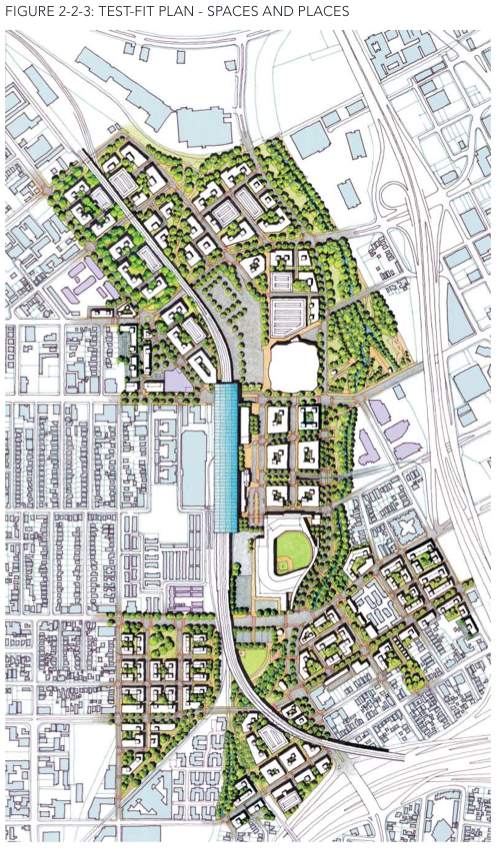
As expected, the San Jose City Council approved the Draft Diridon Station Area Plan, which seeks to transform much of the area around the current transit hub into a destination district anchored by HP Pavilion and Cisco Field. Next up is an EIR for the entire 240-acre vision. Projected impacts will probably force a scaling down of the vision, especially because of limited future redevelopment funds.

Full buildout. North of the arena is the industrial/commercial sector. South of the ballpark is residential. Retail/commercial is between the ballpark and arena. Autumn Parkway is completed through the area.

Tracy Seipel’s article makes mention of the potential need for a master developer, as was the case for Mission Bay (Wilson Meany Sullivan) and the Kansas City Power and Light district (Cordish). The same strategy was employed during planning for the Fremont ballpark, with Gensler as the master developer. While such a strategy could properly unify what would probably be disparate elements of the plan, threats to redevelopment make such a broad scope less realistic. As long as the plan sets out proper guidelines for how development should occur (which it does), the spirit of the area plan should be fairly easy to uphold. Just about everything larger than a single family house will require an EIR on its own.

Lew Wolff said in the past few months that he wouldn’t have anything to do with developing the critical Central area framed by the train station, arena, and ballpark. Knowing how the city fathers have failed time and time again in trying to turn the original downtown into a viable retail district, current civic leaders and developers should not have grand designs on proceeding down a similar path with this. There are three key reasons:

  • No free parking. I don’t mean validated parking, I mean unfettered free parking. Valley shoppers are too used to it and won’t react well to not having it, even if it’s a good idea to charge from a multimodal planning standpoint. Even though Valley Fair and Santana Row are logistical nightmares during the holiday shopping season, people deal with it. A big reason for this is free parking.
  • Inflexibility with events at the arena and ballpark. Parking and access will be heavily impact on event days, especially days when events are happening at both venues. It could create an environment in which locals stay away from the area while events are on. Locals want convenience, and events make convenience difficult to achieve.
  • Market conditions. Development could stretch out over a decade after the project begins thanks to the timing of the BART and HSR projects. That could make it difficult for developers and retailers to gamble on moving in as long as the area remains in a seemingly perpetual state of upheaval.

Historically, San Jose has sought to bring in high-end brands to attract the more well-heeled. The Pavilion downtown failed miserably in that regard, and stopped being a mall over a decade ago. Santana Row opened with numerous tony boutiques. Several years later, most of them have been replaced by typical mall stores.

None of this is to say that the Central area can’t be successful. There is one brand that could conceivably defy San Jose’s jinx and make things work in the end: Apple. Apple could open a store in a toxic waste dump and it’d be successful. They’ve looked at opening stores at or inside highly trafficked transit hubs, including Grand Central Terminal. So if there’s one tenant that the developers and landlords should pursue, it’s the Cupertino tech company. But wouldn’t it be ironic if this district, which at 900-feet long is less than a block shorter than Santana Row, stole business from the San Pedro and SoFA neighborhoods? I could see it.