Tentative 2016 schedule released, A’s screwed over

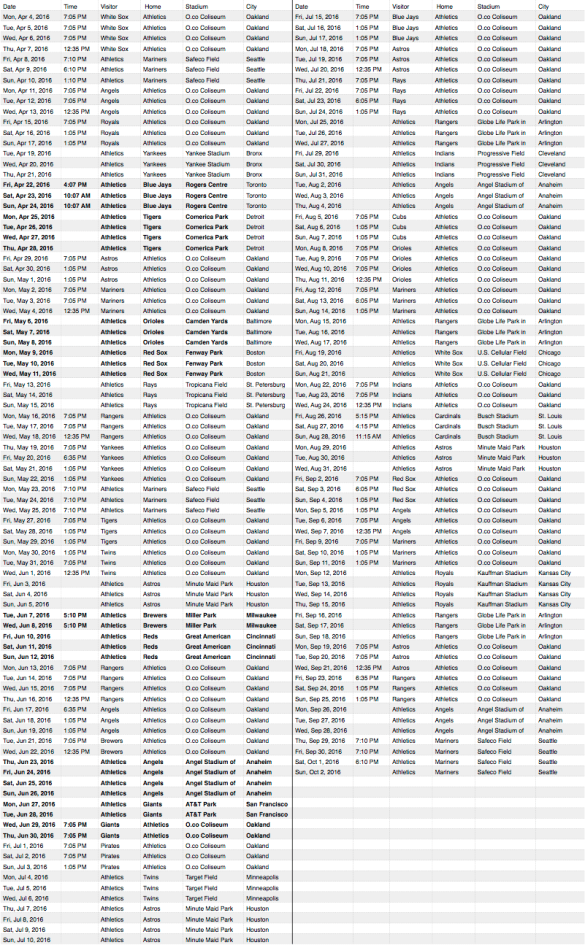
The A’s got a look at the 2016 schedule a while back, and they were concerned enough to lobby MLB in an attempt to make the travel a little easier. They being the A’s, of course, their concerns fell on deaf ears. Now you may be thinking, These guys fly chartered jets and stay in five star hotels, what are they complaining about? True, big time pro athletes travel quite well. The media and fans that follow them don’t. It’s still a grind, and in 2016 the grind is palpably worse than it has been in recent memory.
2016-all

What stands out for 2016 compared to previous years is the number of lengthy road trips and homestands. In baseball, fans are used to the idea of the team being home for a week, then leaving for a week, cycle repeating for six months. For the A’s scheduling is a bit extreme, with three homestands of 9 games or longer and a separate stretch consisting of 13 of 16 dates at home.

stretch

On the road the A’s scheduling woes are marked by a particularly horrific final two weeks in August, in which they go on the road to Arlington and Chicago, come home for a short series with Seattle, then go back out to the Central time zone to face St. Louis and Houston. Worse, the Texas and Houston series aren’t coupled, which would allow for short trips between the cities (made popular by the NBA’s Texas Triangle of Dallas, Houston, and San Antonio). Instead the team will have to go on six separate trips to the state of Texas, none earlier than June. All three trips to visit the Rangers will occur after the All Star break, when the ballpark will be at its least hospitable.

The AL West is slated to play the NL Central this year, with the A’s at home vs. the Cubs and Pirates, on the road vs. the Reds and Cardinals, plus a 2+2 home-and-home set against the Brewers. Another 2+2 is scheduled against the Giants, ending for now the separate 3-game sets against the cross-bay rivals.

Last time the A’s played the NL Central in 2013 the schedule makers were much kinder to the A’s. One of the road trips had the A’s knocking out series against the Rangers and Astros in one week. Another involving interleague play had the A’s in Milwaukee before busing it down to Chicago. I took in part of that trip, watching a four game A’s-White Sox series on the South Side while also catching a game at Wrigley, plus a game at Miller Park. Nothing like that is available for fans in 2016. Arguably the best trip features Toronto and Detroit early in the season, and only because the two cities are about five hours apart. The more doable, stress-free trip involves the A’s visiting Baltimore and Boston in the same week (May 6-11). That’s easily covered by Amtrak, with the option of stopping in Philadelphia and New York along the way. The O’s are going to make some changes to Camden Yards in the offseason, so even if you’ve been to OPaCY in the past, it may be worth another visit next spring.

Speaking of spring, the A’s also released their home schedule at Hohokam for 2016. It was a nice surprise. For Bay Area A’s fans the schedule is much more flexible than the regular season ordeal. There are home games scheduled at Hohokam every weekend. The second weekend looks especially good, as it includes a home date vs. the Cubs on Sunday with a road game on Saturday.

As usual, I’ll compile the complete MLB schedule and work out a full travel grid for the ballpark junkies out there. Look for that towards the end of the week.

Raiders gave Kephart and Oakland just enough rope

Last year the Raiders’ stadium funding gap was $400 million.

Today? Still $400 million.

And that may be the undoing of Coliseum City, just as was predicted many times since the start of the process.

BANG’s Matthew Artz got ahold of a letter written by Marc Badain to Floyd Kephart in April. Despite Kephart’s spin, the letter is incredibly damaging. The crux of it is this:

What is not clear is what the Developer, City, and County are willing to contribute. The Raiders’ $500,000,000 contribution leaves a funding gap of at least $400,000,000 required to build a new stadium. Simply put, the “terms required for the Raiders to commit to remaining in Oakland” are a plan that fills that funding gap without stripping revenues from the stadium and preserves the current level of surface parking. We have seen no progress toward understanding what the Developer, City, or County is willing to contribute and have received no proposals. As a result, there are no “terms” for the Raiders to evaluate nor are there “terms” for the Developer to communicate to the City and County.

You may come away from that thinking that the Raiders demands – all revenue, protected parking, capped contribution – are ridiculous, and in a sense you’d be right. The problem is that it is now abundantly clear that Badain and Mark Davis are comparing proposals, and whatever Oakland is putting forth is being compared to what is being offered in Carson. And Oakland so far is offering… nothing specific. Land? Not really anymore. Infrastructure? Depends on how much. Due to circumstance, Oakland has regressed in terms of what it can offer, a point that Eric Grubman famously made in the spring.

Ridiculous or not, Badain has a point that the G-4 loan money is tied to various team and stadium revenue streams. Fans tend to gloss over the reality. G-4 is a loan program, not a grant. With ties to luxury seating and TV money set in stone, any team receiving G-4 funds is naturally going to fight any attempt to repurpose any other stadium revenue for paying for the stadium, especially if the Raiders have their own projections. Thankfully for the Raiders, exploding league revenue has expanded G-4 to the point that a nearly $2 billion mega-stadium is more than merely plausible.

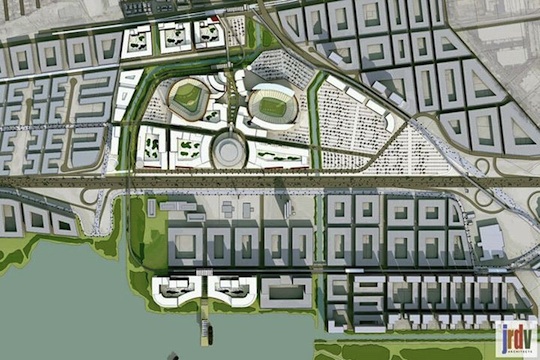
Chances are whatever gets built at the Coliseum won't look like this

Chances are whatever gets built at the Coliseum won’t look like this

Throughout the rest of the letter, Badain offered plenty of examples of how the Raiders have cooperated with the process. They met with developers. They laid out their demands wish list. They met with Kephart, and they continue to meet with Oakland on another track. They haven’t taken the lead on any specific stadium proposal. Then again they haven’t done that with Carson or San Antonio, and they surely won’t be leading the pack on Inglewood. Davis appears to be content to play second fiddle, as long as he gets a good deal for his team. That shouldn’t be too difficult since Davis isn’t going for quite as ostentatious a new home as what Stan Kroenke or Dean Spanos are trying to build. Yet since Davis isn’t driving the bus, he doesn’t get to say much about how nice it should be. FUD is emerging about Davis not being able to afford Carson just as he couldn’t afford to do more in Oakland, but remember, selling a piece of the team is his ace-in-the-hole. In the letter Badain admits that equity in the team is available, but only as a way to bridge the funding gap. Whatever the size of that limited stake, whether 10% or 20%, it’s worth perhaps twice as much in LA as it is in Oakland.

The parking situation also seems to be a nonstarter. It was during the spring that both Davis and Lew Wolff indicated that they wanted to preserve surface parking, even if that means severely curtailing development. Even the final proposal from Kephart does little to address the teams’ parking demands, filling half the space with garages and commercial buildout.

By the end of this project, some $5 million will have been spent on Coliseum City, only to find out that the Raiders’ and A’s stadium goals run counter to the broader planning objectives of Oakland pols. A stadium surrounded by parking is not the kind of high-density, constant-use plan envisioned for the Coliseum. Of course, so far we’ve barely scratched the surface of the other side of the debate: fear of gentrification. With so many bargaining chips taken away over the course of the last several months, how much is left to offer? More importantly, is that enough to get a football stadium deal done? My guess it’s not even close to enough. A ballpark is less expensive and gets used more. It’s getting close to the time when Oakland will need to shift the conversation. They’ve done a good job stalling so far. We can only hope that what remains isn’t scorched earth.

Kephart plays out the string

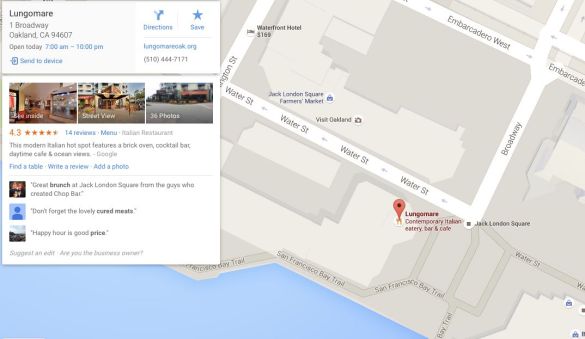
After reading tweets and reactions, and finally listening to Floyd Kephart’s spiel at Lungomare today, I can use one word to describe the whole affair.

Perfunctory

Unlike Kephart’s 50/50-or-less assessment of the project at this late stage, I can say with greater confidence – 80/20 – that this will be the last time you see Floyd Kephart in Oakland. He said that he’ll be there through the early part of October, but that doesn’t mean he has to come back if all signs point to no on the City’s part.

There’s a rendering. It looks modern. Great. The next one’s more interesting.

After reading Kephart’s spoken points and digesting them for a bit, I realized that what Kephart presented today, warts and all, was the most honest proposal anyone’s ever given in the four year saga of Coliseum City. Here’s why:

  1. It acknowledges that the A’s are likely to stay at the Coliseum for a considerable period, so the Coliseum stays intact.
  2. The arena stays as well, because the City wants it even if the Warriors leave.
  3. The project area was downsized to 132 acres, no planned phase west of the Nimitz.
  4. The funding gap, which according to Kephart would be $300 million, would be funded by a City-sponsored conduit bond.

The conduit bond is a tricky thing. This kind of financing has the tax-free, low borrowing cost benefits of regular municipal bonds, but municipalities aren’t on the hook for repayment, as Oakland and Alameda County were with Mt. Davis’s general obligation bonds. Instead, revenues from the development, such as naming rights and certain forms of tax increment on the project area would be used to the tune of $20 million per year. If this sounds familiar, that’s because it’s similar to the way the 49ers financed their gap through Goldman Sachs. During the pre-Harbaugh era, there was a legitimate question about whether the stadium could be paid for this way. A few playoff runs and highly renewed interest later and the 49ers were able to pull it off. The Raiders, well, they’re not in that position. The makes me wonder how the financing would work if there were revenue shortfalls. Who would be responsible, the Raiders? What if they defaulted? And why would the Raiders or the NFL approve such a plan, given the revenue uncertainty?

Kephart said a few other things I found noteworthy.

“Purchase of the (Coliseum) land is key to us staying. In the event that the Council says no…we’re not going to do the development.”

The land purchase is contingent on the City and County coming to an agreement on Oakland buying out Alameda County’s half.

“I’m on my 4th city administrator and 2nd mayor in 10 months. I’m under the 2nd ENA and I haven’t negotiated one significant thing except the ENA.”

That would’ve been a drop-the-mic moment if he was so frustrated that he wanted to quit. He wasn’t. But that’s a stunning admission of how little has actually been done. Kephart has been quick to blame the City, County, and team for his failure. Ultimately, it is his failure since he was brought aboard to bring everyone to the table and work out the deal, so this grousing seems like sour grapes. He made one more observation:

“I’m not the problem, and I’m not the solution.”

Kephart also claimed that it was the City’s responsibility, not his, to get the Raiders, A’s, or Warriors on board. That’s a complete backpedal on his part. Per the ENA, as part of the initial submittal due June 21:

(b) Proposed terms and conditions required to obtain a commitment from one or more of the Oakland Raiders, the Oakland Athletics, and/or the Golden State Warriors to the Project with an update on status of negotiations between New City and each team regarding its commitment to participate in the Project;

I don’t know when this all changed, but I got a hint of it a few weeks ago when NFL point man Eric Grubman was talking about Oakland on Fred Roggin’s LA radio show. Grubman mentioned that the City hadn’t presented anything to the Raiders, which sounded strange since I too thought that New City was responsible for signing the Raiders. Now it makes sense in terms of process, though no light was shed on why it evolved this way. Exactly how was the City selling this to the Raiders? And wouldn’t those efforts run in conflict with the City’s desire to “open” the process for alternatives?

Near the end, Kephart had a sort of kiss-off moment.

“While everybody might think that Oakland is the garden spot of the world, we have projects in three different continents and around the country. And I have lots to do.”

It’s true. The ponies aren’t going to wait for Floyd to come back to Del Mar, you know.

Hypothetical: Could a ballpark fit where the arena sits now?

One of the questions I’ve been fielding over the last few years, especially now that the Warriors are trying to move to San Francisco, is Can a ballpark fit in the space occupied by the arena? The idea is that if the Raiders could somehow find a way to stay in Oakland at a rebuilt (new on the existing site, not renovated) Coliseum, the arena could be torn down to make way for a ballpark. In doing so, none of the capacious parking would be affected except during the construction phases.

The short answer to this is: No. If I’m being generous, I’ll say barely

To understand why, you need to look at the way the complex was laid out in the first place. Remember the old sewer interceptor? It runs in an easement through the Coliseum complex, splitting the stadium and the arena. EBMUD, which maintains the interceptor, needs to have 24/7 access to the interceptor for maintenance.

CC-easements

EBMUD’s sewer interceptor is the green line that separates the stadium from the arena

Combine that with the power lines and other utilities that run through the complex, and suddenly the choices for siting the venues were reduced. If the interceptor had not been there, or had been rerouted around the edge of the complex, the venues probably might have been placed in line with 880, allowing for more of a buffer around both instead of pushing the arena up against the freeway. Such an arrangement would’ve been better for fans going to the arena from the then-years-from-completion BART station, since they would’ve had a more direct route there instead of always having to walk around the stadium.

Nevertheless, here we are. The arena is situated within its own 8 acre parcel in the complex. The fit is tight thanks to the multi-lane 66th Avenue off-ramp.

oracle_space

Ideally there should be a minimum of 600 feet in either direction

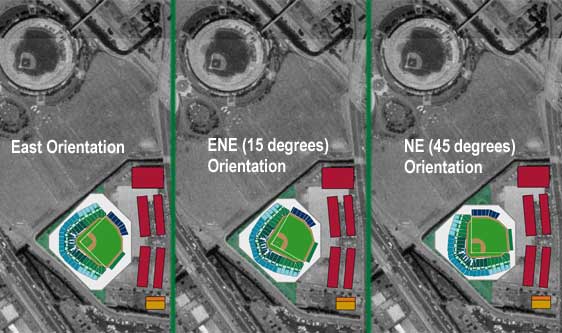
Last month I suggested the HomeBase site, which has 50 feet more width than the arena site yet is also less than 600 feet wide. This is obviously narrower. A tight fit equates to two specific limitations. First, there’s little flexibility in terms of orienting the field. If the A’s wanted to orient the field the same way as the existing field, they would need:

400 feet (home plate to center) + 50 feet (backstop) + 110 feet (lower deck) + 40 feet (concourse) + 30 feet (concessions and restrooms) + 60 feet (staging and infrastructure) + 50 feet (street side buffer) = 740 feet. For reference, the diameter of the Coliseum from the club entrance behind the plate to the back wall of Mt. Davis is 100 feet longer.

To further illustrate the squeeze, let’s drop everyone’s favorite ballpark, PNC Park, where the arena is. I’ll include the approximate location of the sewer interceptor so you can see the problem.

Yellow line represents sewer interceptor

Yellow line represents sewer interceptor easement

The resulting dimension down the right field line would be around 275 feet. Talk about a short porch.

Compromises could be made to make the fit better, like reducing the size of seating decks, concourses, and buffer areas, all of which would negatively affect fan experience. The field orientation could also be rotated 15 degrees north (counter-clockwise), opening up space down the RF line while reducing space in the opposite corner.

Of course, we can’t discuss this option without considering the circumstances and ramifications. Should the Warriors leave by the summer of 2018, there would still be nearly $60 million of debt remaining on the arena. It’s likely the City and County will have to swallow the debt while the A’s paid for a will construction costs, perhaps including demolition of the arena. Combine that demolition and site prep time with a two-year build, and the A’s would be in a new ballpark there by the start of the 2021 season. If the Raiders were also staying, Mark Davis could get his stadium on the current site, also by the 2021 NFL season. Where the Raiders would play during the construction period is anyone’s guess. Same goes for the remaining Coliseum debt.

Back to the ongoing Coliseum City saga. Chris Dobbins of the JPA and Save Oakland Sports announced that the public is welcome to attend Floyd Kephart’s presentation at Lungomare on Tuesday morning (unclear on the time of the event).

lungomare

I’m interested to see if any activists showed up.

Oakland, the non-entity

They didn’t come, they didn’t see, and they didn’t conquer.

That was Oakland’s vibe at the NFL owners meetings. St. Louis made its stadium presentation previously, while San Diego did theirs yesterday and Carson made their preso today. It’s even possible that, unless Oakland pulls a rabbit out of its hat, it may not be invited to make a presentation in October either.

One of the many versions of Coliseum City that didn't solidify into a proposal

One of the many versions of Coliseum City that didn’t solidify into a proposal

Look, the bad news was known weeks before this week’s meetings. Oakland was not invited to make a presentation in front of the owners in suburban Chicago this week, because, to put it mildly, the NFL didn’t believe Oakland had a presentation to make. Here’s how you know how bad it is – in April Mayor Libby Schaaf hired one-time planning director Claudia Cappio to be the new assistant city administrator in charge of development. Among other responsibilities, Cappio became the de facto spokesperson for the project. That’s never a good sign, because when the City puts out a staffer and not a single Oakland politician wants to lay claim to the project, you know it’s in bad shape. What happened to Fred Blackwell? Remember him? Is he no longer consulting for the project? Oh that’s right, he left for a private sector gig. Blackwell clearly saw the writing on the wall.

The most damning statement came from NFL point man-cum-hatchet man Eric Grubman, who said this about Oakland’s situation:

‘The Oakland Raiders have great fans in Oakland city and the county of Oakland and a lot broader territory, but the facts on the ground are that there’s been no viable proposal that’s been made to the Raiders,’ Grubman said. ‘We’ve said one thing consistently to any of the markets that have been engaged in trying to put forth a proposal and it really rests on a couple of pillars. One of them is that a proposal has to be specific. The second is that it has to be attractive to a team and the third is it has to be actionable.

‘What actionable means is it can’t just be an idea to the extent that there is enabling legislation or enabling financing activities or there are litigation threats or anything of that nature, anything that needs to be assembled in a time frame where a club can act on it. Thus far, those sorts of tests have not been made in Oakland so as of yet, there is no proposal for the Raiders to consider.’

The irony of this is if the words above were uttered by Lew Wolff he would be ripped in column after column by the usual lazy critics. Wolff’s statements about Oakland in the past have largely had a similar tone and verbiage. But since Grubman doesn’t represent a specific team, and is in fact an arbiter of sorts for the NFL, these words will be met with little debate by potential critics, and mostly resigned disappointment by others. Yet look at that second paragraph. It is on par with Wolff saying that people can’t just point to a site and hope it into becoming viable. It needs to pencil out. And for three years and counting, Oakland has not made Coliseum City pencil out, not to any appreciable degree.

Thing is, I agree to some extent with what Oakland’s doing. It tried, it found out that the NFL wasn’t interested in a complex developer-finance scheme, it looked for alternatives and found nothing but resistance. All that’s left is to give up or wait for the NFL to kill Oakland. The former provides some (though not much) political cover for pols regarding constituents who want to see the City move on from Coliseum City. The latter provides cover when facing Raiders fans. In the meantime Oakland can finish the process, since it won’t hurt to do so with 10 or 40 days left in the ENA. Two months until the next meetings is not enough to rally the resources to make Coliseum City or an alternative happen, especially if Mark Davis isn’t committed to the effort.

There also has to be some detached bemusement coming from Rob Manfred and the Lodge. Unless Manfred worked out some sort of wink-nudge deal with Oakland, Manfred has to be wondering what kind of effort and political will he can expect out of Oakland for a ballpark. Observers have been poking holes in Coliseum City for years, and Oakland has done little to prove them wrong. Consider that the main accomplishment at Coliseum City was the passage of a planning-oriented EIR. That’s a procedural step, not a truly major milestone. Manfred will certainly play nice with Oakland once a ballpark process begins, but if he doesn’t like what he hears, don’t be surprised if he turns the heat up on the City and even Wolff. Manfred’s previous job was to get the best deals out of everyone MLB worked with, from cities to media outlets.

For now, desperate Raiders fans are left to criticize other cities’ stadium proposals in hopes that their success or failure will “trap” the Raiders in Oakland. It’s hard to come up with a concept more absurd than that. The NFL wants results, and if Oakland can’t provide them, the league is not going to sympathize. It will move on.

Wolff looks elsewhere at Coliseum, Alameda County looks to leave JPA

NFL franchise relocation point man Eric Grubman made a visit to Oakland to talk Raiders stadium. Not much emerged from the talks other than Alameda County Supervisor Nate Miley once again expressing a desire for the County to sell its half of the JPA (land and debt) to Oakland. That’s both good and bad – good in that having Oakland as the sole public entity involved would simplify the deal greatly, bad in that Oakland would have to find the cash to buy the County’s half and figure out how to fund infrastructure for Coliseum City. It’s possible that proceeds from the land sale would take care of the debt, but what about everything else? Oakland would effectively be trading one set of hassles for another.

The big scene-stealing news came from Lew Wolff, who walked back the MLB subsidy idea while providing slightly more detail on his plans. Interestingly, Wolff is considering a site he looked at way back when he was not yet an owner, instead working as an executive for Steve Schott and Ken Hofmann. No, it’s not the flea market all over again, nor does it appear to be the existing complex, either directly north or south of the Coliseum. Instead the site of choice may be what I like to call Coliseum South, better known as the Malibu/HomeBase parcels to the south adjacent to the Coliseum complex.

malibu-homebase

21 acres, though option leaves only 12 acres buildable

The City of Oakland bought the HomeBase site in 2010. That and the triangular Malibu lot total 21 acres, City owned, not JPA owned. Other lots in the vicinity (Denny’s and the EDD building) are privately owned and would have to be purchased separately for additional ancillary development. I suggested the possibility of building there in 2005, shortly after I started this blog. Back then the HomeBase site still had an empty shell of a warehouse, which frequently housed the homeless while the parking lot hosted sideshows.

coliseum_south

My 2005 concept which would’ve included a small retail-entertainment district beyond the outfield

21 acres of City-owned land that’s only used as parking? Break ground tomorrow, right? Not so fast. The City had worked hard to bring the County in only recently because of the pre-existing partnership. Should the County exit stage left and the City work out the financials, that would be a major step forward. However, there is a major encumbrance on the Malibu lot that makes it extremely difficult to build there – utilities.

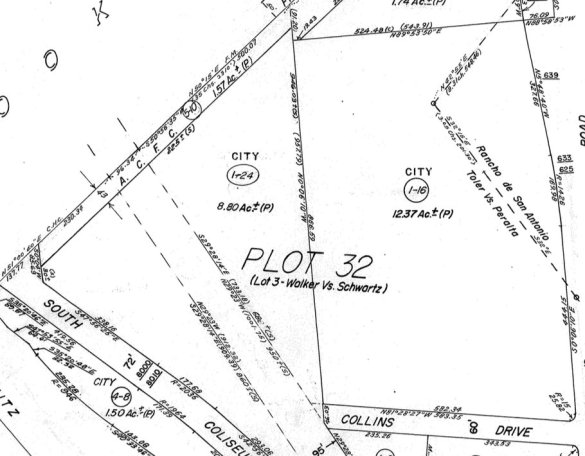
Current assessor's map

Current assessor’s map

The dotted lines running northwest-to-southeast through the Malibu lot represent EBMUD’s sewer interceptor easement, which cannot have anything built on it. Power transmission lines run north-south along the east parcel line, up against the edge of the HomeBase lot. Unless someone is willing to pay the freight for relocating those utilities, chances are that the Malibu lot will remain a parking lot. That leaves 12 acres for a ballpark. The HomeBase parcel is less than 600 feet wide, making for a tight fit for a ballpark. AT&T Park is about 600 feet wide if you extend the first base line out to the promenade and back to King Street. Those constraints obviously go away if the utilities on the Malibu lot can be relocated. Keep in mind that means working with the Public Utilities Commission, EBMUD and PG&E, and chances are that it would mean more than moving them around to simply avoid the Malibu lot. If both utilities are going to be involved, they’ll want projects that are much more long-term, which means much more comprehensive projects. Who knows, it may ultimate prove worth the investment.

Wolff suggests MLB will help subsidize Oakland ballpark

Tyler Clippard did better as A’s closer than I expected, possibly faint praise in light of the pitiful nature of the rest of the bullpen. After Clippard was traded to the Mets for potential back-of-the-rotation starter Casey Meisner, Billy Beane was asked about the team’s strategy and philosophy. Inevitably the discussion turned to his thoughts on a future ballpark (h/t BANG’s John Hickey), whenever the hell that’s gonna happen.

“It seems the environment maybe is right. It’s not my department… I don’t want to be Pollyannaish. I’m hopeful that something or some progress will be made. It will make it easier to plan from a baseball operations standpoint. If you had a ballpark (in the works), this would probably be the proper approach.”

Beane has echoed similar thoughts before, as the A’s were pushing for ballparks in both Fremont and San Jose. It would be completely acceptable for Billy to be gun-shy considering the failures of the past. Yet Beane seemed practically optimistic, despite there being no specific date to break ground, let alone open a new park.

Backing that optimism was Wolff, who took the notion of an Oakland ballpark further, admitting that he’s – get this – talking it over with Rob Manfred.

Wolff did say that new commissioner Rob Manfred was fully behind the A’s getting a new venue as soon as possible. And the A’s owner said Major League Baseball would likely kick in some money to help the A’s get a stadium done at the Oakland site, public money not being available.

That’s about as big of news as we’ve heard all year on the ballpark front. A private subsidy – that’s what we’re talking about here – is exactly what the A’s will need to make a ballpark in Oakland… wait for it… feasible. Oakland has a hearty albeit small fanbase, and it lacks San Francisco’s or San Jose’s corporate wealth. Money from MLB, which would really be paid by the richer clubs, is the stable revenue stream that the A’s need to stay in Oakland. And since it doesn’t come from Oakland or Alameda taxpayers, it’s politically above board.

The easiest path to that money is MLB to continue to keep the A’s on revenue sharing, which I suggested a week ago. While it doesn’t fulfill the goal of getting the A’s off the dole, it solves the Lodge’s problem of figuring out what to do with the A’s without fighting over territorial rights. Enshrined in the current CBA is language specific to the A’s:

Beginning with (but not before) their first full season of operation in a new stadium, the Oakland Athletics shall be subject to the same-percentage revenue sharing disqualification that applies to other market-disqualified Clubs in the given Revenue Sharing Year.

Those “market-disqualified Clubs” are the top 15 markets (teams) in MLB. The bottom 15 are fully eligible for revenue sharing. As long as the A’s stay in the Coliseum, they straddle that line between the two. The owners and Bud Selig probably thought that the A’s stadium mess would’ve been resolved by the end of the CBA, that’s why the language is in there. Instead, Selig’s successor, Manfred, and those same owners now have the choice of resolving the A’s problem by allowing the A’s to stay on revenue sharing. It’s a compromise plan to be sure, one the owners always had in their back pocket.

Revenue sharing is designed to help the have-nots with player development, not for stadium development. That’s an issue that would have to be worked out internally. I would expect that, as with the current CBA, the A’s place within the revenue sharing recipients pool will have another sunset clause, one that’s perhaps 10 years down the road.

There is an alternative to revenue sharing in the form of MLB’s credit facility, which allows up to $100 million per team for reasons outside of normal baseball operations. Eventually that may be the better way to handle the situation. Use of the credit facility would be more like the NFL’s G-3/G-4 program, in that a loan would be taken out against future TV revenues. It’s a smaller subsidy, but if the ballpark costs a reasonable amount ($600 million), it could be enough to cover those years when stadium revenues are running a little dry.

If you were looking for a sign that Wolff and John Fisher are serious about building in Oakland, this is it, short of a plan unveiling. It shows that ownership is serious, MLB is serious, and Oakland is the main focus. At the same time, there is still the saga of Coliseum City to deal with. Nate Miley suggested today that nothing was happening as far as alternative proposals until Coliseum City ends, so we can look forward to that at some point, maybe in the coming weeks. Until then, this is progress.

Coliseum renovation for baseball?

Lew Wolff was profiled in the current edition of Athletics magazine. It amounted to a short biography, with some time at the end devoted to how Wolff sees the A’s future. Much attention has been paid to the following passage:

We continue to respect the desire of the Raiders for a new football-only venue, while we of course would like to play in a new or vastly improved baseball-only venue.

New or vastly improved? Wolff referred to a renovated Coliseum recently, perhaps only in passing. This sounds like a renovated Coliseum is a real option. But is it?

When most A’s fans think about a rebuilt Coliseum, what they think about most is the old Coliseum, pre-Mount Davis. Knock down the concrete eyesore in the outfield, bring back the bleachers and ice plant, fix up some stuff in the old Coliseum and the A’s are set. Which would be true – if this was 25 years ago. We’re in 2015, and the bar has been raised. Removing the football seats isn’t going to bring in casual fans, the attendees that come to Oakland so inconsistently and infrequently. In California, renovation works on old theaters, where wood and accents connote charm and warmth. A hulking stadium once known as the Oakland Mausoleum has no warmth. It would still lack a purpose-built ballpark’s intimacy. And for Oakland and Alameda County, they’d be stuck with $100 million in remaining debt and nothing to show for it. There is a bright side, however. If the A’s took over the Coliseum after the Raiders left, the A’s could claim and repurpose the Raiders’ locker room, eliminating the legacy clubhouse’s plumbing and sewage issues for good. City and County would still be stuck with the debt, but at least they wouldn’t have to pay the Raiders’ ongoing operating subsidy at the Coliseum, worth $7 million a year.

Cost of return to early 90’s Coliseum: $150 million ($50 million in improvements, $100 million in outstanding debt)

Another option could be to repurpose Mt. Davis and replace much of the old stadium, since Mt. Davis is the newest part of the Coliseum. I posted such a concept six years ago to little fanfare, which is exactly what I expected. It’s exactly the compromise plan that you might think it is.

newlook-enlarged-1024x928

It’s sort of the Two-Face of ballparks. The top level of Mt. Davis would be removed, seats replaced on the lower and club levels, plus remodeling of the concourses and suites. New seating decks would be built behind a relocated home plate and first base line. The mezzanine and club levels of the old Coliseum would remain since they fill needs: a restaurant in the outfield and additional seats. The new scoreboards could be assembled into one extremely wide (36′ high x 290′ wide) or large (72′ x 145′) display. No additional major infrastructure other than a revamped field drainage system would be needed. Of course, some issues regarding the sight lines from Mt. Davis would have to be resolved, partly by rearranging the lower bowl and adding new seating options.

Cost of repurposed Mt. Davis-based baseball stadium: $350 million for the A’s, including $100 million Coliseum debt.

—-

A new, bespoke ballpark on the Coliseum grounds is the preferred option for A’s fans and MLB. Is it for Wolff and Fisher? Sure, as long as it pencils out. The idea that Wolff pitched last year was that there was a way to privately finance a ballpark while also addressing the debt by taking it out of the public’s hands. Unfortunately that concept has been hit with two huge doses of reality.

Issue #1 is that it’ll be hard to service the debt of the new stadium and the old stadium using all private sources. Right now Mt. Davis costs low eight figures to service, but imagine if that debt wasn’t serviced by relatively stable sources like taxes, instead paid by stadium revenues. Financing costs would balloon, making an already expensive project even more expensive. That’s why I found it curious that Oakland Mayor Libby Schaaf seems resigned to having the public sector pay off the debt. To go that route would be significant reversal, as one of the goals of Coliseum City was to find ways to wipe away the albatross.

That leads to Issue #2. The sale of the (public) Coliseum land could turn into a political third rail thanks to protests by East Oakland and housing activists. Wolff, like many other developers, is finding that the economics aren’t quite right for a market value project at the Coliseum, where the higher prices are needed to subsidize other project components like the stadium. Even if the pricing worked out, the same aforementioned activists would raise hell over potential gentrification. When the Coliseum City process started, there was an acknowledgement that the various public and private partners would have bargaining chips to play. Slowly, each of those chips is being taken away. We’ll soon be down to the basics: building a stadium privately, with no help.

If a new A’s ballpark can stay reasonably priced, there are ways for it to be financed by Wolff. Like the Giants, there will be some annual set aside for debt service that impacts payroll. Lean years could become extremely lean thanks to the mortgage. The A’s could work a deal with MLB to ensure that they stay on the list of revenue sharing recipients in the next CBA. It would be a reasonable request given the A’s being pigeonholed into Oakland.

Regardless of the difficulty, a new ballpark has to be what MLB and Rob Manfred want for the A’s and Oakland. The old compromises don’t die. They evolve and transform. That’s the new reality.

Make. Them. Pay.

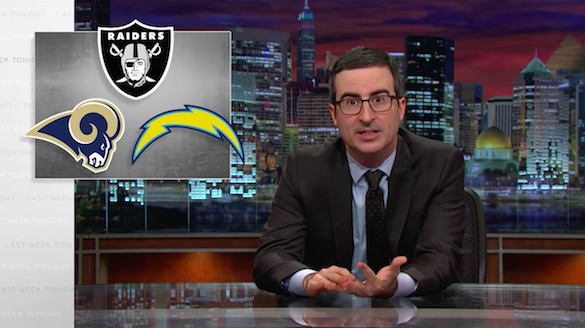
When HBO announced its own fake news show Last Week Tonight with John Oliver I felt great about Oliver, who did exemplary work at The Daily Show. I also felt rather hesitant at the show’s format: a 30-minute show on Sunday night featuring the previous week’s news. It didn’t take much time for Oliver to prove the format a winner. Instead of the rat-a-tat nature of TDS, The Colbert Report, and other late night shows, Oliver was given the freedom of devoting a lengthy segment every week to a single topic. Those segments, usually ending each episode, have providing cutting and often educational rants on a broad range of topics, from FIFA corruption to race relations to an interview with Edward Snowden. So it shouldn’t have surprised me that this week’s topic was near and dear to my heart: stadium development in America.

nfl_teams_la

Oliver starts and ends the segment with references to soaring locker room speeches. I took the liberty of transcribing his own speech at the end. As you watch the end, read the speech.

For the rest of you I want you to look deep down inside your hearts. I want you dig in there and I want you to find something. And it’s gonna seem tiny but it’s the most powerful thing in the world. And it’s the word “No.” No.

So when a billionaire asks you to buy him a hologram machine that doesn’t exist yet, what are you gonna say?

NO.

That’s right! And when they ask you to build a stadium with public money without opening their books, what are you gonna say to them?

NO!

That’s right! And when they ask you if they can keep all the money for calling their arena “Smoothie King Center” what are you gonna say to them?!?!

NO!!!!!

FUCK NO that’s right ‘cause that’s a stupid name for anything, even a smoothie store!

‘Cause I want you all to get out there. And the next time a team comes around asking for a new stadium I want you to MAKE THEM PAY. What are you gonna do?!?!

MAKE THEM PAY!!

WHAT ARE YOU GONNA DO!!!

MAKE THEM PAY!!!!

WHAT ARE YOU GOING TO DO!!!!!

MAKE THEM PAY!!!!!

CLEAR EYES! FULL HEARTS!

CAN’T LOSE!!!

LET’S GO DO THIS!!!!!!

crowd ends in a MAKE THEM PAY! MAKE THEM PAY! chant.

Already my week is made.

Coliseum City Proposal revealed and it sucks

Try as Floyd Kephart and the City of Oakland tried to keep the Coliseum City proposal away from the public for 20 days, the key summary was revealed by BANG’s Matthew Artz late last night. As you might gather from the action to hide the documents from the public under a confidentiality arrangement, there was plenty to hide and precious little to tout. Kephart’s New City did get the documents to Oakland/Alameda County by the June 21 deadline, which is to be commended (somewhat). Beyond that, the whole thing sucks for a multitude of reasons.

Kephart’s New City Development pitched a $4.2 billion plan, which would include:

  • $900 million Raiders stadium to be owned by team, land underneath to be leased by City to team for $250k per season
  • Sale of public lands (Coliseum and surrounding) to New City for $116 million
  • Proceeds would pay off Mount Davis debt
  • Potential for additional proceeds to fund affordable housing subsidy; if not fully covered, bond issue
  • Land reserved for an A’s ballpark through 2019
  • 4,000 housing units
  • 450,000 square feet of retail, 1.5 million square feet of office/R&D space
  • 400-room hotel
  • $100 million in new infrastructure (BART transit hub, roads), not including…
  • $187 million in parking garages (financed by New City)
  • Stadium and essential infrastructure completed by 2019, hotel by 2020, full buildout by 2022
  • Sale of 20% stake in Raiders to New City for $200 million, half of which goes to into stadium
  • Creation of “Stadium Company” to finance $300 million in debt for stadium (49ers have a similar entity)
  • $500 million from the Raiders and NFL G-4 fund (combined)

The football stadium part of the plan has no magic bullet to cover the $400-500 million funding gap. The NFL and Raiders would their part, probably closer to $400 million. There remains an open question about how likely it is the Raiders would get that $400 million. It’s one thing to award the full $200 million G-4 loan (to be matched by the team) to the 49ers and Levi’s Stadium or the Vikings and Falcons, teams whose projects will certainly host future Super Bowls. The Raiders stadium would be smaller and less capable of hosting a Super Bowl and other big events. Its premium revenue-generating capacity would be much lower than other recently built stadia, which makes me wonder just how well the G-4 loan would be serviced. Chances are that the stadium would qualify for a smaller loan, perhaps closer to the old G-3 cap of $150 million. So when you really start to add it up, it’s much more realistic to expect $350-400 million as the “standard” private contribution from team and league. More than that is rather wishful thinking considering the stadium’s size and scope.

A “Stadium Company” would be created on the private side to manage funneling game revenues towards debt service. Its counterpart would be the Coliseum Authority (JPA) or its successor. If the sides ever got down to real negotiations, the real sticking point would be whether the debt would be issued publicly (tax free) or privately (taxed). On one page the Raiders are said to own the stadium, on another they lease the stadium. The model is similar to what the 49ers created for Levi’s, which means that the same questions would arise during the period leading up to the stadium’s opening. Can the Raiders and the various entities sell enough sponsorships and get a big enough naming rights deal to cover the gap? Or does this sound too much like Mount Davis?

Ancillary development, which has been already been dismissed by Mark Davis and NFL point man Eric Grubman, is still very much in play here. The worst part about it is that the money the ancillary development will generate won’t go towards paying for the stadium, or for affordable housing. New City would get to reap the rewards, pay a little towards infrastructure, not get saddled with the responsibility of financing affordable housing, and get a piece of the Raiders in the process. Sweet deal, eh? No wonder the NFL has been so averse to having “middle men” like Kephart involved in these deals. It prefers to have Goldman Sachs and big banks there as the established partner financing arms instead of deal makers.

The ballpark gets one whole line in the 19-page document:

Parcel 6 for development of the ballpark will be reserved through January 1, 2019.

In the Specific Plan Parcel 6 is to the right on the other side of 880 from the Coliseum

In the Specific Plan Parcel 6 is to the right on the other side of 880 from the Coliseum

I can’t blame Kephart for reducing the A’s to one line considering how Wolff disregarded him and the project at every turn. If Kephart’s gonna go out, he’ll go out guns-a-blazing. Wolff was never going to take part anyway, so this is at least a modest allowance. Yet what is Parcel 6? We’ll find out more in a couple weeks assuming the documents are released as expected. For now we don’t have an updated site plan. If Parcel 6 is the same one identified in the EIR/Specific Plan, it’s the Hegenberger Gateway shopping center anchored by Walmart and other properties along Hegenberger. How does that get repurposed for a ballpark? I’ll let you know when BART builds an Airport Connector station there to service the site, more than a mile away from the Coliseum BART station.

Lastly, there’s the sale of public land. The document cites $116 million as fair market value, though that is entirely dependent on use and density. $116 million is ridiculously cheap, at around $1 million per acre depending on how much is actually used for the ancillary development. Lew Wolff’s Coliseum North plan was derailed because he lowballed local business owners, offering the same value ten years ago. Two weeks ago the City of Oakland pushed through a $5.1 million sale of one acre on East 12th Street overlooking Lake Merritt for housing, with the developer agreeing to provide $8 million towards affordable housing elsewhere. City Council sessions got so heated that housing activists took over the Council Chambers in the first meeting, followed by the City blocking off public access in subsequent meetings. All that because the process was supposed to dictate that the sale of public land in Oakland mandated use for affordable housing (if housing was the intended use). Now we’re looking at an exponentially larger project in the Coliseum area. How’s that gonna go over?

With the stench this deal is serving up miles away from any actual deliberation over its merits, recent revelations about an exit strategy and a backup plan for City/County should come as no surprise. That’s both good and bad, as the millions spent on Coliseum City will have gone to waste while that backup plan will have only a few months to gestate. That’s a great recipe for a terrible deal, one even worse than New City’s vision Coliseum City. There’s always a renovation concept to fall back upon, and Wolff’s biding his time waiting for CC to collapse. Looks like you’ll be on the clock soon, Lew.