Bending rules instead of fixing them

As the legislative session ended late Thursday night in Sacramento, the assembled pols found themselves at yet another crossroads regarding CEQA. They were getting ready to prove another project’s sidestepping of existing CEQA law, all in the name of making the state more competitive, or jobs, or keeping a team from moving to another state. While Democrats were generally in lockstep about the prospects of the project, Republicans complained about how granting exceptions like this one doesn’t fix the core problem.

Just about everyone including Governor Brown agrees that CEQA makes the procedural environment too difficult to get things built. It’s all too easy to create year-plus delays because of often frivolous CEQA challenges. Don’t get me wrong, many CEQA challenges have real merit. If a contaminated site needs to be cleaned and an applicant isn’t thorough about mitigation steps, CEQA provides the method to keep such abuse in check. But uses of CEQA can themselves be abusive, such when homeowners object to a project simply because it will affect their property values.

CEQA was designed to protect the environment. While it needs to be overhauled to prevent abuse, whatever programmatic changes need to be made must keep the spirit of the law intact. Judging from the debate on the Assembly floor on Thursday, it’s not clear exactly how that will happen.

State Senate President Pro Tem Darrell Steinberg (D-Sacramento) did a victory lap Thursday afternoon as SB 743, the bill designed to help streamline CEQA for the Kings’ downtown Sacramento arena, was easily approved in both houses. Previous bills provided similar exemptions for other big projects. Farmers Field received an exemption because it was thought that streamlining CEQA would help bring a NFL franchise to LA. It didn’t. SF Assemblyman drafted similar legislation for the Warriors’ arena (AB 1273). And if Howard Terminal got off the ground for any kind of major project including a ballpark, it’s likely that another bill would be written to benefit that project. Given the amount of cleanup that would be required, bypass legislation is practically a given.

During the debate over AB 852, a last minute gut-and-redraft meant to impose union-backed CEQA protections over certain projects, Assemblyman Paul Fong (D-Cupertino) asked the bill’s author, Roger Dickinson (D-Sacramento), if the bill and AB 743 could help a project Fong champions in his backyard, Apple’s spaceship campus headquarters. Dickinson indicated that this was the case.

The problem with providing exceptions for big, high profile projects like stadia and convention centers (or corporate headquarters) is that they chiefly benefit the big money team owners and associated businesses who run such facilities. If we’re going to be serious about real, substantial CEQA reform, we need real legislation to get to the core problems regarding abuse and delay. That way every kind of applicant can benefit, not just incredibly wealthy business interests. Steinberg made some headway by reshaping how some areas of concern are measured, but only after he shelved SB 731, the bill he wrote as a broader approach towards real CEQA reform. Chief among the issues addressed in SB 743 are parking and traffic, both of which will now have a potentially more flexible way to define mitigations. Aesthetics are also deemphasized for certain projects. All in all, these are small but necessary steps that should modernize CEQA. Steinberg did what he needed to do to help the Kings arena, just as he promised to David Stern and the NBA’s Board of Governors. As for properly reforming CEQA? That’s for the next legislative session, I suppose.

Roger Noll declaration

Economist and Stanford Professor Emeritus Roger Noll made a declaration in support of the City of San Jose’s antitrust lawsuit against Major League Baseball. He also provided a (presumably paid for) analysis of the issues at stake. The following is Professor Noll’s complete statement. A PDF version is available here.

DECLARATION OF EXPERT WITNESS ROGER G. NOLL

1. My name is Roger G. Noll. I reside in Palo Alto, California. I am Professor Emeritus of Economics at Stanford University and a Senior Fellow at the Stanford Institute for Economic Policy Research, where I am Co-Director of the Program on Regulatory Policy. My educational background includes a B.S. in mathematics from the California Institute of Technology and a Ph.D. in economics from Harvard University. My complete curriculum vita is attached as Appendix A.

2. My primary area of scholarship is the field of industrial organization economics, which includes antitrust economics and the economics of specific industries. I have taught antitrust economics at both the undergraduate and graduate levels. I am the author, co-author, or editor of thirteen books, and the author or co-author of over 300 articles. Many of these publications deal with antitrust economics. I also have published extensively on the economics of sports, including Sports, Jobs and Taxes, co-edited with Andrew Zimbalist, which deals with the economic impact of sports teams and facilities and for which Professor Zimbalist and I wrote a chapter on the implications of the economic impact of teams and facilities for antitrust policy.

3. I have served as a consultant in antitrust litigation, including matters pertaining to sports. I have served as an economic expert for the players’ association in all major U.S. team sports (baseball, basketball, football, hockey, and soccer) on the economic effects of restrictions on competition in markets for the playing services of professional athletes, including testimony at trial in Freeman McNeil, et al., vs. National Football League (U.S. District Court, Minnesota) and John Mackey vs. National Football League (U.S. district Court, Minnesota). In Bernard Parrish, et al., vs. National Football League Players Association (U. S. District Court, Northern District of California) I testified on behalf of the players’ association about the value of licensing rights for retired NFL players.

4. Other cases in which I have testified at trial in recent years are the following:

• In re Application of MobiTV Related to U.S. vs. ASCAP (U.S. District Court, New York City);

• Reggie White, et al., v. NFL: Lockout Insurance & Lockout Loans (U.S. District Court, Minneapolis);

• SmithKlein Beecham d/b/a GlaxoSmithKline vs. Abbott Laboratories (U.S. District Court, Northern District of California, Oakland);

• Novell vs. Microsoft (U. S. District Court, Salt Lake City);

• DVD CCA vs. Kaleidescape (Superior Court, San Jose); and

• In the Matter of Adjustment of Rates and Terms for Pre-existing Subscription and Satellite Digital Audio Radio Service (Copyright Royalty Board, Washington, D.C.).

5. In addition to the cases in which I have testified at trial, I have submitted expert reports and/or been deposed in numerous matters. I have also testified before the U.S. Congress on antitrust and sports matters on numerous occasions.

ASSIGNMENT

6. Attorneys for Plaintiffs have asked me to analyze Plaintiffs’ allegations in this matter to determine the economic evidence and analysis that would be used to prove liability in support of their claims. In undertaking this task I have read the Complaint, which was filed on June 18, 2013. I also have read Defendants’ Motion to Dismiss, filed on August 7, 2013. Finally, I have made use of information that has been collected from other public sources and my four decades of research on the economics of sports.

7. The purpose of this Declaration is to provide a preliminary analysis of the economic issues in this litigation before discovery has taken place. Hence, I reserve the right to revise my analysis and amend my conclusions on the basis of new information that has not yet become available. In particular, I understand that this Declaration is being submitted in connection with settling of the pleadings and that I am not being asked to opine on the merits of the claims. I would like to have the benefits of the complete discovery record before reaching my conclusions on the merits.

ANALYSIS

8. The objective of an antitrust economics analysis of liability is to determine whether conduct by Defendants caused harm to the competitive process. Ultimately, harm to the competitive process means harm to consumers, in this case sports fans. My main conclusion is that preventing the Oakland Athletics baseball team from moving to San Jose causes harm to competition because relocating to San Jose would substantially increase the potential fan base and attendance of the team.

9. Major League Baseball (“MLB”) is made up of thirty teams. These teams are economic competitors in many markets, including markets for players, coaches, regional television rights, and product licenses. If teams are geographically close, they also compete for attendance among sports fans in a local area. Presently MLB has local teams that compete for attendance in Baltimore-Washington, Chicago, Los Angeles, New York and the Bay Area.

10. Economics research and prior litigation have concluded that each major professional sports league in the U.S., including MLB, possesses market power in the provision of major league games in its sport in North America. Among the ways that MLB exercises its market power is by controlling the number and geographic location of major league baseball teams in North America. MLB has adopted rules that define the “home territory” of each team in the league and that place restrictions on franchise relocation. For now irrelevant historical reasons MLB has placed San Jose in the home territory of the San Francisco Giants, even though a team in San Jose would be less of a direct competitor to the Giants than is a team in Oakland because San Jose is much further than Oakland from the Giants’ home stadium.

11. One domain of competition in MLB as well as other professional sports is competition among cities to attract or to retain a team. Economics research shows that the financial success of a baseball team depends on the economic and demographic characteristics of its home territory, the quality of its home stadium, and the financial terms and other arrangements concerning the stadium. Cities actively compete for baseball teams on the basis of agreements that they offer to a team concerning a home stadium. The alleged anti-competitive conduct in this case is Defendants’ inhibition of competition and restraint of trade through the application of restrictions on team relocation which are preventing the City of San José from competing with the City of Oakland for the Athletics Baseball Club (Athletics).

12. Economists who have studied the location of teams in a league have concluded that in some circumstances a league has a reasonable business justification for restricting relocation. In particular, because the success of a league depends on the financial success of each team, leagues have a valid interest in assuring that each team will enjoy sufficient popularity in its home territory to be financially viable. This pro-competitive justification does not apply to MLB’s refusal to allow the Athletics to move to the City of San José.

13. San Jose is much more attractive than Oakland as a home location for a baseball team for several reasons. First, San Jose has a much larger population base, and so substantially greater potential home attendance for a local team. Second, San Jose is located in the Silicon Valley, which is the corporate home to many of the world’s leading high technology companies. This feature of San Jose is important because an increasingly important component of the revenue of a major league sports team is the sale of luxury boxes and other reserve seating to corporations, law firms, and wealthy individuals. Third, San Jose has identified and made available to the Athletics a location for a new stadium that will be a substantial improvement over the facility and location where the Athletics currently play. For these reasons San Jose is a much more attractive home territory for the Athletics than Oakland. Moreover, relocation to San Jose is financially attractive to the Athletics precisely because it increases total economic output, which in sports is the number of fans in attendance.

14. Competition in the local market for major league baseball would be enhanced if the Athletics relocate to San José. By increasing the potential revenue of the Athletics, relocation to San Jose would increase the financial incentive of the Athletics to field a team of higher quality. Making the Athletics more competitive would intensify competition between the Athletics and the San Francisco Giants, the other Bay Area major league baseball team.

15. MLB has not yet set forth its complete business justifications for preventing the movement of the Athletics to San Jose, so a full analysis of this issue is not feasible at this time. In antitrust economics, a restriction on competition can be justified only if it is reasonably necessary to achieve a pro-competitive objective, which is defined as an improvement in performance that benefits consumers. Given that San Jose is substantially more economically attractive than Oakland as a home location for the Athletics, the only plausible reason for preventing relocation of the Athletics to San Jose is to protect the Giants from more intense competition from the Athletics.

16. Protecting an incumbent firm from losing business to a more efficient competitor is never a reasonable business justification for a restriction on competition. In this instance, such protection is especially unwarranted. Since moving to their new stadium in downtown San Francisco, the Giants are among the most successful teams in MLB. Indeed, the success of the Giants since relocating to a new and much superior stadium illustrates why the quality and location of a stadium is extremely important to the success of a team. While the Giants will experience more intense competition from the Athletics if the latter move into a much better stadium in San Jose, historical experience with stadium improvements demonstrates that increased attendance at home games of the Athletics will not come at the expense of the Giants, just as the Giants’ improved attendance since relocating to downtown San Francisco has not come primarily at the expense of the Athletics.

I declare that the foregoing is true to the best of my knowledge and belief. Executed on September 6, 2013 at Stanford, California.

ROGER G. NOLL

In final pre-hearing response, San Jose takes full aim at MLB’s antitrust exemption

Friday was the last day that the City of San Jose had to file a response to MLB’s filing from a month ago. And so they did, as Joe Cotchett went after baseball’s antitrust exemption. He also brought renowned sports economist Roger Noll to back him up.

The thrust of Cotchett’s argument is that the ATE is limited to the reserve clause and goes no further, citing the Flood, Piazza, and Federal Baseball cases. Naturally, that runs counter to MLB’s argument back in August that the exemption was enshrined by virtue of its long standing and couldn’t be changed except by an act of Congress. What view Judge Ronald Whyte takes when the first hearing is held October 4 is unclear. I’m eager to find out.

In addition to the attack on the ATE, Cotchett argues that the motion to dismiss the case should be denied, because the plaintiff’s claim is ” ‘plausible’ in light of basic economic principles.” Now remember that the original claim was that MLB colluded to prevent San Jose’s competitive bid to get the A’s. The case essentially rests on this particular argument. If Judge Whyte believes the argument is plausible, the case moves forward. If not, the City goes back to square one.

MLB claimed in its filing that the San Jose’s assertion that California’s Unfair Competition Law wasn’t violated because it the supposed violation was an antitrust violation, but because of the ATE, there is no violation. San Jose countered Friday that this ignores the UCL’s additional definitions of “unfair”. Historically, state courts have had difficulty properly codifying what “unfair” truly means, making this yet another test. It’s that very test that should push the case forward, according to Cotchett. Moreover, a chronology of actions/non-actions that have led up to this point was provided. They outline the various stalling measures MLB and the Commissioner’s office have taken to prevent a timely decision regarding an A’s relocation to San Jose, including Commissioner Bud Selig asking San Jose Mayor Chuck Reed to delay a stadium vote.

Cotchett also brought out California Business and Professions Code section 17204, which especially points out unfair competition against cities whose population is larger than 750,000. Of course, that means the statute only applies to four cities: Los Angeles, San Diego, San Jose, and San Francisco. All other California cities have less than 500k population. Does that mean anything? We’ll see.

Finally, Stanford professor emeritus Roger Noll provided a declaration of support for the lawsuit. While it probably won’t have any material bearing on whether or not the case will go to trial, Noll’s presence could become important as a witness if the case does go to trial. Noll’s quote:

“there is no pro-competitive justification for MLB’s refusal to allow the Athletics to San José…There is no conceivable economic justification for protecting the market for one of MLB’s most successful teams (the San Francisco Giants) at the expense of one of the MLB’s least successful teams (the Athletics).”

Noll is referring to the teams’ off-field and box office success, not their respective on-field exploits. I’d like to see which sports economists MLB brings out to argue for the preservation of the antitrust exemption. Then again, even if the case goes to trial, it seems more likely that MLB will be forced to make a deal, instead of the alternative of airing a bunch of dirty laundry and threatening the ATE in earnest. Whoever wins, I’m excited for October 4. It’s a step, even if it’s a halting one.

Armchair antitrust experts, have at it.

On Subsidies and Votes

If you’ve been reading this blog for a while, you’re probably already familiar with my stance on public subsidies for sports teams. It has perhaps become more hardline over the years, as civic coffers have dried up and redevelopment died out. The ideas are pretty simple, and I don’t expect everyone to think the same way I do:

  1. Public money for stadia in the form of cash, loans, or bonds – whether or not secured by upfront taxes or fees – should never happen in this day and age.
  2. All new or renovated venues that do not require public money are generally good, as long as they don’t come with significant kickbacks for the team and developers.
  3. Any public assistance that goes beyond processing permits or planning work (providing land, money, or other benefits) should require a public vote over the terms of the deal.

Note that I haven’t specified dollar values for anything. That means that it doesn’t matter if a municipality provides $1 million or $1 billion in assistance – any assistance merits a referendum. There is no gray area at work.

As currently structured right now the Sacramento Kings’ new arena will not go to the ballot box. The City Council and Mayor Kevin Johnson have argued that a referendum isn’t necessary isn’t because no new general taxes are being levied. Councilman Steve Hansen (no relation to Seattle investor Chris Hansen – we’ll get to that in a bit) even argued in a forum earlier this week that because Sacramento’s airport received $1 billion in publicly-funded improvements without a vote, the arena shouldn’t either. That is utterly absurd. First of all, an airport in a major city is a pretty important piece of public infrastructure, incomparable to an arena, which is a luxury. Secondly, it’s foolish to use third grade-level reasoning to justify a political move such as this (“My friend’s parents let him stay out late, why can’t I?”). Not voting on airport improvements was arguably a bad move in the first place. Not voting on an arena would only compound that error.

An anti-arena group, STOP, emerged as the only entity with enough cash to fund a petition drive that would’ve put the arena on a ballot. STOP’s origins were murky, as it was connected to Loeb & Loeb, a Southern California law firm associated with the Maloof family (former Kings owners). Initially that led to accusations that the Maloofs funded STOP. It turns out that the aforementioned Chris Hansen had actually funded STOP to the tune of $100,000. The non-disclosure and solicitation of the contribution(s) were all state campaign-reporting violations. Hansen eventually admitted his part in the subterfuge and apologized, explaining that he wouldn’t fund the campaign further. Arena advocates are rightly incensed and not satisfied with Hansen’s apology, going as far as asking the hedge fund manager to pull back all gathered signatures. In addition, STOP pulled some shady tactics in misrepresenting aspects of the arena plan, which has caused several thousand petition signers to request their names be removed.

Messy, right? This brouhaha didn’t start with Hansen or pro-arena forces. It started with the need for a referendum. Since the City decided the arena didn’t need one, the anti-arena political machine geared up to get enough signatures to force one. That got another group going in defense of the plan, trying to head off the petition drive at the pass. All of it, and I mean all of it, is unsavory. There’s a very simple, easy way to resolve this once and for all: just allow the referendum to take place. Even if the delay counts for several months it shouldn’t materially impact the construction plan, which has numerous pieces to work out including a potential eminent domain land acquisition. If the pro-arena forces are as confident as they say they are about the plan, there’s no reason to skip this crucial civic step. Mayor KJ has called the arena the biggest project in the City’s history. Shouldn’t the biggest project in the City’s history be confirmed by plebiscite? Forget the dirty politics, the real and phony outrage. Let it all air out in a real campaign. Sacramento voters at least deserve that amount of respect.

Plus, let’s not forget that one famous Sacramentan was caught on the other side of this divide. Last year I wrote about Gregg Lukenbill’s plot to kill the original China Basin ballpark in 1989 with mailers targeting San Francisco voters, all part of a plan to coax the team northeast along I-80 to land next to ARCO (Sleep Train) Arena. (An even more revealing account can be found at The California Fix.) Why no outrage? Because that’s part of the game. It’s also part of the past. After all, Oakland Mayor Jean Quan certainly picked up a few votes after the revelation that Lew Wolff donated $25k to presumed frontrunner Dom Perata’s campaign in 2010. How’d that work out in the end for Oakland?

Eventually, San Francisco got new ownership in that were willing to spend their own money on a ballpark, with minimal city assistance (land, infrastructure). Even that plan ended up in a referendum, one that won in a landslide. Santa Clara’s 49ers stadium plans received legitimacy thanks to their victory at the ballot box, as did San Jose’s arena plans. Meanwhile, Oakland pushed Mt. Davis (and arena renovations) through without a city or county vote to disastrous effects, and pols are hinting at even more stadium plans that won’t require referenda. Are these people nuts? Have some respect for your citizens, politicians. Allow for campaigns. Allow the citizens and fans to be fully educated on the issues. You owe them that much. Sure, campaigns are expensive. The billionaires and millionaires who want these projects can afford campaign costs, they’ve seen and done it before. Chances are that they’ll outspend opponents 10:1. They have the resources. That’s fine. That’s the way the process works. The track record, at least in this state, is that allowing proper vetting of stadium projects is good for all concerned. If stadium and arena proponents aren’t willing to accede to a referendum request, it’s worth wondering what they’re hiding.

Kawakami interviews Mark Davis about Coliseum plans

Say what you will about Tim Kawakami, but he’s the only local columnist talking Raiders’ (and Warriors’) stadium issues. He got a little time in with Raiders owner Mark Davis, who didn’t crack. Davis did, however, reveal some of his motivations for moving the way he has.

Davis continues to not consider Santa Clara as an option after 2013. He said that the team is still only talking to the JPA (Coliseum Authority) about a lease extension, with no actual negotiation yet on a long-term deal – which he prefers. Asked why he prefers a long-term deal, he replied:

(A short-term extension) doesn’t seem to be something that I want to do. I don’t see where that does any good.

If you go back and look at when we did the three-year extension last time, and you look at the quotes from the politicians and the people around, they said, ‘Great, now we’ve got an opportunity to work on a long-term deal with the Raiders.’

If we do it again, then it’s, ‘Great, now we’ve got a long time to work on a long-term deal with the Raiders.’ I think we’ve got to get a little more urgency about it.

Pretty subtle dig at the JPA and Oakland/Alameda County pols there. It’s a good move for Davis strategically, since it will eventually force the JPA to make commitments to a timeline and some minimal level of funding if they really want to keep the Raiders in town. If they’re reticent to make a deal, Davis can turn to Roger Goodell and say, See, I tried. Davis certainly sounds sincere about his stance, though it would be crazy if he didn’t take calls from interested municipalities. He also revealed that he was able to buy out a minority partner, bringing the family’s share of the team to above 50%.

Kawakami brought up Cal’s Memorial Stadium as a temporary venue option. Davis didn’t discount the possibility, but his response showed that he hadn’t considered it much either:

Sure. I mean, if they’d want us. We’ve done it before. There’s some… things about Berkeley that wouldn’t be optimal–the parking and all of that stuff is always tough.

But at the same time, if it’s (there’s a need to play elsewhere for a while) for a new stadium… and we like Berkeley. I think what they’ve done with the new stadium is great.

The issue at Memorial Stadium is a legal one. Neighbors who fought the stadium renovation project hard got a settlement in 2010 that placed a cap on the number of high-capacity events at the stadium and prohibited NFL games as well.

Contrast the Davis’s and Wolff’s positions on lease extensions at the Coliseum. Davis wants a long-term deal that includes a replacement Coliseum with untold amounts of public and private money. Wolff prefers a five-year, short-term extension that allows him to build a privately-funded stadium in San Jose. Neither owner has lashed out at the other or the team, instead calling the shared-stadium situation something their respective teams have to suffer through.

At the moment it doesn’t look like the two teams’ extension will be wrapped up before the end of the baseball season, at the very least. That will only put more pressure on the JPA to make commitments. The timeline will also coincide with a building Oakland mayoral race, which has gone from having few challengers to incumbent Jean Quan to several. It’ll be interesting to see how the sports teams are treated and cited on the campaign trail. Sports may be the one of the highest profile things about the City, but it’s also one of the trickiest to manage.

Selig to the rescue in Tampa

I hope that when Bud Selig makes his expected perfunctory visit to the Tampa Bay area, he wears a cape. Or maybe a mask. Something to signify that he is the man with a plan to fix all that ails the Rays and the market.

Chances are Selig won’t do anything other than make that visit. He’ll decry the attendance woes at Tropicana Field. He’ll continue to say that the team needs a long-term solution. Yet when he attempts to proselytize St. Pete Mayor Bill Foster and other pols, he’ll do so with the knowledge that he has very little leverage in the matter.

Simply put, the Rays are stuck at the Trop through 2027. A plan to vacate the Trop by 2017 was floated a few years ago, with development proceeds used to pay off the remaining debt on the stadium. Obviously that plan went nowhere. Since then we’ve heard officials from neighboring Tampa and Hillsborough County express frustration that they can’t formally talk to Rays ownership without suffering a lawsuit from St. Pete. A developer’s plan to build in St. Pete across the Howard Frankland Bridge from Tampa has come and gone (for the time being, at least).

It’s a situation rich with irony. As MLB’s lawyers puff up to the point of arrogance against San Jose, The Lodge essentially powerless against St. Pete. The clear solution for them would be to cut a check to pay off the remaining ~$60 million in debt. $60 million doesn’t seem like that big a price to escape in the grand scheme of things, does it? Rays owner Stuart Sternberg refuses to name a specific amount he’s willing to pay. It sounds very similar to the impasse between the Giants and the A’s over territorial rights. Both sides have an unstated, unreasonable figure they prefer and have shown little interest in truly negotiating to get to a compromise amount.

Contrast that with our home situation, where the Giants have all the leverage over the A’s internally with MLB and MLB has leverage over San Jose. As we saw with MLB’s response to the antitrust lawsuit, they’re perfectly willing to shove the antitrust exemption in San Jose’s face when they feel they have power. What about in St. Pete, where they have little power? How about using ATE now, Bud?

them-apples

I got an ironclad lease, Bud. How do ya like dem apples?

It used to be that Selig didn’t have to don his cape and fly out from city to city. Instead he used right-hand man Bob DuPuy as his henchman. DuPuy has been out for a few years, so unless Selig is comfortable with Rob Manfred as his toady, poor old Bud’s gonna have to do it himself. But what can he do? Unless he’s promising something to St. Pete to protect the city even more than the existing lease, whatever he sells will probably fall on deaf ears. Before the season started Sternberg offered $1.42 million per year via a lease amendment just to explore sites outside St. Pete. Perhaps Selig will have to sweeten the pot.

The impasse seemed to break last week, when Foster admitted that the team should be able to look outside city/county limits. It was thought that the $1.42 million/year deal could be the key. Foster maintains that the team will have to finish its lease at the Trop, while a framework for the Rays to look elsewhere could be agreed upon. That sounds good except for the whole 2027 part. That’s 14 more years!

Look on the bright side. 14 years is a long time to save money. Bud should suggest a Rays ballpark layaway plan. That’s part of the way we fund infrastructure in California. The BART-to-Silicon Valley extension is being partly funded by accrued sales tax increment. Only when the revenues hit certain targets will the full extension to downtown San Jose take place. Both Tampa and St. Petersburg have indicated they have limited funds to throw at what will surely be a $600-800 million (in today’s dollars) stadium when all is said and done. Even with some sort of out-of-the-box financing plan, there still will be a major public component, which is unsavory to say the least.

Then again, a layaway plan would be a lot more than what Selig has proposed to resolve the A’s-Giants’ T-rights kerfuffle. Don’t expect much substance from Selig. It’s been 53 months since Selig convened a panel to look into the A’s situation, with no resolution in sight. He has 17 months left as commissioner unless he chooses to get himself re-elected again. All of Selig’s recent activity regarding PEDs and replay suggest a man that wants to burnish his legacy before leaving. What about these tough, infighting oriented problems in Oakland and Tampa Bay? They’re probably left for Selig’s hand-picked successor. Hopefully that guy has more spine. And a cape, while he’s at it.

P.S. – For my Tampa Bay ballpark news counterpart, check out WTSP investigative reporter Noah Pransky’s Shadow of the Stadium blog. Exemplary work by a legit journalist, not some mere blogger (such as myself).

Battle: Field

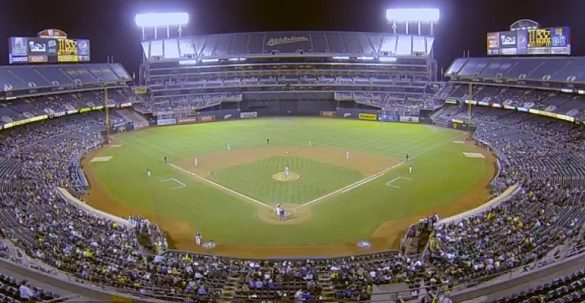
Raiders owner Mark Davis was interviewed during Friday’s home exhibition opener at the Coliseum against the Cowboys. Davis left no doubt about how he felt about sharing the Coli with the A’s, calling the situation a “travesty“.

Just as the A’s and MLB complain about the state of the field when the Raiders invade the Coliseum every August, the Raiders and the NFL complain about the dirt infield dominating the football field. While that has proved to be something of a home field advantage because of Sebastian Janikowski’s well-developed skill in kicking off the brown stuff, the Polish cannon is not going to be around forever. Every other team has either a pristine grass or fake grass field, and frankly the Raiders should have the same conditions in today’s era.

081313-notbad

The baseball configuration 96 hours after the first Raiders game doesn’t look that bad.

Three more conversions to the football setup are planned through the rest of the baseball regular season. Another two or three could occur if the A’s reach the postseason and go deep. There’s an especially tricky period from September 29 to October 6, which will have two Raiders home games sandwiching an indeterminate number of A’s home postseason games. The home dates could be a division tiebreaker, wild card game, part of the best-of-five divisional series.

NFL commissioner Roger Goodell and the other franchise owners are monitoring the Oakland situation continually, with the knowledge that the Raiders’ lease expires at the end of the season. The ratcheted up rhetoric by Davis and the Raiders’ broadcast team is no coincidence. The state of the field is a wedge issue in lease negotiations for both tenants at the Coliseum, with both teams basically saying that they’d rather have the field in their preferred condition. Of course, the only way to truly get that is to get the other tenant to leave. The A’s and Raiders have a friendly and professional relationship so you won’t see them going after each other. Instead they’ll send their gripes the JPA’s way.

At the moment the Raiders have an advantage over the A’s in their respective lease talks due to their ongoing dialogue with the JPA over Coliseum City. However, the A’s need the field ready sooner because their season starts in April. In fact, lease decisions will have to be made in the fall because decisions have to be made about when to start growing grass and rebuilding the infield, a process that usually starts in late January or early February. And you can bet that MLB, which has stayed hands off for the moment, will have no choice but to get involved if there’s a threat of the A’s being “homeless” for 2014.

Davis has said previously that even a temporary lease at the Coliseum is tied to development of a new stadium at the Coliseum complex, which only serves to make negotiations even more complicated. Perhaps the Raiders can commit with only a tentative agreement on how to move forward with Coliseum City. The feasibility study should be complete in a month or so, whereas an EIR is still ongoing.

With all of the lease factors in play, let’s talk about what has to happen next. A Raiders lease extension will need to be finalized well before the end of the season, probably as early as November. The same goes for the A’s because of the earlier start. If the teams are forced to share, there may be a way to minimize the conversion impact. That would probably include the A’s playing late season games at AT&T Park, allowing for the “permanent” football conversion to commence earlier, or the Raiders playing preseason games in Santa Clara (which makes more sense for the A’s). The JPA has to be careful not to appear as if they’re playing favorites, considering that both tenants don’t need much impetus to bolt. Davis may not have formal discussions with anyone in LA, but he’s probably getting a lot of whispers. We know that Lew Wolff only wants to stay long enough to get a San Jose ballpark built.

For now, let’s shelve the possibility that one of the tenants will move. We’ll have the chance to talk about the more drastic scenarios in posts I’ve scheduled for the weekend. Let’s assume that both will stay for now. What do you think the JPA, Oakland, and Alameda County will need to do to keep the teams happy?

Stand for San Jose launches second lawsuit against City of San Jose

Earlier this week I added a section to the sidebar called Lawsuits so that people could easily find references to the ongoing legal battles among the City of San Jose, MLB, and the Giants. Little did I know at the time that the section would have to be expanded. Yet here we are with now a third lawsuit to keep track of. This time it’s between the same Giants-lawyered astroturf group that filed the first lawsuit, Stand for San Jose, and the City of San Jose.

Santa Clara Superior Court Case 1-13-CV-250372, filed Wednesday, seeks to challenge the transfer of the Diridon ballpark site [thanks John Woolfolk of the Merc] to the Successor Agency (SARA), whose oversight board is composed of San Jose and Santa Clara County representatives. In March, the State Controller ruled that the transfer of the Diridon parcels to the separate Diridon Development Authority was not allowed, which forced the City to hand over the properties to SARA. At the time, SARA had its own objections to the ruling, namely that it felt it had a deal with A’s ownership by virtue of the option inked in November 2011. The Controller ruled that the November deal came after the cutoff date proscribed by AB 1X26, whereas the City said that the date was meaningless. Naturally, the Controller stuck with its original ruling, which led to the June transfer of the land to SARA.

Keep in mind that the land wasn’t transferred or sold to the A’s. It was only moved from one governmental body to another as defined by the new law. The option was signed by the A’s, with the only obligation within the first five years being that the A’s pay a nominal annual fee.

S4SJ’s argument is that the option isn’t valid at all because of the ruling. It’s a strange set of circumstances because in the other lawsuit, S4SJ is challenging the entirety of the ballpark deal on three issues:

  • The EIR was “incomplete” (despite having been certified for two different-sized stadia and with updated traffic studies)
  • The deal would take funds away from schools and city services (hard to argue because per the terms of the AB 1X26, city/county/schools have to be made whole)
  • The deal was done without a public vote (City was dissuaded from holding a referendum by Bud Selig).

Now S4SJ is going after the SARA transfer, but what they’re really after is the option. The option is a basic tenet of San Jose’s lawsuit against MLB, and if S4SJ can disarm that threat the antitrust suit would take a big hit. The argument is that there’s no option because the Controller ruled against the transfer to DDA. But that’s as far as the Controller’s power goes. Once the land ends up in SARA’s hands, it can dispose of it as it sees fit, including to the “late” A’s. The Controller and SARA went back and forth after the final ruling. From the Controller’s final ruling:

The City feels that this finding is “simply form over substance and wastes valuable time, energy and resources to arrive at the same result;” however, the legislation is clear that the oversight board shall have the authority to dispose of all assets and properties of the former redevelopment agency (Health and Safety Code Section 34181 (a)). Any attempt to deny the oversight board its rights would be thwarting the intent of the legislation.

SARA’s argument is that the deal with the A’s was going to happen with either DDA (transfer upheld) or SARA (transfer rejected). Which is exactly what happened. San Jose Mayor Chuck Reed telegraphed the strategy at the time. Did the deal not count because the Controller ruled it was late? Is it a deal because of the technicality the City is trying to argue? Or is it a deal regardless?

The real question is, How quickly can S4SJ get a ruling on this? I have no idea how this lawsuit would proceed through the system, especially because it has a related case just starting its trial phase in the fall. S4SJ attorney Ronald Van Buskirk indicates that the two S4SJ lawsuits will be combined, likely creating further delay. Importantly, the new suit names SARA as a party. SARA didn’t exist when the original lawsuit was filed.

Woolfolk notes that the San Jose Giants aren’t a plaintiff/petitioner, which would presumably protect the lawsuit from the discovery actions taken by the City last summer. Still, it’s clear that the SF Giants are behind the whole thing since this move was timed a few weeks after the antitrust lawsuit – just as the S4SJ lawsuit was filed a month after the A’s option deal was struck. At this point, all of the players must have a good idea what moves can and will be played by their counterparts.

Armchair legal experts, have at it.

—–

P.S. – I have a request or two. Please try to stay on topic, and also try to stay away from the usual “XXXX Sucks” type of discourse. If all you’re going to do is vent, I’ll probably delete it. Bite a towel or something.

Giants propaganda invades A’s airspace

Normally when I see a plane in or around the Coliseum I tune it out, because it’s always an ad. I’m not interested.

During today’s game, apparently Budweiser went a bit too far with their plane-flown banner…


The plane and banner were courtesy of Anheuser Busch/Inbev, not the Giants directly. I suppose they got a two-for-one deal by flying the plane a few hours later over AT&T Park, if that happened. Whatever happened, I’m not outraged by it. I appreciate the moxie required to get that ad in the air. This after Budweiser opened one of its signature “Bowtie Bar” locations inside the Coliseum.

That said, I hope y’all don’t mind if I continuously laugh at the Giants’ current foibles. “Defending” World Champs in name only, not in effort, assholes.

Well, I guess it’s a good thing that the concept of territorial rights only applies to building ballparks on a site, not airspace, radio or TV airwaves, placing team stores, or any other extension of a team’s marketing machine.

One other thing – Support local craft beer!

News for 7/24/13

A lot of smaller items this week that I felt should go into a single post.

  • Added 7/25 1:48 PM – Cowboys Stadium will now be known as AT&T Stadium, at a rate of $17-19 million per year (length unknown). For reference, Levi’s bought the naming rights at the 49ers stadium for $11 million/year, while AT&T Park’s deal was for roughly $2 million/year through 2024. Oracle Arena and SAP Center have deals worth $3 million/year.
  • Added 7/25 1:40 PMReally good interview on Athletics Nation with A’s Sales & Marketing veep Jim Leahey about how hard it is to sell tickets for the A’s at the Coliseum.
  • Added 8:40 PM – Completely forgot that the A’s have changed the gate opening schedule on Fridays to 4:30. Normally the gates open 90 minutes before first pitch on weekdays, 2 hours before first pitch on weekends. This is to accommodate a request by many fans (including me) to observe home team batting practice, featuring Derby winner Yoenis Cespedes. Home BP is usually held a little over 2 hours before first pitch in most ballparks. For now the time change is only for Fridays. It could change, but remember that for day-after-night games many teams choose to cancel BP. As luck would have it, I’m flying into OAK from Salt Lake City at 3 on Friday, so I’ll have a chance to watch Cespy do his thing.
  • The Chicago City Council approved a controversial $500 million renovation of Wrigley Field, which will include a big electronic scoreboard, increased signage and advertising, and the development of a hotel and office complex across Clark St from the ballpark.
  • The Port of Oakland’s settlement with SSA was approved and accompanied by a celebratory press release by the terminal operator. Though there’s an interesting bit at the end:

The settlement agreement “has nothing to do with the baseball park,” (Port Board President Ces) Butner said. “We have not determined what we are going to do with Howard Terminal yet. We are going to have to figure out what it will be.”

Tim Kawakami also tweeted this:

Kawakami went on to talk about different uses and configurations for the land. Oakland wanted two downtowns with Coliseum City. I guess they can also explore two Coliseums (Colisea?). It’s all fun to think about until somebody has to pay the bill.

  • According to an annual Harris Poll, the A’s are tied for last (27th) in terms of team popularity in MLB. The poll was conducted in mid-June with 2,210 American fans. Predictably, the Yankees and Red Sox are at the top. The Giants rank 10th in the survey, though they’ve moved around a lot over the years.
  • The Giants played a rare doubleheader at AT&T Park, which occurred thanks to a prior rainout in Cincinnati. While the first game was played as a regularly scheduled home game, the second game had the Reds playing as the home team and batting last. A different type of doubleheader is scheduled for this weekend, with the A’s playing the Angels at 12:05 (national Fox TV game) and the Giants hosting the Cubs at 6:05. I’m seriously considering going to both as I’ve done this doubleheader the past two years.
  • SF State professor and longtime Oakland political scenester Joe Tuman is expected to announce that he is running for Mayor today. An announcement is coming at Oakland City Hall at noon. Earlier today I had said something about San Jose’s antitrust lawsuit and MLB’s leverage, which aroused this response from Tuman:
  • Not to be forgotten, Oakland City Councilman Larry Reid has been waiting for a “sign from God” to put him in the race, though his increasingly snarky commentary at public meetings suggests that this is a mere formality. Having both Reid and Tuman in there could make the race entertaining, to say the least.
  • Sacramento arena proponents have accused anti-arena petition gatherers of lies and dirty pool in making claims about the ESC plan. Neither side looks great, as the anti-arena group may have out-of-town support and the “facts” that the pro-arena group are citing are projections, not facts. Yeesh.
  • Despite the City of Detroit officially filing for bankruptcy, it’s likely that $283 million in TIF-based funding for a new downtown Red Wings arena will go through. All sorts of wrong with that.

More if it comes.