Unintentional funny of the week

There’s a podcast called A’s Fan Radio which I listen to once in a while. I try to catch as many as I can: Athletics After Dark and the new Tarp Talk being two others. A’s Fan Radio is not bad when they’re covering on-field stuff. As for the off-field and business stuff, I mostly tune into AFR because of the sheer unintentional comedy (warning: explicit language) of it all.

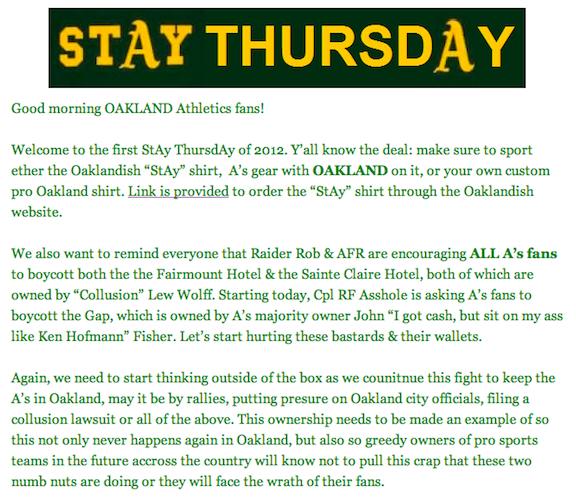
Perhaps the best moment in the short history of A’s Fan Radio came Thursday, when the siterunners asked A’s fans to boycott various businesses owned (or not owned) by Lew Wolff, John Fisher, and company. Here’s the hearty request:

stay-thursday

Surely there’s a meme that could come from this.

There is one GAP store in Oakland, so the boycott there might have some effect. At least it might draw attention. Then there’s the request to boycott the “Fairmount Hotel” and “Sainte Claire Hotel.” The Hotel Sainte Claire recently received some pub for being bought by a coalition including the Wolff family. The “Fairmount” is obviously a misspelling of the Fairmont chain, which has the flagship in San Francisco and another location in San Jose. Surely they can’t be referring to the Fairmount Apartments in Portland, which were converted from a hotel, or the 37-room Fairmount Hotel in San Antonio. That hotel is so cute it has its own dog mascot, Luke Tips, who greets guests and can be requested to stay in a guest room if a guest is lonesome for his/her dog at home (huge thumbs up from me in that regard).

Go ahead. Boycott this. I dare you.

Then again, maybe efforts would be better focused on “putting pressure on Oakland city officials” because when you look back on everything that’s happened related to retaining teams over the last year, it’s clearly evident that the nonexistent effort to keep the A’s in town is related to the nonexistent pressure to keep the A’s in town. As for filing a collusion lawsuit, there are plenty of lawyers affiliated with Let’s Go Oakland. Maybe one of them could take it up. I’m sure the Giants will be happy to pitch in. On second thought, that might come off as collusive.

Chances are that these boycott attempts will have the same effect as most ill-conceived boycotts: zero. After all, there’s no Fairmont or Sainte Claire in Oakland, and many of the Oakland-only crowd claim that there are very few A’s fans in the South Bay, so how much of an impact could it possibly have? Nevermind that most of the guests are out-of-town business travelers who have no clue who owns the hotels. Prove your point and hurt those bastards! And their wallets! Good luck. Oh, and make sure to wear your shirt for maximum impact. Yeah, that’s it. Try this on for size:

#OccupyColiseum

An article with actual substance is due later today. Until then, enjoy your Friday.

P.S. Having an elephant take “batting practice” at the Marlins Stadium is so not cool.

Just another way for the big boys to make money

.

The NFL is poised to start getting nearly $5 billion per year from TV deals with ESPN, NBC, CBS, and Fox. Time Warner Cable is considering simply buying the Dodgers for $1+ billion instead of paying $4 billion over 20 years for the team’s TV rights. The newly vertically integrated NBC/Comcast will stream the Super Bowl on the web for free next month. And today, as part of a decade-long Disney/ABC/ESPN rights renewal deal, Comcast is going to have the various Disney-owned networks “to be streamed live on the Web behind a wall, accessible only to cable subscribers.”

It’s a new strategy that’s at once beneficial and detrimental to consumers. Terms of the Comcast-Disney deal weren’t disclosed, but you can bet that if you’re a Comcast subscriber, your Digital Basic subscription fee is sure to rise. Of course, this is the first large deal in which all live network programming was available on TV and the web simultaneously. Until now, a handful of networks have been experimenting with the dual-delivery model, including the ESPN3 “network” and CNN’s simulcast. As far as programming goes, Comcast is usually out ahead of other cable providers, so expect Time Warner and Cablevision to follow suit, then smaller companies like Charter and Cox. DirecTV has been beefing up its digital bonafides by adding 12 streaming channels to its iPad app.

There was speculation towards the end of 2011 that going into the CBA negotiations, Bud Selig was going to deal with archaic problem of TV market exclusivity. That did not come to pass, and with Selig motioning as if he will exit stage left sooner rather than later, it’ll take a more forward-thinking commish to make that change a reality. Blackout rules are here to stay for now.

Any thought that the internet would quickly democratize delivery of sports for the fan has been extinguished. The way the carriers are paying hundreds of millions or billions for sports properties – and exclusivity in many cases – it’s terrible for the consumer. The providers are overpaying to keep their subscribers from leaving, and in many cases it’s working. Okay, I’m glad that Comcast is going to provide all of this streaming stuff. But I’m also an NFL Sunday Ticket subscriber, which means that I’m wedded to DirecTV. I also like DirecTV’s digital forays. I’m not going to subscribe to two television providers. I would love to have all of this stuff available to me through one provider, and that’s not happening. It might be that I’ll be able to get the streaming ABC/ESPN because I have Comcast Internet, but I don’t expect that to last.

Who is this good for? The rich guy. Someone wealthy enough to want to consume all of this content in every way imaginable may not bat an eyelash at paying $300 or more per month just for TV. I’d like to think that this is just a bubble that will burst sometime soon. I can’t. The cable providers may have been behind the times, but they’ve delayed just long enough to figure out new business models. Want a streaming-only option? Sure, but you’ll pay a lot for it to make up for their “lost ad revenue.”

The winner, no matter how much the cable providers and networks want to sell it, is not the guy behind the remote control. It’s the guy high up in a board room somewhere, figuring out the quarterly dividend checks.

The new Moneyball is… Money

Consider for a moment: the $51 million posting fee paid by the Rangers for the opportunity to negotiate a contract with Japanese pitcher Yu Darvish will surpass the entire 2012 A’s payroll by $15-20 million. We’ve heard enough about the big moves the Angels made. The Mariners are debating whether or not to sign Prince Fielder. Or not. The Astros have a lame duck year in the NL Central before moving to the AL West for good. By the time the Astros enter the AL West, they should be on an upswing with a new, rich TV deal and an incentive for Jim Crane to retain fans because of the move.

MLB and MLBPA announced yesterday that the sum of all salaries for the 2011 season was just a shade under $3 billion. I’ve heard that total revenue was $7.2-7.5 billion, which would put the salaries at only 40-42% of revenue. Average salary was around $3 million. In that same release was the point that only two teams paid the luxury tax: the Yankees ($13.9 million) and Red Sox ($3.4 million). The new CBA is set to be more punitive against luxury taxpayers, but no one should think it’s going to seriously deter the Yanks and Red Sox. If it were a dollar-for-dollar tax as in the old NBA agreement it might have teeth.

Going back to the AL West, there’s a tasty blog entry by the Seattle Times’ Mariners beat writer Geoff Baker about the M’s long-term prospects. Plans are complicated by the ownership situation there. Majority owner and former Nintendo head Hiroshi Yamauchi may be looking to end his ownership tenure, the same way Drayton McLane slow-peddled the Astros for years. The natural choice to take the reins may be minority partner Chris Larson. Unfortunately for he’s embroiled in a messy divorce that has frozen any chances of pulling something off in the near term. (Doesn’t it seem like the only ways owners sell teams – McLane the exception – is because of a divorce or bankruptcy?)

Baker mentions that if the M’s were to be sold, the franchise’s price would be anywhere from $551 to $750 million. That’s an enormous difference. Much of that new value is based on the potential for the M’s to launch their own regional sports network, though they’re locked into an agreement through at least the 2015 season.

Back home in the Bay Area, the Giants (and Angels) are taking advantage of the Dodgers’ malaise. The Bums aren’t going to be down for too long, as they’ll be the recipient of a $4 billion TV deal when they’re allowed to negotiate it. Fox and Frank McCourt have been duking it out in court over when this can happen. McCourt won a battle last week, but today Fox was granted an injunction to stop any sale until their appeal is heard in January. Regardless of the outcome, the new Dodgers owner will be flush with cash thanks to $200 million a year coming just from TV. While the Giants are holding firm to a $130 million payroll, soon the Dodgers will be able to field that payroll without selling a ticket. That, combined with their dubiously perceived threat of the A’s moving to the South Bay, has to scare them a ton. The Giants already have hegemony over the region, and by region I don’t just mean the Bay Area, I’m referring to the 14 million throughout Northern California. They have ownership stakes in the flagship radio and RSN outlets. The sell out China Basin. What else can they do besides hiking up ticket prices sky high?

Surely the Giants have to be thinking about getting more revenue in hopes of matching the Dodgers, even if it means alienating cable partner Comcast/NBC/Universal. It could mean renegotiating the current deal or starting their own network, probably in conjunction with the Warriors, who may be SF-bound. They’d have to go to the trouble of divorcing Comcast, which as we found out with the Orioles/Nationals, isn’t exactly a cakewalk. Still, it’s something that should be explored since the Giants get more households viewing their games than the Angels, yet the Angels stand to make tons more from TV than the Giants.

Moreover, the Giants have to be drooling at the prospect of the A’s leaving NorCal entirely. That would give the Giants completely control over the 7.2 million-strong Bay Area and 14.5 million-strong NorCal region. That last number would put the Giants in control of the largest one-team market in the nation, even larger than the whole of New England (which divides Connecticut between the Red Sox, Yankees, and Mets). One baseball insider I spoke to said that if the Giants got the market to themselves, their franchise value could go up as much $500 million. A billion dollar franchise in SF. That’s the Giants’ gambit. It’s nakedly aggressive and greedy, and it shows in their vociferous defense of territorial rights.

If MLB rules for the A’s to go to San Jose, expect the Giants to go hard at the RSN market. It might start with an attempt to raise the subscriber fee for CSNBA, which shouldn’t be a big deal for Comcast since they’ll get to reap the benefits as well. It would start protracted negotiations with other TV providers such as DirecTV, Dish, Charter, Verizon, and AT&T (oddly enough). And if the Giants weren’t getting enough, they could use their market presence and power to start their own network, Comcast be damned. That would actually be good for the A’s, since it would for the first time create real competition within the market. Right now having Comcast as the only game in town severely depresses the market for the A’s TV rights, even though ratings-wise they’re similar to the Angels. If the Giants were to leave, Comcast could latch onto the A’s as Fox did the Angels, a desperate move to keep valuable content in-house. The A’s could start their own network with the Sharks and Earthquakes, but they wouldn’t be able to muscle Comcast the way the 800-lb. Giants can. (For those who think the cable monopolies will wither as games and other content are going to IP-based solutions with the providers as dumb pipes – think again. There’s too much at stake.)

With all of that in mind, while I’m rooting for the A’s to be able to explore San Jose to keep them in the Bay Area, I’m rooting for the Giants to push forward with their own network and get more revenue, since the move should have positive cascading effects for the A’s as well. Alas, we’re a ways off from anything like this happening. Hang in there, A’s fans.

Retreat!

On Friday there were actually three big news stories that could affect the A’s future for some time to come. Naturally, there was the Oakland press conference that amount to very little, followed up shortly thereafter by the trade of Trevor Cahill to Arizona for prospects. The biggest news, however, may be not directly related to the A’s at all. After the Angels’ blockbuster signings of Albert Pujols and C.J. Wilson, it was revealed how Arte Moreno is going to pay for them: a new TV contract with Fox Sports worth $3 billion over 20 years.

Think about that. $150 million per year for the next 20 years. The previous Angels TV contract (also with Fox) was worth $50 million a year, which already probably tripled what the A’s were getting via TV. Now they’re getting ten times as much as the A’s. They’ll get more from TV than the A’s get from all sources save for revenue sharing.  Jonah Keri wrote in September how the Rangers’ big TV deal with Fox Sports (20 years, $1.6 billion) made the Rangers poised to become another dynasty, and then the Angels come along and blow that out of the water with a deal worth nearly double. The Angels can practically service their entire payroll just with TV, radio, and a little bit Central Revenue money, which makes every ticket sold, every hot dog served pure gravy. And because the Angels have historically had among the lowest ticket and concession prices in the majors, they now have massive headroom to raise those prices and the obvious justification to do so.

Forbes’ 2010 revenue figure for the Angels was $222 million. For the 2011 season, that probably edged up to $230 million. You may recall that I wrote about $230 million being a revenue target for the A’s – in 2015.  The Angels hit that mark this year, and will absolutely blow past $300 million in the future thanks to the new TV deal. The next edition of Forbes’ list could have the Angels jump from #9 to #3 or even #2, past the Cubs, Red Sox, Mets, perhaps even the Dodgers. (Don’t worry about the Dodgers though, they’ve been court-approved for a new TV deal that will zoom past the Angels at around $4 billion over 20 years.) That’s scary. It doesn’t portend well for the A’s in the future. Seattle is just as much in a pickle. The Bay Area is home to 7 million residents, with less than half “devoted” to the A’s. The Seattle Metro has 3.5 million residents. The DFW Metroplex has 6.4 million. The LA-to-Riverside MSA has nearly 18 million. It would seem that TV deals tend to scale based on the number of households in each market, factoring in some level of fan interest. It also helps if there’s competition. LA’s chief cable provider, Time Warner, partnered with the Lakers to start their own RSN starting with the NBA’s 2012-13 season. The numbers for the deal look familiar: $3 billion over 20 years. That competition doesn’t exist in the Bay Area, where Comcast, Fox Sports, and the Giants partner on CSN Bay Area and Comcast wholly owns CSN California.

Given the massive amounts of money being thrown around, there doesn’t seem to be any practical way for the A’s to compete. In the October article I wrote that the A’s would have to double media revenues to compete, they might need triple or quadruple. Even then they’ll be way behind the Rangers and Angels. The best way to effect change might be for the A’s to start their own RSN, though that’s a huge gamble since running a network isn’t exactly cheap and the A’s aren’t the kind of ratings bonanza that’s attractive to advertisers. Plus there will be the immediate friction from Comcast, though in the end I’d expect it to be a ploy to get a better deal at CSNCA. Until then, if you’re the A’s braintrust what do you do? Sure, you work diligently for the stadium and you’ve been trying to improve your station in terms of media revenue. But despite your best efforts, with the new deals for rival teams threatening to make them Yankees equivalents of the West, the long rebuild strategy more than makes sense – it may be the only way to go.

oakland-presser1-120911

City Administrator Fred Blackwell talks about the Coliseum City concept. The only thing missing was a white flag.

Now let’s circle back to yesterday’s press conference. It was accompanied by a letter to MLB from Mayor Jean Quan (PDF). The letter affirms the City’s commitment to the A’s and outlines the support it can provide for its (now) two sites: Victory Court and Coliseum City. Here’s what was written about Victory Court:

Based on updated analysis, the City believes that the costs associated with the Victory Court ballpark project entitlements, land acquisition, and completion of site improvements and infrastructure have changed substantially since its earlier estimates and that those costs remain in the $250 million range. Although the mix of funding sources has been modified, the City remains confident that it will be able to deliver on its commitment to fund each of those elements. With regard to timeline, we believe we can deliver a site, which includes land assembly, full entitlement of the Ballpark project, and completion of infrastructure by November 2014.

The City claims that a new ballpark would be ready for the 2016 season. But that’s wrong. Assuming they were able to assemble the land and infrastructure pieces, construction would take 24-30 months from the ready date. That puts the opening of the Victory Court ballpark at 2017, not 2016. Remember, this is only one year after Victory Court was unveiled, with Quan saying when she got the mayor gig that Victory Court could be “fast-tracked“. Does 2017 sound like fast-tracking to you?

Beyond the problem grasping the schedule, there’s a major problem with the $250 million. City says that the “mix of funding sources has been modified”, which may be code for a reaction to the coming changes in redevelopment. Regardless, it’s clear that the money for this project would come from redevelopment, which means that the bulk of it would come from some form of TIF (federal grants? Don’t make me laugh.). Pushing the completion of the project out to 2017 suddenly becomes convenient. Why? The state’s plan to redirect “excess tax increment” would run for as much as the next five annual state budgets, with the system reverting back to normal once the budget crisis ends. As 2017 approaches and developers start to move on speculation near an approved-for-construction, vetted-by-MLB Victory Court site, property taxes should rise, which means that funding for the $250 million land/infrastructure piece should materialize. But there’s a fundamental flaw with the plan. Does anyone honestly believe that redevelopment will simply go back to normal and the state’s budget woes will be fixed in the next five years? The money to be realized from redirect redevelopment funds is only a small fraction of what’s needed to bridge the budget gap. Already, Governor Brown is pushing hard for new taxes next year and massive automatic budget cut triggers thanks to ongoing monthly revenue shortfalls. Then there’s the looming possibility that redevelopment will be abolished or transformed into a form that requires a new tax structure and local ballot measures.

Now on to Coliseum City. Exactly one year ago, I wrote an analysis of the Coliseum’s plans to build a new stadium for the Raiders along with ancillary development. Back then the plan looked like this:

coliseumredev2-sm

Something’s missing on the left side of the drawing.

The new version:
coliseum-city1-sm

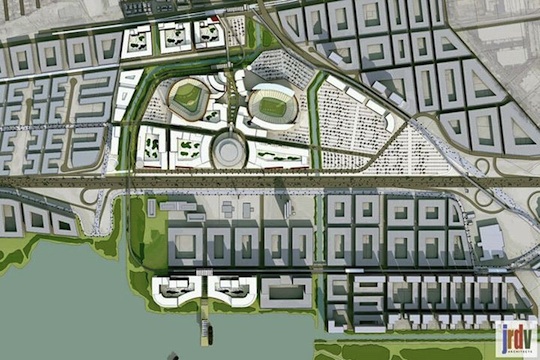
Coliseum City with third venue

Most of the immediate ancillary development has been moved to in-between the venues and along 880. The scope has gotten much bigger. At 750 acres, the new initiative requires two specific plans, one for each side of 880. Coliseum City (at least the immediate area) is conceived of as three venues plus L.A. Live. It would require all three tenant teams to pony up most or all of the cost for their new or improved venues, with the possibility of ancillary revenue to help pay the bills. City is pitching the concept as having two big advantages over other cities or sites: No EIR required and land already owned by the City. While it’s correct that the environmental process should be streamlined, I think that having a third venue will require at least some form of EIR since planners have to account for the possibility of three events happening simultaneously and the impacts that would occur from that kind of situation. As for land, okay. And? The Coliseum has already been dismissed by MLB, so why pitch it as a feasible site now? Nothing has changed to explain how anyone can (not) pay for a privately financed ballpark there.

When I got word of the Friday event, I was curious, then suspicious. First of all, why do this on a Friday? What was the rush? Obviously, it was a reaction to the news that the Warriors are exploring an arena deal at China Basin. Here’s the irony of the situation: While the Giants are exploring with the Warriors a way to leave Oakland, Oakland has been consulting with the Giants on ways to derail the A’s efforts to move to San Jose. Strange bedfellows, indeed. Oakland’s strategy has turned into having a viable backup plan if San Jose doesn’t pan out, in which case not being able to deliver by 2015 or 2016 doesn’t matter since the A’s have no other choice in the Bay Area.

Very few members of the public were present since there was little advance notice. City could have drafted a resolution that would have been discussed at a future City Council session, but decided not to. Instead it was a short press conference with a short Q&A. That’s what it’s come to. A feeble punt of a letter. Even Quan’s letter ends on an odd note:

We are advocating for the A’s to remain in Oakland because we believe that sports franchises can lead to economic growth. So long as a team creates jobs and enhances economic development in the City, then we will encourage them to remain in Oakland. My advocacy for keeping the A’s is not about baseball or a particular sports franchise, it is about doing what is best for the City. I am convinced that Oakland has the best weather, transportation, fan base and sites available to MLB.

It’s all about what the City gets out of it. It’s not about the franchise. That’s refreshingly honest. Yet in the same paragraph Quan touts the sites, process delayed and shaky as they are, as the best. It’s this kind of fragmented, incongruous argument that melts under even the lightest scrutiny that’s had me so frustrated lo these many years.

With that, we have two big cases of retreating. The A’s know the new economic landscape, what steps they have to take to address it, and what shortfalls they face even if they achieve their immediate goals. Oakland has been flailing with its incoherent strategy, not revealing details or taking important steps. When I spoke to Doug Boxer yesterday, I told him that showing progress on an EIR matters. Milestones matter. He said it didn’t matter since the decision rested with one man (Bud Selig), and that the average fan doesn’t care. I was flabbergasted. What’s the point of having a Facebook operation if the average fan doesn’t matter? Why even have a press conference? He’s right about one thing, that there are no parties involved in this mess with clean hands. I came away saddened and I felt like a little bit of my soul died. Thankfully I had a few beers and nice conversation with LeAndre, then went to a friend’s donation party later that night. I could have drunken myself into a stupor, but I chose to ease up because I wanted to write this long article. Because I’m sick of the bullshit. It needs to stop. We need to move forward. Maybe the end is coming soon, maybe it isn’t. I’m not sure if I want to keep writing this blog if things don’t or can’t change. They say it’s always darkest before dawn, right? It’s pitch black right now.
Notes from Wolff-Guardino interview 10/4/11

SVLG President Carl Guardino hosted Lew Wolff on KLIV’s The CEO Show (MP3) again, and it wasn’t some fluff piece. For brevity’s sake I didn’t transcribe all of the interview, only a select few quotes. Listen to the rest and decide for yourself.

Guardino asked about the A’s relationship with Cisco Systems, which seemingly hasn’t budged one bit since the Fremont unveiling in 2006.

GUARDINO: Cisco Systems, of course, is San Jose’s largest employer. They’ve been enthusiastic from the start about partnering with you on a ballpark in downtown San Jose. Are they still involved?

WOLFF: Well absolutely. John Chambers always says to me that we’re partners for life. I hope it’s even longer than that. They’ve been standing up with us. We haven’t really imposed on them too much the last couple of years because it’s up to us to deliver, not them.

Guardino went on to ask about the response to the SVLG 75 CEO letter written a year ago. No response from MLB or Commissioner Selig yet. Then Guardino asked how moving to San Jose would shift the future prospects for the ballclub:

Without question the demographics of San Jose per the number of corporations, which you know, the number of sponsorships, and the fact that we’d have a brand new, really creative venue, will probably almost double our revenues. And that’s on the conservative side. And normally baseball is pretty simple. Depending on your revenues, if your salaries are 40% or 50% of your revenues, you can compete. So if our revenues get up to $230-240 million that totally changes our focus in terms of what we can do.

Stop. At no point in any of my previous projections did I ever have the A’s revenue going past $200 million when Cisco Field opens. If Wolff is thinking $230-240 million, the A’s are suddenly in Giants-Angels territory. That’s a huge development. And it’s one Wolff could regret making as fans may hold him to that.

Wolff also talked about the some of the features in the ballpark we’ve talked about here, such as minisuites and personal signage and advertising. Asked about other features of the ballpark, Wolff describes “that thing in right field”:

Because of the size of the site we have – it’s rather compact – we will have a high wall in right field area. Which will have interesting seating which I won’t get into because I can’t describe it properly… We’re not trying to copy either the retro parks like the Giants have, nor are we trying to copy Wrigley Field or Fenway. We’re trying to do what Silicon Valley and all your members of (SVLG) do. Do something that hasn’t been done before, and not worry about where it hits because it doesn’t have an identical twin somewhere.

Wolff makes the case for sharing the Bay Area again. County Assessor Larry Stone (who had called in during a previous interview) asked to clarify Billy Beane’s statement there may be window for MLB to decide after the end of the World Series. Wolff’s response:

No, he’s not misspoken. Part of what Billy said, and I agree with, I may have even prompted Billy to say it, is that we need an answer, frankly now. While you’re not supposed to make announcements in October… we don’t feel bound that baseball will have to wait until after the World Series.

We’ve reached a point now where being in limbo, like we have been for so long, is not fair to Oakland. It’s not fair to San Jose. It’s not fair to our staff of about 130 people. It’s just not fair to anybody. Even a “No” answer, or “You can’t move to San Jose,” we need to know that. We can no longer – if we have any power – dance around this question.

It’s worth listening to the rest of the interview (MP3). They talk about the Giants and their ownership change, the future A’s roster and payroll, and several other topics.

The Game is on the rebound

We wondered if rebranding of 95.7 and the hiring of new hosts would help. It sure looks like it has. September ratings are due next week, but it doesn’t hurt to take a peek at how the stations performed in August.

It’ll be interesting to see how the offseason shapes up. Not having the Giants on the air should prove an equalizer, which should provide The Game plenty of opportunity to gain in the ratings. The Game’s football coverage is already tons better than KNBR, with Greg Papa and Eric Davis providing credibility for both local teams and a dedicated college football show on Saturdays. Chris Townsend will have Gio Gonzalez picking football games regularly, which will hopefully lead to a regular A’s hot stove show to keep fan interest going. Slow and steady, it looks like progress.

Billy says…

Billy Beane was on The Rise Guys show this morning and said this:

It’s well documented that we’re in a state of flux as it relates to: Are we staying in Oakland? Are we moving this team at some point down the line? That is going to go into our short and long-term planning, and we do expect to have some clarity about this situation very soon. That will have an impact on which way we go.

At the end of the interview Mark Kreidler asked for more clarification on what Beane said about the stadium situation. Beane’s response:

It probably sounds like Groundhog Day and I don’t want to be Pollyannish, but I think we’ve gotten to a point now where all the information is in, we’re at a critical point, and I don’t necessarily have any information. I just think we’re gonna get it very soon and it’ll be great for us. Once again, a decision’s most important because whether we stay in Oakland or go somewhere else, it’ll be important for the planning of this franchise and right now that hasn’t been the case the last couple of years.

Sounds like progress, and that he’s not exactly hearing bad things. He didn’t directly address talk of him possibly moving to the Cubs’ front office other than to say, “Man, you guys read too many papers.”

Link to the audio is up.

Shaking the radio tree

I know, I know. A lot of you aren’t happy. The relaunch of 95.7 as KGMZ or “The Game” hasn’t resulted in more A’s-focused programming. The shift to a sort of KNBR Jr. is more than a little upsetting. And I can even infer that from Lew Wolff’s response to my question about the radio situation, which he deemed “not perfect.” By all rights the A’s deserve a shot at full-time coverage, which in turn should grow the fan base. Sadly for the A’s and we A’s fans, life is pretty damned unfair. Just as the A’s haven’t been world-beaters at the gate, they also haven’t been killing it on the radio, at least historically. We can at least be thankful that they are on a sports station that provides some support, but that’s the bare minimum at least for the time being.

Looking at the big picture, the emergence of The Game is much more compelling in terms of how it affects the Bay Area sports radio landscape. When we first discussed the station, it made sense for it to settle into a nice place between the KNBR-680 and KNBR-1050. However, the station’s hiring of the Sacramento-based Rise Guys, NY loud guy Brandon Tierney paired up with 49ers radio color commentator Eric Davis, and several CSN Insiders, has shown that Entercom means serious business. Cumulus, which runs the twin KNBR stations, has already sacrificed 1050 and is in full retreat with its only local host, Damon Bruce, now pairing up with fading stalwart Gary Radnich on 680. Tony Bruno’s syndicated show is probably not long for 1050 after his racist remark during the Phillies-Giants brawl on Friday night. The loss of Bruce and Bruno leaves KNBR parent Cumulus with few real alternatives. Its only draws are Jim Rome and Warriors/49ers broadcasts when they conflict with the Giants. Already a terrible ratings performer, 1050’s impending demise may force Cumulus to reconsider how it carries its various sports properties. The 49ers re-signed with Cumulus through the 2014 season. The Warriors may jump ship as soon as they see an ready alternative, which may be The Game (perhaps depending on what happens with the Sharks).

Complicating matters for Cumulus is their impending merger with Citadel, which is supposed to be voted on in a week. If the merger is approved, it’s possible that due to FCC rules about ownership of radio stations in specific markets, 1050 or other stations will have to be placed in a trust for future divestiture. Putting 1050 in such a trust could lead to the end of 1050 as we know it, pushing The Game into the #2 sports talk spot in the Bay Area. That would change The Game from a threat to a real competitor. Even if 1050 were to survive, it would only be a shadow of itself. In any case, KNBR management has to be on its toes from here on out instead of coasting as it has for the last several years.

The sad part is that throughout all of this, the A’s are relegated to being bystanders. They don’t have enough clout to dictate anything, and having only two stations could amp up the competing-for-Giants-fans angle. We can only hope that coverage shifts back towards the A’s as the 2012 season starts. Until then, at least it’s “compatible” programming.

The role of new media

This is the letter I wrote to A’s P.R. man Bob Rose in light of Dale Tafoya being stripped of his media credentials:

Mr. Rose:

I write tonight in defense of Dale Tafoya and his exemplary podcast, Athletics After Dark. He and his team have done an excellent job covering the A’s with a different perspective, and at times greater depth, than is normally allowed on the radio or via the regular print media. It would be a shame if Tafoya were not granted the access he has been afforded previously, and I fear that his product would suffer as a result. To me this is important as the A’s (as you are well aware) have been historically media-starved. To hamper his work over an issue that does not appear to have much or anything to do with his professionalism seems counterproductive at best, spiteful at worst.

Moreover, I think this is a good opportunity to explain what the role of the internet and new media is in today’s coverage of pro sports teams. I had spent a few years during college working with a professional photographer who had a great working relationship with Debbie Gallas and her counterparts at the other teams in the Bay Area. Because of this experience I can say I have at least a cursory knowledge of how the press box works, and what kind of professionalism it  requires. Going back to the internet – I had no foresight back then as to what it would really mean because things moved so fast. Six years ago I started out my blog with a focus on economics and business issues for the A’s and other area teams. Because of that off-field focus, I have never requested a media credential and I don’t intend to start anytime soon. Surely though, there is a place for Athletics After Dark, Athletics Nation, and other good outlets for Athletics fandom. The Cleveland Indians started an in-stadium social media presence last year and expanded it this year.

I write “fandom” because it means more than it used to. No longer does the fan have to rely on daily newspaper reports or even hourly radio updates. News, rumors, interviews, and other content meant to sate our appetites is ever more available and desired. That creates a situation where there could be breaches of professionalism, or at least perceived breaches thanks to less editorial control over instant outlets like Twitter. There can and should be a third way that can allow the new media to operate in a structured, professional manner. I don’t claim to have the answers for this. But I think this is a good time to start figuring it out. It’s not just for now, it’s for the next 5, 10, 20 years. Let’s find a way.

Rhamesis “Marine Layer” Muncada
ml@newballpark.org
new A’s ballpark blog

During the last homestand I spent one game hanging out with many AN regulars, including LoneStranger and emperor nobody. I mentioned that the frequently unused loge seats (suite level near the foul poles) would occasionally be used as auxiliary press seating for Raiders games. It was somewhat inconvenient from a logistics standpoint because someone in media relations would have to run copies of statistics and run them out there every quarter/half. For a blogger, who has this information on a laptop or app within seconds of a play occurring, there’s no need to kill more trees just to run out copies. That makes the loge, or an empty suite as the Cleveland Indians have afforded this year, a good spot for new media. I have a few ideas for this third way of accommodating new media:

  • Pay for limited access. A nominal fee of $5-10 per game, per person. Essentially it’s a ticket with perks such as access to the press box but no assigned seating within. Access to players and coaches pre/post-game would have to be negotiable. The nominal fee is important as it buys the individual a license to say anything (within reason).
  • To prevent just anyone from obtaining this access, applicants would have to provide some proof of prior journalistic work or a portfolio of existing relevant new media work.
  • Wireless internet access is a must.

Personally, I’m glad I had my brief experience working in the regular media. For me, familiarity truly bred contempt, and I found the press box a rather toxic environment, one that threatened to kill my fandom. I think that’s one big reason to separate the regular media from bloggers and podcasters. Now, there may be instances where a blogger or podcaster is looking to cross over into the regular media, and that would have to be dealt with as it happens.

Thoughts?

KBWF May ratings plummet in SF market, rise in SJ

95.7 Sportsradio’s ratings took a 33% dive from 0.9 in April to 0.6 in May in the SF-Oakland market. Conversely, they rose 33% in San Jose from 0.6 to 0.8.

Ratings for the twin KNBR’s have stayed steady. As for still-in-receivership KTRB, it’s possible that their AM license may be turned back in to the FCC, a rarity in the business.

Going back to KBWF, it looks like Dan Dibley was brought in to cohost with the temporary guys in the morning/mid-morning, with the idea that he’d get his own show or cohost at some point. I think it’s time to take the training wheels off and let him do his thing. While they’re at it, bring in the “permanent” local talent.