San Jose and SC County officials working out ballpark land deal

We expected a decision on the Diridon land transfer to be released by the State Controller sometime in the late summer. Or late September. Now it’s almost November, and a spokesman for the office has said to the Merc’s John Woolfolk that “there is no set timetable” for a decision.

That hasn’t stopped City and County officials for working on a contingency plan. If the transfers are upheld by the Controller, the ballpark land deal can move forward, with Stand for San Jose’s legal challenge the last real obstacle. If the transfers are declared illegal because of the new redevelopment law, the county-led successor agency would be required to sell the land for market value, at least double the negotiated $7 million land price. The big news in Woolfolk’s piece is that San Jose Mayor Chuck Reed and Santa Clara County Supervisors Dave Cortese and Mike Wasserman are working together to fill any gap that might arise.

“The county does have the capacity to assist in some manner,” Cortese said. “We do have an economic development director and are involved in economic development, so we are equipped to come in and assist if there’s a shortfall and a problem. It’s in our interest to see that this kind of economic development project goes forward.”

Wasserman added that “at the end of the day it could be a win-win if the property is sold at market rate” even if the county has to contribute toward that because “that accomplishes what the state wants and the land stays here” for a ballpark.

Reed, Cortese, and Wasserman will all say that besides the PR positives that would come with bring the A’s south, all sides, including the state, would benefit from $5+ million in property taxes every year, or possessory interest taxes that would approach that figure. When the parcels that make up the ballpark land were privately held, they were also held for long periods, making assessments and property tax bills rather low.

Behind the scenes, Cortese is a leading candidate to succeed Reed as mayor. Reed will be termed out, and the two frontrunners are Cortese, a former San Jose District 3 councilmember, and Sam Liccardo, who is the current D3 councilman. Cortese also has worked with Baseball San Jose in the past. Wasserman (no relation to the late Fremont mayor Bob Wasserman) hails from South County, representing Gilroy, Morgan Hill, South San Jose and Los Gatos.

Perhaps a tightened up land deal is the kind of signal Bud Selig needs to help him render a decision. In an article by the LA Times’ Bill Shaikin, Selig continued to the kinds of frustrating non-answers we can expect. We’ve learned not to expect, well, anything from Selig all these years, and there’s no reason to start expecting anything now. But just as an ace can get an umpire whose strike zone isn’t the size of a barn, or a grounder can bounce off the third base bag to trigger a rally, this is baseball. Anything can happen, and often does.

Update 5:00 PM – A flood of tweets have come in from local media and Shaikin as they bombarded Selig on the subject of the A’s. Selig is in town for the World Series, naturally.

As John Wooden once said, “Don’t mistake activity with achievement.”

Black and Blueprint

At the end of yesterday’s 2-2 draw between the San Jose Earthquakes and LA Galaxy, the Quakes’ shoo-in MVP candidate Chris Wondolowski headed to the supporters’ sections behind the north goal to do his ritual handshakes and celebration with the fans. A camera followed him over and suddenly, in view, was a large sign featuring a drawing of Lew Wolff’s head. The banner thanked him and John Fisher for, well, being the owners of the Quakes. There were no mustaches or devil’s horns drawn on the image, no effigies of Wolff hanging nearby. Whether it’s love is based on one’s perspective. Clearly, there is a level of appreciation among Quakes fans that isn’t being felt in Oakland, and perhaps never will. Being more tuned into what’s happening in Oakland, I thought my eyes deceived me at first. Thankfully, another observer saw the image on television as well.

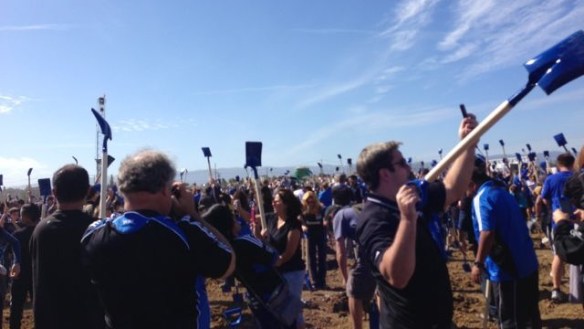
That appreciation was on display earlier in the day, as the Quakes held their stadium groundbreaking ceremony on the other side of the tracks from Buck Shaw. 6,256 fans showed up at 1125 Coleman Avenue for what would eventually be declared a Guinness World Record for the most simultaneous participants in a groundbreaking. During the typically long __, Quakes President David Kaval thanked Wolff, his son Keith Wolff, and Fisher for bringing the team back and getting the stadium underway. That elicited hoots and hollers along with the expected applause. Lew was introduced and spoke briefly, thanking the fans. San Jose Mayor Chuck Reed and the City Council was there too, keeping the procession of dignitaries going.

Pretty shovels, all in a row.

Kaval and Quakes defender Jason Hernandez explained to the crowd how the groundbreaking was supposed to work. A large painted soccer ball was hooked onto the end of a crane. When the ball dropped and hit the ground, an airhorn would go off, signaling to the “crew” that it was time to start digging for two minutes. Thousands of commemorative shovels were stuck in the dirt field, which had painted lines and goals at each end. When the horn went off, the assembled crowd started digging. Since we were all in a fairly compressed space, many of us found that within a minute we had pretty much dug up most of the loose dirt in our respective vicitinities, leaving the next layer of hard clay to deal with. For me, that made the second minute of digging more a minute of manicuring. A countdown led to a second horn announcing the end of the two minutes. Public address man Danny Miller laid down a little suspense as he said that the Guinness people had to tabulate the crowd on hand. Miller announced “Six-thousand…” and was quickly drowned out by the crowd’s roar. Kaval held up a certificate in victory, and the masses started to depart.

Dig for two minutes and you get a free shovel.

It’s no secret that the stadium has taken longer than anticipated to get built. Whether it was concern over sponsorships needed to get it built or process issues like permitting, fans have been waiting long time for the first permanent, unshared home for the franchise to materialize. When AEG took the first MLS incarnation of the Earthquakes to Houston, Colts-style, after the 2005 season, a pall descended on the fanbase. The logos and branding would remain in San Jose, but there was no indication that a new franchise would materialize right away. AEG, which operates the Coliseum complex, Staples Center, and owns the LA Kings NHL team, is reviled in San Jose even more than Lew Wolff is in Oakland. Don Garber, the MLS commissioner who flew in to attend the ceremony, was AEG’s evil puppet and accomplice in December 2005.

Commemorative shovel

The expansion Quakes franchise took the field for the 2007 season, when Wolff and Fisher swooped in. For MLS, Lew Wolff and John Fisher represented enough money and local ties to keep the team going throughout what would be trying times ahead. Fisher may well have been the most interested person within the ownership group in getting a franchise. As for Wolff, building a stadium for the Quakes would be a good warmup for doing a much larger, more expensive stadium for the A’s, whatever the location. Wolff’s son Keith would focus on the details. As the recession struck and sponsorship dollars disappeared, the Wolffs pursued land deal concessions, which they received. The vision for the stadium was scaled back, then when the economy recovered, expanded. When the Earthquakes Stadium opens in March 2014, it will have been over 8 years from when the team was purchased to opening kickoff. If the Wolffs are tired of going through the “process”, the outward signs are slight. Still, Lew has talked about not being around for when a ballpark finally happens, and Keith has certainly dealt with enough that he may be gunshy about saddling up for an even bigger battle. Yet that’s what will be necessary if they want to get something built for the A’s. Maybe it’ll be in San Jose, maybe it’ll be in Oakland. However it proceeds, there are probably a lot of lessons from the Quakes stadium experience that are applicable for an A’s ballpark. Given how hard it is to get something funded and built in California, having that experience can’t hurt one iota.

News for 10/19/12 (plus Young trade thoughts)

Update 10/20 3:00 PM – The A’s front office decided to kick off the hot stove league early by trading IF Cliff Pennington and 3B prospect Yordy Cabrera to Arizona for CF Chris Young (not that Chris Young) and $500,000. This has immediately led to speculation regarding the future of current CF Coco Crisp, who is scheduled to earn $7 million in 2013 and has a $7.5 million club option for 2014 ($1 million buyout). Young is due $8.5 million in 2013 and has a $11 million club option for 2014 ($1.5 million buyout). Cabrera was flipped to Miami for reliever Heath Bell. 

Pennington was either going to remain a mediocre shortstop or become an okay second baseman surrounded by many other okay second basemen in Oakland. That makes a trade for Young a steal, even if there’s no obvious place for him at the moment. Young came off a subpar 2012 season, especially compared to his 2010 All-Star campaign. September callup Adam Eaton (not that Adam Eaton) appears to be the CF of the future for the Snakes.

The A’s still have something of a logjam at 2B going forward. Jemile Weeks, Adam Rosales, Scott Sizemore, and Eric Sogard are on the 40-man roster. Grant Green waits in the wings. Expect more trades.

….

Much to go over in this edition.

  • The NHLPA rejected the NHL’s most recent CBA proposal, which would have had the owners/players revenue split at 50/50. The union responded with three different proposals which would’ve more gradually brought the split down to 50/50. In response, the NHL has cancelled all games through the end of October. At this point it seems highly unlikely that the proposed 82-game compressed schedule could be pulled off. [NHL | Washington Times/Steven Whyno | NJ.com/Charles Curtis]
  • The Raiders received a 24-hour extension to the weekly TV blackout deadline imposed by the NFL, and were able to reach the goal of 85% of seats sold for the game Sunday vs. the Jags. Next potential blackout date: the next home game against another Florida team: Tampa Bay. (Also – kind of weird that the Raiders are playing all three Florida teams this season.) [CSN Bay Area/Paul Gutierrez]
  • The City of Reno was able to get a ballpark built in the middle of the Great Recession by getting a $55 million short-term loan. That loan will be due before the end of 2014, and the City and Reno Aces are scrambling to refinance the loan. Property taxes used to fund a TIF plan for the ballpark have dropped drastically, forcing the two parties to come up with something else. The Aces, which are owned by Indiana Pacers owner and mall magnate Herb Simon, are willing to pay $1 million in rent per year, with the rest of the $3 million annual obligation split between the City’s general fund, a ticket tax, whatever meager redevelopment money can be scraped up, and other public sources. Simon has threatened to move the team if no deal can be met. The Aces won the 2012 AAA championship and were awarded the AAA All-Star Game for 2013. [Reno Gazette Journal/Brian Duggan]
  • Lew Wolff came out against San Jose’s Measure D, which would raise the city’s minimum wage from the state’s $8/hour to $10/hour. Wolff’s argument is that the hike is unfair to hotels and restaurants in San Jose, which could potentially lose business to Santa Clara and other neighboring cities. The hike would also presumably affect seasonal employees at the two stadia Wolff wants to build, the Earthquakes Stadium and Cisco Field. Wolff played down that issue, saying that there’s less direct competition there to affect the Quakes/A’s. The City Council is split on the measure, while Mayor Chuck Reed has come out against it, along with the Chamber and Restaurants Association. My take? I hope it’s passed in San Jose, because like the plastic bag ban that was passed a couple years ago that spurred similar bans throughout the county, it could lead to a minimum wage hike countywide. As I’ve mentioned before, I have relatives who work low-pay, low-skill hotel/restaurant jobs, and they could certainly use the hike – though they don’t work in San Jose proper. [San Jose Mercury News/John Woolfolk]
  • Speaking of the Earthquakes, their groundbreaking ceremony is Sunday at 11:30 AM at 1125 Coleman Ave, San Jose. At least 5,500 have RSVP’d for the event, which should break a Guinness record. Walkups are welcome if they bring their own shovels.
  • Teams are announcing their ticket prices for the upcoming season. At least in terms of season tickets, the A’s have no change from 2012. The Cubs have announced modest drops in response to a large attendance dropoff, and the crosstown White Sox have announced even bigger cuts. [Chicago Tribune/Paul Sullivan | ChicagoNow, James Fegan]
  • The A’s announced their 2013 promotional schedule, and while it doesn’t have everything yet, there are now six fireworks nights instead of the usual five on the slate. There will now be two in August, on the 3rd and 31st.
  • The Port of Oakland placed its executive director on paid leave pending an investigation into improper spending and expensing by Port employees. This included a $4,500 tab at a Houston strip club, and numerous other suspect charges in the US and abroad by the Port’s maritime director James Kwon. Abuses could be so widespread as to be institutional. Yesterday, port workers scheduled a protest against fiscal mismanagement. The blowback from this investigation could curtail or place a trained eye on certain Port activities, such as (pre) development at Howard Terminal. Knowing the Port’s history, it’ll probably be more of the same. [SFGate/Matier & Ross | KTVU | SF Business Times/Eric Young]
  • Cal may have trouble paying off the $11.6 million annual debt service on Memorial Stadium because of lackluster premium seat sales. This smells a lot like the Mt. Davis deal. [Daily Californian/Justin Abraham]
  • The Warriors further explain their SF arena vision, with the help of Snøhetta architect Craig Dykers. The form will be “soft” and “lozenge-shaped”. The Fiscal Feasibility Report unveiled earlier this week can be viewed here. [Golden State Warriors | SocketSite]

More as it comes.

The bar has been raised

Last night I gave myself until midnight to mourn the end of the A’s 2012 season. At midnight I realized that I hadn’t eaten since lunch, too nervous to do so during or before the game. So I took an hour and took care of my hunger pangs before settling in to start this post.

The memories of this season will remain fresh throughout the winter, through the inevitable rumors about roster shuffling. Which starting pitchers will be kept? Can Billy Beane find a real solution at second? And most importantly, what expectations will we have for the A’s in 2012, after they came out of nowhere to take the division from two teams (Rangers & Angels) whose combined payroll was five times that of the A’s?

That’s what it comes down to. Going into 2012, no one had any expectations of the roster, the fans, ownership, or anything else associated with the Oakland Athletics. All that has changed starting October 12, 2012. The bar has been raised. Everyone from fans to the media to the rest of baseball will expect more out of the A’s. The element of surprise that fueled much of the euphoria this year will have evaporated. That childlike joy, that sense that no one has anything to lose, will have to give way for a more consistent, more professional franchise. New expectations come with a weight for a team to bear, and in our case, the fans also have to bear it. It’s not enough to look at two weeks or a month and call Oakland “saved” for baseball. That would be like looking at Brandon Inge’s first week in an Oakland uniform and declaring him the third baseman of the future. It’s asinine and completely absurd. No, the test starts now: of ownership to cultivate this success, of the front office to sustain it, and of the fans to respond in kind.

Nothing gets a pro sports team’s sales organization going like a playoff run. In September the A’s sales group started to push hard for season ticket deposits, fueled by renewed fan enthusiasm. They got me on board for 2013, my yearlong experiment with walkup and online ticketing over. I’m an easy sell. I don’t have a grudge against ownership, and my worldview isn’t inextricably tied to the word “Oakland”, keeping me from investing my fandom. Many longtime A’s fans have stayed away because of ownership. They are naturally going to be tough sells. Has this fresh, exciting team brought those fans back into the fold, or will they look for more from ownership to convince them?

Yesterday’s pregame announcement of tarp removal for the ALCS/World Series elicited some positive reaction, but that isn’t enough going forward. Those same tarps for the original upper deck (West Side) should be removed forever, just as I had outlined as an option last week. Close down the Plaza Reserved seats to dial back the capacity somewhat, and simply sell sections of the upper deck on an as-needed basis as the Dodgers have done in the past. That should bring the capacity back to 43,000 or so, with 36,000 in play most of the time until high-demand or premium games comes around.

As for the roster, the front office is fortunate that there is only one high-priced free agent on whom to make a decision, Stephen Drew. While Drew played solidly since his trade from Arizona, $10 million is a high price and from a pure value perspective, not worth it. There’s a chance that Drew is bought out and a new deal done, but that would also put him on the open market, where there could be a premium for a someone who is ostensibly an average-to-good shortstop.

Then there’s Brandon McCarthy. Take away the horrendous line drive incident, because McCarthy’s already throwing and all parties were looking to clear him for the World Series. He even took time to write a back-page article for SI. No, McCarthy’s issue has, and always will be, the health of his right shoulder. Prior to September, McCarthy had to be put on the disabled list twice in 2012 and frequently had extra days between starts as his shoulder issues kept creeping. That may sound like a good opening for the team to let him go as many young starters are waiting in the wings, but I go back to what Farhan Zaidi said on Blog Day: “We try to build a set of options – 8, 9, 10, 11-deep of starting pitchers.” In that context, McCarthy should be a fairly easy guy to make a case for, since his injury history has depressed his value somewhat. His effectiveness when he’s there, his presence in the clubhouse, and the outsize positive attention both he and his wife Amanda have brought to the team are all reasons to bring him back for 2 years/$14 million.

Jonny Gomes was a major force, even though he saw only one at bat during the ALDS due to matchups. He should be back, also for 2 years at maybe $6-7 million. Bartolo Colon, who was practically forgotten as A.J. Griffin and Dan Straily were brought up, may not be too easy to dismiss. His PED suspension should’ve driven him out of baseball completely. Yet there’s something appealing about a guy who can simply eat innings. That helped the A’s staff in no small measure in 2012. Maybe he gets signed to a minor league deal and is stashed in Sacramento if he’s willing to be there. Then there’s the case of Dallas Braden, who’s as snakebit now as Justin Duchscherer was a few years back. Again, there’s a limited market for Braden’s services, so non-tender him, sign him to a minor league deal, and let him work out his shoulder problems in the spring and extended spring training.

The second base dilemma is the most puzzling, because none of the options are great. Five or six guys could play the position. Cliff Pennington’s the best defensively because of his arm. Jemile Weeks has the speed and potential leadoff ability but regressed badly in 2012. Adam Rosales is all heart and arm and little else. Scott Sizemore is an unknown because of his lost year. Eric Sogard may have disappeared down the depth chart for good. Grant Green, a organizational fan favorite, has a bat and no glove. Chances are that some guys will be non-tendered, at least one will be traded, and someone else will be stuck in Sacramento for another year, blocked by someone else in Oakland with marginally greater ability. The organization should expect more from second base in the future. It’s up to these players to break through and take the starting job for themselves.

Will the front office attempt another international free agent splash signing? Which Josh Donaldson and Chris Carter will we see to start 2013? How much can the catchers improve defensively? All of these questions have much of the internet fanbase already going through that yearly phase called rosterbation, what has classically been called the Hot Stove League. People in general are talking about the A’s again. There’s real interest and the non-hardcore fanbase may have been aroused enough to commit.

That’s where it gets difficult. The A’s fanbase won’t be judged solely on the last two weeks, as much as people would like to see it. The media liked to characterize this pennant chase as “rekindling Oakland’s love affair with baseball”. It’s romantic and hits all the right notes. But you know what often happens with affairs, right? They wither. They end. What starts as grand and limitless in May can be consigned to the dustbin in December. This is where the fans come in. Fans have to commit. Whatever anyone thinks of ownership, they have produced a winning team. Now it’s time for fans to respond by buying season tickets. Last I heard, season ticket subscriptions added up to 7-8,000 full-season equivalents when accounting for all of the partial plans. If you want this team to stay in Oakland, you need to do your part. Get that number to 10,000. Aim for 2 million in total attendance. Both are modest figures when compared to what happens regularly across the bay, but it’s a start. MLB may be struggling with its Oakland/San Jose decision because it needs to see real numbers like these to justify whatever decision it makes. In Oakland, MLB needs to see that even without a new ballpark, enough fan interest can be generated to avoid a Miami-like situation where attendance dropped off a cliff after the team started to disappoint in their new digs. In San Jose, MLB needs to see that enough of the existing East Bay fanbase can come along even after being alienated to help support the fans in the South Bay. Fan interest, or an apparent lack thereof, is a problem that affects both cities, whether the booster groups and ownership want to admit it or not. If you live in the Bay Area and you love the A’s, now’s the time to show it. Time to stop the posturing. Time to end the excuses. All of the goodwill built up over the last four months will evaporate if  next May there’s another run of 10k crowds at the Coliseum. If fans deserve a winning team, they got it. The players have earned our support. The least we can do is provide support en masse. The bar has been raised for us fans too, as it should. If we can’t step up, then we’ll be back to the same old questions about viability and ownership and disaffection. And no one will care outside of the Bay Area, including MLB.

Deposition bid fails in Stand for San Jose lawsuit

The bid by attorneys representing the City of San Jose (and the A’s) to smoke out the “nefarious” group behind the astroturf group Stand for San Jose has failed, thanks to a ruling by Santa Clara County Superior Court Judge Joseph H. Huber.

I mentioned in my wrap of the hearing two weeks ago that the judge mentioned that cases like this happen all the time, and that just because there are business interests at stake doesn’t mean a plaintiff doesn’t have standing. At that point any observer could see how the judge was going to lean, making this ruling practically a foregone conclusion.

The question now is: What’s next? With this matter out of the way, the decks should be clear for the lawsuit to proceed unencumbered – unless the defendants’ attorneys line up yet another challenge. Whether the lawsuit actually moves forward is now more a matter for the Giants, A’s, and in all likelihood, MLB, to figure out. No new filings have been made since the ruling was made. We’ll continue to monitor events associated with the case to keep you informed.

Blips and trends

A popular refrain is emerging from the Oakland-only camp, in which the A’s should stay in Oakland because the team’s playoff run, thereby proving that the team can be competitive in Oakland. During the Wheelhouse today, Greg Papa and John Lund mentioned Chris Townsend’s argument that Wolff could go to Selig and the owners and claim, “This is as good as it gets, now let me move the team.” Both arguments are guilty of the most shallow, gut-reaction analysis and are as strong as a wet paper bag. In fact it was Papa who, when Lund asked him if the A’s resurgence changes the equation in any way, correctly pronounced that this season is meaningless in terms of the Oakland/San Jose debate because it doesn’t take into account the big picture.

The fatal flaw with the Oakland-only argument is that they’re arguing against something that wasn’t ownership’s argument to begin with. One season is an outlier, an anomaly. It may start a trend of great success, which would in turn engender greater fan support, which would be great if that happened. If the team can continue to be successful, if it can get season ticket subscriptions past 10,000 for next season, then there’s a very good argument that the fanbase can not only support the team by the loudness of their voices, but also by their sheer numbers. The success may also be a blip, in the way that success couldn’t be sustained over multiple or even consecutive years. No owner, no matter how much he spends on payroll, can guarantee playoff appearances let alone championships, every single year. To expect that of any owner is wholly unrealistic.

Ownership’s argument about moving to Silicon Valley’s better economic environment has always been about being able to sustain a competitive team. Any team can be successful for a year – Oakland and Baltimore this season are testaments to that kind of randomness. It takes incredible skill, luck, and just as important, money to sustain success. Anyone who has been a lifelong fan of A’s baseball has seen this play out several times. Over their 45 years in Oakland, the A’s have lost Catfish Hunter, Reggie Jackson, Rickey Henderson (twice), Jose Canseco, Mark McGwire, Jason Giambi, Miguel Tejada, the Big Three, and most recently Gio Gonzalez because of ostensibly economic reasons. No ownership group was immune from this inevitability, including the great Walter Haas. If the A’s don’t have a ballpark deal in place the next couple of years, guess who’s going to join that illustrious list? Yoenis Cespedes and Josh Reddick, they of the nearly 8 fWAR combined this season. They’re both young, cost-controlled, and will net significant young assets in trade.

The A’s celebrate in front of an announced crowd of 21,162. The crowd appeared much larger – but why?

Now maybe there’s a legitimate economic argument to keep the A’s in Oakland. If there is, it needs to involve vastly improving season tickets and FTEs (full-season equivalents) past that 10k figure. The Giants are flirting with 30k season tickets thanks to their ballpark and World Series win. The A’s don’t need to match that number, but they need to get to something approaching 20k if anyone wants to take them seriously, whether they’re talking Oakland or San Jose. The thing that is killing the A’s right now is the major swings in attendance. Sure, we can pull in a full house for a Star Wars fireworks night, or what appeared to be 27k for last night’s wild card game clincher. The problem is that the baseline attendance is that season ticket/advance sales figure, which absent of promotions or giveaways hovers around the 10k level. Last night the paid attendance was 21k, including 5,000 walkups. The crowd looked fuller, which can be explained several ways:

  • $10 Plaza Level/Outfield seats from the night’s Dynamic Deal
  • Much of the Field Level outfield seats taken by season ticket holders who redeemed unused tickets for the last available, designated home date for exchanges. Those tickets count as comps, not as new paid admissions. (thanks to Lone Stranger for that observation)
  • Great weather inviting more people out to the yard on a warm, indian summer night
  • A meaningful game against a division rival

That said, the 27k I cite is just an estimate based on previous observations of crowds. The Coliseum’s capacity is 35,077. So why wasn’t it completely full? Well, you can’t count on 15k walkups for an A’s game at the Coliseum, no matter how good the team is. Where were all the empty seats, then? Take a look…

The Plaza Reserved level, practically empty for Monday night

No discounts were available for the Plaza Reserved tier, though the A’s will frequently fill the deck when discounts are made. Tonight a similar Dynamic Deal to last night’s was made available. Couple that with the ritual free parking on Tuesdays, and it’s easy to see the announced attendance tonight being 28-30k. These loud, and potentially sizable crowds don’t prove anything other than that people will come out to see a good A’s team when the conditions and price are right. To prove that the market is viable will take a much greater commitment among the fanbase. Don’t call a blip a trend, Start a trend. Without that measurable improvement, that greater commitment, there’s really no discussion to be had.

…..

P.S. – Tomorrow I’ll discuss a way to make improve attendance and renew fan goodwill. Yes, it will involve removing tarps.

Wolff claims ballpark could boost A’s revenue almost $100 million annually

Last Friday, Lew Wolff was interviewed on an episode of CNBC Sports Biz, which you may have missed because it airs on NBC Sports Network instead of CNBC (what?). The show also is one of the few NBC properties that can’t be pulled up via streaming. Maybe the identity problem has something to do with it.

Anyway, in the interview, Wolff told CNBC’s Brian Shactman (who took over the spot from now-ESPNer Darren Rovell) that the A’s annual revenue could rise by almost $100 million with a new ballpark.

Asked to further clarify Wolff’s comment, Shactman followed up with another tweet.

Since we can’t see the interview (reruns only played over the weekend with none scheduled this week), we don’t know what Wolff’s context is. Is he referring to a revenue rise without the $30+ million revenue sharing check? The revenue sharing check that’s supposed to go away with a new ballpark, after 2016? That’s the only way the number makes sense to me, though clearly I don’t have access to the books. When I talked to Wolff over a year ago, he suggested that numbers proffered by Forbes overstated the A’s actual revenues.

In any case, Wolff is probably using that figure to press the case with the other owners and with the national media. Whether that makes any difference – well, we’ll see about that.

Hearing to compel deposition (S4SJ lawsuit)

Today’s hearing was brief at only 20 minutes. Attorneys for the City/A’s and S4SJ/Giants made their cases to Judge Joseph H. Huber. Quick rehash: City/S4SJ requests a deposition of the lawsuit petitioners (S4SJ and 5 individuals) to determine if they have standing. S4SJ/Giants believe that because of CEQA law, standing is already there. A secondary argument is whether or not the business relationship the Giants have with S4SJ represents a conflict of interest.

Judge Huber will decide if the deposition request will be granted. The decision will be made in the next couple of days. Regarding the business relationship, the judge noted that many cases involve outright competitors even if a legal challenge was first made on non-competitive grounds. I suspect that he’s leaning to allow the case to move forward without narrowing the scope to just CEQA issues. As for the deposition, we’ll just have to wait for his ruling.

Again, I have to question the wisdom of the City striking the discounted land deal with the A’s. If the land option were granted at “fair market value” S4SJ wouldn’t have been able to add that issue to the case. Assuming that the redevelopment land transfer legality matter were resolved in the near future, that would’ve left only CEQA and the referendum question as the main tenets of the case. As it stands it’s a muddled mess, with the judge wondering what the next steps are as there are no additional hearings or procedural items scheduled at this point. The wheels of justice only turn so swiftly.

—–

Side note: The attorney for the City/A’s mentioned that one of the lawsuit petitioners actually supported the A’s move to San Jose during a previous hearing. Curious.

News for 9/22/12

We’ll start with the lede, courtesy of CBS Sports’ Danny Knobler:

A’s owner Lew Wolff said Friday that he believes his team’s quest for a new ballpark will be settled within the next year.

Does that mean a new ballpark is about to rise in San Jose, Oakland or somewhere far away?

Not necessarily.

“I do think this long trek will be coming to an end,” Wolff said, in an interview with CBSSports.com. “I can’t predict the end.”

Wolff did suggest that he has no interest in either taking legal action or doing something that would lead to legal action from the Giants (who claim the San Jose territory). He also said he’s not interested in either selling the team or moving it out of the Bay Area.

“We’re going to persist in the Bay Area as long as we can,” he said. “It’s not a journey we’re going to cut short.”

Wolff’s latest statements he has indicate less confidence in the process that he has supported all this time. Maybe he has the same resolve as ever about San Jose, but the constant drag by the commissioner isn’t helping. Either way it appears that no outcome is certain. At least there will be an outcome, which is better than the team being in limbo as it has the last three years. One thing’s for certain: at least one group of people is going away from this mess extremely unhappy.

Update 10:52 AM – While in New York to catch part of the A’s current roadtrip, Wolff had a chance to explain further to the NY Times’ Tyler Kepner what he’s trying to build in San Jose. In addition to confirming that he and the rest of A’s ownership has the money to build a ballpark, Wolff also talked about how the high-tech concessions stands would work.

“All of our concession signs will be digital, so when you’re supposed to stop serving beer, you just press a button and it disappears,” Wolff said Friday over lunch at a Midtown Manhattan hotel. “And then if you have extra hot dogs, you can reduce the price.

“I mean, I’m being silly about it, but we’ve had plenty of years to think about this. It isn’t like all of a sudden we get approved and now we’ve got to start thinking about how our ballpark’s going to look. We’re really ready.”

Additionally, Buster Olney hears that Bud Selig is working the room to get enough votes to grant South Bay T-rights to the A’s. (via MLB Trade Rumors)

Other news:

  • The Angels denied a report that they were negotiating with Ed Roski’s Majestic Realty for the NFL stadium site in Industry. Whether the Angels were actually talking or not is moot. Industry is now a potential threat, albeit one that’s not very practical. The site had numerous challenges when the plan was for a 10 games-per-season NFL slate, 80-90 games would turn the hillside location into a second Dodger Stadium from a parking/circulation standpoint. The site, near the junction of CA-57 and CA-60, is also situated on a hillside that slopes down from southeast to northwest. That’s a poor orientation for siting a ballpark. [LA Times/Bill Shaikin]
  • El Paso’s City Council approved the $50 million AAA ballpark deal that could bring the Padres’ affiliate to town by 2014. The combination of rent, a ticket tax, and sworn parking revenues should bring in around $500,000 per year, not nearly enough to pay off the stadium on its own. The final say belongs with El Paso’s mayor, who will have until Thursday to approve or nix the deal. [El Paso Times/Cindy Ramirez]
  • After 10 years of abject failure, the “ballpark village” plan next to Busch Stadium is finally a go, thanks to million in subsidies coming from the State of MIssouri. [St. Louis Post-Dispatch/Elizabeth Crisp]
  • In case you haven’t heard, the NHL is in a lockout. [Yahoo Sports/Nicholas J. Cotsonika]
  • Barclays Center, the first major pro sports venue in Brooklyn since the Dodgers abandoned Ebbets Field, had its ribbon-cutting ceremony on Friday. {NY Times/Howard Beck]
  • Next Friday the 28th, the hearing to compel discovery in the Stand for San Jose vs. City of San Jose lawsuit will be held at 9 AM at Superior Court in downtown San Jose. I plan to observe.
  • Still awaiting the State Controller’s ruling on the legality of the Diridon land transfer.

That’s it for now.

Shaikin on A’s future, Wolff

Hopefully you’ve read LA Times baseball writer Bill Shaikin’s piece on the A’s from last night (I tweeted it shortly after I saw it in Google News). If not, take a few minutes to gather it in and then come back here.

Okay, ready? Let’s do a deep dive into the meaty parts of the column.

There are indications Selig might rule by the end of the year. Yet, rather than say yes or no, Selig appears to be considering a ruling that could challenge both the A’s and Giants to fulfill certain criteria.

“I think there will be an effort to be Solomonesque,” said someone who has spoken with Selig but declined to be identified because of the sensitivity of the issue. “This is not a ‘yes or no’ sort of thing.”

The status quo works just fine for the Giants, but it is corroding the A’s.

Lew Wolff, the A’s owner, won’t say much about the process. But he will say this: If Selig puts conditions on his ruling that require a year or so to fulfill, the waiting game is over.

“That would be a no,” Wolff said. “They might as well just tell us no.”

For instance, the burden could be put on the A’s to guarantee their financial projections. If the A’s move to San Jose, pay to build the ballpark, and come off baseball’s welfare system of revenue sharing, how can the A’s ensure the long-term sustainability of a championship-caliber club?

First, let’s look at the “Solomonesque” effort. For some time, the level-headed among us have espoused this concept. It would mean the Giants wouldn’t be able to extract $200 million from the A’s or whatever the price was they won’t communicate in private or public. And it would mean that the A’s wouldn’t get San Jose for free. There is a price. The actual number and terms are still up for debate, but despite what many think of this arduous process, Selig is at least attempting to resolve this in a fair way. If it’s done right, both sides will come away happy and with something to complain about, as is the case in most big money negotiations.

The status quo item is something we’ve covered ad nauseum here. No need to rehash it now.

Then there’s Wolff’s comment. This is the big one because it shows that he has a limit as to how long he’ll wait for an answer. Shaikin confirms this in a tweet accompanying his column:

Remember that in May, Wolff asked for a vote on the territorial rights issue. That vote did not end up on the agenda for either the May or August owners meetings. That would make the November meetings pivotal for Wolff, if not for Selig or the other owners. With the sale of the Padres out of the way and national TV deals on their way to being sealed, the A’s should be on the front burner again. (I’m not getting my hopes up.)

If Selig asks for more time, the ball’s in Wolff’s court. He could sell, which has to date not shown a willingness to do. Despite the lack of a stadium deal and the A’s being stuck (for the time being) in Oakland, the A’s could fetch $500 million easily, especially if multiple bidders were involved. Selig and the other owners, sympathetic to the Wolff’s plight (Wolff is well-liked in the Lodge), would push hard for Wolff to get top dollar for his patience. If the team were to stay in Oakland, incoming owners would have to show that they had a stadium plan ready to go and funded. The CBA’s stipulation that the 15 teams in the largest markets (which include Oakland) have to stop taking in revenue sharing is all the motivation any ownership group needs. The worrying factor is the possible emergence of a Clay Bennett-type of bidder who seeks to move the A’s out of the area. It would be difficult to pull off, but not impossible, and with the legal issues that will arise with any T-rights battle, the idea could be considered an easier path to resolution than keeping the team in the Bay Area.

Wolff could try to make it work in the East Bay, but it seems like those bridges have been burned so badly that there’s no trust upon which a relationship can be built. I’m reminded of Tom Benson’s situation as owner of the New Orleans Saints both pre- and post-Katrina. At several points it seemed like the Saints were gone, especially as the Superdome was destroyed inside and out in the wake of the hurricane. It took $320 million in mostly federal and state money to bring the Superdome up to current NFL standards. The NFL only funded $15 million of it. It took an act of god to turn the Saints around and to reform Benson’s pariah image.

The last part about guaranteeing financial projections is a fair request. It’s not just a matter of making sure Wolff gets the best deal possible, it’s also about ensuring that if the team is sold down the line it isn’t saddled with really bad debt. If, as Wolff has indicated, the ownership group will put together a lot of upfront equity for Cisco Field, that’s a huge selling point to Selig. It would reduce outstanding debt and would positively impact any future franchise sale, since the team’s interest in the ballpark would be part of the sales price. Look at it this way: while many franchise rely on regular cash calls to fund operations, the A’s don’t have to do that because of revenue sharing and tidy fiscal management. Going out-of-pocket for the ballpark is a one-time, major cash call. Seems like ownership is already leaning in this direction, the question is how much?

Numerous short-term matters will also come into play, such as the Coliseum lease and whatever progress is being made by Oakland on its Howard Terminal effort. Whatever decision Selig and the owners make, it’s better than the uncertainty that has loomed over the franchise for so long. The Lodge owes A’s fans and A’s ownership that much.