Opening series in Japan announced

The A’s will be making a return trip to Japan in March 2012, scheduling two “home” dates against the Mariners as part of a nine-day sojourn to the land of the rising sun.

The games will be played at the Tokyo Dome on March 28 and 29 (Wednesday-Thursday). To make up for the two Japan games, two home games against the M’s will now be off days: April 8 (Easter Sunday) and July 5 (a Thursday first game of a four-game set).

Will this mean the A’s are more aggressive in trying to re-sign Hideki Matsui? Maybe Godzilla, a notoriously late starter, will respond better by starting off the season a week early.

Note: The Tokyo Dome sold out both games of the A’s-Red Sox series in 2008 (44,628 and 44,735 respectively).

Baseball San Jose’s Moneyball showing tonight

It’s probably too late for you to get a free ticket, but you can get $1 if you show up rocking either A’s or BBSJ gear at the wonderful Camera 12 in downtown San Jose tonight at 6:15 PM. If you haven’t seen Moneyball yet, now’s the time to atone for your insolence. If you have seen the film, you can start working on remembering some of the great snappy dialogue.

The actual time of the movie is 6:50, though you should get there early if you want to talk ballparks, A’s, etc. I’ll be there at 5:45 and will either hold court at Starbucks or Philz. If you see me, we can talk. No big whoop.

Adventures in re-signing

If you weren’t convinced the A’s “stadium or die” stance regarding re-signing Josh Willingham was real, get ready for confirmation. Now it’s Coco Crisp’s agent, Steve Comte, who’s breaking the bad news thanks to tonight’s Susan Slusser article:

Comte… said he also believes the A’s spending will depend on the speed and the outcome of a stadium decision. Last week, Josh Willingham’s agent, Matt Sosnick, told The Chronicle that he’d gone to the A’s with proposals for a multi-year deal but was told the team is in wait-and-see mode while Major League Baseball continues to examine territorial rights issues that affect where a potential new stadium would be built – currently two and a half years of deliberations and counting.

Comte said that he hasn’t spoken to Oakland general manager Billy Beane recently, but he said, “The reality is that we knew in spring training that the situation with the stadium could impact their long-term spending.”

Slusser goes on to describe the Giants as Crisp’s #1 suitor. Crisp projects as a Type B free agent, meaning he’s worth a supplemental first round pick (a.k.a. “sandwich pick”) if he is offered arbitration, declines (as would be expected), and signs elsewhere.

Again, I have to say that I think we’re talking about the difference between a $50 million payroll and a $70 million payroll, not a gutting of the young talent (at least not right away). I can’t say that it’s a good idea to involve players and agents in this stadium business, but as long as everyone’s aware of the factor(s), I suppose it’s better to be above board than to couch everything in euphemisms.

At least the A’s made one key re-signing today: Ken Korach has been extended through the 2014 season.

Update 9/27 12:00 AM – Another down note – the deal between the A’s and the City of Phoenix for improvements to Phoenix Municipal Stadium is apparently dead, with the A’s probably on the move after their lease expires in 2014. That is, unless something miraculous happens to bring the A’s and City back to the table. The A’s aren’t alone in abandoning Phoenix, as the Brewers are prepared to leave Maryvale even sooner (2012). 

News for 9/26/11

Haven’t done one of these for a while. Good links in here.

  • Governor Jerry Brown will, in fact, sign that LA football stadium bill. Guess he’s not such a sports hater after all. /s
  • The Merc’s Mike Rosenberg profiles Jack Hill, the Texas guy who gets things built. What things? Cowboys Stadium and American Airlines Center to name two.
  • At Grantland, Malcolm Gladwell juxtaposes the NBA’s talk of financial ruin with the Nets/Atlantic Yards deal.
  • According to Biz of Baseball’s Rob Smith, Rays owner Stuart Sternberg needs a stalking horse to get the ball rolling on a new ballpark in Tampa-St. Pete.
  • Bleacher Report’s Brandon McClintock has his own debate about what the Willingham situation means for the A’s.
  • The NY Times reports that there are red flags over Cal’s ability to pay for the Memorial Stadium makeover.
  • As the season ends, Bryan Stow is getting better.
  • Oakland Unified School District plans to close as many as 13 schools by the end of the school year, and up to 30 more over the next two years.
  • Yesterday’s sellout crowd of 61,546 at the Coliseum was the largest for a Raiders home game in two years (via CSN’s Paul Gutierrez).
  • Also in the NY Times is an article that asks if we are in a new dead ball era.
  • Rangers Ballpark finished the season with 228 home runs hit there, leading baseball. The Coliseum had 109.
  • San Rafael approved a deal to bring a North American League club to the city’s Albert Park.
  • It’s worth checking out Merc writer Dan Brown’s chat segment about Moneyball.
  • There is expected to be a press conference today in Seattle to announce the 2012 opening series between the A’s and M’s in Japan.
  • Added 6:22 PM – The NY Mets know how to play the T-rights game too, having denied the Yankees’ request to temporarily host their AAA affiliate in Newark, NJ for a year while their permanent home in Scranton-Wilkes Barre is renovated.

I’ll add more if I see anything else worth mentioning.

Eminent domain the last hurdle for San Jose

I want to point out something before we begin. Whether it’s this story or the quotes from Susan Slusser’s articles, let’s remember that none of it are statements from the A’s, MLB, or San Jose. As close as they seem to the situation, there’s a lot of conflicting information out there so take all of this with multiple grains of salt.

It’s always been there, lingering in the background. I even wrote about it only six weeks ago. It’s the boogeyman. It’s eminent domain. A frequent commenter has the gory details:

I was at a bachelor party in San Diego this past weekend. A San Jose city council member was part of the group and we discussed the A’s in detail.

What he told me was this:

1. ATT is being a “pain in the ass” and will not move unless forced to by eminent domain. Even re-zoning the land for ATT in West San Jose did not help the cause at all. In fact the city council in hindsight would have never agreed to it had they known ATT would still refuse to leave.

2. The city will not use eminent domain on ATT unless MLB gives the OK that the A’s can move to San Jose. Therefore this is not a “race” between OAK and SJ. San Jose like Oakland is in a holding pattern waiting for MLB to make a decision…..Two cities, same boat.
He told me that they cannot “justify” using eminent domain on ATT without MLB approval to move forward.

3. He stated to me their RDA is pretty much done and he “implied” to me Wolff will have to buy the last 2 parcels himself but would not out right say it when I tried to question him more on it. The city council knows full well that Wolff will pay for it because everyone knows it is a “drop in the ocean” of the overall cost of the stadium. He also mentioned SJ unlike most cities did not misuse their RDA funds and used it for several successful developments across the city.

4. He agrees with me Lew Wolff has some kind of “backdoor” deal with Selig as being a former lawyer he does not understand Wolff’s patience with the situation. The city has brought up an anti-trust lawsuit to Wolff and he has told the city “not to sue” and to let the process play out despite San Jose having an excellent case in anti-trust court, which he agreed with me is “solid”.

5. Without Wolff supporting an anti-trust lawsuit San Jose is stuck in mud and he is very pessimistic the A’s to San Jose will ever occur. Although he is still holding out some hope.

6. He also agreed San Jose is getting the “best ballpark deal” of any city in history of MLB. The city is not paying for anything outside of what they have so far. Diridon will be re-developed regardless of the ball park but not for several years to come. BART or High Speed rail would have to be within 3-5 years of being in San Jose.

I wanted to share this info with everyone as this is first hand info from a SJ city council member that is as recent as yesterday.

AT&T owns the largest remaining property within the Diridon site. Its reluctance to sell will force San Jose to use eminent domain to acquire AT&T’s land (and possibly one other piece) in order to complete the site. There is no way to build a ballpark without the AT&T land.

AT&T land is in blue. Most of the rest has either been acquired or is no longer part of the planned site.

Even though Lew Wolff has expressed a willingness and confidence in the ability to acquire all of the ballpark site, not having a willing seller creates a big time hitch. San Jose can’t force AT&T and the A’s to negotiate on land. Instead, San Jose can acquire the land, then negotiate on the relocation and replacement land costs, then have the A’s reimburse the City. Making things more complicated is the fact that public-to-private exchanges tend to be politically unpopular. That may cause a final step in which the A’s buy the land, then convey it back to San Jose for free so that the site (and maybe the ballpark) are publicly owned. The Quakes stadium site is a publicly owned “island” surrounded by Quakes-owned land. Wolff indicated there are numerous ways this could play out, and these are just a couple different permutations.

Adding to the complications is the still lingering fate of redevelopment, which won’t be decided until January. Right now no agency is allowed to buy anything even though the state Supreme Court granted RDAs a six month stay to operate. San Jose is trying to bypass this roadblock by moving assets to its San Jose Diridon Development Authority, a redevelopment wing thinly disguised as a joint powers body. Keep in mind that San Jose has not made its ransom payment to keep its barebones redevelopment group running, choosing instead to sue Governor Jerry Brown over the new redevelopment laws. For that matter neither has Oakland, and Oakland could require eminent domain on multiple landowners to clear Victory Court.

Despite this major hurdle, all we’ve heard over the last week is a growing confidence in public statements by both Wolff and Billy Beane, indicating Sid’s item #4 may well be in play. If that’s the case, here’s how I see this playing out:

  1. Wolff gets green light during November owners meetings.
  2. San Jose seizes upon this and makes one last offer to AT&T before the end of the year. If AT&T continues to holdout, City notifies that it will start the eminent domain process via SJDDA.
  3. City can’t actually start eminent domain without a referendum, so if it’s required a special election will be held during the early spring (with MLB picking up part of the tab).
  4. City procedes to acquire the land and begin relocation, which should take 3-6 months to complete.
  5. Demolition and site clearing would have to be done throughout the summer and fall of 2012.
  6. Groundbreaking happens in November or December 2012.

It’s important to note that there’s always that final offer. Eminent domain is every bit as much a threat as it is a tool and may be used simply to bring parties to the table. AT&T knows that San Jose is hamstrung by the referendum requirement and other political realities, so it may be playing its own special brand of hardball. A supposed quid pro quo deal between City and AT&T over rezoning an old work site near Santana Row may have been AT&T playing City like a fiddle. The Death Star of telecom is no stranger to strongarm tactics. This is the company that thinks eliminating a wireless carrier by acquiring it will actually bring more competition to the industry.

FWIW, I’ve been consistent in my feeling that no one in the South Bay camp has the stomach for a lengthy antitrust challenge to MLB. As for the “best ballpark deal”, with the A’s on track to pay for everything ($450 million ballpark and up to $100 million in land and improvements), yes, it would be better than the deal for AT&T Park and any other MLB ballpark deal in the last century.

Willingham signing hinges on stadium resolution

Susan Slusser’s report on Josh Willingham’s status makes my last post look downright prophetic (I swear I had no idea). According to Willingham’s agent, Matt Sosnick, any kind of multiyear deal is completely dependent on whether or not the A’s get the green light to move to San Jose.

“We gave the A’s an idea of where we were, and we were told they have interest in bringing Josh back, but before they did anything, they want to see what happens with the stadium,” Sosnick said. “Josh and I both made it clear he’d like to stay, but at this point, I’m pretty sure he’ll test the free-agent market.

“We talked about a time frame, given that Billy would like Josh back, but it seems like Billy is sort of hamstrung right now.”

Now if you haven’t read the last post on the Moneyball script, read it now. And enjoy the symmetry.

Slusser also notes that if the A’s get that green light, they’ll reduce payroll and go into a full rebuilding mode. That would make sense, since Beane and Wolff/Fisher would probably want to time the opening of Cisco Field with a fully resurgent team, one that could maximize revenue. That probably means trading any or all of the cost-controlled young starters, Kurt Suzuki if he has any value left, and maybe even *gulp* Jemile Weeks. The moves wouldn’t have to happen right away, though I figure that Beane will spend some time trying to find a sucker to take Brian Fuentes’ $5 million for 2012. The moves are one more reason for the pro-Oakland folks to hate ownership, though I have to point out that if they were to build in Oakland they’d go through the same phase. If they were to stay in the Coliseum indefinitely, they’d have to keep payroll at the $70 million level in hopes of attracting more fans at the gate, though $70 million doesn’t get you more than scraps as we’ve seen over the last few years. Want to see how Taylor and Carter look with 500+ PAs? We might finally find out.

Thing is, such a hardline stance may not be necessary since several players may not be expected to re-sign with the A’s, and will have their money come off the books in the offseason. That includes $5.75 million for David DeJesus (despite the strange love affair with the guy) and $4.25 million for Hideki Matsui. Plus there’s the dead money of Kevin Kouzmanoff ($4.75 million) and Conor Jackson ($3.2 million). So even if they re-sign both Willingham and Coco Crisp, they can keep their payroll under $55 million while giving the kids precious playing time.

Without Willingham and Crisp, the payroll would be around $40 million, roughly the same amount as the 2002 Moneyball A’s. It would seem that signing both of those players might make sense in that both of them might yield something better in trade near next season’s trading deadline than the first round/sandwich picks the team would get for letting them walk. Beane’s argument is that without a resolution of the stadium situation, there can be no effective long-range planning, since there would be an endless cycle of building up and selling off. As more of the youngsters hit arbitration eligible years, Beane has to keep that in mind and plan accordingly. It’s a tough spot to be in.

Part of the Moneyball script which did not make it to the screen

In the film there’s a scene near the beginning when, after the heartbreaking 2001 ALDS loss, Billy Beane heads to Steve Schott’s office to talk about payroll and replacing players. The scene was revised significantly from the original script, so when I ran into the script today I had to give it a look. One of the cute touches shown is how Beane drives his truck over the Bay Bridge to Schott’s office, which is presumably in San Francisco. Schott’s company, Citation Homes, is actually based in Santa Clara. Nevermind that, there’s little scenic about the drive down 880 (or 680 for that matter).

Anyway, the original script’s longer discussion between Beane and Schott is interesting, though in the end not very necessary. Take a look and decide for yourself:

INT. SCHOTT’S OFFICE – CONTINUOUS

It’s a very nice office, and we’ll notice that amidst the other knick-knacks are some photos of SCHOTT with the Oakland A’s. It’s raining outside.

Once the door closes, SCHOTT looks at BILLY–

SCHOTT     Damn, right?
BILLY      Yeah.
SCHOTT      How’re you holdin’ up?
BILLY      I’m fine. I’m also sorry.
SCHOTT      You don’t have to be sorry to me.
BILLY      Come on–
SCHOTT      No–
BILLY       Steve–
SCHOTT      Billy–
BILLY     Okay.
SCHOTT     Well I just wanted to say you had a helluva season and we’ll get ‘em next year.
BILLY     Thanks, but we’re gonna have a problem getting ‘em next year.
SCHOTT     Why?
BILLY      We’re gonna lose some players.
SCHOTT     Who?
BILLY     Johnny Damon and Jason Giambi for sure and probably Jason Isringhausen.
SCHOTT     We’re losing Damon and Giambi?
BILLY      Yeah.
SCHOTT     Where do they rank on the team in terms of RBI’s and Runs-Scored?
BILLY      One and Two.
SCHOTT      Really.
BILLY      Yeah.
SCHOTT     Where are they going?
BILLY      Giambi probably to the Yankees and Damon probably to the Red Sox.
SCHOTT      Can we match the offers?
BILLY      The Yankees’ll offer Giambi 17-million.
SCHOTT (beat)      17-million a what?
BILLY      A year.
SCHOTT      Bullshit.
BILLY shakes his head that it’s not.    
SCHOTT       You don’t pay our whole infield 17 million dollars.
BILLY      I know.
SCHOTT       For 17 million dollars you should be able to get a first baseman and an F-16 Tomcat. What’s Damon gonna get from the Red Sox?
BILLY       He’s gonna get a lot, Steve, he’s gonna get what he’s worth.
SCHOTT       Well I’m confident that you’ll be able to replace them and Isringhausen too.
BILLY       I need more money.
SCHOTT      You should take a couple of weeks, this just happened.
BILLY      I’m still gonna need more money.
SCHOTT      Take your wife and go to Hawaii.
BILLY      When I come back from Hawaii I’ll need more money.
SCHOTT      I’m saying just relax for a minute.
BILLY      I appreciate that but none of this calamitous week is going to melt away with the spirit of mahalo. I’m trying to beat the Yankees and the Red Sox with a third of their payroll. I need more money, Steve.
SCHOTT      Siddown.
BILLY sits.
SCHOTT      I’m building some middle-income houses along Jane St.
BILLY      Steve–
SCHOTT      They’re nice houses. For what they are, they’re nice houses. You know what faucets the cost? It doesn’t matter. You turn them on and water comes out. The same water that comes on at my house. It costs a hundred dollars but works just like the one that costs two-thousand.
BILLY       I understand.
SCHOTT      I care what it costs because it’s a cost to me.
BILLY      Yes.
SCHOTT      But the family that moves into the house doesn’t care what it costs.
BILLY       I get it. Look–
SCHOTT      And they don’t care that the counter-tops weren’t imported from Italy–
BILLY (how much longer)      Wow.
SCHOTT       And they don’t care that the molding is 2- inches instead of 6-inches and–
BILLY       Due respect, Steve, I’m gonna blow my brains out.
SCHOTT       You don’t like my analogy?
BILLY       Your analogy falls apart because the people who move into your new houses know the difference between winning and losing. And so do I. I can’t lose anymore. I just–I can’t.
SCHOTT      Our house is in Oakland.
BILLY      All of this could have been accomplished by just saying we’re a small-market team.
SCHOTT      It’s not in New York–
BILLY       But feel free to persevere.
SCHOTT      –or Boston or Chicago or LA or–
BILLY       –other big cities.
SCHOTT       Jason Giambi and Johnny Damon are appointments that are too expensive for our house.
BILLY       You can’t ask me to be okay with losing. That’s too much to ask a professional athlete.
SCHOTT     You’re a professional general manager now. I’m asking you to be okay with not spending money I don’t have. And I’m asking you to take a breath and shake off the loss. And then I’m asking you to get the fuck back in a room with your people and figure out how you’re going to replace these guys with the money I do have.
(beat) Got it?

SCHOTT can go from milquetoast to ruthless in a blink and he just did. 

Schott mentions Beane’s wife, Tara. That part, played by Kathryn Morris, ended up on the cutting room floor. I suppose they did it to further Beane’s seeming isolation from others and his obsession with the job. It’s too bad. This scene, and another in which Tara consoles Billy over the loss, is classic rat-a-tat Aaron Sorkin at his best. I hope Bennett Miller has a Director’s Cut that includes more of these scenes.

Thoughts on Moneyball

SPOILER ALERT: IF YOU HAVE NOT READ THE BOOK, DO NOT GO ANY FURTHER. IF YOU WANT TO MAINTAIN SOME SUSPENSE REGARDING THE MOVIE, YOU MIGHT ALSO WANT TO WAIT UNTIL AFTERWARDS.

The struggle to transform Michael Lewis’ Moneyball from a study of a business model into a compelling screenplay has been an ordeal, to say the least. Unlike Lewis’ later work, The Blind Side, the payoff wasn’t as easy or tailor-made for Hollywood. Still, what remains at the core of both narratives is a redemption story, based on a character overcoming incredible odds to attain real success. That makes the Brad Pitt vehicle a show of artistic symmetry, in that the movie’s success to come is nearly as improbable as the on-field exploits of that plucky 2002 edition of the Oakland Athletics.

The first thing that struck me about Pitt’s performance is how weathered he looks as Billy Beane. The bags under his eyes are reminiscent of Benicio del Toro. He shows a full range of emotions, from his portrayal of Beane’s well-known mercurial attitude towards the team to his surprisingly tender moments with his daughter (Kerris Dorsey) and Peter Brand, the assistant GM amalgam played by the now-svelte Jonah Hill. Every A’s fan knows how Beane has evolved in terms of finding greater efficiencies, from unathletic OBP/OPS types to undervalued defensive players and now decent minor leaguers blocked from promotion by established stars in the majors. Despite that evolution, there’s that lingering suspicion that Beane’s methodology was either a fluke or wholly flawed, simply because the A’s didn’t get to or win a World Series. Acknowledgment of that suspicion shows on Pitt’s face, which was constantly full of regret.

The audience may come away from the movie thinking that the 2002 A’s were the MLB equivalent of the Bad News Bears. They weren’t. They had the year’s AL MVP (Miguel Tejada) and Cy Young winner (Barry Zito), neither of whom gets much pub in the film. Neither do Tim Hudson or Mark Mulder, the other two legs of the Big Three, nor Eric Chavez, who would in short order become the face of the franchise. That shouldn’t stop anyone, A’s fans included, from enjoying the film. It was necessary to pare down the story into one big narrative with a limited number of subplots. The team itself, as was known by that year three of the contending window, was a notoriously slow starter and bullish second half performer. Tension regarding Beane’s job security was ratcheted up a bit, as his halo didn’t really get dinged until 2004 or later.

Finishing the movie is Beane’s trip to Boston, where Red Sox owner John Henry bowls him over with a tremendous offer to become the highest paid GM in baseball, only to be followed by Beane backing out of the job and staying with the A’s, where he’d eventually get a small ownership stake a few years later. He famously stated about his fateful decision to choose the Mets over a Stanford scholarship:

I made one decision based on money in my life… and I promised I’d never do it again.

Despite the ownership stake and a contract that runs through 2014, Beane is linked to the Cubs’ GM opening and could be linked to both the Red Sox and Yankees GM positions should they become available. If he stays true to that quote – and it’s always tough to turn down big money – I don’t think he’ll leave the Bay Area. I got that sense earlier in the week, when Beane made rare lengthy appearances on A’s TV and radio broadcasts, and on 95.7. He claimed that he had no inside information, but I’m not convinced in the slightest. He seemed barely able to hold back whatever he was not telling.

The film seeks to give Beane some form of redemption by explaining how a sabermetric-focused approach helped the Red Sox win the Series in 2004. It’s still not the kind of Hollywood ending that the masses want. Beane is a loyal guy to family and organization, even if players are treated as little more than commodities much of the time. I think if he really wants to shake the critics once and for all, he’s gonna have to do it on his terms, as the GM of the Athletics. After spending the last four years in organizational limbo while the stadium situation had no resolution, Beane may be finally sniffing that rebirth, that window opening again. By no means does that mean the A’s will have payroll parity with the Yankees and Red Sox, let alone the Giants. But I figure he’ll take that extra $25-40 million a year in revenue, be rid of the “50 feet of crap” that the A’s are under, and start dealing in earnest once again. Like the long, strange road trip the film took towards eventuality, the stadium may yet see such a resolution and that may be the boost Beane needs to turn the A’s from challengers to champs. It would be more than enough to turn Moneyball from bittersweet to just plain sweet. I’m looking forward to it.

Billy says…

Billy Beane was on The Rise Guys show this morning and said this:

It’s well documented that we’re in a state of flux as it relates to: Are we staying in Oakland? Are we moving this team at some point down the line? That is going to go into our short and long-term planning, and we do expect to have some clarity about this situation very soon. That will have an impact on which way we go.

At the end of the interview Mark Kreidler asked for more clarification on what Beane said about the stadium situation. Beane’s response:

It probably sounds like Groundhog Day and I don’t want to be Pollyannish, but I think we’ve gotten to a point now where all the information is in, we’re at a critical point, and I don’t necessarily have any information. I just think we’re gonna get it very soon and it’ll be great for us. Once again, a decision’s most important because whether we stay in Oakland or go somewhere else, it’ll be important for the planning of this franchise and right now that hasn’t been the case the last couple of years.

Sounds like progress, and that he’s not exactly hearing bad things. He didn’t directly address talk of him possibly moving to the Cubs’ front office other than to say, “Man, you guys read too many papers.”

Link to the audio is up.

The adult conversation

Two weeks ago, Think Big Sacramento released its 100 Day report (PDF), meant to provide a clear picture of funding and economic impact of a new downtown railyards arena for the Sacramento Kings. The 199-page report is actually comprised of 10 separate reports, the last two covering nearly 70 pages of economic impact. Unfortunately, no reader will find the solution within the 199 pages, though that can be somewhat forgiven since they’ve only had 100 days to put this together. Still, the document is a good, important step on the way to actually building anything because it actually lays out all of the financing options, public and private.

Barrett Sports Group prepared a 74-slide Powerpoint presentation on those financing options. I’ll cut to the chase and list the conclusions (emphasis not mine):

  • Public-Private finance plan will likely include a public contribution in the form of land
  • Parcels of public land located in the downtown area, many of which are not currently being used or are severely underutilized have the potential to increase in value due to the development of the ESC downtown
  • ESC development development allows for the maximization of land sales that could increase the number of jobs created in the short term and increase the economic impact of the project by encouraging private development
  • Finance plan will require support from three areas: private investment, user fees and public participation
  • User fees represent a key contribution as these revenues are provided by those benefiting from the facility and bear a direct nexus to the complex

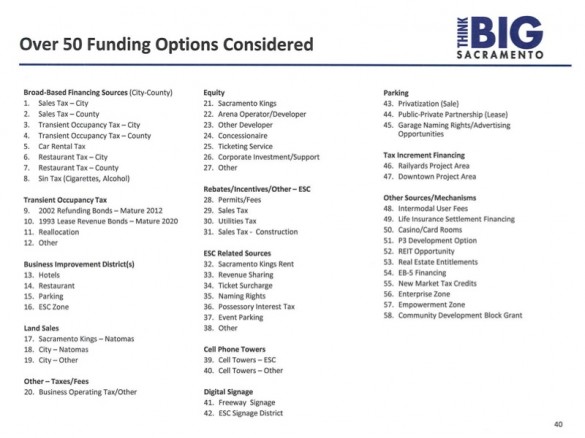
Doesn’t tell you much, does it? The conclusion actually belies the other key information within the presentation. For instance, BSG studied every possible public financing option, from taxes to fees to the sale of parking rights. Here’s the entire list:

funding_options-all-585x438

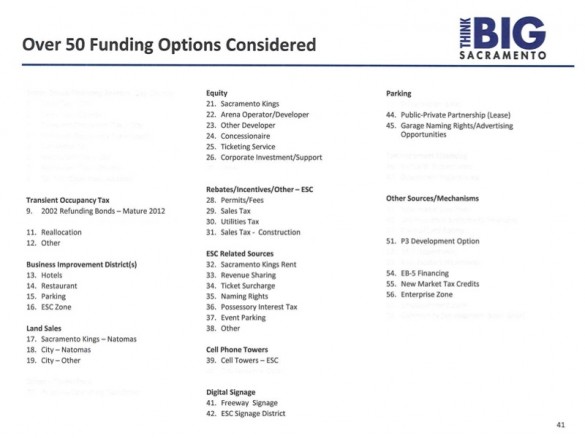
Unrealistic sources were culled, cutting it from 58 to 36. The following is the list Sacramento citizens, the public and private sectors can consider as feasible for any kind of contribution:

funding_options-culled-585x438

Once you get past the first eight options (the usual taxes used for many venue financing plans) the pickings get pretty slim. There was talk of potentially selling future parking revenue to a private operator in exchange for an upfront payment, which may be illegal in California. And notice how there’s no mention of redevelopment. That’s a good sign that the folks up in Cowtown are ready to engage in a substantive, adult conversation about how this is going to get done. The rest of the year is supposed to be spent creating the funding mix(es) that will be debated by the City Council, and in all likelihood, voted on by Sacramento voters. That’s a tough one to deal with, considering another component study’s admission that only one-quarter of visitors to ARCO/Power Balance come from within Sacramento city limits.

Some other interesting nuggets from the study:

  • The Oakland Coliseum gets $1.2 million per year from the numerous billboards spread throughout the complex. That’s about as much money as they get from the A’s. FWIW, the Raiders pay a little more than a half million bucks to the Coliseum Authority annually.
  • Public support for user fees is as follows: Selling naming rights: 74%; Parking surcharge: 71%; Ticket surcharge: 57%; Arena fee on concessions: 57%
  • One assumed source of revenue is the sale of other various lands, including the Natomas site where ARCO/Power Balance currently sits and another city-owned Natomas site.
  • A remote source of financing being considered is called EB-5, or “green card” financing. It would provide a conditional green card to immigrants who invest at least $500k or $1 million dollars. The Atlantic Yards project was cited as an example, though the EB-5 financing was used for ancillary development, not Barclays Center. The EB-5 may be what attracts Filipino investor Manny V. Pangilinan, though as someone a little familiar with the immigration process, I have to say that people with money or business skills aren’t the ones who need help with green cards.

While I’m glad that Sacramento is going through the process (even if it eventually leads nowhere), I’m confounded that Oakland has not gone through even a tiny bit of this. Why not? The Bee’s Marcos Breton nails the similarity between Sacramento and Oakland:

One thing is certain: Sacramento does not have the corporate base to privately finance buildings, such as AT&T Park in San Francisco or the Staples Center in Los Angeles.

Sounds familiar, right? No number of cute T-shirts or banners hung from railings is going to take the place of real discourse over what Oakland needs to accomplish to retain both of its outdoor teams, let alone the Warriors. If Oakland is serious about getting something done it needs to have its adult conversation. Not lip service. Not a claim of getting an EIR done in a year and then not having a draft in nine months. Getting something big done starts with getting the little things done. And if you’re not having that dialogue with your citizens, you’re just avoiding the subject.

P.S. Of course, Sacramento Mayor Kevin Johnson goes and blows away the adult conversation with an offhand comment about how Cowtown can support two teams, including a relocated A’s franchise.