Notes from the true doubleheader

Saturday’s double-dip truly had an event feel. It’s hard for the A’s to wring value out of a game when tickets are so cheap and frequently discounted. There were no bobbleheads or fireworks today, which made the game itself the real attraction. When the preliminary schedule was released, there was no doubleheader and the series was a typical post-ASB four-gamer. Even though combined attendance for typical Thursday and Saturday games would have eclipsed the 27,379 posted today, today’s number was a better number. From the look of the crowd and the parking lot, 27,379 is more reflective of the actual attendance than the regular paid figure. That feeling of fullness multiplies the sense of energy within the crowd and the venue.

Despite the good vibes, the day was not without hiccups. I didn’t arrive until the bottom of the first inning, which means that I didn’t experience the service debacle that Bryan Cauwels (Hey Bud, PleA’se stop the TeA’se) did. According to Cauwels, many of the concession stands were not fully staffed or ready to serve until 1:30 PM. If this was a strategic plan by the A’s and Aramark to work with a late-arriving crowd, it backfired as many were left standing at concessionaires that normally would’ve been open at that time. Cauwels also went to the West Side Club, where he tried to get sandwich, only to be turned down because the sandwich vendor ran out of bread. I’m not sure how a vendor runs out of bread before a game starts, but it doesn’t make much sense.

By the second and third innings, the lines cleared up and nearly every stand along the original concourses was open. Both stands in the value deck were also open. Lines were short or non-existent, except in the West Side Club. That’s where, in between games, I hung out with a bunch of AN regulars. While in the Club I got an impassioned plea from Josh “emperor nobody” Chase Fields, which was centered on protecting the A’s legacy and progressing to something better (a new ballpark), then an assault on baseball’s antitrust exemption, and finally, a polemic. Since I don’t do polemicizing on the blog, I’m going to try to distill what he said into something with a little less heightened rhetoric. That’ll take some time, so that’s for later in the week.

Once the second game started, I roamed around the Coliseum as I’m wont to do from time to time. Seagulls hovered over the seats, confused about the crowd that was not abandoning the birds’ rightful dinner (their Pavlovian cue is the seventh inning stretch). After taking in the sun for several innings in Section 205, I walked around to the other side of the Coli and met up again with the ANers in 229.

All the while, I was keeping tabs on something statistical. I have a passing interest in the Bay Area’s microclimates, hence my nom de plume (partly). Since we were guaranteed at least six hours of baseball from first pitch to last, I figured I’d jot down the temperatures in both Oakland and San Jose during the game. These are according to AccuWeather, which has in its data a statistic called Real Feel. Real Feel is a trademarked, not publicly codified measure containing a composite of ambient temperature, humidity, sunlight, wind, and other factors combined to approximate the actual feeling on skin. For the period when the sun broke through, there were times when the sun brought the temperature inside the stadium well above 70. When the low clouds reformed, temperatures felt as though they dropped considerably. Saturday was unseasonably cool, so to compare the two cities properly I’ll run this again next month, when the region hits its seasonal highs.

Dew point - which is closely tied to humidity - in the region is usually between 50 and 58 degrees Fahrenheit, which is one reason why the Bay Area is so comfortable year round.

In future comparisons, I’ll probably use data from both AccuWeather and Weather Underground for greater granularity and accuracy. Let me know what you’d like to see in this. What I’m most curious about is the effect of humidity on a baseball’s flight. We on the West Coast have a good idea of what the marine layer can do to a fly ball, especially at night, but there hasn’t been much written or said about why. I think it’s really important to understand this, so that we can know what the right-sized ballpark is in Oakland, San Jose, etc. As much as I love 1-0 pitching matchups, I also don’t want our developing hitters in the farm system to feel that they’re condemned to a life of singles and doubles if they don an A’s uniform. There’s a lot more coming on weather and climate throughout the second half of the season.

Coliseum Authority to allow open bids for facility management

Yesterday, the EBX’s Robert Gammon reported on how the Coliseum Authority was set to vote today on whether to allow current operator SMG to continue running the complex. The alternative would be to allow open bids, presumably from several other powerhouse companies such as AEG, Global Spectrum, and Live Nation.

The good news, according to the Trib’s Angela Woodall, is that that open bidding is happening. It won’t improve the experience much at team sports events, but it should help for concerts and other team sports, plus it should make those dates when events are occurring at both facilities much smoother. SMG has been notorious for not promoting Oracle Arena for concerts in order to reduce costs, though they have improved over the last few years.

In other news, Alameda County has chosen to bite the bullet and pay to continue operating its redevelopment agency. That doesn’t necessarily help Oakland, since Alameda County can only influence projects done on unincorporated land or land partly owned via a joint powers authority. It’s another sign that the legal threats being floated by various cities are just a bunch of talk, with the cities truly being forced to pay to play.

Refreshing the Territorial Rights debate

A bunch of comments about T-rights in the last thread got me thinking it’s time to reset the debate. There’s some confusion about what was done when and for whom. Previously I’ve written a primer and other posts designed to get into further depth (The Neukom Doctrine, When encroachment is not encroachment). Now let’s get a long-held myth out of the way.

Team X originally held the rights to Santa Clara County. FALSE. According to Doug Pappas, the use of counties to define territorial rights did not become part of the Major League by-laws until the early 90’s. Not coincidentally, this was at the same time that Wally Haas agreed to “give” Santa Clara County to Bob Lurie so that the Giants could pursue ballpark proposals in San Jose and Santa Clara (the city). Historically, teams held rights to their own cities and in some cases other cities well outside their own metropolitan region. In the 90’s teams started to define what their regions were by annexing surrounding counties.The Baltimore Orioles also pursued this line by specifying just about everything between Baltimore and DC, even including parts of the District via the use of Rule 52, also known as the 15-mile rule.

The table below lists all teams in the two-team markets and some data for comparison, including the defined operating territory for each team. The Major League Constitution defines an operating territory as the area “within which (clubs) have the right and obligation to play baseball games as the home Club.”

Note that operating territories in several cases includes both cities and counties. On the other hand, television broadcast territories are all shared.

Note that operating territories in several cases includes both cities and counties. On the other hand, television broadcast territories are all shared.

Baltimore’s deal looks similar to what the A’s are getting now. The biggest difference is that they control their local TV market through MASN, which was created as part of the deal to allow the Expos to move to DC. The O’s pay the Nats a fee to carry TV rights, controlling all revenues that come into the network. Once Nationals Park opened, the Nats actually surpassed the O’s in annual revenue.

The ongoing Dodgers saga could provide its own test of territorial rights. SPORTSbyBrooks reports that MLB is in talks with AEG about a possible downtown ballpark near Staples Center and the LACC. That’s the same area targeted for a NFL domed stadium, making it highly unlikely that both could be downtown. However, it’s not hard to see MLB using this as a stalking horse against Frank McCourt, just in case bankruptcy proceedings allow him to keep Dodger Stadium and the parking lots, if not the team itself. Even if both the NFL and the Dodgers don’t bite there could be another interested party: Angels owner Arte Moreno. Despite the recent signing of lease options at The Big A, the Angels are only locked in through the 2016 season. Moreno is open to looking all over the LA for the next home, and unlike the A’s restrictions vis-a-vis Santa Clara County, Moreno can look at the entire region. That includes downtown LA, which would place the Angels 2.5 miles from Dodger Stadium. Preposterous as it sounds, Moreno hasn’t been afraid to play the leverage game, and the timing of having such an option available would play right into his hands. It’s unlikely that the next version of the ML Constitution will split the LA market unless MLB arranges a downtown LA ballpark deal with AEG and the Dodgers’ next owner, a deal that sounds too complicated to actually work.

Going back to the Bay Area situation, I’ve been trying to figure out how redrawn territories might look if the A’s were to move to San Jose. The pro-San Jose crowd likes to think that the Bay Area would become a large shared territory, like NY/LA/CHI. However, I don’t think that’s realistic. DC-Baltimore remains a split market and with the teams separated by 35 miles and the cities having their own distinct identities, it’s a much better comparison to the Bay Area. A swap of the East Bay for the South Bay is also suspect because it’s practically worthless to the Giants. Operating territories mean nothing except when it comes to playing home games, and the Giants aren’t going to look at building in Oakland anytime in the next, well, forever. Yet the Giants would object to leaving the East Bay unassigned since they wouldn’t want a third MLB team 10 miles or less from China Basin, as unlikely as that sounds. Pro-Oakland forces could lobby MLB to leave the East Bay unassigned, but that does little to address the monetary obstacles in getting a new ballpark built there. It’s clear that either San Jose or Santa Clara County would have to be assigned to the A’s instead of the territory being shared.

The strange thing about the county-based annexation done during the 90’s is that most ballparks are built in downtowns, or at least within major cities’ limits. The Rangers are the only exception to this rule, with their home being halfway between Dallas and Fort Worth in Arlington. One of the iterations of the Washington Senators moved to the Twin Cities suburb of Bloomington at first before moving to Minneapolis proper. The Florida Marlins have always played in the Miami suburb of Miami Gardens, though they’ll move to a ballpark within the city limits next season. With public dollars drying up and tools like redevelopment severely restricted in California, it may be time to redefine what an operating territory is. Just from a practical standpoint, we know several things about what MLB looks for in a ballpark site (in no particular order):

  • Downtown or sufficiently urban location, close to transit if possible
  • Significant infrastructure already in place near the ballpark site
  • Large enough market population and economic strength to make a move worthwhile for the team and MLB as a whole
  • Proximity to existing fans in cases where building in an established market

It’s hard to believe that a piece of suburban, undeveloped land would fulfill these requirements. Knowing this, it may be best to pare back the definition of operating territory to cities instead of counties. For the Bay Area, that would mean the Giants’ territory would strictly be the City/County of San Francisco, while the A’s territory would strictly be San Jose. The rest of the Bay Area could be shared/restricted from the standpoint of hosting a major league franchise, with both teams requiring consent for further moves or incursions by each other or “invading” major or minor league teams. The point of the operating territory is to maximize physical accessibility to fans throughout a market. The Bay Area’s sprawling landscape makes it difficult to do that for all fans, since either the North Bay or South Bay will be pinched. If MLB is looking to evolve the game now just as they did 20 years ago, T-rights are worth a rethink in order to maximize presence for baseball fans throughout the Bay Area, not just the Giants.

Selig says contraction off the table

As part of the ongoing All Star media extravaganza, Bud Selig responded to an inquiry by the Chronicle’s John Shea: shea-twitter

There goes the idea that contraction was a bargaining item for the CBA. So let’s go with the idea that the Giants have been hoping that the A’s give up and leave town or get contracted. The latter is not happening, at least through the length of the next CBA (which is expected to approved by both MLB and MLBPA by the end of this season). Now let’s pivot to the A’s, who want Selig to force the Giants to make a deal or have Selig force a vote. Based on Selig’s reputation, the latter is not happening there either. Is that complex, as Selig says? Not really. Is it a difficult negotiation? Certainly. Let’s not make the issue bigger than it really is.

News for 7/12/11

Back from a much-needed camping trip, and I’m ready to deal with the anger and frustration. And boy, is there a lot of it. Wouldn’t you be frustrated if the man who holds your future in his hands answers questions in this manner?

Q. What is the latest on the possible relocation to San Jose for the A’s franchise?

COMMISSIONER SELIG: Well, the latest is, I have a small committee who has really assessed that whole situation, Oakland, San Francisco, and it is complex. You talk about complex situations; they have done a terrific job. I know there are some people who think it’s taken too long and I understand that. I’m willing to accept that. But you make decisions like this; I’ve always said, you’d better be careful. Better to get it done right than to get it done fast. But we’ll make a decision that’s based on logic and reason at the proper time.

Selig held steady on other pressing topics, such as the Dodgers, the CBA, realignment, and instant replay.

Joshua “emperor nobody” Chase and Tyler “Blez” Bleszinski have written distinctive, impassioned calls for action and change for the A’s. Both are must reads.

2009 first round pick Grant Green was named MVP of the Futures game last night. After crushing what he thought was going to be a home run against the wall, keeping him to a double, Green said this:

“I’m happy getting doubles. It’s the type of thing where I know I’m not going to be a 20-homer guy in Oakland. Not in that ballpark.”

Imagine if teams could trade draft rights in baseball the same way they could in the other three leagues. Pick signability would take yet another hit for the A’s as long as the Coliseum remained their home.

Despite the A’s struggles on the field, TV ratings at CSN California have seen a slight rise annually from 1.23 last summer to 1.33 this summer. That combined with the slight rise in attendance should mean something, shouldn’t it? If so, what?

Even as cities are looking to sue the state over the death of redevelopment, at least three cities are looking at ways to potentially work within the system. So far that includes the three most prominent cities: Los Angeles, San Diego, and San Francisco. Both Oakland and San Jose have said initially that they can’t afford to pay the price to keep their RDA’s functioning. We’ll see about that.

The Florida Marlins are closing off the upper deck at Sun Life Stadium for the rest of the year, with the exceptions of a dog-oriented game in August and the final home game ever in the stadium. Looks like fans are holding out until the next year in the new, air-conditioned space, which is oh-so-Miami sports fan.

The funeral for fallen Rangers fan Shannon Stone was held on Monday in Brownwood, TX. The Rangers and Brownwood have set up memorial funds for Stone’s family, to which the A’s contributed $5,000.

As part of its continued correction, Cisco Systems may lay off anywhere from 5,000 to 10,000 jobs before the end of the year, up to 14% of its current workforce. A reduction of 5,000 jobs would save $1 billion in costs and increase profitability 8% in 2012, according to Bloomberg.

There’s a half-serious movement emanating from SoCal to have 13 counties secede from California to form their own largely conservative state. Secession efforts have occurred in the past, mostly from the also largely conservative counties in the northernmost section of the state. It’s not really relevant to the ballpark or baseball economics discussion except that it provides an interesting “what if” scenario if it ever came to pass. Would the new state, which would include Orange and San Diego counties, be more or less friendly to potential franchise relocation candidates? How would they relate to teams who have outdated facilities?

Lastly, it appears that there’s a post-doubleheader tailgate happening on Saturday and a slew of activities before the first game. Given that those of us who are attending will be unable to leave the stadium between games, how about a mini meetup during the intermission? I’m open to suggestions as to where in the O.co Coliseum.

A completely avoidable tragedy

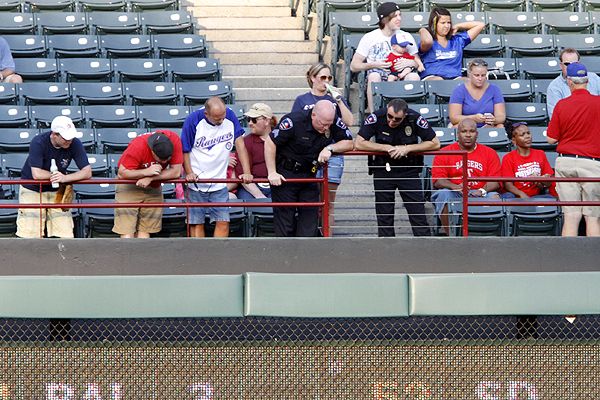
By now you’ve probably heard about the terrible tragedy that occurred at Rangers Ballpark in Arlington earlier tonight. A foul ball off the bat of Conor Jackson went down the LF line and caromed into fair territory, where Josh Hamilton picked it up and tossed it to some fans in the outfield seats. Shannon Stone, a firefighter from Brownwood, TX, leaned over a railing for the ball and fell some 20 feet to the ground below. He later died of his injuries. This is the third incident of a fan falling over a railing at Rangers Ballpark, this one being the first death. He had brought his 6-year-old son to the game.

Any adult who sits in an elevated front row should be aware of the potential for danger, especially if you’re fixated on catching a ball. The LF seats in Arlington are a unique situation in that there is a sizable gap between the front row and the out-of-town scoreboard, which forms the LF wall. I have no idea why the gap is there. Historically, the scoreboard was manually operated, which would require some space for the crew to maneuver. After the scoreboards were changed to LED panels two years ago, the space in back of the scoreboard seemed to be unnecessary, except for perhaps ventilation purposes. At the Coliseum, there is no such gap between the scoreboard and the seats. Instead, there’s a three-foot-wide yellow ledge which provides a roof for the crew, and then a wall which extends up to the bleacher seating. Every other ballpark with a scoreboard built into the wall has fans either directly above the scoreboard, or separated by either a net or something solid. The Giants even put in an extra rail at AT&T Park’s bleachers to keep fans from reaching over the fence and potentially interfering with a ball in play.

A gap with no purpose. (Image taken from CSNCA broadcast)

Why the Rangers didn’t install either a net or a chain link “cage” is beyond me. Installation wouldn’t have cost much and would not have compromised ventilation for the scoreboard. It’s not like they haven’t had such a system at Wrigley for decades.

In Arlington, the prior incidents caused the Rangers to raise the railings from 30.5 inches to a height of 46 inches, or so they said. In foul territory this is difficult to pull off, because every fan is looking down into the action on the field (20-35 degrees). Higher railings could compromise views. A closer look shows that the raised railings only occur along the aisles, not the seating sections. That in itself is tragic given the location of this incident. Outfield seats have a much less severe angle of the action, especially the pitcher-batter confrontation. It would’ve been easy to make 36 inch or higher railings uniform across the board, which might have been high enough to keep the man from falling. To understand how unsafe it is, take a look at this picture provided by the AP to ESPN. Notice on the far right how the railing is lower than the fan’s butt? That’s not good.

It’s simple. Either put up a net or raise the railings to a height that might actually protect people instead of merely providing a footrest. Or do both. It’s only your fans’ safety at stake, Nolan. For now, all anyone can do is send their sympathies to the family of the fallen firefighter. Still, it’s hard to get over the fact that this incident was thoroughly avoidable.

P.S. – The tour I took last summer of Rangers Ballpark didn’t allow us anywhere near the field because it was a game day.

Bay Bridge Doubleheader By The Numbers

If you didn’t get a chance to take in today’s Bay Bridge Doubleheader (Mariners @ Athletics in the afternoon, Padres @ Giants at night), fear not! You’ll have one more shot on Labor Day weekend, Saturday, September 3 to be precise. On that day, the schedule will kickoff again with the Mariners visiting the A’s, this time a 1:05 PM game. The nightcap will be the D-backs invading the Giants, hopefully with both teams in the full throes of a pennant race. It’s also possible that the following day, the Giants game will be moved from a 1:05 start to 5:05 to accommodate ESPN’s Sunday Night telecast. Note: I was thinking that the NFL’s labor situation may have an impact, but that weekend is scheduled to be the final exhibition weekend and customarily no games are played on that Sunday. However, a compressed schedule may require games on that Sunday. Back to the original topic.

Today’s double dip was truly unforgettable, and unbeknownst to me 14 hours ago, truly epic. Here’s a breakdown of what I experienced/endured today:

  • Combined time of both games – 6:04 (A’s – 2:12, Giants – 3:52)
  • Total attendance – 61,407 (A’s – 19,491, Giants – 41,916)
  • Innings – 23
  • Pitches thrown – 612
  • Home runs – 3 (bookends – Scott Sizemore to start scoring and win the game for the A’s in 1st, Nate Schierholtz to win the game for the Giants in 14th, also Schierholtz also in 4th with two on)
  • Total cost of tickets – $28 (A’s – $12 value deck, Giants – $16 SRO)
  • Total cost of public transit – $12.15 on BART
  • Total cost of parking – $0 at Hayward station
  • Total cost of gas – Approximately $10
  • Miles driven – 68.4
  • Food/beverage cost – $18.14 (A’s $3.60 out of pocket plus $6 value in ticket for popcorn chicken and soda, Giants – $0, Red’s Java House – $12.25 for Double Cheeseburger + Fries + Anchor Steam, Bayside Market – $2.29 for 1L bottle of Diet Pepsi)
  • Time I left home – 11:00 AM
  • Time I arrived home – 12:35 AM
  • Time my phone ran out of juice – 9:30 PM

Speaking of bookends, the games were the last ones I’ll have attended until the big doubleheader on the 16th. Should we do a meetup? Tailgate? Anyone perhaps interested in the 9/3 Bay Bridge doubleheader? Despite the long day, I’d do it again in a heartbeat.

P.S. – While I was walking around I noticed a number of newly painted lines on some parts of the arcade and behind the bleachers at AT&T Park. It turns out that there are now designated areas for standing and circulation. This was mandated by the fire marshal after an inspection brought up uneasiness about the large, difficult to disperse crowds on the arcade. In retrospect, you have to wonder why it took over a decade for that action to take place. I spoke with an usher about it and he said that the number of standing room tickets had to be reduced due to the lower amount of space available for SRO.

Update 11:52 AM – I emailed A’s Stadium Ops czar David Rinetti to inquire about any special fan rules for the doubleheader. Here is his response:

We are conducting our double-header like every other game, with the following exceptions:

  • fans will be able to enter the stadium from 11:05am until around the 7th inning of the 2nd game
  • the second game will start 35 minutes after the conclusion of the first game
  • alcohol sales will continue all the way through the 5th inning of the 2nd game

Like all regular games, there will not be in and out privileges.


Bay Bridge Doubleheader

Earlier today I posted on Twitter that I was going to take in the Bay Bridge doubleheader by attending both A’s and Giants home games during the same day. The A’s-M’s game, which was not televised, was a tidy affair punctuated by quick innings by both Joey Devine and Andrew Bailey to complete a combined shutout started by Guillermo Moscoso. Now I’m in SF, having bought a SRO admission for tonight’s Giants-Padres tilt. I’ll probably grab something to eat nearby before the game starts. It’s my first time being able to do this, so I can knock it off my bucket list.

Revisiting 980 Park

You may remember that last September, Jeffrey did an overview of architect Bryan Grunwald’s 980 Park site. An innovative solution, the ballpark would be placed on an expansive concrete deck above I-980 as the freeway becomes a wide urban canyon as it passes downtown before it becomes CA-24. Thanks to Grunwald’s persistence, the 980 Park site is an alternative on the Victory Court EIR. Since we know it’s part of the discussion from a process standpoint, it’s time to take a better look at what 980 Park’s advantages and disadvantages are.

Grunwald uses Fenway Park as the model. The park is above I-980, bounded by 14th and 18th Streets to the north and south, and Brush and Castro Streets to the east and west.

Looks like everything works, right? Not so fast, my friend. While many detractors focused on the terrorism fear angle of putting a ballpark above a big piece of transportation infrastructure, that’s not really that much of a problem. SFO’s International Terminal is built directly over the main access road. Madison Square Garden and Boston’s TD Garden are on top of heavily used train stations. Parts of Target Field, including the plaza between the ballpark and arena, are above a freeway segment. No, the biggest problem with 980 Park is the size and shape of the site.

In the picture above (provided by Bryan Grunwald), Fenway appears to fit almost perfectly into the site. After further investigation, not everything is at it seems. As an urban canyon, this freeway segment may be one of the widest in the nation thanks to the liberal use of ramps, shoulders, and landscaping. At its widest (Brush St. curb to Castro St. curb), the width is 450 feet. That’s an amazing amount, and that vastness probably led to the physical and psychological separation of West Oakland from the rest of the city. As Grunwald sees it, 980 Park is a chance to reconnect West Oakland with the rest of the city, right that postwar wrong for good. Going back to dimensions, 450 feet is great for any number of commercial projects. It’s not so great for a ballpark. To keep things in perspective, remember that 450 feet is only 10 feet longer than dead center at old Tiger Stadium.

Width of the site varies from 450 feet (yellow line) down to 300 feet (18th St.). Freeway on/off-ramps would have to be modified per Grunwald's plan.

Original yellow line indicates 450 feet (width of 980 Park site). Additional lines show actual dimensions of Fenway from the Green Monster to the end of the opposite grandstand plus additional infrastructure.

The yellow line in the above picture runs from the Fisk Pole south 450 feet. It terminates short of the back of the grandstand. This makes sense when you consider what goes into making the ballpark. Start with 310 (er, 308) from the Monster to the plate and 50 feet to the first row. That leaves only 90 feet for seats and circulation on that side. That’s simply not enough. Osborn Engineering was incredibly resourceful in dealing with the lack of space at Fenway by sticking the main concourse underneath the lower deck. They also crammed in as many seats as possible into the space by having narrow seats (18″) and row treads (30″) in the grandstand area, and if you’ve ever sat in those seats at Fenway you’ve noticed.

At the back of the lower deck grandstand is a narrow corridor for circulation and a "curb" on which people can stand, back to a fence. Upper deck and suites were added much later. Notice how much bigger the seats look from the upper deck club to the front of the lower deck to the back?

The advent of modern standards such as the “growing” American and ADA requirements make it impractical to implement Fenway now. Cisco Field at Diridon may be highly influenced by certain elements of Fenway, but it’s not going to be cramped like Fenway. Fenway’s field is rotated relative to the grandstand and street grid, yet its LF line lines up almost perfectly with the Meridian. Unlike my idea for rotating Cisco Field to expose more fair field dimensions, no amount of rotation can make up for the lack of space at 980 Park. It works at Diridon because the shortest dimension available on the irregularly sized lot is 570 feet, 120 feet more than at 980 Park. Curious about how this disparity works out to other small ballparks throughout the country, I whipped out Google Earth and used its virtual tape measure at several more space-constrained current and former ballparks. What I found was a pattern.

Shortest dimension when accounting for playing field (LF/RF line) in calculation. When possible, figure only includes ballpark grandstand and does not account for setbacks or sidewalks. Acreage includes field, grandstand(s), and everything else within exterior walls. Parking lots and ancillary buildings are not included.

There may be ways to widen the 980 Park site. Brush and Castro Streets are essentially three-lane, one-way frontage roads with parking on one side. Grunwald’s plan could reclaim one lane on each side, adding 15 feet to each side. However, the 450-foot measurement goes from curb to curb, and it will be necessary to have some amount of setback for sidewalks, trees, etc. That requirement alone would eat up the two reclaimed lanes. Beyond that, it’s hard to see what other changes could be made to fit a reasonably-sized ballpark. The field might be able to be rotated so that home plate sits directly above the median of the freeway, and the pitcher and batter face up/down the freeway. That would put the foul poles at Brush and Castro, leaving precious little space for circulation and creating limitations of the seating configuration. It’s a problem for a real architect like Bryan Grunwald, not a blogger enthusiast like me, to figure out. I don’t necessarily think it’s insurmountable. It is definitely a challenge, to put it mildly. And it would most assuredly be a first. Good luck, Bryan.

Quakes draw team-record crowd at Stanford

.

Most of the crowd stuck around for the fireworks show

The only thing that tempered last night’s joy on the Farm was the occasional defensive lapse by the Quakes, which led to a 2-2 draw. For fans of that other San Jose team, defensive lapses aren’t exactly rare. Danny Miller, who does PA work for both the Quakes and Sharks, announced a crowd of 41,028, the third largest in team history. More importantly, it was the largest crowd in which the Quakes weren’t playing the undercard to a larger international exhibition match.

A bigger stadium and bigger grounds all around made the whole event much more festive than the typical Earthquakes game at Buck Shaw Stadium. I arrived early to see a food truck extravaganza set up in the javelin-throwing area adjacent to the track stadium. Lines were ridiculously long for many of the trucks. I chose to wait in line at one of the gates so that I could enter the stadium at the 6 PM opening time. (I won’t bother reviewing the stadium experience, since I did that five years ago after the rebuild.) On Friday I bought a general admission ticket for the Supporters Section(s) on the south side of the stadium. Around the time I bought the ticket, the Quakes announced that the lower bowl (21,000 seats) had been sold out, with 30,000 seats sold in total.

About two-thirds of the crowd were in Earthquakes regalia. Nary a Red Bulls fan could be found, which is important because it means that the 41,028 was almost all homegrown, not visiting – unlike what happens for a game against the hated L.A. Galaxy. The rest of the crowd appeared to be other locals who came partly for the game, partly for the fireworks display. It’s important to note that this is the first such display in Palo Alto in several years, making the event quite a novelty. Some locals who weren’t interested in the game chose to hang out at Palo Alto High School, where a good view of the show was guaranteed.

The hidden factor for many may have been the lure of $15 general admission tickets. There were actually three different GA sections: supporters (south, where I sat), family (north), and upper bowl. Together they accounted for some 20,000 tickets on their own. The great thing about playing in a stadium five times the size of your regular home is that you can afford to charge less for tickets. I was helping some friends move earlier in the day and I told them about the game. One friend’s biggest complaint about the Earthquakes is that their tickets are too expensive ($20-50) for what you get. Yet you drop the price under the $20 mark and put the game in a freshened venue and suddenly he’s interested. If I had organized a group outing instead of deciding the day before to go, I probably would’ve ended up bringing 4-6 more people.

The lower deck of Stanford Stadium holds 21,000. Maybe that's the right amount of seats for the Earthquakes.

Then again, you can’t get past the simple fact that Stanford Stadium is a really nice place to watch a game of futbol or football. It’s clean, comfortable, intimate, and friendly. There’s even a sort of karma that comes with the way it was built inexpensively and efficiently, yet with clear nods to the past. Clearly everyone from longtime Quakes season ticket holders to curious Paly residents were enjoying themselves. The difference between atmospheres at Stanford and Buck Shaw could not be more stark. Buck Shaw will always feel temporary no matter how it’s dressed up, the same way the Coliseum feels cold and uninviting after Mt. Davis. That’s not to say the venue or even the team are enough. Until the Harbaugh era Stanford’s football team has historically been a bad attendance draw, thanks partly to the school’s low undergrad enrollment (>7,000) and international alumni base.

That makes it difficult to gauge what the real support for the Quakes is. Obviously, 41k is an outlier for a team that doesn’t quite sell out its regular digs and one game is too small a sample size for comparison. But it’s clear that there is a pent-up demand for the Quakes to play in a really nice venue. The team has always played in someone else’s venue: SJSU’s Spartan Stadium, SCU’s Buck Shaw, the A’s/Raiders’ Coliseum. Is the 15,000-seat stadium at Airport West enough? Judging from the Quakes’ attendance history going into yesterday, I’d said it was a bit on the small side but with additional standing room admissions (2,000+) it was probably enough. From witnessing last night’s game, I’m not so sure anymore.

New Earthquakes Stadium. Capacity: 15,000 seats with limited expansion capability.

I estimate that each additional row at the top of the Earthquakes Stadium during conception would add 800 seats. Cost is difficult to establish, perhaps $2 million per row depending on the materials used. An extra 5 rows would bring capacity to 19,000, slightly larger than Kansas City’s Livestrong Sporting Park. If Lew Wolff and David Kaval went with the same construction techniques employed at Stanford, the cost may be more manageable. 19-21,000 would seem the sweet spot for the Quakes. Is it worth the cost? I’d like to think it is. There’s one way to find out: play another regular season game or two at Stanford without the fireworks to see what kind of crowds they draw. There isn’t much time to do it before the football season starts, but it’s worth a look this year and next year.

More reading: Kaval outlines the vision at Airport West.