Sacramento needs a partner

In 2005, AEG started construction of an arena in Downtown Kansas City. The arena already had a naming rights sponsor, hometown telecom Sprint, a year earlier. Thanks to that deal and Kansas City’s need for a new arena to replace the aging Kemper Arena, the Sprint Center was built on spec, without a real major league tenant. The funding breakdown for the $276 million facility was as follows:

  • AEG provided $54 million upfront
  • The NABC (National Association of Basketball Coaches) gave $10 million
  • Sprint’s naming rights deal was $2.5 million per year for 25 years, reduced to $1.7 million if no NHL/NBA franchise moves in
  • New $4 rental car fee
  • $1.50 per room/night hotel tax

As of 2009, debt service was being paid off thanks the higher-than-expected tax revenues. AEG was running the venue profitably despite not having a team tenant. Ironically, it could be Kansas City, the city from which Sacramento lured the Kings, that provides a blueprint. That’s not to say it’s a good financing plan for other cities to emulate, but thankfully it hasn’t crippled KC the way the Coliseum deal has crippled Oakland and Alameda County. One hurdle Sacramento faces as far as the taxation part goes is that one potential source, airport passenger facility fees, has already been sworn to SMF’s airport modernization project otherwise known as “The Big Build.”

Mayor Kevin Johnson’s plan is to have an arena and entertainment complex in Sacramento, with or without the Kings. So far ideas have included creating a six-county authority from which one or more taxes could be raised, and the usual mixed-use mega development from which proceeds could help fund the arena. Sacramento has never done a large, modern, publicly financed venue on its own. Raley Field was done by Yolo and Sacramento Counties and West Sacramento. ARCO Arena/Power Balance Pavilion was privately financed. The hard slog will be in formulating the financing pie. It’s safe to assume that the cost will be at least $400 million not including the land (Orlando’s new arena cost $380 million in construction alone).

Sprint Center’s being on spec is rare and unusual, especially when compared to other arenas throughout the NBA and NHL.

Ownership status of arenas throughout the NBA and NHL. Privately owned arenas in bold.

Notice a pattern there? The top list has ten arenas shared by two or more teams. and almost all of them are privately owned and operated. Such a business model allows the operator to work as hard as possible to fill its schedule and maintain a modern. competitive venue. Now there’s some talk in KC about whether AEG really wants a team at Sprint Center, since it could cost the operator prime concert dates. That’s not the way AEG operates Staples Center, where the company has to juggle the Lakers, Clippers, NHL Kings, Grammys, Pac-10 hoops tourney, and numerous concerts. For Sacramento to pull off an arena deal, it will need to partner with someone who doesn’t have a hidden agenda. Sacramento may have numerous choices, all of them somewhat problematic. It’s unclear how much cash the Maloofs could put up towards an arena. Would they relinquish the right to operate the arena to company like AEG in order to become a tenant? If AEG or another company were to build the arena, could they partner with the Maloofs, or would they want someone they’re familiar with in the captain’s chair, such as Ron Burkle? What role does Chris Webber play in any of this?

It’s not just about getting an arena deal done. It’s about getting a good arena deal done. All of the moving parts, different parties, and divergent goals are guaranteed to make a deal difficult, though not impossible. If KJ can get contributions from a team owner, a separate venue operator, and a big naming rights sponsor, he’ll be off to a very good start. Then he can start to frame discussions around whatever public contribution will be required. It’s an issue that he has chosen to become a plank in his economic development platform, and his second term probably rides on the project’s success or failure.

New redevelopment bill SB 286 introduced (updated)

State Senator Rod Wright (D-Inglewood) introduced a “compromise” redevelopment bill last week. SB 286 is intended to deal with the excesses of current redevelopment by introducing new levels of oversight, including regular audits of redevelopment agencies. The agencies themselves would remain largely intact, but they face new restrictions on what specific types of projects they could take on. A big one is the elimination of projects on currently non-urbanized parcel five acres or larger in size. Simply put, all projects have to be done on infill land. Development on “blighted” farmland and open space would be verboten. Direct assistance also couldn’t be provided to casinos, race tracks, speedways, and golf courses. And there’s one extremely important new rule related to sports facilities.

SEC. 7. Section 33426.5 of the Health and Safety Code is amended to read:
33426.5. Notwithstanding the provisions of Sections 33391, 33430, 33433, and 33445, or any other provision of this part, an agency shall not provide any form of direct assistance to the following:

(e) A development or business, for the acquisition, construction, improvement, rehabilitation, or replacement of property that is or would be used for a stadium, coliseum, arena, ballpark or other sports facility that is intended for use by a professional sports franchise unless the proposed assistance or another component of the financing for the proposed project is submitted to the electorate that resides in the territorial jurisdiction of the agency providing assistance, and is approved by a majority of the voters voting on the proposed development.

The upshot is that every stadium or arena project throughout the state would require a vote if the bill is passed. In San Jose that’s not such a big deal because a vote is required per the city charter. Now everything from LA’s Farmers Field to Oakland’s Victory Court to Sacramento’s Kings-saving railyards arena would automatically trigger referenda. If it’s a city project, city voters would have to approve. If it’s a county project, county voters would have to approve.

Keep in mind that the alternative, as we know it right now, is the complete elimination of redevelopment as dreamed by Governor Jerry Brown, and redevelopment’s replacement by successor agencies with an even smaller scope and breadth of powers than specified in SB 286. Furthermore, SB 286 is sponsored by the pro-redevelopment League of California Cities and the California Redevelopment Association. While the bill could undergo changes in committee, it’s unlikely that the sports facilities clause will see a big change since a reversal would strike at the heart of the bill’s intent, weakening the bill in the process.

So, that talking point that the Oakland-only crowd has but putting out about not needing a vote in The Town? Might have been a little premature about that one.

Updated 3:04 PM – Governor Brown is pushing AB 101, which would kill all redevelopment agencies and cap borrowing as of July 1. The League of California Cities has said the bill is unconstitutional. That makes it SB 286 vs. AB 101 for the future of redevelopment. It’s possible that one or both don’t make it out of committee. It’ll be interesting to see if they end up as competing ballot initiatives with poison pills.

48 hours and a bobblehead

On Saturday I sat in section 130. This was the crowd during the game.

For today’s game I sat in my regular Value Deck seat in section 317. This was the crowd as the A’s took the field just before first pitch.

The announced paid crowd was 9,193, easily the smallest crowd of the season so far. The actual number of in-house attendees may have been as few as half that number. The unusual wraparound series configuration and the 12:35 getaway day start time both conspired to depress attendance for today’s tilt. It also didn’t help that unlike the previous three games in the series, there were zero promotional ties or giveaways for this game.

I fear that this upcoming Cleveland series will also fare poorly in terms of attendance. A friend from NYC is in town on business this week, and I got two $2 seats for Wednesday’s game. The game was not on my original schedule, and I have no idea if we’ll actually be able to go. Still, it was just a $4 expenditure at the box office, so no big deal, right? (Note: Plenty of $2 tickets remain for Wednesday night.) That absurdly high availability and cheapness of A’s tickets is a double-edged sword. It’s great for those of us who want to go at a moment’s notice. It’s not great for the A’s and it definitely doesn’t impress MLB.

As much as I want a beautiful new ballpark for the A’s, I’ll miss the “no big deal” accessibility of the A’s and the Coliseum right now. Actually, no I won’t. As amusing as it was to hear Grant Balfour swear (yeah, everyone heard it) after missing his spot on yet another pitch, I’d rather have a bigger crowd. And frankly, we shouldn’t need bobbleheads to get people to come out – many of whom only show up to get the swag and leave.

One thing I saw in the stands gave me a little hope. An (East) Indian man and his young son sat a row below me. They were immigrants. The son was wearing a rugby shirt. The kid loved baseball. His dad was doing his best to stay interested. The kid watched every pitch and was with the wedding-white-clad warriors the whole way. After Godzilla’s walkoff blast, I ran down the aisle and high-fived the father and son and everyone else within reach, which wasn’t a big deal because there were only eight people in the vicinity. I don’t know how the boy started loving the game, I just love how he and has were trying. Despite the lack of a crowd or a roster full of stars, we got a new fan. Hopefully for life. Hopefully, a lot more just like him soon.

Kings to stay at least one more year in Sacramento

Here’s the press release from the Maloofs:

MALOOF SPORTS AND ENTERTAINMENT STATEMENT

“Out of respect to Kings fans and the regional business community, we have decided to remain in Sacramento for the 2011-12 season. The fans’ spirit and energy, specifically our season ticket holders, has been remarkable and we are truly thankful for their loyalty. We also are greatly appreciative of the support from our corporate sponsors as well as other local businesses that have come forward in recent weeks.

Additionally, we would like to take this opportunity to send a heartfelt thank you to the loyal and hardworking team members within our organization. From the game night staff to the front office, coaches, and players, we are grateful for their professionalism and devotion.

During this process, Mayor Johnson has strongly indicated to both the community and the NBA that he is capable of getting the support to build a state-of-the-art entertainment and sports facility that the Sacramento Region and the tremendous Kings fans so rightly deserve. We look forward to seeing Mayor Johnson bring his vision to reality. However, if an arena plan cannot be finalized in a timely fashion, the NBA¹s relocation committee has assured Maloof Sports and Entertainment that it will support an application to move the franchise to another market starting in 2012-13.”

A report from the ICON group is due later this month. That information and perhaps another arena proposal from an “anonymous” Nevada businessman will frame the discussions for a new venue going forward. The scary part for Kings fans and Sacramento citizens is that it doesn’t appear as if the Maloofs are on the hook to do anything as part of the effort to stay. Presumably there should be some sort of contribution from the ownership group, but what will that be? If they’re cash poor, what can they provide other than the old arena, which it appears they’d give up anyway if they were to move? Right now this has to feel good for fans, but the task they and Mayor Kevin Johnson is daunting to say the least. Even if Ron Burkle were allowed to buy the team from the Maloofs, it’s not realistic to expect him to spend $400 million out of pocket on an arena. At least they’re getting a year, which is more than you could say for many other teams’ fans.

Bidding war is ON in Sactown

I had no idea the Sacramento Kings cleaned up this well. A report by FOX40’s Jim “Scoopmeister” Crandell indicates that there is now a third group interested in the Kings and a second arena deal in the works.

WHA?!?!?!

The third group, which is publicly anonymous for now but known to the Maloofs and NBA brass, is headed by a Nevada businessman. Their intent is to build an arena in Sacramento. They claim they will match any offer by Henry Samueli. Their arena plans involve a 25,000-seat, “community funded, community owned” arena. That’s right, 25,000 seats. The facility would include a 5,000-seat amphitheater and an indoor aquatic center. Obviously there are enough holes to drive a fleet of trucks through at this point, so I’m more than a little skeptical. Regardless, the offer has been submitted so it must have passed some basic scrutiny.

This comes at the same time Samueli and Anaheim have bumped up their offer to the Maloof brothers. The offer now stands as follows:

  • $70 million upgrades
  • 6-year TV deal, at least $24 million per year on multiple networks
  • $75 million loan

The loan and TV parts are the major changes. Is that enough?

Not to be forgotten, Ron Burkle remains in the picture and the ICON group has its arena plans (not related to the aforementioned plan) coming later next month.

The Maloofs are on the fence. They’ll have a tense weekend to make their decision, unless David Stern gives them yet another extension past the Monday deadline. Wouldn’t it be something if, years later, we found out that this was all a ruse to get a new arena in Sacramento for the Kings?

San Jose approves Draft Diridon Station Area Plan

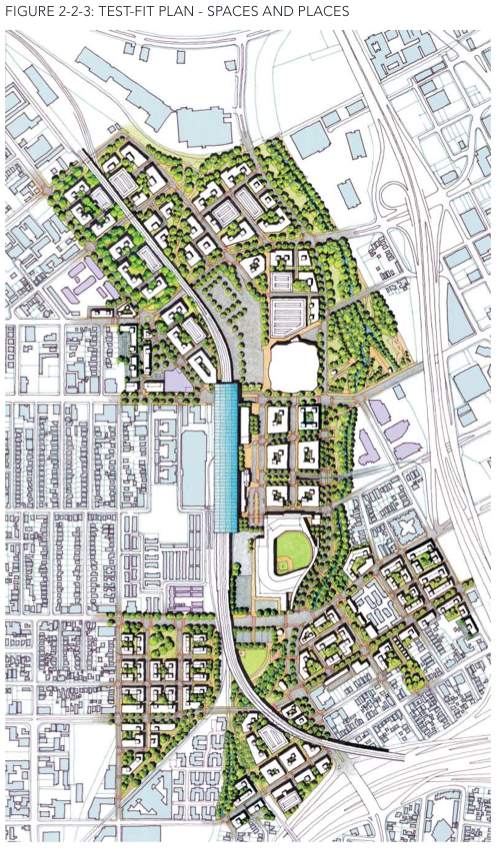
As expected, the San Jose City Council approved the Draft Diridon Station Area Plan, which seeks to transform much of the area around the current transit hub into a destination district anchored by HP Pavilion and Cisco Field. Next up is an EIR for the entire 240-acre vision. Projected impacts will probably force a scaling down of the vision, especially because of limited future redevelopment funds.

Full buildout. North of the arena is the industrial/commercial sector. South of the ballpark is residential. Retail/commercial is between the ballpark and arena. Autumn Parkway is completed through the area.

Tracy Seipel’s article makes mention of the potential need for a master developer, as was the case for Mission Bay (Wilson Meany Sullivan) and the Kansas City Power and Light district (Cordish). The same strategy was employed during planning for the Fremont ballpark, with Gensler as the master developer. While such a strategy could properly unify what would probably be disparate elements of the plan, threats to redevelopment make such a broad scope less realistic. As long as the plan sets out proper guidelines for how development should occur (which it does), the spirit of the area plan should be fairly easy to uphold. Just about everything larger than a single family house will require an EIR on its own.

Lew Wolff said in the past few months that he wouldn’t have anything to do with developing the critical Central area framed by the train station, arena, and ballpark. Knowing how the city fathers have failed time and time again in trying to turn the original downtown into a viable retail district, current civic leaders and developers should not have grand designs on proceeding down a similar path with this. There are three key reasons:

  • No free parking. I don’t mean validated parking, I mean unfettered free parking. Valley shoppers are too used to it and won’t react well to not having it, even if it’s a good idea to charge from a multimodal planning standpoint. Even though Valley Fair and Santana Row are logistical nightmares during the holiday shopping season, people deal with it. A big reason for this is free parking.
  • Inflexibility with events at the arena and ballpark. Parking and access will be heavily impact on event days, especially days when events are happening at both venues. It could create an environment in which locals stay away from the area while events are on. Locals want convenience, and events make convenience difficult to achieve.
  • Market conditions. Development could stretch out over a decade after the project begins thanks to the timing of the BART and HSR projects. That could make it difficult for developers and retailers to gamble on moving in as long as the area remains in a seemingly perpetual state of upheaval.

Historically, San Jose has sought to bring in high-end brands to attract the more well-heeled. The Pavilion downtown failed miserably in that regard, and stopped being a mall over a decade ago. Santana Row opened with numerous tony boutiques. Several years later, most of them have been replaced by typical mall stores.

None of this is to say that the Central area can’t be successful. There is one brand that could conceivably defy San Jose’s jinx and make things work in the end: Apple. Apple could open a store in a toxic waste dump and it’d be successful. They’ve looked at opening stores at or inside highly trafficked transit hubs, including Grand Central Terminal. So if there’s one tenant that the developers and landlords should pursue, it’s the Cupertino tech company. But wouldn’t it be ironic if this district, which at 900-feet long is less than a block shorter than Santana Row, stole business from the San Pedro and SoFA neighborhoods? I could see it.

San Rafael group looks to get NAL franchise

A group of investors is venturing to bring independent league ball back to the North Bay, in the form of a North American League franchise. The investor group, Centerfield Capital Partners, will make a public presentation tonight at the San Rafael Community Center. The details:

Please be aware that the city is considering a proposal to host Minor League baseball at Albert Park/Albert Field.

The plan includes seating for up to 1500 people. A total of 45 games would be played on Friday and Saturday nights, until 11pm, and some Sundays, May through September. A copy of the plan is available at the address listed below.

Beer and wine concessions will established.

A presentation will be given on April 28th at the San Rafael Community Center at 618 B Street at 7 pm by the developer CenterFieldPartners

Please attend and and share your thoughts on this project: Good for the area? Too much noise? Security/Police? Alcohol related issues?

City of San Rafael Contact is Carlene McCart, Director of Community Services, 618 B Street, 485-3333.

An article in last week’s Marin IJ has quotes from Brian Clark, the head of the investor group. The target ballfield at Albert Park is an old downtown charmer with a covered grandstand. Some area residents have responded by hiring an attorney, who may push for an environmental impact report.

The North American League came about as merger of three other independent leagues: Northern League, United Baseball League, and Golden Baseball League. You’ll remember the GBL had a prolific expansion last decade and attracted several past-their-prime stars, including Rickey Henderson (San Diego Surf Dawgs). The GBL’s head, David Kaval, left the league and joined the San Jose Earthquakes.

Centerfield Capital Partners has territorial rights over the entire Bay Area. The only other franchise in Northern California is the Chico Outlaws, a former GBL team. These efforts shouldn’t affect Chris Lee’s interest in getting a California League team in Windsor. San Rafael and Windsor are far enough apart that there shouldn’t be any encroachment of fanbases. For Lee, the gating mechanism continues to be the SF Giants, whose protection of its various territories continues to frustrate others all over the Bay.

News for 4/28/11

It would appear that new Coliseum naming rights holder Overstock.com is the snake to current signage/broadcast sponsor and hedge fund Kingsford Capital’s mongoose. Or vice-versa. Weird.

The 49ers made two big announcements yesterday. They brought in mega-agency CAA to handle its naming rights search. That comes after Santa Clara authorized the team to start selling said naming rights. The 49ers also hired former Facebook and YouTube CFO Gideon Yu to become its Chief Strategy Officer. Yu may have been bored working at venture capital firm Khosla Ventures. You know how in the past I wrote wondering how the 49ers were going to finance the Santa Clara stadium? Well, this hiring proves that there’s some truth to it, and Tim Kawakami agrees. The Yorks are having to search far and wide, looking into perhaps novel or unexplored revenue streams to pay for the stadium. For Santa Clara taxpayers’ sakes, I hope they hit a vein of gold (preferably not on their uniforms).

It’s a bad time for online security. Sony’s PlayStation Network was severely breached last week and is still down for rebuilding. Now according to Deadspin, the New York Yankees accidentally leaked a file containing the names of 20,000 season ticket and plan holders. No credit card info was in the file, but plenty of personal information was. It didn’t get everyone, though. The suiteholders and high rollers in the really expensive (and often empty) club seats were not affected. It’s good to be the king. Also, the number of tickets sold (2.1 million) and revenue pulled in just for the non-premium sections ($131 million) are absolutely staggering.

Speaking of staggering, Frank McCourt visited New York to lobby Bud Selig to approve his own personal TARP bailout by Fox. The plan, which would have included $300 million upfront that would have gone straight into team equity, was not approved by the commissioner. That prompted McCourt to hold a 30-minute press conference in which he railed on Selig, calling his actions “un-American.” Listen to the audio. There are some serious theatre of the absurd elements. I thought it was all quite entertaining until I realized that the slow legal process that will tie up MLB and the Dodgers for the next two years will cause Selig to extend his term yet again, probably through 2013-14. I was instantly depressed.

Escondido’s AAA ballpark plan for the Padres may turn into a tech business park if Mayor Sam Abed has his way. Now that was quick.

Doctors are trying to reduce medication to Bryan Stow so that he can emerge out of his coma. #rootingforhim

Two different visions for old deflated domes:

  • The H.H.H. Metrodome is quickly getting its roof repaired. The new roof by Birdair won’t end Zygi Wilf’s quest for a new Vikings Stadium. It will be there in time for the Vikings’ 2011 season, assuming that the league starts on time. The replacement is being paid for by the stadium’s insurance, so there’s no new public cost.
  • B.C. Place in Vancouver is getting a unique cable-supported retractable roof built on top of the existing stadium, replacing the original roof. Construction of the roof and related improvements started shortly after last year’s Winter Olympics, with the price tag rising from $350 million to $458 million and now $563 million. The remodeled, reroofed venue will be home to both the B.C. Lions CFL team and the Vancouver Whitecaps MLS team.

Google Earth rendering of the new B.C. Place. Next to it is Rogers Arena.

More news today as it gets reported.

Added 11:40 AM – BART is workshopping different types of seats for its trains. The agency was prompted in response to rising cleaning costs for the fabric covers on the existing seats. They’re also playing around with narrower seats with less legroom, which I’m sure is a crowd pleaser. This change follows a switch from carpeted floors to rubberized floors, which is ongoing. Personally, I think wide and tall vinyl seats, such as those used on Caltrain’s Baby Bullet cars, would work well.

KJ names names

Sacramento Mayor Kevin Johnson is on a roll. He made a great preso to NBA brass last week. He received the NBA committee with a phalanx of Cowtown business interests this week. Yesterday he even released the list containing 30 business interests willing to commit up to $10 million for the Kings next season. The list itself doesn’t look that impressive at first glance, but you know what they say about having a bird in hand…

  • American River Packaging
  • Anheuser-Busch/Markstein Beverages
  • Arden Fair Mall
  • AT&T
  • Barry Katz
  • Brown Construction Inc
  • Burger Rehabilitation
  • Buzz Oates Group of Companies
  • Capitol City Escrow
  • Golden 1 Credit Union
  • Greenberg Traurig LLP
  • Hallsten Corporation
  • Jiffy Lube
  • Kamilos Group
  • Kevin Nagle Foundation
  • McDonald’s
  • Mechanics Bank
  • Rabobank
  • Sacramento Jet Center
  • Sacramento Rivertrain
  • Sleep Train
  • SMUD
  • SPI Solar Power
  • SureWest Communications
  • Sutter Health
  • Synergex
  • Thunder Valley Casino
  • VSP Vision Care
  • Weintraub, Genshlea Chediak
  • Wells Fargo
  • Western Health Advantage
  • Zoom Imaging Solutions, Inc./Toshiba

It’s actually a decent list. You’ve got banks, a minimal public sector presence, some big commercial names, and local companies. I’d say KJ has done the equivalent of his amazing dunk over Hakeem Olajuwon during the 1994 NBA Playoffs.

Of course, that particular series didn’t actually go that well for KJ’s Suns squad as they were eliminated by the Rockets in Game 7. That’s a reminder of how long the game really is. These moments are nice and maybe even a little cathartic for Kings fans. They aren’t the end result. Getting an arena is. At least some eyes have been opened.

Related: Forbes’ Mike Ozanian has some franchise values that vary based on location.

Strength in numbers

Since Let’s Go Oakland and the City of Oakland made their pitch to Bud Selig’s panel last year, there has been a curious talking point emerging from that camp, “We have enough corporate support.” The argument is that Oakland’s geographic placement between San Francisco and the growing East Bay (if not Oakland) makes it well suited to capture corporate clients for premium seating and sponsorships. To that end they’ve listed about two dozen companies, many of whom are not headquartered in the East Bay, who could sign on with a new Victory Court ballpark. It sounds reasonable on the surface. Scratch that surface a little and it looks a little weak.

For Oakland there is a “checkbox” problem. Oakland partisans frequently cite Clorox, Kaiser Permanente, Dreyer’s, and Cost Plus, plus Chevron if they extend the reach a bit. If Oakland has Cost Plus and maybe Ross Stores, San Jose has Orchard Supply Hardware and Fry’s Electronics – and those latter two companies have proven track records sponsoring sports in the South Bay. These are the low hanging fruit of the corporate game. Every team has official sponsors and partners for which there are exclusive deals. For instance, Kaiser Permanente would be a fantastic official health provider/insurance of the A’s and the new ballpark. It is huge, national, and is a major presence throughout the Bay Area. However, there are multiple available substitutes who would love to have regional market exposure, yet the exclusivity part restricts them to radio or something else. Right now the A’s have Washington Hospital Healthcare System, a Fremont-based partner whose deal goes back to the Pacific Commons concept days. Maybe the price of such a sponsorship will be too high to renew with a new ballpark, maybe the location (if it isn’t Fremont) won’t prove attractive given Washington Hospital being Fremont only. If Kaiser doesn’t sponsor Cisco Field it leaves a competitive opportunity for one of the other large HMO’s (PacifiCare, Aetna, Anthem Blue Cross, etc.) to swoop right in, along with another hospital network.

Along the same lines, there are numerous other official sponsors who should be there regardless of where the ballpark is. Chevron signed on with the A’s a couple years ago after several years with Valero instead. There will be an official fuel sponsor regardless. There will also be an official soft drink provider (Pepsi), beer (Budweiser), broadband provider (Comcast), mobile phone carrier (Verizon), and newspaper (BANG). These are the easy gets because in many cases there are other related deals in place, such as CSN’s broadcast rights or Pepsi’s pouring rights. Chevron could choose not to go with a San Jose ballpark, but that risks losing exposure in the company’s backyard.

It’s when you get past the checkbox deals that it starts to become difficult. It’s not going to be hard for the A’s to get those deals above. Nine-figure naming rights deals are hard. Suite deals can be challenging, especially if they don’t involve one of the vaunted sponsorship slots. That is where the comparison between what Oakland and the rest of the East Bay can muster up vs. what San Jose and Silicon Valley can provide ends.

The second problem is one of competition. The team will need to do more than just sign Company X to some deal. They need to extract maximum dollars upfront to pay down the large debt service that will come with new digs. That means that getting 32 or 33 companies, as Doug Boxer suggested, isn’t enough. There needs to be a real market situation that can propel those revenues. Without that demand and those commitments in place it’ll be harder to put together the financing piece. If you look at SVLG’s letter from last September, you see a lot of competitors in the same industries signing on. Wells Fargo and Bank of America. Cisco and Brocade. HP and IBM. Three different venture capital firms. Numerous competing chip manufacturers. It’s creating a situation where there have to be winners and losers, and that’s good because it should create mini bidding wars. That’s what you want – no, need – if you’re MLB and the A’s and you have $25-30 million in debt service every year.

The Mercury News has an index of local publicly traded companies called the Silicon Valley 150. The combined market cap for those 150 companies is $1.55 trillion, and well over $1 trillion just for the top 50. The list below (all figures FY 2010) omits companies outside of Santa Clara County and nearly every company beyond #60, yet it remains impressive.

There are some companies who I wouldn’t expect to be involved in a major way with Cisco Field, such as Google and Apple. Neither company has done much in the past in terms of sports sponsorships, and their focus tends to be global instead of local. Maybe they’ll get a suite or club seats to use as employee perks, maybe not. Whatever they do, it’s reassuring to know that so many other companies stand ready to fill in the gap. Interestingly, many of the companies will have a motivation that only applies to the Valley and has since the dot-com boom. Top tier software engineers are in extremely short supply, and competition is so fierce among various tech companies that they are throwing crazy money at the so-called rock stars of the industry – not just to sign, but to stay. The market has effectively exploded after a DoJ investigation that uncovered a “no poaching” gentleman’s agreement among the biggest, most well funded tech companies. Now that there are no restrictions, self imposed or otherwise, the market for engineers and C-level talent is unfettered and extremely competitive. The billboards along Highway 101 aren’t selling for millions as they did in the 90’s, but they still serve an important purpose for tech companies looking to catch the attention of talent. Signage at HP Pavilion and commercials on Sharks broadcasts serve the same purpose. Even now, Rambus has an aggressive ad campaign running during Sharks games on CSN California. Rambus doesn’t sell anything to consumers. It barely sells things to companies. Much of Rambus’ revenue comes from patent licensing and awards from lawsuits against patent violators. What the company wants is new engineers to create the next big advance in memory technology that could create the next patent licensing gravy train. Those engineers are predominantly in the Valley.

Multiply Rambus’ efforts by 100 and you have the potential for Cisco Field. The A’s are well positioned to take advantage, as they could lock a high bidder into a 10-year deal if the market is competitive enough. Those long-term agreements are what made China Basin possible. It’s what Oakland will need to get a ballpark built, since they and we know that the A’s would have to pay for it in the end. For Oakland it’s a much bigger challenge because its accessibility from the Valley and the Peninsula is not great and will be worse if they move to Downtown Oakland. Oakland simply cannot replicate those market and network effects. There are burgeoning industries, such as green tech, where several Oakland companies are out in front. Unfortunately, few of those companies are as yet profitable and many require massive government subsidies to keep them going, which is not a bad thing for the nation moving forward towards energy independence but puts those companies in a position where bidding wars for suites and signage doesn’t make much sense. Another indicator is media coverage. The East Bay Business Times, which contacted me almost six years ago shortly after this blog was started, folded in 2008 and was merged with the SF Business Times. Sister publication San Jose/Silicon Valley Business Journal remains in print and relevant, and is one of the companies in the SVLG letter.

Let’s be clear. Oakland and surrounding East Bay cities have corporate strength. Some of it is homegrown, some of it is from subsidiaries of larger companies. To compete with the South Bay it will need every bit of that strength. Since we don’t know what LGO’s list of commitments consists of, we can’t say whether it makes Victory Court more or less feasible. As long as the there is such a vast disparity between the East Bay and the South Bay, questions about that feasibility will linger, fair or not. The campaign needs to be much more than “We’ve got enough.” Because what you consider enough may not actually be enough for those who make the loans and the others who have to pay them off. Sacramento put together $10 million in commitments in the span of a few weeks. Sacramento is coming strong. That’s what needs to be done to convince MLB that Oakland can work in the long run. That’s not hate. That’s reality.