See you at the “O”

Sports Business Daily is reporting that internet retailer Overstock.com is getting naming rights at the Coliseum for six years, at $2 million per. Overstock has gone through many different ad campaigns over the years. The new one includes a new actress spokesperson, Caitlin Keats. Now I haven’t bought anything from Overstock in years, and I always found them more geared towards housewares and with a feminine edge. Buying naming rights to the home of the Black Hole is certainly a move away from that. I personally have nothing to say about the name change other than this:

Knowing that Overstock is pushing its O.co domain hard, Ken Arneson is trying out a bunch of new names. My favorite is the “O.co Liseum.” Squint hard enough and you might think it’s not commercial at all. Maybe not.

Nuggets from the Boxer and Reed interviews

I recorded the two interviews using TuneIn Radio (really worth getting on your smartphone platform of choice), so I had a chance to listen to them again. I picked up on a few things that I thought would be interesting to discuss. First, the Boxer portion.

  • Boxer mentioned that the suite requirement for Victory Court was 32-33 boxes, not 40 (which is what Wolff is aiming for). Perhaps this would explain why the capacity is greater (39,000), to make up for the reduced suite requirement. Maybe this is a realization of how difficult it is to sell suites in the East Bay with the corporate environment.
  • Since Boxer left Oakland’s Planning Commission in February, he hasn’t been as plugged in regarding the EIR process. That’s a shame when you consider that there’s such a vacuum when it comes to real information right now.
  • Townsend was bit miffed when he tried to get Oakland Mayor Jean Quan on for the segment. Her office referred him to Boxer instead. That’s not to say that Boxer wasn’t good – he was, especially because he talked for an hour – but it shows there’s a disconnect. They want to say that they’re operating within a gag order, but that gag order should be extended to San Jose Mayor Chuck Reed, so why was he available while Quan wasn’t?
  • People jumped on Boxer for misstating attendance and Townsend for naming the wrong company for the ballpark, to which I say, “STOP.” None of that matters. You’re getting distracted by the most insignificant details.
  • The Coliseum has been effectively deepsixed as any kind of ballpark site by MLB.
  • Boxer admitted that if redevelopment goes away, getting the plan going would be very challenging. He notes that some development powers should be enshrined in a successor agency, though it’s unclear how far-reaching those powers would be. What’s going for Oakland is that CEDA/ORA has bonding capacity for further land acquisitions and infrastructure improvements.
  • Boxer also mentioned that the EIR process takes the better part of a year to complete. While he was probably referring to the entire process (it usually takes longer), a draft shouldn’t take anywhere near that long.
  • Boxer alleges that Schott/Hofmann didn’t pursue the Uptown site because if they committed to it, they feared that the franchise’s value would drop. Curious. Update: The franchise value would have dropped because the team would have been less attractive if it were locked into a new stadium.
  • Boxer mentions in passing that Wolff may have violated the contract with the Coliseum Authority by talking to San Jose in the past. That again? If that’s a problem, then just sue already, stop talking about it and do it. Before John Russo escapes to Alameda.

Now for the Reed segment, which was much shorter.

  • Reed hasn’t had any direct contact with Bud Selig. He and his team have been working solely through Selig’s committee. Reed thinks the work is finished, though it’s hard to tell at this point.
  • As in recent print interviews, Reed is palpably frustrated.
  • Reed’s not giving up on the ballpark as long as Wolff is optimistic.
  • No word on whether Reed would try for this November’s election. I’m guess no unless word comes down from on high.
  • Reed referred to the new joint powers authority (San Jose Diridon Development Authority) as carrying on the ballpark development work as SJRA shrinks or disappears.

What did we learn today? Not much. There will be some pro-Oakland folks who are happy that Boxer was on for an hour, which was good. However, the fact that no new information came out was highly disappointing. Hope can’t live on words alone.

P.S. Really great work by Chris Townsend today. There’s been more stadium talk in the last week than in the last five years on all of the sports and talk radio stations combined.

Boxer, Reed on with Townie Monday

As mentioned in the previous post, there will be stadium talk on Monday on The Chris Townsend Show. It kicks off with Let’s Go Oakland’s Doug Boxer from 1-2 PM. That’ll be followed up by a presumably non-stadium segment with Jose Canseco. At 2:45, San Jose mayor Chuck Reed will be on. Boxer will be taking questions from callers, which will be great. It gives him an opportunity to feed the Oakland faithful with news, hopefully about a forthcoming Draft EIR, even though most of them won’t read it (most of the people in San Jose didn’t read theirs either). I won’t be calling in, but if you are and you need some ideas for questions, here are a quick ten:

  1. When will the Draft EIR be released/distributed?
  2. Are there any great renderings, illustrations or site plans to accompany the EIR?
  3. How long do you think it’ll take to get the EIR approved and certified?
  4. Are there any alternate ballpark sites in the EIR besides Victory Court?
  5. Will there be an alternative that only includes land up to Fallon Street, or is it still everything west to Oak Street?
  6. Have any additional Victory Court parcels been acquired yet?
  7. Is the plan to have the ballpark face the Estuary (SE), Lake Merritt (NE), or Downtown (N)?
  8. Why is the plan to have 39,000 seats?
  9. We know that you’ve been working with MLB. Has there been any communication with the A’s and Lew Wolff? If not, is that by design?
  10. What do you think of what’s happening in Sacramento with the Kings right now?

I’m sure you readers can come up with plenty more good questions. Can’t wait for Townie to do his thing.

Cities Simpatico

Holy Week finds Oakland and Sacramento in similarly uncomfortable places. The new sports radio station (95.7 FM) has been talking about the A’s stadium fate all week, and that will only continue on Monday when Chris Townsend interviews both Doug Boxer and Chuck Reed during the first hour. A death watch has hovered over Sacramento since the Kings’ last regular season game of the season ten days ago. Both cities have had highly active grassroots groups rally the resources to get their respective higher powers (MLB/NBA) to give their homes another shot, perhaps their last. So it may be fitting that during a religious week, the Kings appear to be resurrected – if for a year.

As the process for both the Kings and A’s drags out, comparisons will be made between the teams, cities, owners, and fanbases. The easy (and somewhat lazy) thing for the media to do would be to lump them in together. To get a better read on where either team might end up down the road, it’s important to highlight the similarities and differences between each team’s current predicament.

What’s similar

Admittedly, this is the easy part. Both the A’s and Kings play in outdated venues, the histories of which have been well documented here and elsewhere. Both cities have somewhat unfair reputations as not being particularly corporate-rich and both are government towns. Oakland is the county seat and it has the Port, UC, MTC, and BART. Sacramento has the Capitol and numerous agencies associated with it. Both cities have been hit by crushing unemployment. There’s a sense that either team’s ownership group hasn’t exactly given 100% effort towards a new venue in their respective home cities. Lew Wolff’s last try in Oakland was in 2006 (Coliseum North), and the Maloof brothers infamously dropped support for a railyards arena in the middle of the campaign – also in 2006. Both venues’ financing plans involved the selling of land entitlements. Those plans crumbled in the wake of the real estate market collapse. While neither party has verbalized it, it’s that collapse that has caused Wolff and the Maloofs to have doubts about any financing plan in Oakland or Sacramento. Now nearly five years later, Wolff is looking 40 miles south whereas the Maloofs are looking 400 miles south.

What’s different

This stuff is harder to explain, but it gets at the heart of the problem. Most of this it is inside baseball, making it hard to pin down or easily explain away. Unfortunately the differences are more likely to be responsible for what eventually happens than anything else.

  • Markets. The Kings would be moving out of the Sacramento market (2.1 million population) which it has to itself in order to inhabit Orange County, part of the Greater LA market (18 million). LA already has six major league teams. The A’s would move within the Bay Area market, which would preserve TV and radio presence but cause upheaval among available fans for attendance and sponsorships.
  • Venues. While both the Oakland Coliseum and ARCO Arena are antiquated, that’s where the similarities end. The Coliseum is owned by the City of Oakland and Alameda County. ARCO Arena is owned by the Maloofs. That’s an important distinction because of who to “blame” regarding the state of those venues. The Coliseum has received few upgrades and limited maintenance since the Raiders came back, thanks in part to very limited public funds. Kings fans have targeted the Maloofs due to their seeming neglect of their asset.
  • Team ownership styles. The Maloofs saw fit put a well-paid team on the court as long as they were competitive, going over the NBA’s salary cap on a regular basis during the glory years (1998-2004). Ticket prices were in the upper half of the league to help pay the bills. The brothers’ business fortunes have taken a tumble, which has caused them to field low payroll teams filled largely with young players. Wolff has been practicing that philosophy for years with Billy Beane at the helm, though payroll for the A’s more a function of team revenue than anything else. Thanks to frequent discounting, A’s tickets are among the cheapest in MLB.
  • Television complications. It is believed that the Maloofs are going to Anaheim lured in part by much greater television revenues. In Sacramento, they’ve been getting $11 million from CSN California, one of the lowest annual deals in the NBA. Earlier this week officials from CSNCA have suggested that they would bump up that number if the Kings were to stay, though they didn’t say how much. As part of the move, the Kings would be on Henry Samueli-owned KDOC for a year until the Lakers’ deal with Fox Sports ends, then that slot would be available. The KDOC deal is worth $20 million for the year. However, LA’s pre-existing NBA teams, the Lakers and Clippers, object to the move on the grounds that they’ll be negatively impacted. In the Lakers’ case, they could lose up to 10% of their newly inked deal with Time Warner. That deal could provide as much as $5 billion over 25 years, and would take a hit if a third team such as the Kings/Royals played in the market. Considering the opportunity cost for the league, there’s now a legitimate question of whether new TV revenue in SoCal for the Kings/Royals makes up for that lost revenue for the Lakers.
  • Antitrust exemption. MLB’s longstanding exemption allows the commissioner to control all franchise moves, which has made baseball the major sport with the fewest moves in the modern era. The NBA has no such protection, which has allowed nine franchises to move since 1972. During the same period MLB has only moved one franchise, the Expos to DC, and that was orchestrated by Bud Selig. Whatever the NBA decides, Stern doesn’t have to worry about actions that may set a precedent since Stern’s already been through it. The possibility of setting a precedent with the owners seems to paralyze Selig, who was once an owner and wants to remain buddy-buddy with the owners. Stern may be the opposite in that he’s often received criticism that he’s more supportive of the players – specifically the stars – than the owners.
  • Timeline. Selig’s panel has been deliberating for two years with no end in sight. In the last few days, David Stern and his committee have essentially set a real end date to the process, March 2012 – if the Kings are stay in Sacramento as has been reported. If the move is approved, the moving trucks will be at ARCO faster than you can say “Mayflower.” The Maloofs have pushed out a deadline to apply for the move, but that application and the decision making process are not expected to drag out for very long.
  • Sales pitch. Let’s Go Oakland may have gotten some attention with its $500k in pledges last summer, but that’s nothing compared to what Sacramento mayor Kevin Johnson has put together. Working with Denver consultancy ICON Group and Sacramento-area civic and business leaders, Johnson has gotten $10 million in commitments to keep the Kings in town. Johnson also may have dazzled the NBA’s brass in a way only a young upstart who isn’t a career politician and had a lengthy career as an All Star point guard can do. San Jose’s sales pitch has been glacial, minimal, and could be boiled down to a MS Project chart with milestones. Anaheim’s pitch has been rushed to the point of incoherence.

At this point, it’s all up for grabs for both teams, all of the cities, all of the owners. MLB and the NBA have upcoming collective bargaining sessions, though MLB’s should be less contentious. It’s hard enough to know how all of this will turn out if there weren’t a ton of external factors. Many think that the simplest path is to have money rule the day, and that cities like Oakland and Sacramento haven’t a chance. Hardcore fans hold out hope for a white knight like Ron Burkle or Larry Ellison to save the day. There’a a well-earned feeling of solidarity between Oaklanders and Sacramentans, with some being fans of both the Kings and A’s. Whatever happens, we’ll give it a thorough look. Just sit back and buckle your seat belt. It’s gonna be a bumpy ride.

A’s and Dodgers could be tangled up after all

The McCourt-Dodgers meltdown could have an unusual and for-now unmeasurable impact on the A’s depending on one decision: Who will be brought in to oversee the team now that MLB has seized it? According to ESPNLA’s Tony Jackson, the shortlist has three candidates:

  • Stan Kasten, former Nats president
  • John McHale, Jr., executive VP within MLB
  • Corey Busch, frequent MLB committee member and former team exec

Yes, that’s the same Corey Busch who’s on the A’s stadium panel with Irwin Raij and Bob Starkey. Busch has been all over the West Coast with his baseball involvement, including a key role in the ownership transition between Fox and the McCourts. Supposedly Busch was to stay on after the transition to become the Dodgers’ team president, but the job was offered to then-Red Sox front office man Mike Dee. Dee declined the position, got a raise, and eventually moved on to the Miami Dolphins in 2009. In 2005, Jamie McCourt became team president and executive VP. I wouldn’t be surprised if that was around the time the downward debt spiral began in earnest.

The commissioner’s appointee will have the tough task of sorting out the huge mess the McCourts made. Unlike Oakland, there will be no stadium study. Instead, it’ll be an effort to determine what abuses were made and what the team’s real fiscal health is. That’s important, because MLB will want to get as high a price as possible for the team once it finalizes its seizure. It wouldn’t be surprising to see Raij (law) and Starkey (accounting) brought in soon.

Problem is that the whole rigamarole would take at least a year, probably two. The McCourts’ divorce proceedings are in recess and aren’t scheduled to begin again until next year. Meanwhile, Frank McCourt is considering a lawsuit or injunction against MLB. That would be interesting since as we all know that teams (and owners) are prevented from suing each other or MLB thanks to the covenant known as the ML Constitution. If McCourt sues and a judge decides to allow his lawsuit to move forward instead of dismissing it early, the action would effectively challenge both the commissioner and baseball’s antitrust exemption together in one fell swoop. Which would be, well, is it 2012 yet?

The best thing for Frank McCourt would be to see the writing on the wall, take his lumps, and give up the Dodgers. That would speed everything else up.

Short term, what does this mean for the A’s? It could be interpreted as two possibilities. Either the panel is done with its work, or Selig has seen fit to put the A’s on the backburner while the Dodgers mess is cleaned up. Or both. The crazy thing about this is that the whole strategy about keeping the A’s and Rays in limbo for the upcoming CBA talks has been pretty much blown out of the water thanks to the much scarier impact of the Mets’ and Dodgers’ woes. Neither of those will get fixed before the next CBA is ratified. So, Bud, how about getting the “easy” stuff out of the way first?

More good reading: Dodger Divorce, Biz of Baseball, Forbes

Isaac and Suke talk Dodgers-A’s-Wolff

Cue the conspiracy theories. Unsubstantiated reports have Bud Selig giving Lew Wolff right of first refusal on bidding for the Dodgers when it comes up for sale. Strange. Apparently this is all because Wolff lives there. Guess what? Brewers owner Mark Attanasio lives in LA, why not him? Discuss.

Update 2:30 PM – Right on cue, here’s a response from Wolff via Joe “Quicktweet” Stiglich (thanks Different James):

Lew Wolff, on being mentioned as potential buyer if Dodgers go for sale: “I’m only interested in the A’s — and getting above .500.”

More from Bill Shaikin:

Although Bud Selig’s takeover of the Dodgers on Wednesday could lead to a sale, Oakland Athletics owner Lew Wolff said Thursday he would not be a buyer.

“I’m not interested in the Dodgers,” Wolff said.

“My focus is deep into getting us a new venue for the A’s,” Wolff said. “That’s where my long term is.”

Amick: Sacramento may get reprieve after all

Turns out the rosy numbers expected to save the Maloofs may not be materializing as they hoped, according to NBA writer Sam Amick. Hesitance on commissioner David Stern’s part (and the owners’) ostensibly rests on three issues:

  • TV money isn’t as impressive as it could be. A new $20 million/year contract not with Fox Sports, but rather Henry Samueli-owned KDOC, is more than the $11 million/year the Kings are getting from CSNCA, but perhaps they could be getting more considering how large the SoCal market is.
  • Stern and the owners are concerned about the nature of the relationship between the Maloofs and Samueli. Are they spooked about the spectre of massive debt in light of what’s happening with the Dodgers? Is this about setting a precedent, or not wanting an outside bidder to have too much control over the process?
  • Sacramento Mayor Kevin Johnson claimed he had $7 million in corporate commitments. Amick poses this as a, “Why couldn’t the Maloofs get this?” problem though frankly, we don’t know enough to make a judgment. Is that $7 million for a new downtown arena? An updated ARCO? What does it represent?

The key indicator may be that the Kings’ ticket office is getting instructions to start selling season tickets again. Short term, it would allow Sacramento to keep the team for at least another year while it continues to work on an arena plan. Yet again, that’s what it comes down to. Unless there’s a city/voter-approved plan, all of this is delay, not solution. The most recent NBA arena project, Amway Center in Orlando, required $50 million in cash upfront from the Magic. Shouldn’t that at least be the starting point for the Kings in Sacramento?

Translating that to San Jose, this raises some question as to whether a second NBA team could work in the Bay Area. There’s no way a second NBA team will get $20 million in local TV rights, probably much less. Keep in mind that such a team would probably end up at CSNCA, whether or not the Kings were still in Sacramento. Stern’s goal is ostensibly to get a moving team on a much better economic footing, not a marginally better one.

The $131 million bargain

An announced crowd of 22,197 braved near-freezing temperatures to catch the inaugural game at TD Ameritrade Park in Omaha, new home of the College World Series. The 24,505-seat stadium, which also serves as the home for the Creighton University Blue Jays, fared well despite the dreary skies.

TD Ameritrade Park’s first game between U. of Nebraska and Creighton U. on April 19, 2011. Image courtesy of White and Blue Review

Designed to be easily (not sure exactly how) expanded to 35,000 seats, TD Ameritrade Park was built for a mere $131 million. Compare that to a $400-450 million MLB park in either San Jose (36,000 seats) or Oakland (39,000), and there’s a $300 million discrepancy. TD Ameritrade Park looks like it could be a major league park at least on the surface. What, then, is the difference between this so-called “hybrid” park and a true major league stadium? Let’s take a look.

First, let’s start with what it has in common with most modern MLB parks.

  • Large upper deck – The upper deck wraps nearly from foul pole to foul pole
  • Wraparound concourse with views – The lower concourse provides unobstructed views around the entirety of the lower deck
  • Expansive outfield seating – Very similar to what’s offered at Kauffman Stadium and US Cellular Field
  • Wide seats (21″) with lots of leg room (36″)
  • Club seats – Most of the upper deck seats are of the club variety
  • Bullpens beyond the outfield seats
  • Large concourses, at least 30 feet wide
  • Large, modern press box – Important for covering multiple teams during the College World Series
  • Highly modern grass surface and drainage system

Sounds like everything a team would want aside from the total capacity, right? Not quite. Scratch the surface and you’ll soon see where much of that extra money goes. To illustrate this, I’ll compare TDAP with last year’s ballpark gem, 39,504-seat Target Field.
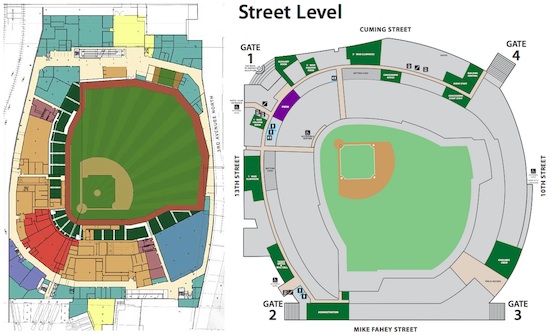
Event/Field level comparison between Target Field (left) and TD Ameritrade Park (right).

Event/Field level comparison between Target Field (left) and TD Ameritrade Park (right).

Last year’s review of Target Field did not include a tour, so I didn’t get to see the bowels of the place. However, schematics of every level were made available two years ago, so I made sure to download them for future comparisons like this one. On the left you can see the different kinds of color coding and walls built throughout the sunken event level. The red-orange area behind the plate is the Diamond Club. The adjacent gold areas are the team clubhouses. With only eight acres to accommodate the Twins, virtually every possible space was used and optimized. On the right is the buildout for TDAP. While it’s not as detailed as the other drawing, it’s a clear indicator that not nearly as much space has been built out down below. Perhaps as little as 50% of the available space underwent a buildout. As a result the clubhouses are much smaller. There is no club lounge behind the plate. The commissary is smaller. And it all makes sense. There’s no need for all of the luxury amenities at a place that’s meant to serve college baseball first and foremost. Or at least you’d like to think so.

Plenty of other differences pop up once you start looking around.

  • Fewer levels – TDAP has three levels plus the press box on top. Target has six levels and is much taller, which translates to more than double the amount of concrete and construction work.
  • The missing 8-15,000 seats – To properly add permanent seating, a third deck or significant expansion of the existing decks would be required. That means more concrete and structural steel, more $$$.
  • Scoreboard/Video board – The video board is just slightly larger than the new auxiliary board installed at Target Field over the winter, and one-third the size of the main board. The scoreboard is a refreshingly retro line score job, no frills.
  • Electronic signage – There is no ribbon board or other signage along the upper deck facing, which gives TDAP a very clean appearance.
  • Fewer amenities – No multiple clubs or restaurants, team stores, or team offices. The one club lounge is small compared to most at MLB parks.
  • Fewer suites – The 30 suites is fewer than what you’d see at a MLB facility. They’re also not quite as decked out as comparable suites.
  • Simplified circulation – No escalators and few elevators. That knocks off a few million in capital and maintenance costs right there. There isn’t even a complex network of ramps and stairs.
  • Little flex space – There’s no need to build additional space that could be used to rent out as Omaha has its arena (Qwest Center) and the adjacent convention center across the parking lot from the ballpark.

All the stuff listed above adds cost, and in a manner closer to exponential than proportional. It’s unfortunate, but that’s the price to play in the majors. It’s possible to design a ballpark so that it’s less complex, which is what 360 has been doing. Value engineering also comes into play, though at varying degrees and at different times depending on the budget situation. Could the A’s build a ballpark on the cheap? Sure. That said, once you start ratcheting down you get into dangerous territory. Wolff has already received criticism for downsizing the Earthquakes stadium vision. The last thing he’d want to do is recreate the experience of ARCO Arena, which was built on the cheap. The cheapness would become evident quickly, and it may have done the Kings in as a result. As the definition of a “major league” venue has only grown in cost and complexity over time, so has the gap between good enough and great.

For a level-by-level overview of TD Ameritrade Park, check out this interactive Flash graphic from the Omaha World-Herald.

Dodgers now under MLB control

Brief, terse press release from Commissioner Selig today regarding the Dodgers.

“Pursuant to my authority as Commissioner, I informed Los Angeles Dodgers owner Frank McCourt today that I will appoint a representative to oversee all aspects of the business and the day-to-day operations of the Club. I have taken this action because of my deep concerns regarding the finances and operations of the Dodgers and to protect the best interests of the Club, its great fans and all of Major League Baseball. My office will continue its thorough investigation into the operations and finances of the Dodgers and related entities during the period of Mr. McCourt’s ownership. I will announce the name of my representative in the next several days.

“The Dodgers have been one of the most prestigious franchises in all of sports, and we owe it to their legion of loyal fans to ensure that this club is being operated properly now and will be guided appropriately in the future.”

The big clue that this was happening was that Selig rejected a $200 million loan and a new TV deal between Fox and the Dodgers. Fox sent McCourt a smaller $30 million loan last week just to cover payroll, which may have been the last straw. The last thing Selig and the other owners want to see is for the Dodgers to hit such a debt level that it negatively affects bidding on the team. This didn’t hurt the Rangers when Tom Hicks put the team in a similar position, but still, at some point enough is enough. Apart from the messy process of legally extricating the Dodgers from the McCourts, the team is still one of the most valuable in baseball and should attract numerous bidders, none of whom are likely to be Lew Wolff.

A’s, City of Phoenix agree to extend Spring Training lease, improvements

The Arizona Republic is reporting that the City of Phoenix City Council is set to improvement a lease extension for the A’s at Phoenix Municipal Stadium and Papago Park. The lease will run $425,000 per year to the A’s through 2025. They’ll also pay $50,000 per year into a capital improvements account. Most of the improvements would be at the Papago Park training facility, not Muni.

(A’s director of minor league operations Ted) Polakowski said the improvements are needed not so much at the stadium, which will require ongoing maintenance, but at the training facility. The team is outgrowing the current indoor space, he said, and the parking lot is getting tight. The A’s would like additional clubhouse space for its minor-league operations.

Maybe they’ll build Rich Harden a shed where he can stay during his eternal rehab, amirite?

Total cost of the improvements is slated to be in the $8-10 million range. That’s a far cry from the $30 million that Lew Wolff was looking for, and much, much less than the $100 million spent for the Salt River Fields project. From the sound of things, both Wolff and Phoenix were driven by new fiscal realities. Phoenix was willing to help, but it wasn’t going to make major sacrifices to do it. Wolff probably saw how Salt River’s opening sucked the life out of the competing complexes in the Cactus League, and figured that any really expensive improvements to Muni short of a brand new complex would’ve been futile. At least they don’t have to share.

The piece ends on this note:

Robert Johnson, a political consultant who helped in the campaign for the Cubs facility, said Phoenix should jump on the A’s offer.

“It makes a lot of sense,” he said.

The interim agreement contains language allowing either party to pull out of the agreement with two years’ notice, but Harman does not anticipate that becoming an issue.

“The A’s have been a great partner for us,” he said, “and they are committed to staying in Phoenix.”

In Oakland, someone’s ears are burning. BTW, it would cost $10 million just to fix all of the plumbing problems at the Coliseum.

The great news is that just like before, you’ll be able to fly into PHX in the morning, take the free shuttle and then light rail ($3.50 round trip) to Priest Drive and walk right in. It’s so convenient, one reader and frequent commenter here was able to do this and catch a game during a layover a month ago. How’s that for convenient?