The Miner and the Bomb

I have had the opportunity to talk to a few folks from Oakland over the past week about ballpark related items. It all started when I got a message to my facebook account that said something like, “There is a site in Oakland that no one is talking about.”

I made a few phone calls, spoke with a few folks (very excellent, forthcoming people who shall remain nameless as I have promised) with varying degrees of information and I came away with one conclusion. Oakland is playing Stratego while Oakland Boosters think they are playing chess.

Oakland’s strategy has three main points:

  1. Wait out MLB. Obstruct and keep from having a decision on TR’s made in San Jose’s favor.
  2. When Lew Wolff grows tired of waiting/TR’s are reaffirmed, recruit Larry Ellison to buy the team.
  3. Pledge public funds for a ballpark at Victory Court.

I know, I know. I teased you all with a “plan,” implying specific tactics, and came back with a high level “strategy.” Let’s delve into each of the points above a bit, shall we?

Territorial Rights Affirmation

To a man, everyone with knowledge I talked to said, “There is no way MLB will let the A’s into San Jose.” Almost that direct quote, almost like it was being read off a card.

“Why?”

The answer? Various versions of, “because the Giants owners told us so.” The main argument is that San Francisco floated bonds to fund 5% of AT&T Park based on the Giants existing territory (As Dennis Herrera said when threatening a law suit). They claimed there was a contract between MLB and San Francisco. I can only assume they are referring to the letter from former National League President, Leonard Coleman, sent in 1997. That is what Herrera referred to in his shot across the bow (PDF).

Recruit Ellison

I’ll be honest, this one baffles me. From what I can tell… the idea hasn’t been broached with Larry Ellison. It is an assumption that has been made by those who want a new owner. Larry Ellison wanted to buy the Warriors and lost out. The Warriors are in Oakland. Therefore, Larry Ellison wants a professional sports team based in Oakland.

It sounds crazy. The thing is, multiple people told me that Ellison is the guy that Oakland will try to persuade to buy the team. They didn’t say, “We will find a new local owner.” They said, “We will try to get Larry Ellison to buy the team.”

I am not sure if they realize Ellison also tried to buy the Seattle Sonics and move them to San Jose, before he tried to buy the Warriors. I am not sure if that is important.

As you can probably tell, this part seems really unrealistic to me. But what do I know?

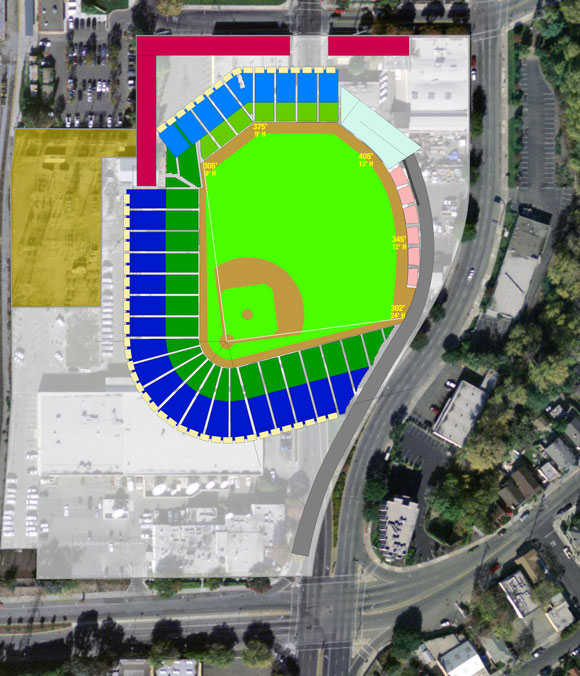
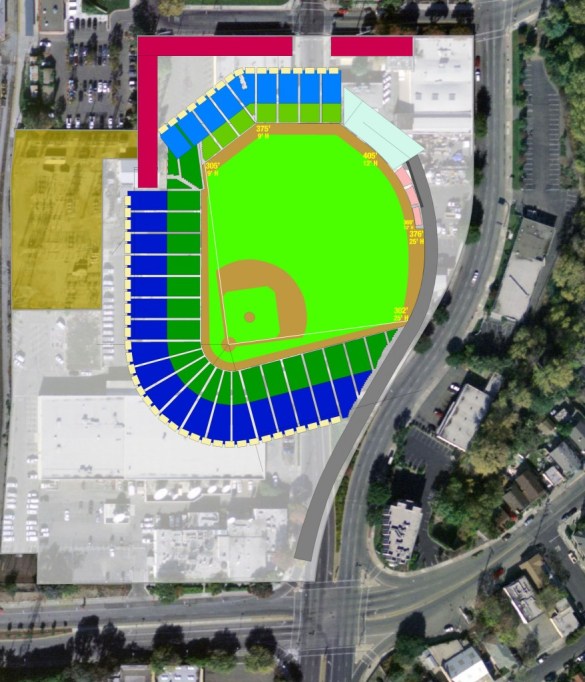
Victory Court

We have all assumed this already, right? Victory Court is the site that Oakland refuses to confirm as the site. There are some challenges though, and I wonder if avoiding a spotlight on said challenges is the real reason for all the subterfuge.

Newballpark.org has obtained a series of letters from nearby neighborhood associations, most notably the Jack London District Association, urging the City of Oakland to consider an alternative to the alternatives presented to MLB. Here are the reasons as stated in the letter:

It is far too soon to actually endorse this plan vs. any other option, but the preliminary assessment is that it would create far less disruption to existing businesses and residents and create an environmentally preferable commute for many of the workers at the facility, who could walk from their West Oakland and downtown homes. In addition, there would be far fewer environmental mitigation issues, compared to the frequently toxic environmental conditions in much of the Port and Jack London District Areas. This new site proposal also has the advantage of requiring far less land acquisition, reducing cost and potential litigation, when compared to other suggested sites.

Those near Victory Court are concerned with a one thing in particular, in addition to those called out in the paragraph above. Traffic.

Even with BART about a quarter of a mile away, most folks will come to baseball games via automobile. Should only half of all spectators come by car there will be thousands of cars that aren’t normally there. The freeway infrastructure around Victory Court, and the surface streets in the area are not set up to handle a great deal of cars. There are basically two approaches, one coming West on Oak Street, which requires use of an off ramp with a sharp 90 degree turn. Or, coming up from the South on Embarcadero, which requires crossing train tracks. The combination of an inadequate off ramp and trains, that frequently pass through the area, have the potential to create a huge traffic nightmare. How huge? We won’t know until someone way smarter than me does a real traffic study for an EIR.

If my sources are correct, and I believe them, MLB has told Oakland that it will come up with a loan of about $150M for a ballpark in the city, if it is in the right place. That would leave Oakland CEDA on the hook for an estimated $150M for property acquisition, business relocation and environmental remediation. There is another $400M to be found somewhere in this calculus.

I am told, that some portion of this money is expected to come from City issued Bonds. Raiders, anyone?

In Summary

When I used to love to play Stratego, my favorite part was figuring out where to set my bombs and using my miners to defuse my opponents bombs. It was a slow, and painful progression at times. Sometimes, it worked and I captured the opponents flag. Sometimes it didn’t and before I defused enough bombs they had my flag. It seems to me that the City of Oakland is doing something similar. Lying in wait, watching the progress of San Jose from afar and banking on too many bombs blowing up in their path. Leaving Oakland with the only clear path to the flag. Is it a good strategy? I guess time will tell, but I can think of a better one.

This started with someone reaching out to me about a different potential site in Oakland, didn’t it? And didn’t the letter from JLDA above mention an alternative to consider?

Those are one in the same. Stay tuned….
KTRB lays off staff

According to the inimitable Rich Lieberman, KTRB just laid off its staff, leaving behind only A’s baseball, Chris Townsend’s pre and postgame shows, and Michael Savage. Head on over to AN for discussion. Who will the next station owner be? More to come.

Update 10:00 PM – According to Carl Steward, Savage has also been dropped.The station has gone into receivership, and the bank will continue to honor existing contracts with the A’s and Stanford football. Chris Townsend will become an employee of the A’s, not the radio station.

Update 9/11 11:08 PM – Susan Slusser is reporting that the auction price may be lower than that fetched via a private sale, which could make KTRB an enticing opportunity for the team to jump in and buy the station. Let’s cross our fingers, shall we?

Reaction to the SVLG letter

Before we get started, our thoughts and prayers go out to the victims of the San Bruno Crestmoor fire. I have relatives that live on the other side of the fire from 280, and they’re okay. Those affected were not so fortunate.

A few articles have come out in the last 24 hours since the soft pitch to Selig.

I’m in agreement with Ratto on the “MLB won’t be rushed” argument, but I’m not with him on how San Jose needs to show money and shovels. The City has already laid out its process for Selig. It acquired half the site, had the vote lined up for November, which would authorize eminent domain for the rest if negotiations got to that point. But Selig asked for a delay, which means that MLB is the party that needs to get its ducks in a row, not City.

Furthermore, Ratto is one of the few Bay Area writers who believes that the T-rights negotiation is a relatively trivial matter:

Oh, and whole you’re not wondering about that blue-ribbon committee, stop wondering about territorial rights, too. Territorial rights were, are, and will be a simple negotiation about how sizable a bribe the Giants will need to shut up. And if the Giants want to get cranky about it when the other owners are ready to move the A’s, they can be de-legged with a simple 29-1 vote. You know, the kind Bud specializes in at big moments like this.

While I think that a vote will probably come out 29-1 or 30-0, it’s getting to that point that’s the hard part. If, as Ratto argues, City and the A’s need to show more money and shovels, there’s a problem. A company like Cisco has already stated what it’s willing to do. Does Selig want to risk losing Cisco to the 49ers, who’d love to poach them for their own naming rights deal? By including the A’s in SVLG, they’ve created a sort of corporate solidarity. It’s up to Selig. The more he draws this out, the more he risks pissing off SVLG and its members. If he wants their business, it’s as much up to him as it is them, an argument from the letter that was made in an oh-so-subtle manner.

Update 9/13 11:00 PM: The CEO’s of SunPower and Brocade have reinforced the SVLG letter with their own opinion piece in the Merc.

SVLG makes plea to Selig

It’s best that I just post the contents of the letter sent by SVLG to Commissioner Selig today (Merc article), so without further ado…

September 8, 2010

The Office of the Commissioner of Baseball
Allan H. (Bud) Selig, Commissioner
245 Park Avenue, 31st Floor
New York, NY, 10167

Dear Commissioner Selig,

The Silicon Valley Leadership Group strongly supports a new home for the Athletics baseball team in downtown San Jose. We were encouraged to learn of San Jose Mayor Chuck Reed’s positive conversation with Major League Baseball President Bob Dupuy regarding the timing of a possible election next spring should the A’s be granted approval to pursue the construction of a baseball-only state of the art Ballpark in downtown San Jose.

By way of background, the Silicon Valley Leadership Group was founded in 1977 by David Packard and has grown to become the largest organization of its kind in Silicon Valley with more than 300 member companies. Combined member companies employ more than 250,000 local workers – nearly one of every three jobs – and generate more than $2 trillion worth in global revenue.

We, the undersigned CEOs and senior executives, are committed to bringing jobs, revenue, a rich culture, and a thriving business climate to Silicon Valley. We believe that an intimate state of the art ballpark located on a prime downtown San Jose parcel, close to mass transit and major highways will be a catalyst for economic development in our region. We also believe downtown San Jose offers a compelling location for the advancement of Major League Baseball in the 21st Century. Silicon Valley is well known throughout the world as the cradle of innovation and the leading incubator of new ideas and new possibilities for human kind. There is no better location than San Jose, located in the heart of Silicon Valley, to advance the Major League Baseball brand on a global basis.

San Jose is a world-class community, and the ballpark proposal not only secures a quality Major League Baseball team for America’s 10th largest city, but also creates jobs, strengthens our economy and enhances the cultural opportunities for our workers and their families. According to an economic study commissioned by the City of San Jose, a new ballpark will generate thousands of construction jobs and permanent positions at the ballpark and surrounding area.

The Silicon Valley Leadership Group, along with other respected and diverse organizations, stands ready to offer any support needed to move this important project forward. The Silicon Valley Leadership Group is comprised of both devoted A’s and Giants fans and we will continue to enthusiastically support both teams. We strongly believe that both teams will thrive in a vibrant two team market anchored by San Francisco and the Bay Area’s largest city, San Jose. Today, the Bay Area is the only two team market in Major League Baseball where the teams don’t fully share their common geographic territory. The divided territory was imposed at the request of San Jose baseball boosters in 1992 in a previous attempt to secure a Major League Baseball team. We can only hope moving forward that the Bay Area can be restored to a shared marketplace for the two teams in a manner similar to Chicago, Los Angeles and New York.

It is integral to our mission that we support and promote opportunities to improve the quality of life for families who live and work in Silicon Valley. A new A’s ballpark will provide a great entertainment and community asset that will capture the essence of Silicon Valley. It will be a tremendous benefit to our region, with a wide appeal that can help to promote Silicon Valley – and Major League Baseball – on a national and international level. The new venue will be a great source of pride for our innovative region, and deserves your consideration and approval to move forward.

Please call on us to help make this decades old dream to attract a Major League Baseball team to Silicon Valley a reality in the near future.

John Chambers
CEO, Cisco Inc.

Carol Bartz
CEO, Yahoo!

Tom Werner
CEO, SunPower

John Donahoe
CEO, eBay

Mike Klayko
CEO, Brocade Inc.

John Doerr
Partner, Kleiner Perkins

Carl Guardino
CEO, Silicon Valley Leadership Group

Shantanu Narayen
CEO, Adobe

Other signatories include Lew Wolff, former mayor Ron Gonzales, the publisher of Silicon Valley/San Jose Business Journal, the presidents of Santa Clara University, UC Santa Cruz and Foothill-De Anza Community College District, the CEO of Palo Alto Medical Foundation, and the head of Goodwill Silicon Valley, who happened to be head of the Valley’s largest beverage distributor a couple years ago. Just about everyone else on the second page is either the head of a tech firm or a bank. Including the main heavy hitters, that’s 75 companies and organizations, and the vast majority of them are not small businesses.

The crux of the letter is the request to share the Bay Area the same way New York, Los Angeles, and Chicago are shared. My guess is that this won’t happen because of certain long term implications. Unlike those other three markets, the Bay Area is uniquely set up for a game of franchise musical chairs once any lease ends and a team wants a new stadium. The others aren’t. If a T-rights compromise were to occur, the definitions would look much more like Washington-Baltimore just because of the decades of history there (and here) that can’t be easily wiped away. That said, the letter’s soft pitch does have one statement that has some hidden teeth.

We strongly believe that both teams will thrive in a vibrant two team market anchored by San Francisco and the Bay Area’s largest city, San Jose.

Something’s missing from that declaration.

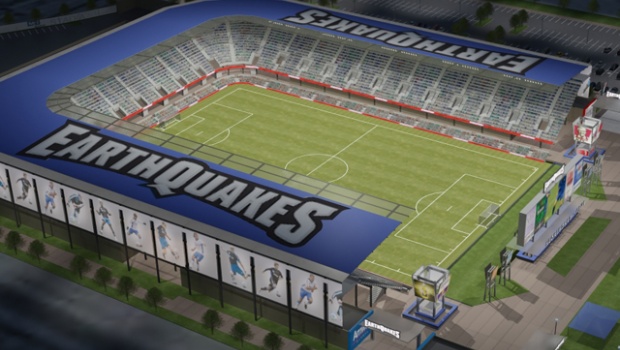
360 Architecture does package deal for A’s & Quakes

A while back, I had postulated that construction of both the A’s and Quakes’ stadia would be done together, sequenced to take advantage of lower combined materials costs and labor. Little did I know back then that this sort of packaging extended to stadium design as well. That’s exactly what has happened as Wolff/Fisher put out a press release revealing the combined effort.

The timing of the release is obviously to capitalize on 360’s involvement as principal for New Meadowlands Stadium, which is due to have its first regular season NFL game next Monday. Print media reviews should be flooding in over the next several days, allowing for further mentions of 360’s past and future projects, the latter of which should include whatever they’re doing in the Bay Area.

Beyond the possible PR mini-coup, I figure that this was also a smoke signal sent up to say, “Hey, we’re still here and we’re working on it.” In fact, they’ve been working on it for a while. While we figured that ownership had 360 on retainer while all the political mess was sorted out for the ballpark, it was expected that Rossetti would be the firm of choice for the soccer stadium, since they had done several others over the past decade. And since the Quakes’ renderings are basically the same ones from last year’s EIR draft, it’s clear the 360 has been working on the Quakes project for some time.

Try as they might, however, this doesn’t mean that MLB is any closer to getting anything done. Even if that were the case, we wouldn’t hear about it until at least November or the winter meetings.

Stadium4

On the technical side, the Quakes’ stadium and the A’s ballpark are a study in contrasts. The Quakes have their club seats at field level, whereas the A’s have theirs at the top of the stadium. The A’s will have luxury suites, the Quakes may not have any to start. The Quakes will have a planned development right next to their stadium. Something like that at Diridon for the A’s is much further down the road, and the A’s may have little to no control over it. The Quakes will have plenty of parking on the premises. The A’s won’t.

I suspect that this is by design. By offering certain amenities in one facility and not in another, they’re inviting the public to experience both in a mix-and-match fashion. If you’re looking at it from the perspective of a corporate seat buyer, you may have the ability to pick from different combinations of accommodations. It would take Jeffrey’s regionality idea and give it a twist, in that it bridges multiple leagues from a selling standpoint, not just business operations. And if the Quakes are still struggling to get corporate sponsors to commit to the Quakes stadium, it would make sense to leverage the A’s ballpark as a valuable selling point in the form of a package sponsorship deal. Combine that with, say, a future investment in the teams by the Sharks’ ownership group (SVSE), and the potential for further integration is huge. Now, I have no idea how the accounting would work with all of that, but we’re talking about an accountant as the managing partner – he probably has a few ideas. If you’re the Giants, this is most certainly something to watch. The Giants would love to be able to grab additional revenue streams by building a new SF arena for the Warriors, and this kind of flexibility has to be part of the game.

Diridon Capacity Estimates

While the Diridon renderings left many wondering about the little details, one major item we had no inkling about was the stadium’s capacity. Only vague mentions of 35,000 or 45,000 have been floated, but only briefly. So I figured that, absent a press release or backing documentation, I’d deconstruct 360’s model to determine the capacity. Keep in mind that this is my interpretation of what I’ve seen, so take it with several grains of salt as it is not gospel.

In doing this, several assumptions were made.

  • Regular seating is normally 19-inch, 20 per row, with 2-4 inches on each side to accommodate standards. Aisles are at least 4 feet wide. A switch to 20-inch seats would reduce capacity.
  • All seats are chairs with backs, no benches.
  • Club seats are at least 24 inches wide with or without side tables, plus drink rails.
  • Although not illustrated, a reduction in seating due to dugout placement is taken into account.
  • ADA requirements nowadays recommend a dispersal of accessible locations, not just behind a section (this is why you see front row accessible sections in many stadia). This is not taken into account. However, I’ve been aggressive about providing ADA locations, so a reduction of seating as part of making such accommodations would be minimal.
  • Bullpens are in center field.
  • The field is sunken 25 feet.
  • There are 40 suites and 40 minisuites. Club seats are up top. A club area in the grandstand behind the plate would reduce capacity slightly.
  • Reduction of seating due to columns has not been calculated. Neither has a number of potential obstructed view seats.
  • The press box has also not been factored in. It could displace up to 400 seats in the balcony.
  • Terminology: Grandstand (lower level from foul line to foul line), Balcony (upper level from foul line to foul line), Outfield reserved (lower level left field), Outfield Balcony (upper level left field), Bleachers (lower level right field)
  • The 1,500 figure for standing room comes from San Francisco’s maximum SRO limit for AT&T Park.

In my previous analysis, I had mentioned that I thought both decks would need more rows to make up for their limited length. To flesh this out, I’ve plotted two models. One has 40 rows in the lower deck and 24 in the upper deck. The other has 40 rows in the lower deck and 20 in the upper deck. In the second model, the last 4 rows have been eliminated in the main balcony level and the outfield balcony as well. The point of this is to illustrate how much of a difference capacity lopping off a few rows makes – in this case, almost 2,300 seats. Update 9/7 2:43 PM: Table updated to include an alternative with only 32,000 seats.

In the comparison, a third model is included. In it, the controversial right field bleachers, which in the 360 concept cut into the playing surface and reduce the RF power alley to a short 345 feet, have been significantly reduced. The result is that nearly 600 seats have been removed, but the alley is now 376 feet, though it quickly becomes 368 thanks to the cut-in of the bleachers.

Below is the original model.

Now here’s the modified version.

One thing mentioned in the comments is the lack of a service entrance to the field for vehicles and such. Since the field is sunken, there isn’t a way to incorporate a simple access ramp from right field. If the design moves forward, I would expect an entrance to be placed in the LF corner, where the multi-angle seating is situated. That would create a loss of up to 150 seats, but it would be space efficient and would allow for access from either the north (San Fernando Street) or south (Park Avenue) via the event level (field) service tunnel.

Note about the field dimensions: the original model’s quasi-rectangular shape (compared to a regular baseball field) would appear to be appropriate for fitting a soccer or football field. Unfortunately, the LF corner would cut into any such field layout, and the seats in the LF corner are terribly angled for either sport. Basically, this can be considered a baseball-only park.

Last item: the field dimensions show a 25-foot height in RF. However, this may actually be much higher if the home run lines are to be believed. The wall could be as much as 40 feet high, which would make it higher than both Fenway’s Green Monster and a similar, slightly taller wall called Arch Nemesis at Sovereign Bank Stadium in York, PA.

So, are you surprised by the capacities? What other questions or comments do you have?

Good Reading 9/1

Good ballpark articles this week, everyone.

  • Baseballparks.com (Joe Mock) just named their Ballpark of the Year for 2010. And the winner is… BB&T Ballpark in Winston-Salem, NC. What/where/why? you ask? Read the review and the press release (PDF). And note that one of the firms involved was none other than 360 Architecture. BB&T Ballpark won out over Target Field and several other minor league parks. Mock tends to like the retro look, so you may feel different. In any case, both are worth a read. Update: In a previous thread, craiger [hat tip] mentioned that 2009 award winner (and 360 project) Huntington Park in Columbus, OH, has a RF colonnade reminiscent of what has been conceived for Diridon. Take a good look at this pic and ask yourself if you want the brick façade treatment on the exterior, the unadorned columns on the interior, or something in between? It should also be pointed out that the ballpark is a companion piece to another 360 project, Nationwide Arena.
  • The Braves are good, but the crowds aren’t. Where’s John Rocker when you need him?
  • SI writer and Minnesota boy Steve Rushin waxes much more poetically than me on Target Field.
  • Eminem and Jay-Z are doing a sort of home-and-home, hip hop, ballpark concert series at Comerica Park (this coming weekend) and Yankee Stadium (the following weekend). B.o.B. opens.
  • Among the revelations at the McCourt divorce proceedings: Frank McCourt planned to slash the Dodgers’ payroll in 2006 to $85 million to stem losses. Dodger Divorce has more. (Here’s an idea, Selig: let Mark Cuban and some big money people buy the Dodgers. Just a suggestion. Then we’ll have the wonderful symmetry of David Boies, who is representing Jamie McCourt, destroy Frank, forcing him to sell to Cuban and Co., who take over the Dodgers and go on to destroy Bill Neukom’s Giants. Dee-licious.)
  • Escondido continues to figure out whether or not bringing the Padres AAA franchise in would be worth it.
  • Speaking of the Pads – they want no part of a soccer match at Petco during a pennant race. I’m sure that Larry Baer won’t regret the Cal Bears playing at AT&T next year, especially if the Giants continue to bring in defensive liabilities to play the outfield.
  • Rosenblatt Stadium says goodbye tomorrow.

You’re welcome. I feel like Trey Kerby all of a sudden.

Postseason Ticket Prices

Yesterday I got an envelope in the mail from the A’s regarding postseason tickets. As fans in the 2000’s, we got used to getting a bit of price gouging, with bleacher seats often going for as much as $35. Imagine my surprise, then, when I took a look at the pricing table and saw no change from existing season ticket prices. Keep in mind that the season ticket prices listed below are for non-premium games. Shocking, really.

Parking for all 10 games is $191. Broken down by round, that’s $17 per game for the ALDS and $20 per game for the ALCS and World Series.

A couple of conditions:

  • Deadline is September 15 to pay for tickets
  • If you buy a full game strip, credit for unplayed games can either be applied to 2011 season tickets or refunded. Those buying less than full strips must accept credit towards 2011 season tickets.

Would the pricing strategy be different if the A’s were in first place, instead of 8.5 games out as September begins? Who knows? Whatever the motivation, this is a great gesture towards fans.

It’s That Time Again

Bill King is the greatest broadcaster I have ever listened to. The National Baseball Hall of Fame gives out an award to the best of the best every year and fan voting (to add 3 candidates to an eventual list of 10 that past Ford C. Frick Award winners and a specially appointed panel will use to select the next winner) begins on facebook tomorrow.

It stuns me that we still have to push for him to be posthumously honored with the Ford C. Frick Award. But we do. And we should. I can’t believe the A’s aren’t and haven’t. On this, all of us should agree: Bill King deserves this recognition.

This article says the we can “influence” the outcome. I sort of chuckle and roll my eyes at that. We have made Bill the top fan vote earner on multiple occasions and a lot of good that did us. We need to crash the gates people. My plea to all of you:

  • If you don’t have a facebook account, please get one. You can delete it after the month. All fan voting will be conducted on the National Baseball Hall of Fame and Museum’s facebook profile. You can even friend me!
  • Everyday when you vote, post a facebook status that says “I voted for Bill King for the Ford C. Frick Award and you should to.” Or something.
  • Rinse and repeat daily, starting tomorrow and concluding the last day of September.

We fight all the time on this here blog about where the A’s should play. I think we all agree that Bill King deserves this recognition. Let’s unite and form some kind of Voltron thing and make the Hall of Fame’s appointed panel pick him.

And one last reminder of how awesome Bill King is, was and always will be (at about 1:39 in the below video, full disclosure I wrote the song, recorded it and made the crappy video):

Go A’s, Go Bill and thanks for listening to my rant.

Target Plaza

I’ve gotten a lot of questions about my glowing comments about Target Plaza. At the Diridon walking tour yesterday, Dennis Korabiak asked those in the crowd who, if anyone, had visited Target Field to experience it first-hand. I was the only person who raised his/her hand. Korabiak immediately shot back, “Ours will be better!” Now that’s a bold statement, and pretty hard to back up given how good Target Plaza is. Since it’s so new and hard to visualize (and I felt I hadn’t done it justice), I figured I’d devote a post to what the Plaza looks like.

First up, here’s a very shaky cell phone cam of the walk from downtown to Target Field through the plaza. I don’t blame you if you get sick watching it, that’s why I didn’t put it in the original Target Field post in the first place.

Now for some pics. First up, a view from 6th Street North and Hennepin Avenue, where you get a glimpse of the stadium down the street.

As you get closer, layers of the ballpark begin to reveal themselves. A view from street level:

And then a view from the Skyway:

Near Gate 34 is a cute, friendly monument honoring all of the various Gold Glove winners throughout the Twins’ existence (I just noticed the use of “Golden Glove”):

Now, a view back towards the city from near that spot:

And if you want an interesting before/after look, head on over to Google Maps and fire up the street view. While the Plaza is not in any Street View update yet (get on yer bikes, Google!), you can see the area transformation at two intersections, 7th St N/2nd Ave N and 5th St N/3rd Av N. Click on those, get your bearings, then move north along the map ever so slightly and – presto! – baseball magic. You can also do the same at 6th St N/2nd Ave N to see how 6th St gets split up vertically – upper level for pedestrians to the Plaza, and lower level for vehicles.

The challenge in doing this in either Oakland or San Jose is the presence of a large elevated freeway (880 and 87, respectively). In both cases, the great reveal can’t happen until after fans pass the freeway. Stadium lights will act as a beacon, so that helps a little. In Minneapolis, the freeway spur I-394 runs underneath and terminates next to the ballpark.