What to Build? Part 1

Today we are starting a series! Instead of talking about the stuff that goes on around the park, it is my assignment to cover what goes on inside of it. Regardless of where a stadium may one day be constructed, the design of the stadium will have a real impact on the game.

You can go and read stories from back in the 90’s, you can read them from a few years ago, or you can read them in the past few weeks. Whenever a GM is asked “What do you want to see in a new ballpark?” they will give a similarly worded answer that say, “As long as it plays fair, I am okay with it.”

Hogwash! What is the point of having a home field if you have no advantage? What sport gives you more of a home field advantage than the only one with different playing field dimensions depending on where you are playing?

So, for the first installment, let’s tackle Home Runs.

“All this land is mine for as far as this ball shall travel!”

Who remembers this being shouted on Sportscenter? My personal favorite was the time I heard Craig Kilborn (I think?) say, “And Giambi says, ‘mecca lecca hi mecca hiney ho!’ to that one.”

While Home Runs inspire some irreverent banter on highlight shows, their impact on the game is much bigger than that. There are many angels we can look into here but I am going to focus on two interrelated concepts. Signing free agents and building teams that win games.

First, let’s start with a non A’s related factoid. As Marine Layer once semipredicted- Citi Field hath wrought havoc upon David Wright! Look at the precipitous drop in his slugging percentage… That sucking noise is future millions disappearing from David Wright’s future bank account.

And this brings me to my first point… What do Jason Bay and Adam LaRoche have in common? I’d say agents who understand park effects… except Bay’s let him sign with the Mets. Of course, Bay doesn’t have to worry about his future millions, so much, when he is getting 80 of them now. That’s right people… Randy Johnson came to SF because he believed it was a great place to pitch while two above average hitters decided they wouldn’t listen (in Bay’s case) or would turn down a metric tonne of cash (in LaRoche’s case) rather than to spend a summer in the coldest winter of San Francisco.

Or, more succinctly… Free agent hitters will come to a new Bay Area ballpark if there is a place they can hit home runs and get paid ridiculous amounts of coin. Free Agent pitchers on the other hand…

The next question is, on behalf of those free agent pitchers, “Are these park factors real or are they the result of the team that plays in the stadium?” It sounds dumb, right? Of course some parks are easier to hit in and others are easier to pitch in. Right?

In the sabermetric community, Park Factors, are used to normalize performance. The argument goes that, since Kevin Kouzmanoff played half his games in Hades for hitters (Petco Park has a PF of .721 for yard balls hit in 2009) than his 720 OPS is actually more like 800. Or, actually, if the park has a PF below 1.000 than it is harder to hit bombs than if it has a number above 1.000. For the record, in 2009, Petco was the worst with .721 while the next closest was Cleveland with a .838. These Park Factor numbers are published for offensive categories including Runs, HR’s, 2B’s, 3B’s, Hits and Walks.

Let’s check out Oakland, using the rate of runs scored as a barometer,  just to prove the point (all park factor numbers from espn.com, barf):

  • 2001- 1.357
  • 2002- .703
  • 2003- .515
  • 2004- 1.012
  • 2005- 1.061
  • 2006- .921
  • 2007- .833
  • 2008- .916
  • 2009- .974

Well… ugh. How the heck did the park move all over the place if the park is what drives the numbers? Or, is it that a team can be built to accentuate a given park’s factors? Or is it both?

When I think of teams built for the park in which they play, off the top of my head, I think of the Colorado Rockies in the mid 90’s. Also known as the Blake Street Bombers. That team always felt like a team that was built on the premise that, if slow pitch softball games are going to be played in the big leagues we might as well build the best slow pitch softball team possible. Or, if our park is suited to home runs, let’s get a bunch of dudes who can swing from their heels. Come to think of it… that isn’t all that different then the A’s in 2001.

But to cut to the chase on this team building thing… If I had a vote I would ask that the stadium be built with a short porch in left field, a plus 400 foot center field and an average right field. Then, I would get right handed sluggers (and borderline sluggers) to come play in my new digs. I would overpay for ground ball pitchers and a good defensive infield. It is a fool proof plan, says I.

While everyone else is chasing the left handed sluggers, like Johnny Damon, and I get the right handed bats all to myself. The pitchers will want to come where they will get run support and the punch and judy middle infielders will want a ring. I feel like a Doctor Evil pinky pose is in order.

What’s the worst that could happen? Like Rafael Furcal would turn down my offer (that is clearly superior to the Dodgers’ offer) or something.

What do you guys think? Do you want to see a Home Run hitter’s paradise?
2007: The lost season

Judging from the lack of feedback, I take it that most of you haven’t read, let alone downloaded, the Fremont conceptual approach documents. That’s okay, it’s my (second) job to parse through that. If you had the wherewithal to go through the appendices, you would’ve found a hidden gem that explains a ton about where A’s fans come from and how they perform in terms of buying tickets on a per city basis. To help foster conversation on that, I’ve taken the six key pages from the appendices and made them available here.

Before we start the debate, let’s set the table. While we remember 2006 fondly – at least until the ALCS – 2007 rarely gets a mention anymore. That season is remembered for being the start of the current decline and rebuilding phase, but that wasn’t the intention going into Opening Day. Consider the following:

  • Opening Day payroll was $79 million
  • The only major free agent loss was Frank Thomas, who signed a severely overpriced 2 year, $18 million deal with Toronto only to underperform, get waived and subsequently re-signed by the A’s in 2008. Thomas was initially replaced by Eric Karros, who also failed to achieve a career rebirth. gojohn10 reminded me that the A’s lost Barry Zito. All of the KNBR bashing probably devalued him in my mind.
  • Beane/Forst signed Alan Embree and Shannon Stewart – all excellent, productive, low cost moves.
  • It was the first – and most promising – year of Jack Cust, who ended up being a left-handed hitting, poor-man’s version of the Big Hurt.
  • Milton Bradley wore out his welcome.
  • Once again, injuries sunk the team. This time it was the expected high risk players: Eric Chavez (snakebit), Rich Harden (fragile), Mark Kotsay (old), and Bradley.
  • The team hovered around the .500 mark for the first two months, then made a brief surge until the end of interleague play when injuries finally caught up to and ravaged the roster.
  • The selloff began with Bradley in June, followed by Jason Kendall in July.

Got that? 2007 began as a season in which the A’s were expected to contend for the division crown and perhaps make the WS if the roster stayed healthy. Unfortunately that didn’t happen, so the usual selloff-for-prospects began as it does in every season the A’s aren’t competitive. At that point, the A’s farm system was bereft of big prospects, causing the front office to unload Dan Haren and Nick Swisher the following offseason.

Now, you might expect that a team coming off an appearance in the LCS, with the highest payroll in its history, would have seen measurable gains at the gate. It didn’t. It was the second year of tarping, which drove total attendance lower while the experiment in scarcity failed to bear fruit. Just so we’re clear on how this manifested itself, take a look at attendance at the opening series against the White Sox:

  • 4/8 (Opening Night): 35,077
  • 4/9: 15,153
  • 4/10 (BART Double Play Wednesday): 19,130

That was followed by three straight sellouts with the Yankees, then 20k and 17k for a short two-game series with LAAoA. The most damning figure comes straight from the spreadsheet.

  • 2007 season attendance: 1,921,844
  • 2007 local credit card sales: 1,013,977

Keep in mind that credit card sales could mean advance tickets or gameday/walkup tickets paid for by credit card. Around the time the Wolff/Fisher group took control, they got rid of those kiosks on the BART plaza and outside the lower gates which sold preprinted cheap tickets for cash. A primary motivation must have been reduced staffing. Beyond that, I’m certain that ownership wanted to obtain further information on how tickets were being purchased, so driving walkup fans to the box office probably helped in that regard. We can infer from this figure that tickets purchased hours/days/weeks/months ahead of first pitch were some amount lower than 1 million.

That said, selling just over 1 million advance tickets (less than 53%) to your core audience is PISS POOR. Sure, the A’s raised ticket prices 8.1% that year, but that’s to be expected coming off a division crown, ALDS win, and an appearance in the ALCS. If you want to look for Exhibit A for the MLB panel, that’s it. The Giants have most certainly sold far more than 2 million local advance tickets every season since they moved to China Basin, and there are plenty of teams for whom 3 million advance tickets was more than a mere aspirational goal.

I can’t count the number of times I’ve sat in the bleachers with no one in the eight immediately adjacent seats around me. Yes, it was April or May, and it was either Monday or Tuesday, with the marine layer dropping the temperature to the low 50’s. And yes, I’m partly responsible for that low number since I often bought walkup tickets with cash (not so this year, I got a fielder’s choice plan and will buy group tickets in advance). But really, given the on-field success the A’s showed in 2006, we as a fanbase should’ve responded much better the following season. The excuse makers will point to tarping, a lack of marketing, or even the loss of the Big Hurt. The problem goes far beyond that. If there are that many fans all over the Bay Area that would respond to a competitive team, to a higher payroll, 2007 was the time it should’ve happened. It didn’t for whatever reason. It bugs me to this day.

I’m writing this post not to get an answer, because I don’t know if I’ll get one that’s satisfactory. Instead it’s mostly therapeutic. I’m tired of wondering about it, and hopefully posting this will allow me to let it go. We now know that attendance and sales for the past several years is a key piece of evidence for the panel, and it will contribute heavily to the panel’s recommendation. The thing is that we as fans could’ve done better. We should’ve done better. If the A’s leave Oakland, we need not look further than that lost season of 2007, what could’ve been. Until a new ballpark is built, we may be due for another 2006-07 cycle, possibly in 2-3 years. For the have-nots like the A’s, the window for contention is fleeting. It has to be planned diligently by Billy and David. The hardcore fans can do their part by recognizing this. If you only want to be a fan on your terms (only going when ownership respects Oakland and pays for a competitive team), in the end you will lose. It’s one thing to argue about X percentage of the team’s sales come from city Y, but what if those sales aren’t good enough? That, I think, is the real problem, and the future of the franchise is at stake.

Cold bucket news

This ain’t the hot stove league, folks.

Owners’ meetings are scheduled to start tomorrow in the desert. While much of the focus will be on-field, an important matter may also be covered:

A committee established by Selig last year to find a new home for the Oakland A’s should be close to offering its recommendations. A’s owner Lew Wolff wants to relocate to San Jose. The Giants claim that city as part of their territory. In 2005, Selig helped broker the deal that moved the Expos from Montreal to Washington. Orioles owner Peter Angelos said the nation’s capital was part of Baltimore’s extended territory. San Jose is the 10th-largest city in the country and third population-wise in California behind Los Angeles and San Diego. So there’s a lot at stake.

Coupled with Buster Olney’s musings over the weekend, it sounds like this is all coming to a head soon.

An audit to get the final cost of Petco Park was just completed and presented to San Diego’s City Council.

The Marlins made a pledge to increase payroll in anticipation of their new stadium, could amount to MLB’s first salary floor – if the Marlins follow through on their promise to MLBPA.

The Twins moved into Target Field 28 months after construction began and 3 months before opening day.

Finally, the 49ers downsized former A’s exec Andy Dolich today, eliminating his COO position. The 49ers will be on the hunt for a chief marketing officer whose job it will be to pursue corporate sponsorships.

Liveblog from Fremont Study Session 1/12

Just got here. Jeffrey and gojohn10 are present. Not quite Packed house, plenty of supporters and opposition on hand. All hands on deck from Council and City Staff.

Mayor Wasserman just mentioned that because this is a study session, there is nothing to vote on tonight.

City Manager Diaz said that a sports consultant, Dan Barrett of Barrett Sports Group, will speak towards the end. He is giving the intro now focused on the NUMMI closure. Diaz makes clear that Council has not approved or endorsed the “conceptual approach” (plausible deniability?).

Presentation now being given on potential at NUMMI. Emphasis on turning the land around more quickly than other large-scale projects such as closed military bases. A catalyst project, such as a ballpark, could help.

5:17 PM – Dan Barrett now speaks on conceptual approach. “MLB’s timing was such that we needed to get this in.” The panel was looking for communities that could provide land and infrastructure, while the ball team (A’s) would pay for the construction of the stadium. The site (northern part of NUMMI) is clean and would require minimal demolition. The A’s would be responsible for construction and cost overruns (explanation later).

Side note: Barrett Sports Group has worked with the Giants, A’s, Padres, and River Cats.

Parking requirements will be reduced once BART to San Jose opens, allowing for further development opportunities on the land initially assigned for parking.

Siting of ballpark at Grimmer/Fremont was felt to be best for fostering ancillary development.

“We discussed deal terms with the A’s (regarding Pacific Commons) but never got to the point of making the deal.” Now discussing lease terms. The City would have the right to host several events per year. All ballpark operations costs and municipal services are the responsibility of the A’s. The City will have no direct investment in the ballpark.

If City wants to move forward, it should approach County to acquire the land. County or JPA would own the land during the lease, County would own land after lease is terminated. Rent, other project sources, and TIF would be used to finance infrastructure. $300 million in infrastructure has already been made in the area. Additional project-specific infrastructure would be funded using TIF, etc.

Back to Fred Diaz. Diaz reemphasizes that this is not a proposal. Nothing has been decided yet. Now Council will have questions.

Natarajan: What is the difference between a “conceptual approach” and a proposal?
Barrett: We (staff/consultants) did not have the authority to make a proposal. It’s not an approved deal and they (MLB) understand that.
Natarajan: And what was proposed by Oakland?
Barrett: Something along the lines of sites, I don’t know if it was a formal proposal.
Natarajan: Why was the committee looking for proposals?
Barrett: Lew Wolff is looking in San Jose, the committee wanted to see what proposals were made, what happened, why didn’t (deals) happen? Then it moved to “what sites are available?” It wasn’t until NUMMI announced that it was closing the plant, and then in November, that work could begin.
Natarajan: When will a decision be made?
Barrett: We think it’ll be at the end of the month, but we don’t know.

Wieckowski: If we find a new user (auto manufacturer), what is the impact?
Lori Taylor: It depends, there may be room to have the site be declared underutilized.
Diaz: We would have to see what the uses are.
Taylor: There is an undeveloped portion at the south end of the plant which could be used for a new user. A new user’s need for space may differ (from NUMMI).

Jill Keimach: Infrastructure is only available on the outskirts of the project area. The 120 acre site is undeveloped and would require new infrastructure (water, sewer, sidewalks).

Wieckowski: What other catalysts have been identified to energize the site?
Diaz: (joke about Dubai’s indoor skiing facility) Nobody really knows. Sometimes they fall out of the sky. Sometimes a collection of leaders pursue it. It’s hypothetical. We wondered, “What if MLB asked us?”
Wieckowski: What would be our timeline if MLB weren’t interested in the site?
Diaz: It’s in the ether somewhere. If you look at Alameda NAS or Hamilton Airfield or Fort Ord, those have been there a long long time.
Taylor: We plan of submitting an RFP/RFQ to the EPA soon. It could take 6 months, so hopefully by the end of the summer.

Chan: 114 of 120 acres are owned by NUMMI. Who owns the other six?
Keimach: There is a single family home and a construction storage area.
Chan: Would Alameda County weigh in on the financing?
Diaz: There has been no official dialogue with AC yet, but some supervisors have expressed interest in keeping the A’s in the Bay Area.
Barrett: Historically AC has not had any votes regarding deals with the A’s or Raiders.
Chan: What is NUMMI’s opinion?
Diaz: They are aware, they have not expressed approval or disapproval so far.
Chan: What about site cleanup?
Keimach: We’ll do a check and any contamination would be the responsibility of the instigator, just like a gas station. We don’t expect to find contamination at the site.
Chan: How can this be done without impacting the general fund?
Barrett: Property taxes or possessory interest taxes would be used along with rent for the needed infrastructure. The team would also pay traffic impact fees for the additional road construction.

CEQA may not be completed by …?
Keimach: Action would have to be taken by August 1 to get it onto the ballot.

Harrison: What is NUMMI using the 120 acres for now?
Taylor: Much of it is unused and leased for agricultural uses. A large section is used for “vehicle marshaling” (er, parking)
Harrison: There was an HOK study done years ago. Are we back to that spot?
Barrett: Yes we are.
Harrison: Except for BART.
Barrett: Yes, BART is more “real.”

6:13 PM – Mayor points out that the next step will only happen if MLB wants it to happen. If it doesn’t, this will be the beginning and the end. Tonight, there is limited time for public comments until the regular session, so the bulk of public comments will be reserved until the regular session.

Buildup to Tuesday

ESPN’s Buster Olney had an Insider article (subscription required) with a bit of ballpark speculation in it:

Fremont, Calif., is going head-to-head with Oakland in its effort to get the Athletics. Heard this from some sources within major league baseball: The perception within the industry is that if Oakland doesn’t commit to a new ballpark for the Athletics, commissioner Bud Selig will step in and have to negotiate a territorial rights deal between the Giants and the Athletics. And if there is a deal, it will be very, very lucrative for the Giants, given the circumstances, along the lines of the Orioles’ deal to permit the Nationals into Washington.

Over at the Sacramento Bee there’s a profile of Let’s Go Oakland and its leader, Doug Boxer. At the Facebook page, Marty Glick is asking for Oakland business to commit to pony up for suites and advertising.

Fremont’s conceptual plan

Odd terminology Fremont’s using there. It’s not a plan or even a concept, it’s a “conceptual approach.” By being purposely vague, there’s a lot of room for modification, whether it’s brought on by the City Council and Mayor, Alameda County (if it chooses to be involved), or the citizens of Fremont. If you remember from when we first explored the Warm Springs site, most of the land on which a ballpark could be placed is currently undeveloped. NUMMI’s aversion to a ballpark was due to a fear of interruption to its operations, which are supposed to be 24/7. NUMMI was able to control costs by not having a large onsite parts operation, choosing instead to have suppliers ship parts rail and truck in a just-in-time manner so that parts arrived just prior to assembly. In choosing to close NUMMI, Toyota felt that suppliers were often located too far from plant, making transportaion costs higher than they are for other plants. The closure of NUMMI could run in a few directions. Fremont could take no action in the near future and choose not to create a redevelopment plan, in hopes of Toyota reopening the plant at some point or selling to some other interest who might see the plant as a major asset for its own manufacturing operations. That’s not likely as Toyota neither wants to reopen the plant given the aforementioned rationale nor keep it indefinitely and pay nearly $2 million in property tax on dead weight land. Instead, what will probably happen is that Fremont will work with Toyota on a redevelopment plan that could allow for construction on the undeveloped sections while maintaining the plant for manufacturing from other industries. As the parties start doing soil samples on and near the plant, they’ll probably find enough contamination accumulated over several decades to create a brownfield situation. In that case, Toyota will be responsible for the cleanup, though the federal government would be expected to step in and contribute something towards the effort as well. Assuming that the mess isn’t too bad at the ballpark site, it could be primed and ready-to-go in a fairly short period. According to City Manager Fred Diaz, who spearheaded the renewal of the ballpark plan, redevelopment is expected to happen at NUMMI whether or not a ballpark is built. The City has identified $62 million of onsite infrastructure spending and $15 million of offsite infrastructure spending that would have to be done to make the conceptual approach complete.

  • Northwest Parking (next to ballpark) – $16.883,686
  • Rebuilt South Parking (NUMMI vehicles lot) – $21,118,644
  • Pedestrian Promenade (links BART to ballpark) – $12,741,727
  • Frontage and Landscaping (area is barren right now) – $6,950,409
  • Site Utilities Infrastructure (power, sewer) – $4,459,185
  • Fremont/Grimmer intersection expansion – $1,035,000
  • Auto Mall/Grimmer intersection expansion – $350,000
  • Mission/Warm Springs intersection expansion – $350,000
  • Auto Mall/Osgood intersection expansion – $3,450,000
  • Warm Springs Rd/Ct signaling – $380,000
  • Ramp widenings from I-880 & I-680 – $985,000
  • New pedestrian bridge from Warm Springs BART station over tracks – $8.47 million

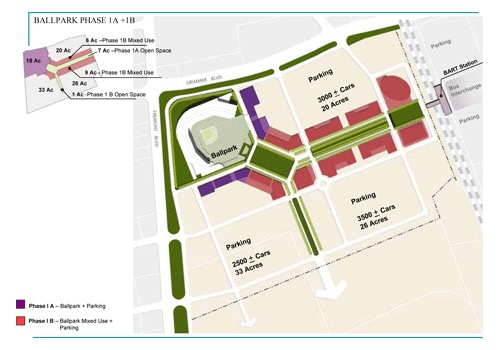
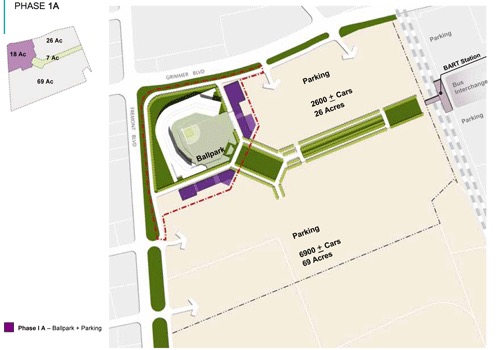
In addition, the City identified other pieces of infrastructure that have been built the last several years that can contribute to the feasibility of a ballpark at NUMMI. The ballpark, if/when completed, would look something like this:

nummi-phase1

The distance along the new pedestrian promenade would be around 1/4 mile. The City expects BART parking on the other side of the station to be used for the ballpark, so the station and bridge would be constructed in a manner that allows for walking through the station without having to enter a paid area. The vision doesn’t end there. The drawing above is considered Phase 1A. Phase 1B would involve the construction “of approximately 920,000 square feet of land and building area devoted to office, retail, and restaurant development along the promenade.” Should that come to fruition, the area would look more like this:

nummi-phase2

Phase 1B is essentially a reshaping of the ballpark village concept. Similar design cues exist, especially that public square beyond centerfield. The Pacific Commons setup was more of a quadrant extending from the ballpark.

ballpark-village-1

Once again, having the A’s in Fremont will come down to an age-old debate among residents over their vision of the city. Is it a sleepy albeit large bedroom community cobbled together from five towns decades ago, or a city that aspires to having more a cosmopolitan feel? Over at the Tri City Beat, a comment by former mayor and ballpark opponent Gus Morrison sums up one side of the debate:

We don’t have much of a night life, but every time, every time, someone brings some fancy idea for a entertainment venue of some kind, it turns into a disaster, sooner or later. People open nice restaurants and we don’t go to them, and they close. We are what we are – a city built for families. We ought to be proud of that. Cities around this country, bigger and smaller than us, envy us. If we are going to change that, it ought to happen only after a lot of public input. Not 72 hours.

Something tells me this struggle will go on well after my generation is too old to care anymore.

The return of Fremont

Some of you have already taken to the Fremont news in the previous thread. There’s a lot to go over here, so for now I’ll just give a brief overview of what Fremont’s doing.

In July, I wrote about the challenges that Fremont faces with NUMMI. At the time, the winds were blowing cold for the plant and only a month later, Toyota announced plans to close the plant. Knowing the future it faced with the loss of a major employer, Fremont snapped into action. The documents the city has made available are a culmination of nearly three years of EIR work. There’s the traffic and transportation study that we’d been looking for, lots of valuable ticket sales data furnished by the A’s, and more. Here are some handy links if you want to dive in:

Here’s how I understand this would work:

  • Fremont and perhaps Alameda County via a JPA would buy 120 acres of NUMMI land at the north end of the plant for the ballpark and parking.
  • The 36,000-seat ballpark would be located roughly 1/2 mile west of the future Warm Springs BART station.
  • The massive lot used for assembled vehicles would be the main parking lot, with 8,920 spaces. 2,000 spaces would be off-site.
  • City expects 10% of fans to use public transit, plus a fairly high number of charter bus users.
  • The next three years would be spent prepping the legal stuff including zoning and entitlements changes.
  • Construction would start in March 2013
  • Opening Day would be in April 2015, coinciding with the projected start of BART service to Warm Springs in late 2014.
  • Ballpark land lease would be $1 million a year
  • City would get a $1/ticket fee
  • Parking revenue splits would be 75% A’s/25% Fremont

Before some of you start laying into Oakland for not having something like this ready, keep in mind that much of this data was already available for Fremont, so it’s not like there were additional expenditures or lead times for reports.

One of the biggest issues for Fremont is figuring out how to acquire the land. Fremont doesn’t have a massive redevelopment agency like San Jose and Oakland, and it doesn’t practice land banking as a method to cover the cost. NUMMI is also not in an established redevelopment zone, so if the City were to move forward with this, they’d have to go through the process of making NUMMI such a zone (which makes sense ultimately – still it’s a hurdle).

Of course, I would be remiss if I didn’t mention the NIMBY factor, which helped sink the previous plan. The difference between this location and the oft-considered location in the aborted Warm Springs plan is not great, only 1/2 mile. I imagine that many of the concerns expressed then will still be concerns now. We’ll see if the economic change – both local and national – seen in the last year affects perspectives.

Dissect this

Since the regulars are all willing to debate numbers this week, I’ll put up a simple table for you to interpret. It’s a list of counties followed by two sets of numbers: the breakdown of fans from the 2008 Sorenson survey, and the breakdown of advanced ticket sales from the A’s 2005 season.

distribution

The only commentary I’ll provide is that the combined 18.6% of sales coming from outside the Bay Area is very comforting. Many of those sales will come from tourists, visiting business people, and loyal A’s fans who can’t make it more than a few times per year (if that) due to distance. As much as we argue over who and where the A’s fanbase is, that 18.6% is a solid figure that should only grow with a new ballpark, wherever it is.

As for the rest of the table? That’s for you the reader/commenter to figure out. Some questions to consider moving forward:

  • Why do some areas have large discrepancies between the survey and ticket sales percentages?
  • Are some areas over/underperforming? If so, why?
  • Is there a common thread in these numbers?
  • How could these figures be affected by a ballpark located in (insert city name here)?

A couple of rules. No trashing of cities, politicians, ownership, or other commenters. Let’s keep the focus on the numbers and why they appear as they do. As Andy Partridge once sang, “Let’s begin.”

8:05 AM – I noticed in this SF Business Times article that the A’s are going to offer free parking on Tuesdays this upcoming season. The price of parking doesn’t get discussed much since there are multiple “free” options nearby. Still, this could bring extra people out on Tuesday nights.

Roski wants Bills or Jags, not Chargers

The list of relocation candidates for a future LA football stadium may be long, but Jacksonville and Buffalo appear to be way ahead of the rest. California’s three existing teams are on the backburner due to ongoing stadium efforts for each. The two eastern teams are both small market, making LA’s potential a built-in selling point for the NFL and other team owners.

Neither Jacksonville nor Buffalo have new stadia on the horizon, and it’s not clear if new digs would actually help them. The Jags have had constant trouble selling out the old Gator Bowl, enough that several upper deck sections have been tarped off. The Bills sell quite well in western New York and have frequently placed in the upper half of the NFL’s attendance figures. Their trial balloon of playing at Rogers Centre in Toronto hasn’t panned out the way they’d envisioned, leading some to think that the CA$78 million being paid to Ralph Wilson for a mere 8 games over 5 years is just a money grab (average ticket cost: $51 in Buffalo vs. $183 in Toronto).

Regardless of who’s being targeted, the real news here is Ed Roski’s change in his required ownership stance. To wit:

Semcken also said Majestic chief executive Ed Roski’s preference is to find owners willing to sell their franchise to a consortium of investors that he would lead, rather than buying a minority stake in a team that would move with its existing majority owner at the helm.

A few weeks ago, the thought was that Roski would be able to get in with just his stake in the stadium while the entire ownership group could enrich themselves with the ancillary development that could happen over time. Now that he’s pursuing a more traditional ownership model, the hill for Roski and supporters of future team in LA just got steeper.

First astroturf, now push polls!

Thanks to A’s Fan for picking up the link.

Over at Watch Dog Silicon Valley, a good San Jose voter passed along notes taken while he/she was surveyed by an obviously Giants-backed firm. Here’s the subject matter captured by the surveyee:

Major topic areas:
– Economy
– Greedy team owners
– No promises for mitigation for impacts
– Giving away land

Take a look at the blog post to get the rest of the scoop. This quite obvious push poll – not a real survey – is thoroughly astounding, reminiscent of dirty campaign tactics used during the ’08 presidential campaign.

To paraphrase Joseph Welch, “Have you no sense of decency, Giants, at long last?”

This year, I resolve to have extra glee in angry Giants fans calling in to KNBR, complaining that the team’s front office can’t won’t pony up for a bat. Those on King Street can have their push polls, I’ll have schadenfreude.

Quick postscript: In many stadium efforts, the pro-stadium campaign usually overwhelms the anti-stadium forces thanks to fundraising, the backing of the business community, and better media links. In this case, it’s possible that campaign spending will be fairly close on both sides thanks to that SF ballclub and its proxies. I know that the San Jose boosters have been quietly raising money for some time, including a sort of war chest for future endeavors. Sounds like they’ll need every penny of it and then some.