It must be getting serious

Yesterday we had news of the SJ Giants-led citizen group making its comments. Today we have the City Attorney of San Francisco, Dennis Herrera, expressing “grave concern” over a change in territorial rights and how it could affect the city financially (letter in PDF).

What’s really happening is that the SF Giants have launched a two-front war on the San Jose effort and the A’s through use of proxies, the city and the minor league team/community group. It’s an extremely clever way to fight a battle, especially when you know you have no direct course of action within the confines of MLB.

The best part? Herrera mentions “binding agreements” five times, but cagily doesn’t mention that the agreements are only with the Giants, not MLB. To wit:

And the City made its
commitments with the implied understanding that Major League Baseball would continue to
respect the Giants’ territorial rights.

And the City made its commitments with the implied understanding that Major League Baseball would continue to respect the Giants’ territorial rights.

Maybe a lawyer can tell me how binding an “implied understanding” is.

Next, Herrera lists the various financial interests the city has in AT&T Park and the Giants, including:

  • Ground lease for the AT&T Park land, currently $1,577,439
  • Parking lot A rent: $2,000,000
  • Possessory interest tax revenue used to repay the TIF fund meant for surrounding area improvements.
  • Admissions, parking, sales, and other taxes.

The important thing to note here is that this is a derivative take from what the Giants are arguing. Essentially, Herrera is saying the trickle down revenue from having the Giants at China Basin will be harmed if the A’s move to San Jose. Herrera is threatening a lawsuit, but the real question is, “How can the City prove it will be harmed?” Some questions to ponder when considering such a legal action:

  • How much of the fanbase really is in the South Bay?
  • How much of that subset would eliminate or significantly reduce attendance at Giants games?
  • How much of the affected fanbase would be replaced by additional availability in the immediate area (SF/Marin/SM Counties)?
  • How much of the affected fanbase would be replaced by East Bay fans who would be adversely affected by an A’s move?

The most interesting thing is that Herrera doesn’t say exactly who the city would sue. MLB? The A’s? San Jose? All of them or some combination? If you really want to get down to brass tacks, a tampering charge could be leveled at all three. Then again, would Herrera be arguing about tampering with an implied understanding? That doesn’t sound like all that strong an argument to this layperson.

If SF really wants to move forward on this, it’ll be the baseball equivalent of assassinating Archduke Franz Ferdinand: it’ll set off even greater costly, pointless legal actions. An antitrust action would almost certainly come from the South Bay against the Giants and MLB. That’s just what everyone needs, more taxpayer money going down the drain (SF would retain outside counsel for this). Really, it’s not surprising, considering that the kerfuffle is emanating from the Worst Run Big City in the U.S.

Parting thought: Despite the bluster, there may be another angle to this. If the point is not so much to kill the move as it is to negotiate a revenue guarantee for the Giants via the city, this is a good first step.

Liveblog from SJ EIR Scoping Meeting

Update 10:35 – The Merc has an editorial rebutting the “Stand for San Jose” group. The brief opinion also references Astroturf.

Note: My comments will be in italics.

Principals are making their introductory statements about the purpose of the meeting, EIR/CEQA process and other factors that are germane to the City Council eventually coming up with a decision regarding the ballpark proposal.

6:38 – Dennis Korabiak confirms that the new projected capacity is 36,000. Also confirms that the parking structure that was planned for the block south of the ballpark is no more. Instead, it’ll be either two blocks north on Autumn Street, or a multi-level structure on the site of the existing Arena parking lot. See NOP for updated maps/pictures.

6:41 – The ballpark shown in the drawings is not specific, it’s a placeholder. Akoni Danielson points out that changes will be made to Park Avenue. Korabiak talks about the transformation to only 2 lanes, instead of the “grand parkway” envisioned in years past. Also describes the transformation of Autumn Street to a “river parkway” to Coleman, which will be done with or without the ballpark. He finishes clarifying the errors in vehicle counts for I-280 between CA-87 and 11th St, which are a big reason for doing the revised EIR.

6:47 – Danielson describes EIR circulation process. A Draft SEIR (“S” for supplemental) will go out and a 45-day comment period will follow. He expects the process to finish by summer. The planning commission will then vote to certify the EIR. He reminds us that the previous EIR did not have an appeal, and thus was certified without incident or legal action. I should mention that this is a smaller room than the one normally used for the Good Neighbor sessions. Attendance is probably 50 people.

6:51 – Korabiak makes clear that a vote is required for this project, and that the earliest a vote could be taken is November 2010. A “no” vote kills the project.

6:52 – Dennis Brown from LSA Associates (same firm that did previous EIR and was working on Fremont EIR) speaks. Focus will be largely on traffic. Will also be focusing on reduced size and carbon footprint (greenhouse gases). Also will include impacts from HSR and BART.

6:55 – Question time. First question asks about new capacity:

Q: Is this an appropriate size?
A: Korabiak says that the trendline is going down, without mentioning Lew Wolff’s statements about a 32,000-seat facility. Korabiak is selling intimacy, using a comparison from this room to council chambers as an example. Follow-up: Is this size an economic impediment to the team?

Q: You say that public money requires a vote. This report requires public money. Why doesn’t this require a vote?
A: Because the money isn’t being spent on the ballpark, it’s being spent on the study. Otherwise it’s a Catch-22. CEQA requires the study.

Q: Why is Diridon the only site for the ballpark? There’s too much impact… the Fairgrounds would be perfect.
A: The purpose of the EIR to make the public and the council understand the impacts. We also looked at the FMC site and other sites. We are also describing alternatives.

Q: How will the transit (VTA) cutbacks be reflected in the EIR?
A: We’re coordinating with VTA to incorporate that information into the report to gauge cumulative impact.

Q: What about construction impact? If they do it at night it will be terrible.
A: The document will contain impacts from construction. Korabiak mentions that he was the project manager for the Guadalupe River Park project, which involved significant amounts of piledriving.

Q: I’m unclear as to what the scope is going to be. You just talked about construction noise. Are you really going to open that up again? (Marc Morris)
A: We will see if the old EIR information is outdated and then update it to reflect changes such as the facility size, new/different parking structures and roadways.

Q: What about updated traffic analysis?
A: We will update to reflect the change in traffic.

Q: Are you going to address any of the issues regarding outside advertising, digital scoreboards?
A: We have no specific proposal at this time. If we have a proposal for this we may need to do an additional SEIR for this aspect.

Q: So if this passes, we won’t get to make any input?
A: Don’t assume that. Things that conform to our sign code would be okay. If it doesn’t conform, it wouldn’t be okay and we wouldn’t change the sign code without another environmental process.

Q: The previous EIR was rubber-stamped in the middle of the night because it was thought that the A’s were going to Fremont. Will this EIR get more scrutiny? What about the differences in the site?
A: The only difference in the ballpark site is the expansion into Park Avenue and narrowing of the street.

Q: What about how Cahill Park (townhouses) and Plant 51 (condos) affecting sound?
A: That will be taken into account.

Q: Will the A’s be referenced in the EIR?
A: Yes.

Q: If the ballpark were shifted south, would the impact be different regarding the FAA’s SJC one-engine disabled operating requirements (height)?
A: We’ve been working with the airport to come up with updated procedures. Performance of engines is better, and jets now have two engines instead of four. In the project area there is a “flat plane,” so there isn’t any difference.

Q: What happens if the agencies that are required to answer questions for the EIR don’t provide answers in time (referring to HSR in particular)?
A: We are working with them, but we don’t run those projects and so we can’t control when they’ll comment.

Q: What other sites are being considered?
A: FMC/Coleman, Flea Market, Reed & Graham, Del Monte. All of these sites are in some other development plan at this point, with the possible exception of Reed & Graham.

Q: How will we know what events could be allowed/restricted there based on the noise?
A: We can’t talk to the A’s, so we can’t get too specific but there will be a use agreement. If monster trucks became key to the agreement between the team and city, then we would determine if it fits into the “box” of acceptable use and Council would make the final decision.

Q: Are soccer games being at the ballpark being considered as part of the EIR’s impact/use?
A: It hasn’t been on the table.

Q: How did you determine there were only 10 days of conflicts between the arena and ballpark?
A: We asked the A’s to give us our attendance of days by time the games are held (weekdays/nights/weekends). We overlaid that with every event at the arena and did a hypothetical analysis of when both venues were operating. It’s in the 10-15 day range.

Q: You didn’t include any impacts from the weekend festivals (held in downtown) to the ballpark?
A: That’s more of a management issue. Permits are required six months out. The TPMP (transportation & parking management plan) will address those cases.

Q: What about blimps and skywriting planes trying to advertise in the area?
A: We’ve flown helicopters and planes in the area and once we were 10 seconds inside the flight path the FAA told us to get out. Area is in the flight path/noise contour.

Q: Is the nuisance of forced neighborhood permit parking considered an environmental impact?
A: As far as we know that’s a neighborhood decision, not a forced decision. We consider that a nuisance but not a significant impact.

Q: How far does the EIR report go out in terms of analysis?
A: For traffic we may look miles or tens of miles for freeway segments. We won’t look miles away for noise. It depends on the topic.

Q: Suggestion for mitigation: If neighborhoods require permit parking in the future, the burden of the cost of those permits should go to the stadium, not the affected residents.
A: Noted.

Q: Why is this the location as opposed to the alternatives, given the potential significant impacts?
A: This goes back a decade, including a site at CA-237 (Zanker). This site has ultimately stood the test of time. This is a repeat of a meeting held seven years ago. This is your meeting to tell us what you think of this. Tell us what you want us to analyze.

Q: Have the alternatives been studied as deeply as this?
A: Those alternatives have been included in the 2006 EIR.

A commenter counters that this site makes sense because of the transit options, cites the impact of AT&T Park.

A lawyer for “Stand for San Jose” (astroturf group?) is here to submit a letter regarding concerns from the community. There were conflicts between the EIR and the general plan and neighborhood plans. As per CEQA, approval of the project shouldn’t be piecemeal, it should be concurrent with those plans. You’re going to the public with the vote. They have to have the information. The EIR has been sitting on the shelf and it needs to be updated across the board so that the public can make the decision with the best information.

Q: Does the EIR include an alternative that covers buildout of planned development per the neighborhood plan (Diridon Arena plan)?
A: Yes.

Q: Will the change of size affect the ballpark’s height, if so how much? And how will that affect the FAA’s policies?
A: We don’t have that information yet.

Another comment about site alternatives. And that’s it. I’m off to pick up a copy of the letter from the “Stand for San Jose” group.

8:11 – I just got the flyer and the website for Stand for San Jose. The domain is registered to the San Jose Giants.

Let’s hear it for the cockblock

Word out of the South Bay is that the Giants have gotten their own community group together to challenge the San Jose ballpark effort and the EIR, which is due next month. The group is being led in part by the San Jose Giants and team president and Chief Executive Jim Weyermann.

Weyermann declined to say what role the San Francisco Giants are playing in the campaign, referring questions to the club. Officials there did not immediately return calls for comment.

Asked who is paying for the law firm and the San Francisco public relations agency that’s assisting the fledgling group, Weyermann would only say the San Jose Giants were not footing the bill.

The timing couldn’t be better, given that earlier this year the City approved $600,000 in renovations to San Jose Municipal Stadium (PDF). It doesn’t make sense to complain about the EIR in oh, 2006, when the team and the city were still figuring out who was going to pay for the improvements. Perhaps the Giants would like to refund some of that money so that San Jose can improve schools and city services, eh? Or better yet, how about the big parent club foot the bill and show how much San Jose really means to them?

Wednesday’s EIR scoping meeting (PDF) wasn’t expected to be very dramatic, but now the public comments period might get interesting.

50 acres and a bad idea

That’s right, 50 acres. I’m not sure if Chip Johnson’s gone off his rocker. After all, the Chronicle’s Oakland muckraker’s last column was titled, “Oakland mayor – pompous, not politic.” Mayor Dellums has been Johnson’s whipping boy pretty much since he took office, yet Johnson’s newest offering suggests that Dellums could save his reputation and his lackluster tenure by brokering a deal to bring the A’s downtown.

Seriously? This is the same mayor whose January approval rating was 25%. I doubt that it’s gotten significantly better, what with a tax problem, travel expenses scandal, and Dellums’ distant, absentee mayor rep. A baseball stadium and some condos is going to fix that? Oakland residents can’t be that easily fooled.

Notice that I don’t mention – and neither does Johnson mention – voters. We’re still in the dark as to whether or not Dellums will run again, but as I said previously, that’s largely immaterial. The timing is all wrong for Dellums, who pivots about as well as a snail, to crank a deal up before his term expires. To illustrate, let’s go through a theoretical timeline.

  • January – MLB Panel recommends that Oakland is the best option, sets a 24-month timeline to complete a ballpark deal
  • February/March – Dellums and his task force, which had not decided yet on a specific ballpark site, hold private and public meetings to narrow down the list of four to a specific candidate.
  • April – A’s and Oakland agree to exploratory arrangement in which team underwrites EIR study. Start the clock on the EIR, which should take at least 12 months to prepare, probably much longer depending on issues involved
  • April – Oakland starts negotiating land acquisitions with current property owners. Process should take the better part of 2 years if eminent domain is not used. (See: Diridon and DC ballpark site acquisitions)
  • May/June – Revised zoning and other preparatory steps are started.
  • June – Staff provides update on project status, City to decide whether or not to move forward.
  • July – City has to decide whether or not to place a referendum on the project. This is especially important if eminent domain is used.
  • August – City starts outreach meetings with neighborhood groups and citizens
  • October – Staff project update
  • November – General election
  • April 2011 – Assuming that all of the above steps go well, a Notice of Preparation for the EIR is distributed
  • May – EIR is distributed, citizens have 45-60 days to comment and make recommendations
  • May/June – City has to decide when to put out ballot measure (if necessary)
  • July – Final EIR distributed
  • November – Election for ballpark project

Now do you see why I’m bothered that the City presented four sites instead of just one or two? Do just one, and you can cross some of the preparatory steps off the list early. Even if MLB gives a 24-month deadline, it’ll be incredibly difficult to accomplish all of  the tasks set forth. The possibility of changing horses midstream is guaranteed to hurt the cause, not help it.

I don’t know where Johnson is getting his information, but 50 acres seems completely out of line. There was talk that the land being sought totaled 20 acres, which is also an arbitrary albeit less offensive number. Whichever one is correct, it appears that MLB is setting the bar rather high when compared to Target Field and AT&T Park, both of which were built with less than 15 acres allocated to them.

The cynic in me thinks that MLB is playing Lucy, always ready to snatch the ball from Charlie Brown as he tries to kick it. It’s nearing 2 a.m., and I’m just thankful that I didn’t knock back a few before reading Chip Johnson’s article. Oakland, if you really want to run this gauntlet, good luck to you. Pardon me while I look away as you run up to the ball.

Update 10:40 a.m.: Just a thought. There is one way the land could balloon up to 50 acres, and that’s if it includes the delay-plagued O29 development. Apparently, Signature Properties has been looking to get rid of it for some time. Wolff and company would have to be able to get it for a song. I’m not even sure if Wolff wants the headache of developing that property.

Navigator Called It! (Or Victory Court: An Overview)

My mom used to always be on me about reading the books I was assigned and not just faking the book reports with the help of Cliff’s Notes.  As I studied these sites in Oakland and reread the old HOK study, I was reminded of this past summer and my trip to watch Rickey go into the hall.  Who knew he was so profound? “Mom do knows best.”

So I set out to question the assumptions I had made about Howard Terminal and the OFD Site. And to learn just what the heck JLS West was.

I already had read a bunch about Howard Terminal and was pretty sure it was not workable, I still feel that way after reading some more. I had read next to nothing about JLS West and done less research on the site, but now I can see why it would be an intriguing option for the MLB panel looking into this sort of thing. Before embarking on this research, the site I was most optimistic about was Victory Court (or OFD as ML called it based on navigator’s original suggestion). Is that still the case? And based on what? Before we run the HOK test on the site, some context to what I consider to be the Victory Court site:

oak-aerial-1024x691

The picture above is a mock up ML has done to show JLS West and Victory Court and their suggested orientations. JLS West is closest to us, Victory Court in the upper right hand corner. The green line is BART towards SF. The Yellow line is BART out towards Contra Costa County. The giant skeleton hand attached to a pier is the ferry routes.

Basically the two new sites in Oakland are neighbors. But does that mean they are pretty much the same? Let’s use the HOK method to test, shall we? Same rules as before, which is to say I shall bend them a bit but still keep “7” as the top score.

Urban Design– The main difference between the two locations, from a design perspective, is the orientation of the playing field. This is for purely asthetic reasons. Over at JLS West if you point the stadium towards the water you get a nice view of a power plant. Over here, at Victory Court, if you point the stadium away from the water you get a freeway over-crossing. But if you point this one toward the water… well you get a 7 on the HOK test. Or, more accurately, you get a view across the estuary, into Alameda and the out into the grayish green, mother nature provided central air conditioning unit known as the San Francisco Bay. With all the condos/warehouses in the area there is a real opportunity to have the stadium blend right in to the urban landscape. Not too shabby a view:

oak-skyline3-1024x691

Transportation– The site most comparable to this one in the original HOK study was Laney College. You can almost think of it as the same lot, just cut in half by a freeway. Okay, that is an overstatement, but here is an overhead showing their proximity.

ofd-andlaney

Another nearby spot in that report was Oak to Ninth. Howard Terminal is also just down the street. As seems to be a theme lately when talking about JLS, access is not exactly ideal. The transportation scores for these sites? Howard Terminal 4, Laney 2 and O29 1. That’s right, they were bottom of the barrel. There have been some improvements in parking infrastructure since that time, and this site is much closer to BART than the other JLS site worth exploring. But the 5 in the original report (Fremont) was more accessible, served by two freeways with ample room for parking and BART station planned for nearby (opening in 2014 complete with protestors and picket signs directed at the A’s!)… so how do we score it? I give it a 5, but only because it is better than JLS West and I gave that a 4.

Site Factors– This one is pretty close to a wash with JLS West. It has a bit more acreage per oakladnexplorer.com but it has constraints with the freeway and railroad tracks converging on the site. Plus the area where the OFD Training site actually is, along the estuary, can’t be used as it is slated to become a park. Soil stabilization will be an issue. All things considered, this site is not as good as JLS West, but isn’t really much worse. I say we give ’em both a 4.

Cost– This site is a little bit more expensive than the JLS West site. The value of the land and the structures combines for about $40 Million. Add to that the cost of relocating businesses and you get a site that is clearly not as good as JLS West from a cost perspective. It also bears noting that the cousin across the freeway, Laney College, was rated equal to Howard Terminal in cost back in 2001. While I don’t expect this spot to be as bad from a cost perspective as Howard Terminal, it won’t be as good as JLS West. So let’s count it as a 3.

Timing– Originally, in the 2001 study, the timing was measured as such: Can this site be ready for opening day 2006? If yes, it was scored a 7. If no, it was scored a 1. The only site that got a 1 was Laney College. We gave JLS West a 6 yesterday due to the complexity created by having 57 parcels and 33 landowners to work with. Here there are 12 land owners. I’d say that is less complex. It is a 7.

Grand Total: 25

25 was good enough to say “potentially viable” yesterday… and it’s good enough to say it today. Today’s parting vision:

oak-street2

Good thing the MLB Committee has been looking into these for a while, there is plenty to research.

Just a thought: Maybe we should take the 4 Oakland sites and Diridon and do our own little HOK Test scoring on a 1-5 scale. Who is game?

JLS West: The New Guy in the Scrum

Forum thread

Now that we are moving on to the sites where the question of viability remains, we should do a quick refresh on the last real study of potential sites in the East Bay. Well, outside of the current MLB Expos Relocation Team Reunion Tour, that is.

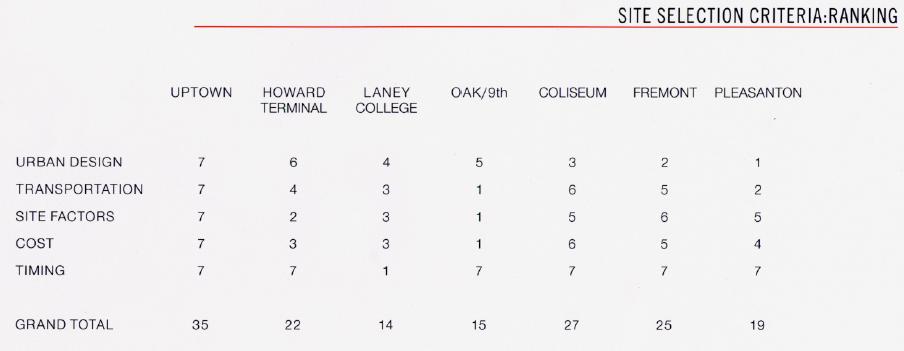
In December 2001 HOK presented a study on 7 potential stadium sites in the East Bay. Those sites (in order of preference based on the study) included Uptown (now condos), The Coliseum (please, no), Fremont (been there, done that), Howard Terminal (not viable), Pleasanton (now a planned mega development), Oak to Ninth (now slated for something else after much wrangling), and Laney College (ain’t gonna happen).

That study used an established matrix that HOK had developed for evaluating each of the available sites in a particular region in relation to one another. The categories used to evaluate each site included Urban Design, Transportation, Site Factors, Cost and Timing. Each factor held equal weight with the best site in a particular category getting a score of 7 and the worst getting a score of 1. If two sites were judged to be equally “the best” they both got a 7 and the next best could get a score no higher than 5. All in all, it is an effective way to objectively rank sites. So what does this have to do with JLS West (pictured below)?

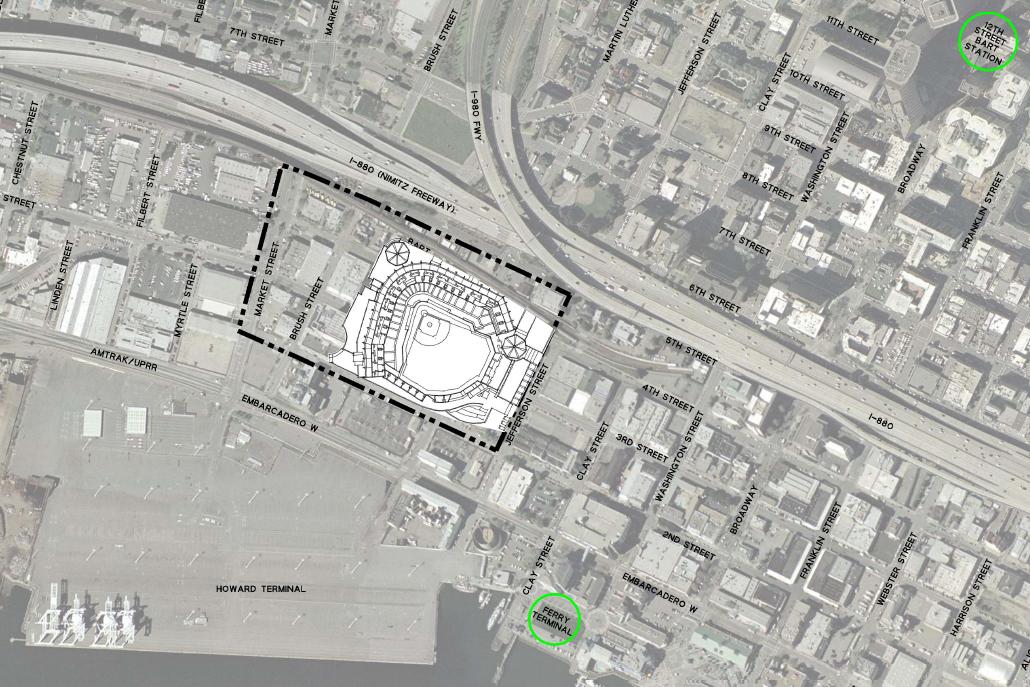
JLSnorth

Well, we can use these same factors to evaluate the plausibility of the site that Marine Layer was so prescient about. We can also use the scores for some of the similar sites evaluated in 2001 as yard sticks for this site (and the OFD/Victory Court Site in a subsequent post) and see where it would have lined up. I warn you all I am taking some liberties with the scoring method, meaning I will play loose with the rules a bit because I can’t actually make a 100% accurate translation. So while the top score will still be 7 (when it should be 3-5 at this point), I won’t follow the rule that says if there are three “7’s” on the board the highest alternate score has to be “4.”

It is safe to say at this point, based on what we know, that “viability” is not something we can really give a ruling on.  As Tony pointed out, viability is in the eye of the beholder. It is very early in the game and there is a long road to prove the site ultimately viable. All we can do at this point is call a site “potentially viable,” or worth more exploring.

For argument’s sake, we can say a “potentially viable” site is one that was in the top 3 of the original study. Why? Because the top sites not covered by condos were looked into by Mr. Wolff and Howard Terminal, the first “rejected” site, was number 4.  So, let’s get to it and do it!

Urban Design– I honestly think we can skip this category. Or, further we can just give this site the highest possible mark. I envision a potential stadium in this site resembling what I consider to be the most aesthetically pleasing of all stadiums in the big leagues: PNC Park.

800px-Pedro_goes_to_Pittsburgh

Sure, there wouldn’t be a bridge or a river. But imagine the Oakland skyline looming beyond Left Field in a similar way and… Ahhhh, I can smell the hot dogs and taste the beer. This site is clearly a 7 on the HOK scale.

Transportation– This site is not all it is cracked up to be from a transportation perspective. It is pretty comparable to Howard Terminal, which didn’t score so well in the original HOK study. The ferry is close, BART isn’t. Parking is a bit of a struggle, but not impossible, and the freeway infrastructure (on ramps/off ramps) in the area is just okay. I’d give it a 4 on the HOK scale, which is the same score Howard Terminal got in 2001.

Site Factors–  There are 57 separate parcels (per oaklandexplorer.com) in the area that is defined by the rectangle in the City of Oakland’s presentation. Those 57 parcels have at least 33 individual owners and include a few residences.  Excluding the streets, this area is 14.2 acres. I wouldn’t anticipate a huge environmental clean up cost, but soil stabilization will be an issue. One potential issue is BART running through Left Field, but that becomes more of a footprint constraint than a deal breaker. In 2001, this site would have been better than Howard Terminal, probably comparable to Laney College. Those sites scored 2 and 3 on the HOK scale. In this case I will give it a generous mark of 4.

Cost– Land Acquisition in this area, though complicated by the high number of parcels and individual owners, shouldn’t be outrageously expensive. The value of the buildings and land comes to somewhere around $25 Million dollars if we budget $25 per square foot for land and use the oaklandexplorer.com values for the structures. Business relocation will add to the cost, for sure. There would need to be some on site parking, probably a garage with 1,000 to 1,200 spaces. This site would be better than Laney College, Oak to Ninth, and Howard Terminal were when it comes to costs, though more expensive than Uptown, the Coliseum or Fremont. Which really isn’t bad or good, but right in the middle. I feel comfortable giving this site a 4 on the HOK scale for costs.

Timing– While those 33 parcel owners might not drive up the cost of the site, they could become a factor in the speed with which the site could be developed. I imagine they could derail it altogether, but I don’t think that would be the case. In the original HOK study all sites but Laney College were tied for best. None were this complex, but this site isn’t as tough as the Laney College site was either. So let’s give it a 6 on the HOK scale.

So that makes this site a 25 (with some rule bending for sure).  How does that compare?

hokmatrix

That’s right, a tie with Fremont. Based on the definition of “potentially viable” above… this site deserves some exploration. I imagine that the MLB committee is doing this exploration in the report we won’t ever get to read. But for now, I leave you with a vision:

oak-skyline1-1024x691

Worth exploring, no?

MLB’s very own death panel

Forum thread

Debate may be raging on Capitol Hill about the future of America’s health care system, but in the Bay Area we have our own health-of-the-A’s debate and it clearly involves its own death panel. The three-person panel appointed before the season by MLB Commissioner Bud Selig was initially tasked with analyzing previous ballpark proposals and the prospects for a new ballpark in the East Bay. Since then, the panel has expanded its search to the South Bay while remaining engaged with Oakland, and as we’ve found out recently, Fremont.

Many have thought all along that the panel’s mission was simply to rig the game and get it in writing. The new set of site proposals and an admission by Lew Wolff that he may have to investigate another Oakland option seems to contradict this sentiment. Now that Oakland, Fremont, and San Jose all appear to be in play to some extent, it’s clear that once the panel makes a recommendation and a decision is rendered, the future of MLB in at least one city will be sealed. Will Oakland cease to be a major league city? Will San Jose’s efforts once again be stillborn? Will Fremont become a mere footnote, along the lines of an Irwindale? Then again, it may not be as simple as letting it be written. MLB could give themselves and the A’s a lot of flexibility by rendering a “nuanced” recommendation. Gary Peterson took a stab at trying to figure out this mess, I think it could be more complex. Let’s take a look at the possibilities.

  • The panel rules that Oakland is no longer an option and recommends a move to San Jose. If you’re a conspiracy theorist, you’ve got money on this one. Backstory abounds, from panel member Corey Busch perhaps wanting to screw the Giants to Bud Selig’s apparent hatred of Oakland. While South Bay partisans won’t publicly admit it, they have to like how familiar and cozy the relationship is between Selig and Wolff, Wolff and Busch, Wolff and the other owners. This same panel oversaw the disintegration of the Expos and the team’s subsequent rebirth as the Nationals. The head of the panel, Bob Starkey, has had no shortage of controversy related to MLB’s financial matters. Yet even if the deck weren’t stacked against Oakland, there isn’t a great deal of evidence to support “The Town.” Oakland partisans love to point out the support during the Haas era, but I argue that if it take multiple WS trips and break-the-bank payrolls and deficits in order to elicit good support, your argument isn’t that strong. Fan support in other years has ranged from poor to average. If your pitch is “We’ll support a team that respects us,” well guess what folks? You’re leaving the barn door wide open. All teams go through down years. All teams have crappy ownership from time to time. The measure of a fanbase is how they respond during those lean years, not just the good ones. By that measure, A’s fans (and I’m proud to say I am one) have not done well. The only thing that makes a bitterly cold Monday night game in April and May worse is knowing there should be more of us out there to support this team we love.
  • Territorial rights are upheld, keeping the team from moving south. While there is growing sentiment that this won’t happen due to economics, don’t dismiss the possibility that the notoriously conservative Lodge would keep the status quo. It could set the stage for the A’s to leave the area completely, though Portfolio.com’s recent market study indicates that there are fewer relocation candidates than in years past (Thanks Ezra). I’m more of the opinion that Fremont, which was dead in February, could come back to life. Now that we know that NUMMI is closing next March, the landscape has changed there somewhat. NUMMI’s land holdings and impact are so large that any new development will have to be done within a large master planning framework, which could take years. If the panel finds that at least one of Oakland’s sites is a winner, negotiations on a downtown ballpark could be set in motion. Which could bring up that “nuanced” position…
  • The panel recommends that the A’s work with Oakland, but sets a deadline. It could be a year, 18 months, 2 years. The idea is that Oakland would be given one last shot to show they have the wherewithal to get a ballpark deal done. They’d probably have to aggressively pursue the privately held land, start the EIR process, and work on a development plan that makes the concept compatible with downtown/JLS development guidelines/zoning. Oakland would have to show that it has the finances ready by issuing RDA bonds, selling any banked land, and identifying whatever additional federal sources (stimulus) it might need to assemble the ballpark site. If Oakland doesn’t make enough progress or hit certain milestones, the A’s would then be allowed to explore the South Bay. For many this could be considered fair, though the matter of whether or not Oakland has gotten a fair shot in the past is entirely subjective, especially based on this site’s comments.

The panel’s recommendation will have far reaching effects. If Oakland is shut out (Option #1) or fails to meet MLB’s demands (Option #3), it is an absolute certainty that MLB’s – not just the A’s – days in Oakland are numbered. For many that view the team as regional rather than city-based, this is not that big a deal. For those who view the team as an Oakland cultural institution and a source of civic pride, it’s the end of pro baseball in Oakland. It may also be the last shot for San Jose, since they have no prospects for a team outside of the A’s. There will never be three MLB teams in the Bay Area, the market isn’t big enough to support three teams. As fans, we can only hope that whatever the panel’s recommendation is, it’s fair and clear in its goals. That’s the least they can do for A’s fans, who’ve been through a lot over the years.

On Viability…

Viability- Capable of working, functioning or developing adequately.

A common theme amongst our readers, and readers of other websites, is the definition of  “viable.” It is the key variable in MLB’s requirements for a new stadium site. The others being “aesthetically pleasing” and “owned by the city, leased to the team.”  To tell you the truth, I can’t imagine a site in Oakland that wouldn’t be aesthetically pleasing, unless of course there was a giant football grandstand blocking out any of the cool views.

The Pro Oakland take is, “With all these options, something has to be viable.”

The San Jose spin is “If something really was viable they would be putting it out there to stand alone.”

I can see the logic of both perspectives. I have a different one. One of the three sites is not viable, one could be and the other I am not so sure about. With that in mind, let’s dive into our individual reviews of each site with the one I am sure about. Howard Terminal.

The strengths of this site are many. If the ballpark were built as originally suggested in the 2001 HOK study, there would be some breathtaking views of the San Francisco Bay, as you can see below. It could combine with the already under way regeneration at Jack London Square to create something Oakland doesn’t really have right now, a true entertainment district. This is the formula used in San Francisco, San Diego, Denver, etc.

howardterminalhok

So why do I say this site isn’t viable?

I, for one, would love spending summertime afternoons sometime in the next few years sitting in the bleachers, with a beer, watching ginormus ships make their way through the Oakland Harbor. I’d be watching the game except Crush Carter, Brett Wallace, Adrian Cardenas and Jemile Weeks have made the A’s offense so ridiculous that the A’s score 6 runs a game.  Meanwhile the new big 5 of Trevor Cahill, Brett Anderson, Gio Gonzales, Vin Mazzarro and Josh Outman have silenced all the bats and the A’s are regularly running off 10 and 15 game win streaks.

A nice dream, for certain, but an unrealistic one for sure. And, unfortunately, this is exactly what Howard Terminal is. As Marine Layer has pointed out.

We can start to dig in by rehashing the 2001 HOK study. That study didn’t rule this site out, in fact it named this the fourth best site available, behind Uptown, the Coliseum Parking Lot and Fremont. The best aspects of the site were deemed to be it’s urban design potential and the speed with which it could be constructed (due to the fact that is already city owned). The reason it was ranked behind those other three sites was because it scored horribly on cost and site factors, and only mediocre in transportation.

The reality is that none of those things have changed. It still would be awesome from a design perspective. Land acquisition still would not be the long pole in the tent. But the negative factors are also still the same.

Even if we only considered the cost, that would be enough to sink this site. In 2001 the construction cost was estimated to be $517 Million. That is $600 Million in today’s dollars. I don’t see, and any sane person would agree, anyone investing $600 Million dollars in a baseball stadium in Oakland or San Jose.

But let’s consider the site factors as well. In order to turn Howard Terminal into a baseball utopia, the Port of Oakland would need to lose some container berths, or move them somewhere else in Oakland. This is expensive to do. But even more than the direct cost is the opportunity cost. Why mess with the City of Oakland’s economic engine? This is the fourth busiest port in the US. 99% of Northern California’s containerized goods pass through the port.  Is it possible that building a baseball stadium here would even be a break even proposition for Oaktown? Probably not.

So let’s not waste anymore time rehashing old, cast off sites.

Let’s move forward and talk about sites that can keep the A’s in the Bay Area. There are two new sites to talk about.  If we know that Howard Terminal is “not viable” we can use it as a sort of barometer. Stay tuned sports fans, we have two other sites to review… and they won’t be a waste of our time.

Welcome the new editor-at-large, Jeffrey

A couple of housekeeping matters first. You’ll see in the info box that I’ve given myself the title of editor, and a new editor-at-large Jeffrey August will be contributing feature pieces from time to time. We’ve been talking about this for a while, and I figured that with some of the news that’s going to be made in the next couple of months, now is the right time to bring in another passionate soul to help carry the weight. Jeffrey, a.k.a. “jeffro” at AN, cut his teeth putting together a fantastic, nine-part series there called “Greener Grass” to help educate fans there about the ballpark situation. If you want to sample Jeffrey’s work, check out the series.

Jeffrey has also been commenting here and at the old site for quite a while. He even started a Facebook group called “Keep the A’s in the Bay Area.”

Over time, I’ll be looking to have additional guest contributors whose unique expertise and perspectives could add dimension to the site. For now, welcome aboard Jeff, and we all look forward to your future articles.

Radio wrap

First of all, thanks to Englishmajor at AN for getting the interview together so quickly. She was responsible for getting the brief interview from earlier in the year. I never thought I’d be able to spend an hour on radio talking about this stuff. Thanks to Dave Iverson for smoothly segueing between the 49ers and A’s, and to Keven Guillory for the prep yesterday.

As for discussion, there’s plenty over at AN. Nate did the play-by-play. And now the audio links are up, including podcast and stream (below).

At some point, perhaps around the time of the release of the MLB panel’s report and San Jose EIR, I’d like to do a round table discussion that could be podcasted. We could have fans, architecture/planning experts, on to cover all of the issues and discuss next steps. Would you be interested in this?

On to the interview. I wasn’t initially aware that Andrew Zimbalist was going to be on. The fact that he was on was great. No matter what you may think of his recent stances regarding sports venues, he is still one of the preeminent experts in the area. When pressed by Iverson about what Santa Clara voters should focus on, Zimbalist demurred and rightly so. Voters should educate themselves on everything, not just a couple of pamphlets. I know that’s hard, but it’s worth it. I think I did my part to bring up the $330 million Stadium Authority issue, since it hasn’t been getting enough coverage.

I tried to stay within the framework of the questions asked. I didn’t come with any prepared notes or material, and I’m glad I didn’t because I wouldn’t have gotten to much of it. It’s amazing how quickly a radio hour can fly by.

One more thing. The guest in the 10 o’clock hour, bestselling author and incredibly good human being Greg Mortenson, almost couldn’t make it because of illness. Iverson joked that Chronicle writer John Cote and I might have to stick around. I was secretly wishing to keep going, even though Mortenson’s efforts to build schools in Afghanistan and Pakistan are far more admirable than anything I’ll ever do and are much more worthy of the hour. Send your lumps of coal…

Your thoughts on the KQED segment?