Forgive me for having a Stephen Colbert moment. Robert Gammon cleared up much of the site confusion that started with last week’s Matier & Ross report. The sites, according to Gammon’s sources, are (drum roll please):
- Oak St & 3rd St (west of the OFD Training site)
- Howard Terminal
- Area north of Jack London Square and Howard Terminal
- Coliseum parking lot
Why am I patting myself on the back? Well, I did write about a possible alternative just north of Howard Terminal three months ago (not in depth, but at least it wasn’t one of the “recycled” ideas often put forth). Gammon mentioned that the site currently contains the offices of the East Bay Express, which would have to be moved if the A’s moved in.
Since Wolff has already dismissed the Coliseum and Howard Terminal, the choices really boil down to OFDT (Oak/3rd) and MLK/3rd (for lack of a better term). For anyone that wants to keep the A’s in Oakland, this is a good thing. Why? Because it can allow the community to coalesce around one or at worst two sites, instead of debating three or four sites and creating factions. Really, what the City and boosters need to do at this point is to pick one and run with it. The future of the A’s in Oakland depends on this choice. Knowing this, there is an obvious, crystal clear choice based on some simple facts: MLK/3rd. I’ll explain after the chart.
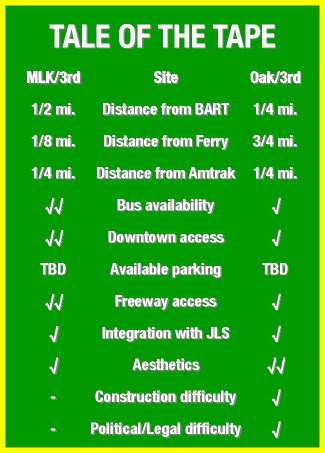
Transit – BART is closer to Oak/3rd than MLK/3rd because of the proximity of the Lake Merritt station compared to the 12th Street station. Either site would require a transfer for some group of fans, though that isn’t any different than the current situation at the Coliseum. The ferry terminal, which admittedly would get far less use than BART, is only two short blocks from MLK/3rd. Proximity to Amtrak is roughly the same as with BART, except that the JLS station is on this side of 880/980. No one talks about buses, but they shouldn’t be ignored. MLK/3rd is almost adjacent to Broadway, which is the spine of Oakland’s AC Transit routes. Oak/3rd’s closest existing bus stop is at JLS Amtrak, making it a bit out-of-the-way.
Downtown access – MLK/3rd isn’t tucked into a corner, making it easy for fans to walk from Downtown and even Uptown to the site. Oak/3rd is tucked into a corner, sandwiched between 880 and the active UPRR line. There are far more restaurants and bars between the 12th Street station and MLK/3rd, creating a natural synergy.
Available parking – I put TBD here because there are several variables. It’s not known how many public and private spaces would be available for MLK/3rd, but the potential could be greater. At Oak/3rd, the wildcard is Laney College, which could make lots of parking available for weekend games but not necessarily for night games (due to night classes). Both sites would have access to parking located underneath the 880 viaduct.
Freeway access – On/off-ramp capacity limitations that affect the OFDT site also affect Oak/3rd. MLK/3rd’s more central location makes for a better distribution of traffic among current on/off-ramps. MLK/3rd is also closer to the 5th St exit from 880-South, which means less surface street driving for fans.
Integration with JLS – MLK/3rd is two blocks away. If one of the City’s concerns is properly filling the space between Downtown and JLS, a ballpark is a pretty good way to do it. Oak/3rd is, again, out of the way.
Aesthetics – Neither site is going to beat the old Coliseum’s view of the hills, especially with 880 in the foreground. At least MLK/3rd won’t have an unadorned overpass going over Lake Merritt Channel in the view. For those who might like it, there will probably be a way to design a MLK/3rd ballpark so that fans can see BART trains pass by as they enter/exit the subway portion.
Construction difficulty – Oak/3rd is just above the designated tide line, but much of it may also be landfill, just like China Basin. If so, needed foundation work could prove more expensive than at MLK/3rd.
Political/Legal difficulty – Oak/3rd has a complicated ownership situation, as Caltrans, Union Pacific, and the CPUC all have interests in the area which may not be easily negotiated. Both sites have some number of private owners, so they should be on equal footing in terms of acquisition costs.
I’d say it’s pretty clear which site makes the most sense, although I’m sure some of you will debate this. However, the key to getting anything like this done is political will. As the rest of Gammon’s column notes, Mayor Dellums has challenges he has to deal with before turning much attention to a ballpark. Unfortunately for Oakland, it’s a matter of timing. If Dellums decides not to run for re-election, his lame duck status will render him unable to see a big project like this through since it’ll take over a year to approve. If he does run and wins, he might spend too much time in the interim on other more pressing matters or his campaign to wage a development battle like this. If he runs and loses, his replacement (perhaps Don Perata) might choose to scrap existing plans and move forward with his own. The question is, will that be too late?
Note: While doing some quick research on Oakland recently, I noticed that on the relevant page on everybody’s most trustworthy information source, Wikipedia, someone posted that Oakland’s 2009 population is 645,345. I was absolutely perplexed by this. There are multiple “citations” for this figure, but none of them report that figure or anything remotely close. The census 2006-08 estimate is 362,342, a 9% drop in population from 2000. I don’t know who put that up there, but I’m hoping someone – a reader who edits Wikipedia articles – could look into that and correct it if necessary. There’s no need to fudge something like that. Oakland’s population is now listed as 404,155.


 newballpark.org