Jingletown Stadium @ Fruitvale

Faithful New Ballpark readers: Marine Layer made the very foolish decision to let me, Chris Kidd, stand in for him for this post. I come, hat in hand, to offer you something you all thought you would never see. It is a favorite sticking point for San Jose partisans (and something in Oakland which we prefer to ignore) that none of the proposed sites in Oakland have a level of preparedness equal to Diridon. There’s no EIR, they say. The needed infrastructure improvements are too great, they insist. Well, I believe I might have found a site in Oakland that will not only have both of those issues fully addressed within 18 months, but it will be done without costing the Oakland A’s ownership a single penny (and if I might editorialize for a moment: In your face).

What is even more amazing is this site is far superior to both of the rehashed waterfront sites so far proposed in Oakland, specifically the site at Oak to 9th and the site at the Howard Terminal in the port of Oakland. Far superior. Have I whetted your appetite enough yet? Can you not stand the suspense anymore? Well, wait no longer: the site I’m talking about is on the Oakland Estuary at the base of the Fruitvale Avenue Bridge. A site I like to call Jingletown Stadium.
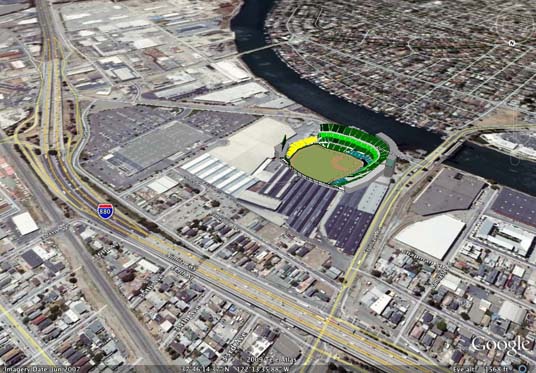
So, let’s first talk about the site itself. It’s 26 acres currently inhabited by the Owens Brockway Glass Container company. It is bounded by Fruitvale Ave to the north/west, Alameda Ave to the south/west, Home Depot to the south/east, and Boehmer and Elmwood Ave’s to the north/east. I call it “Jingletown Stadium” because the site is across the street from the vibrant artist community of Jingletown (photo blog).

Now, let’s compare this site with the two other Oakland waterfront sites: Oak to 9th and the Howard Terminal. When comparing sites, there are some yardsticks to go by: the size of the parcel(s), the ease of acquiring said parcel(s) and dealing with the displacement of the current occupants, the current infrastructure, the current public transit options, and the feasibility of adding infrastructure and parking.

Let’s go point by point, though I’m going to save a little bit for dessert.

  • Size of Parcel: Jingletown Stadium is 26 acres, compared to 029’s 40 acres and Howard Terminal’s 46 acres.
  • Acquisition: Though 029 would be the easiest parcel to acquire, the A’s would be taking on a ginormous NIMBY fight that has stalled out the development of 029 to this day. You don’t want that. Howard Terminal is equally squishy: the port of Oakland just signed a 25 year contract with Matson Shipping and they would be required to relocate them to an equally large site for their exclusive operation. Space like that on the waterfront is neither easily attained nor is it cheap. While Jingletown Stadium would need to relocate the glass factory to elsewhere in Oakland, this is a much easier prospect than moving Matson Shipping. Oakland currently has an over-abundance of available industrial space, and finding another site for them to inhabit should not be difficult. One solution I particularly love is to put them on the Oakland Army Base. It offers the same proximity to a major freeway and the city would be able to offer them the land for free as incentive. Additionally, it would remove a large industrial polluter to an area of the city that isn’t nearly as densely populated. But I digress…
  • Infrastructure: To put it succinctly, they suck for the other two sites. The Howard Terminal is near only 1 freeway exit southbound and 2 exits northbound. 029 doesn’t fare much better with 2 exits northbound and 1 exit southbound. Compare that with Jingletown Junction having 3 exits reasonably close southbound (23rd, Fruitvale & High) and 2 northbound (High & 29th/Fruitvale).
  • Public transit: Here’s where Jingletown Stadium cleans the clocks of the other two sites. Fruitvale BART is only a third of a mile away from Jingletown Stadium. Even better, Fruitvale BART is a regional hub for AC Transit. 029 is over a mile from Lake Merritt BART and Howard Terminal would require an infill station for BART. Screw that mess.

So, you guys have had to slog through quite a bit of article so far, but are you ready for dessert? I saved the best part for last, contained in the question of feasibility for upgrading infrastructure and parking. This is the lynchpin for what makes Jingletown Stadium far superior to all other sites in Oakland: The Central Estuary Specific Plan. Now, I could go through a whole explanation about what the Central Estuary Specific Plan is, or I could use the wonder that is The Internets and show you. I wrote some guest articles about the CESP for Vsmoothe’s phenomenal blog A Better Oakland. They’re here, here, and here. You can also read more by my blogger-crush DJ Crimson at his blog Oakland Streets here and here.

If you’re link-averse, I’ll spare you the work and give you the quick and dirty right here. The city is developing a “specific plan” for the area of Oakland’s waterfront bound by 19th Ave, 54th Ave, 880 and the estuary. An EIR is created which will cover the entire specific plan area, and developers who want to build anything that is contained within the range of this EIR can use it to gain approval to build instead of having to create their own. The process for the approved types of new development will have a much faster time getting approval and getting construction started. For the significant amount of time and money saved by the developer using this EIR, they have to pay a “user fee” which will only be used within the specific plan area. These fees will do things like build sidewalks, create open space, modernize the sewer system, underground utilities, etc.

This is where the A’s come in. If the staff drafting the specific plan include a stadium plan within the EIR, it’s conceivable that the A’s could use it for the stadium. What’s more, the pretty hefty user fee the specific plan area would extract from the A’s could go towards all the types of infrastructural improvements that the A’s would need at a new stadium. Streets can be reconfigured, freeway exits can be modified. The area around Jingletown Stadium is still relatively underdeveloped: it can accommodate a lot of the upgrades needed to the roads and there are many underdeveloped lots that could serve as additional off-site parking to make up for the insufficient amount of space the 26 acres of Jingletown Stadium would provide for parking.

Plus, I bet Jingletown Stadium would have some mean burritos.


Editor’s notes:
Like any site, Jingletown has its positives and negatives. I don’t have any familiarity with this area other than driving through there several years ago while looking for waterfront sites.

  • Of the 26 acres, half would be devoted to the ballpark and the other half to parking in all likelihood. That translates to about 1,600 on-site spaces if only a surface lot were built to save costs. That could grow to 3,000 (two levels) or 4,500 (three levels) if a garage were built, but someone would have to foot the bill for that. The more parking is immediately available, the greater traffic impact. 10,000 spaces for any ballpark would be for any site, regardless of the site’s proximity to transit. A worst case scenario has to be assumed to properly identify problems and create mitigation plans.
  • A 2002 report by environmental watchdog site Scorecard indicates that the Owens Brockway plant has a less than glowing report card in terms of toxic chemical/waste generation. If the site were acquired, it’s likely that some amount of site cleanup would be required. The flipside is that wherever the plant is moved, it’s possible that a cleaner replacement could be built. Owens Brockway’s parent company is one of the largest glass container manufacturers in the world.
  • If Owens Brockway isn’t interested in selling, the plan is dead in the water. Unlike the other two waterfront sites, this one is privately owned. As usual, eminent domain is assumed to be out of the question.
  • The picture intentionally orients the field east instead of creating a “Splash Hit” situation. A street acts as a buffer between the ballpark site and the waterfront.
  • Impact to Alameda is unknown, which means NIMBY reaction to such a concept is unknown.

Discuss.

Quakes get land discount + TIF approved for Diridon/Arena area

Following up on an item from last month, San Jose’s Redevelopment Agency (City Council wearing different hats) unanimously approved the price cut for the Airport West site, from $132 million to $89 million. The land will be used for the Quakes’ new stadium, plus some future commercial development. The discounted price is $8 million more than what the City paid in 2005.

On a more A’s-related note, SJRA also approved creating a tax increment zone just north of the Diridon South ballpark site. The area includes Diridon Station and the 8 blocks between HP Pavilion and the ballpark site, with Guadalupe Parkway/CA-87 on the east border. Virtually all of this area is zoned either industrial or commercial. At least one site, the old SJ Water Company land bought by Adobe, has development plans underway.

TIF funds could be used for the new infrastructure stuff we’ve discussed previously, from the new multimodal transit hub to additional parking to open space. It’s hard to say what yields they are expecting, but it stands to reason that whatever gets built, TIF will be stretched out enough for the corresponding projects to be paid for.

Tying the two news items together, it’ll be interesting to see how quickly construction begins on the Quakes stadium. As I understand it, the land there is already graded and ready to build. Should a new stadium have it groundbreaking in the summer or fall with visible progress over the next several months, it would be a major achievement politically for the City and A’s/Quakes ownership. It’s expected that the ballpark will have its own ballot measure, and there’s no better political capital than showing that you’re getting something done – with your own money, nonetheless.

Minority partner Saperstein fires back at Russo

While I would just as soon prefer the A’s saga not get played out so publicly in the media, it makes sense for members of the ownership group to circle the wagons when they get attacked. And so minority partner Guy Saperstein wrote into the Trib with a strongly worded rebuttal of City Attorney John Russo’s letter last week. Saperstein, a retired Oakland lawyer who contributes to several left-leaning websites, doesn’t quite fit the profile of collusive carpetbagger many have bestowed upon Lew Wolff. I will be curious to see if, oh, Zennie Abraham and Rich Lieberman devote as much blog space to Saperstein’s letter as to Russo’s.

Saperstein ends with a sentiment echoed by this blogger and many others (though not all) throughout A’s fandom:

What is most noteworthy about Russo’s commentary is what it fails to identify: A single viable stadium site in Oakland. Russo writes a long commentary claiming that “feasible options for a new ballpark” exist, and that it only takes “imagination” to find it, then fails to identify a single feasible option, or indeed, any stadium option.

The time is long past for platitudes and empty rhetoric from grandstanding politicians who aspire to be the next mayor. If you have a secret stadium site and plan that no one else has yet seen, Mr. Russo, let’s see it.

The key word there, of course, is viable. I guess we’ll find out if it exists in a week. Can’t wait.

On a related note – how many more lawyers are we going to hear from? I’ll put the over-under at 3.

Everything old is new again

Matier and Ross report that there may be three locations presented by the Oakland Stadium Task Force. One is the Coliseum parking lot option, the other two unclear, though M&R are pointing to Howard Terminal and Oak-to-Ninth. Yes, this is all familiar territory.

Quick refresher: Howard Terminal (aerial view) was reopened in 2004, with shipping giant Matson signing a 25-year lease. A related deal, finalized only last year, has SSA Marine operating the terminal on behalf of Matson.

O29 is a bit more complicated. The largely residential development on the Estuary had its EIR certified in January (PDF), after 3+ years of legal wrangling. Unfortunately for developer Signature Properties, the timing coincides with a horrible decline in the housing market. The Ghielmettis have long maintained that they would be willing to share the site with the A’s for a ballpark. However, the devil is always in the details. If putting a ballpark in means a significant drop in open space (which was what much of the legal wrangling was about), any plan would be likely be DOA, if not beset by renewed lawsuits.

Both sites would require new EIR processes to begin, as is common with new development.

At least the task force is aware that it can’t just throw a couple of sites out there:

Planning Commissioner Doug Boxer, who is part of a public-private group led by Mayor Ron Dellums working to keep the A’s in town, confirmed that part of the parking lot at the Coliseum would be offered as a ballpark site. But he said there has been no final decision on which two waterfront sites will be presented to the baseball poobahs May 12.

“We don’t want to provide them with the same old sites that are going to have some of the same issues that have been identified as problematic,” he said.

In other words, they’re still sorting it out.

When the HOK study was completed in 2002, Howard Terminal and O29 emerged 4th and 6th, respectively.

I’d love to be a fly on the wall at the task force’s presentation, which is scheduled for May 12th.

P.S.: Rich Lieberman comments further on the M&R report, though he must not have gotten the memo that the Marlins’ ballpark plan has been approved, not killed. Miami-Dade County expects to sell the bonds in the next two months. The site has been cleared, the Marlins planted flags there over the weekend, and a very detailed site plan has already been circulated (thanks Transic and M Festa). The constant drone I’ve been hearing from Oakland partisans is “It’s too hard to go anywhere else, just get it done here even though the potential isn’t as good.” It somewhat fits with the path of least resistance M.O. I ascribed to Wolff in the past. I understand the reasoning behind this, but it’s not exactly an overwhelming sales pitch.

No A’s/High Speed Rail conflict, say planners

Years ago, when the High Speed Rail project was only slightly more than a pipe dream, I had a dream of my own. It involved a few friends and me going on a quick weekend trip on HSR. We’d pack light, walk from my house, and board an HSR train on a Friday afternoon. Three hours later, we’d be in Anaheim, just in time to catch the first game of a division rivalry weekend series at Angel Stadium. We’d bunk with some other friends in the O.C. We’d reciprocate the hospitality when they wanted to come up here, of course.

This was before the final alignment was decided. Since then, the East Bay has been shut out of the initial phases of HSR, making such a trip from the East Bay less convenient than what I just described (a transfer from BART in SF remains possible). From San Jose, the dream is not only alive, it’s within grasp. And according to comments by SJ city planners and HSR planners, it can work for them too.

“Engineering hasn’t been done, and decisions haven’t been made,” said Hans Larsen, San Jose’s deputy director of transportation, “but there’s nothing to indicate — that we’ve seen — any chance of a conflict between the two projects.”

Added Mehdi Morshed, the rail authority’s executive director: “The more activity, the more development, the more things that are located in and around the station, the better it is for our riders. We would go out of our way to work with them, to do everything we can to match our station design to fit the city’s priority.”

Now that sounds like the spirit of cooperation to me! Each independent working group knows what the others are doing, they appreciate what the other could bring to the table. Hopefully, they’re also thinking about sharing infrastructure along the lines of what I suggested last month.

Eventually, HSR could be a boon for all sports teams situated near it. An A’s or Giants fan in Fresno could conceivably get to SF or SJ about 90 minutes. A Padres fan who wants to attend a Pads-Dodgers game in LA but doesn’t want to deal with LA traffic would have a solution that gets him end-to-end in just over an hour. Baseball fans from all over could join cool train-based ballpark tours, visiting all 5 major league parks as well as several minor league parks along the route if they wanted. The potential is staggering.

San Jose reaches 1 million

It’s a development that doesn’t really make a difference in putting a ballpark plan together. Still, civic leaders and pols pushing for a ballpark will undoubtedly point to San Jose’s newly minted seven-figure population.

Kevin Starr, a professor of history at the University of Southern California and a former state librarian, said 1 million people is a distinct urban threshold.

“When a city reaches a million, it reaches a certain transformative population,” Starr said. “You are dense enough then to get anything done that you want to get done. So let those people that don’t want San Jose to be a big city move to Redding — seriously. This place was destined to be an important American city right from the beginning.”

I don’t know if San Jose will ever “arrive” the way Tom McEnery had envisioned in the past. Reaching 1 million is certainly a step towards that. In the meantime, at least San Jose can say it has more tall buildings than San Antonio. Woohoo! – er, um…

The enemy of my enemy is my friend

And so the recriminations begin.

A letter from Oakland City Attorney John Russo gave a Rajon Rondo-on-Brad Miller style slap to Lew Wolff. Zennie Abraham quickly jumped on it, as did Robert Gammon. I’m sure the comments section will be full of people going back and forth yet again on the subject, so I won’t bother rehashing history for the umpteenth time.

Abraham somehow managed to bury the lead in his blog post by not acknowledging in text what he said in his vlog – discussions with the A’s and the Blue Ribbon Committee are not going well. That development is anything but surprising, given the committee’s makeup. Matier and Ross reported on yesterday’s meeting between Wolff and Dellums. Fittingly, the meeting was derailed by a planned fire drill, forcing the parties to move the proceedings elsewhere.

Russo isn’t going to pen a legal brief on his own, he has orders. He may have done it at the behest of the Mayor or City Council. Abraham speculates that it’s a step towards pitting Oakland and the Giants against the A’s and MLB. He even trots out old Rule 52, which as I’ll explain later, is not applicable these days.

Let’s take the confrontation angle first. As noted previously, the Giants don’t have a legal option to exercise regarding territorial rights. It’s in the ML Agreement, and Maury Brown spelled this out in his reading of the ML Constitution in a 2005 Hardball Times series:

If there are any disputes or controversies between the clubs, or between club(s) and any of MLB’s entities, and if the resolution isn’t expressed elsewhere in the Constitution, the Major League Rules, the Basic Agreement with the MLBPA, or the collective bargaining agreement with the Major League Umpires, the Commissioner serves as the sole arbitrator. (Article VI Sec.1)

What recourse do the Giants have, then? They can try to go to bat for Oakland, even though they have no history of doing that previously. Even though, in moving to China Basin, they’ve actively siphoned East Bay fans away from the A’s. Even though they’ve held a regional hegemony for decades. It wouldn’t be hard to posture themselves as saviors of baseball in Oakland – no matter how strange that sounds – as it wouldn’t require much effort and could be done in a sort of stealth mode. It wouldn’t be difficult to get a few letters from prominent pols in order, so no problem there either. The best part is for the Giants is that it works. It paints Wolff as a villain and Oakland as a victim, despite the backstory’s greater complexity.

Problem is, behind all of the sizzle there isn’t much, if any, steak. For Oakland to be successful, there still needs to be an actual ballpark deal in place. The Giants know firsthand what it means to fail to get a stadium built, they’ve understood it many times over. All of this posturing is fantastic if you’re trying to win a war in the media, it’s not good for getting anything done. Could the Giants be brazen enough to goad Oakland into a lawsuit against the A’s and MLB? The A’s and Oakland are only tied together via a lease deal at the Coliseum. As valued as history and tradition are, they are largely intangible. Collusion? R-i-i-i-ght. Does Oakland really want to go down the path of trying to prove that? They’re not the only ones with documents.

Would the Giants try to bring Bob Piccinini out of the woodwork to do the same? Ironically, Vincent Piazza sued MLB over the Giants’ aborted move to Tampa-St. Pete, and eventually got $6 million to go away. Unlike Piazza’s almost immediate action, a move to sue now would likely be beyond any statute of limitations. The fact is that suing to keep a team in town, even if you have a good case, isn’t much of a winner. It certainly didn’t work for Seattle.

Make no mistake, the Giants aren’t taking the T-rights matter lying down. It isn’t simply a matter of them being quickly and/or cheaply paid off. They want to defend their territory as vigorously as possible, and I don’t blame them. It’s really a matter of whether or not their whining will get more than a token acknowledgment as MLB looks towards further stabilizing the league as a whole.

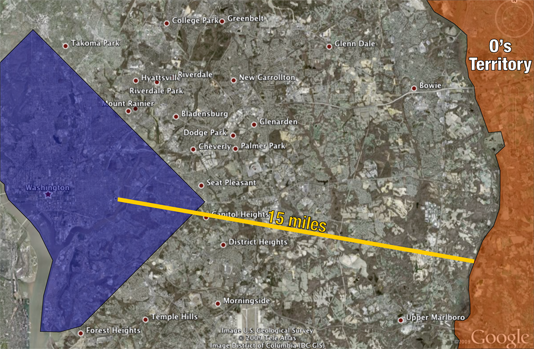
As for Rule 52, even if it were in place (which isn’t verifiable at this point), it isn’t applicable to an A’s move to San Jose. It applies to moves near an established territory, not an invasion of a territory. It would’ve been applicable to an A’s move to Fremont, since either ballpark site was only 5 miles from the Santa Clara County line. Yet, did Peter Magowan raise a big fuss about it? Nope. Contrary to popular belief, it would’ve been applicable to the Expos’ move because portions of DC are within the 15-mile O’s territory buffer. Yet while Peter Angelos objected in the end, Rule 52 was nowhere to be found.

dc-to-md1

How bizarre would a lawsuit look? Oakland, backed by the Giants, would allege collusion between the A’s ownership and MLB. The A’s would probably counter that the antitrust exemption is keeping them from moving to San Jose. San Jose/Santa Clara County, not the A’s, would sue MLB and the Giants, thereby threatening the antitrust exemption. I’m sure that Bud Selig’s stockpiled a ton of antacid just in case.

Thinking out of the (sky) box

They are a necessary evil. They make new stadiums possible even as they detract from many fans’ experiences. They even go by different aliases. In the U.K. they are often called executive boxes. Here in America they usually go by the term luxury suites. Jon Miller has seen fit to call them condominiums. They used to be called skyboxes, before current stadium and arena architecture started to put them as close to event level as possible. Whatever you want to call them, they aren’t going away. The question is, what can we do to make them work better for all fans, not just the suite folks?

Before I get into a solution, a little history is required. During the post-Camden Yards building boom, ballparks were designed to enhance premium revenue generating possibilities. This meant building lots of suites and club seats. In the 90’s, architecture firms like HOK (now Populous) experimented with different configurations to accommodate team requirements. For the ChiSox, 2 suite levels sandwiched a club level. In Cleveland, 3 suite levels ran along the third base line while a club seating area was placed on the first base side. However, HOK wasn’t alone with its crimes against upper deck fans. NBBJ designed Safeco Field and Miller Park, both of which had conservative seating layouts. Same goes for Ellerbe Becket, whose Chase Field feels like a huge airplane hangar. HKS did the football stadium-like Rangers Ballpark.

By the turn of the millenium, a standard recipe had been found. Teams wanted 40-42,000 seats, 50+ suites, and several thousand club seats. Various other niceties were added in to achieve some sense of uniqueness, but the fundamental recipe was the same. Like a pop song’s structure, it wasn’t something to be trifled with. The recipe looked like this:

  • 40 rows at field level
  • 8-12 row club mezzanine
  • Suite level either above or below club mezzanine
  • Split upper deck containing 24-26 rows above suites, with or without an open concourse
  • 35-40 foot concourses

However the mezzanine is sliced up, the club/suite facilities add around 36 feet to the height of the stadium, and more importantly, the upper deck. This also causes the upper deck to be more steep, even though it usually isn’t cantilevered much over the lower deck. In these new ballparks, these choices create a more open, sunny environment. Unfortunately, in striking that bargain, intimacy is lost in the process.

Obviously, it isn’t possible to lose the suites and club seats. They need to be there, and they need to be attractive to the premium market. That means suites can’t be placed above and behind a third deck. They should be reasonably close to the field. Again, how to do this without hurting the upper deck fans?

Bring back the skybox
The great thing about building a 32-35,000 seat stadium is that the layout can be really compact. Each additional row adds about 500 fans. To get from 32k to 40k, 16 extra rows have to be built. That equates to an extra deck from foul pole to foul pole. For now, thankfully, we don’t have to worry about that pesky third deck.

In the third deck’s place, why not put the luxury suites there? To make them attractive, cantilever them over the second deck. Here’s a cross section:

It’s a very simple, compact, fan-friendly, intimate layout. An extended club seating area is at field level. Suites are elevated a bit, but they’re only 24 rows from the field (Second level is the press box). This placement accomplishes two goals that are seemingly at odds: bring suite holders close to the action while not adversely affecting the upper deck. As you’ll see from the next table, both would be closer than their counterparts at any modern ballpark.

The skybox location’s distance to home plate is on par with other ballparks whose suites are tucked under a second deck. It’s around 30 feet closer than in ballparks whose suites are under a third deck. The best part is that the upper deck in this model is nice and close. Its last row of the upper deck is 173′ from home plate. Most recent ballparks have a large, tall, swept back upper deck. The first row is 150′ from home plate, last row 250′ away.

Having trouble envisioning it? Take a look at these comparisons. First, this model vs. Target Field (AT&T Park is similar):

Next, the model vs. Citi Field (with Shea Stadium as well):

Finally, the model vs. New Yankee Stadium:

The model has one major drawback. Major expansion (8-10,000 seats) would be prohibitively expensive due to the suite level(s) in place. It could be constructed with the flexible seating system I described over the weekend to add up to 2,000 seats as needed. Also, the model shown has both the upper deck and the suites cantilevered. A column could be used, probably to cut costs.

Do you think this is a model the A’s should consider? How do you think it stacks up with 360’s Cisco Field model?

Expanding from within

Somehow, amidst all of the NBA and NHL playoff games, A’s and Giants baseball, and incessant NFL Draft coverage, I managed to carve out an hour of time to satisfy my stadium jones. This was thanks to the Science Channel, whose series, Build it Bigger, covered the construction of the new Dallas Cowboys Stadium in Arlington, TX.

The series gives solid profiles to major engineering and construction projects around the world. Two years ago, one of the subjects was University of Phoenix Stadium, the most similar existing design to what Jerry Jones is building. This week’s ep covered all of the major stuff, from the massive roof and arch system to the enormous center-hung video boards and the largest sliding glass doors in the world.

On a smaller albeit similarly impactful scale, a segment was devoted to what I feel is the most innovative thing about the stadium: the seats. Made by Australian manufacturer Camatic, the seating system is notable for the way it’s mounted. Most seating manufacturers mount seats directly to concrete risers. Over time, the only major innovations have been the switch from wood to plastic and the places of the mountain standards on the vertical part of the riser to facilitate easier postgame cleaning. Once seats are mounted, they can’t be moved or modified except to change out hardware when it breaks. One baseball-specific innovation has been the angling of seats towards a focal point, usually home plate.

Camatic’s Quantum series introduces an all new method: seats mounted on a beam. The beam is attached to the riser and seats snap into place along the beam. This allows for incredible flexibility, as seats of varying types and widths can be used, even on the same beam. They can be installed or removed quickly, creating more free space or additional capacity at a moment’s notice. Watch the video below to see the system in action.

Here’s an example of how this would work for the A’s. Let’s take a single section of seats, a matrix consisting of 18 rows of 24 19-inch seats. Each row would have to be at least 38 feet wide. To accommodate expansion, each row would be widened to 40 feet, which would allow for those 19-inch seats to take up 20-inch spaces. At the back of the section is an ADA-compliant row containing wheelchair spaces and companion seats.

Now let’s consider the possibility of a playoff series or All Star game. As the stadium operator, you’re obligated to keep a percentage of wheelchair spaces available for each price range. This time, unlike other stadia, you’ve designed the space to accommodate either wheelchair spaces or additional spaces easily. The wheelchair spaces are on a portable steel platform that can be removed and stowed out of sight. That would uncover two rows with unused beams. Ops can then bring in seats and mount them in minutes. In addition, those 20-inch seats can be turned into 19-inch seats with space remaining for an additional 25th seat per row.

The change nets an additional 51 seats per section. Projected out, that’s 1,000 more seats per level or 2,000 more seats in the ballpark. That means going from 32,000 to 34,000 with little fuss, and with room remaining for standing room admissions.

Camatic, which has experience in the US (Turner Field, Qwest Field), is onto something with its new seating system. If Lew really wants to manage seat capacity and inventory on a similar micro level as he does his hotels, it’s hard to ignore what Camatic brings to the table.

Forbes: A’s worth $319 million (-$4M)

This year’s Forbes valuations are out, and the A’s are down 1% from last year, which to me is surprising. I expected a bigger drop due to lower local revenue, but total team revenue actually rose from $154 to $160 million. This season’s the big test, as MLB is expected to take a broad hit, including the possibility of lower TV revenues if not redone TV contracts. If a drop in valuation is going to occur, it’ll be a year from now.