Bobb for Oakland mayor?

Former Oakland city manager Robert Bobb is doing more than just dipping a toe in city politics. He has expressed interest in the 2010 mayoral race, in which he would be running against Don Perata. It should at least shape up to be an epic race, with both candidates having campaign dollars and established political support at their disposal.

For those who haven’t kept up with Bobb’s doings since he left Oakland, here’s a summary:

  • Sept. 2003 – Dec. 2006: City Administrator for the District of Columbia. From all outward appearances, Bobb was brought in mostly to do the DC ballpark deal. Bringing MLB back to the District is no small feat, though it can be argued that the District got ripped off in the process. Regardless, it’s a feather in his cap.
  • Jan. 2007 – Dec. 2008: DC Board of Education President. I can’t comment on his tenure there, read this and this for more details.
  • Jan. 2009 – present: Emergency Financial Manager for Detroit Public Schools. Bobb was brought in to make drastic cuts in the school district’s budget. This will include closing up to 50 schools.
  • Bobb’s consulting firm has specialized in fixing bad fiscal situations in municipalities. Recently, this included cleaning up the budget mess left by his successor in Oakland, Deborah Edgerly.

It’s a bit early to predict what could happen ballpark-wise with Bobb, since we still have many steps to go, including the Blue Ribbon committee’s report. Should Bobb run and should Oakland elect Bobb, he’d be the guy to get a ballpark deal (site and political wrangling) done.

Previous posts on Robert Bobb:

It would be interesting to find out if Bobb’s interest in the job would wane if the A’s were fated to go to San Jose.

Jet Stream Stadium

If you’re a Canadian goose who happens to be a baseball fan, you might enjoy an easy wind-aided jaunt from Yankee Stadium to Citi Field to enjoy literal bird’s eye views of the new ballyard palaces. The distance, shortest among crosstown rivalries, is only 6.6 miles. Of course, you might get sucked into a jet engine, but that’s another story.

Like most baseball fans, I watched in wonder as the New Yankee Stadium opened and immediately turned into… a hitter’s park? Small sample sizes be damned, the place has already recorded 20 home runs in 4 games. With the Oakland Anemics Athletics coming to town, that average will likely drop. Still, it’d be nice for Giambi to rekindle that old short porch aim for this series, and for Holliday to connect down the LF line for his first in an A’s uniform.

Green-and-gold performance aside, there are probably hundreds of engineering students and professionals champing at the bit to determine the cause for the Bronx power spike. The Yankees have undoubtedly had their own studies done as well prior to construction, but it’s so curious that the ball just flies to right even though the old and new stadiums have the same orientation, and are only several hundred feet apart. Players and coaches are already blaming the phenomenon on prevailing winds, which appear to be a bigger factor in the new digs than the old digs. From an amateur perspective, there’s an explanation for the wind problem. It’s the Stadium’s open layout.

Old Yankee Stadium has a small footprint, and was designed by Osborn Engineering to make the most of very limited space. That meant putting in the massive overhanging upper deck, narrow concourses and ramps, and walls everywhere. New Yankee Stadium was designed by HOK Populous in response to Old Yankee’s deficiencies. Where walls once stood, there are now open concourses. All three concourses are open to the field. The upper deck, which is where most winds will come in before swirling around the seating bowl, has two sets of openings. Besides the concourse, the back of the upper deck has the now familiar fence instead of Old Yankee’s slits-in-concrete. The upper deck itself is not as steep as before. The roof is more extensive in New Yankee, but it’s hard to say how much of an effect it has on the wind as a whole.

Over in Queens, Citi Field has racked up 10 HR’s in 6 games. Its new orientation (NE instead of Shea’s ENE) and cavernous RF makes Citi Field a pitcher’s park more in the mold of PETCO or AT&T than any other East Coast ballpark. Side note: The Mets’ roster has no major lefty bats other than Carlos Delgado, who will soon be a free agent.

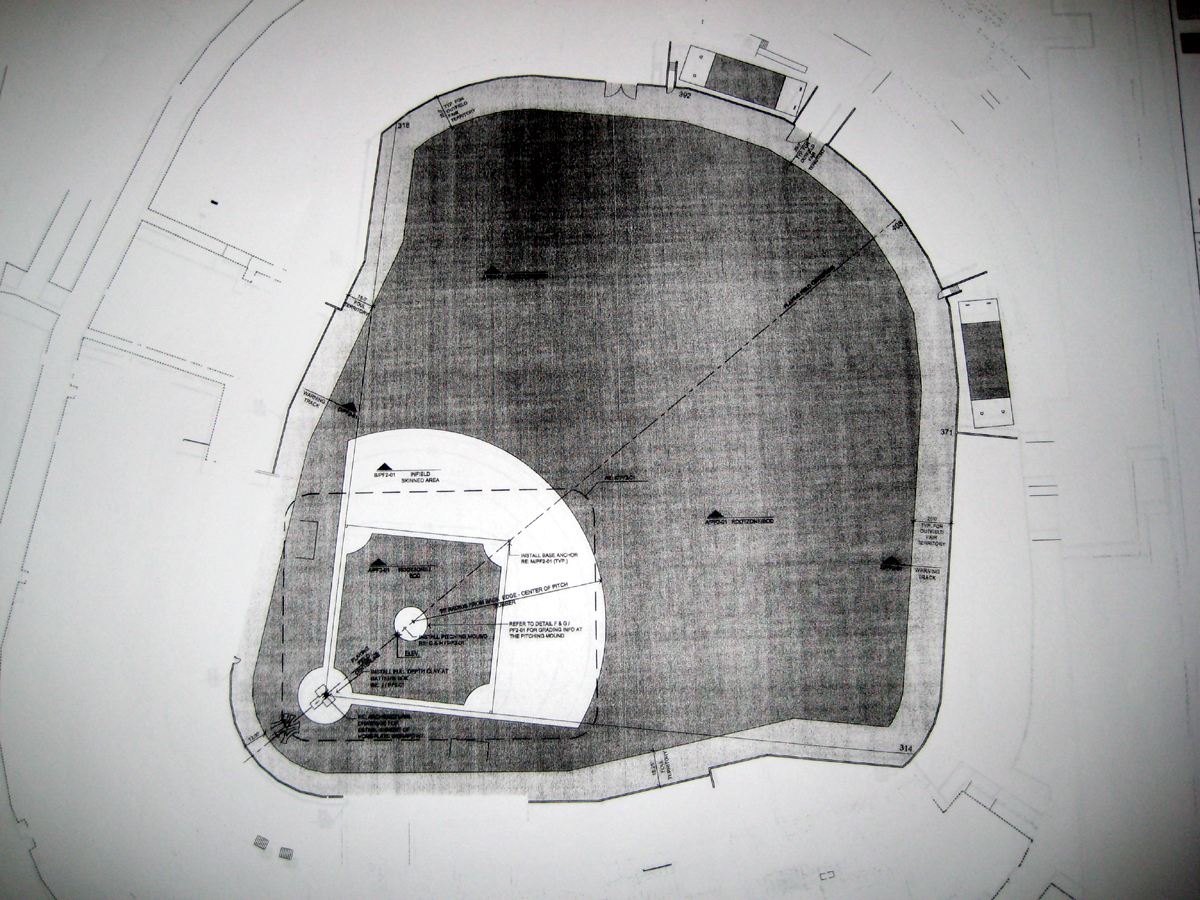
To understand the big difference between the two parks, I’ve constructed a quick overlay of New Yankee Stadium’s field over Citi Field.

Even without the weird notch (pointless affectation) in Citi’s RF, it can nearly envelop New Yankee’s field.

I haven’t had a chance to see every homer hit at New Yankee so far, but from what I could gather at least 3 landed in the RF first row, including Jorge Posada’s controversial pinch hit job earlier today. None of those would’ve gone out at Citi Field, and it could be argued that Old Yankee would’ve contained those flies as well. The Yankees claim that New and Old have the same dimensions, so what gives? It’ll be some time before we know. One other thing about the environment: In only one of the four games so far has the temperature been above 70 degrees at first pitch.

Historically, teams have averaged a 1 HR/game, with the trend fluttering above 1 during the steroid era. If this trend doesn’t settle down during the season, the Yanks will have major problems grooming and signing pitchers. Big parks like Safeco and Comerica had their fences brought in over time, just like Old Yankee Stadium. It’s much harder to expand a bandbox. For now, some of us can delight in the horrified looks on the Yankees’ brass as they realize their new home has just become Arlington or Denver.

Diridon’s Neighbors

Merc reporter Denis C. Theriault just penned an article capturing the state of affairs in and around the San Jose ballpark site. Reaction by neighbors is mixed as would be expected. Some demolition is expected to begin this summer, probably the old Amtrak/Butcher Electric building in the northeast corner, as well as the old KNTV studio. As these buildings are torn down, much needed parking goes up in place. On a weekday, daily parking in one of the area lots is $2-3, event parking $15-20.

One curious quote came from a resident of Delmas Park, the neighborhood between Diridon South and CA-87:

Just ask Chuck Bean, 60, who lives on Gifford Avenue in Delmas Park, where nearly all parking is by permit only — a concession granted after HP Pavilion was erected.

“People will park here anyway, despite the fact that there’s a $50 ticket. It doesn’t faze them,” he said from the house his wife’s grandparents bought in 1942.

All the more reason for more parking to be built in the area, in conjunction with additional event use and future transit hub use. Then again, maybe the city is “okay” with the situation since those $50 tickets help San Jose’s general fund?

Dellums, IDLF, Reid meet with MLB committee

The first of what promises to be several meetings between the City of Oakland and MLB’s “Blue Ribbon” committee took place earlier today. On hand for the City were Mayor Ron Dellums and City Council members Ignacio De La Fuente and Larry Reid. Their counterparts were Bob Starkey, Corey Busch and Irwin Raij.

“It was an excellent meeting,” Dellums said afterward. “We’ve begun an excellent dialogue. We’ve agreed to meet on a regular basis and our hope is that we will come to some fruition at some point down the line. … Obviously, on our side, we want to keep the Oakland A’s.”

Obviously, it’s premature to expect anything truly substantive to come out of an opening session. Recriminations have to happen first, I suppose. What struck me was this:

Dellums has not yet finalized the local A’s stadium committee, said Paul Rose, the mayor’s spokesman.

I’m not sure how to react to this.

Oakland FD Training Site

In the last few weeks, I’ve gotten several requests to add a particular Oakland site for review on the blog. The site in question is a veritable wedge formed by the mouth of Lake Merritt channel to the east, 880 to the north, Fallon Street to the west, and the combination of Union Pacific railroad tracks and The Embarcadero to the south.

The site is often referred to as the OFD training site, and while that’s correct, the city only owns 6 acres in the area, 4 of which are actually usable for the ballpark (the rest is either underneath the elevated freeway or a buffer for the channel). Another key section is owned by Peralta Community College District, though it by all appearances is cleared out. The area was once home to a sizable homeless encampment, which was cleared out about 2 years ago.

In between the two parcels is the remains of an old rail right-of-way. A bridge spanning the channel still exists, AFAIK. According to OaklandExplorer, the ROW is not on any parcel maps, so it is also probably owned by the city. As you’ll see from the next image, the combination of these parcels is not enough to contain the ballpark.

The ballpark encroaches upon a few industrial properties in the area. At least one of these is either vacant or available for lease, which means it could be ripe for purchase. However, as V Smoothe pointed out in the previous thread, this is where it gets complicated. The entire site is split between Central City (Downtown) and Central City East (Fruitvale/San Antonio/O29). I don’t have specifics about how this makes the situation more difficult, but I can imagine that either some kind of RDA annexation would have to occur or bonds may have to be raised separately to acquire parcels in either section. Each district has its own distinct RDA budget and bonding cap. Here’s a breakdown of the district separation:

  • Central City East – OFD, Peralta/Laney, East Bay Restaurant Supply and adjacent warehouses
  • Central City – Self Storage facility, residential triplex, additional warehouse

The other industrial properties in the area wouldn’t be a big deal if it weren’t for an additional requirement – 1,200 parking spaces near the ballpark. Yes, there are parking garages being built near JLS, but a new, 1,200-space garage will be the minimum for team employees, VIP’s, and premium seat holders.

As I mentioned in the previous post comments thread, freeway infrastructure in the area is severely lacking. The Oak St offramp from 880 north is less than 1/4 mile long, and it will need to be lengthened and widened to handle new traffic. The 5th Ave overpass and exit project is currently out for bid, and was not designed to handle traffic from something like a ballpark. The Embarcadero is slated for widening and new traffic signals as part of the O29 project. The recently certified EIR for O29 shows that traffic at Embarcadero/5th Ave will reach unacceptable levels by 2025. A ballpark will not enhance the situation, and if something gets built there a major revamp of on/offramps will be needed to make things livable for all who live and work in the area, not just the A’s.

Fortunately, the site is only 1/4 mile from the Lake Merritt BART station. It’s also 1/4 mile from the JLS Amtrak station. A shuttle is planned to take new O29 residents around Downtown. There was talk earlier in the decade about a trolley, but there’s no chance of that happening in anytime soon.

If the outfield view doesn’t look too terribly impressive, that’s because the distance to the Oakland Hills through center field is twice as far as the distance from the Coliseum to Leona Quarry.

Now’s the time for some back-of-the-envelope numbers.

  • Ballpark: $500 million (assuming 2014 or later opening)
  • Land acquisition for ballpark: $30 million
  • Relocation costs for OFD training site: $5 million plus land acquisition
  • 1,200 space garage: $30 million including land
  • Freeway access improvements: $50 million or more depending on how extensive already planned 880 project is going to be
  • Surface street traffic improvements: Unknown

That’s $115 million in infrastructure improvements with additional mitigation work on the horizon.

Keep in mind that a ballpark project would have to undergo its own EIR/CEQA process. Judging by the difficulty encountered in the O29 project, a ballpark EIR could be just as lengthy. The same environmentalists who decried O29 would only have to shift their vision slightly to the west. Why? The key piece of land, the fire training site, has already been designated as open space. When I asked this same group a few years back about whether or not a ballpark could be used on open space, I got two reactions: quizzical stares and chuckles.

There’s also the question of whether or not area landowners are willing to sell. Thankfully, there aren’t that many here. Should one or two balk, it would be difficult to get a ballpark deal done. The one I’m curious about is East Bay Restaurant Supply, which just celebrated its 75th anniversary in Oakland. Eminent domain has to be out of the picture, unless one lives in Fantasyland.

Economically, the site would be better for the A’s than the downtrodden Coliseum area. Still, there’s probably a sizable gap in available corporate dollars between this site and San Jose, given that the ballpark is moving further away from Silicon Valley. The cost of needed infrastructure has to give one pause. The City of Oakland has requested $2.6 billion in stimulus funds. I’m not going to present a false dichotomy here, but if the City really felt it had to request more in stimulus funds than the rest of the Bay Area cities combined, it’s pretty difficult to justify adding another project whose value outside its limited purpose is questionable at best.

Gotta admit, though, it looks pretty good in the screenshots.

Oh Happy Charade!

Tonight was the first Opening Night I’ve missed since college, going back 15 years. Instead, I was with family and friends across the plaza at the Roaracle, watching a surprisingly entertaining game between the W’s and the Yao-less, T-Mac-less Rockets. Thanks to all who offered a drink tonight at the A’s game, I most assuredly would’ve taken you up on the offer if I was there. I’ll take a rain check.

To beat the traffic on 880 tonight, I missed the Friday episode of Chronicle Live, which had an interview with Lew Wolff and other guests. Greg Papa had Scott Ostler and SacBee columnist Paul Gutierrez in studio, more on that later.

Papa, who’s done a bangup job as host so far in the show’s brief history, did his level best to corner Wolff on several quotes and tough questions to get the A’s managing partner to make admissions about San Jose. Wolff wasn’t biting, however, and Papa realized this perhaps halfway through the interview. Hopefully there’ll be a rematch in the future and we can see Wolff dodge Papa’s thrusts again.

Papa’s best questions involved Wolff’s motivation for abandoning the Fremont plan so quickly. Here’s the exchange:

Papa: We were at a luncheon, if you recall, in late February… and I asked you about Fremont and where that was, and at the time you gave me some encouraging feedback that the Fremont ballpark option was there. In less than a week later I read in the paper that the Fremont option is no longer there. So what happened in a week’s time, what happened to Fremont?

Wolff: The only two sites that were available – we were hoping that at least one would work out – in one case we had adjacent property owners, retailers, who had a liability clause that we couldn’t accept. In the other case we had really well organized homeowners – we weren’t trying to hurt their neighborhood – but they were indicating that they were prepared, under CA law, to file a CEQA lawsuit which could go on a couple of years. We just didn’t want to continue under that circumstance. The City was fine, as was the staff.

Papa: Was the financing in place to get the ballpark built?

Wolff: We’re not as concerned about the financing as getting a place to build it. Because of certain income streams we have including your organization (CSN), I think we can do what we can do – our great ballpark. Remember we’re only talking about 32,000 seats. We’re not trying to emulate Yankee Stadium or the Mets.

CSN’s Chronicle Live site currently has truncated video segments. Here’s one of four:


Jumping forward a bit during the in-studio followup:

Papa: Listening to Mr. Wolff talk, I’m a little surprised why they gave up so early on Fremont. Because people were protesting outside? … if the financing is there, and you’ve got land to go ahead and do it, are you gonna back off? Anytime you build anything in this world you’re gonna have protesters. I think baseball would say, “Let’s go back and look at this Fremont deal a little closer.”

Ostler: Somebody on the Giants told me – I think they’re within their rights – when we were planning our ballpark if we had given up every time 50 neighbors got together to complain we would have never…

Papa: I can’t build a fence up in my yard without my neighbors protesting!

Gutierrez: The thing with Fremont to me, it never made sense because it was 5 miles from the nearest BART station.

Papa: You want them to go to Sacramento.

Gutierrez: I said it was a 10,000-seat stadium, it’s actually a 15,000-seat stadium that’s easily expandable.

Well, Gutierrez is right about Raley Field being expandable. Easy? Not so much. Can’t blame the guy for trying. It’s a civic duty of some sort, I suppose.

The most anticipated segment was to have San Jose mayor Chuck Reed and Doug Boxer, head of the committee to keep the A’s in Oakland and recently part of Oakland’s Planning Commission. Boxer happens to be the son of Stuart Boxer, longtime Oakland attorney, and Senator Barbara Boxer, she of the lovely letter to Selig from last week. Selig and the A’s stepped in to put the kibosh on that segment, probably in light of the recent tragedies. As noted by Papa, it would’ve been inappropriate to debate this now. It’s also an indicator that Selig is indeed tightening the leash and controlling the narrative.

Elsewhere, a commenter purporting to be Doug Boxer went on V Smoothe’s A Better Oakland blog to press the case for keeping the A’s in town. A comment that he might want to take back no matter how true it may be is this:

Have you watched Bud Selig as the Commissioner. He’s a dolt who doesn’t get it. I doubt he did any homework. He’s a college frat brother of Lew’s and I’m sure it has more to do w/ that than anything else.

I’m guessing that if you want to keep the A’s in Oakland, it’d be a good idea not to refer to the guy who holds the team’s fate in his hands as a dolt who doesn’t get it. Otherwise, the exchange between Boxer and V Smoothe is a good one. Definitely worth reading.

In other news (4/8/09 edition)

New Yankee Stadium and Citi Field may be getting all the press, but let’s not forget the $250 million in renovations being done to Kauffman Stadium. The big stuff has been completed, which includes the following enhancements:

  • Widened concourses from 24 to 37 feet
  • The ability to walk around the entire stadium, including the outfield
  • Hall of Fame in left field with party suites/meeting rooms underneath
  • Restaurant in right field that opens 2 hours before the gates open, party deck on top
  • Miniature playing field for kids way out beyond the LF wall
  • Royals team administration offices with modern exterior
  • Increased and improved landscaping
  • The crown-topped new video/scoreboard in center, a fitting replacement for the original
  • Standing room area below the fountains in right

Check out the Kansas City Star’s open house photos and a PDF explaining the new features. It’ll be interesting to see if the changes produce a significant increase in attendance. The team may be coming of age at the right time to give KC a double boost.


Miami-Dade County approved the issue of $563 million in bonds for the Marlins’ Orange Bowl ballpark. Questions remain about the general fund being raided to pay for it if hotel tax revenue doesn’t come in as expected, and the interest rate(s) the county will be able to secure in the market. The market’s weak enough that it eventually could be dangerous for both the county and the team:

The county bonds are designed as interest-only instruments at the start, with large payments due at the end. The plan to pay off the bonds relies on steady growth in sports and tourism tax revenue.

Is it me or does that seem a little too subprime? If the bond deal can’t be struck by July 1, the whole thing is off.


Down south, the cities of Diamond Bar and Industry settled over traffic concerns spurred by the LA Football Stadium project. Diamond Bar will get $20 million to cover traffic mitigation work. Neighboring city Walnut has filed a lawsuit, claiming that Industry’s EIR for the project was insufficient. As far as the stadium goes, it looks like a Staples Center for football. Ed Roski must have an obsession with purple seats.


Frank Deford thinks architects should pipe down in their critiques of Yankee Stadium and Citi Field. His argument is that ballparks are for nostalgic fans, not architects. I don’t know about that, it seems that ballparks are as much about making money as they are about fan experience.


Check out the piece that Deford criticizes, by NYT architecture writer Nicolai Ouroussoff. Citi Field’s first regular season game comes April 13. Yankee Stadium’s first game is scheduled for April 16. Last but not least, Reno’s ballpark is scheduled to open April 17.


A man died after getting into a fight at the A’s-Angels game last night. Apparently the guy was cheap-shotted. I’m sure a manslaughter charge is coming…


Giants and A’s ownership are making the rounds in the media. Bill Neukom and Larry Baer were on CSN’s Chronicle Live yesterday, Lew Wolff and SJ Mayor Chuck Reed (their first joint appearance?) will be on Friday. Baer was also on KQED-FM’s Forum this morning. His stance? “A rule is a rule.” When pressed on T-rights later, Baer admitted that the issue would be “hashed out by Major League Baseball.” What happened to the litigation threats? Hmmm???


19 San Jose Giants games will be on the Comcast Hometown network, channel 104 for South Bay Comcast subscribers. There’s something so utterly patronizing about what the SF Giants are doing, I have to chuckle a bit.


A Field Poll shows that 82% of California residents are opposed to splitting the state into Eastern and Western California. 71% are opposed to splitting the state into Northern and Southern California. But you wouldn’t know that from the comments at the bottom of the SacBee article, and after all, aren’t comments sections truly reflective of the populace? Randomly sampled surveys by reputable firms? Pish posh.

The “I” word

I spoke briefly to John Pastier after the vote was made, explaining how much of a fan I am of his work (Historic Ballparks/Slate article “Diamonds in the Rough“). I hope to pick his brain on the architectural aspects of a future ballpark. You guys think I geek out about the political stuff, no way – not nearly as much as the buildings themselves.


While pretty much everyone from the mayor on down agrees that public funds for a ballpark are a nonstarter, the real debate will involve whatever amount of public money is required for infrastructure improvements in the area. Opponents are starting to pitch their argument as transit hub vs. ballpark, claiming that the site is valuable land that would be better used to flesh out the hub or foster additional transit-oriented development.

This argument is a trap. It’s not an either-or scenario, as both facilities can be accommodated with related development that can properly complement both. To understand why, it’s important to establish how we got to this point.

In 2005, when plans coalesced around a San Jose Ballpark effort, the CAHSR project was also formally getting started. Both were considered mere glimmers in the eyes of their respective supporters. Only when certain measures passed in the November 2008 election did they gain real traction.

From there everything diverges. CAHSR is projected to start service in 2020, 6 years after a ballpark could open. Amazingly, that’s 5 years before BART is slated to come to downtown SJ despite its vastly greater system length, expense and complexity. City fathers are looking to build a great rail facility, already drawing comparisons to Grand Central Terminal.

Let’s stop right there. Grand Central? Are you kidding me? There’s one unusual fact that everyone should understand before dreaming about Beaux Arts rail stations: You could fit the original Diridon Station building inside Grand Central’s Main Concourse 12 times and still have space to walk around. Grand Central Terminal was built during an era that emphasized trains in a city that is built for them. While we should look to the old lady as a prime example of how to efficiently move large numbers of people around, it is wholly impractical for San Jose to build anything approaching GCT’s scale. Besides, as romantic as people view GCT, it’s Penn Station, GCT’s unloved brother, that moves more people on a daily basis.

CHSRA head Quentin Kopp has been clear in his battles with the Transbay Terminal folks that he is most concerned about getting the SF-LA main line built as quickly and cheaply as possible, not so much about fancy passenger terminals. If you’re a city that wants to build one anyway? Fund it yourself. Want to run all of the tracks underground, as Menlo Park and Palo Alto are planning? Put your money where your NIMBY mouth is. San Jose has asked for $100 million in stimulus funds to help build the hub, a good start if it comes through but not enough even with whatever is available from the Authority’s budget to build anything truly “grand.” Harvard University’s Graduate School of Design recently won a contest to design the new hub. Hopefully they can put it together in a way that provides efficiency and real aesthetic value while not costing an arm and a leg. On a related note, SJ’s redevelopment agency just moved one step closer to raising its debt ceiling to $1.5 billion.

To make it a fully multi-modal transit center, bus facilities will have to be relocated. They may go underground, they may inhabit the space where the PG&E substation sits. Parking will sit on top, with street level retail and perhaps some office/commercial development on the 8 acres bounded by HP Pavilion, Diridon Station, and the ballpark site. I’ve mentioned before that parking is a potential win-win for all parties, as the expensive garages that will go up here don’t have to be single-use (transit only, arena/ballpark only). That said, what kind of parking will be needed for HSR use? Day parking, as we find with Caltrain users, or something else? The last thing anyone wants is for any new garages in the area to turn into an incredibly expensive version of long term parking.

Any vision of a sleek, effective transit hub has to be done in a public/private partnership. In this case, that could mean that like Transbay Terminal in SF, the hub facilities will be funded by development on the street and above. Once the area is cleared out, transit could only have two immediate neighbors, the Sharks and A’s. The Sharks already have their own parking requirements with the city and will be affected by the construction process. The A’s will have even greater parking requirements, but at least with the A’s accommodations can be baked into the plan.

Why not partner with both teams to make it work? Certainly all parties can work out a deal that can send the right amount back to pay for the transit hub’s eventual debt service while also covering the A’s and Sharks for the cost to develop the area. Build in a method to pay for parking enforcement in nearby neighborhoods, and everyone’s on the same page. The projected opening dates for the ballpark, CAHSR and BART are staggered enough that not everything needs to be built at once.

Liveblog from City Council Session

Media is present. Local movers and shakers present. Lots of people wearing A’s gear in the house. There will be many comments made. I will only cover notable comments, positive, negative, and in between. Mayor Reed takes care of a ceremonial item, and we’re off.

7:20 – Reed prefaces this by going over the circumstances that got San Jose to this point, repeats the mantra that San Jose is in MLB’s hands re: T-rights. “Let’s get to work again,” he says.

Harry Mavrogenes (Redevelopment) does short presentation. “With proper management a project like this could be an asset to the area.” He brings out map. Need revision: AT&T parcels include San Fernando parking lot next to old Stevens plant.

EIR indicated improved access necessary by connecting Autumn Street between Coleman and Julian. Engineering plans are 35% complete. Acquisition process of property for Autumn Street/Parkway has begun.

7:28 – Comments start now. Michael Mulcahy starts (Baseball San Jose/Pro Baseball for San Jose, Inc.) off. Cites Cisco as even more motivated. Thanks the mayor.

Former mayor Janet Gray Hayes chimes in. Notes that she was originally opposed to the Arena, now says she was wrong and that the situation was managed beautifully. Supports ballpark. Representatives of the San Jose Arena Authority, Soccer Silicon Valley, and County Assessor Larry Stone come out in support.

First child speaks in favor about 10 speakers in, Matt Ross of Los Gatos. So far, two residents of the site-adjacent Georgetown neighborhood have spoken in favor.

First different viewpoint, a family including a small child. Is mostly concerned about the San Jose Giants’ future and the family friendly nature of Single-A baseball.

First opposing viewpoint, slams Mulcahy for coming in 5th in mayoral election.

Transit planning advocate wants ballpark to be designed with HSR in mind. Wants City to do a comprehensive EIR update that includes all public facilities including transit and parks.

7:54 – Senior VP of McAfee (yes, that McAfee) represents the Chamber. Supports ballpark.

A partner at Deloitte & Touche (which has an office downtown) supports ballpark as a quality of life/recruitment plus.

Member of the Market-Almaden neighborhood (Convention Center) support a ballpark, but want City to give area residents a strong vote. One of them showed my 2-D model on the projector.

John Pastier, former architectural critic for LA Times speaks and ballpark historian (lives in Naglee Park neighborhood). Notes how horrible the Coliseum was for the World Series. Supports ballpark.

Parks & Rec commissioner or District 6 asks for partnerships to build/maintain sports fields.

8:09 – Someone finally talks about T-rights!

Shasta/Hanchett resident speaks out about fiscal responsibility. Two other area residents say that Diridon South is needed for transit facilities, not a ballpark. Both would like to see The Alameda transformed into a pedestrian friendly, tree lined boulevard. The back end of the comments period has more cautionary commenters, most of whom are asking for a full rewrite of the EIR.

Ross Signorino has a sign saying “Be a good neighbor dume (sic) stadium.” Every city has at least one of him. He’s wearing a Baseball San Jose shirt, given out at the famous rally at which former council member Forrest Williams cried, “San Jose has a constitutional right to have a baseball team!” Or something to that effect.

Marc Morris, who challenged the traffic study in the EIR, also feels that the land would be better used for development of the transit hub.

Carl Guardino (SVLG) speaks second to last. Talks survey. 285 members were sent survey. 120 responses were received in a week. Survey consists of 3 questions with 2 sub-questions.

  • Do you agree that the CIty of San Jose should be the home a MLB team? – 70% Yes, 10% No, 19% No opinion
  • Companies currently sponsoring/advertising with the Giants who would support the A’s – 68% Yes
  • Companies hold season tickets or luxury boxes – 70% Yes, 13% No, 17% No opinion

SVLG will post results shortly on its website. SVLG will take issue to board before taking a formal position.

Former mayor Susan Hammer speaks last. Thinks the ballpark can be done, unlike 1992. Supports ballpark.

8:49 – Comments ended. Council members speak before a motion on the floor. Ash Kaira defends the previous EIR process, saying that it was thorough. Nancy Pyle mentions that the Arena has brought $1.28 billion to San Jose since its opening. Reed wants guidelines for a public/private partnership, and emphasizes a net positive impact to the general fund. (I wonder what that means?)

9:14 – Motion approved, on to the next step.