Survey: 70% of South Bay corporations support move to SJ

A survey done by tech industry lobbying firm SVLG shows that of its constituent members, 70% would support the A’s in San Jose. Surprisingly, many of those companies already support the Giants yet would support both the Giants and A’s if the A’s relocated south. The timing makes it almost certain that the survey’s results will be mentioned in tonight’s City Council session. It’s quite reassuring for San Jose partisans, who appear to be building a case for the move, the first tenet being the South Bay’s “independence” from T-rights.

A list of SVLG’s 293 members can be found here. Note that it isn’t restricted to Silicon Valley, though most of the roster is based there.

San Jose and Santa Clara County actions tonight

In the wake of media reports about San Jose and Santa Clara County looking to free themselves from the Giants’ territorial clutches, both will take up the matter tonight at their respective governing body sessions.

I will be attending the San Jose session, which is scheduled to start at 7 PM, in the Council Chambers inside San Jose City Hall. The agenda item is as follows:

9. JOINT COUNCIL/REDEVELOPMENT AGENCY
CONVENE REDEVELOPMENT AGENCY BOARD TO CONSIDER ITEM 9.1 IN A JOINT SESSION
9.1 A’s Stadium in San José.
Attachment – Memo from Mayor Reed
Recommendation: As referred by the Rules and Open Government Committee on March 11, 2009, consider the following actions:
(a) Discuss actions that San José can take to prepare for the possibility that Major League Baseball (MLB) makes a decision allowing the Athletics (A’s) to consider relocating to San José
(b) Direct staff to prepare and return to Council with a Resolution indicating the desire of the City of San José to support the A’s if MLB favors a relocation of the A’s to San José; and, indicating that the City is willing to accommodate the A’s on the site at Park Avenue and Autumn/Montgomery Streets.
(c) Direct a team of City and Redevelopment Agency staff to assess what steps may need to be taken to prepare the site at Park Avenue and Autumn/Montgomery Streets for potential consideration, and develop an outreach program to neighboring residents and businesses.
(d) Direct staff to provide a status report and recommendations for additional actions that may need Council authorization to the Community and Economic Development Committee within two months of the April 7th Council hearing followed by a discussion at the City Council.
(Mayor)
[Rules Committee referral 3/11/09 – Item 10.1(b)]
TO BE HEARD IN THE EVENING

You’ll be able to find the stream here. On a related note, San Jose approved chopping 30% off last year’s sale price of the Airport West land. That’s a cool $40 million. Airport West is going to be used for the Quakes’ 15,000-seat stadium, plus future office/retail development.

Santa Clara County’s involvement is less direct, and their issue is more a matter of supporting San Jose than anything else.

8A.

Consider recommendations relating to Major League Baseball’s Territorial Rights for Santa Clara County.

Possible action:

1. Adopt Resolution requesting that Major League Baseball act on the territorial rights in the County of Santa Clara. (Roll Call Vote)

2. Approve letter regarding Major League Baseball’s (MLB) Santa Clara County Territorial Rights and direct Clerk of the Board to forward letter to MLB Commissioner Bud Selig.

Transmittal BOSD308 040709
Resolution (Resolution)
Letter to Commissioner Bud Selig (A – Multiple Recommendations)

Baseball San Jose is scheduled to have a pre-session event at Billy Berks, a few blocks away from City Hall on 1st and San Fernando.

New post on SJ City Council session later tonight. I may liveblog again.

If Hollywood can do it, so can I

Hope springs eternal on Opening Day. A month ago I took the wraps off a site redesign. Now it’s time for another new feature I’ve been working on – 3D modeling. That’s right, all those mockups I’ve been doing are going to be in 3D. Several films are coming out in 3D, so it makes sense for the progression to happen here as well. The model featured here and all future models will be available for you to download and play around with if you so choose.

Above: Google Earth skyline view behind home plate. Below: View from southeast, HP Pavilion in background

Download links:

Both Google Sketchup and Google Earth are free apps, so get cracking!

Now for some notes on the model:

  • Depending on whether or not you have the Terrain feature selected in Google Earth, the stadium and field may appear to be raised above street level. This is intentional, as the field is meant to be sunken and if it were the terrain would obscure it.
  • There are no concourses, suites, scoreboards, or visual effects in the model. This was done mostly to get it out the door. Eventually all of that stuff will be added. Update: Added concourses, batter’s eye.
  • I am working on a site-nonspecific model that could be planted in the Coliseum and elsewhere.
  • Press box is above and behind the upper deck.
  • The building to the left of dead center is a restaurant/club. Presumably a scoreboard would be affixed on top.
  • The LF and CF walls are 9 feet high, RF is 21 feet high. Dimensions are 325′ down the LF line, 322′ down the RF line, 408′ to center, 373′ and 368′ to the left and right power alleys.
  • It may look like the ballpark has four decks, but it does not. It has two decks that are each split.
  • Outlines for the bullpens are in left and left-center. Yes, the bleachers are elevated several feet above the pens. Several hundred seats are situated between the bullpens as well.
  • The red area is the PG&E substation.
  • I’m 99.9% certain of scale and size thanks to Sketchup. Previously, the mockups were drawn on Freehand/Illustrator and I had to use blown up aerial photos and parcel maps to line everything up properly.

Enjoy.

Players dump on Coliseum

CBS Sports baseball scribe Scott Miller writes from a national perspective, so you can’t expect a lot of breaking local news from him. Still, he dug up some interesting quotes from players about the Coliseum, especially snakebit franchise cornerstone Eric Chavez.

“A couple of years ago, a new ballpark was of huge interest to me,” said Chavez, 31. “Now, I don’t see myself being around whenever we get a new stadium. So I don’t pay much attention anymore.

“It’s literally a Coliseum, where we play now. As a fan, it makes sense to go to a beautiful park like Pac Bell (in San Francisco), or whatever they call it now.”

Now that is the sound of a beaten man. Why do I sense that Chavy will end his career as a Giant if he can’t go to his childhood home San Diego? I’m going off on a tangent. Anyway, fan fave A.J. Pierzynski will no doubt endear himself even more to the Coliseum faithful with this gem:

“The dugouts aren’t really dugouts. They’re just benches they stuck in front of the fans.”

Hey A-hole Jerkoff Pierzyzewkyszerbiak, most benches I’ve seen don’t have a restroom at the end. Or bat racks for that matter.

Prodigal son Jason Giambi chimed in with his observations on the House that Boss Tweed George Steinbrenner built.

“It’s unbelievable,” said Giambi, who toured the new Yankee Stadium toward the end of last season when he still played for the Yankees. “It’s a billion dollars. You can’t even fathom that type of money. It has every amenity you could possibly want from a players’ perspective and from a fans’ perspective.”

Each Yankee’s locker will be equipped with a computer. There is a large video room just behind the Yankees’ dugout, in which the players can watch videos of their at-bats — or study the opposing pitcher — just before heading to the batter’s box.

I like the idea of all 25 players running into the clubhouse between at bats on April 13 just to send tweets via their locker-mounted computers.

Reed updates agenda for next week, issues resolution

SF Business Times’ David Goll highlights a new memo by San Jose mayor Chuck Reed to the City Council. In the memo (PDF download) is the first mention of a request to MLB to “be freed of restrictive territorial rights.” Verbatim:

3. Resolution of Support
Authorize the Mayor to send a letter to Major League Baseball with the October 5, 2004 Resolution of the City Council of the City of San José, (Resolution 72344), which includes a request to be freed of territorial rights.

Direct staff to prepare and return to Council with a Resolution indicating the desire of the City of San José to support the A’s if MLB favors a relocation of the A’s to San José along the lines of the attached draft.

There are other instructions outlining how related issues should be addressed, such as the EIR, site and area development plans, community outreach efforts, etc. But the meat is in the new Resolution, which is on the third page of the memo.

Again, just like with the Dellums letter to Selig, I have to ask if this is the most effective way to deal with the T-rights problem. It could be said that Dellums got some traction by getting the blue ribbon committee to evaluate Oakland (cynics like me would say that traction is very slight). A city resolution doesn’t carry much weight unless it comes with a plan, or least a proper leadup to a plan. That’s definitely what the City is putting together, but we’re still around two months from seeing it.

This might be more of an indicator that it’s time for MLB to take the negotiating reins from Lew Wolff, who would take more of Samson/Loria-in-the-background role.

Here’s the full resolution for those who are interested:

RESOLUTION OF THE CITY COUNCIL OF THE CITY OF SAN JOSE REQUESTING MAJOR LEAGUE BASEBALL AWARD TERRITORIAL RIGHTS TO THE COUNTY OF SANTA CLARA TO THE A’S

WHEREAS, the local and regional economies would benefit from the relocation of the A’s to San José; and,

WHEREAS, the San Francisco Giants currently have territorial rights to the County of Santa Clara, which were granted in 1992, during its consideration of a move to the County of Santa Clara; and,

WHEREAS, the A’s have identified San José as its principal choice for its new location; and,

WHEREAS, the proposed site is immediately accessible by multiple transportation networks, including bus, light rail transit, Caltrain, and High Speed Rail and BART in the future; and,

WHEREAS, the City of San José’s rights of self-determination, autonomy and independence are being compromised through a decision over which it has no control; and,

WHEREAS, the A’s were gracious and cooperative in 1992 when asked to agree with the assignment of the territory; and,

WHEREAS, the County of Santa Clara is one of two primary economic markets in Northern California, and includes San José which is third largest city in California.

NOW, THEREFORE, BE IT RESOLVED that the City Council does hereby respectfullly request that Major League Baseball allow the A’s a fair opportunity to move to San José.

Next week’s gonna be very interesting. One more thing: Santa Clara County’s Board of Supervisors is on board too.

Wolff on short leash? IDLF as savior?

Two Oakland-related items for this afternoon. The Trib thinks someone needs to pinch hit for Mayor Dellums if the A’s are to stay in town, and I agree. Dellums isn’t exactly the most proactive guy out there, and the City needs some who can work the system and has some passion for the cause. Naturally, the Trib drops the name of Ignacio De La Fuente. I’m certain that De La Fuente can broker a deal. Can he broker a good deal? That’s the question. It’s not an indictment of IDLF, rather it’s a matter of whether or not the resources will be there to see it through.

Fresh from the rumor mill (via Scott Sabatini’s Examiner article) is Zennie Abraham’s suggestion that Lew Wolff was almost fired when the Fremont plan failed, and that he’s now on a short leash. I agree with the second part more than the first, as many of Wolff’s wounds from the past several weeks have been entirely self-inflicted. Enough to fire him? I doubt it. What’s certain is that Lew will have to tighten things up to get through the San Jose labyrinth. And if he can’t, I’m pretty sure he’s gone. He was brought in to get a ballpark deal done, and if it can’t get done there’s not much purpose in having him around, is there? College frat buddy friendships only go so far. In the rest of Zennie’s post he mentions redevelopment and stimulus funds. Please Zennie – don’t go there! That’s not change we can believe in.

If you have 20 minutes or so, check out Zennie’s recently posted video on the Coliseum ballpark plan. The plan itself had to be “dusted off” as it hasn’t been touched in a few years, but the concepts haven’t changed. You’ll notice the name Chris De Benedetti, the former ANG reporter who’s now on the Mayor’s Stadium Task Force. I find that fascinating, as former Merc reporter Barry Witt, who worked the San Jose/Santa Clara stadium beat, now works for the City of San Jose.

The last years of the Haas era revisited

I’m paraphrasing here, but here’s a common refrain I’ve read lately:

Why can’t we have owners like the Haas family, who respect the tradition of the Oakland A’s and are willing to spend money?

Why not indeed? These damned money grubbing owners, all they want to do is (insert conspiracy theory here – apparently the theorists can’t even come to a consensus this), they don’t care about baseball! We need to exhume Wally Haas, reanimate him, sue MLB and the A’s to invalidate the last two ownership groups, and put the soon-to-be canonized man back where he belongs, as owner of the A’s.

Nostalgia’s great, isn’t it? We can choose to ignore certain facts that we feel are inconvenient. We can bask in the glory of the great triumphs while whistling in the dark about the more unsavory aspects.

When Rickey Henderson came back to the A’s during the ’89 season, it was a signal to fans from Haas and Sandy Alderson that the team was serious, that it was going to make its run. We all know about the great payoff for that season, but what happened the following years? As you can see from the chart below (data from the old Business of Baseball website), it was a tremendous struggle to stay competitive in the wake of baseball’s economic upheaval. Some call it charity on Haas’s part, I see it more as a very shrewd strategy. Haas saw that the Giants were struggling to get a new stadium in San Francisco, and there was a distinct opportunity for the A’s to have the Bay Area all to themselves if the Giants left for Tampa Bay, or most of the Bay Area if they moved to San Jose.
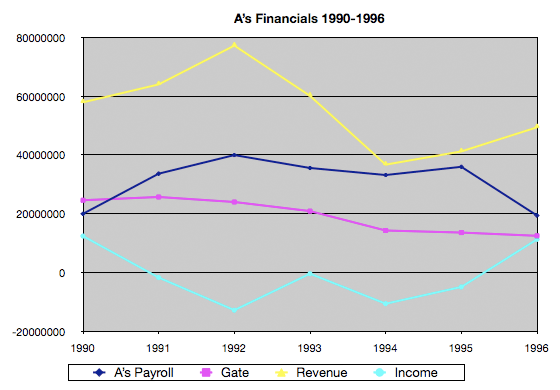
financials-1990_1996

The light blue line is the leading indicator. 1990, the team’s last World Series appearance, was the last profitable season during the Haas era. From then on, the team lost a combined $30 million in 5 seasons. That’s the equivalent of an entire season’s payroll back then. Currently, the average payroll is around $90 million. Can you imagine the A’s losing $90 million during a 5-year span? Fortunately, revenue sharing is around to help the bottom line, though even with the annual revenue sharing receipt, the A’s would still lose money since their receipt would drop proportionally as their revenues rose.

It’s good to remember the on field successes and the work done to get them. Throughout my childhood, I listened to Bill and Lon on my parents’ 70’s-era Sears console stereo in the living room while I did my homework. I still remember KSFO often using Madonna’s “Borderline” as bumper music between innings. As great as these memories are, the successes did not occur in a vacuum. Incredible amounts of money were spent, from the core of the team to the annual rent-a-slugger and solid veteran 4th starter to having both legends King and Simmons in the booth. It’s not only impractical to expect that of Lew Wolff, it’s patently unfair.

Every owner does what he can with the cards he’s dealt. Wolff signed off on a $79 million payroll in 2007, only to have the team beset with injuries. Hope springs eternal this season, but already we’re seeing the injury bug decimate the pitching staff. (Side note: let’s not get too excited about Anderson or Cahill yet. For every Big Three, there’s also a Generation K – knock on wood.) If the team manages to stay competitive during the first half, it’s likely that we’ll see a big arm rental along with Matt Holliday stay through the end of the season. If not, guys will be sold off and we’ll go back solely to grooming young guys who can hopefully stay healthy. We know that Billy’s going to try to get value whenever and wherever he can. The cycle will repeat itself continually until a new stadium is built. It’s sobering, but those are the Wolff/Fisher group’s – and our – cards.

49ers, Santa Clara close to terms

Not to be left behind, the Yorks and Santa Clara are back pumping up the 49ers stadium plan. While the basic structure of the arrangement is the same, the numbers have changed a bit. The vote was to be either binding or advisory based on the availability of a completed EIR. By pushing the referendum back to June 2010, all EIR/CEQA should be completed by then. The projected subsidy, which has been estimated at anywhere from $109 million to $180 million depending on certain options, has now been trimmed to less than $90 million. The total price tag is projected to be $900 million.

Why wouldn’t the 49ers simply foot the bill for the remaining $90 million, since it’s only 10% of the budget? True to form, Jed York says that’s the NFL’s requirement. Ever since the stadium building boom, the NFL has required some level of public investment if the league tapped into its G-3 fund. The league’s rationale is that it’s the way for a municipality to get skin in the game. Even though G-3 is gone, it will be replaced by something else and apparently, similar rules will be applied.

It’s been over 20 years since the last publicly financed, voter approved sports venue in the Bay Area. That venue was San Jose Arena. Since then, all publicly financed stadium initiatives have largely failed. Let’s recap:

  • 1989: San Francisco’s Prop P (China Basin GIants ballpark) lost by 2,000 votes
  • 1990: Santa Clara County Giants ballpark measure (1% utility tax) failed
  • 1992: San Jose Giants ballpark measure (2% utility tax) loses in a landslide
  • 1995: Oakland Coliseum renovation to bring back Raiders – done without a vote, notoriously unsuccessful
  • 1996: Coliseum Arena renovation for Warriors – probably the most successful to date, high costs to operate venue make it less attractive for non-NBA events compared to HP Pavilion
  • 1997: Proposition D passes in SF, providing $100 million towards a new Hunters Point stadium for the 49ers. Development was scaled back, project became stillborn
  • 2001: A’s efforts to work out a publicly-financed ballpark deal in Santa Clara die due to mistrust of team among City Council members

It’s hard to fight that kind of track record, isn’t it? Regardless, the Niners will forge ahead anyway. I’d like to think that the A’s have learned from this, but I wouldn’t put it past them to put out a publicly financed ballpark deal in San Jose. If that happens, I’ll be first in line at the ballot box to vote it down. Given the state of the economy, I’d do the same if I were a Santa Clara resident come June 2010.

Note: I omitted Pac Bell Park because the public money involved went towards infrastructure, not the stadium proper.

“I claim this city for Mother SF!”

The gloves are out. The line in the sand has been drawn. Honestly, I’m hoping for a Hamilton-Burr duel. Then again, maybe not. Andrew Baggarly reported today that the San Francisco Giants have just purchased a 25% stake in their high-A little brothers, the San Jose Giants.

The Giants will claim one of four seats on the San Jose club’s board; if they agree to purchase a controlling interest, they would occupy three of five board seats.

Industry sources pegged the value of San Jose’s franchise at $7-10 million, making the Giants’ investment worth an estimated $2-3 million.

San Jose officials are not amused with the Johnny-come-lately appearance of the mothership’s
“investment.”

Reaction from San Jose city leaders was not warm. Mayor Chuck Reed will not participate in Thursday’s event at Municipal Stadium, according to an aide.

Councilman Sam Liccardo, a big-league-ballpark booster who has been meeting with community leaders to draft a pitch for the A’s, was blunt about the Giants’ move, calling the timing “notable.”

“The only time I see pitchers from the Giants in San Jose is when they’re on a rehab assignment,” he said. “And this pitch looks like an attempt to rehabilitate a San Francisco ballclub’s image in San Jose.

“Everyone’s assumption is that this is a plea to the commissioner, and I don’t think it changes anyone’s mind in the end.”

San Jose is a bit upset because the Muni renovations, which the City and the SJ Giants have been arguing about for years, could’ve been made more complete had the mothership lended a hand.

This move is not about reinforcing the Giants’ major league territorial rights. It is about C-A-S-H. It looks like the baseball equivalent of flipping a house. Look at it this way. When a public company, like recent example Genentech, faces a takeover, the interested buyer (Roche) has to pay a premium over the prevailing market share price. In Genentech’s case, the premium was 16%.

I’ve mentioned this in passing, but I’ll say it again: Both the SF and SJ Giants would need to be compensated if the A’s moved to San Jose. Obviously the terms would be different for each team. The parent team’s $2-3 million investment could yield $1 million or more if they played their cards right, not including the costs associated with moving the team to a smaller market – say the North Bay, for instance. Should they raise their stake to the 55% controlling interest, they’d get even more.

Who’d figure out the compensation? I’m guessing the blue ribbon committee that’s sorting out the East Bay situation. Smart move, Neukom. Smart move.

Tight. Really Tight.

In light of the news emanating from San Jose’s Redevelopment Agency yesterday, I figured it was time to do another mockup. This time, the ballpark has a ENE orientation, almost the same angle as the Coliseum.

The yellowish area to the left is the PG&E substation parcel. Its irregular shape is caused by the easement that extends north to Cahill and W San Fernando Streets. The easement is undeveloped save for a power transmission pole which connects to the rest of downtown. Both this easement and the small Caltrain-owned parking lot to the west are probably going to be acquired by the city as part of an updated Diridon/Arena Area plan. I don’t necessary expect the land to be used for a planned high speed rail terminal. There’s more room north of the existing station for that.


View Larger Map
I expect the Cisco Field footprint to be even smaller than what I’ve posted because my model doesn’t employ long cantilevers or columns like the 360 model we saw previously. Going small comes in handy in this case.

Specs are still the same:

  • 32,000 seats plus
  • 1,000 or so standing room
  • 40 suites
  • 40 minisuites
  • Playing field 12 feet below street level


The 4 acres south of the ballpark have to be tantalizing as they’re a blank slate. Some parking will go there for sure. I wouldn’t be surprised if the A’s/Sharks/SJRA figure out a way to stick a concert hall down there.

Comment away (please stay on topic).