SJ Bizjournal articles

Update:
I’ve had a chance to read the articles (thanks to all who have helped) so I can now give me take on them:

  • The NUMMI article introduces a new factor that I hadn’t been aware of – the building of a hybrid car plant. If Toyota’s smart they’ll move forward with the hybrid plant, despite the high costs of doing business here. The fact that a Prius or Highlander hybrid is actually built here in California is pure PR gold for Toyota and should increase sales volumes, especially within the state. They’d also finally be able to do something constructive with the land without worrying about encroaching development. If NUMMI is still concerned about residential development next to the plant, having another plant running 24/7 next door should eliminate the threat. Whatever their plans are, a plant sounds better than having a parts distribution center, which was under consideration when I called NUMMI last year.
  • Still, the NUMMI site has to look attractive just for the potential to a future BART, even if there’s no timeframe for BART to come to Warm Springs right now. As I understand it, Santa Clara County leaders are redoing their plan to scale the Santa Clara extension back to Milpitas or Berryessa. That would impact ridership estimates, but at least this time they could look realistic. Since VTA’s light rail ridership is up and should continue to rise, it might be a good time to explore and emphasize a LRT-to-BART link at the Great Mall. Fremont Mayor Wasserman seems to have his preference of sites – Pacific Commons.
  • Some of you have asked me if there’s a possible that both sites (or portions thereof) could be used – one for the ballpark and village (NUMMI) and the other for housing (PacCom). I suppose it could be done, but it would require two new and completely different environmental impact reports, marketing changes and new infrastructure requirements. I won’t rule it out, but it looks prohibitively expensive unless someone can figure out a way to divvy up the land appropriately.
  • As for Santa Clara County Assessor Larry Stone, he’s always been the head cheerleader. As one of the leaders of Baseball San Jose he’s always been out in front, despite the political machinations that have occurred within. Notice that he stops short of outright slamming Fremont, other than to say that downtown (San Jose, that is) is preferable to suburban. There’s a reason why…


As I am not a print subscriber, I don’t have access to the new articles from today’s edition of the Silicon Valley/San Jose Business Journal. And considering the fact that I am nearly 7,500 miles away from a local newstand or vending machine that carries the paper, I’m pretty much S.O.L. on the articles. In fact, last week I was asked if they could use one of my overhead graphics. Alas, I was “in the bush” so to speak. If one of you gentle readers would be nice enough to recap the articles and send me your thoughts, it would be much appreciated.

Here are the links:

Absent the actual text, I’ll refrain from commenting on the articles, except that the headlines are rather salacious.
Two words: UGH. LEE.

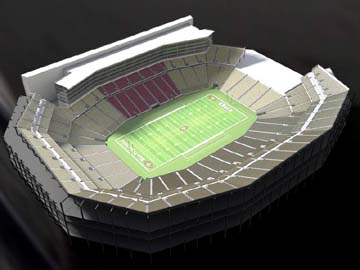
I just got a look at HNTB’s concept for the new 49ers stadium:

hntb-stadium1

How uninspiring. It doesn’t help that the gold seats appear beige in the picture. Gone are the sweeping lines of the HOK design. So is the Mills mall, and with it, probably the $100 million that was promised for the project by the city (because of the jobs that come with the mall). The boxy layout is eerily reminiscent of work done by HNTB across the bay, otherwise known as Mount Davis. In fact, take the entire sideline section in shadow. Does it not look just a little like the Coliseum outfield?

It should be pointed out that like the A’s ballpark concept by 360, there’s no exterior treatment on this stadium, so it can’t be judged by a face that doesn’t exist. Still, while stacking the suites and boxes on one side of the field is commendable for cost-cutting and better sightlines for fans, the whole package can’t help but look a bit like a bloated SEC college football stadium. The concept works well for Ford Field, where it’s wrapped in a neat gimmick – the use of an office building in the stadium bowl covered by a dome – but it doesn’t look right in this case. That big structure behind the suites looks like a retaining wall to prevent the nearby hill from collapsing onto it.

Supposedly the design is flexible enough to work as an Olympic stadium should the time come in 2016. I can see where the use of large numbers of portable seats (also like Mt. Davis) could make such a concept work. The open north end should facilitate this as well. But does anyone remember what Atlanta’s Olympic Stadium looked like prior to its conversion to Turner Field? Thought so. This design just deadpans “bland.”

Fox/TBS ink new national TV deal

In case you missed it in the past couple of days (I did while I was flying back to Australia – again), MLB sewed up its national broadcasting rights for the next seven years by inking deals with Fox and TBS. The actual money being doled out to MLB by the networks is actually going to be about the same if not less than the previous Fox-only contract. Let’s tally up the national TV money:

  • Fox – ~$250 million per year for 7 years. Includes World Series, All Star Game, national Saturday broadcasts, and alternating ALCS and NLCS based on the year.
  • TBS – ~$150 million per year for 7 years. Includes ALDS and NLDS, and whichever LCS Fox does not pick up. Deal includes 26 Sunday afternoon games (new schedule, not the ESPN Sunday night game) per season. Atlanta Braves broadcasts will be reduced, which probably means Turner South will take over many of the Braves’ games.
  • ESPN – $296 million per year for 7 more years (new deal started this season). Includes Sunday night and Wednesday night broadcasts along with certain marquee and late season matchups (usually Yankees-Red Sox). Does not include playoff games.

Combined, it comes to upwards of $700 million per year through 2013 ($5 billion total), not including money gotten from the Japanese TV deals, internet streaming through MLB Advanced Media, and various other rights fees. Still, this pales in comparison to the NFL’s whopping $3.7 billion per year in national TV rights. Of course, that’s comparing apples with oranges since MLB makes up the difference with tremendous amounts of locally generated revenue, including local TV rights.

The news sets the table for the upcoming CBA negotiations, which as mentioned before, are more a battle between big and small market owners than between owners and labor.

Alioto named Quakes Exec VP

In a move that foretells the A’s acquisition of Earthquakes v. 3.0, the team’s sales and marketing veep, David Alioto, has accepted the newly created position of Executive VP of Earthquakes Soccer, LLC. According to the press release, Alioto “will oversee business operations, sponsorship opportunities, develop sponsorship opportunities and assist in venue development surrounding A’s ownership’s attempt at securing a soccer specific stadium in the Bay Area for a Major League Soccer franchise.”

Basically, it means Alioto will be doing for the Quakes what Michael Crowley currently does as President of the A’s – except there’s no team yet, of course. Good luck to Alioto on negotiating the extremely murky waters that define San Jose politics. Alioto may end up leaning a bit on both Crowley’s and Lew Wolff’s South Bay local status to get the SSS deal done. I’d like to see the Quakes get the benefit of some clever McCann-Erickson ad campaigns, the same kinds used for the A’s the last couple of years.

From a strategic standpoint, there’s something attractive about being able to pool certain parts of operations for the two teams. The seasons run concurrently, so some stadium operations can be consolidated. Sponsorship opportunities can be pitched to cater to the different audiences. Packages of club seats and suites may look attractive if they’re for two teams (and all related venues’ events) instead of just one. The ballpark financing concept is already out-of-the-box, why not sales as well? (Trivia note: According to Andrew Zimbalist’s splendid book In the Best Interests of Baseball?, MLB Advanced Media runs the MLS website.)

Coliseum BART lot mockup

I promised this a couple weeks ago, so here it is:

According to city records the combined parcels that make up the BART lot make up some 8-9 acres, 10-11 acres including some the extra streets that run through the lot. The neighborhood northeast of the ballpark has no real buffer separating it from the lot aside from some small auto shop/garage-type buildings. Residents there would be impacted by noise and possibly light pollution. The only ways to orient the field are north (shown), east (similar to the Coliseum’s field orientation), or south/southeast (field facing Hegenberger Road).

Purdy puts Wolff at top of power player list

The Merc’s newest edition of their “Bay Area’s Most Powerful Sports Figures” is due, and columnist Mark Purdy has placed Lew Wolff at the very top. That’s not surprising. Wolff currently controls the fates of two sports franchises – the A’s and the future Quakes – and his deals may indirectly affect revenues for all other major pro sports teams in the region due to club/suite and ad revenues.

While A’s ownership including Wolff (and family, I’m sure), President Michael Crowley, and GM Billy Beane have been living it up in Germany recently while attending the World Cup. Undoubtedly, they’ve gotten pointers looking at new and refurbished stadia, many of which hold a baseball-friendly capacity of 40,000. Before soccer fans get their hopes up, costs will prohibit a European-style fully-enclosed, mostly roofed stadium from being constructed here (unless someone other than the A’s is willing to foot the bill). In the meantime, putting out a shingle for an Earthquakes office and retail store could help salve the wound created when the team Mayflowered its way to Houston.

Purdy takes a position that is a definite shift from what he has argued in the past. Instead of pitching Fremont as a diversionary tactic while the A’s deal with San Jose, Fremont is meriting real consideration. As the greatest media flagwaver for the San Jose effort, this is almost downright earthshattering.

Back to the list. Bay Area sports history has had a huge range of personalities and styles among its power brokers, whether they were brilliant (Wally Haas, Peter Magowan, Eddie DeBartolo), inept (John York, Chris Cohan, Steve Schott), or somewhere in between (Al Davis, Bob Lurie). Superstar players and coaches also inhabit the list, as do some non-print media types. Wolff’s ascent to the top of the list is a testament to how Wolff understands and plays the media game. Other than Trib columnist Art Spander, Wolff has Bay Area media eating out of his hand. He’s skillfully given bits and pieces of his vision, never giving too much away and always leaving the curious (like me) wanting more.

Purdy ends the piece with could be interpreted as a bit of foreshadowing:

“A year from now,” Wolff says, “I’d like to be deep into the process of getting environmental approvals for a baseball park. And for soccer, I’d like a place we can play for the following season, even if it is just temporary.”

To me that sounds like a Fremont ballpark and Spartan Stadium (temporarily for the Quakes). Even if Ron Dellums’ staff starting work on a proposal the minute Ignacio De La Fuente conceded the mayoral election, an EIR/study couldn’t get fast-tracked to start in Oakland before the end of 2007.

Estuary plan moves forward

After a long give-and-take process between developer Signature Properties and Oakland-based environmental and affordable housing groups, the long-awaited Estuary (Oak-to-Ninth) development appears to be moving forward. Only a city council vote next Tuesday remains, and once that happens, you can officially cross one more site (one touted by Ignacio De La Fuente last year) off the list.

I was excited by the Estuary site last year as well, at least until I understood the grueling process it took to get to the actual planning of the development. This included passing legislation at the state level to approve of the land sale and numerous hearings with the aforementioned community groups so that they could have a say in the plan. Issues such as the height and placement of buildings as they related to the view from the hills, the amount of public parkland, traffic, and the preservation of historic structures all came into play.

One of the keys to getting this deal done was Signature’s willingness to pay for site cleanup. However, they got a huge discount in the land price as a result. The Estuary plan’s size makes it a better comparison to a potential Wolff-Fisher development somewhere than anything else in the works in the Bay Area. Compromises were made by all parties to get it done, and it took a long gestation period (ongoing). One neat little concession is that Signature is going to allow around 15% of the housing to be termed low income and senior housing – but it doesn’t have to build it all at the Estuary. It could shift some of the units to one of its other Oakland projects, though it would have to build more of them. Considering the prime waterfront location, this shift sounds likely.

Dellums wins outright

Thankfully, cooler heads prevailed in an election whose winner had a 154-vote margin. Ron Dellums is now Oakland’s mayor-elect, and in a press conference at the Oakland City Center Marriott, he continued his message of hope that, unfortunately, lacked much detail. He argued that predecessor Jerry Brown’s 10K plan was not enough, and that he wanted to have 100,000 new residents in the downtown area – though he didn’t say when. And when I saw that Dellums will create task forces to study a variety of issues, I cringed. For Oakland’s sake, I hope Dellums really follows through on his promise to be a galvanizing, uniting force for the city. Talk about public-private partnerships could set off some heated debate, as Oakland residents may not take too kindly to certain types of projects – of which a ballpark and ancillary development may be one. Note: An A’s development simply won’t be about throwing some land at Lew Wolff. Wolff has set the price that he’s willing to pay for land – around 25 cents on the dollar. The question is, “Is this doable in Oakland?”

Dellums’ speech apparently contained nothing about the local sports franchises, so it’s hard to say where he’s leaning. In the end, the A’s future in Oakland may well depend upon whether or not Dellums believes Wolff/Fisher want to keep the team there. Hopefully, Dellums will recognize how much pride the team brings to the city, and that the team is worth the mayor-elect trying to “break his pick” to keep the team in Oakland.

OUSD site finds a developer

Oakland Unified School District is on its way back to being on its own feet, with labor issues put to bed and money that will come in from the sale of OUSD’s 8.25-acre mini-campus near Lake Merritt. According to new reports, a partnership of East Coast firms Terramark and Urban America have put together the winning bid on the property. They intend to build a mixed-use development containing 1,000 housing units and commercial space. The district needs to pay off an emergency $100 million loan the state lent a few years ago, so it’s likely much of the sale price will go towards that debt. The price of the land is expected to be between $55 million and $70 million.

OUSD had originally intended to share the space with the eventual developer, but it now appears that will not be the case. At the bottom of the district’s memo (first link above) is a mention of moving into or building new facilities somewhere, including downtown Oakland. Unclear is the fate of the five (mostly small) schools residing on the campus, though the memo states that La Escuelita Elementary will be kept in the area.

Long-time readers may remember that over a year ago, I declared the OUSD site unsuitable for a ballpark due to its size and unusual “J” shape. So it’s not as if there were some major opportunity to build a stadium on the OUSD site. The link is more tangential – it’s less one prime site on which a decent-sized “village” concept could be built, even if it weren’t co-located with a ballpark And if you’re looking to get something like that done in Oakland, you’ll need to assemble some decent, easy-to-acquire land to make it happen.


One other thing – thanks to those who have been responding with the latest news on the Oakland mayoral race. It looks like the final tally won’t be out until the end of the week, and so far everything points to a runoff in November. That could reduce a key advantage Oakland would’ve had even though Dellums couldn’t take office until January. Now he’ll have to throw considerable resources into a fall campaign instead of lining up a transition staff well in advance. However, we should still remember that as important as this political jostling is, it doesn’t supplant the two most important factors: Is there a good site? and Who pays for it? Everything else, including transportation concerns, pales next to those questions.

The New Landscape

While the A’s ballpark future was not resolved coming out of Tuesday’s primary, changes occurred that surely will affect future efforts by cities to attract the A’s. At the end of the day, the lesson to be repeated ad nauseum was: Don’t pin your hopes on an election.

  • As expected, Ron Dellums was elected mayor of Oakland with a majority, thereby avoiding a runoff. While he won’t take office until January, don’t be surprised to hear rumblings about his well-heeled supporters and associates working on big-ticket projects. Dellums has friends in both city and county government. What’s not known is how nice Dellums will play with State Senator Don Perata’s minions. Current mayor Jerry Brown always had an uneasy alliance of convenience with Perata that at times strained under both pols’ visible agendas. That, and the reality of dealing with dirty, day-to-day business as a mayor in Oakland, will prove whether Dellums’ vision for Oakland can translate into real action. As an outsider, I’d like to believe Dellums could really foster the city’s growth, but he’s going to have to make some very tough decisions about issues like police staffing and presence, affordable housing, big box retail, redevelopment of industrial areas, and the changing demographics of the city. In other words, I’m glad I don’t have that job.
  • In San Jose, the ballpark effort was dealt an enormous blow with county voters’ rejection of the overly broad Measure A. That’s not to say that BART-to-San Jose would have been some great problem solver (the difference between opening day at a ballpark and the BART launch would have been several years), but it would have at least provided some relief along the 880 corridor. BART proponents now have to seriously think about either pulling back the cost of the $4.7 billion project or even scrapping it completely. There’s talk of limiting BART to only Milpitas or Santa Clara, which could cut the extension’s cost in half or more. However, that would limit the project’s scope, reduce ridership projections, and force VTA to come up with a completely new justification for the extension. I’d be more optimistic about SJ’s chances if the High Speed Rail initiative had any momentum behind it, but it’s headed for a November election with scant support while competing with the governor’s and legislature’s other bond initiatives.
  • Fremont will be affected if BART-to-San Jose is either dropped or delayed. A note on the WSX extension page has the service starting to run in 2012 or 2013, which could be within a year or two of a ballpark opening. If the WSX extension doesn’t happen and the ballpark does, there will be a real infrastructural issue for Fremont’s government and citizens to consider. There is no direct, one-road route between the Pacific Commons site and Fremont BART, and the main arteries running in the area (Stevenson Blvd, Mowry Ave, Fremont Blvd, Paseo Padre Pkwy) could be severely impacted by increased bus traffic – that is, if fans choose to transfer between the BART station and Pacific Commons using a bus. For now, let’s dismiss a rail or trolley-based option due to cost. How much will infrastructure such as transportation and increased police cost in the end? How big of a price is Fremont willing to pay to get on the map?

Think of how all of that comes into play in the A’s ownership’s decision making process. So many variables and dependencies make it difficult to valuate a potential site. The natural tendency is to move in the direction with the least resistance. That appears to be Fremont at this point, but as the Fremont plan gets fleshed out and citizens are better educated about the issues, it could become contentious. Then again, maybe not. No matter where I am (this week I’m overseas), expect comprehensive coverage here. And thanks to all of you who have written in with your support.