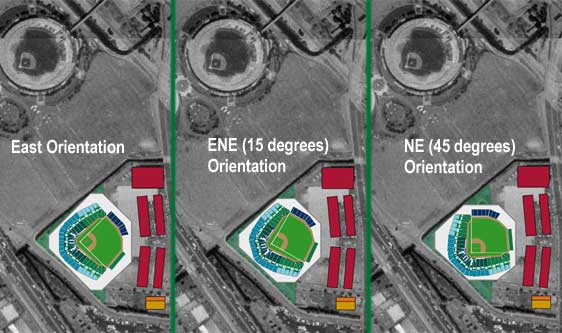
Ballpark mock-up


This is a roughly scale projection of what a new 40,000-seat ballpark would look like on the new property. Notice how it’s a good deal larger than the 8.5 acre parcel owned by the JPA. Mixed development would occur beyond the outfield walls along Hegenberger Road.

In the next mockup, I’ll add a possible development model.

The A’s and Revenue Sharing

It looks like this season the A’s will be the recipients of a handsome revenue sharing windfall:

Unlike the NFL, baseball might not share all of its revenue. But the 300 million bucks a year it does share now are having a major effect….The A’s, according to sources, will get about $19 million.

Now before anyone starts jumping up and down screaming “We won the lottery!” it’s important to understand what that revenue sharing figure means in the grand scheme of things. According to the Major League Agreement, all thirty teams have to share a third of their locally-generated revenues (tickets, ads, local TV/radio). The money is then pooled and split 30 ways. So if the A’s paid in $15 million (1/3 of a rough estimate of $45 million in local revenue) and got back $34 million, their revenue sharing rebate is $19 million. If Jayson Stark is right about the following:

And that doesn’t even include the $20 million or so each team collects in national TV money. Or the $4 million they’re about to get from the new XM radio deal. Or the $6 million to $8 million each team gets from the swelling central fund.

… then the A’s should have gotten well over $100 million in revenue for 2004 when merchandise sales and other national streams are included. That makes sense considering the A’s pulled $110 million in 2003 according to Forbes. Remove about $40 million in infrastructure costs such as player development, front office costs, rent on the stadium and spring training facilities, and the team’s left with $60-70. Most of that will go to players. Some of it may end up becoming a small profit for the ownership group. Chances are that the payroll and revenue will remain the same or dip slightly for 2005, and the cycle will continue.

More on Coliseum South Lot

After checking the Alameda County Assessor’s property database and the City of Oakland’s city-owned property list, I’ve come to the somewhat educated conclusion that most of the target property is not owned by the Joint Powers Authority or any other public entity.

The only part that is owned by the JPA is the overflow lot southeast of the drainage channel that runs along the southern border of the Coliseum complex. Below is a photo with that parcel highlighted (in green):

coliseum_south

The land is about 8.5 acres and is mostly unimproved. Electrical transmission lines run through it, posing challenges to the JPA and developers. How do the lines get rerouted? Who pays for it?

The remaining land (17 acres) would have to be purchased by the team or purchased by the JPA and given to the team. My guess is that it would be the latter. Additional cost of land? $10-15 million, based on the price of the land at Hegenberger Gateway.

By the way, 8.5 acres is not enough space to build a new ballpark in the modern era. 12-15 acres minimum is required. SBC Park sits on a 13 acre footprint.

Amtrak to the Coliseum

This spring, fans will have another transportation option when going to the Coliseum. In 2003, the City of Oakland and Amtrak partnered to build a new train platform immediately east of the stadium. The $4 million project, called the Oakland Coliseum Intercity Rail Station, is being built to provide an anchor for the transit hub concept being envisioned for the Coliseum BART station area. Eventually, the transit hub would link BART, Amtrak, AC Transit buses, and the People Mover that may be built to carry passengers in between the hub and Oakland International Airport.

The Intercity Rail Station will be a fairly spartan affair, with a single 600-foot platform on the easternmost-track, a shelter, and 35 parking spaces. It is unclear how these spaces will be used and regulated during games, which could become an issue since at least a few hundred fans per game use the Coliseum BART station as free parking for events (BART does charge for Raiders games and high attendance A’s games).

The Capitol Corridor run by Amtrak is important because it is the only direct public transportation link between Oakland and San Jose. Amtrak runs 22 trains per day betwen Rocklin and San Jose on this route. With the completion of track improvements on the East Bay portion, the service will expand slightly, mostly benefiting South Bay passengers.

The price of a trip to the Coliseum on the Capitol Corridor is another story. The regular round-trip fare between San Jose Diridon Station and Oakland’s Jack London Square station is $22, which to me is prohibitively high. However, Amtrak does provide frequent traveler discounts, include a 45-day/10-ride ticket. Between JLS and Diridon the card costs $63. Between the Coliseum and Diridon it might cost $59. I’ll check to see if there are any restrictions on the card’s usage, such as if it can only be used once per person per trip or if can be used for multiple persons on the same trip. If it’s the latter, it could prove to be a very competitive option as a family of five could get to a ballgame for less than $6 per person each way. A regular roundtrip on Caltrain between Diridon and San Francisco is $11, or $9.35 if using a 10-ride ticket. BART costs $6 roundtrip between Fremont and the Coliseum, plus $7 roundtrip on VTA‘s Express #180 bus between Fremont and Diridon.

A trip from Fairfield to Oakland JLS costs $22 roundtrip as well. Sacramento is $34.

New stadium issues affecting Stockton Ports

The Stockton Ports, who just a few months ago became the high-A affiliate of the A’s, have been complaining about the $22 million ballpark being built for them on the banks of the Stockton Deep Water Channel. Among their complaints: the ballpark is too big (too many seats). Is it justified? Judge for yourself.

For those of you wondering why the A’s high-A affiliate is no longer in Modesto, it had much to do with being lured by – that’s right – a fancy new ballpark. What has Modesto done to get a new team? Why, they’ve gone Nuts.

News from the last several days

Most of these articles are about the sale of the A’s from Steve Schott and Ken Hoffman to the group led by Lewis Wolff and John Fisher.

Wolff: A’s ballpark already in works
3/14

A’s sale clears next-to-last hurdle 3/12

Wolff: Athletics’ ‘focus’ is in Oakland 3/12

New A’s owner says he will control planning of ballpark 3/11

A’s suitor requests reins for new park 3/11

Group resurfaces for A’s ballpark bid 3/8

From the latest (top) article:

“Here’s a major quid pro quo,” Wolff said. “I promise you, we will not write a check to the Giants. I can tell you that we are not planning to buy out the Giants’ rights.”


This is important because it is one of the main arguments for San Jose baseball proponents. Since Peter Magowan of the Giants is not willing to name a price for territorial rights and Lew Wolff isn’t willing to pay for them regardless, it would appear that a move to San Jose is a non-starter at this point. Still, the Baseball San Jose group continues its efforts just in case the Oakland efforts fail to produce a mutually agreeable ballpark plan.

New Ballpark site

Group resurfaces for A’s ballpark bid

In fact, little has been done since Wolff, who had been investigating the possibility of a new park as a minority owner, designated the Coliseum area as the best available site last summer. The park would be built on the south side but Dean doubted it actually would be in the existing parking lot, as was once thought.

“You’d have to have a parking alternative with all those spaces gone,” he said, “and the idea of building a parking structure doesn’t work. First, it would be prohibitively expensive and then, it would be a nightmare with everybody trying to leave at the same time after a big game.”


This is the first specific mention of the idea that the ballpark will not be built on the existing Coliseum grounds. In the 2001 study done by HOK for the A’s and Oakland, the Coliseum option had the ballpark built on the north (66th Avenue) side of the park.

Below is an aerial photo I modified to highlight the new site. The old Coliseum option would have placed the ballpark directly north of the arena (in the dark parking strip). Hegenberger Road runs along the right (east) side of the picture. BART is in the upper-right corner. 880 (Nimitz Freeway) is west of the arena.

coliseum_south

The site is around 25-26 acres in size. Most of it has been fenced off to prevent vehicle access due to frequent use as a site for sideshows and before that, raves. The only active tenants on the combined site are the Denny’s at the NW corner of Coliseum and Hegenberger, and the EDD/office building at the NE corner of the lot. I’m not clear on who exactly owns the properties in question, but I should have that info soon enough.

What? and Why?

Welcome to the new A’s Ballpark blog. My name is Rhamesis Muncada, and along with being a lifelong A’s fan, I have always been a fan of the architecture of stadiums, arenas, theaters, or any venue where people gather to watch entertainment. For as long as there is an effort, I will keep this blog updated with news and links to articles about efforts to build the A’s a new ballpark. First, I’ll post a couple of statements about myself.

1. I am not a season ticket holder, but I go to 30-40 games a year. The A’s attendance patterns make it easy for me to go to games as a spur-of-the-moment thing. If a new ballpark is built for the A’s, I would most likely become a season ticket holder. I also attend roughly a dozen Giants games per year as well.

2. It is my belief that low revenues directly related to pricing and attendance at the Network Associates Coliseum have led to the team’s inability to keep major free agents. I am astonished that General Manager Billy Beane and his staff have been able to keep the team competitive for six years straight even with the problems that a low-revenue team faces every season. That said, a new stadium with more attendance and revenue streams could very well help make the A’s more competitive, though I acknowledge that a new ballpark is not a guaranteed panacea.

3. My focus is entirely on a new ballpark. While I understand the “Moneyball” approach to building a team and have faith in Beane’s methods, there are other blogs and fansites that do a comprehensive job covering topics such as OPS, WHIP, and Range Factor. There are links for those sites on this page.

4. I do not support new general taxes such as sales or utility taxes to fund ballparks. I believe that ballparks should be able to fund themselves in large part, with minimal public investment in the form of limited infrastructural improvements. I would support a bond measure to fund ballpark construction if debt service on those bonds is met by revenues obtained through activities at or related to the ballpark. (Why the Tax Reform Act of 1986 largely prohibits this.)

5. I prefer to see the A’s stay in Oakland, and have hope in new owner Lewis Wolff’s efforts to get a new ballpark built. However, I hope that if a new ballpark can’t be built in Oakland, it can be built elsewhere in the Bay Area so that I can continue to support the team. This includes San Jose, which is not currently available due to the Giants’ territorial rights over Santa Clara County.

6. Yes I am named after a pharoah.

7. I live in San Jose. At A’s games, I usually sit in the bleachers.