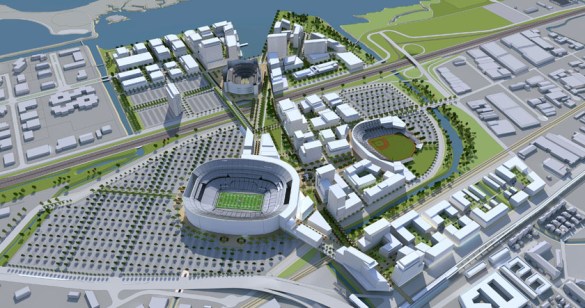
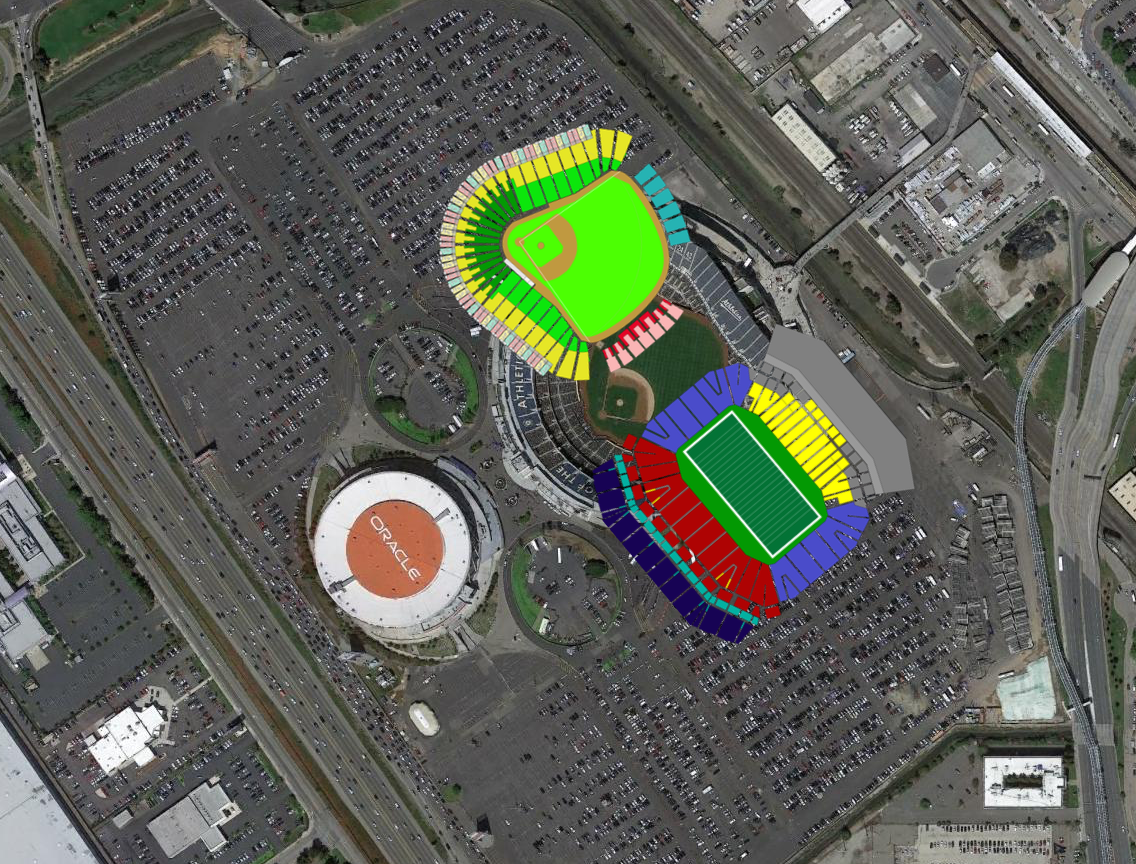
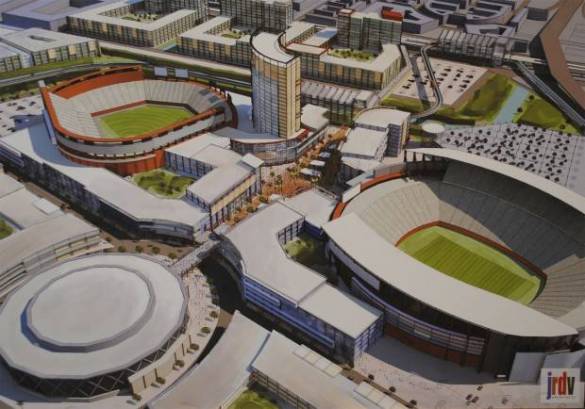
We all have different opinions about what’s happening with the teams at the Coliseum. One or more will likely leave, maybe one or two stay, maybe everyone leaves or stays. Perhaps the remaining Coliseum debt will be paid off by private interests, maybe not. There are different timelines for each team, different project costs, different levels of financial wherewithal, and differing approaches. And that says nothing about a third party like Floyd Kephart, who has to figure out how to keep a team and make money off the deal, or the City and County, who are scared to death of being ripped off as they were 20 years ago.
Take all of those factors, throw them all into a bowl, mix them up, and see what you get out of it.
Kephart announced that he submitted his June 21 deliverables on time. City/County/JPA will take 20 days to review the documents, and decide after that review whether to continue with the plan as offered by Kephart, with no leaks or public release prior to that date. For me it’s frustrating, but I get their caution. Coliseum City is extraordinarily complex, so due diligence is of the utmost importance.
While I’m certain many behind the Coliseum City effort have been nothing but sincere in their desire to retain teams while revitalizing Oakland, there’s also been an underlying feeling that the whole thing is a stalling tactic. To that end it has worked to an extent. Both the A’s and Raiders could’ve been gone as early as after the 2013 seasons thanks to their short-term leases. Instead the Raiders are in Oakland through at least 2015, and the A’s could be in the Coliseum until 2024. Yet while Oakland treads water, the teams aren’t standing still… actually, they are standing still. The A’s chose to wait this process out in hopes of getting the Coliseum all to themselves, a strategy that Andy Dolich called “intelligent inaction” on YSTL tonight. They pushed for the lease extension last year, and so they have a sort of first-mover advantage because the lease is solid and they have fewer complications than the Raiders. The Raiders could’ve taken a similar approach, but Mark Davis chose to use one-year leases to help spur Oakland – a strategy that hasn’t worked so far. Meanwhile, Davis has given some broad strokes about what he wants:
- Raiders would buy some of the Coliseum land (for how much and for what purpose aren’t clear)
- City/County/JPA would provide free infrastructure, costing $100-140 million
- City/County/JPA would retire Mt. Davis’s debt
There’s still no word on how exactly the funding gap on the stadium would be addressed. I figure that 1 & 2 are related and would offset each other somehow. The Mt.Davis debt has to be added to the total cost of the stadium, as the City and County have been adamant about not subsidizing the old venue more than they have to. Does that make the gap $400 million? $500 or $600 million? Hard to say at this point.
This project has been marked by a series of decisions made on all sides. The teams chose not to negotiate, waiting either for a stadium to fall into Mark Davis’s lap or for the project’s demise. The City chose to partner with three different entities in hopes of finding someone that had the resources and connections to make the project take off. The County chose to sit out for three years, not becoming a party to the talks until this spring.
Ironically the City/County/JPA, the Raiders, and A’s all would benefit if they didn’t have to make choices of their own free will. If the Raiders leave on their own the public sector gets a little political cover, since they can point the finger at Mark Davis for abandoning Oakland. Should the A’s wait and the Raiders put together a stadium deal, the A’s can say that the Raiders caused hardships, forcing the A’s out. And the Raiders can point to either the A’s no-sharing stance or Coliseum City’s expected demise as their own obstacles to staying in Oakland. Even when they don’t actively decide, there are consequences.
Try as they might, the big decisions can’t truly be avoided. Because in multibillion dollar stadium deals just as in life, eventually if they don’t make choices, someone else (NFL, MLB) will make choices for them.
—
P.S. – At the end of the Dolich segment he expresses amazement at how the City/County/JPA aren’t in direct negotiations with both the Raiders and the A’s. That sentiment is completely understandable if the goal is to wrap up a deal ASAP. The problem is that the teams aren’t on a level playing field. If both had separate stadium projects with similar costs and similarly sized private contributions, working out fair deals for both should be simple. That’s not the case here because of the football stadium’s massive funding gap. If the public sector attempts to make any kind of public contribution (land, infrastructure, direct or indirect funding) for the football stadium, you can be assured that Rob Manfred will ask about the same kind of contribution for the ballpark. He’ll have every right to ask, and he’ll have every right to be severely disappointed if City/County/JPA can’t deliver. That’s the danger in making the deal.


 newballpark.org