Stan Kroenke is an extremely wealthy guy. He is worth more than $6 billion on his own, combined with his Walmart heir wife they’re worth $13 billion combined. If Kroenke wanted to build a stadium on his own, he most certainly has the resources to do it. That doesn’t mean he will. But the potential is there.
So it was more than a little curious when Kroenke acquired 60 acres of parking lot between The Forum and the Hollywood Park racetrack in Inglewood. It’s an opening move that sets up numerous possibilities. He could move the Rams to LA against the other NFL owners’ wishes, a rogue move that would have to withstand legal battles. He could partner with the NFL and facilitate a two-team venue. He could stay in St. Louis by squeezing every last nickel out of the State of Missouri, which is planning to unveil new stadium plans on Friday. He could also stay put at the Edward Jones Dome, leaving the various threats hanging over many heads. Stan Kroenke has a first mover advantage, one that threatens to disrupt the NFL is myriad ways.
Thing is, despite Kroenke’s vast wealth and sports portfolio, he has only one new stadium opening under his belt, Dick’s Sporting Goods Park in the suburban Denver area. He has usually bought teams after their new venues were built. The Denver Nuggets and Colorado Avalanche were a package deal two years after the Pepsi Center opened. Kroenke was a minority partner in the Rams when Georgia Frontiere died, allowing him to buy the Rams in 2009. He bought English football club Arsenal after Emirates Stadium was completed.
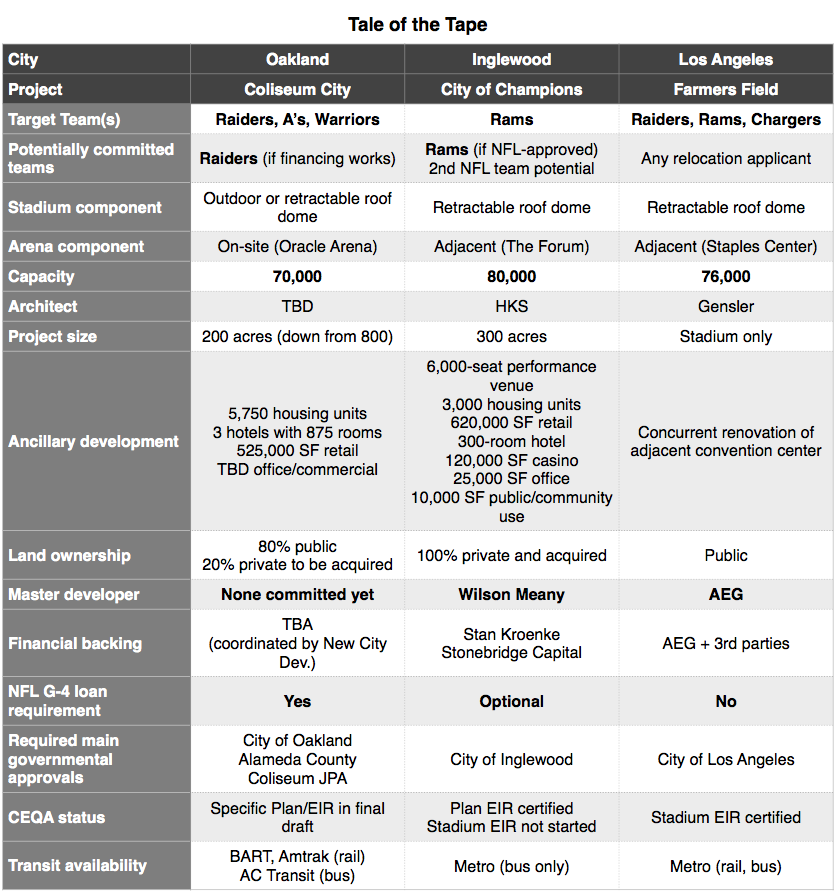
Should Kroenke decide to move the Rams to the City of Champions development in Inglewood, he would forego the NFL’s G-4 loan program, which can hand out up to $200 million per team. The 80,000-seat retractable roof stadium would be the new West Coast Super Bowl rotation favorite. Or would it?
The NFL would prefer to have two teams in LA, to keep from any single owner profiting too heavily on the LA market. Any of the three teams (Rams, Raiders, Chargers) that moved to LA would conservatively double their franchise valuations once they arrived, with greater riches coming from new stadium revenue. Kroenke’s move is barely above squatting, since it would be in keeping with a 2016 timetable. Other than that, Kroenke’s move spells trouble for the NFL if their hope is to control the transition(s).
The NFL has staff working on potential relocations for all three teams, trying to work out ways that maximize value for the owners while minimizing short-term revenue damage in respective markets. The league would prefer to announce the teams and venues on its own schedule. It appears to be working on a deal with AEG for Farmers Field. Just as important, the NFL would like to control the LA Super Bowl venue. It could do that by partnering with AEG and bringing in a single team, providing competition for Inglewood.
Think about the impact of TWO large, indoor-outdoor NFL venues in LA. The NFL could punish Kroenke by never awarding the Super Bowl to Inglewood, which would hurt him in the wallet. There’s nothing he could do about it. Farmers Field would be in the Super Bowl rotation instead, every 5-6 years. Beyond that, AEG/NFL and Kroenke would be competing for Final Fours, college football playoff and bowl games, soccer and rugby matches, and mega-concerts for the Southland. They’d also compete for large corporate sponsors. A stadium bidding war, turned on its head.
Could LA properly support some $3 billion in mega-domes? There are already plenty of questions about the LA’s willingness (not ability per se) to support a single team. Two domes, with 300 luxury suites and 15,000 club seats to sell will be a strain, even in mighty LA. Having it all in one venue softens the blow. With two competing venues selling out is a must. It’s easy to see a sort of stadium arms race happening in LA, with the two competing stadia trying to leapfrog each other in terms of amenities, scoreboards, and perks. The NFL, which has spent decades successfully extorting other cities out of billions in stadium subsidies, would have to subsidize a money pit of its own. That’s not a war that the NFL wants to get into. It would rather work hand-in-hand with Kroenke or AEG, provide that regular Super Bowl carrot, move the NFL Network studios to that stadium, have two teams in the same building, and maximize revenue. Threatening to build a competing facility in LA takes away Kroenke’s first mover advantage, since the NFL has more cards to play than Kroenke. It also doesn’t hurt that AEG has a certified EIR for its stadium, whereas Kroenke hasn’t started one yet.
Since the Inglewood announcement, I’ve seen a lot of conjecture about what Kroenke’s gambit means for the other teams. Many in the media have said that the chances of the Raiders staying in Oakland become better. Sure, as long as it’s only the Rams moving there. If, as outlined in the previous paragraphs, the NFL decides to compete with Kroenke, Mark Davis will undoubtedly trample everyone in his path to be at the front of the line for a Raiders move south. After all, he’d get a stadium all to himself during the regular season, along with all the benefits of splitting the #2 market. He wouldn’t deserve the windfall, but it would work out perfectly with his M.O.: let the process play out while letting others spend the money and take the arrows.



 newballpark.org