Rethinking Coliseum City with the A’s in mind

As summer drags on, the deadlines for Coliseum City continue to slip. Whether it’s the EIR or commitments from teams, the multi-billion dollar project moves further into the pipe-dream category than anything resembling real progress. Talks between Oakland, BayIG, and the Raiders (ostensibly) continue at least through October, with BayIG expected to produce real working agreements at that point.

A’s owner Lew Wolff has made himself into something of a foil of Coliseum City. He has never bought into the plans because of the enormous complexity and cost, not to mention the placement of the A’s as a Phase III addition off to the side, scheduled for 2022 or thereabouts. Now Wolff has been in talks with the JPA about an alternative to Coliseum City, which would pay off the Coliseum and Arena debt, which currently total $191 million. Presumably that would be in exchange for rights to free or discounted 120 acres of Coliseum complex land. Should Coliseum City meets in demise and Wolff be given the opportunity to develop at the Coliseum, there are numerous things that can be done to improve upon the ideas first explored with CC. The goal would be to make a more truly attractive, cohesive neighborhood, as opposed to a mega-development with every kind of building crammed into every conceivable open space.
jrdv-coli_city3_plaza_rail

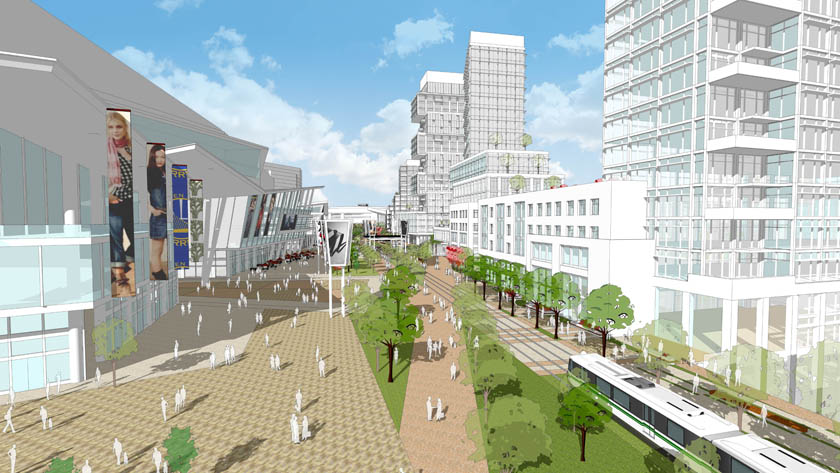
Concourse Park as the “spine” of Coliseum City, football stadium to the left

When I first saw renderings for Coliseum City, I liked the idea of a spine running through the complex that connected the BART station to the venues and surrounding development. However, when I looked through the master plan released earlier in the spring, I noticed that the spine, or concourse, also acts as the only park in the entire complex. In the 120 acres, what you see above is the only open space. For some that’s fine given the urban context, but it’s also an odd choice given that the anchors are sports facilities. Shouldn’t there be a ballfield, basketball/tennis courts, or something else where residents (yes, there will be residents) can play? Or will everyone in Coliseum City have gym memberships? Not to mention the fact that the concourse will be 30 feet or so above the parking lot or street level. That makes accessibility tough for everyone except for people coming off BART.

Then there’s the placement of the ballpark. Off in the furthest corner of the A lot, fans would take a redone BART bridge from the station, then descend from the concourse and walk 2-3 blocks to the yard. That would miss a major opportunity to integrate the ballpark in a way that not only features the venue, but also invites people to visit.

Speaking of that redone BART bridge, that’s part of the opportunity. For decades now A’s, Raiders, and Warriors fans have gotten desensitized to the concrete-and-chainlink cage that takes them from the BART station to the venues. The biggest compliment anyone can make about the BART bridge is that it’s serviceable. Otherwise it’s generally a negative. It looks foreboding, especially the part over the railroad tracks where the chainlink completely covers you. At 20 feet wide, it’s subject to frequent foot traffic jams, usually caused by vendors taking up a third of the walkway on either side. And it ends with Joe Fan face-to-face with Mt. Davis’s hulking backside. It’s not particularly pleasant. The experience is conducive to simply walking as fast as possible. Rare is the leisurely stroll across.
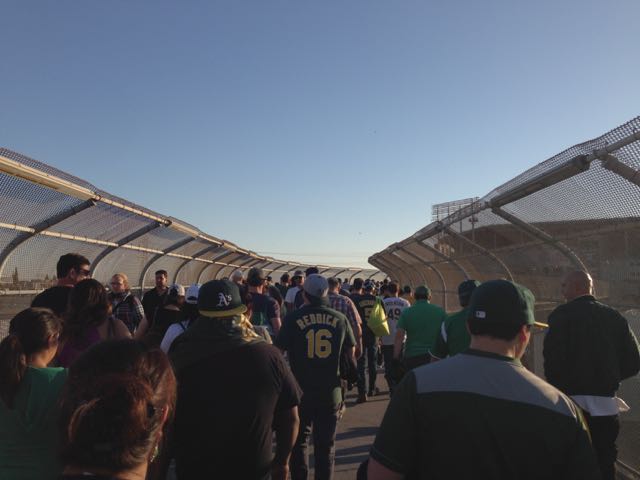
The BART bridge, where the motto is "Just Keep Swimming"

The BART bridge, where the motto is “Just Keep Swimming”

Coliseum City’s infrastructure plan calls for up to $22 million to be spent on a redone BART bridge. The bridge is 800 feet long. At that length, $22 million can go a long way (hopefully not the way the Bay Bridge East Span went). The bridge will eventually be widened to prevent those large crowd traffic jams. There’s also an opportunity to make the plaza much friendlier, with places to stop along the way, see the ancillary development under construction, and appreciate the view. What view, you ask?
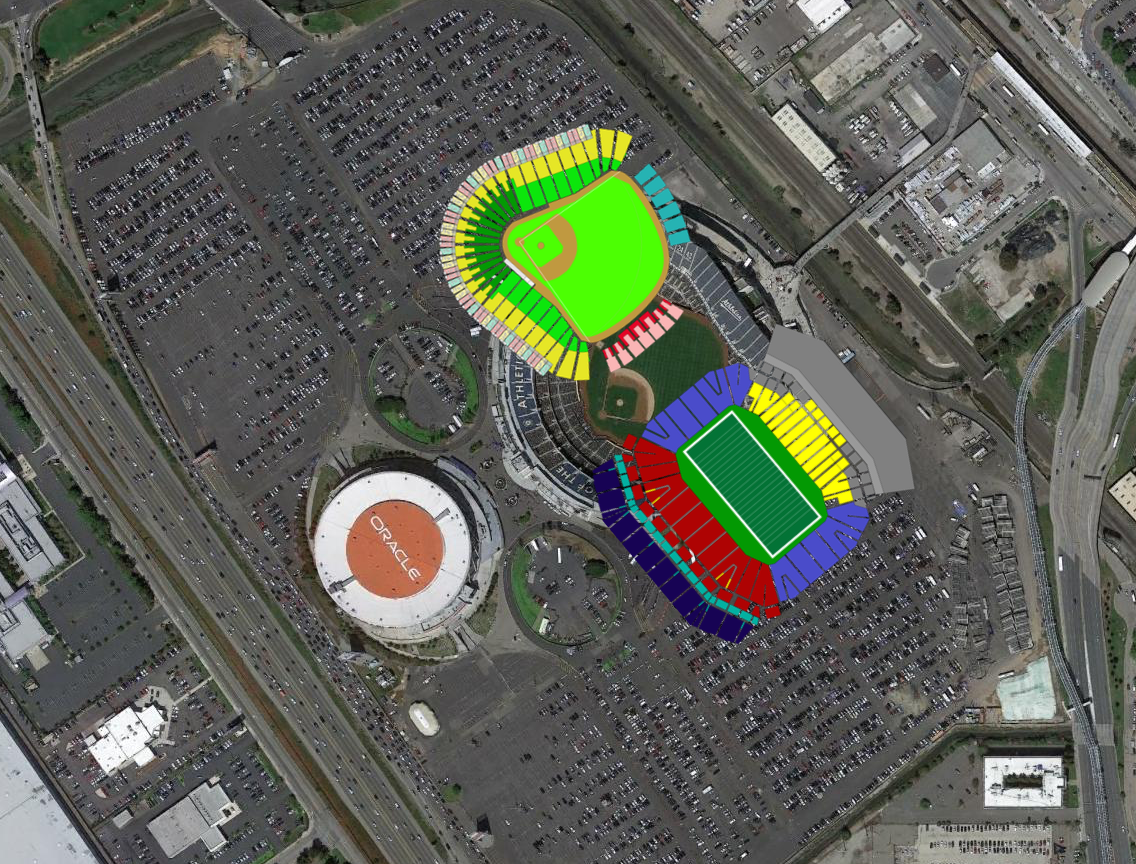
Two new venues on a slightly larger footprint than the original

Two new venues on a slightly larger footprint than the original

Imagine this: You’re coming to your first game at a new A’s ballpark on BART. You see the familiar lights off to the side as the train stops. The lights are a little different, somehow less distant. You take new stairs that bring you directly to the bridge, instead of having to go down then back up. The stadium lights continue to guide your way. As you get closer bits of the ballpark are revealed. First it’s the RF grandstand in the distance, then the scoreboard. Then you get little peeks inside the ballpark. You arrive at a huge, 20,000 square-foot public plaza with monuments to Dennis Eckersley, Joe Rudi, and Chief Bender. The center field gate, to your right, beckons.

But you know better. You know the history of the Coliseum. You know to keep walking along the plaza to the smaller right field gate. Immediately outside that right field gate is a huge bronze statue of Rickey. You know the pose. 939. The statue is placed exactly where third base was in the old Coliseum, only 60 feet higher, maybe because it seemed like Rickey lifted that base 60 feet in the air. That’s the gate you use. That’s the gate you teach your children to use.

When you’re inside, one old friend has returned: the Oakland Hills in left. No longer blocked by a concrete wall of suites and football seats, Leona Quarry, now partly developed, comes back into view. There’s something in front of it, though.

Mary Avenue Pedestrian/Bicycle Bridge in Cupertino. Photo by R.S. Shaw

$14 million Mary Avenue Pedestrian/Bicycle Bridge in Cupertino. Photo by R.S. Shaw

Somehow you missed some pretty great architecture that you were walking on. You must’ve been really excited to the see the ballpark, eh? Well, you can take in the new view of the bridge and the hills from your seat. Life’s pretty good.

P.S. – I almost forgot – there’s a football stadium too. Like the Coliseum City plan, there’s space set aside for it just as there was for a ballpark. The stadium flanks the plaza the same way the ballpark does. Some fans in either stadium will have views into the opposite venue. I can’t say how it would be financed or what size it will be, whether it will have a retractable roof, or any other details. The point is, the space is there. It’s up to Mark Davis, the NFL, and other investors to figure the rest out.

Notice in the overlay I put together that the combination of the two stadia, even with the plaza in between, is only slightly larger than the old Coliseum, which covers 20 acres (Levi’s Stadium has a 17-acre footprint) . Despite placing two stadia there, only 1100-1200 parking spaces are lost. Those could be recaptured by reclaiming space after the arena is demolished, though I would prefer to keep the arena there if there’s a way to operate it without running deeply in the red after the Warriors leave.

P.P.S. – Now I’m sure you have a lot of questions. That’s good, because I left out a lot of details. Fire away.

Rob Manfred elected next MLB commissioner by owners

After a full day of deliberation and several trays of cookies, MLB’s owners finally approved MLB executive Rob Manfred as baseball’s next commissioner (NY Times/USA Today/LA Times/MLB/ESPN Sweetspot. Throughout the day, there were frequent reports that the vote was deadlocked at 22-8 or 21-9, 1 or 2 votes shy of the three-quarters of owners needed to approve Manfred. A late afternoon break preceded the final vote, which in true Bud Selig fashion, was tabulated at 30-0. Perhaps the so-called Reinsdorf block saw the writing on the wall and gave in knowing Red Sox co-owner Tom Werner didn’t have a chance, or they knew that Manfred, who has worked in the league offices for 15 years, was the more qualified candidate. Either way, in February Manfred stands to inherit a full plate of for now unresolved issues from Selig, who is now officially a lame duck.

Who was the swing vote that got Selig’s man, Manfred, over the top? It appears to have been Brewers owner Mark Attanasio,

Among the issues that need resolution sometime in the future:

  • Nats-O’s (MASN) television rights negotiations/lawsuit
  • The future of the Tampa Bay Rays
  • Negotiating terms of an Oakland ballpark, if it can come to fruition
  • The next collective bargaining agreement (current one expires after 2016 season)
  • Blackout rules for local broadcasts

Jerry Reinsdorf wanted to go hardline against the players’ union, despite MLB having one of the most favorable, cost-controlled deals in sports. He considered Selig to be too conciliatory in his dealings with the union. It’s hard to say how much more Reinsdorf would’ve gained in the next labor talks, though the obvious goal would’ve been a salary cap of some sort. Reinsdorf was considered the power behind Selig’s throne, the senior whip who got the votes Selig needed. Here’s to hoping that sanity, not greed, wins out in the next labor talks.

During Selig’s tenure, he sought to consolidate power, getting rid of the league president roles and the deputy commissioner, opting instead for a more vertical org chart with subordinates’ autonomy reduced. One of the rumored challenges for the owners in the upcoming CBA/Constitution talks is how to curtail the powers of the commissioner’s office, which now includes disbursements of a discretionary fund that runs into eight figures (see Nats-O’s).

Going in, it was thought that the Larry Baer and the Giants supported Manfred, while Lew Wolff and the A’s supported Werner. Early voting seemed to bear this out. They even had some discussions early in the day.

The official approval of Manfred would appear to confirm the status quo going forward: Giants not budging on T-rights, A’s forced to make a deal in Oakland. The recently approved Coliseum lease extension further keeps the A’s in Oakland at least for the next several years. After that, well, who knows? MLB has seen enough of the stadium saga to know that neither city is a slam dunk, so contingency plans are needed. And it was Manfred who affirmed the threat to move “out of Oakland” last month, supposedly going so far as to mention San Jose in the same breath. So if anyone’s thinking that any city has an ally in the MLB commissioner moving forward, they shouldn’t. Manfred’s on baseball’s side, not yours.

Davis won’t seek lease extension for Raiders

The stadium-building playbook usually involves a team owner using leverage at various points to coax a compromise out of the public officials on the other side of the table. Raiders owner Mark Davis employed this tactic three months ago he openly complained about a lack of urgency on Oakland’s part, even though Davis has done little lifting on his own in the local effort.

At the conclusion of A’s lease extension talks, JPA Board President Nate Miley said that talks had started with the Raiders for a short-term extension, presumably to allow for more time to flesh out Coliseum City. Those talks appear to have gone sideways, as Davis said today that he has no plans to extend after the end of this season. I had earlier reported that there may be an option, but the lease is only for the NFL’s 2014 season, plus the playoffs stretching into 2015 if that occurs.

Meanwhile, Davis has been pallin’ around with Jerry Jones, Magic Johnson, and others in Oxnard this week as the Raiders and Cowboys have held joint practices. Magic waxed nostalgically about Michael Ovitz’s plan to re-do the LA Memorial Coliseum. Jones gave Davis his support, no doubt with the idea that a Raiders move to LA means that the team won’t encroach upon Texas (San Antonio to be specific). There’s no shortage of media willing to buy the LA move plan, from CBS Sports’ Jason La Canfora to the BANG’s Tim Kawakami.

LA still remains a tough proposition, because of the lack of consensus on a site and the NFL’s own agenda, which may have roadblocks for Davis on the way south. It should be crystal clear, though, that most of the problems with LA can be solved with money, and when it comes time to decide, there are more than enough people there to write the checks.

For the Raiders it comes down to following the rules. The NFL’s guidelines dictate that all teams looking to leave have to give their current city at least a year of good faith negotiations before turning elsewhere. By having involvement in Coliseum City, Davis has done that. Then there’s the brief window that all NFL teams have to notify the league that they intend to move to another market. That doesn’t happen until after the season ends. Assuming that Coliseum City doesn’t get finalized in the next six months, Davis will probably provide notice.

Knowing how the JPA reacted to Lew Wolff’s and MLB’s threat to relocate the A’s, Oakland could easily go into another panic mode. That’s the plan, the playbook. For better or worse, Coliseum City is Oakland’s playbook.

San Jose’s uphill battle against MLB continues in 9th Circuit court

This is how oral arguments started today.

For San Jose, it pretty much went downhill from there. City of San Jose Attorney Philip Gregory was up first, and he had a very tough time against the three man panel of judges: Chief Judge Alex Kozinski, Judge Barry Silverman, and Judge Richard Clifton. Gregory asserted that the Portland Baseball case limits the antitrust exemption to the reserve clause. Kosinski and Clifton took issue with that. Gregory argued that the prior cases often cited (Portland, Curt Flood) are more about minor league-major league system interactions/transactions than major league franchise movement. The judges didn’t appear to be swayed. Gregory was left to argue that the case shouldn’t be dismissed at this early stage, and should go to discovery.

MLB lawyer John Keker was next, and he had a much easier time. He was able to go at least 2 minutes without being interrupted, which indicates that the judges had little to question.

The most resistance Keker got into was a hypothetical that Kozinski put forward. The judge first asked Keker if baseball has an antitrust exemption, doesn’t that mean that this case automatically doesn’t have standing? Keker agreed. This was also a key tenet of MLB’s filings going into today’s hearing. There was even a playful back-and-forth between Kozinski and Keker, in which Kozinski prodded, “Just between you and me…” That was followed by a chuckle from the much larger-than-normal gallery. Keker kept to his argument.

That left the rebuttal to Joe Cotchett, who brought props. That led to this exchange:

Cotchett tried his best to take down MLB, calling the territorial distribution as outlined in the Major League Constitution one that builds an “economic wall” around San Jose (Santa Clara County) because no team is allowed to move in there. He also brought up the recent decision in a US District Court to allow an antitrust case to move forward against MLB and broadcasters over TV blackouts and exclusive territories. Judge Clifton didn’t appear to be swayed by this either.

Despite the poor outlook for San Jose, Cotchett got to hold another presser outside the courtroom after adjournment, which for him is just as important as the actual proceedings inside. Even if he loses this case in the Ninth Circuit, he aims to bring it all the way to the Supreme Court. The way things look now, getting there would be the equivalent of a six-run home run.

Courthouse coverage comes from the Merc’s Howard Mintz and Fangraphs’ Wendy Thurm.

What happened to the Stand for San Jose case?

I really should check into these court cases more than once every couple weeks.

While many eyes will be focused on the City of San Jose’s Ninth Circuit appeal against Major League Baseball this Tuesday, another case appears to have been resolved. That would be “citizen group” Stand for San Jose’s lawsuit against the City in Santa Clara County Superior Court. A hearing was scheduled for the end of this week, August 15. However, that was wiped away as the court vacated the hearing. In fact, the court now has the case status as disposed as of July 24. In other words, the case is resolved, over, done. Big hat-tip to Wendy Thurm, who alerted me to this on Friday.

The only recent action leading up to that point was notice that the Oversight Board of SARA (Successor Agency of the Redevelopment Agency) would file its own motion to dismiss by July 25. The idea was that since the Oversight Board was given the power to dispose of the Diridon ballpark parcels however it saw fit as long as it took care of financial obligations to the state. That was to lead for a motion for pleadings on August 15. Then suddenly, the dismissal on July 24. It’s important to note that it’s a dismissal without prejudice, so it could come back at some point. Regardless, it’s a surprising move for all concerned. I’ve asked around to understand what happened, and haven’t gotten any answers yet.

Besides the legal maneuvering, one other thing has happened this summer that might have brought all parties to the table. That would be the A’s and the Coliseum JPA approving an extension at the Coliseum through at least 2018 (up to 2024). Obviously that’s speculation, and the filings may reveal something else, which is why I’m heading to Superior Court tomorrow afternoon. Be forewarned: I don’t expect to get much out of my inquiry. When cases are resolved in a non-public manner as this was, the parties can sometimes choose to reveal little about the motivations to do so.

Then again, there’s this update which came in on Friday:

081414

Some day all this legal stuff will end and there will be a ballpark under construction. Maybe.

The “new” architect and a great old Coliseum idea

Out of the formality that was the Coliseum extension news on Tuesday was a related item that got Oakland fans all excited and hopeful. Lew Wolff, in full photo op mode with the various assembled pols, mentioned that he was working with an architect on a ballpark design at the Coliseum. Wolff gave few specifics, other than saying that “several design ideas” were being considered. Wolff declined to say much else, or even identify the architecture firm he’s working with.

The general sense of astonishment I saw in articles and social media feedback, and in Damon Bruce’s lighthearted take on it on his radio show yesterday, confirmed yet again the fact that the average fan is not going to be bothered to keep up with much of the news. Not that they should be expected to, this is a fairly boring subject at the planning and political stage, and has niche value once shovels hit dirt. Still, fans called in and mused with great hope about one feature or another being integrated into a new ballpark at the Coliseum. But it seemed as if they weren’t going to believe in Wolff’s overtures until he uttered those magic words, I’m working with an architect. My goodness, an architect! Fiddle-dee-dee!

Of course, those who have been following this stadium saga for some time probably already know that Wolff has been working with a prominent architecture firm for nearly a decade. That firm is 360 Architecture, a company that had roots in HOK and created an offshoot, Heinlein Schrock Stearns, before merging with another to become 360 in 2004. They opened an office in San Francisco in the fall of 2005, as the Coliseum North plan transformed into Fremont’s Pacific Commons. Later they worked up plans for the Diridon site and the soccer stadium near San Jose Airport. And if you read SVBJ scribe Nate Donato-Weinstein’s interview with 360 principal Brad Schrock from Tuesday, you might’ve picked up a hint of what was happening next.

Donato-Weinstein: What’s your dream project?

Schrock: We’ve been working with the A’s for such a long time. I’d love to do a ballpark for the A’s. I’d love to do one in San Jose or Oakland. The A’s are just such an interesting franchise. Trying to craft a facility that meets their mojo is a lot of fun. The other one I would die to be involved in is if the city of LA ever gets an NFL team. That would be phenomenal to work on.

While there are no major league ballparks under Schrock’s new shingle, his firm is responsible for the lovely Huntington Park, which I visited a few weeks ago. During his Heinlein Schrock Stearns days he was responsible for Safeco Field, which to me is #1 or #2 in the bigs. 360 is more well known for arenas than stadia, having designed Sprint Center in KC, but with most arenas being early in their lifespans, the firm has done outdoor venues. They cut their NFL teeth on MetLife Stadium, whose soullessness is not 360’s fault but rather the design-by-committee, tug-of-war conducted by the Giants and Jets. Now they’re working an an incredibly ambitious project, the new Atlanta Falcons Stadium. They also have the upcoming Rogers Place in Edmonton under construction, and the Earthquakes Stadium, which is set to open next year.

Some of the plans under consideration in Fremont included a truly retro design featuring columns, similar to legacy ballparks Wrigley Field and Fenway Park. Partly motivated by cost savings and a desire for better sightlines, the concept didn’t appear to go far thanks to the stigma held by obstructed view seats. Assuming that column-free, minimal-cantilever is the chosen path, I think there are some very important positive lessons than can be taken from being stuck at the Coliseum – not just the Coliseum of yesteryear, but the current tarped-off, Mt. Davis-eyesore version.

One of those lessons has to do with the noise level. Sure, the expansive foul territory makes the seats down the lines terribly far away from the action. The activity of the crowd, which is good even on 15k nights, makes up for the lack of line-hugging seats. Yet there’s one other thing that contributes to the noise factor, and it only really started when the tarps were installed in 2006.

Simply put, about 90% of the Coliseum’s seats (in current baseball configuration) are lower than 60 feet above the field. That’s about 32,000 seats. That vertical conservation concentrates crowd noise to a degree not known since old Comiskey and Tiger Stadium were still around. That’s why today’s MLB players are so taken aback when they come into the Coliseum, because despite the old girl’s decrepitude, it’s uncommonly loud.

Why? Just look at how ballparks are constructed these days. It’s easy to point to levels of suites, and yes they are largely responsible, but there are also regulatory standards that come into play. On the lower concourse, wheelchair rows need to be 30-36 inches above the row in front of them for proper compliance. That height grows the higher you go. Plus architects have their own guidelines to prevent people in the back rows from having their views clipped by an overhang, which happens in the back rows of both the Field and Plaza levels at the Coli.

In new ballparks, especially those that follow the familiar HOK blueprint, you have a lower deck of about 30-40 rows, then the elevated wheelchair row merged with the concourse, then decent height so standees can properly see the action. Then there are club and suite levels in different configurations. Finally there’s the upper deck, which these days is split into two decks. When you look at a cross section of a ballpark, it’s easy to identify 4 or 5 separate seating levels, all the better for the teams to separate those levels by price.

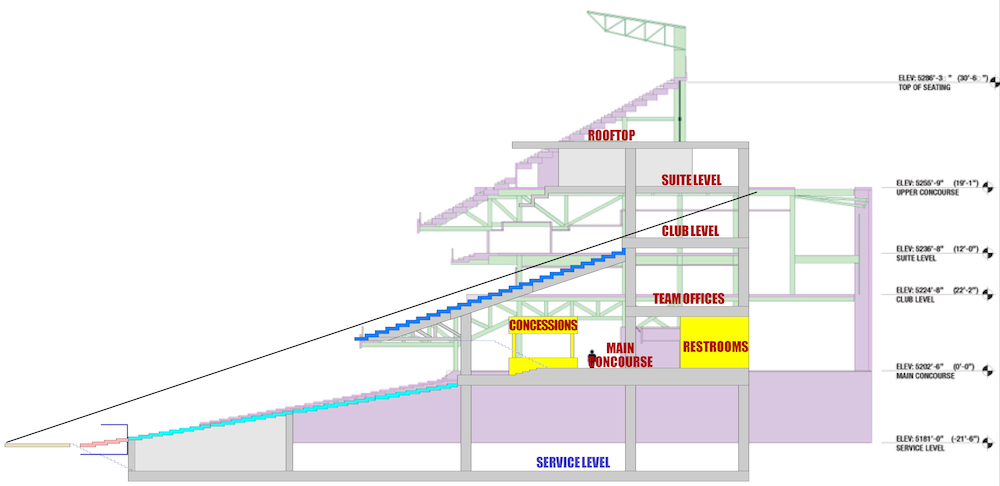
Coors Field, which is similar to AT&T Park. Top row is 105 feet above field.

Coors Field, which is similar to AT&T Park. Top row is 105 feet above field.

Take Coors Field, which is pretty much the standard bearer among the modern, HOK/Populous breed. Lower deck, Club level, Suite level, Upper deck. It’s a big building that was downsized before the start of the season. That’s good, but it won’t fix the sightline problem. The top row is 105 feet above the field, which makes the action truly look like it’s a Mile High. Add to that the limited cantilevering and it’s pretty far from the action, nearly 235 feet from home plate to that back row in the upper deck. Could be worse, though. Mt. Davis’s top row at the 50-yard line is 335 feet from the near sideline. That’s longer than a home run in the LF/RF corners.

pitch-low_two-med

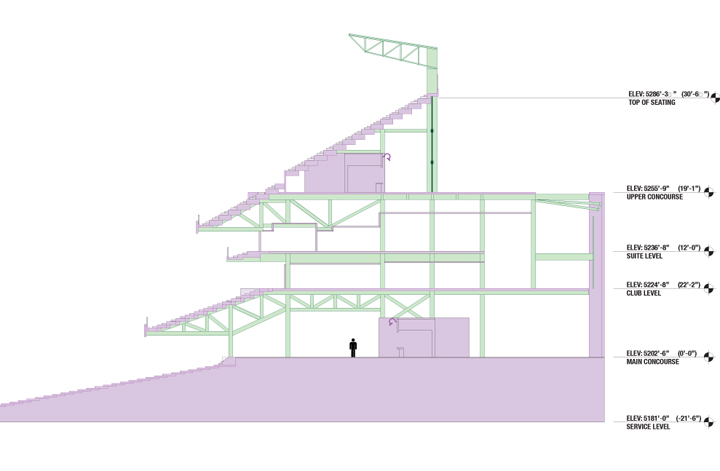
A two-deck ballpark design with no suites in between

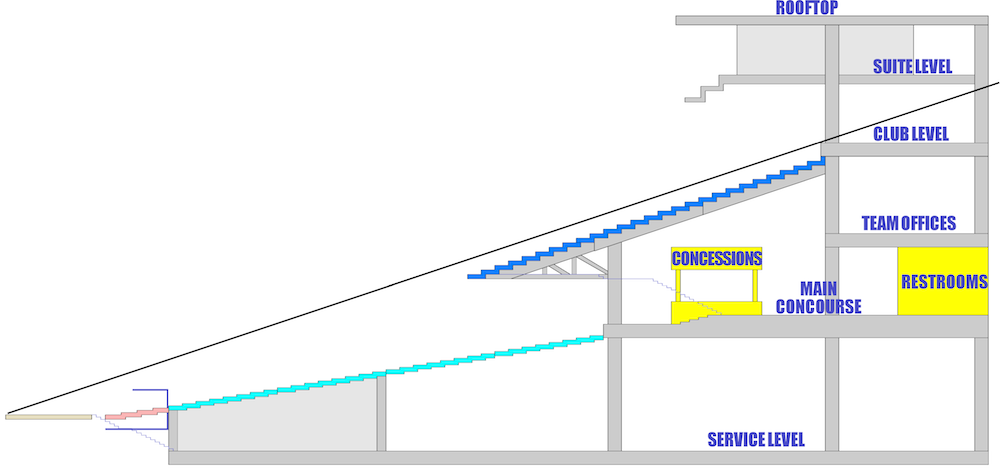
Now look at this cross-section, which somewhat mimics the first two decks at the Coliseum. It has 32-36 rows down low, 24 rows up above, then skyboxes over it. The last row is only 56 feet above the field. There is only one regular concourse, but it’s 65-83 feet wide. There are club seats and a separate club concourse up top, probably with no fancy lounge or restaurant. Above the suites is a rooftop deck, which can be used the same way the 49ers use theirs at Levi’s Stadium. Or it could simply provide expanded seating in the future. The roof is only 88 feet above the field, or almost 2 stories lower than the top row at Coors.

Overlay of Coors and two-deck concept

Overlay of Coors and two-deck concept

There are compromises. The suites and club seats are about 20-25 feet further away from their counterparts at Coors (AT&T). Does that matter? I doubt it.

To be clear, I have no idea if 360 and Wolff are pursuing anything like this. It would be a great way to go. It brings over that vertical conservation that no other ballpark in the majors save for PNC Park attempts to accomplish. If the goal is the best baseball viewing experience, I hope that this is something that the A’s-360 team is exploring. We’ll all be better off in the end if they did.

Cleveland Indians announce changes for Progressive Field in 2015

The Jake is 20 this year, and Indians ownership has decided it’s in need of a refresh. While the ballpark was certainly a premier venue during its first decade of operation, the times have changed and the novelty has worn off. Repeating the team’s 455-game sellout streak is unlikely as the Jake is too large for today’s MLB. And there are aspects of the look and feel of the place that are very 90’s. The Indians felt it was time for a wardrobe change, if you will.

gatec

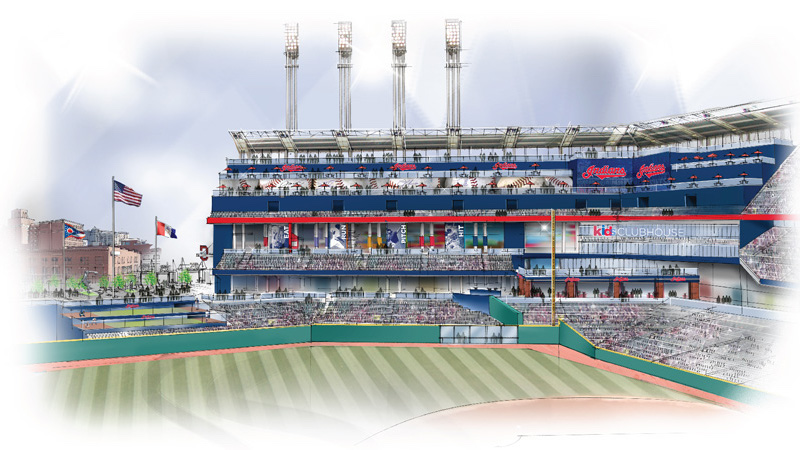
Reimagined center field gate

Much of the effort will be focused on the outfield, where seating and circulation will be reconfigured. Gate C in center field will be opened up. Currently the gate is a fairly nondescript plaza with some young trees and little signage. Views into and out of the ballpark were obstructed. To remedy this a food court and bar in center will be removed. This is a well conceived transformation, as it’s this gate that many fans parking downtown will use (those arriving via the light rail system use Gate A in left field).

The other major change, which can be seen at the top of the sketch above, is the modified upper deck in right field. The Rockies removed seats in their similar RF sections and transformed them into huge rooftop decks at Coors Field. However, unlike in Cleveland where the seating bowl will apparently remain intact, in Denver actual concrete risers were removed. The result at the Jake will be patios that will only face the field. Perhaps the Indians are doing this to preserve seating capacity for the future. Whatever the reason, it’s not as interesting as the 360-degree treatment at Coors.

Transformed upper deck

Transformed upper deck in RF

Bullpens will be reconfigured from their “slit” design to terraced next to the batter’s eye. The concourses will undergo their own freshening, with bright colors everywhere in the form of paint and vinyl. A kids play area will be expanded. Current capacity is 43,000. As a result of the RF changes, capacity will drop to 37-38,000. The changes should at least attract fans who haven’t been to the yard in a while, though in Cleveland, only winning will keep bringing them back. I’m glad I got a chance to visit before the Jake undergoes this facelift.

This slideshow requires JavaScript.


JPA approves revised Coliseum lease

MLB will formally review and approve the lease terms. Although owners meetings are scheduled for next week (during which they may vote on a new commissioner), approving a lease extension is really a matter for MLB’s legal and operations teams to review. No owner votes needed for that.

Mark it down: NHL Stadium Series coming to Levi’s on February 21

A Ticketmaster snafu last week probably spoiled the surprise, but it wasn’t much of a surprise anyway. The NHL today announced that Levi’s Stadium has been awarded one of the prime Coors Light NHL Stadium Series games on February 21, 2015. The game will feature the home Sharks and the much reviled, defending champion Kings.

When talks initially started about hosting a Bay Area version of the Stadium Series, the question was whether to hold the game at picturesque, touristy AT&T Park or at the newer, much larger Levi’s. In the end, size won out. Hopefully, what will also win out is the desire to curb needless theatrics.

The Valley isn’t San Francisco, and it definitely isn’t Los Angeles, though at its worst it aspires to be the latter at times. Last year’s game at Dodger Stadium had so peripheral things going on during and before the game (roller skating, beach volleyball) that it was perfectly – and perhaps ironically – emblematic of the California fan experience: easily distracted, ready to move on to something else if the weather’s good.

There’s a hockey rink behind there somewhere. Credit: Hans Gutknecht, LA Daily News

As the discussion was being had locally by the host Sharks, an uprising of support came from the South Bay to hold the game at Levi’s instead of AT&T, because the Sharks are a South Bay team, not just a Bay Area/Northern California representative of the NHL. While it’s unclear how many fans expressed this sentiment, since many of them are longtime season ticket holders, Sharks management had to hear them out and give their voices weight. It also doesn’t hurt that Levi’s Stadium is arguably considered the destination outdoor venue on the West Coast.

This time the game will be in a football stadium, which is set up to be congruent with hockey, so there will be less open space to worry about filling as there would be at AT&T. There should be enough casual interest to sell 68,500+ seats, though that will be borne out over time and with published ticket prices. The rich tech population should eat this novelty up just as they have 49ers seat licenses. Another huge sporting event, Wrestlemania 31, is scheduled for March 29.

Seating chart for Stadium Series game

Seating chart for Stadium Series game

With the announcement, all that’s left is to figure out how to theme it. I shudder to think of the marketing concepts. Nevertheless, I expect to be there with a bunch of friends. How about you?

River Cats announce new indoor club at Raley Field

The River Cats organization spent much of last week hyping up a big announcement scheduled for Saturday, August 2.

Given the mysterious nature of the team’s affiliation with the A’s after 2014, some thought the announcement would have to do with changing affiliations, say to the Giants for instance. Rules set in place by MLB and MiLB prohibit such announcements during the season. Teams aren’t even allowed to formally seek out new PDC’s (player development contracts) until mid-September, after the minor league season ends. Naturally, River Cats management refused to answer questions about the situation, so nothing new on that front.

What did they announce, then? A new 5,000 square foot, air conditioned club, named the Western Health Advantage Legacy Club. Open to all season ticket holders, the WHALC will also be available for special events. The air conditioning is a key point, since that sets it apart from other spaces within the park. The club will be an extension of the suite level down the left field line, above the beer garden.

This slideshow requires JavaScript.

The River Cats are finding themselves competing with the resurgent (at least off the court) Kings, whose downtown arena is scheduled to be completed in time for the 2016 season (2017 as a fallback). A ceremonial demolition ceremony at the mall where the arena will sit was held over the weekend. It’s better for the River Cats to make such amenities available before the new arena opens, the better to lock in sponsor and entice business-type season ticket holders whose eyes may already be wandering downtown.

As for that affiliation announcement? We’ll have to wait until September.