Clippers sale: Bubble burst or new reality?

The pro sports valuation bubble officially hit a bursting point last week, when outgoing Clippers co-owner Shelly Sterling accepted a $2 billion bid for the team. The winning bid came from former Microsoft CEO Steve Ballmer.

Confusion reigned as the bids came in fast and furious early in the week, while at the same time Donald Sterling filed a lawsuit against the NBA for $1 billion. Eventually, language was included in the bid that would have lawsuits and punitive measures dropped, including the league’s lifetime ban against Donald Sterling. NBA commissioner Adam Silver and the notoriously litigious Sterlings managed to get done in one week what normally would take three months, and with the Sterlings was expected to get dragged out for perhaps years.

Ballmer, a longtime basketball junkie, had been involved in Chris Hansen’s bid to move the Sacramento Kings to Seattle. With lion’s-share financier Ballmer out of the picture, the prospects for a team in the Emerald City look rather slim for the foreseeable future. Ballmer has said that he won’t move the Clippers to Seattle, mostly because his $2 billion investment would be immediately be devalued upon relocating the franchise.

Even in the 2nd largest media market in the US, the $2 billion price has to be questioned. Sure, the Clippers are due a local boost when their TV deal comes up for renewal in a few years, and a national boost when the league’s TV deals get negotiated at the end of the decade. Those boosts still won’t properly support a $2 billion valuation. Forbes’ January valuation of the team was $575 million, based on $128 million in annual revenue, or 4.5X revenue. That’s already pushing things a bit, since it’s customary to value a team at 3X revenue. To justify $2 billion, the Clippers would have to realize at least $500 million annually, or a 4X jump from their current circumstances.

There’s no chance that such revenue will come from the new TV deals. The Clippers could get an additional $30 million a year from national TV, and another $100-150 million from Fox Sports West. Even so, that boosts their annual revenue to around $300 million, which would support a valuation of $1 billion. Of course, there’s no accounting for the competitive bidding activity that has surrounded recent franchise sales, so $1 billion would have to be considered a baseline, which was the case. Forbes’ Kurt Badenhausen laid out the case for why the team could fetch such a high multiple, but it still doesn’t quite add up.

The Dodgers sold for $2.1 billion, which came about because they too had a local TV deal up for bid. That bidding culminated in the birth of Sportsnet LA, the Dodgers-only regional sports network that will provide the team nearly $250 million per year. As one of the marquee franchises in the Southland along with the Lakers, a $2 billion sale price was considered enormous but not outlandish, especially when the value of Dodger Stadium and the 100 acres surrounding it are taken into account. The Clippers don’t have their own arena, or their own land outside of a recently built practice facility. They are mere tenants at Staples Center, and for the most part get the runt’s pick of dates and times at the arena. While the franchise has experienced a good run of success since they drafted Blake Griffin and traded for Chris Paul, Paul’s going to turn 30 next year and on-court success tends to be cyclical.

Ballmer will take over a team that has had few playoff appearances, let alone division, conference, or championship banners. He’ll look for ways to get the team to the summit, perhaps with an analytics-focused general manager. The Clippers are locked into their lease at Staples for another decade, so no new arena deal is in the offing – not that a new arena plan is emergent. Many in the media are calling for the Clippers name to be changed, its legacy tied to Donald Sterling’s long tenure as the worst owner in sports.

Then again, Ballmer may simply view the Clippers as a way to park $2 billion. Surely there are better growth strategies available, but when you have $20 billion and you have to diversify anyway, why not take on a franchise where you can reasonably expect the franchise growth to outpace inflation, where you’re virtually guaranteed to not lose money? Plus he’ll have a nice toy to play with. Ballmer attended many Sonics games as a season ticket holder when the franchise was in Seattle, and his old Microsoft colleague Paul Allen has long owned the Portland Trailblazers. If you’ve got the cash, it sure beats putting money into something boring like municipal and corporate bonds.

Should a 6X multiple become a new standard for franchise valuations or sale prices, it would grow the valuation bubble to enormous sums. The Warriors would be worth $1 billion, double the then-record 2010 purchase price of $450 million. The trend could quickly take hold throughout the rest of the NBA and spread the other major sports, where the Raiders and 49ers could hit $1.3 and 1.5 billion respectively, and the A’s could reach $1 billion. The market dynamics could be balanced out if a number of owners decided to cash out at the same time, so the leagues will be hard pressed to draw out any new franchise transfers in order to prevent a buyer’s market from breaking out, crazy as that sounds. The simple truth of the matter is that pro sports teams are exclusive and extremely lucrative, whether playing the long game or running the team annually. Budgets are fairly easy to work out and costs are incredibly well-controlled thanks to collective bargaining agreements and pools of centrally-derived revenue. Even paper losses can easily translate into profits at the end due to owner-friendly depreciation rules. You favorite team has turned into a part of some rich guy’s portfolio. The hedge fund guys started figuring that out during the recession, and it has only grown since. That’s the world we live in.

Announcement: Writing for Bloguin network, too

I’m happy to announce that in addition to my regular, roughly every other day posts at this site, I will be contributing to a regular column on the Bloguin network, home of Awful Announcing and a slew of sports blogs. While I don’t have an automatic fit with a particular site, my first piece was published today at The Outside Corner, Bloguin’s general baseball blog. The post is titled, “Can the A’s Survive California’s Stadium Drought?”

First post on The Outside Corner

First post on The Outside Corner

I expect to make contributions weekly, maybe even twice a week or more if time permits. The topic will be largely stadium construction, though I’ll also cover sports economics occasionally. I’ll post links here and immediately on Twitter. Bloguin CEO first proposed the idea last week, and I felt that I had the bandwidth so I said yes. I look forward to taking more of the general sports posts that I used to write more frequently here to Bloguin, where I feel they’ll have a more appropriate home.

As usual, feedback is welcome. Thanks to all of you loyal readers. It’s you who have helped build this site’s creditability so that I could spread knowledge elsewhere.

Ballpark Vote seeks to assess A’s fan interest in stadium sites

A site run by three San Luis Obispo residents aims to determine which potential A’s ballpark site(s) fans like the most. Named Ballpark Vote, the site was launched three weeks ago. Listed are five sites or ballpark concepts:

  • Howard Terminal (Oakland)
  • Coliseum City (Oakland)
  • Estuary Waterfront Project (Oakland)
  • Raley Field (Sacramento)
  • Cisco Field (San Jose)

Fans are allowed to vote for more than one choice. Even though the site was up since at least May 7, I only found out about it early this morning. Between then and the time of this writing, voting has jumped up considerably. Obviously the results aren’t scientific, and are prone to change due to the nature and dynamics of social media. Voting appears to be limited to one set of votes per browser session, though people could use multiple browsers to game the system.

What fascinates me about this is that when I first checked the site at nearly 2 AM, Howard Terminal had over 500 votes, double that of the next two selections, Cisco Field and Coliseum City. Since then Cisco Field has spiked well past Howard Terminal. Some in the stAy crowd have called out the site for being a tool of ownership or some sort of fraud, without any proof of course. When I tweeted about the site I received a handful of replies and only two favs, so it’s not as if there was some massive viral effect at work. The site is new enough that it hasn’t established a monthly trend, a common metric used to measure traffic. Hopefully the site runners will reveal some of the statistical data behind the survey.

Davis clarifies stadium wish list through Papa

Greg Papa had a lengthy conversation with Mark Davis after the owners meetings, during which Davis clarified what he wants out of Oakland. Papa related the discussion on The Wheelhouse earlier today (about 14 minutes into the recording). There are some different criteria and some flexibility shown by Davis, which could make the process easier if that pesky funding issue could be figured out. Davis’s wish list:

  • Davis could provide $200 million of his own (Raiders) money
  • $200 million would come from the NFL’s G-4 program.
  • Davis wants a stadium with a 60,000-seat capacity and would like a Super Bowl, which requires a 70,000-seat capacity.
  • Davis also said that he (or rather his mother) owns 51% of the team, and can retain controlling interest with only a 20% share. Davis will never give up controlling interest.
  • Davis has met/lunched with and likes Lew Wolff.
  • Davis continues to prefer that the old stadium be torn down and replaced with a new one. A lengthy lease with the A’s would interfere with those plans.
  • Papa hinted that the JPA could provide $100 million in public funding.
  • Davis would be comfortable with temporarily moving elsewhere for 2-3 years while a new stadium was being built.

So we have Davis’s 60,000, AECOM’s 50,000, and BayIG’s number, which may be 65,000 or more based on their optimism about the East Bay as a market. Someone’s going to have to put everyone on the same page. I’m at a loss as to who does that or how it gets done. Coliseum City is a complex project to put it mildly. So many different stakeholders make for more variables.

What does Mark Davis really want?

With this year’s NFL Draft firmly in the rearview mirror, the time has come for Mark Davis to once again talk about the urgency required to get a new stadium for the Raiders built. It’s becoming an awfully familiar refrain, one we’ll hear again every few weeks throughout the summer and as the football season starts. According to NFL.com’s Mike Coppinger, Davis says that the Raiders are in the 11th hour, a rather dire place indeed if you believe such metaphors.

“I would probably say (negotiations are in) the 11th hour,” Davis said. “It’s always the 11th hour because we’ve been waiting a long time, been waiting a long time on this project. If it doesn’t happen, then we have to start looking at the other options. … We want to stay in Oakland. We want to get something done.”

Updated 5/29 – The story originally came from Zennie Abraham’s 5/20 post, in which he spoke to Mark Davis and Raiders finance officer Marc Badain at the owners meetings.

Oh, so it has always been urgent. Okay.

Davis even pumped up his own position by claiming that he has more money to throw at the project:

$400 million could be very useful. It could also be illusory. There’s no indication of whether that pledge includes money from the NFL’s G4 program or strictly from the team. Either way, the project is still short at least $500 million based on new stadium cost estimates. BayIG has its estimates, AECOM has different estimates. The EIR is due in a few weeks, and BayIG is expected to deliver a complete market and revenue study in the near future. Let’s be clear on one thing, however – $400 million is no more than a nice gesture at this point.

And there’s something odd about how Davis has gone about this stadium quest. While he has occasionally asked about land in Concord and Dublin, he has publicly stayed “loyal” to Oakland. Oakland and the JPA have reciprocated that commitment, at least to the point of getting Coliseum City studied. Yet there’s a strange omission from Davis’s efforts, and it’s a pretty glaring one once you think about it.

Davis has never proposed his own stadium plan.

Not in Oakland or anywhere else in the East Bay. Not in LA either. Instead, Davis has been content to allow others to formulate their own proposals, which he could support from a distance. As BayIG asks for information, Davis directs the front office to provide it. Then Davis will talk about the progress of the project, which has for some time now looked stunted. When the Coliseum City concept was in its infancy, there were rumblings that the Raiders and the NFL were at odds with the JPA regarding the scope of the project. The Raiders wanted an smaller, open air stadium on the site of the current Coliseum, not the big retractable dome that Mayor Jean Quan advocated. Sometime in the last year, the Raiders stopped (or did they even start?) fighting for their scaled down stadium plan.

Let’s look at the history of local stadium plans, shall we?

  • Giants – Led stadium effort in late 90’s, opened new downtown SF ballpark in 2000
  • 49ers – Left SF for Santa Clara, lobbied hard for new stadium, opening in 2014
  • Warriors – Suffered setback with waterfront arena, then secured expensive land for different site in SF
  • A’s – Led effort in Fremont which died in 2009, then took up mantle for San Jose
  • Sharks – Weren’t even around when San Jose arena was first being considered, then used own money to get arena up to proper spec
  • Raiders – ???

Davis showed up at a petition effort to keep the Raiders in Oakland, which makes for good optics among fans. His lack of willingness to get his hands dirty for an Oakland stadium is simply baffling. No stadium in the modern era gets built without a lot of lobbying, horse trading, and compromise. Davis has shown no sign of being willing to work to get it. His reactions have simply been, Well I’m waiting here and nothing’s getting done. Perhaps the question that should be posed to Davis is, What are you willing to do to keep the Raiders in Oakland? If $400 million isn’t going to cut it, and Davis isn’t going to carry the water for the effort, what are we dealing with here? We have seen the cost estimates spiral upward. Davis could have used that as an opportunity to present his own more feasible, more cost-efficient plan. That hasn’t happened. If I were a Raider fan, that would make me nervous.

Sacramento City Council approves arena deal 7-2

They overcame the Maloofs, Chris Hansen and Steve Ballmer, and forces from Orange County. In the end, the City of Sacramento voted to approve the final form of its downtown arena deal, which will pave the way for site demolition and the eventual construction of the ESC, to be opened as early as 2016 (deadline set by the NBA is the start of the 2017-18 season).

Final estimate of the arena (ESC) cost is $477 million, $222 million coming from the Kings and $255 million from the City. The Kings are providing much of the upfront money while the City secures either short or long-term financing. The team has also asked for a short-term, $12 million loan from the City to cover permits and other related expenses. That request was approved as part of the vote. A CEQA challenge may be filed by opponents as early as tomorrow, but it won’t be able to halt construction.

Sacramento is banking on the arena to revitalize downtown, especially as the venue replaces the largely failed Downtown Plaza mall. While regional spending on Kings games and some concerts/ice shows should show at least a modest improvement due to the ESC replacing Power Balance Pavilion, additional concerts should come thanks to the more attractive facility, which should boost ticket sales and ancillary economic activity. The City is rerouting a great deal of parking revenue to pay for its share with the hope that new construction will spring up the same way Staples Center catalyzed downtown Los Angeles.

Most of the country has not seen the economic boom that hotspots like the Bay Area, Texas, and North Dakota are experiencing. Sacramento is see some improvements, though it’s not close enough to the Bay Area to see any major benefits. Hopefully a widespread boom will sustain growth in downtown Sacramento, because if the country hits another one of those bust cycles, the dream of a revitalized urban core will have trouble coming to fruition. Personally, I’d be more impressed if the many Silicon Valley interests who have ownership stakes in the Kings open offices in the Sacramento area. That would really be putting money where their mouths are.

The large public subsidy remains a sore spot for me. I’m a bit of a hardliner on the issue. I realize that the subsidy issue is often considered a value proposition by many. X dollars may be the price required to attract or retain a team. If the public supports that, so be it. It’s happened in Santa Clara, now in Sacramento, and maybe in the future in Oakland. Nevertheless, I’m happy for Kings fans that they’ll be able to see their team locally for decades to come.


River Cats may change affiliation from A’s to Giants (Updated with River Cats statement)

Update 5/19 11:15 AM – The owners of the Fresno Grizzlies aren’t showing concern about the future of their affiliation with the Giants. They feel that the long history of Fresno being a Giants’ town, going back to the Cal League in the 40’s, will win out in the end. In addition, the Angels have renewed their PDC with the Salt Lake Bees through 2016.

Update 2:00 PM – The River Cats released a statement about their affiliation with the A’s.

“Though our player development contract with Oakland does expire after this year, we place the utmost value on our affiliation with the Athletics. This year, as in years past, we will perform an internal evaluation after the season has concluded. Our first priority has always been, and will continue to be, providing our fans with the best experience possible at Raley Field. This year is no different.”

That internal evaluation will probably include exchanging the more successful A’s-supplied rosters with the generally mediocre Giants-supplied Grizzlies rosters. While there would be a honeymoon effect, chances are it would be offset by fan response to bad play in the long term. Is it worth it? That’s for the Savage family to decide.

Art Savage and Lew Wolff were friends going back many years, when Savage was the CEO of the fledgling San Jose Sharks. Seeing an opportunity to the north, Savage decided to gamble on moving a AAA baseball club from Vancouver to Sacramento, where there hadn’t been any kind of pro baseball in decades.  There was much shock and sadness when Savage died in 2009, at 58. Since then, his wife Susan and his sons have taken the reins of the River Cats, which are effectively the family business.

Despite the River Cats’ constantly excellent attendance performance (1st or 2nd in the PCL annually), the River Cats may choose to drop the A’s affiliation and shack up with the Giants after the end of the 2014 season, according to the Chronicle’s Susan Slusser. The River Cats-A’s Player Development Contract, which has been renewed with little rancor since the move from Vancouver, expires at the end of 2014. There is nothing stopping the River Cats from shopping around to hook up with a team that could provide maximum attendance and marketing opportunities, which in the NorCal market would clearly leave the Giants as the favorite, previous affiliations notwithstanding. 11 of the 16 Pacific Coast League clubs have their PDC’s ending this year, which will make the offseason a serious game of franchise musical chairs. A similar situation occurred in 2005 with few changes.

The simple fact of the matter is that attendance has dropped off from the 10k average crowds the Kitties experienced throughout much of their first decade at Raley Field, now at 8-9k per game. A trend of 10-15% drop off should be alarming for any club operator. If the move happens, it’ll be because Susan Savage felt that the best way to improve the bottom line was to work with the Giants. The orange and black fan base is extremely strong in Sacramento. Whether the team chose to keep the River Cats branding or switched to the Sacramento Giants, there would be more chances to leverage the Giants’ history and their greater ability (than the A’s) to keep stars. As Slusser noted, there’s also a chance for a more lucrative TV deal.

The Giants have every reason to pursue Sacramento if the Savage family is open to a new deal. Bringing Sacramento into the fold would further solidify the Giants’ hegemony in NorCal. It would provide a major obstacle to the A’s possibly moving to Sacramento, as the Giants could ask for unreasonable amounts of compensation if the A’s attempted such a move. The Giants would also have a better performing affiliate in a better market with a larger airport, a healthier financial outlook, and shorter driving distance for Giants farmhands.

Parent clubs pay for all player salaries and baseball operations, including coaches, for each of their affiliates. The minor league team’s responsibility is to cover marketing and ticket sales. Certainly the River Cats have been doing well, especially when compared to many of their PCL brethren. But there’s always the potential for more, so it would make sense for Susan Savage to at least take a cursory look. Sacramento is the belle of the PCL ball this offseason.

If the Giants got the River Cats and Sacramento market, that doesn’t mean that the A’s AAA affiliate could go to San Jose. While there’s no PDC for the San Jose Giants due to the team being owned by the SF Giants, there is a lease through 2018. Fresno would be the most natural alternative, although there’s a chance the Angels could also be interested as their PDC with Salt Lake City also ends this year.

One thing that could complicate matters would be if the Giants wanted to buy the River Cats from the Savage family. They already own the San Jose Giants, and they have the cash to buy any of their minor league affiliates outright if they chose to. If the Giants wanted to go that route and the Savages resisted, that would push them back into the A’s arms, since the A’s haven’t operated that way and probably won’t in the future. If the Savages wanted to cash out, there’d be no better time than this offseason. How chilling would that look? Giants surrounding the A’s on three sides: San Francisco, San Jose, and Sacramento. The A’s would have Oakland, Stockton, and Fresno. Talk about haves and have-nots.

The $200 million alternative for Oakland

The dark side of being a city that proudly hosts a major professional sports franchise is the fact that the very same city has to pay for that pride. Usually it means taxpayer subsidies on new or upgraded facilities. Efforts have been made over the last 20-30 years to include capital improvement budgets in each stadium deal, to pay for new seats, scoreboards, or simply to keep up with the Joneses. So it’s rather disheartening to hear the NFL Commissioner Roger Goodell, only months after the passing of beloved Buffalo Bills owner Ralph Wilson, Jr. and the approval of a plan to upgrade his namesake stadium, is already calling for a brand new stadium. The lifespan of the old stadium is at its practical end to Goodell and NFL brass. A new stadium somewhere in Western New York is the best plan, not just for the league but also for the team valuation if Wilson’s heirs decide it’s time to sell. Knowing this, I’m going to posit an idea that would have little to no traction if it were presented in New York. Read it anyway, think it over, and ask yourself why these stadia cost so much. The Citrus Bowl in Orlando is undergoing a $200 million, 9-month makeover. For that $200 million, HNTB (same firm that redid the Coliseum in the 90’s) is demolishing the lower bowl. The only parts of the original stadium remaining are the upper decks along each sideline, which were completed in 1990. You could call it a reverse-Mt. Davis.

This slideshow requires JavaScript.

Pretty much all of the things you’d expect in a brand new pro stadium will be in the redone Citrus Bowl. That includes:

  • 60-65,000 seats depending on event
  • 5,000 club seats
  • 25,000 square feet of club lounges
  • 34 suites (10 additional)
  • Loge boxes
  • New locker rooms for teams and officials
  • Expanded lower and upper concourses
  • Circulation stairs, escalators, and elevators
  • Restrooms and back-of-the-house facilities
  • 40 x 120 main scoreboard, smaller boards in opposite end zone
  • 10,000 square foot party deck in end zone

Other than the suite total and the greater number of seats, how is that different from what the Raiders are seeking? And it’s being done for $200 million, in only NINE MONTHS. That’s roughly the same timeframe as the Stanford Stadium reconstruction project, yet more comprehensive. HNTB and Turner Construction are under the gun to get the stadium done by November, in time for the first game there: the Florida Blue Florida Classic, the football matchup between historically black colleges Florida A&M and Bethune-Cookman. The Citrus Bowl no longer has a permanent team tenant since Central Florida moved to their own on-campus football stadium. That leaves the FBFC, and two bowl games, the Russell Athletic Bowl and the Capital One Bowl. The Raiders could have virtually the same thing done at the Coliseum. AECOM’s study showed that the Raiders have too many suites, with 75 as the right number as opposed to the 143 they currently have. The East stand (Mt. Davis) has 90 suites on its own. One of the levels suites could be converted to broadcast and press facilities, but that side of the stadium is prone to bad sun conditions in the afternoon, when most home games would be played. Perhaps the press box could be placed in the lower suite level, with something in place in the new seating bowl to block out the sun. In league with that transformation, the locker rooms would be moved to under the East lower seats. The space there is mostly used for storage. If not that kind of reuse, the Raiders could have a new press box above and lockers rooms below the redone western seats (old main bowl), though that would be more expensive. Then again, Orlando is somehow doing all of this for $200 million, so how much more could it cost Oakland? 50%? That’s still a no-brainer compared to the prospect of a $1 billion, 50,000-seat stadium. Another thing that would have to change, in order to accommodate 50,000 or so seats for the Raiders, is the removal of the upper deck of Mt. Davis. That would get rid of approximately 9,000 seats, leaving 13,000 seats on the East side. Now let’s say 1,000 more are removed to accommodate the press box move and the switch from some club seats to loge boxes, that’s 12,000. Even then, the Raiders and Oakland would only have to build 38,000 new seats, most of them concentrated in a single structure on the West side. Essentially, the new construction would be limited to a structure with the capacity of a ballpark, which should be significantly cheaper to implement.

There are any number of ways this could work. Maybe everyone decides to use half of the Mt. Davis upper deck instead of the whole thing. Or they could build a new cantilevered seating deck where the top suite level currently is. Either way it makes a ton more sense than spending $1 billion or more on a new stadium. It could be done in 12-18 months, which would force the Raiders to play in Santa Clara for a year. The model is there and proven, Oakland. Will Oakland have enough sense to consider it?

Selig succession committee appointed

Only 8 months from the end of Bud Selig’s lengthy term as MLB Commissioner, a succession committee has been formed to search for Selig’s successor. Not surprisingly, the committee is formed of nothing but owners.

EXECUTIVE COUNCIL FORMS SUCCESSION COMMITTEE FOR NEXT COMMISSIONER

Seven-Member Committee Will Be Chaired by Cardinals’ Bill DeWitt, Jr.

Baseball Commissioner Allan H. (Bud) Selig and the Major League Executive Council announced today the formation of a succession committee, whose work will include the selection process of the game’s next Commissioner.

The Executive Council has convened several times in recent months regarding the procedural steps ahead. As a result of those meetings, a new seven-member committee has been formed to act on behalf of the Executive Council in overseeing the succession process and collecting the input of all 30 Major League Clubs.

The committee will be chaired by William O. (Bill) DeWitt, Jr., Principal Owner and Chief Executive Officer of the St. Louis Cardinals. The other members are Colorado Rockies Owner/Chairman & CEO Dick Monfort; Philadelphia Phillies General Partner, President & CEO David Montgomery; Los Angeles Angels of Anaheim Owner Arte Moreno; Pittsburgh Pirates Chairman of the Board Bob Nutting; Minnesota Twins CEO Jim Pohlad; and Chicago White Sox Chairman Jerry Reinsdorf.

DeWitt said: “Our committee will conduct a thorough, discreet process and ultimately will provide guidance to the Executive Council on identifying a successor. All of the parties involved share the goal of acting in our game’s best interests, and thus we will refrain from commenting out of respect for the confidentiality of the process.”

Commissioner Selig has led Major League Baseball since September 9, 1992, when, as Chairman of the Executive Council, he became interim Commissioner. He was unanimously elected Baseball’s ninth Commissioner on July 9, 1998. On September 26, 2013, Selig announced his plans to retire upon the completion of his current term, which runs through January 24, 2015.

Surprisingly, only two members of the committee are big market owners: Arte Moreno and Jerry Reinsdorf. Philadelphia could also qualify to an extent. Neither New York team is represented, and owners of teams that are currently embroiled in territorial disputes (O’s/Nats TV deal, A’s-Giants T-rights) are also not in the committee. For the most part the owners are of medium market teams with no wedge issues to potentially drive their own respective agendas. Unfortunately there are no former players, coaches, or front office staff in the committee, which speaks volumes about what the of candidates we can expect to see.

Going in it was thought that the job was MLB COO Rob Manfred’s to lose. The committee is shaping this as a legitimate, thorough process, though the lack of transparency will automatically make many outsiders suspicious. There are at most three owners meetings sessions left before Selig retires, so they had better get a move on.

New Braves ballpark renderings released

The Atlanta Braves released a new set of renderings for their 60-acre ballpark village concept, set to open in 2017 in Cobb County, Georgia. A quick roundup of features:

  • 41,000-seat ballpark
  • 6,000 parking spaces
  • 500 residences
  • A boutique hotel
  • Retail and office space

Populous is designing the ballpark. Something bugged me about the look when I first saw the pictures this morning, but I couldn’t put my finger on it. Then I realized that the bowl looks like two-thirds of a football or soccer stadium. The “C” shape with its curving corners are as inoffensive as Wonder Bread. It has three seating decks, or four if you count the split upper deck/single concourse as two decks. Club seats and suites are packed behind the plate, as is the case with so many recent Populous parks. Firm principals Joe Spear and Earl Santee (lead) talked specifically about not having the park resemble other previous work. I suppose they can’t avoid it. The Chop House restaurant in right field resembles a similar feature in left at Target Field. Cantilevering is modest, except for the 90-foot long roof, which will be great for fans in the upper deck.

This slideshow requires JavaScript.

The big change is of the orientation to nearly true south. No current park has such an angle, the closest being Comerica Park’s south-southeast orientation. While that shouldn’t have much of effect on the game on the field, fans along the third base line could be subject to some difficult sun in the afternoons (or nice sunsets in the evening). Previously the ballpark faced southeast. Northeast is the preferred orientation by MLB.

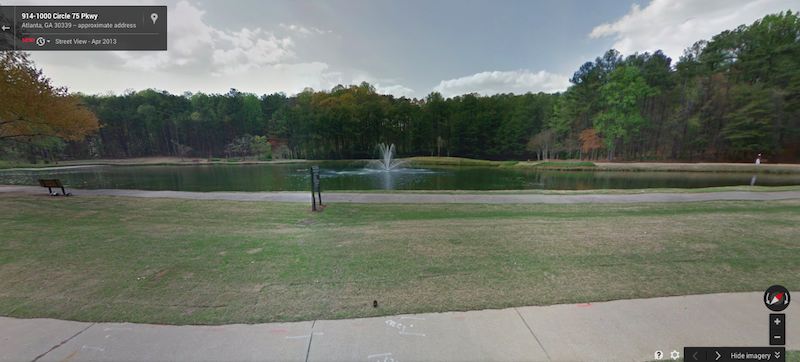
Lake on property with fountain

Lake on property with fountain

By changing the orientation, Populous can take advantage of an already existing feature on the mostly undeveloped land: a lake with a fountain. That lake will be transformed to fit the development, yet it will remain just beyond the outfield and near the big entry plaza. Populous is also utilizing topography, by nestling the grandstand into a hill that rises 70 feet from the lowest point on the property.

Parking will be situated at the western and eastern ends of the property. They’ll need garages to get to 6,000 spaces, otherwise that much parking would require 46 acres of surface lots. It would seem appropriate for traffic planners to route fans from the north to one end, while fans from the south use parking lots at the other end. The Braves are also claiming that they’ll have parking available from parking lots surrounding the village, which tends to lead to overly optimistic projections. The ballpark will be one of the least public transit accessible parks in the majors, which translates to the team needing more than 10,000 spaces at a close proximity. 6,000 won’t cut it.

All told, the Braves’ plans bear a keen resemblance to Lew Wolff’s failed ballpark village efforts in Oakland and Fremont. The key difference is that the ballpark in this case feels tangential to the rest of the development, not wholly integrated. A bolder approach would’ve been to put the ballpark on the western end, parking on the east end, and allow fans to walk 1,000 feet to the ballpark through the village. The ballpark could be oriented to the east and Populous could even take advantage of a small hill on the western end. Oh well.