Previous Seattle posts:
—–

Puget Sound, with the Port of Seattle in the foreground, Downtown Seattle to the right
I’ve been going to Utah a few times for business this summer. During one of the trips, I got to hang out with Scott White, a loyal A’s fan from the Beehive State. While we sat in some excellent seats for a River Cats-Bees game at Spring Mobile Ballpark (thanks Scott and Mrs. White!), he asked me for recommendations on a baseball weekend trip. He had been to Oakland, of course, but as a married guy in his early-mid 20’s he hadn’t done a ton of baseball travel yet. The most convenient trip, I argued, was Coors Field in Denver, a short plane trip or an 8-hour drive away. On the other hand, if he wanted to go to a more interesting city that has far and away one of the best ballparks in the world (and SF was already checked off the list), Seattle’s Safeco Field is a better choice.
Then again, I hadn’t been to Safeco for several years. It is a great ballpark, yet I had trouble conjuring memories of the last visit. So I used that as motivation to spend a weekend in Seattle, where I could stretch out and enjoy more than a few hours in SoDo. Boy, did I ever.
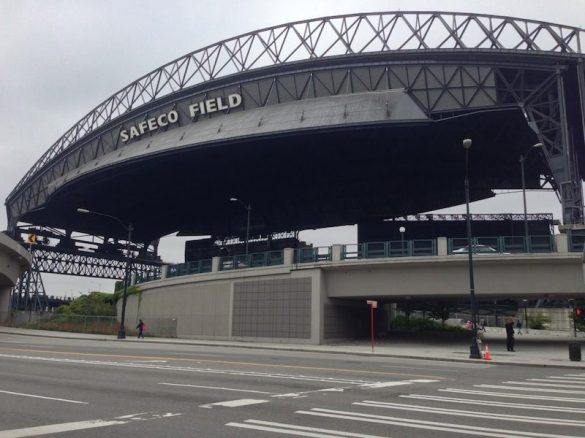
I don’t know that there’s a best way to approach Safeco Field. Taking light rail to the Stadium station allows for a meandering stroll to the park, where the roof dominates the landscape. The walk down 1st Avenue South from Pioneer Square and downtown is not terribly long and has little to write home about. VIPs at M’s games have their floors at an adjacent garage so they can avoid the riff-raff. The best thing to do is to walk along the west facade until you’ve reached the home plate gate, where the lovely rotunda is your entrance. An art installation made of white plastic bats called “The Tempest” hangs from the ceiling like a massive chandelier.

The Home Plate Rotunda, where The Tempest is installed
The challenge when conceiving the successor to the ill-fated Kingdome was to allow the Mariners to play games protected from Seattle’s seasonal downpours while making the overall environment feel like an open air ballpark. Of the new parks with retractable roof technology, Safeco Field has done it best. The roof retracts to the east of the stadium outside the seating bowl, so it doesn’t cause shadow issues like those suffered at Miller Park or Rogers Centre. And unlike Minute Maid Park, a similar design that opened a year after Safeco, or Marlins Park, it doesn’t feel like such a sealed off place when the roof is closed. Part of this is due to the more forgiving summer climate in the Pacific Northwest, which allowed the team and architects to forego air conditioning. Regardless, Safeco was put together with the knowledge that summer is actually pretty great in Seattle (outsiders aren’t supposed to know this), but to be safe the other seasons should be accounted for.

Edgar’s Cantina, a bar that replaced a section of bleacher seats.
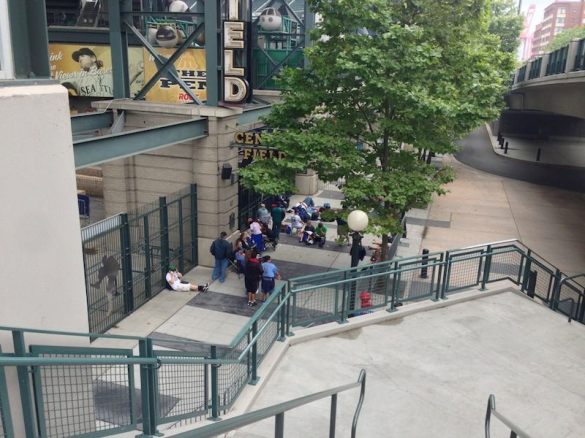
If there’s one thing to take away from Safeco, it’s that the place is meant for you to have a beer and enjoy yourself. Beer stands, often with quality craft offerings, litter both concourses. The entire left field bleacher area is devoted to two bars, one that greets fans that enter the center field gate, and Edgar’s Cantina, situated atop the visiting bullpen. Where AT&T Park is known for its kids-oriented facility, Safeco feels at times like one big party deck, or Wrigley Field with better beer.
I took a tour and went to two games, a night game followed by a day game. The night game was special, as it was Ken Griffey Jr. Day. The slugger was being inducted into the M’s Hall of Fame, and it was one of those rare occasions this season where 47,000+ fans showed up. During the induction ceremony, fans listened with rapt attention as their beloved hero was feted. Commemorative Junior bobbleheads were made for the occasion, though only 20,000 fans walked away with the memento. The vast majority of fans stayed through most of the game, even as Hisashi Iwakuma gave it up in the seventh, turning a pitchers’ duel into a Brewers blowout.
The Sunday getaway day game, which attracted 25,390 to the yard, was your classic King Felix start: low-scoring and quick (the game ran only 2:11). A few hundred fans sat in the designated King’s Corner, clad in gold shirts. This was the game that really showcased Safeco as an outdoor stadium, since the roof was open and a bright sun was filling the park. My seat was in the front row of the LF bleachers, which felt great despite it being 30 feet above and recessed from the outfield fence. Speaking of those fences, they’ve been moved in a tad. They’ve already surpassed their home run total from last year, so it seems to have worked, though Raul Ibanez skews things a bit. So far the M’s haven’t done anything with the limited space. There’s enough room for a row of overpriced field level seats if they want to go that route.
A replacement scoreboard was the other major change going into 2013. Larger than a basketball court, the new scoreboard replaces the old combo board flanked by static signage. Unfortunately, most of the time the retro-themed display shows replacement ads where the old static signs used to be. The M’s have ongoing advertisement and sponsorship agreements with various companies, so this couldn’t be avoided. The graphic packages are lovely, with a lot of motion and variety. The Fenway green background used during the game is somewhat gimmicky, but the detail and sharpness are so good that you could be forgiven for thinking the board was itself static – at least from the upper deck where I sat.

New scoreboard above the CF bleachers measures 57′ x 107.5′, or slightly larger than two single family home lots back-to-back.
As one of the larger parks in MLB these days, Safeco isn’t intimate. The cantilevers aren’t aggressive, and when the smaller Sunday crowd was in there it felt too big at times. Yet somehow it isn’t cavernous, the way Chase Field tends to be when the roof is closed. It has the requisite multiple clubs, a boatload of suites, plus generous concourse space and amenities. Access is excellent and there are many places to hang out during the game, such as the aforementioned LF area or the rotunda roof behind home plate. It feels like an oasis. And when the sun sets over Puget Sound and the Olympic Peninsula, it’s hard to imagine a better spot in baseball. It’s even harder to imagine leaving.

Baseball Museum of the Pacific Northwest & Mariners Hall of Fame
The best part of Safeco Field isn’t kissed by the sun or close to the action. It’s the Baseball Museum of the Pacific Northwest, a carved out part of the lower third base concourse behind some concession stands. Practically hidden away, it’s a gem of a spot that frankly is the best reason for coming to a game early, better than batting practice or autographs. The Museum chronicles baseball history in the region, from the turn of the century era to the Seattle Giants to Sicks’ Stadium and the Pilots and finally the Mariners, the Kingdome, and Safeco. Included in the collection is the Mariners Hall of Fame, which has the requisite player monuments you’d expect (Big Unit, Gar, Alvin Davis, Buhner, etc.). Naturally, Junior’s monument is the newest addition. At one end of the museum are displays showcasing the various forgotten teams of the past. At the other end are family stuff, such as exhibits explaining the construction of bats, balls, and gloves, and a replica outfield wall where fans can take pictures of themselves making “leaping” catches. The piece de resistance is a craft beer bar called Power Alley, which has a dozen taps and numerous canned and bottled varieties. Whoever put this together prior to the 2007 season deserves a promotion.
While the SoDo neighborhood isn’t as lively as South Beach near AT&T Park or Blake Street near Coors Field, there are a few bars nearby. Pyramid Alehouse has an outpost across the street, which is convenient. Pioneer Square is a 15-minute walk away. I was so focused on the experience inside Safeco that everything outside it barely registered.
Baseball at the Kingdome was even more drab and gray than the Coliseum is now, thanks to the concrete everywhere you looked. It was dreary, depressing, and hopelessly artificial. The Mariners and NBBJ’s Dan Meis took a major compromise, a retractable roof, and managed to minimize it to as little as possible given its size and heft. Now that light rail runs nearby the park is even better integrated than it was when it opened. Given the circumstances, Seattle has made the biggest upward transition from old stadium to new ballpark. The team’s recent suckage has made the ballpark the biggest draw in recent years. Whatever happens next, many of the financial concerns have subsided thanks to retirement of debt two years ago. Regrets are few. That makes Safeco, in every sense, the exact opposite of the Kingdome. For that, Seattleites can rejoice.




 newballpark.org