US Cellular Field (New Comiskey)

In a previous installment of this year’s Chicago travelogue, I described what it was like to go to both Wrigley Field and US Cellular Field on the same day thanks to a scheduled Chi-town doubleheader. While I went into some length about my experience on the South side, I wanted to save the bulk of my observations for a proper review, especially because I wanted to compare the current version to what I saw in 1996, five years after the park opened as New Comiskey Park.

us_cellular-04-outfield_view-sm

View from right field seats

Until the extensive, multiyear renovations package (done by HKS) was completed in 2012, the Cell had earned a somewhat unearned reputation as outdated. This wasn’t entirely HOK’s (Populous) or Jerry Reinsdorf’s fault. Reinsdorf wanted a modern edifice and used Royals (Kauffman) Stadium as his inspiration. The result was nothing like old Comiskey, cramped and dank. The new Comiskey was spacious, exclusive, and packed full of what was then the newest technology outside of a retractable roof. When Oriole Park at Camden Yards debuted the following year, starting the retro ballpark craze, all of the features that made New Comiskey modern made it look fan unfriendly and lacking in intimacy. If that meant outdated, so be it. They lacked the foresight to go retro? Fine. The O’s earned great acclaim for their small urban ballpark, while the White Sox and the City of Chicago spent much of the next two decades playing catchup to the Camden Yards and just about every other new park.

Visiting (Athletics) bullpen

Visiting (Athletics) bullpen, John Jaso (right) getting ready to take some warmup tosses

A look at the bones of the Cell should tell you the era it comes from. There’s a lot of bulky prestressed, pretensioned concrete in the supports and columns. The only structural steel you’ll see is in the upper deck, holding up the roof. The massive pole-to-pole structure backing the outfield concourse holds the scoreboards and numerous ads. If the park were built a few years later, Reinsdorf might have considered turning the ballpark north to take advantage of a great view of the Chicago skyline. Architect Philip Bess offered up his own alternative to New Comiskey in 80’s and in his book City Baseball Magic. Bess’s plan, called Armour Field, was more like Old Comiskey and even more retro than Camden Yards, with extremely shallow dimensions in the corners and a grandstand shape that evoked the Polo Grounds in New York. The park would’ve had a northern orientation, providing fabulous views of the Loop from inside the park. Instead, Reinsdorf chose the parking lot across the street from the old one and oriented the new one southeast towards Bronzeville. Call it a missed opportunity.

Arches evoke old Comiskey Park. White panels cover previously open upper concourse.

Arches evoke old Comiskey Park. White panels cover previously open upper concourse.

New Comiskey was criticized immediately for having a very steep upper deck that was also far removed from the action since it is placed atop two suite levels and a club level (sandwiched between the suites). In hindsight, this critique was perhaps a bit too heavy-handed as many Populous-conceived parks have used variations of this placement. Some may use a large club mezzanine backed by suites (Camden Yards, Petco Park). Another variant had a large club mezzanine, then a glassed-in concourse, then the suites, then the upper deck (AT&T Park, Safeco Field, Coors Field). Others utilized a triple deck of suites on one side and a club section on the other (Progressive Field). Now that we’ve seen 20 years of ballpark development, it’s easier to be kind to the Cell. In actuality, the biggest problem with New Comiskey was that there were too many rows in the upper deck, a chief complaint of the park’s inspiration, Royals Stadium. The latter day renovations chopped the top eight rows off the upper deck and enclosed the upper concourse in translucent glass. A much more substantial roof replaced the previous version and was heavy enough that it had to be supported by the aforementioned steel columns. Curiously, these columns also introduced something that Reinsdorf had worked hard to eliminate: obstructed views. The obstructions only occur in the furthest reaches of the upper deck, and you’ll be hard-pressed to find anyone who says the new structure properly evokes Old Comiskey. Still, it adds definition to a part of the stadium that sorely lacked definition.

Upper concourse at U.S. Cellular Field

Upper concourse at U.S. Cellular Field. Steel beams are meant to support roof, not seats

Obvious nods to Old Comiskey come in the form of arched windows and openings in the facade, and the big scoreboard in center, complete with the multi-colored pinwheels and fireworks that go off after every White Sox home run. The board is flanked by screens in left and right, which are perfectly functional but not complete despite the number and size of the screens. Out-of-town scores are pretty much an afterthought. The arches, while a tasteful treatment, are nothing compared to the hulking network of ramps that nearly encompasses the Cell. The only thing that makes these ramps an improvement over previous cookie-cutter ramp structures is that they’re somewhat removed from the stadium. The problem with that implementation is that since fans enter at gates attached to these ramps, there’s no way for anyone to easily move between the different decks. To this day the White Sox maintain a policy that a fan’s ticket restricts him/her to a specific level. Fortunately, I was taking in three games of the A’s four-game set in Chicago, so I had a chance to roam around all of the non-premium areas. The White Sox have said that they plan to open up the park more in the future to allow for the kind of in-game circulation experienced at other parks. Even if they do that, moving among the decks will still be a pain because of the ramp system. At least at Gate 5, there’s a bar to accept fans pre and post-game.

View from behind the plate at dusk.

View from behind the plate at dusk.

At least the various food options have improved. The lower concourse has long had a good variety of concessions, including the staple Chicago dog and popular nachos stands. With the upper deck revamp came a number of new selections, including wings from Hooters and several open grills. I had a piled high Chicago dog, just as I did at Wrigley, and I liked the South side version more. A Jimmy John’s ad on the outfield fence teases about sandwich availability at the Cell, unfortunately the only Jimmy John’s is two blocks away along 35th Street, near the El and Metra stops. Outside food is allowed.

The outfield concourse, which has always been reminiscent of the old bleachers at the pre-Mt. Davis Coliseum, is as spacious and friendly as ever. The bullpens have moved from the former slots to Fenway-like spaces along the outfield fence. A patio area sits next to the visiting bullpen in right. The bleachers, which used to occupy both left-center and right-center, are solely in the former. A multi-level outfield platform was erected in the LF corner. Atop this deck is the Comcast-sponsored FUNdamentals children’s play area. Like everywhere else in the park, it has an usher or two to grant access, and when I approached to take look I was naturally looked upon suspiciously as no child was accompanying me.

Ramps and escalators are separate from concourses. This ramp set at Gate 5 is also separated by 35th Street.

Ramps and escalators are separate from concourses. This ramp set at Gate 5 is also separated by 35th Street.

Which brings me to the biggest issue I have with the Cell. The place has staff everywhere. Every aisle has an usher, every open stand (most) has a big crew. Normally that’s a good thing when you need help. At the Cell, it feels more like Jerry Reinsdorf doesn’t trust his fans and chose to have eyes everywhere. Most of the staff were friendly enough, but not to the level of either Miller Park or Wrigley Field. During the game, the upper deck ushers will watch the seats to make sure that fans don’t roam around, say, to the top of the stands. This results in a situation where sneaking down is very difficult. Your best bet for a good ticket below face value may be to find seats on Stubhub or via a scalper. US Cellular Field is the most overstaffed ballpark in the majors by far, and needlessly so.

Night view of... mostly ramps

Night view of… mostly ramps

The neighborhood is still not great. The Sox have gone so far as to point out neighborhood restaurants and bars in the vicinity, though none of them are right at the park other than the aforementioned attached Bacardi Bar. After the Saturday game we walked to Mitchell’s Tap, which has a pretty good beer selection including multiple selections from Founders (which is not available on the West Coast). Even so we eventually traveled back to the North side, ending up at the wonderful Hopleaf in Andersonville. The transitioning (or gentrification) process around the Cell is very much a work in progress.

A decade after opening in 1991, New Comiskey/US Cellular Field has undergone major, near constant changes. It started out with 42,000 seats, moved up to 47,000 seats, then dropped down to the current 40,000+.  Royal blue seats were switched to green, while the white outfield framework was painted black. The upper concourse looks nothing like it used to. Ultra premium seats and a club were added behind the plate. The outfield was changed, foul territory was reduced, and the ballpark was made to resemble its predecessor more than the original vision would have suggested. That’s not enough to place it among the top 10 ballparks on my list. It’s enough to make the Cell a very respectable, functional ballpark that should last another 20 years without major changes. After that? It’ll be up to Reinsdorf’s sons.

—–

P.S. – Many thanks to all of the readers and good people I met out there including Shane/Zonis, Nick, Joe, Derek, Mike, Tom, and everyone else I failed to mention here. All of you made the weekend even better than I expected. I’ll definitely put together a full meetup the next time I’m in town.

P.P.S. – As I’m planning a trip for New York over Labor Day weekend, after that’s completed I’ll do a feature that focuses on the ballparks for the premier teams in the two-team markets, and then another feature on the second banana ballparks (like the Coliseum and the Cell).

Oakland Mayor Quan with Bucher & Towny, 7/3/13

Update 7/5 5:00 PM – The Trib’s Matthew Artz confirmed what we were all thinking:

Get on that, Oakland. Chop chop!

—–

Oakland Mayor Jean Quan continued to make the case for Howard Terminal on Bucher & Towny’s show today, talking up site control at both the waterfront site and at Coliseum City, which she more-or-less admitted MLB has little interest in based on their inquiries. She even got a dig in at Lew Wolff, saying that “to say there are no sites in Oakland you have to have blinders on.”

Streetscape of The Embarcadero adjacent to Howard Terminal

Quan also revealed that the A’s Coliseum lease extension is very close, that the JPA has been negotiating all spring, and one item remains to negotiate – the scoreboard replacement. A capital improvements fund that was set to cover replacement scoreboards was raided to cover costs associated with the Coliseum City study, and that chicken has come home to roost. There’s no reason to think that the scoreboard would be a showstopper for the two parties moving forward, but this is the JPA we’re talking about. Who knows what can happen in the coming weeks.

Chris Townsend alluded to a July 11 announcement that Howard Terminal could be fully available. In all likelihood that’s dependent on the Port approving settlement terms with SSA, which are now under fire by the longshoremen’s union.

Townsend also tried to get an explanation for what needs to be done with railroad tracks at Howard Terminal, which brought on the following exchange:

Townsend: Someone has told me that one of the problems with Howard Terminal – I wonder if you can speak to this – is that the railroad tracks that run through there… can you talk about that one main concern?

Quan: Well, the ones that go to the Amtrak are outside the (area) so I don’t see that as a problem at all. The other tracks were going straight to the ships. If that’s no longer a terminal they’ll just be lifted up or out, or maybe we’ll make it part of a new light rail system into the ballpark. I don’t know. All of the developers I’ve had look at it have never raised that as an issue.

A couple things to point out here. First, the main tracks that run down The Embarcadero are owned and operated by Union Pacific, who also has a huge yard just northwest of Howard Terminal. The rail line is a vital part of port operations, and that won’t be moved. There’s no chance of that. The issue, as we identified last year, is that a bunch of infrastructure has to be built in conjunction with Howard Terminal’s conversion to a ballpark site in order to support cars, bikes, and pedestrians that would all converge there for games. Plus there would have to be streetscape improvements and safety equipment installed to prevent people and drivers from playing chicken with heavy diesel trains. Add in the presence of a gas pipeline and you have a situation where the Public Utilities Commission will have to come in and approve everything that gets done along The Embarcadero.

Second, the tracks on the site are little more than an afterthought at this point. They were preserved as part of the capping process. If, as Quan says, the tracks can be lifted up or out, the cap would be breached. I always figured that the cap would have to be breached to prep the site, so no big deal there, right? But if a ballpark is supposed to be built without disturbing the cap, how is digging up and removing the tracks supposed to be compatible with that? Moreover, the thought that the tracks could otherwise be folded into a light rail or streetcar project shows how little Quan understands about the situation there. There are strict federal rules about separating freight and other heavy rail trains from light rail trains, to the point that grade separations are frequently required to ensure safety along both lines. The tracks as they sit feed directly into the big railyard, so they couldn’t be used for light rail or a similar purpose unless someone built another bridge to lift trolleys above the heavy rail tracks. The cost to do that would be astronomical on top of the other bridges that would be required there.

Look, I don’t expect Quan to be on top of all of the little details. She seems content to delegate much of the work to her teams and committees, and that can work in many instances. On the other hand, this puzzling response about the rail safety issues clearly shows that her background info on Howard Terminal is very limited. Maybe there’s a reason for that, and that reason is that there is no environmental impact report. Townsend suggested that there’s an EIR for Howard Terminal is coming, but Quan backtracked from that, saying that the Coliseum City EIR is around the corner while not providing a timeframe for Howard Terminal. She said that she believed the Port Commission has ordered the review work. There’s no record of any initial or ongoing environmental review happening at Howard Terminal, so color me confused. Quan took some time out to talk about the importance of CEQA, so she’s fully aware of how mindbogglingly thorough CEQA can be. CEQA is so thorough that new construction has to at least have an initial determination of whether or not a project requires the rest of the CEQA process. So far, there’s no record of that step or any beyond that happening. Now, the Port could be doing some background work to help supplement an EIR if it gets formalized. If that has occurred it hasn’t been publicized. That’s far different from the running clock on an EIR. Oakland won’t be able to cut the EIR clock in half by doing prep work. There are hearings and public comment periods that are required.

Quan fielded election-related questions at the end, with the knowledge that no one of note is running against her in 2014. She’s full of bravado if not outright swagger, propelled by the green lights at the OAB Port project and Brooklyn Basin. She even articulated Oakland’s general stance about the stadium effort in a very succinct way, “You have to prove that we can’t do it.” Well, it’s been proven that Victory Court was a loser. Will Howard Terminal and Coliseum City be strikes two and three?

News for 7/3/13

There’s a lot of news during this holiday week. I figured it would be best to drop it all in here. First up, A’s news.

MLB announced today that it has retained John Keker of SF firm Keker & Van Nest to represent baseball in the San Jose antitrust lawsuit. Keker has a long and colorful history as one of the country’s top trial lawyers, and would be a formidable opponent for Joe Cotchett if the suit ever went to trial. Or, as a former partner at KVN, Wendy Thurm (@hangingsliders), put it:

Keker’s first statement about the case description of himself as a frequent defense lawyer is also colorful:

Keker also has his hands full defending Standard & Poor’s in the federal government’s lawsuit over allegedly fraudulent practices. Let the games begin, I say.

Besides MLB announcement, if you were worried that the lawsuit would leave the news cycle, there are new articles from the LA Times and Forbes covering the matter. In other news:

  • Members of the ILWU (Longeshoremen’s Union) are opposing the SSA settlement, which would close Howard Terminal and potentially convert it to a ballpark site. The union’s complaint is that the net effect of the settlement and consolidation is the loss of union jobs. This contention has evidently forced the Port of Oakland to again delay voting on the settlement to July 11.
  • BART’s still on strike. Last night’s announced attendance was 17,273, the smallest crowd since the end of May. Tonight’s a fireworks game with the 4th tomorrow, so crowds should be hefty despite the lack of BART.

—–

Away from the A’s…

  • The City of Glendale, Arizona, approved a 15-year lease deal to further subsidize the Coyotes NHL club, keeping them in town until at least 2018. The team has an out clause after only five years if they demonstrate they’ve lost $50 million over those first five years. In return, the team will be renamed the Arizona Coyotes. While the NHL continues to own the team in the interim until a purchase is finalized by Renaissance Sports & Entertainment, a new arena operator has been found in titan Global Spectrum.
  • Folks in Seattle were following the happenings in Glendale closely and were ready to pounce if no agreement could be made. Now the Emerald City and Chris Hansen are officially 0-for-2 in attempts to lure franchises to Puget Sound.
  • The City of Anaheim and the Angels are jointly funding a study to determine the cost to keep Angel Stadium up-to-date. Initial estimates have the cost to renovate Angel Stadium at $120-150 million. After the Dodgers spent $100 million to renovate clubhouses and scoreboards, I’d be surprised if the Angel Stadium tab was only $150 million.
  • As the cost to build a AAA ballpark in El Paso rises, the new owners of the franchise backed away from giving $12 million in personal guarantees towards the project.
  • Curbed has a neat pictorial retrospective on the various ballparks that have called New York home over the decades.

And a quick announcement: I plan to be in New York for a few days around August 24-25 Labor Day weekend. I’m still locking down the plans. The Yankees are in town that weekend and the Mets prior to that. I’m working to take in games at both ballparks, and some US Open tennis action if I can fit it in. If you’re there at that time, drop me a line (email, Twitter) and we can have a chat and/or take in a game.

BART, AC Transit strikes to affect A’s fans

By now you’re probably aware of the awful gridlock gripping much of the Bay Area because of the BART employees’ strike, which started this morning of months-long negotiations broke down again over the weekend. The employees, who are members of the ATU and SEIU, have been asking for raises to make for recession-era givebacks. The ATU asked Governor Jerry Brown to force an order to keep the trains running while negotiations continued. Brown refused to act, leading to a complete shutdown of trains. (Disclosure: My dad, who retired 2 years ago, was a shop steward for ATU in the South Bay/VTA chapter.)

Whatever your feelings are about the strike, if it goes on throughout the week there will be no BART service to the three-game series against the Cubs, Tuesday through Thursday. BART has attempted to bridge some of the commuter gap by running charter buses between its terminal stations (Fremont, Dublin/Pleasanton, etc.) to San Francisco, but those buses are limited to commute hours. AC Transit is providing extra Transbay buses, while service along the BART spine remains as-is.

AC Transit’s employee contracts were also up last night, so they’re currently working without a contract. There is talk that AC Transit employees will do a one-day walkout as early as Tuesday, which would compound the the East Bay’s transit crisis.

Ferries are experiencing a huge surge in ridership. Unfortunately, fans still need AC Transit (or Capitol Corridor) to get from Jack London Square to the Coliseum.

And not to be left out, the City of Oakland’s non-emergency public employees started their own one-day strike on Monday.

Capitol Corridor is an option that will provide uninterrupted service, despite the fact that its trains are actually operated by BART. While Capitol Corridor isn’t the quickest or most convenient way to get to the Coliseum, it can do in a pinch if you’re set against driving to what will undoubtedly be a more packed Coliseum parking lot. Amtrak even started a promotion this summer that allows riders to pay only $5 each way for companions, up to 5 companions per trip. Capitol Corridor doesn’t have a very frequent schedule late at night, so if you’re considering taking the unelectric train, first check the schedules to see if they work for you.

Fans along the 680 corridor are pretty much screwed from a public transit standpoint. As for South Bay and Peninsula folks, BART was never a direct option unless you drove to Fremont or Millbrae to take BART in the first place. Same goes for North Bay fans, whose transit options to the Coliseum have historically been limited.

BART usually accounts for 15-20% of fans getting to the Coliseum. Tuesday’s date is not a Free Parking Tuesday game, so don’t be shocked if you have to pay – it was on the schedule from the beginning. The A’s haven’t provided any advisories for the series yet, but you can expect to see something tomorrow. The A’s homestand ends Thursday, which should hopefully limit damage if the strike extends through the weekend. The Giants have a six-game homestand starting on Friday starting with a Dodgers series. The A’s return on the 12th with a Red Sox series.

The last BART strike occurred in September 1997, at the end of a particularly dismal season for the A’s (65-97). The A’s weren’t affected in the first two days of the six-day strike as they were on the road. Come Wednesday, September 10, the A’s were greeted by crowds of 4,764 and 6,135 against Toronto.

Advice: Carpool as much as possible. Allow for an extra 30 minutes to get to the ballpark, or leave late (close to 7) to avoid the nastiest part of the commute. Try Capitol Corridor if it works within your schedule. And hope that the different parties can come to their senses and end this mess.

When meaningless numbers are spun

In the eight-plus years I’ve been writing this blog, I’ve remembered a lot of little details. I’ve also forgotten just as many. Such was the case Thursday, when a John Shea article brought up San Jose’s economic impact report from 2009 (Exhibit 3 in the antitrust case filing). Shea asked whether a move to San Jose would boost attendance. He then pointed to the report’s assumption of only 2.1 million in annual attendance at a hypothetical 32,000-seat ballpark.

A’s superfan, radio gadfly and occasional commenter here (and friend of the blog) Bleacher Dave stepped up to push the idea that San Jose has an attendance problem, even though an Athletics game has never been hosted there. I rebutted that the attendance claims were never meant to forecast actual demand, only to provide a baseline for tax benefits (conservatively) and indirect benefits (usually outrageous). No matter, Dave pressed on, citing study author CSL’s experience in the field to buttress his argument.

CSL also did similar reports for the 49ers and Raiders to back those teams’ respective stadium campaigns. So far, only the 49ers have their stadium going. I pointed Dave to the Raiders report. Later I remembered that Let’s Go Oakland did its own report for a hypothetical Oakland ballpark either at the Coliseum or somewhere in the Jack London Square area.

Funny thing. Gruen Gruen & Associates, the firm hired to do LGO’s study, made its own attendance assumptions for a new ballpark:

  • Coliseum: 2.11 million/year
  • Jack London Square: 2.24 million/year

The key difference is that LGO’s study has a ballpark capacity of 36,000 instead of San Jose’s 32,000, which would in theory allow for larger sellout crowds when sellouts occur. The projections put the Coliseum roughly on par with San Jose and JLS ahead of both to the tune of 1,600 fans per game. If San Jose’s capacity were greater and had a similar number of sellouts, San Jose would land somewhere in the middle of the Coliseum and JLS projections.

Now if I wanted to twist these numbers into something they aren’t, I’d say that there’s something definitely wrong with the supposedly rabid Oakland fanbase only increasing attendance over the old Coliseum years by 7-13%. Surely there’d be a better response than that, right?

But I won’t. Because that’s not what these studies are for. The studies base their assumptions on five-year historical ticket sales at the Coliseum, which as we all know isn’t exactly an attractive, modern venue. Only one of those years was a playoff year. A major rebuilding plan marked the following years, which negatively affected ticket sales and fan interest. Wherever the A’s build, they won’t have the luxury of getting a big public subsidy as was the case in Miami or Washington, DC. If this thing actually gets built, it’s reasonable to expect that there will be so much pent-up desire to be there (the wildcard of on-field performance notwithstanding) that attendance should easily surpass those assumptions. It all has to do with season ticket sales.

Before a single pile is driven or brick is laid, the A’s will probably have to get somewhere in the neighborhood of 15,000 season ticket commitments or FSEs (full season equivalents). The closer to 20,000, the better (the A’s hover below 10k currently last I heard). The Giants maintain 25-27,000 FSEs annually, and they were so confident in the demand when their park opened that they only offered full season ticket subscriptions. (Note: More upfront ST commitments – especially multiyear – also proves to banks that the project is worth financing.)

The greater the ST sales, the better for the whole A’s market. It creates scarcity for the remaining seats, it provides a solid secondary market, and if pricing tiers are set correctly, should create good value for fans at multiple levels. It also means a lot fewer really cheap seats, but that’s the price of growing into a better, privately funded facility.

The two economic impact reports written for San Jose and Oakland provided none of this context and took none of these factors into account. All they did was average attendance over a short window, bump it initially upon opening, and taper it down over time as the honeymoon effect wore off. That’s the most basic of analysis and should be treated as such. Actual numbers should be better, but could also be worse if prices are too high or the team is pitiful. There are no guarantees.

If the goal of certain individuals is to create a gotcha moment out of a misinterpreted number, then we’re going to waste a lot of time finding gotcha numbers and moments everywhere. It smacks of a political race. There are much more important numbers to consider, such as the cost of Howard Terminal or a territorial rights payoff. Those are the numbers that matter. Not some previously ignored projections from several years old documents that are easily disregarded.

If people want to persist with stuff like this, I can’t stop them. We’ll be here as we always have, ready to provide the nuance that the news articles, tweets, and radio callers often lack.

—–

P.S. – Oakland Fan Pledge, which was started to prove fan commitment to the A’s, has just over 4,000 pledges so far (including mine). We’ve got a long way to go, folks.

P.P.S. – One more thing to consider. The Giants have long maintained that they need attendance of 30,000 every game in order to take care of AT&T Park’s debt service and field a competitive roster. How on earth would the A’s be able to pay for a more expensive park with 25,000 a game, even if prices were jacked up?

Oakland’s Port settlement gamble: Short-term pain, long-term gain

The Port of Oakland’s board ended today’s session without a decision on the SSA settlement, pushing the matter to a special session next Tuesday. Thankfully, the Port also released the upcoming meeting agenda, which includes summary of the settlement terms this afternoon, allowing the public to review the settlement.

At no point in the document do the words “Athletics”, “stadium”, or “ballpark” show up. While anyone following recent news could divine Oakland’s purpose for Howard Terminal, no pro sports (or any other development) are associated with it. For now. Instead there’s a pretty level-headed analysis of the pro’s and con’s of settling SSA’s lawsuits against the Port, repurposing Howard Terminal for non-revenue uses, and the broader effects on overall Port operations.

As part of the settlement, SSA would cease operations at Howard Terminal on behalf of Matson, and would move down the harbor to Berths 60-63, where they’d take over for Eagle Marine Services (who chose SSA to succeed them). SSA, which was complaining about higher fees compared to competitors, would starting running the new terminal under the same fee structure as EMS. In exchange for the lower costs, SSA has agreed to drop its lawsuit against the Port.

If Howard Terminal is vacated, the Port assumes that it will lose $10 million per year in revenue, minus any offsetting revenues gained by SSA’s consolidation and costs associated with the lawsuits (I pointed this out last year).

While the settlement is driven by Port’s desire to get rid of the lawsuits while consolidating facilities, the ballpark push looms in the background. There’s no amount of ballpark activity that can pump $10 million per year into the City/Port, but that’s a moot issue since there’s no way a ballpark would be ready anytime in the next four years. The big gamble is what happens to Howard Terminal if MLB doesn’t like the site, or if MLB approves the A’s move to San Jose? What to do with land that has to be regularly monitored that has limited use?

Assuming that the settlement is approved as expected on Tuesday, the City is showing that it’s making an effort towards providing a proper ballpark site away from the Coliseum. That may be just as well, since former Coliseum JPA board member and current Oakland City Councilman Larry Reid said this towards the end of City budget discussions tonight:

Ah, but will Oakland and Alameda County spend many, many more dimes to get Howard Terminal spiffed up?

Settlement could move Howard Terminal forward

Previous posts about Howard Terminal:

Later today the Port of Oakland’s Board of Port Commissioners will hold a meeting, during which an important settlement with SSA Marine will be discussed. This settlement is important as it should resolve the biggest legal obstacle hanging over Howard Terminal. The settlement discussion is a closed session item, so the terms weren’t made publicly available. Still, there’s no reason to think that the terms won’t be approved as the parties apparently have been in discussion for some time, and would probably prefer to avoid further litigation (which could run through next year).

howardterminal_birdseye-labeled-sm

Howard Terminal overhead shot with Jack London Square nearby

During the Don Knauss interview, he mentioned that environmental concerns were overblown. To wit:

We’ve done the diligence there as well and been assured by experts that a ballpark can be built on that site without a substantial cost associated with cleanup. Basically we can build a ballpark on top of that site without having to scrape the site clean like AT&T was built on (China Basin).

Wait a minute. China Basin was built without having to scrape it clean? Actually, it was scraped clean. Site remediation was done by the Giants, not the City or Port, and reimbursed to some degree by the federal government via the Federal Brownfields Tax Initiative. Piles were driven deep into bay mud (fill) to provide a proper foundation. Knauss is suggesting that a Howard Terminal ballpark can be built without replacing the fill currently at the site or even piercing the asphalt cap designed to contain the site’s contamination. I’ve heard this claim before but not the plan behind it. Naturally I have to be skeptical of this claim. China Basin and Howard Terminal are similar enough that it’s hard to conceive of how this would work.

AT&T Park’s foundation was built the many expected: land was cleared, cleaned up, and piles were driven to support the stands and ancillary buildings. This was required because China Basin sits in an extreme liquefaction zone. Howard Terminal also sits in an extreme liquefaction zone, which would presumably mean similar measures to China Basin would have to be undertaken. The difference with Howard Terminal is that the State of California put the asphalt cap over the contamination over a decade ago instead of cleaning it up completely, a process which would’ve cost $100 million ($131 million in 2012). That cost has long been the biggest source of the site costs associated with Howard Terminal.

Then again, maybe Knauss and the Oakland backers have a clever, innovative plan that would not require piercing the asphalt cap, or at least minimizing the number of intrusions. That would probably require building a smaller number of larger sized footings at the site, then constructing an above grade podium on which the ballpark would be placed. If that sounds familiar, it’s because Bryan Grunwald proposed a similar approach at his 980 Park site. There’s no concrete estimate of the cost of such a podium, but I’d expect it to be at least $100 million given the the size and load it would have to carry. That could conceivably be cheaper than cleaning up Howard Terminal. Would it be that much cheaper? We’re talking about building a ballpark in a liquefaction zone. There’s no room to cut corners.

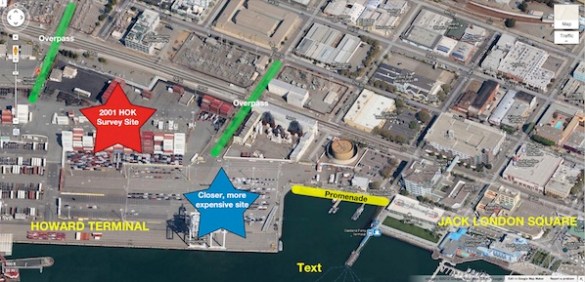
Another issue is the amount of planned infrastructure. Again, Knauss claims that costs are being overblown. But he also acknowledged that parking would need to be provided on site, which makes sense given the lack of parking in the immediate area (only 1,200 spaces within 1/3 mile). And if more parking is to be provided on the 50-acre Howard Terminal site, more infrastructure has to be built to bring cars into the site. I had previously suggested two overpasses, one for vehicle traffic and one for pedestrians. Add those to the podium, other site improvements, and additional improvements to the area north of HT, and we’re talking about an estimate north of $150 million. Maybe it’s less, maybe they’ve come up with something really innovative. The problem is that quality engineering is expensive and requires expensive materials. Heck, even bad engineering can be really expensive.

Finally, there’s the lingering question of Who will pay for it? The Giants paid for their site cleanup, got a tax credit from the Feds, and received a minimal amount of TIF funds for the surrounding area. If Knauss is suggesting the same kind of deal to Lew Wolff, it’s a nonstarter. That’s around $650 million worth of risk, 95% of it to be borne by the A’s, with little promise of the kinds of returns the Giants got at China Basin. (Note: Walter Shorenstein thought China Basin was so risky that he divested his share of the Giants, and many within The Lodge looked askance at the plan.)

Maybe, just maybe, Knauss and his people have this figured out. Maybe there’s a creative way to make this all work for everyone. Again, I’m skeptical. Many of the same claims were made about Victory Court, and that site was swept under the rug with barely a peep.

—–

P.S. – We haven’t even touched the transportation gap at Howard Terminal (BART or the mythical streetcar). Or whether the City, Port, and County would create yet another joint powers authority. Or lease terms. Or the lack of redevelopment funds for surrounding area improvements.

Knauss on 95.7 The Game: We think the world’s changed here

Clorox CEO was on with Chris Townsend earlier today. As usual, Townsend had a pretty thorough, wide-ranging interview that touched on a number of A’s and stadium-related topics. I’m going to highlight a couple of items.

Townsend: When it comes to buying the A’s, are you personally interested? Is Clorox interested?

Knauss: No I wouldn’t say we’re interested (Clorox) in buying the A’s. We clearly would love to work with the current ownership, Lew Wolff and John Fisher, on keeping the A’s here. I think there’s a lot of old data that Lew Wolff has about working in Oakland… We think the world’s changed here.

Later in the interview…

Knauss: I think we have this tremendous site down Howard Terminal, which is just adjacent to Jack London Square. We have what I believe can be the premier site in baseball… When I last talked to Lew about that last year, he said ‘we looked at that a long time ago, it’s not viable’. I think the last time the A’s actually sat down with the City in any serious way was over five years ago with Mayor Dellums. At the time I heard some of the old excuses why Howard Terminal wouldn’t work and they’re all void now, it’s a completely different place.

Townsend: Why do you believe Howard Terminal is viable?

Knauss: In 2005 the last time they looked, the Port was close to full capacity. Now it’s under 50% utilization. The Port can easily use Howard Terminal for a ballpark without adversely affecting the shipping business… The second thing I’ve heard over the years is that there is this environmental contamination on the site and people throwing some crazy numbers around about remediating that site. We’ve done the diligence there as well and have been assured by experts that the ballpark can be built on that site without a substantial cost associated with cleanup. Basically we can build a ballpark right on top of that site without scraping the site clean, the same way AT&T Park was built on that pier.

Knauss went on to talk about the revitalization of Jack London Square and the recent Brooklyn Basin deal. Then Townsend moved onto Knauss’s potential interest in owning the A’s.

Townsend: In the past you’ve talked about having a group to buy the A’s. Why have you never made an offer?

Knauss: We’re trying to respect baseball’s protocol. Our attitude is to negotiate this and not litigate this… We’d love to have Lew sit down with us and go over the new world that’s down there, not the old world that he’s familiar with. The other thing is that we’re close to getting this lease renewed so I think we’re demonstrating that you can get things down in Oakland and Alameda County… The second thing is getting site control of Howard Terminal. So I think that’s the reason we haven’t said, ‘Let’s find another ownership group.’ We think that could be viable, but I think clearly we’d rather say, ‘Look Lew, we’ve got a viable site, we believe that the team deserves a new world class ballpark, but there’s a way to get that done here in Oakland.’

Townsend: Clorox moved a number of jobs to Pleasanton. Why do you do that but yet you still say, ‘Ah we’re still about Oakland.’

Knauss: It’s a fair question. There are two things we wanted to try to achieve with that. One is, it’s a bus- it’s really a focus on innovation. The reason we’ve been around for 100 years is because it constantly innovates new products. We wanted to get all of our innovation people in one location. Now obviously innovation is driven by R&D, and we’ve always had R&D people folks out in Pleasanton. We had about 400 scientists out there and we’ve had ’em out there for decades. What we’ve learned over the years is that when you put all of the functions out there that drive innovation – marketing, sales, finance, human resources, legal, etc. – put all those people out there with the R&D people, then you get much quicker innovation, you get bigger ideas developed. So we wanted to create a new campus out in Pleasanton where we had our nucleus and add those people. We moved a lot of those folks out of downtown Oakland out to Pleasanton – but we kept them in Alameda County.

The second reason we did it was a business continuity issue. The headquarters building – obviously we’re all in the Bay Area sitting on various faults. We wanted to get some dispersion of our IT resources out in Pleasanton too where we thought we could spread out some of our risk from a business continuity standpoint. Those were the two central reasons: better innovation, better business continuity, minimizing risk. We’ve kept people in Alameda County, and we’ve kept our general office in Oakland, and certainly I’m sitting here in Oakland and I live in Oakland. So we’re committed to Oakland.

Let’s try to put this in perspective. Don Knauss was brought in as Clorox CEO in October 2006, shortly before Ron Dellums was elected mayor. Knauss is clearly referring to the anti-sports Brown administration and the general absence of leadership during the Dellums era. Are we – and Wolff & MLB – supposed to believe that a new sheriff is in town, that Oakland has suddenly gotten its act together? Moreover, Knauss recited Quan’s stance on the ballpark issue: As long as we provide the site, the A’s and MLB can’t turn us down. I think it’s pretty simple. If Oakland provides all site prep costs, streamlines the process, and throws in $200 million, then you can get MLB to pay attention. Without that it’s not really an even playing field with San Jose, where the greater number and size of upfront revenue commitments can help pay down ballpark debt early, just as is being done in Santa Clara.

Knauss also talked at length about the issues associated with developing Howard Terminal, which he minimized as much as possible. Muppet151 has a little insight into this:

HT is in a state of constant and PERMANENT review. I talked to the guy in charge of overseeing the site who said it’s somewhat similar to what contained contamination at the San Jose Arena. You can read the SJ documents here:

https://www.envirostor.dtsc.ca.gov/public/profile_report.asp?global_id=43730007

The HT project manager explained things a little further in an email to me when he said “While the Land Use Covenant restricts activities that would interfere with the cap from being conducted without DTSC approval, it is common in development plans to engineer acceptable solutions that modify cleanup remedies including caps under DTSC oversight.” If the footprint of the stadium extends outward to the point it’s over the capped area, and it’s my understanding it would, the stated scenario would take place.

From a technical standpoint, HT is definitely possible, and can be done. The problem is that this is not a 1 time fix. This is a permanent issue, and worst of all this is infrastructure work that the public will be on the hook for. There was cleanup work done in the area in 2004 making the ballpark possibility a little stronger. But the 200,000 cubic yards of capped material remains, as done the 2002 CA DTSC estimate of a $100 million cleanup should something go wrong. And again, that’s public money. Things might go smoothly….but over time, caps need maintenance, and putting a stadium over the underwater caps makes the situation remarkably unique.

Currently, nothing can be built at the San Jose Arena parking lot, including a garage for the arena or a future high speed rail terminal, without a comprehensive and costly remediation plan. Right now there’s only a sealed asphalt cap there.

Knauss also brought out the “respecting the process” stance used by many on the outside, including the mayors of both San Jose and Oakland. They’re all willing to “respect the process” until they hear something that doesn’t work with their agenda. That’s how the game is played. Unfortunately, as we’ve seen recently, the only way to get Bud Selig’s attention these days is to sue baseball.

When asked about Clorox’s move of hundreds of jobs to Pleasanton, Knauss’s previously well-focused responses devolved into some incredibly inane, weaselly CEO-speak. Read that response carefully. Earthquake faults? When Loma Prieta hit on the San Andreas fault, the Coliseum had enough structural damage to force Games 3 & 4 to be played at the ‘Stick, despite the Coli being on the Hayward fault (and supposedly less prone to damage). Knauss didn’t touch the issue that really caused the move: many of the scientists and their families lived along the 680 corridor and preferred to work there instead of commuting to Oakland. Knauss had to make the tough decision to keep Clorox competitive. That’s the reality of the move, not some BS reasoning about earthquake faults or risk management. And that’s the irony of it. Clorox is perfectly able to move 500 jobs to Pleasanton or 300 jobs to Arizona if it has business or competitive reasons. In terms of pure economic impact (tax revenue, job creation), the A’s are a much smaller company than Clorox, yet they can’t move 35 miles for competitive reasons. Makes me wonder if Knauss just did this to provide cover for the company’s previous and future moves under his leadership. It didn’t cost him anything, that’s for sure.

—–

Further reading:

Miller Park (The Return)

Upper deck behind home plate with the roof open

Upper deck behind home plate with the roof open

Last time I visited Miller Park in 2010, I had scheduled a stadium tour followed by a night game at Wrigley. On the way back on I-94, I was pulled over for speeding. The patrolman asked why I going 78 in a 65 mph zone. I replied that I was in a hurry to make a game at Wrigley. We then spent a minute talking about the differences between Miller Park and Wrigley Field. Other friends from Chicago have commented at times about enjoying games at Miller Park, whether or not those games involved the Cubs. Curiosity piqued, I vowed to return to understand why people from all over the Midwest liked Miller Park so much. After spending a day there, it’s easy to see why. It fills a niche that no other park fills for a thousand miles.

A cheery atmosphere on the approach to Miller Park

A cheery atmosphere on the approach to Miller Park

Lest we forget, the two Chicago ballparks are outdoors. Even if you aren’t stuck under an overhang at Wrigley with the wind whipping around, April and May games can be brutally cold at times. Milwaukee has it slightly worse being 90 miles north of Chicago. And now that the Twins have moved outdoors, Miller Park is the only stadium in the Midwest that provides a comfortable domed environment for those occasional inclement weather games.

Not that the dome was needed during my visit. The temperature on Sunday was 70 with clear skies. The game would’ve been perfect at old County Stadium. Over 30,000 came to watch a tanking Brewers club take on an aging Phillies squad. It was a perfect matchup in 2010. Now it’s a matchup of also-rans. Fans came out to get a Carlos Gomez bobblehead, and unlike many other ballparks I’ve been to, there was a huge supply available at any gate even at first pitch.

miller_park-04-harley_gate-sm

Just outside the left field entrance. Bernie Brewer’s home run slide visible on the right.

Before I entered the stadium, I drove to the general parking lot on the east bank of the Menomenee River. A pair pedestrian bridges connect the stadium to the general lots, with preferred lots located closer. It’s easy to be distracted by the various types of tailgating arrangements on display in the general lots. Orderly clusters lined each row with precision, while larger staging areas were set up next to the river. A live cover band played 90’s hits. Klement’s, the sausage company that makes the meat tubes for the Brewers and sponsors the famed sausage race, has its own outpost on the east bank. The pedestrian bridges, while short, created that processional feel that we A’s fans know from walking on the BART bridge. The Miller Park scenery is far less foreboding than industrial East Oakland, and Wisconsin even landscaped Hank Aaron State Trail along the river. The sausage racers were assembled on the bridges, posing for pictures with fans. The whole thing was friendly, friendly, friendly.

Right field lower concourse plaza

Right field lower concourse plaza

Enter the park at either the left or right field corners and you’re greeted by a wide concourse that feels equal parts arcade, state fair, and ballpark. The concourses are so wide that each corner has its own mini food court. Attractions for kids are everywhere along the outfield. The scene becomes less interesting around the infield, where suites and restrooms line the lower concourse, pushing fans out to the glass skin enveloping the ballpark. Behind home plate the fair resumes and views of the field are available.

Numerous escalators fill the space, and they’re necessary since there are four full levels of seats. The field (lower) deck has at most 26 rows. The loge (second) deck has less than 20. Each has its own full concourse. The loge deck has minimal cantilever over the field deck, extending well back over the lower concourse. A short club/suite level is sandwiched between the loge deck and the 20-row terrace (upper) deck. As if often the case in domes, the limited footprint required to conserve space forces more vertical construction. The upper deck is chock full of Uecker seats. I went up to Section 404 in the RF corner and took pictures from the top. It didn’t seem quite as high or cavernous as Chase Field, but it was close. At least from the bird’s eye view I got a real appreciation for how the roof was put together. A unique, five-panel fan shape, the roof has a pivot point behind the plate and travels on guides atop the outfield wall. Mitsubishi was forced to replace the bogies that move the roof panels in 2006 for over $13 million. The roof was open during the game, which allowed light to flood in from the top and through the large clerestory arches down both baselines. The windows in the outfield were also open. Although the roof’s mammoth presence tends to dominate the landscape from outside Miller Park, it manages to be somewhat minimized inside. It also helps that outfield signage is mostly limited to the center field scoreboard. After the game the roof was promptly closed.

Behind the batter's eye

Behind the batter’s eye

Just beyond the outfield fence are a series of party spaces. In left are the T.G.I.Friday’s bar and the Harley-Davidson Deck, plus Bernie Brewer’s slide, which the mascot uses whenever the home team hits a home run. In right is the Mountain Dew “Dew Deck” and field level seats behind the bullpen. There’s also a patio immediately behind the outfield fence with a full bar.

millerpark-13-bullpen_patiobar-sm

Right field fence party patio

No Brewers game would be complete without a Klement’s bratwurst, which I scarfed down after throwing some secret stadium sauce on it. At $4.25 it’s a good deal, if a bit small. I also got a swirl frozen custard for $4.75. Given the poor craft beer choices and the fact that I had to immediately drive back to Chicago, I decided against getting a beer. One thing I noticed is that Miller Park’s concessions, run by Delaware North, are part of that growing trend of using volunteers with nonprofits as labor. I’m sure it’s a good way to raise money, and the staff were plenty competent, but I always come away from the experience feeling that teams only follow this practice to make some extra bucks.

Roof closed after the game

Roof closed after the game

If there’s a big negative, it’s that sneaking down is pretty difficult. The public service announcement for fans entering the ballpark urges them to stay in their assigned seat only. Ushers at every aisle checked tickets rigorously and repeatedly, even through the 7th inning. Maybe it’s easier with a smaller crowd, but while I was there enforcement was strong enough to be a serious deterrent.

View of Miller Park from Helfaer Field

View of Miller Park from Helfaer Field. Area outside 1B line is a designated legal ticket resale (scalping) area

When I visited Miller Park three years ago, I came away feeling it was too big, too gimmicky, and not intimate enough. While those points stand, they’ve been softened a little upon further review. Miller Park may be the friendliest ballpark in the majors, whether we’re talking about fans or staff. Sometimes people make all the difference. That’s definitely the case in Milwaukee.

Who is Joe Cotchett?

Let’s meet Joe Cotchett.

Cotchett, as lawyers are wont to do when filing high profile lawsuits, was full of bluster, using terms like “economic rape and pillage” and “moral outrage” in the first minute of his interview with NBC Bay Area‘s Raj Mathai. By the end of the interview, Cotchett dialed down his rhetoric a tad, admitting that the real goal of the lawsuit was to force a settlement, not a wholesale teardown of MLB’s antitrust exemption. Though if MLB remained recalcitrant, Cotchett would certainly relish the opportunity to tear down AE himself.

While making the media rounds earlier in the week, Cotchett was also on The Game with John Lund and Greg Papa. Apparently Papa wasn’t aware of Cotchett’s role as attorney for the NFL and the Rams when the then-Oakland Raiders forced a move to Los Angeles in 1981. Cotchett’s involvement in pro sports is quite long and varied, though most of it is with the NFL, not MLB.

  • 1981-82 – Cotchett represents NFL & Rams in Al Davis and LA Memorial Coliseum’s antitrust lawsuit against the league. After a mistrial, Davis wins, paving the way for the move.
  • 1994 – Billy Sullivan, who had recently sold the Patriots to Victor Kiam, sues the NFL for not approving a public offering deal that would’ve provided Sullivan with more operating cash. The lawsuit is settled for just over $11 million. Cotchett represented the NFL.
  • 1995 – Cotchett attempts to put together a group to keep Rams in LA. Instead, team owner Georgia Frontiere takes $300 million deal to move Rams to St. Louis.
  • 2004 – This time representing the Raiders, Cotchett successfully defends Davis against a lawsuit by Raiders minority partners attempting to remove Davis as managing partner. Cotchett and the Raiders win using argument that minority partners have no standing.

As you can see, Cotchett has plenty of experience on both sides of the franchise move and antitrust issues, winning and losing some while settling others. While antitrust is Cotchett’s game, he was also successful going up against Charles Keating in the Lincoln Savings & Loan scandal and Bernie Madoff. The State Bar of California named Cotchett their Antitrust Lawyer of the Year in 2011. He’s also made a habit of taking numerous cases on either a pro bono or contingency basis, with attorneys fees to be paid by the losing defendants (as has indicated for the San Jose-vs.-MLB case).

MLB is a different ball of wax, as shown by its still preserved antitrust exemption. Cotchett will argue that MLB is no different from the NFL or any other pro sports league and is subject to the same commerce laws and regulations as the others. Chances are that he won’t get to make that argument given what San Jose and baseball are looking for, but you never know what can happen if/when a trial starts. One thing that can be universally said about the new lawsuit: It’s anything but frivolous.