Dust settles after the big lawsuit filing

I’ve spent much of the last week in transit, as my job requires a lot of travel all over the country. Some of the pictures and posts you’ve seen since the beginning of the season have been a byproduct of little side jaunts taken at the end of business trips or cashed in frequent flyer miles. It’s allowed me to visit a lot of the parks I’ve wanted to see fairly cheaply, though the downside is that it has severely reduced my attendance at A’s home games.

Another byproduct of near-constant travel is that I can’t get into a good writing rhythm. I’m already a rather deliberate writer, and I’m envious of the pros who can toss out 500 words constructed in cogent manner in only 15 minutes. Instead I’ve preferred to shift my writing to ever longer pieces, 1000-1500 words, eliminating many of the peripheral “busy” posts that I used to do.

Yet when the San Jose-vs.-MLB lawsuit was filed on Tuesday, I was left at a loss as to how I was going to cover it. While I get a lot of advice from lawyers and legal experts, I still went through the week uncomfortable about touching the legal issue with any real depth. I wasn’t sure I could do it justice (pun intended). Instead I sat back and read all of the great writing by many lawyers-turned/cum-baseball writers like Jason Wojciechowski, Wendy Thurm, and Craig Calcaterra. ESPN legal analyst Lester Munson covered the lawsuit in the broadest manner possible, but the effect of his piece was greater than most because of the wide audience. And we have plenty of lawyers who read and comment on this site. Judging from the last post, they’ve been waiting for this moment for a long time. I’m glad that they may have a chance to sink their teeth into something juicy like this. As for me, I’m glad that at long last the A’s plight is getting the attention it deserves (and San Jose to a lesser extent). (While I was in Phoenix on Thursday, the local ESPN affiliate did a wide-ranging interview with Tim Kurkjian, and the A’s/San Jose/Sewergate were one of the main topics!)

However, let’s be clear about what we should expect from this potential circus. While many can’t agree on what the outcome will be, let’s understand what’s really at stake.

1. San Jose isn’t really trying to overturn baseball’s antitrust exemption.

Attorney Joe Cotchett’s initial bluster aside, San Jose would be perfectly fine with territorial rights being modified, their basic structure left intact. That could mean sharing Santa Clara County or the Bay Area at large, or something in between. As long as they have the right to host the A’s, they’d be fine with territorial rights maintaining monopolies (or duopolies as the case may be) here and elsewhere.

2. San Jose didn’t decide to do this on a whim.

Mayor Chuck Reed told Lew Wolff last week that the City was planning to sue baseball. Councilman Sam Liccardo had been talking up the lawsuit threat since spring 2012. From what I hear Cotchett has been involved for nearly as long. What they’ve been doing during that time is strategizing the particulars. What they came up with is arguably weak from the standpoint of trying to overturn AE, but if the goal is shake up baseball, there’s a chance it could work. SewerGate became a most serendipitous event PR-wise – as serendipitous as rising floods of sewage can be.

3. MLB is not concerned… yet.

MLB knows San Jose’s strategy, and they will certainly push hard to get the case thrown out for lack of standing. If they succeed, we go back to the status quo and San Jose is at the mercy of baseball. That doesn’t mean that San Jose is done, it just means the City can’t force the issue. All parties, including the A’s, know this. The important thing for MLB is that San Jose remains an option, however slight, because if the only option is Oakland and a scramble for extremely limited public funds, the option is poor. Of course, the City could decide at that point that it would give up the seemingly quixotic quest for a MLB franchise. Knowing how the current mayor and leading mayoral candidates operate, that’s highly unlikely. The lawsuit is costing them nothing and giving the City a ton of press and awareness. None of it is bad except that it annoys Bud Selig, who is supposedly in his lame duck period anyway.

On the other hand, if the federal judge finds that the City does have standing, then MLB has to decide what it’s willing to risk during the pre-trial discovery phase, when pertinent documents are exchanged between the two sides. As we saw in the Stand for San Jose case, one side made the blunder of providing privileged information, which the opposing side tried to use in its case. S4SJ’s attorneys, who didn’t disclose or return the confidential docs until they were caught, then were dressed down by two separate judges and nearly thrown off the case. The Lodge has demonstrated in the past that they are very fearful of any releases of team or league financial data, forced or leaked. I wouldn’t expect them to fold like cheap tents, but if enough pressure is applied, the pendulum could swing in the City’s direction as the owners simply prefer the quickest exit to the fiasco. The quick exit won’t come cheap or easy because the issue is complex, as Selig has said (but never properly articulated).

MLB’s lawyers will argue that there is no contract, hence no standing. The City’s lawyers will argue that there could’ve been a contract if MLB hadn’t dillydallied. It’s not mentioned in the lawsuit, but they could easily point to…

4. The Earthquakes

Lew Wolff and San Jose have a contract in place to build a stadium. In San Jose. On land sold by the City to Lew Wolff that started with an option. While the stadium has been delayed due to financing and general economic problems, it’s getting done. Without tortious interference – the real issue in this case. The bar for some antitrust complaints may be lower in California than the federal standard, thanks to the Cartwright Act. Whether this passes muster is up for a judge to decide.

5. The A’s are a defendant

In suing MLB, San Jose is suing all 30 member clubs in the process. So even though Lew Wolff wants to move the A’s to San Jose, he isn’t joining the lawsuit. Wolff’s public statement indicates, yet again, that he doesn’t want any part of the legal process, fiddle-dee-dee. And it sort of makes sense given that teams are bound by the MLB Constitution not to sue baseball or each other. Except that…

6. MLB’s Constitution expired?

According to Cotchett, the last Major League Constitution expired at the end of 2012. Baseball hasn’t posted a new one, so it appears that they aren’t operating with one. It sounds crazy to think that baseball could operate without a Constitution for even a brief period, as the document lays out all manner of league and team business, in conjunction with the CBA. The most recent version dates back to 2005, as part of the Expos’ move contraction-and-expansion to DC. It outlines everything from banal matters such as the timing of the owners meetings to how the leagues and divisions are constructed, and pertinent to our ongoing discussion, club operating territories. You’d think that the document would at least be amended to include the Astros’ switch to the American League West. Right?

Then again, if the league is operating without a Constitution, does it mean that there’s a loophole? If there is no binding Constitution then are territories no longer assigned? I doubt it, there’s too much at stake. The New York teams aren’t going to allow Stuart Sternberg that kind of loophole to move the Rays. Prior to the gag order, the Giants pointed to the Constitution every chance they got to back up their T-rights claims. You think they’d let the document lapse? Even if there technically isn’t a Constitution, the clubs are certainly operating within the spirit of the legacy document, which is probably good enough for a judge. The Lodge is the Lodge is the Lodge, after all. Now, if MLB intentionally let the document expire so that no one can point to the constraints of T-rights, then we’ve just devolved into anarchy within the Lodge. Which probably isn’t a bad thing.

In all likelihood, MLB does have a new Constitution and simply needs to produce it. Issue rendered moot.

7. Where does Oakland fit into all of this?

Oakland is not a party to the lawsuit. That’s just as well, since there’s a good chance San Jose will fail and the A’s will have no choice but to deal with the East Bay. The “tail-between-legs” scenario is what they’ve been hoping for all along, not that they’re presenting realistic options should that happen (remember Victory Court?). The real problem for Oakland is simple: no one’s fighting over Oakland. The clubs are fighting over San Jose, and they’d fight over San Francisco if it came to that. No one outside of the Oakland-only holdouts and Larry Baer is talking about Oakland as anything more than a short-term solution. Have you heard any other owners talk about Oakland in terms of a permanent home for the A’s? Of course not, because it isn’t even entering their minds. The only thing helping Oakland at the moment is each owner’s self-interest. In this scenario Oakland is the safety school of cities, the girl from work you go out with because she’s accessible. And that’s what really hurts. Whether the neglect is benign (Coliseum deterioration, deprioritizing the A’s) or more “sinister” (ownership motivations), Oakland’s status as a baseball town is at best tentative. If San Jose comes out of this with the A’s, no other existing teams are going to start looking to Oakland as a viable MLB home. Expansion is out of the question. The best Oakland could hope for is a minor league club of some sort, either AAA (Pacific Coast League) or high-A (California League). If Oakland is truly afforded the opportunity to keep the A’s, they’ll be ransomed like many other cities have been. MLB will bring in the consultants (just like Miami) to say that a franchise there isn’t viable without a publicly-financed stadium. Then what?

Other observations:
Exhibit 3 in the filing is the CSL-written economic impact report commissioned by San Jose in 2009. Normally we roll our eyes at how these things are written, because they’re designed to convince mayors and city councils, not judges. The use of such a document against baseball is more than a little ironic.

During the first press conference, Cotchett trotted out the SVLG letter and list of companies as signed-on supporters of the lawsuit. He quickly backtracked on that. The letter is Exhibit 2.

—–

As I finished this post the plane descended over the Peninsula. I saw the lights on at AT&T Park while Candlestick Park sat silent and lonely. I wanted to get a good look at the Coliseum, but the view across the bay was obscured by a scratched up plane window and the encroaching marine layer. We landed at SJC and the plane was held on the tarmac because a computer malfunction at Southwest Airlines’ headquarters kept all other planes at their respective gates. How appropriate, I thought.

San Jose City Council votes to sue MLB (4 PM Update includes press releases, links)

PDF of the lawsuit filing

It’s on.

More from ABC 7:

So, the city has hired Peninsula attorney Joe Cotchett to file a lawsuit. “This is all about economics. And, you have a city like San Jose, the tenth largest city in the United States, cannot get a baseball club. I can name you other cities that are pulling for San Jose for the same reason. They want the right and the chance to bring a baseball team to their city, their county, whatever it might be,” he said.

A 2009 study found that a new ballpark for the A’s could pump $130 million a year into the San Jose economy. And, San Jose’s mayor has hinted in the past that he’s considered legal action, but the city has always deferred to the principal owner of the A’s — Lew Wolff.

The City has been talking to Cotchett for a while about prepping the lawsuit. I had also heard that Cotchett may be taking this case pro bono, but I can’t confirm that at the moment. Correction: Cotchett is taking the case on a contingency basis. Cotchett has a ton of experience with antitrust suits and sports, representing the Raiders and the NFL at different times.

The Merc’s John Woolfork also has an article with a primer.

And then there’s this.

The podcast of the Cotchett interview is available here.

—–

San Jose Mayor Chuck Reed’s office put out the lawsuit press release:

For Immediate Release:

June 18, 2013

Contact:

Michelle McGurk, Office of Mayor Reed

(408) 535-4840 or (408) 655-7332 (cell)


City Council Unanimously Authorizes Lawsuit to Allow A’s to Move to San Jose

San Jose, Calif. – The City of San Jose has filed legal action in federal court to eliminate the territorial restrictions that Major League Baseball has used to keep the A’s from moving to San Jose. The complaint was authorized by the City Council during closed session this morning.

“For more than four years, the City of San Jose has made an exhaustive effort to work with Major League Baseball to resolve any concerns about our city’s capacity to host a major league ballclub,” Mayor Chuck Reed said. “During that time, it has become abundantly clear that Major League Baseball prefers to use territorial restrictions as an excuse to restrict commerce and prevent the Athletics from relocating to San Jose. This restriction is costing San Jose residents millions of dollars in new annual tax revenues that could go towards funding more police officers, firefighters, libraries, gang prevention efforts, road repairs and other critical city services.”

The Oakland Athletics ownership group has expressed a desire to construct a new privately-financed and privately-operated ballpark in Downtown San Jose. While the City of San Jose has worked with the Athletics to facilitate the construction of a new ballpark, their efforts have been stalled by the San Francisco Giants’ claim of “territorial rights” to Santa Clara County. In 2009, MLB Commissioner Bud Selig appointed a special blue ribbon committee to analyze the Athletics’ options for a new ballpark. But after four years, there still has been no decision on whether the Athletics can relocate to San Jose.

According to an independent economic analysis report conducted by Conventions Sports & Leisure International, a new major league ballpark in Downtown San Jose would generate significant benefits, including:

$5 million per year in new tax revenues to the City and other local governments;
$130 million per year in total net new economic output; and
Nearly 1000 new full and part-time jobs.

San Jose has entered into an option agreement with the Athletics Investment Group, LLC, the California limited partnership that owns and operates the Oakland A’s, to purchase property for a ballpark in Downtown San Jose. According to the suit, Major League Baseball is interfering with this contract by refusing to allow the Oakland A’s Club to locate to the City of San Jose. San Jose seeks to restore competition among and between the clubs and their partners by ending MLB’s collusive agreements. The lawsuit outlines several practices that have resulted in an unreasonable restraint on competition, in violation of federal and California law, and constitute unlawful, unfair, and/or fraudulent business practices under California law, including violation of California’s Unfair Competition Law, Tortious Interference with Contractual Advantage, and Tortious Interference with Prospective Economic Advantage, and for violation of the federal Sherman Act, and violation of California’s Cartwright Act.

The City of San Jose is being represented in this case by attorney Joseph W. Cotchett and the firm of Cotchett, Pitre & McCarthy LLP. The firm is working on contingency.

Additional Resources:

Legal Action filed June 18, 2013: http://www.sanjoseca.gov/DocumentCenter/View/18492.
Economic Impact Analysis: http://www.sjredevelopment.org/ballpark/EI_Report_09022009.pdf
Ballpark archive, including renderings: http://www.sjredevelopment.org/ballpark.htm.

—–

And now, MLB’s response:

FOR IMMEDIATE RELEASE – June 18, 2013

MAJOR LEAGUE BASEBALL STATEMENT

Major League Baseball Executive Vice President for Economics & League Affairs Rob Manfred issued the following statement in response to the lawsuit filed by the City of San Jose today:

“In considering the issues related to the Oakland Athletics, Major League Baseball has acted in the best interests of our fans, our communities and the league. The lawsuit is an unfounded attack on the fundamental structures of a professional sports league. It is regrettable that the city has resorted to litigation that has no basis in law or in fact.”

———-

Additional comments from San Jose Councilmembers, who unanimously voted to approve the lawsuit:

Xavier Campos, Councilmember, District Five: “The Mayor and City Council want to send Major League Baseball a clear message that the future home for the Athletics is in San José. The new ballpark will draw more fans and generate additional revenues, and create jobs during the construction phase of the project as well as permanent jobs well into the future. It’s a win for San José and it’s a win for Major League Baseball.”

Kansen Chu, Councilmember, District Four: “I am disappointed Major League Baseball has prevented the A’s from moving to San José. Winning this lawsuit not only will provide a great economic impact for the City of San José but will also benefit Major League Baseball.”

Rose Herrera, Councilmember, District 8: “This is the right step to take on behalf of our residents to get the baseball team that we deserve.”

Ash Kalra, Councilmember, District 2: “Major League Baseball has given the city of San Jose no other option but to turn to the judicial system to have our concerns heard and this matter resolved. The lack of response from Major League Baseball has been extremely disrespectful to the efforts our city and community have made in creating an attractive environment for the Athletics, particularly since the team’s ownership agrees that San Jose, the Capital of Silicon Valley, is the ideal location for their great organization.”

Johnny Khamis, Councilmember, District 10: “I supported filing the lawsuit against Major League Baseball today because San Jose deserves economic justice.”

Sam Liccardo, Councilmember, District 3, “Our Downtown hotels, restaurants, shops, cafes, and clubs and their workers will benefit the tens of thousands of people attending each game at a Major League ballpark,” said Councilmember Sam Liccardo, who represents the Downtown. “Independent experts put the total economic impact at $130 million a year. But the wait staff and cooks at our local restaurants can tell you about the real impact professional sports have on a large-city economy. When the Sharks play, Downtown is packed with patrons. We expect an even bigger impact with baseball.”

Pierluigi Oliverio, Councilmember, District 6: “As the Councilmember representing the majority of the land where a future ballpark would be built, I support taking this action today. San Jose residents need resolution now. We have waited for four painful years, and the area surrounding the future stadium has languished due to years of indecision. In addition to Downtown, surrounding neighborhood business districts like The Alameda and West San Carlos will benefit from the economic revitalization that a major league ballpark will bring to the Diridon Station area.”

Donald Rocha, Councilmember, District 9: “Today’s legal action is hopefully the first step in a process which will bring the City, Major League Baseball, the Giants and the A’s to the table. I firmly believe that there is an opportunity for a positive outcome for all parties, and for too long we’ve all been so focused on our own best interests that we haven’t pursued that conversation.”

———-

Further reading, if you’re interested:

Commentary later tonight.

MLB’s statement on SewerGate

You can feel the fortitude and resolve pulsing with each mushy keystroke that was pressed to create MLB’s mealy-mouthed, non-committal statement on #SewerGate:

“As we have stated many times, the Oakland A’s need a new ballpark. Sunday’s unfortunate incident is a stark illustration that they need a long-term solution. This industry has a long record of navigating challenging circumstances and finding solutions. The situation in Oakland is particularly complicated, evident through the years of work it has required, yet we remain hopeful that a resolution can be reached so that the A’s can secure the 21st Century venue that the franchise and its fans deserve.”

That, folks, is leadership at its finest. We can look forward to something happening… sometime in the 21st Century.

A River (of shit) Runs Through It

There’s fifty feet of crap. And then there’s us. – Billy Beane, Moneyball

Brad Pitt as Billy Beane in "Moneyball"

Brad Pitt as Billy Beane describing the A’s station in “Moneyball”

Figurative turned literal on Sunday, as the A’s and Mariners (and umpires) were forced to vacate their respective clubhouses after the game because of a sewage backup. The backup caused sewage to seep out of the shower drains as players were trying to clean up. Both teams were forced to use the Raiders’ locker room showers, which are located a level up in the old Exhibit Hall.

As part of the 1995 Mt. Davis renovations, the Exhibit Hall was transformed into new football locker rooms, while the A’s clubhouse and visiting facilities remained mostly untouched. As a result, the plumbing in the clubhouses continues to deteriorate and requires constant repairs, which the A’s usually end up paying for during the season. Per the team’s lease, they can deduct the cost of the repairs against their annual rent payment. During the NFL offseason, the Raiders locker room often gets used as an extra staging area for VIPs. As a part of the stadium that was constructed less than 20 years ago, it’s in much better shape than the old baseball clubhouses.

In 2011, I asked Lew Wolff about the state of affairs at the Coliseum. Here’s an excerpt of our discussion:

Wolff: We’re constantly making repairs that are not our obligation.

ML: Really? Like what?

Wolff: Leaks and things. The scoreboard. There are two of them because of football. I think they’re finally going to replace them, but if they don’t there are no more parts. If a light goes out we borrow it from another one. It’s aggravating. But they basically say they don’t have any money. They still have bonds to pay off. The place is old and this is not the time for cities to write a check for sports.

Two years later the leaks have gotten worse and the scoreboard still needs replacement, with funds to make that happen siphoned away to study Coliseum City. It’s easy to make scoreboards a low priority at a decrepit place like the Coliseum since they don’t affect players or revenues. Functional clubhouses, however, are a different matter entirely. It’s one thing if the clubhouse flooding and contamination was confined solely to the A’s clubhouse. This time it affected both teams and the umpires. Now there’s the prospect of complaints being filed by the A’s, Mariners, and the players’ and umpires’ unions. (Susan Slusser noted that the Angels complained about a similar incident in 2001, citing a possible E. Coli threat.) Ultimately the responsibility falls on the Coliseum Authority, the body acting as the landlord for the three Coliseum tenant teams. A Herculean effort by an industrial cleanup company like ServPro should get the place up and running. The structural deficiencies will continue to linger.

I know next to nothing about engineering sewer systems, but I do know that having facilities below sea level (such as the clubhouses) can make it difficult to get a proper gravity-based flow going. The funny thing is that one of EBMUD’s huge sewer interceptors runs right through the Coliseum complex, so it should be easy to get wastewater and sewage out of the complex assuming that the sewer lines and pumps are working properly. Evidently at least one part of the stadium’s sewage infrastructure wasn’t working at all. Think about that. There is a river of shit running right through the Coliseum and somehow it couldn’t be utilized on Sunday.

Some are pointing to the possibility that the sewer system was taxed by large crowds. The A’s drew 171,756 total fans during this recent six-game homestand. Let’s put that in perspective. That’s 28,626 per game, or roughly half the originally designed 1966 capacity of the Coliseum. Even the Sunday sellout was only 57% of the 2012 football capacity. The system as a whole should not have been stressed in the slightest.

As the investigation into the cause of the incident continues, it will occur against the backdrop of ongoing lease negotiations. Previously it was assumed that the Authority would have a good deal of leverage because the A’s have nowhere else to play in the Bay Area post-2013. Now the tables have turned, as it can be argued by many parties that the Coliseum is unfit to host MLB games until the clubhouse sewage problem and other deficiencies are addressed. MLB could even step in to make preconditions on the JPA prior to further lease talks. That would put the JPA in quite the pickle. How can the JPA recover more money from the A’s towards Coliseum debt service if it has to fund additional, costly improvements at the Coliseum? If the JPA wants to lock the A’s into a deal longer than 5 years, how much money is the JPA willing to put up to make it worth the A’s and MLB’s while? And how does that coincide with any requests the Raiders are making for their lease extension?

Prior to this incident, Lew Wolff offered to continue on at the Coliseum for five years with the current use terms, rent TBD. He could and should demand infrastructure improvements, but he and Michael Crowley could be enticed to stand pat and maintain the status quo since it would be less complicated. It would be hard for the A’s to make any leasehold improvements without prior approval of the JPA, and since they’re not bound by the lease beyond December there’s no immediate incentive to do so. All they’ll probably do at the moment is make necessary repairs, clean and disinfect the place, lay down some new carpet in the affected areas, and hope for the best. While that should be enough to get through the rest of the season, imagine another sewage incident occurring during the postseason. What kind of PR disaster would that be for Oakland? And I can’t image naming rights sponsor O.co is thrilled to be associated with this debacle. It’s bad enough that from afar the stadium resembles a toilet.

Three weeks ago Jon Heyman incurred the wrath of A’s fans over his snide tweet comparing AT&T Park to the Coliseum. He mostly stayed away from any remarks this time around, except for a retweet of Slusser getting a David Rinetti (A’s VP of stadium operations) quote:

Smart move by Heyman to stay away from this mess, though I wouldn’t blame him if he gloated in private. Trololol.

—–

Update 10:45 AMBob Nightengale has a choice quote from Wolff and reiterates a story from February.

The A’s, of course, have tried to bolt town for the last five years. The San Francisco Giants won’t share their territory and permit the Athletics to move to San Jose. Major League Baseball, which hoped the A’s and Giants would somehow reach an agreement on their own, finally got a resolution from their blue ribbon committee. The committee submitted a set of guidelines to Wolff in February, and if he agreed to meet the requirements, a move could soon be underway.

Wolff won’t talk about the guidelines. Neither will the Giants. Or even Major League Baseball.

Well, since the NSA isn’t sharing any of Wolff’s telephone conversations with Commissioner Bud Selig, it’s fair to say that if Wolff agreed to the parameters, he’d have a shovel in his hand today digging into the San Jose soil.

Wolff denied the February report in last week’s radio interview. Clearly something isn’t meshing here. The two short-term decisions at the moment are the lease and the S4SJ lawsuit. It would make sense to wait to announce something until both of those issues are resolved.

—–

Update 2:30 PM – Amazingly, Lew Wolff is pulling his punches, at least according to a new Carl Steward article.

“What it says basically is that it’s a deteriorating facility,” he said. “I think everybody is aware of that, even the people who run it. We’re sort of all in this together, so it isn’t something I would use … we just have to solve it right now.”

Wolff downplayed that this might be the kind of incident that would give him extra ammunition to force the hand of Major League Baseball to act on the A’s situation, which has been stalled for several years under a panel appointed by Selig to assess the team’s options.

“Even if they said tomorrow, `OK, you can have a new stadium,’ we can’t do it in one day,” Wolff said. “We’re still going to have a plumbing issue.'”

Of course, Wolff isn’t going to stop the M’s, other teams, MLBPA, or WUA (umpires) from filing their own complaints. Those may have more bite. On the other hand, Billy Beane’s comments were a little more pointed.

“Today this is national news, but it happens here all the time,” Beane said. “Our employees are impacted by this. I was the first to see the manager’s office (Sunday), but we see it all the time, and this is not unusual. I don’t blame them (the Mariners) for reacting, but we have to live with it on a semi-regular basis.

“If we say anything, we’re told we’re being opportunist,” Beane added. “I wish these were working conditions we didn’t have to work with. When it affects somebody other than us, it becomes a story. I’m used to it. I deal with it.”

Doesn’t get more Oakland than that.

The power of Selig compels you

Allan H. "Bud" Selig, at your disservice

Allan H. “Bud” Selig, at your disservice

Well, not you, Gentle Reader. Lew Wolff and Larry Baer, to be specific. Both respective team head honchos were interviewed on The Game as part of the Newsmakers week of sitdowns with owners. Baer talked mostly about the Giants’ franchise, but was also asked (by Bucher & Towny) about their apparent cockblocking of venue efforts by both the A’s (San Jose) and the Warriors (Piers 30/32). Baer indicated vague support for both teams’ efforts, but would not comment further on what that meant.

Then on Tuesday, Lew Wolff had an absolute disaster of an interview, one where he hesitated, fumbled, and dodged. By the end, everyone including the interviewers were clearly frustrated, Wolff even half-jokingly saying that he wanted the A’s PR department to get him out of the interview.

Wolff’s prior-held opinions on Oakland and San Jose were repeated, but it took only 30 seconds for Wolff to give the first of an endless stream of “No Comment” responses to many of the solid, pointed questions that were aimed his way. “No Comment” has come about because of the gag order imposed by Bud Selig over Wolff and Baer, who had been previously sniping and using the media to their own ends at regular intervals.

Beyond the ongoing rejection of Oakland having any viable sites, Wolff also repeated the mantra that he has been guided to put baseball first, team second. That means no antagonistic PR battles or lawsuits, no waging the territorial rights war. What it also means is that the A’s will continue to be in limbo, at Selig’s and The Lodge’s behest, until Selig or his successor deems the A’s dilemma important enough to resolve in a meaningful way. Lew has always painted himself as a go-along-to-get-along guy, even if the scope of that philosophy is limited to baseball and alienates A’s fans everywhere, along with friends in the South Bay.

Lew is clearly grateful to Bud for bringing him into the Lodge, that much is clear. Thing is, now that he’s in, it’s hard to get him out. Besides the ownership group or individual partners going into bankruptcy (no sign of that happening), there’s little anyone can do in The Lodge or outside it to force anyone out. Lew knows this and has tried to work the process (calling for a vote, etc.) to no avail. It wouldn’t hurt to fight for the franchise instead of always taking one for The Lodge, as is happening now. If the idea is to curry favor with the other owners for something down the road, there’s no indication of such a deal.

I think we’re seeing a repeat of what happened with the 49ers and the Yorks, where Dr. York spent a few years fumbling around as the head before handing the job over to the more media-savvy Jed York. Lew’s son Keith Wolff has had his hands full taking care of the Earthquakes stadium, and may be wary of absorbing the arrows anew with the A’s after having completed an arduous, albeit smaller, task for the soccer franchise. Nevertheless, if Keith is up to it, he’s the guy to smooth things over. Even then, nothing can actually be smoothed over until Selig provides better answers and more information. As the team gets further into the season and off-season without an inked extension for whatever length, this is only going to get weirder and uglier. And as long as the gag order is in place, there will be no point in having additional interviews like Tuesday’s.

The reactionary stadium (Chicago doubleheader)

I should go, see you in June – Smashing Pumpkins, “Rhinoceros”

us_cellular-09-skyline_sunset-sm

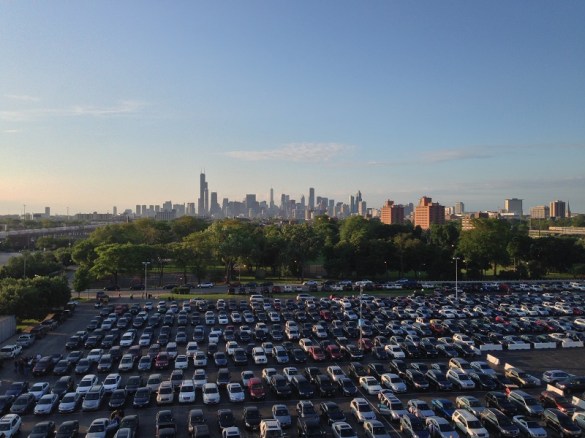
Chicago skyline from Gate 5 at U.S. Cellular Field

As a born-and-bred West Coast, California kid, I gleefully admit to my various friends my general ignorance about other climates around North America. Many of my friends are transplants who casually talk about missing seasons while secretly celebrating not needing air conditioning (or much heating) where they currently live in the Bay Area. I’m smug and glib about it, I know. So it’s those times when I go out of my comfort zone that I learn a lot more about baseball and the way it’s enjoyed in other parts of the country.

Midwesterners tell me all the time about weird summer weather and turning leaves. None of it is a good substitute for me experiencing that weather. So it was with a little disappointment that I learned just prior to this weekend’s Chicago trip that the weather would be mostly overcast or partly sunny during the day with highs in the upper-60’s/low-70’s, lows in the low-50’s. I thought to myself, That’s the weather I’m USED to, I didn’t bargain for this. Rain would not be a factor in any of the five games on my slate, with only a tease of thunderstorms on the way in and out of Chicago. Alas.

View from my seat of Wrigley Field grandstand. Ramps and fence behind grandstand are visible.

View from my seat of Wrigley Field grandstand. Ramps and fence behind grandstand are visible.

Still, since I was in the area four days, there was time to experience the game at a less rushed pace. Friday was the big doubleheader, a 1:20 game on the North Side and a 7:10 tilt on the South Side. I went to the Cubs game solo and the A’s-White Sox game with Zonis, who lent me a day parking pass for his street just three blocks from Wrigley Field. I had been so used to taking the El up to Wrigley Field that I wanted a different experience, and there was no way I would pass this up. Safe navigation to Zonis’s house completed and after a chat with the young man and his dad (they had just completed their own mini ballpark trip to Milwaukee and Beloit), I walked out of Zonis’s house and started the three block walk.

Vinyl covered exterior seems loud, no?

Vinyl covered exterior seems loud, no?

Then I heard it. The pregame organ. It’s a siren song to the residents of the neighborhood, telling everyone that’s okay to come out and play, to cut school or work, to enjoy a day at the yard. It’s something that often gets ignored coming from the Addison Red Line station because of train and crowd noise. In the comparatively tranquil setting of the Lakeview neighborhood, the organ made me feel like I was already there, that the neighborhood was a big theme park where all the streets would eventually lead me to Wrigley. No other urban ballpark is as integrated to its environs as Wrigley Field is. Fenway comes second at night when it turns into Red Sox game mode, but Wrigley really shines for these day games, making Fenway a distant second. Nothing else comes close, because of the way new ballparks are designed to be insular.

Wrigley Field exterior along Addison Street

Wrigley Field exterior along Addison Street

Wrigley famously has very little façade. Behind home plate is the light gray concrete structure accented by green and the distinctive red marquee. It’s not brick or sandstone, and there’s little to write home about. At some point recently the Cubs decided to have huge vinyl signs of the players cover up much of the concrete, as many newer parks have done. As much as I appreciate the blast of color, I miss the old humble concrete. Along the first and third baselines are chain link fences, so the back of each deck is exposed to the street it faces. Narrow ramps and corridors fill some of the space along the fences, creating numerous places for fans to stand. The back of the lower deck is also a great place to catch some sun, especially if you don’t have the gift of a sun-kissed seat close to the field (or the bleachers for that matter). One of the downsides of the open back is the lack of wind buffeting. Throughout the back of the grandstand the wind has a tendency to swirl, whereas close to the field the conditions are downright placid. An open back design would never pass muster in the current era. Potential neighbors would complain about the lack of noise insulation that a façade and other elements provide. Owners and architects would push for a design with more heft, and that requires a façade whether it’s stone, brick, or glass.

Gate 5 at U.S. Cellular Field is separated from the ballpark by 35th Street. Fans who enter here use footbridges to enter ballpark.

Gate 5 at U.S. Cellular Field is separated from the ballpark by 35th Street. Fans who enter here use footbridges to enter ballpark.

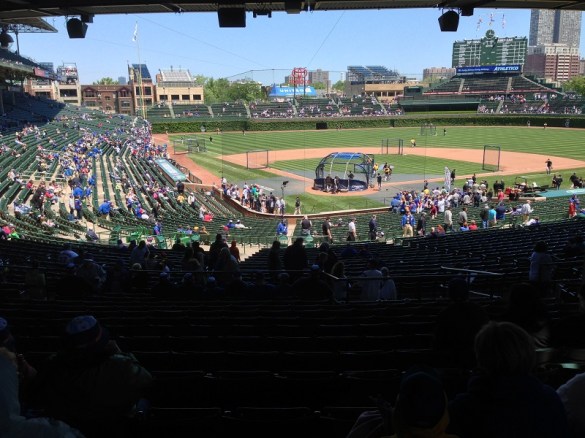
I had a seat in section/aisle 223, row 27, which had me hopelessly stuck under the upper deck overhang with a column in plain view (but not obstructing). As the winds swirled around and brought the shade temperature down to the mid-50’s, my jacket-less and goosebump-ridden self started to look for ways to warm. The back of the lower deck was nice option. Wrigley’s compact design and unique network of ramps makes it easy to move among the decks. There’s only one concourse at street level, beneath the 200-level seats on the lower deck. I made my typical shutterbug walk in the 4th inning to capture as much with my camera as I could.

The true beauty of Wrigley reveals itself best when emerging from one of the tunnels in either the left or right field corners. Up a long stairway, suddenly you’re among the lucky sun-drenched fans. Ferris Bueller and his friends made the LF corner idyllic, whereas Steve Bartman made it notorious. You go there and then you figure out ways to stay there forever. As the shadows move during the game, those further away from the field down the 3B line get their sun taken away, a cruel tease.

wrigley-03-seatview-sm

View of home plate from my seat at Wrigley Field

Old Comiskey Park was even worse from a sun standpoint. The upper deck was only 16 rows from the field in foul territory, and completely hung over the lower deck in fair territory. While Wrigley was “wide open” behind the lower deck, Comiskey had windows to let some natural light in. Nevertheless, Comiskey’s reputation was always darker and more foreboding, an image owed to numerous factors such as the South Side location, the catacomb bullpens, and the generally darker, danker atmosphere.

View of home plate from my seat at U.S. Cellular Field (night game)

View of home plate from my seat at U.S. Cellular Field (night game)

Knowing what Sox fans had experienced for decades, Sox owner Jerry Reinsdorf would give fans coming to the new Comiskey Park (nee U.S. Cellular Field) a much sunnier, wide open experience. The suite/upper deck cantilever is only a few rows above the back of the lower deck. Initially there was only a small roof covering the upper rows the upper deck. With a modern design derived from Kansas City’s Royals Stadium, New Comiskey was to be the more family-friendly albeit less intimate experience. Ramps were well removed from the concourse, especially the ones on the 3B side (across 35th Street). Escalators brought fans to their exclusive levels on three seating levels, with no way for fans to move from one level to another without proper admission. Seating sections were narrow to provide better access. The outfield seats were a single level, fully exposed like the Wrigley bleachers, and had full concessions plus a huge concourse. Enormous scoreboards and a video board were placed along the outfield, blocking much of the view of the less-than-desirable neighborhood to the southeast.

us_cellular-14-sunset-sm

Upper concourse at U.S. Cellular Field

The upper deck concourse was also exposed, with only the tall seating bowl providing protection from the elements. That was changed in the 2004 renovations, when the concourse enclosed with translucent windows providing natural light. The Gate 3 ramps provided gorgeous views of The Loop, but the ballpark was built in the era before recognizing skylines, so New Comiskey turned its back to the city. Reinsdorf eventually reduced the park’s capacity while introducing touches reminiscent of Old Comiskey, such as the more extensive roof.

And so we have the starkest contrasts in ballpark building (multipurpose stadia don’t count as ballparks per se), mere minutes from each other on the Red Line. There’s “The Cell” with its hulking, seemingly impenetrable concrete edifice, and Wrigley, where the boundary between the ballpark and its neighborhood almost doesn’t exist. The former advances sun at the expense of intimacy, the latter brought intimacy well before anyone cared to consider ballparks as intimate or not intimate. We’ve seen the era of multipurpose stadia rise and fall, to be replaced by retro ballparks that feign intimacy while providing virtue for sun-seekers. It’s a summer sport, and in a place where summer really exists for only three months, we’ve seen owners and fans take great care to appreciate every bit of summer they can get. While Californians take summer for granted, those in the Continental climate savor it just a little more than we do. Therefore I can’t blame new ballparks like The Cell or Comerica for not being intimate. They’re just trying to give as much summer to as many fans as they can bring into the ballpark. As much as I prefer an aggressive cantilever to bring upper deck fans closer, I can see the argument against it. It took a trip to Chicago to fully understand the dilemma.

Chicago-Milwaukee trip redux

Originally I had planned to be in Chicago through Sunday. Thanks to some work-related trip changes (this was entirely a leisure trip and it makes more sense than flying home and flying back to the Midwest during the week), I’ll be here through Monday. That last-minute change has allowed me to reshuffle my schedule while I’m here. Good thing I didn’t buy tickets too far in advance. Here’s my revised schedule:

  • Thursday, June 6, 7:10 PM – A’s @ White Sox. No promotion. Ticket purchased.
  • Friday, June 7, 1:20 PM – Pirates @ Cubs. Promotion: Cubs floppy hat (fishing cap), first 20,000 fans. Ticket purchased.
  • Friday, June 7, 7:10 PM – A’s @ White Sox. Promotion: Fireworks
  • Saturday, June 8, 3:10 PM – A’s @ White Sox. Promotion: 1983 White Sox T-shirt, first 20,000 fans [I loved the old logo BTW]
  • Sunday, June 9, 1:10 PM – Braves @ Brewers. Promotion: Carlos Gomez bobblehead

I realize that I haven’t followed up much on meeting up with the Chi-town faithful. I’m also in Milwaukee for Sunday night (what-what). Please reach out to me in the comments or via e-mail/Twitter and we can figure something out. See you at the yard.

Marlins Park

Note: For more pictures, check out the Flickr set I uploaded from the weekend. I’ll be doing this for all future ballpark visits. When I have time I’ll add old ones too.

View from RF corner at Marlins Park

View from RF corner at Marlins Park

Ever since the first indoor major league baseball game was played at the bold, brash Astrodome in 1965, purists have lamented the absence of character and quality in the domed game. Too loud, many said. Artificial, especially with the advent of fake turf. Aesthetics were brutally utilitarian because all of the early domes were multipurpose. Trading in difficult climates for air-conditioned perfection meant a lack of natural light and the regular smells and sounds of the outdoor game. In 1989, SkyDome took a big step forward with its retractable roof, even as all of the other dome elements remained the same. Eventually technology evolved to the point where there are now five newer retractable roof ballparks in Phoenix, Seattle, Houston, Milwaukee, and as of last year, Miami. The political side of how Marlins Park was built and funded has been well documented, so I won’t cover it here. Instead, I’ll focus mostly on the ballpark itself: how well it does hosting ballgames and how well it’s integrated into the neighborhood and city.

marlinspark-26-littlehavana-sm

View from near where I parked my car west of Marlins Park

I had driven 4 hours from Tampa to Miami in a beat-up rental, battling torrential (yet normal) rains along Alligator Alley. Marlins Park is set in Little Havana at the former site of the Orange Bowl. I could come here a thousand times and still be struck by the juxtaposition of this enormous, gleaming edifice dominating the landscape against low-slung, generally low-income housing. When the Orange Bowl was there it all seemed the fit – a rickety old stadium set among rickety old houses. There’s no worry about gentrification here, as Little Havana will have no trouble retaining all of its old charm and character. Great, inexpensive food from just about everywhere in Latin America abounds within a mile or two of the park. And the unique parking situation, carried over from the Orange Bowl, remains completely intact. Anyone driving through the surrounding neighborhood on game day will see a multitude of flag-waving residents luring cars to their yards with the promise of cheaper parking. The official garages charge $20, within a block it’s only $10. If you’re willing to go a block further, like me, you can find parking for $5. I found an older Cuban gentleman sitting on a chair next to his corner lot, and when he said parking was only $5 I was sold. Many of the yards are partly paved to accommodate cars so they’re prepared for this, and street parking is a no-go for non-residents, so cough up the $5 and walk the two blocks.

Triangular ramp at first base gate

Triangular ramp at first base gate

Two monuments commemorate the old football stadium: a painted column on the lower deck commemorating the old stadium’s history, and the arrangement of the distinctive “Orange Bowl” letters on the east side of the ballpark. It’s not much to show for all of the history the stadium has experienced as the host of a major bowl game and the University of Miami Hurricanes, but it’ll have to do. The ‘Canes have swapped places with the Marlins, playing their home games up north at Dolphins Stadium.

First pitch for the Mets-Marlins tilt was set for shortly after 4 PM, perfect for the retiree set. I had been told that there’s absolutely no reason to buy a walkup ticket at the box office. That assessment was proven correct as there were numerous scalpers assembled along the streets leading to the main plaza behind home plate, west of the stadium. $10 later (should’ve been $5) and I had a seat in the outfield at field level. Apparently the Marlins are giving away blocks of promotional tickets to get people in the park. On both Saturday and Sunday the tickets I bought were marked “promo”.

Main concourse

Main concourse

The plaza is certainly friendly enough, with lots of open space and numerous tents and stages set up most weekends. Saturday had a performance by Cirque after the game in the plaza, whereas Sunday had a large tent setup for a pet adoption drive. The tents and canopies helped soften up the plaza, which is flanked on the north and south ends by the concrete tracks that guide the rolling roof. The first time I saw those tracks in the original renderings I swore they were inspired by the USS Enterprise. Two restaurants are tucked into the street level facade, along with the team store and a cell phone outlet. The home plate gate is nothing to write home about, with simple gates leading straight to escalators that go up to the promenade (main level). The third base gate (SW corner) has a unique triangular ramp structure, perhaps the most elegant architectural element at Marlins Park. Its support columns are on the inside of the triangle, giving the appearance of the segments floating in mid-air. Unlike most other stadia, the ramps had limited access. The club, suite, and other premium levels were not accessible from the ramps, which was perhaps the first indicator of Jeff Loria’s disdain for the regular fan.

Outfield at Marlins Park

Outfield at Marlins Park

Neither gate has much in the way of a grand entrance into the concourse. It felt like entering a mall through one of the side entrances. Once inside, however, the space opened up fully and looked magnificent. Wayfinding signs were set just so, and the place had a very museum-like quality to it, precise yet inviting (fitting considering Loria is an art dealer). The promenade was at least 40 feet wide everywhere, with the concourse floor covered in a colored, textured surface resembling terrazzo. Regions of the concourse were color-coded in bright primary colors. Strangely, even though the Marlins adopted orange as one of its main colors in its image revamp prior to the opening of Marlins Park, there is precious little orange inside the stadium. Concourses, walls, and tiles are blue, red, yellow, and green. Everything else is museum white. Teal, the team’s former main color, has been banished. Loria left the garish treatment for the lime green outfield walls and the ever controversial home run scuplture by Red Grooms, a painted steel ode to sealife that resembles the backdrop of a pinball machine.

Seating bowl from center field

Seating bowl from center field

Concessions are surprisingly ho-hum. There is a “Taste of Miami” food court area, and a concessions stand in right center serves up pressed Cubano sandwiches, but everything else is fairly standard, uninteresting fare. Although pre-made, the Cubano was better than I expected. There’s no carvery or wok station like Target Field. There aren’t even any portable grills for fresh hot dogs, or a single permanent grill like the Saag’s stand at the Coliseum. It’s not just that the grill provides a better tasting sausage, it also contributes to the ballpark atmosphere via the wonderful aroma of grilled hot dogs, Italians and brats. Without that element, the air inside smelled a little too clean and conditioned. It felt  arena-like.

With food and beverage in hand, I passed up my seat beyond the bullpen in right and looked for the best sneakdown opportunity I could find. I found one in section 3, about 15 rows up from the RF line. Pretty much everyone was sneaking down at some point, and I had no idea why the hundred or so people sitting in the upper deck were still there. After the sandwich was consumed I walked around the full length of the concourse, which has a view to the field from every section including center field. An enormous Budweiser bar stands in center and was quite popular. The Bacardi bar on the other side looked downright desolate, despite both having many of the same offerings. If anything the Budweiser bar benefits from being backed by the huge glass curtainwall doors in left field. The doors and roof weren’t open as there was some rain in the forecast and the temperature was 86 degrees outside. (By the way, the beer selection at Marlins Park is terrible, as one would expect from South Florida.)

marlinspark-07-columns_roof-sm

A good look at how the roof column and truss system is put together, cutting into the seating bowl

A long escalator in left took me to the upper deck, which was depressingly empty. For both games, only a single concession stand was open. I saw directly behind home plate in the fourth row and liked the view (and the A/C effectiveness) better than at Minute Maid Park. The Marlins chose to stack most of the luxury suites behind the plate, with only a handful along the baselines at club level. That makes the first row of the upper deck behind home plate roughly five stories above the promenade, a somewhat common Populous practice these days (Progressive Field, Busch Stadium). The cantilever of the club and upper decks is not particularly dramatic, so it doesn’t feel very intimate despite the relatively low seating capacity (37k). Regardless, the upper deck didn’t have bad seats, and there didn’t seem to be any obstructed views. There are huge columns that interrupt the upper reserve seats down the third base line, but there seemed to be enough space to prevent obstructed views.

Those columns probably made the roof system a lot cheaper to build, as a much shorter than usual truss system was constructed. The roof itself is similar to those at Safeco or Minute Maid, a two-way multi-panel rolling structure that retracts to one end of the stadium (in this case, behind the first base line). The roof is tilted slightly from north to south, and the ceiling panels are steel, which contributes mightily to a serious amplification effect. Even though there were less than 20,000 at both games, when they got loud it sounded like 40,000 thanks to the roof. This effect was needlessly enhanced by the extremely loud PA system, which Fangraphs’ Wendy Thurm (@hangingsliders) complained about bitterly on Sunday. Worse, the PA had the most unconscionable practice of playing piped-in boos over the loudspeakers when the Mets homered. The sound was unmistakeable as it sounded like two or three guys booing into a microphone. No way that was the crowd. The PA certainly didn’t lend any organic crowd feel to Marlins Park, that’s for sure.

The Clevelander after the game

The Clevelander after the game

I didn’t have access to the club levels so I can’t comment on what goes on there. I did check out The Clevelander in left field after the game. A branch of the popular South Beach bar, The Clevelander has very expensive tickets ($50 seats, $30 SRO) during the game, but has free admission after the game. I followed much of the younger crowd to the club and marveled at how perfectly Miami the setting was inside a ballpark. DJ? Check. Dancers? Check. Full bar? Check. Pool? Check. Multiple lounge areas and a patio? Got that too. The Marlins and The Clevelander have to make an extra five figures just by having the place open after games. It’s not for the purist, but for the casual fan, it’s a must-see.

Despite the convertible nature of today’s dome, any domed ballpark has to be judged differently from open-air parks. The ability to control the environment is simply too much of a factor to compare fairly to open-air parks. As it stands, Marlins Park reminds me of a brand new Rawlings baseball, fresh out of the box. It needs to rubbed up with a little mud. It needs some character. Perhaps if the team didn’t go bust in 2012 and there was some carryover to 2013, I could describe the feel more positively. For now Marlins Park is a place with a good bones, waiting for a good team and a good crowd to arrive.

Panorama from upper deck

Panorama from upper deck

A quick visit to Tropicana Field and the Tampa Bay market’s problems

If you’ve never visited the Tampa Bay Area and you know little about the market, you might be inclined to think that St. Petersburg is an excellent, central location to place a ballpark for the Rays. Tropicana Field is roughly 30 miles from the northern end of Pinellas and Hillsborough counties and 30 miles from Sarasota, whose separate MSA (Bradenton-Sarasota) holds another 688,000 residents. All told that 3.6 million citizens in the eight-county group is often considered a better representation of the full market than what we usually read in the media or in studies. It’s roughly 120 miles north-to-south and 50 miles east-to-west, plus the bay to displace it. By comparison, the nine-county San Francisco Bay Area is around 150 miles north-to-south and 50-70 miles east-to-west, certainly larger in area by not appreciably given the diminishing rural population at the fringes. One key difference is that the SF Bay Area has twice the population, 7.2 million. And in its oft-criticized yet mostly functional public transportation system, the San Francisco Bay Area has a secret weapon that Tampa Bay doesn’t have, one that could really help fans get to a ballpark more easily. Even if only 20% of A’s fans make it to the Coliseum via BART, having that option removes some friction because there’s always the option not to drive.

Tropicana Field looks central in this view

Tropicana Field looks central in this view

Local pols in Pinellas and Hillsborough counties are trying to put together a regional transit coalition that would widen some key bridges and construct a light rail system. Something like BART would be far too expensive in this era, which is a big reason why you see light rail being deployed in emerging metros and not electric third rail systems like BART. Even if they are successful, the place would have to become much more densely populated to properly support a major league team on a 2.5 million season attendance clip (30k/game). St. Petersburg is particularly not dense, with an area slightly 25% larger than the City of San Francisco and less than one-third SF’s population.

With so many numbers and issues swimming around in my head, I took some downtime while I was in the Tampa Bay area to properly drive around and get a feel for the market – as good as I could for several hours. I stayed a night near the St. Petersburg-Clearwater airport. The hotel was across the way from the Carillon business park, touted last year as a potential Rays ballpark site. The site was close to equidistant from downtown Tampa, St. Pete, and Clearwater, which should have made it convenient for about 2 million of the region’s population. Alas, the concept died, leaving Rays owner Stuart Sternberg still pining for Tampa and St. Pete Mayor Bill Foster shutting down any talks with the rival city.

Friday night I stayed in the Westshore area of Tampa near the airport. Westshore is at the eastern end of the Howard Frankland Bridge, the non-toll span of I-275 that carries the bulk of the traffic between Tampa and St. Pete. It’s where you can find Tampa International Airport and Raymond James Stadium. 5 miles west of downtown Tampa and Ybor City, it’s as close as you can get to being in St. Pete while actually being in Tampa. Around 5:30 I was trying to figure out what to do. The Rays were in Cleveland, and the only Florida State League team hosting a game was Dunedin, several miles north of Clearwater. A trip that normally would take 30 minutes was advertised as taking 50 minutes due to the rush hour commute, so I decided to pass. Pinellas County is notorious for having few freeways, making commutes in much of the peninsula much like crosstown commutes in San Francisco – slow and arduous. Thankfully, Cigar City Brewing was closeby so I could work on my beer appreciation.

Saturday morning I took the 20+ minute drive to Tropicana Field. Before I got there, I drove through a rather depressed neighborhood north of the stadium. Notable businesses nearby include a government health clinic, U-Haul truck center, and a strip mall with a check cashing shop and a dollar store. No event was being held at the Trop, but there were cars in the parking lot so I parked and went to the entrance to take a look.

Ebbets Field? Um, maybe not.

The security guard was nice enough to let me take a few pictures of the rotunda

Tropicana Field, formerly known as the Florida Suncoast Dome, was built without any specific guidance by a MLB team, and it shows. It opened at the end of the static dome era, a year after SkyDome (now Rogers Centre) dazzled fans with its moving roof and other technology. It has a moat around the outfield exterior and a rotunda that was added to resemble that of Ebbets Field. Sadly the rotunda looks more like a library foyer than the inspiration. It’s the main entrance to the stadium, as most of the parking is on the east side of the Trop. I couldn’t go any further than this, which is unfortunate as I would’ve like to take some new pictures of the main concourse, which reminds me of an 80’s mall arcade without the carpet.

Gate 1 at Tropicana Field

Gate 1 at Tropicana Field

Inside, Sternberg has done about as much as he could to put lipstick on this pig. There’s lots of color everywhere. Party boxes were placed down each foul line to cut into the foul territory. Astroturf was replaced by more grass-like Astroturf, which somehow looks worse on TV than the old stuff due to its weird sheen. Tarps were placed in the upper nosebleeds to reduce capacity, and like the A’s it hasn’t helped attendance. Little has worked. The atmosphere is still dreary, the catwalks still strange and frustrating. Sternberg wants out and he has reason to want out, but the alternatives are not cheap or easy. No city is going to build the Rays a ballpark for free, including cities outside the market. The team is stuck at the Trop until 2027 unless Sternberg chooses an expensive buyout after 2017. Plans to turn the Trop into a redevelopment zone have gone nowhere. The Rays are in an arguably worse position than the A’s stadium-wise, since the Rays are bound by the lease and Sternberg can’t formally speak to Tampa about new digs.

Worse, it’s easy to get the sense that as far as baseball goes, the Rays have to fight just to be recognized in the region. Despite their recent World Series appearance and multiple playoff appearances, the team has to compete with 4 Florida State League teams in the market, and the Yankees, who have a radio affiliate and their spring training facility in Tampa. Plus there are all those other Grapefruit League teams quenching any early baseball thirst in March. Maybe the Rays would have a better chance if there wasn’t as much competition. A new ballpark could help as long as the franchise wasn’t saddled with debt. No wonder then, that Bud Selig hasn’t exactly pushed hard on this one. That M.O. sounds familiar…

Is your city disrespected? Nobody cares.

After Tuesday’s Game 2 of the Bay Bridge Series, CBS Sports national baseball writer Jon Heyman jostled the hornets nest that is the Oakland faithful with this tweet:

That brought a furious wave of replies, including some by current A’s players such as reliever Sean Doolittle.

Of course, numerous fans came to the defense of the Coliseum, citing certain sightlines that are better than at AT&T Park (only a few) and the more raucous crowd. I tried to sum up the general sentiment with this tweet:

Now let’s set the table for the discussion to follow. This is Newballpark.org, after all.

  • The Coliseum is, in fact, outdated and a replacement is needed for the long-term viability and competitiveness of the franchise.
  • The long-time, hardcore fanbase has stayed loyal thanks to not being priced out of attending games, despite ownership’s general indifference towards them.
  • Attracting casual fans to games is difficult unless the team is playing extremely well (sometimes) or the opponent is a good draw (Yankees, Giants, Red Sox).
  • The experience of attending a game is not luxurious in the slightest, but it can be very energetic and entertaining.
  • Fans debating about the future of the Athletics mostly squabble over the site of the next A’s home, whether it’s in Oakland, San Jose, or elsewhere in the Bay Area.

Heyman’s uninformed opinion is sadly reflective of much of the East Coast (Northeast) media, which still holds onto the notion that in the Bay Area, San Francisco is “The City” and everything else is a satellite orbiting around it.

Nevermind that Oakland has undergone significant upheaval over the last several decades, or that San Jose has grown to become larger than SF. San Jose remains sleepy and banal, Oakland dangerous and difficult. It takes more than a generation or two to shake a reputation, especially when there are forces at work to maintain certain aspects of that rep (crime, politics, growth policies).

A look back at Frank Deford’s 1968 Sports Illustrated article shows that things haven’t changed that much in terms of perception from the outside. It was during that era that the other Bay Area cities started to puff out their own chests and brandish their own civic pride. That pride led to Bob Nahas getting the Coliseum complex built. It also fomented a backlash against SF, according to late Warriors owner Franklin Mieuli:

“Now, everybody’s thinking is reversed. People feel they must swallow local pride to come to San Francisco. Or they’re indignant. You know, ‘Why the hell should I have to go to San Francisco?’ People come from halfway around the world, breathless, to get to San Francisco, and the people around here are annoyed if they have to go 15 minutes.”

After 45 years, much of the country and the world doesn’t know about this, and more importantly, they don’t care. New York and Chicago have had more than a century to build rivalries among boroughs or along north-south divides, and there’s plenty of documented historical support to back them. Allowing the Warriors and Seals to carry the generic “California” or “Golden State” monikers only steeled Oakland’s collective resolve. Defenders of cities can scream to the high heavens about their town being disrespected. Most casual observers have little empathy when other issues take greater import. Outsiders don’t know that these days, the only true satellites of SF are the Peninsula and Marin County.

Yet the lion’s share of tourist attractions and cultural resources remain in SF. Since the 60’s Silicon Valley become America’s (and the world’s) tech capital, and Napa Valley became the American focal point of the wine industry. Tract homes replaced farms and fields. Ever-growing freeway systems and disorganized public transit systems were built to meet citizens’ needs.

During the decade from 1972 to 1981, Oakland teams won six championships: 3 by the A’s, 2 by the Raiders, and 1 by the Warriors. None really changed much for Oakland as a city, though it did solidify the teams’ fanbases to various degrees. Even when Al Davis took the Raiders to LA, Oakland officials plotted for years to lure him back – and they eventually did.

Oakland has garnered exactly one title since Al left and none since he returned. If the point of having teams winning championships is to build civic pride, the luck hasn’t been on Oakland’s side. Is there anything that can be done to correct long-held misconceptions? Probably not – at least not immediately. Civic leaders can try to build a ballpark or arena downtown, and most have used forms of redevelopment to remake rundown parts of their cities, often with mixed results. Sure, there’s a nice ballpark in Cleveland, but it’s still in Cleveland. The new ballpark in Miami has done little to change the prevailing notion that it isn’t a baseball town. Phoenix has both a ballpark and arena, but outside of events at those venues people would rather go to Scottsdale.

Al Davis, in the 60’s light years ahead of his peers and others in terms of strategizing football, proved sagelike when it came to thinking about cities in the Deford article.

“Haven’t we passed the point of who is Oakland and what is Oakland?” he asks. “Too many people are still living on local color. They can’t see past the Golden Gate. They keep telling me: ‘Hey, we showed those 49ers.’ I have to say, ‘Look, can we show Green Bay? They’re the epitome of football. Green Bay, not San Francisco.’ “

Then again, what happens when the champion IS San Francisco?

P.S. As for the Coliseum, I figure I’ve written about it ceaselessly for 8 years. The issue is really up to MLB at this point. Does the Lodge want to force “progress” via a new ballpark that will inevitably price out many of the fans who currently are a big part of the A’s image? Is the status quo fine for now until whatever form progress takes is fully formed? And who will foot the bill for the Coliseum’s replacement? The bitter truth is that MLB doesn’t care much for the $12 fan, preferring to kick them to the upper deck corners where The Lodge thinks they belong. If someone protests, The Lodge can simply point out that the A’s pull in $30+ million a year in welfare and that Oakland fans should be grateful they still have a team within city limits. Progress, however it comes, will satisfy some and alienate just as many. Unreserved bleachers will become $20 reserved seats. Tailgating opportunities will be reduced. Section 317 will be much higher. At the same time there will be myriad improvements. A beautiful field throughout the whole season. Less foul territory (the most spun thing among A’s fans ever). Facilities that will make marquee players want to stay or sign as free agents. Functional scoreboards. Better food on the concourses. I have seen these things, I have experienced them, and they are good. In the end, it’s as much a choice for fans as it is for MLB. If we’re priced out of the seats that we currently have, how do we react? Do we swallow the higher prices? Go to fewer games? Pick worse sections? There is a price for all cities to be major league. In one way or another, everyone pays for it.