Two mayors, two different approaches

Some people are going to view this post as more piling on Oakland. It’s not. It’s a demonstration of what leadership is, and what it means to follow through. You’ve been warned.

—-

Many of the mayors throughout the country are in Washington this week to attend the US Conference of Mayors, where the big topic is gun violence and how to reduce it. The big fish at the event is Vice President Joe Biden, who President Obama tasked with developing a plan for gun control and other related initiatives.

In the face of increasing criticism over her effectiveness in handling the crime and murder rates in Oakland, Mayor Jean Quan left for the conference earlier this week. Her office says that she is “hoping to have conversations” on how to reduce the crime rate, which frankly, sounds like a bad excuse for taking a trip to DC for the inauguration. Maybe she’ll get some kind of commitment from someone in a federal capacity, but VP Biden’s team put together the plan and President Obama signed 23 executive orders without needing Quan to be in DC.

Also in DC for the conference is MC Hammer, who became an employee of the city’s Convention & Tourism Bureau last November. Hammer’s position is to promote tourism, which I have to imagine is a difficult sell when everyday there are headlines about one shooting or another. So there are two Oakland leaders in DC at the moment.

Now all of this would be little more than your typical Washington hobnobbing session if it weren’t for the actions of Sacramento Mayor Kevin Johnson, who abruptly canceled his trip to DC. Why would he cancel the trip even as he was scheduled to speak?

The things that KJ is referencing are his efforts to put together (in parallel) a competing ownership bid that would keep the Kings in Sacramento and an arena package that would be acceptable to David Stern and the NBA owners. KJ is working with a deadline of March 1st. Quan’s deadline for both the Raiders and A’s is effectively the end of the year, so she technically doesn’t have to act too swiftly. But it’s telling that while East and West Oakland are going to hell, Quan is in DC just a month after going to China. In both cases, she’s trying to find solutions, money, or both outside of the city. On the stadium front, Quan has created one task force or another and authorized money for a Coliseum City study which has not yet materialized. There isn’t much to show for Victory Court or Howard Terminal (so far) for that matter. Meanwhile, KJ is rallying forces in the Sacramento region to find a solution. It’s a stark contrast, and while there’s a good chance neither will be successful in the end due to circumstances beyond their control, it’s clear that there’s one mayor who’s trying, and another who’s simply asking for help and not actually doing much.

Then again, this is Quan’s last Twitter update (she’s more active on Facebook):

Welp.

Super Bowl Musical Chairs

In May the NFL owners are expected to award the Super Bowl L (50th Anniversary in 2016) to either Miami, or San Francisco/Santa Clara. The loser will get to square off with Houston for the right to host Super Bowl LI in 2017.

Officials in Miami are scurrying to make improvements at Sun Life Stadium that will make it continue to be viable for future Super Bowls including L/LI. Recently, the NFL had been hinting that Sun Life Stadium could end up out of the game’s regular rotation (every 5-7 years) if changes weren’t made. That’s possible now that the Marlins have left, allowing the Dolphins to remake the stadium as a football-only facility.

Improved viewing distances to the sideline and displays should make Sun Life Stadium more appealing

Improved viewing distances to the sideline and displays should make Sun Life Stadium more appealing

To accomplish those goals, the Dolphins plan to add seats along the lower level to reduce the 90-foot gap between the first row and sideline. They’ll also replace all of the existing seats, which will be colored turquoise instead of orange. (I think we’ve all learned over the years that orange seats don’t do well in the sun.) Sections in the upper deck corners will be reduced to accommodate large video board. Sun Life received two of the largest boards in sports a few years ago. Those will probably be moved with two others added. The big addition is a free standing canopy that will cover much of the seating bowl and upper concourse.

Will that be enough? While Miami is a veteran of putting on big events like the Super Bowl, it lacks ancillary features at Sun Life that could bring in more revenue, such as a convention center. South Beach is 18 miles away from the stadium, closer than the distance between the Santa Clara stadium and what is expected to be the media hub in downtown SF.

Dolphins owner Stephen Ross has pledged to pay for the “majority” of the project’s $400 million cost, with no new taxes as part of the promise. Some public funds could come from a sales tax rebate on items sold in the stadium. 8 of the 9 pro teams in Florida already receive this benefit. The Dolphins are the only ones that don’t. The team estimates that this will raise about $3 million per year, which would go towards debt service on the improvements for 30 years.. Additional funding could come from hotel taxes.

The 49ers and the City of Santa Clara are being asked to make their own concessions, though the requests are not of the stadium. Instead, the NFL wants the nearby Santa Clara Convention Center, Soccer Park (next to the 49er HQ), blocks of hotel rooms, and perhaps a cut of different revenue streams.

It’s all part of the laundry list of items the NFL usually asks for from host cities. The NFL has the leverage in this relationship, and their M.O. has always been to pit cities against other every year to get the best deal possible. We discussed this laundry list a year ago. The league asks for a lot, and in most cases, they get it.

Santa Clara is also unique in that it controls its own power utility, Silicon Valley Power. City backers have been quick to note this as a way to cut costs. However, the NFL could just as easily make demands of the City to extract the lowest possible cost for power during the week. Down in the Phoenix area, Salt River Power is giving a $1 million sponsorship for 2015’s Super Bowl XLIX, which includes numerous services the utility controls.

It’s also unclear how the Super Bowl could affect operations out of SJC on gameday. When planes take off during good weather, they head north before quickly turning east for the most part. If the weather is bad, SJC reverses its approach, having planes land from the north. That puts those planes rather low and – as I noticed over the Thanksgiving weekend when I flew in from SoCal – directly over the stadium.

Neither city should expect to get much in the way of direct tax revenues. They’ll be able to tout an immense amount of acute economic activity, and for most cities, that’s plenty.

Other cities are working to keep up appearances. Houston’s bringing in new scoreboards, while Charlotte is looking to state legislators to approve $125 million in improvements at Bank of America Stadium. The NFL sees this and loves it. It’s all part of the game to get The Game.

George Gund III: 1937-2013

I never met George Gund. I’ve heard quite a few stories about him. He was a character, an iconoclast, a real fan who just happened to be rich. He lived the kind of lifestyle many sports fans would’ve liked to live, jetting off to tournaments and film festivals and pretty much doing whatever he wanted. To appreciate the man, read these four articles about Gund:

What I’d like to do is tie his career into the fabric of the Bay Area sports world. First, we have to start in Cleveland. Gund was what we’d now call a trust fund baby. He loved sports, film, and classical music. In keeping with those passions, he bought two hockey franchises, married a filmmaker, and sat on the board of an orchestra. He partnered with his brother, Gordon Gund, to buy the Cleveland Cavaliers. George was always the hockey fanatic while Gordon was the basketball junkie. It worked out pretty well for both in the end.

The journey, however, was long and at times quite difficult for the Gunds. After George Gund permanently moved out to San Francisco, he took a minority stake in the California Golden Seals NHL franchise. The Golden Seals were sold by Charlie Finley, who tried and failed to establish his “branding” on the hockey club (green and gold colors, white skates). Gund partnered with Mel Swig, who owned the Fairmont in SF (like someone we know). For various reasons, running the Seals wasn’t working out at the Coliseum Arena. Swig tried to put together an arena deal in SF, but that fell through. The Gund brothers bought the team from Swig and relocated it to their childhood home of Cleveland.

Except that the team, now named the Cleveland Barons, played out in the sticks at the Richfield Coliseum, about halfway between Cleveland and Akron. The idea was to leverage the fanbase from both markets, and it failed miserably. With the Barons and the Minnesota North Stars in danger of folding and the NHL still struggling against the rival WHA, the league decided to merge the two teams. The franchise remained the Minnesota North Stars and would have a good deal of stability for the next decade, including a Stanley Cup Finals appearance in 1981 (a loss to the juggernaut NY Islanders). The Cavs stuck it out in Richfield for over a decade before moving back to downtown Cleveland. The new home was named Gund Arena.

In 1991, George saw his opportunity to bring a team to the Bay Area. The NHL was starting its Sun Belt expansion phase, and it seemed a good time to put a team in the Bay Area. Howard Baldwin, who was already known as a sort of serial franchise owner, was pushing hard for the franchise to be in San Jose. George Gund stepped in to swap the North Stars for the rights to the expansion franchise, which eventually became known as the San Jose Sharks.

The Sharks played its first two seasons at the aging Cow Palace, an arena that was already outdated for both the Warriors and Golden Seals by the mid-70’s. A new, hockey-focused arena deal was in the works in San Jose, with recent transplant and future Sharks play-by-play man Randy Hahn playing a key organizing role. Gund had the opportunity to try the Oakland experiment again even though the Coliseum was small and poorly set up for hockey, or try to get an arena built in SF. He found willing partners in San Jose in Mayor Tom McEnery and numerous business leaders, all of whom were willing to do what it took to put San Jose “on the map”.

With two major franchise moves under his belt, George Gund could’ve been considered a carpetbagger. He didn’t live in San Jose, choosing to stay in SF and build an apartment inside San Jose Arena. (Frankly, I’d do it if I was asked to contribute.) Yet his legacy stands as a key figure who made San Jose major league and cultivated a great, appreciative fanbase – even though the Sharks mostly sucked during the Gund era.

Gund’s story as an owner is similar to that of Wally Haas, Jr. Both were scions of very wealthy families. Both were revered by their respective team’s fans. Both made great efforts to make their teams successful, business of the game running secondary to winning. Both were well known as philanthropists. Both bought teams from Charlie Finley. The biggest difference between the two was the state of their leagues – while MLB was still clearly the national pastime during the 80’s, the NHL had major competition, growing pains, and difficulty carving out a niche as the fourth major North American pro sports league. Haas was 20 years older than Gund and part of the established SF gentry, so I can’t imagine they ran in the same circles. But I imagine that when Gund took the elevator upstairs over the weekend, he was greeted by Haas and Franklin Mieuli. Mieuli handed Gund a cigar and the beverage of his choice, while Haas showed him the way to the lounge. They could talk about how the Warriors and A’s are resurgent, and that Gund got there just in time to watch his beloved Sharks start their new season. You’re home now, George. Relax and enjoy the game.

FanFest 2013 SOLD OUT

If you were waiting to buy tickets to FanFest this week or by walkup, you’re out of luck. The event’s 10,000 tickets are sold out. Just as with the playoffs, fans shouldn’t take ticket availability for granted. You snooze, you lose.

Of course, the announcement will bring about the usual grousing about how anti-fan A’s ownership is and such. That ignores two big issues.

  • The Coliseum is unavailable because of a motocross event on Saturday the 26th. Most teams that have FanFest in their own ballparks use the field as a huge concourse and staging area. The A’s won’t have that luxury since the field will be a big pile of mud. That would force fans into aisles and concourses, and we know damn well how congested the lower concourse gets at times. I once took an out-of-town friend to the Giants’ FanFest in 2008, which was held at AT&T Park. The field was also unavailable there due to a motocross event. It was a less-than-ideal situation and had all the feel of a hard hat construction zone.
  • Oracle Arena’s concourses were very congested last year at FanFest. While some people chose to sit and watch interviews, most were on the main concourse, inside the lower club, or in line for autographs. The upper deck was blocked off (familiar story). I suppose that the A’s could’ve thrown an Eric Sogard autograph line up there. Would that really help things?

2012 FanFest

When putting on one-off events like FanFest, the biggest wildcard is the impact of a previous season’s success on attendance. The Giants were overwhelmed by the response at their 2011 FanFest, causing extremely long lines and waits for autographs and World Series trophy pictures. You want to bring in as many people as possible because you can sell tickets, but you also don’t to create a situation were the experience sucks for fans. Oracle Arena would be a perfectly fine venue if it had more expansive concourses like HP Pavilion or Staples Center. That wasn’t in the cards for the 1997 renovation.

Perhaps the A’s could’ve held FanFest at Jack London Square or another large public space. That’s fine, though personally I like having the clubhouse tour right there at the Coliseum/Arena. That’s not possible at JLS. Tell you what: Don Knauss and his people could’ve offered to sponsor FanFest by underwriting the cost to hold it at JLS, right next to their preferred Howard Terminal ballpark site. Oh well. Maybe next year.

A’s look to trade Papago for a Grotto

No, we’re not talking about the BatCave or the Playboy Mansion, but it’s a grotto of a sort. The City of Mesa has approved a memorandum of understanding between the City and the A’s that outlines the terms of the A’s move to Hohokam Stadium starting in 2015. (If you haven’t been to Hohokam or would like a visual refresh, this photo blog is a good start.)

Per the terms in the MOU, the A’s would stay at a renovated Hohokam for 20 years initially, though they have the chance to break the lease after the 15th year as long as they pay $1 million for each year they don’t stay. There are also two 5-year options the team can exercise after the 20-year term is up. Hohokam Mesa was the A’s spring training home from 1969-78, much of the era spent at a place near downtown known as Rendezvous Park. After spending a few years in Scottsdale, the A’s moved to Phoenix Municipal Stadium. The 2013 season marks the 30th spring training spent at Muni, with only one more before the move 8 miles east to Mesa. The Cubs were granted major improvements to Hohokam/Fitch in 1997.

At 12,500 (or 13,000) seats, Hohokam has arguably the largest capacity of any spring training ballpark, Cactus or Grapefruit League. That stands to reason because the home team has long been the Cubs, whose large, multigenerational, national fanbase and eager snowbirds regularly put up league-leading attendance figures. For the A’s some of that capacity won’t be needed, so some of the seating sections will be removed or reduced in size, to be replaced by more premium, revenue-generating facilities.
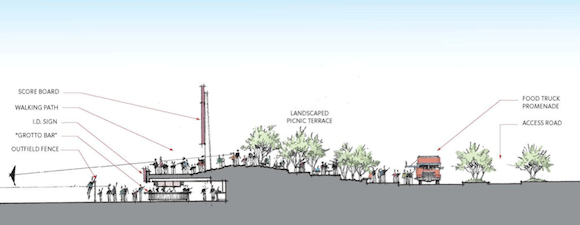
Renovated area beneath LF scoreboard includes “Grotto” bar at field level

Renovated area beneath LF scoreboard includes “Grotto” bar at field level

The biggest major change will be in left field, where the expansive berm will be significantly reduced if not altogether eliminated. Instead there will be two standing tiers, the lower one containing a dugout-like “Grotto bar”. This bar will be at field level, which means that the solid fence in left will be replaced by chain link to provide fans views from the bar. The upper tier leading up to the scoreboard is a smaller standing platform. Behind the scoreboard is a terraced picnic area leading down to a staging area for numerous food trucks. Though it’s not mentioned, I imagine that the scoreboard itself will receive some upgrades.
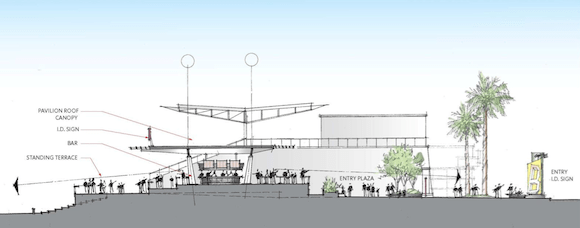
Down the LF line a set of bleachers will be replaced by a covered pavilion

Down the LF line a set of bleachers will be replaced by a covered pavilion

Another bar will take the place of a freestanding bleacher stand near the left field corner. It will be part of a covered pavilion whose standing terrace will replace several rows of seats down the line. The setup is very reminiscent of Raley Field’s beer garden, which is also down the left field line.

The drawings above are preliminary and are subject to change. They were the only two from the City Council presentation, with another slide devoted to changes at the nearby training facility, Fitch Park. Even with the reduced seating, I figure the capacity will be at or around 10,000, which would put Hohokam in the middle of the pack as far as the Cactus League goes. Unless the A’s make other changes, it appears that the other berm areas in center and right field will remain intact. Altogether, it’s a nice set of improvements from not only PHX Muni, but also from the current Hohokam. There will still be inexpensive and family-friendly options, along with more swanky facilities for fans. Fitch Park will get a clubhouse expansion. Even with the fairly restrained upgrades the A’s are getting compared to other teams with new spring training complexes, the Hohokam/Fitch combo will be superior to the Coliseum. There’s all sorts of just not right in that.

—-

The funding part is simple and straightforward. As we discussed two weeks ago, Mesa is paying for the first $15 million of the project. Mesa and the A’s split the cost from $15 million to $20 million, and the A’s will pay for the rest. What’s interesting about this is that the A’s aren’t paying any rent. For the three month period (January 15 to April 15) that the A’s occupy Hohokam/Fitch, they pull in and keep all revenues while paying for all costs. City controls revenue and pays for costs during the other nine months. Those costs include concessions, security, and parking personnel plus utilities. During spring training the A’s are responsible for repairs and maintenance inside the walls and fences so to speak, whereas City takes care of the surrounding grounds. Both sides are to contribute $25,000 annually to a capital improvements fund during the lease term, but that’s it as far as yearly obligations. Mesa has used a similar agreement for the Cubs for years.

Compare that to the now-dead lease extension agreement negotiated for PHX Muni. The A’s would’ve paid up to $500,000 per year plus a $50,000 capital improvements contribution through 2025. Assuming operating costs isn’t small potatoes, but it’s a preferable arrangement for any team since it has control over everything.

Why would the City of Mesa do the deal? City has been wanting to keep Hohokam/Fitch up-to-date even after the Cubs leave for nearby Riverview Park. They did a study to determine what the costs would be in three scenarios:

A: Do upgrades needed to make Hohokam/Fitch attractive for another team in the future, including teams currently in the Grapefruit League
B: Cease operating Hohokam/Fitch as a spring training facility and run it only as a public park
C: Do upgrades up to the A’s standards request
Turns out that the annual cost for Scenario C was $773,231, slightly more than half of Scenario B ($1,490,228) and slightly more than a third of the cost under Scenario A ($2,310,406). Those figures don’t include debt service on the $15-20 million of improvements. By that sort of limited perspective, having the A’s at Hohokam is better than the alternatives. It leaves one lingering question: Who’s paying for the $15-20 million?

Tourists and locals, that’s who. Funding for both Hohokam/Fitch and the Cubs’ $99 million Riverview Park (“Wrigleyvile West”) project will be covered by Mesa’s Enterprise Fund, which is essentially a big redevelopment fund bucket. Debt service is paid for by utility taxes on the 439,000 (bigger than Oakland) residents. Last year Mesa was able to refinance the existing fund debt, which could save Mesa up to $72 million over the next five years. Some money may also come from the Arizona Sports and Tourism Authority, the state-authorized body that boosted hotel and car rental taxes to help pay for numerous Cactus League ballparks and the market’s crown jewel, University of Phoenix Stadium.

While it’s not apples to apples, there may be some comparisons between the Hohokam/Fitch deal and whatever may be negotiated for the A’s at the Coliseum. Short of the Coliseum Authority giving the A’s an extension of the current deal and throwing in some improvements on top of that (fat chance), I can’t see how the A’s could get a better deal than what the team is getting in Mesa. Unless you’re the Cubs, that is. The Cubs are getting this:

Lew Wolff and Flip Maritz own a hotel in Mesa. Unfortunately for A’s fans, it’s 3.5 circuitous miles away from Hohokam. Luckily for Cubs fans and Maritz Wolff, the Hyatt Place is only a mile from Wrigleyville West, just off the top of the rendering above. I guess if Cubs fans are stuck with an eternally heartbreaking team, nice surroundings can provide some consolation.

=====

P.S. – If you’re going to the Valley of the Sun to catch some spring training action and you’re headed to Hohokam, you might want to check out the Mesa Historical Museum, which has an exhibition called “Play Ball: The Cactus League Experience“. The museum is located in downtown Mesa, 2 miles from Hohokam. Exhibits will include items and photos of the A’s first stay in Mesa.

Kings sale Update #3: More players enter the fray

Does anyone remember a journeyman outfielder named Eugene Kingsale? 4th-5th outfielder type? He started out on the O’s with fellow Aruban Sidney Ponson before going to Seattle. His career ended right about the time the Sacramento Kings stopped being a good NBA team. Kingsale? Seattle? Don’t you dare call it a coincidence.

Let’s try to reset this Kings mess, shall we?

On Saturday, real estate investment firm JMA Ventures expressed in helping the Kings stay in town. Originallly, reports had JMA building an arena on the site of the mostly empty Downtown Plaza shopping mall, which JMA bought from mall giant Westfield last summer. This remains true. What does not is the idea that JMA might also bid on the franchise. That’s not happening, though there are whispers that Ron Burkle may be networked in to buy the team while JMA builds and operates the arena.

If the name JMA Ventures sounds familiar, that’s because it is the company that offered to buy Great America from theme park operator Cedar Fair late in 2011. That deal fell through, as Cedar Fair was granted some parking lot protection and other concessions by the City of Santa Clara in exchanging for dropping a lawsuit. Westfield sold Downtown Plaza because it was a heavily underperforming property. JMA paid $22 million for the mall, partnering with LA firm Downtown Properties to complete the deal.

An arena and associated development on a nice, 14-acre site sounds like a great way to turn $22 million of uncertainty around, and it can’t hurt JMA to get involved, especially since they knew that Downtown Plaza was considered as a potential arena location.

Later Saturday night, Sacramento Mayor Kevin Johnson was seen talking to interested party Mark Mastrov courtside at the Heat-Kings game. Meanwhile, co-owner Gavin Maloof was reportedly selling his area home and everything inside it.

Over the weekend, a Sacramento-based ticket pledge campaign called Here We Buy was launched. As of this writing, the campaign has claimed 1,192 pledges for a combined $3.8 million.

Unfortunately, JMA’s involvement may end up as little more than a footnote in this saga, as Yahoo’s Adrian Wojnarowski today filed a revealing column about the advanced state of Kings-to-Seattle sale talks. The deal points:

  • $525 million is the purchase price based on valuation.
  • The Hansen-Ballmer group would purchase 65% of the team. That comes to $341.25 million. The team’s minority partners, who are largely Sacramento based, would probably sell their own stakes sooner rather than later to other interested (and probably linked to the Seattle group) parties.
  • It remains unclear if the Maloofs will retain any stake in the franchise.

All of this sounds less rather discouraging if you’re a Sacramento Kings fan. Yet, it’s following much the same playbook used by Clay Bennett, Michael Heisley, and George Shinn on their way out of town. Bennett was able to buy out a lease for Sonics I. Heisley ran the Grizzlies into the ground. Shinn did the same with the Hornets. The Maloofs are only bound by debt to the city, but they are about to get that paid off by billionaires.

Sacramento will probably be left with the rights to and history of the Kings, going back to Tiny Archibald and Oscar Robertson. Stern might grant the city first dibs at an expansion franchise after he retires. While Stern and the Maloofs sail off into the sunset, the City drowns in the Sacramento River.

Let this be a lesson for those who seek to play hardball with pro sports franchises: You may think you have leverage. You don’t. You really don’t.

Conflicting reports escalate Kings sale story

Dueling reports today on the Kings. First, CSN’s Matt Steinmetz reported that the deal to sell the Kings to the Hansen-Ballmer group is all but done, with the price rising to $525 million. That may have been enough to convince the Maloofs to sell and back off any demand for partial control of the team. That was followed up shortly thereafter by a report by CBS Sports NBA reporter Ken Berger, who tweeted that 24 Hour Fitness owner Mark Mastrov has expressed interest in buying the Kings and has met with the Maloofs to boot.

You may remember that a group led by Mastrov ended up as a runner-up to the Lacob-Guber group in bidding for the Warriors (2nd or 3rd depending on where Larry Ellison falls in). Mastrov is only worth $350 million, but his group was vetted by the NBA to participate in the W’s bidding, so there’s no reason to think he wouldn’t be legit if his group were reconstructed to buy the Kings. Sleep Train CEO Dale Carlsen also threw his hat in the ring. It’s unclear at the moment if all of these various rich guys (plus more to come) would put together competing bids or pool their resources.

The Maloofs reportedly own only 53% of the team with controlling interest, with the rest owned by various local limited partners. Joe Benvenuti, who had the largest minority share, died last May. Benvenuti was the developer who built both ARCO Arenas I & II in partnership with Gregg Lukenbill.

To complicate things, David Stern made remarks that seemed to have him leaning towards Sacramento if a “local” group trying to keep the team in town came forward. Of course, Stern and the NBA’s Board of Governors is the final arbiter of the team’s fate, as they would not only approve any relocation effort, but also any incoming ownership group. It’s unlikely that any Sacramento group would be approved unless an arena deal were done first. That would leave Mayor Kevin Johnson with the task of resurrecting the Railyards arena plan, which was scrapped last April when the Maloofs couldn’t come up with their share.

The price to keep the Kings in Sacramento may be up to $107 million lower than the Seattle bid, because there’s the $30 million relocation fee and the $77 million arena purchase-leaseback loan was constructed as a poison pill. Now, if I’m a local bidder and David Stern, I might push KJ hard to forgive the loan for any incoming group. That would allow the debt load to lighten significantly and free up resources to pay for the new arena. There would remain environmental issues with the Railyards arena plan and it would still require a vote, but those can be dealt with.

It’s only going to get more dramatic and difficult for fans in Sacramento and Seattle. Expect nothing to be finalized until we get really close to March 1.

—–

Update 7:00 PMDale Carlsen was interviewed by Grant Napear today. Carlsen clarified that he wants to help keep the Kings in Sacramento, but that won’t be done by him “writing a check”. Instead, he’d work to rally the business community to coalesce around whatever the solution is.

Update 1/12 12:00 AM – Mayor Johnson claims that he can put together $400 million or more so that a local group could buy the Kings.

Update 1/12 2:00 AM – Ric Bucher is bringing up the idea that the Maloofs still want to maintain some level of control over the team and may threaten to take the team to Anaheim, or even file an antitrust lawsuit against the NBA if they don’t get their way.

$500 million and rising

There’s no done deal. And there probably won’t be one tomorrow, or even by next week. We know that the Maloofs and the Hansen-Ballmer-Nordstrom group are in serious discussions about selling and moving the Kings to Seattle. Everything else is just details.

Here’s what we understand about the situation going in.

  • The Seattle group has pitched $500 million at the Maloof family.
  • The Seattle group’s combined net worth is at least $17 billion, with Microsoft CEO Steve Ballmer’s piece being the largest at $14 billion.
  • Murmurs of the Maloofs looking to sell started in the last two weeks.
  • According to Forbes, the Kings are currently worth only $300 million. The Maloofs paid $156 million for the franchise in 1998.
  • The Kings owe $77 million to the City of Sacramento, with the debt secured by Sleep Train Pavilion and the surrounding land.
  • The Kings also owe anywhere from $125 million to $217 million to the NBA as part of loans from the league’s $2.3 billion credit facility. The number is fuzzy because the debt limit for an individual team is supposed to be only $125 million, but the team may have been granted a discretionary exception to exceed the limit by Commissioner David Stern.
  • A relocation fee of at least $30 million will be assessed to the new ownership group.
  • There is no additional territorial compensation cost because there’s no team currently in Seattle. Compensation cost to both the Lakers and Clippers helped sink the Kings-to-Anaheim plan.
  • The reborn SuperSonics would play at KeyArena for two full seasons before moving across town to a new arena in SoDo (near Safeco Field and CenturyLink Field).
  • Environmental studies for the new arena only started two months ago. From now, that leaves less than 33 months to finish all studies and prep work, acquire all necessary land, and build the arena.
  • The new arena will cost $500 million. $200 million will come from public financing to be repaid by revenues from the arena itself. The rest would come from the ownership group.

Got that? Now let’s do a deeper dive.

First, let’s talk about the debt situation. There are two kinds of debt here, the $77 million owed to the City and the ~$200 million owed to the league. The latter debt figure is high, but as is often the case with sports franchises, not unusual. It’s common for debt to be carried and transferred as part of a franchise sale. There are tax advantages to doing this, and given historically low interest rates, it make less sense to buy cash than it is to carry debt and invest one’s cash elsewhere. However, such debt helps inflate the franchise sale price and eats into proceeds for the Maloofs. The $77 million piece consists of a $64 million loan and $14 million exit fee. The loan was part of a purchase-leaseback deal of then-ARCO Arena. The Maloofs did the deal to offload an asset that that had little potential (more on that later). By the terms of the deal, the Kings’ ownership group would have to buy the arena back from the city if the team were relocated. If the team were to default on this debt, the City would assume ownership of Sleep Train Pavilion and sell it on the open market. They’d also go after the Maloofs if there was a shortfall. That’s a big reason why the Maloofs want to get as much as possible. They’d like to escape Sacramento clean and with enough cash to focus on their post-NBA lives, which would be hard to do if Sacramento sued the Maloof family and got a judge to freeze assets. There’s a possibility that a bankruptcy situation could develop, but that’s far more likely with the Maloofs keeping the team instead of selling the team because the family was running very low on cash on a year-to-year basis.

The Game’s Ric Bucher claims that the Maloofs want to get back into the liquor distribution game that they abandoned to keep the Palms casino and the Kings afloat. To do that, they’ll need to clear even more money from the sale of the Kings. Which might explain the tweet from CBS Sacramento’s Steve Large that said that the Maloofs balked at the (presumed) $500 million offer. Removing the two debt obligations, the family would get a pre-tax haul of $225 million, a good amount but not the kind of windfall many team owners have been seeing recently (Chris Cohan, Frank McCourt).

Tweets from Yahoo! Sports’ Adrian Wojnarowski appeared in the 10 AM hour. Seattle Mayor Mike McGinn held an unrelated press conference at noon where he was asked about the Kings/Sonics and was coy about the whole affair. That was followed by Sacramento Mayor Kevin Johnson holding a presser at 3:30 PM, which was staged to directly address the situation. The big takeaway from the event was that now that KJ officially knows that the team is for sale, he will work hard to get a competing group together that could bid on the Kings.

Already, the name Ron Burkle has come up. Burkle, the billionaire former supermarket magnate, could be a well-heeled backer for the cause. After partnering with Penguins great Mario Lemieux to buy the hockey club in 1999, they steadfastly tried to work the public financing/threaten-to-leave model until the economy collapsed, then got $47 million from Pennsylvania to help fund $321 million Consol Energy Center. Bonds for the arena’s financing were raised by a quasi-governmental arena authority, making the deal similar in structure to the 49ers’ Santa Clara Stadium or HP Pavilion in San Jose. In 2010, Burkle and Lemieux quietly met with Pirates owner Bob Nutting in an effort to buy the struggling baseball team. Nothing came of the talks. Burkle could get involved now at KJ’s behest, but why? Unless Burkle has an overarching sense of charity towards Sacramento, it would be a hard sell for him to play, mostly because he’d be entering (or creating) a bidding war. Burkle didn’t get to $3.2 billion by not driving a hard bargain. His name has been associated with the Kings as a potential buyer for at least two years, and he can’t be pleased with the inflation seen among pro sports properties, or the debt being carried by the Maloofs. Like Larry Ellison, he probably isn’t desperate enough to overpay for the Kings, as the Seattle group appears to be.

One player who has been silent since the news broke this morning is former Kings/Warriors star Chris Webber. C-Webb put together a group of investors in 2011 that included Filipino billionaire Manny “MVP” Pangilinan. There may be renewed interest in getting the band back together. Pangilinan scared the bejeezus out of the Philippine government last fall by threatening to repatriate elsewhere. Perhaps it’s time to resurrect the EB-5 plan.

That plan could come in handy if FEMA lifts the ban on development in the Natomas area where Sleep Train Pavilion is located. Instituted in 2008 after Hurricane Katrina forced changes to levee and floodplain planning, the ban allows for no new development in Natomas and even severely restricts rebuilds of existing properties, including a potential on-site replacement for the arena. Whether an owner that kept the Kings in Sacramento preferred the Natomas site or used the site for redevelopment purposes to help fund a Railyards arena, the inability to do anything with the land cripples any ownership group that owns the property while the ban is in effect. The ban could be lifted even as work to shore up the levees remains incomplete. The task of lifting the ban falls on Congress via legislation, and well, it’s Congress. Don’t hold your breath on that one.

It would not be surprising if the final sale price of the Kings rose above $550 million. The Maloof family has the asset and it’s a seller’s market, so they can play hardball for the next few weeks and allow a real bidding war to happen. Even if a white knight group promised to match whatever the Seattle group offered, the Maloofs aren’t obligated to accept such a bid. If Hansen felt that the Maloofs were trying to rip him off, he might not budge past a certain amount. We’ll see how long it takes to complete the deal. As Kings play-by-play man Grant Napear admitted during his radio show on Wednesday, the franchise is a free agent. With free agents, hometown discounts are the exception, not the rule.

Maloofs to sell Kings to Seattle group headed by Chris Hansen and Steve Ballmer

Yahoo! Sports NBA columnist Adrian Wojnarowski has the breaking story.

Didn’t expect the Maloofs to act this quickly, but it lines up with all of the rumbling coming out of Seattle. Celebration in one town equals heartbreak in another. What will it mean for Sacramento’s future in terms of pro sports? Mayor Kevin Johnson could pivot towards the A’s, though A’s ownership hasn’t shown interest so far.

More as the situation develops.

=====

Update 2:00 PM – CBS Sacramento reporter Steve Large tweeted something different from the prevailing reports on the way up to Seattle.

It’s the Maloofs. Expect nothing less than a big, ugly mess.

Did anything happen at the owners’ meetings? January 2013 edition

Probably not. We’ll find out over the next couple of days, as the meetings kick off Wednesday. This quarter’s meetings are being held in Paradise Valley, AZ.

Absent any real news, here’s a musical interlude while you have your inevitable Hall of Fame water cooler discussion.